Look Up | The Daily Post

This week is all about taking a moment to check out what’s going on above you. For this week’s challenge, take a moment to look up. Whether it’s the fan above your head at work, your bedroom ceiling, or the night sky, what do you see? Is it familiar? Or does it show you a new perspective on your surroundings?

Source: Look Up | The Daily Post

DSCF0236

Looking up

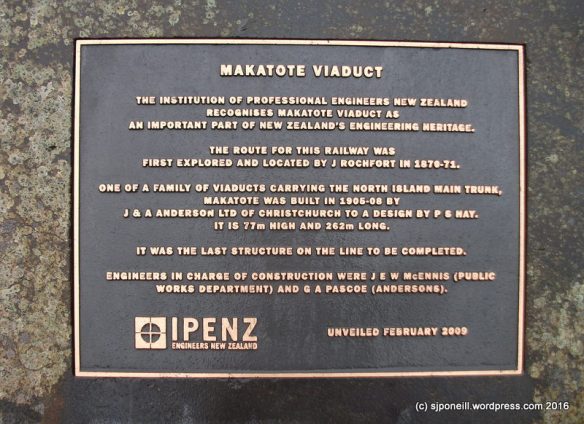
This dead tree towers over State Highway 4 as it snakes under the Makatote Viaduct between Horopito and National Park Village. I’ve driven this road hundreds of times and only noticed it when i was driving back from my physio appointment yesterday. I’m not sure if it’s the result of a lightning strike but it surely is a candidate for one now…

DSCF0231

DSCF0232

Looking across

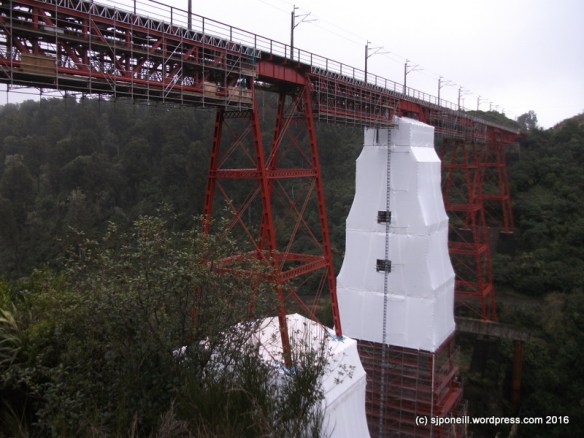
The viaduct has been undergoing some serious maintenance the last year or so and the plastic shrouds are to prevent sprays and dust contaminating the environment around the viaduct.

DSCF0248

Looking down!!!

Someone’s clearly had a party!! And dumped the rubbish at the lookout by the viaduct. Most of this is recyclable: bottles, cans, and pizza and beer cartons. That just goes to show how lazy some people are: there is no charge for dumping recycles at the transfer station. Some of the good lads from Downers were there tidying this mess up. A highlight of their day – not!

DSCF0251

One of the problems we have up here is campers who can’t get their heads around the fact that when the bin’s full, the bin’s full and that doesn’t mean they can just stack the rest of their rubbish beside it. A rubbish bin does not denote a dumping site and this is why all the rubbish bins have been removed from places in the Park like Whakapapa Village: put one out and half an hour later it’ll be buried under a pyramid of rubbish bags.

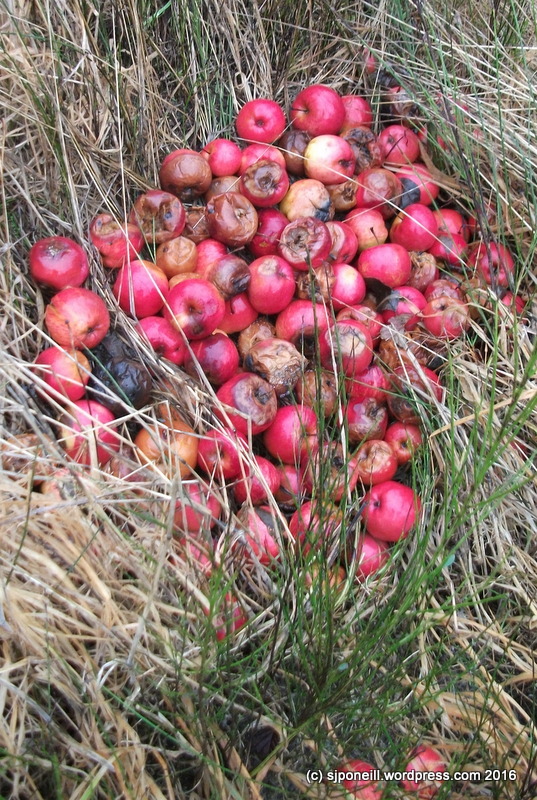
DSCF0252 These apples were dumped at the side of the lookout car park. Sure, they will eventually break down but that still doesn’t making this blatant dumping OK…

As you drive around the Park, and you see dumping like this, take some pics and report it…even better, if you see someone doing this, take their pic and report them…

Clouds | The Daily Post

Write a new post in response to today’s one-word prompt: Clouds.

Source: Clouds | The Daily Post

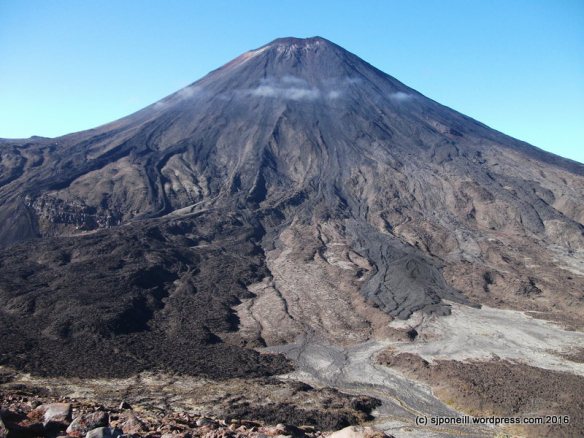
Mt Ngauruhoe Summit climb April 2016 -015

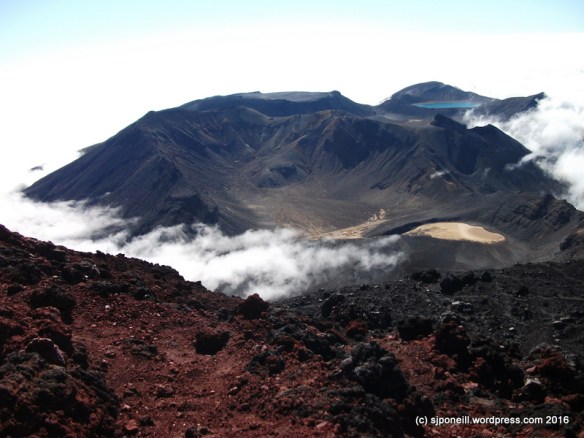
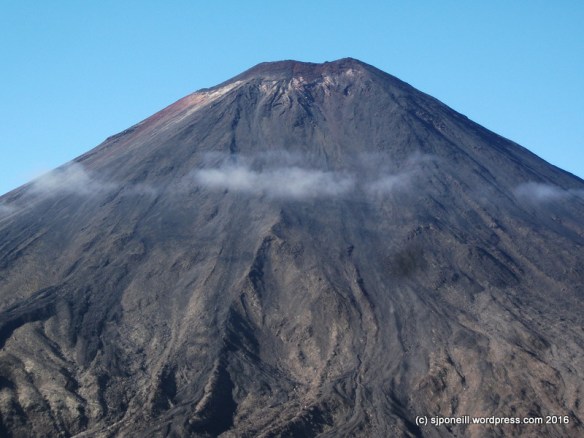
As the sun climbs, dew on the slopes evaporates and cloud form beneath you. From the summit of Mount Ngauruhoe.

Raurimu-008

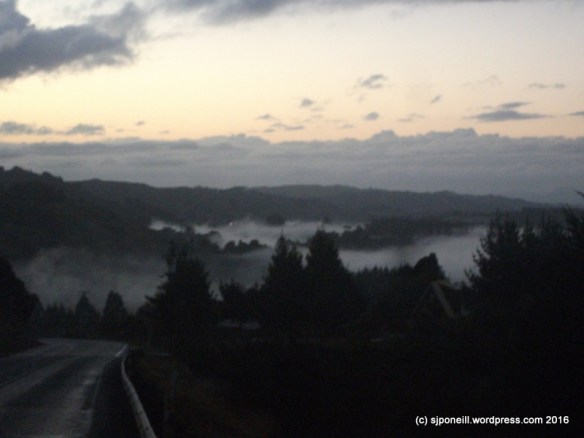
Early morning cloud rests in the low lands around Raurimu.

Tongariro Apr 04 - 1

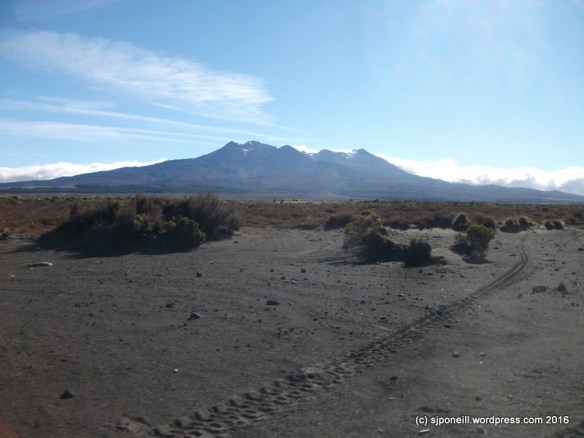
Mount Ruapehu from the Desert Road

Whakapapa-005

Mounts Ngauruhoe and Tongariro taken from the beginning of the Taranaki Falls track in Whakapapa Village.

DSCF8343

Mount Ngauruhoe from the Chateau golf course.

DSCF9856

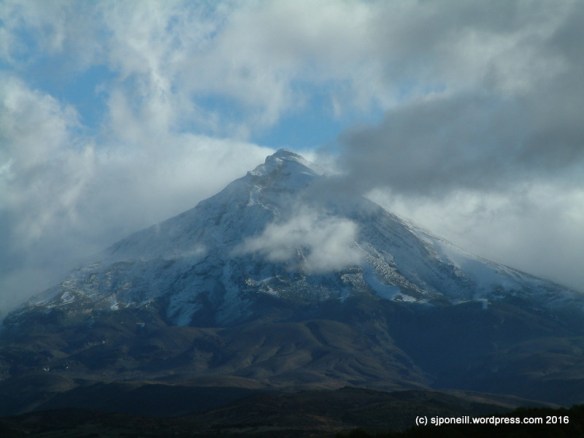
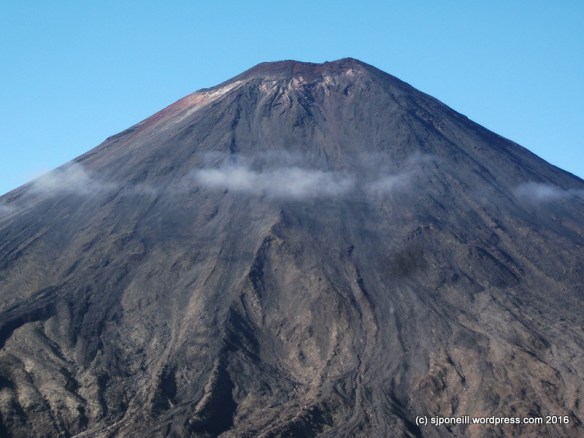
Cloud forms off the slopes of Mount Ngauruhoe. This is taken from the summit of Mount Tongariro: 15-20 minutes later we were greyed out.

Disaster | The Daily Post

Write a new post in response to today’s one-word prompt.

Source: Disaster | The Daily Post

…sometimes the measure of success is how well you respond…

That was my parting shot in The magnificent seven ride again…, the tale of a 2011 pub crawl against a backdrop of NATO’s Libyan ‘intervention’ and the  lone wolf terrorist attacks by Anders Behring Breivik in Norway in July 2011.

Mt Tongariro Summit Back Route April 2016-013.JPG

Five years later, those are still true words although I see response from a different perspective now…once, response was force projection, rapid deployment, targeting; now response is something we manage every day…

Today’s prompt is disaster…the biggest disaster to hit this region in the last 2000 years was the Taupo eruption around 182-300AD, depending on whose book you read. Of course, if disaster strikes and there is no one there to suffer from it, is it really a disaster or just a large scale natural event..? I mean, we’re talking seriously large scale here: the biggest explosion that the world has experienced in the last two, possibly more, millenia.

When we talk eruptions here, it is always in the context of when, not if: we know that the three volcanoes – Ruapehu, Ngauruhoe and Tongariro – will erupt again. The iffy bits are when exactly and how much…questions that can only be answered after the fact. Predicting eruptions is much like predicting earthquakes: often we can see a shift from what’s considered normal, maybe an increase (or decrease) in gas emissions, a cooling (or warming) of a crater lake, more (or less) volcanic tremors: but what it means is very difficult to determine.

Because prediction is problematic, a lot of resource goes into response. The timelines are pretty tight. A lahar (big volcanic mudslidey thing) coming down the western side of Ruapehu will hit Whakapapa ski field in about 90 seconds…that’s not enough time to check your phone  for directions, call a friend or update your Facebook page about the big black shadow coming down the mountain…part of the disaster response on the ski field is to ensure that people know what to do beforehand…

Further down the the hill, residents of Whakapapa Village have a whole twenty minutes to evacuate everyone from the danger area along the Whakapapanui Stream, essentially the Holiday Park and the housing area across State Highway 48 from the Chateau. Twenty minutes doesn’t sound like much time but after a fortuitous (probably didn’t seem like it at the time) series of false alarms in 2015, Whakapapa residents know they can do this at nine at night, in winter, after dinner and maybe a few beers.

Untitled.png

There may be no warning. An eruption may occur on a beautiful blue sky day, or in the middle of a black, freezing, sleeting, icy night. Luck ran twice when the Te Maare craters erupted in August 2012. Lucky once because an eruption at 11-30PM meant there were no walkers on the Tongariro Alpine Crossing as rocks hammered down onto the track. The biggest of these weighed three tonnes, enough to hurt if it landed on your toes. Lucky twice because, even though it was night, the bunk room at Ketetahi Hut was unoccupied as a rock slammed through the roof.

It’s been many years since we have had a disaster in Ruapehu – some tragedies, yes – but the last real disaster in terms of loss of life and damage was probably Tangiwai in 1953. Once of the reasons that we haven’t had any real disasters since then is our ability to respond. The March 2007 lahar had potential – it was certainly much larger – to be as deadly as its 1953 predecessor : that potential was mitigated, some might say neutered, by a effective well-planned, well-practised response. In fact, between exercises and false alarms, the disaster response was so well-practised that when the main event event occurred, it all seemed a bit boring…

So, when  you visit our maunga, take a moment to read the signs and be aware of what’s happening, what might happen around you…if you’re here for your fifteen minutes of fame, don’t let it be in 5000 years when some alien archaeologist chips you out of the remnants of the great Whakapapa Lahar…

Earth | The Daily Post

Share your vision of our magnificent Earth through your lens.

Source: Earth | The Daily Post

DSCF9880

Red Crater, Tongariro National Park

Yes, I need a camera with a wider angle lens…!

DSCF9985

Tupapakurua Falls Lookout, Erua Forest

DSCF8890

Mounts Tongariro and Ngauruhoe, Tongariro National Park

DSCF0765

Native flax sunset, Tongariro National Park


A day in the Desert

DSCF0024-001Zone 1 of the Waiouru Military Training Area is one place that I never thought I would find myself again…

Zone 1 is one of about three dozen zones that the New Zealand Army’s main training area is divided into; it extends from State Highway 1 to the eastern slopes of Mt Ruapehu and provides an open country manoeuvre and live firing area for Army units. It has been used for live firing since the early 20th Century, in the days before unexploded munitions were tracked and recorded and thus remains an area closed to the public – unless escorted by Army staff.

DSCF0046

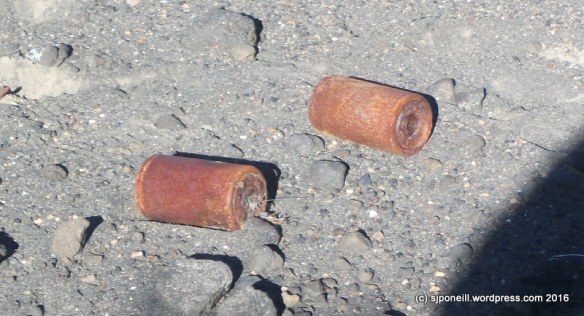
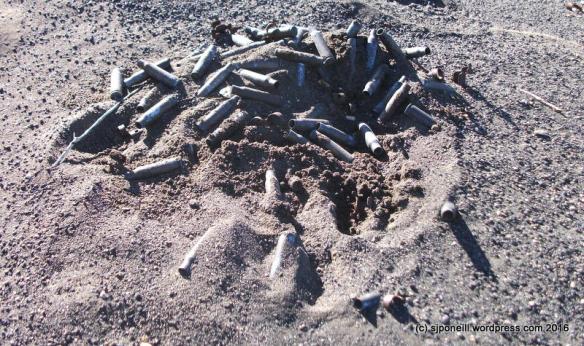
Hazards…if you don’t know, don’t touch it…these are each the size of a can of baked beans…do you know what they are..?

DSCF0040

…possibly safe…but what lies beneath…

DSCF0043

…shiny…don’t touch…

One of its claims to fame is that it starred as Mordor in many scenes from Peter Jackson’s Lord of the Rings trilogy, mainly Return of the King, including the physical Black Gates at the entrance to Mordor and the final battles that concluded the saga. Mt Ngauruhoe lies physically in about the same relation to Zone 1 as Mt Doom did in relation to the Gates.

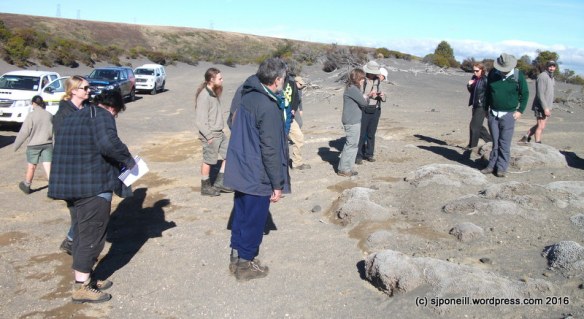
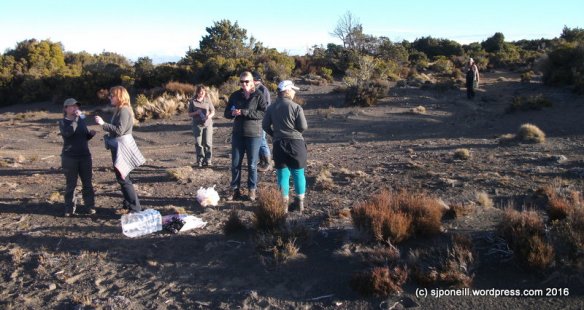
Today I was fortunate to have been invited to attend a seminar to discuss the volcanic dunes in the Rangipo Desert, with a series of research-based presentations followed by a field trip into Zone 1 to view the dune environment directly. Our group was admirably hosted by the Army – very good to renew my acquaintance with Major Pat Hibbs who I’ve known since my days as a very young soldier in 2/1 RNZIR –  firstly at the National Army Museum, and then our escort as we forayed into the desert.

The four presentations at the Museum set the scene for our diverse group and provided a valuable opportunity to either clarify or raise any questions before we set out:

Graeme La Cock – a synthesis of information on the volcanic dunes of the Rangipo Dunefield

Harry Keys – disturbance role of lahars and eruptions, Japanese research interest generally and revegetation issues, including the disturbed area near SH1 and the bund.

Mark Smale – The age, vegetation and formation of the volcanic dunes

Angelina Smith – The impact of vehicles on the Rangipo Desert, and suggestions to mitigate these impacts.

What did I learn…

Lots…first to remember a pen and paper next time to write it all down…I’ve deliberately left out all the scientific terms because my memory just wasn’t up to remembering it all but I may rewrite this if the morning’s presentations are shared and OK’d for release.

DSCF0026
Many agencies cooperate and share research on the dune fields. These include the Department of Conservation, NZ Army, Landcare Research, The University of Waikato and Massey University. In addition, overseas researchers also conduct and share studies on the volcanic dune fields.

Volcanic dune fields are very rare, existing only in Iceland, Peru, the coast of California, Indonesia and New Zealand. Although there are other inland dune fields in New Zealand, the only volcanic dune field is at Rangipo.

The Rangipo Desert isn’t really a desert: it has too much rain…the annual rainfall in Waiouru is around 1200mm, and on Mt Ruapehu around 2400mm, actually quite wet by New Zealand standards and certainly well above that for any definition of desert to stand.

DSCF0029.JPG

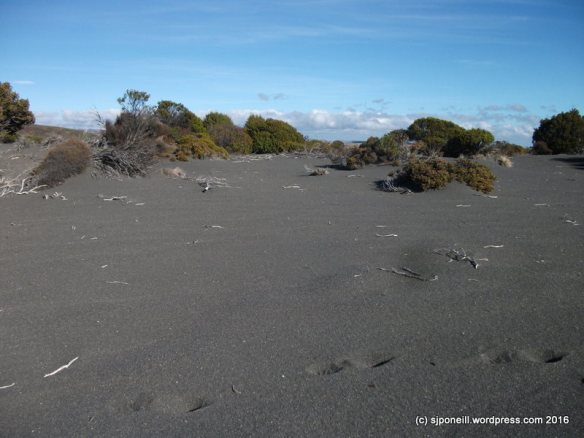
If not technically a desert – even though it may appear like one to the untrained eye i.e. lots of sand – it most definitely does qualify as a dune field, basically an area of shifting sands forming terrain features.

It is not considered that the military use of the area over the last 100 years has affected it one way or another. Although Zone 1 has been and still is used as an impact area for artillery, bombs and rockets, and is a manoeuvre area for armoured vehicles ranging from 17 tonnes (NZLAV) to 50 tons (Centurion) it does not appear any different visually from the adjacent section of the dune field that lies within Tongariro National Park. The theory is that the whole area i.e. the surface, is so unstable anyway that the impacts of shells and vehicles is actually negligible compared to the effects of wind and rain, snow and ice.

Because the dunes are constantly changing it is very difficult to measure their age. This is complicated in Zone 1 because the very real risk of buried unexploded munitions prevents digging and core-sampling. One of the recent studies found that the best way to tell the age of a dune is by measuring the age of the vegetation on it…

DSCF0048-001

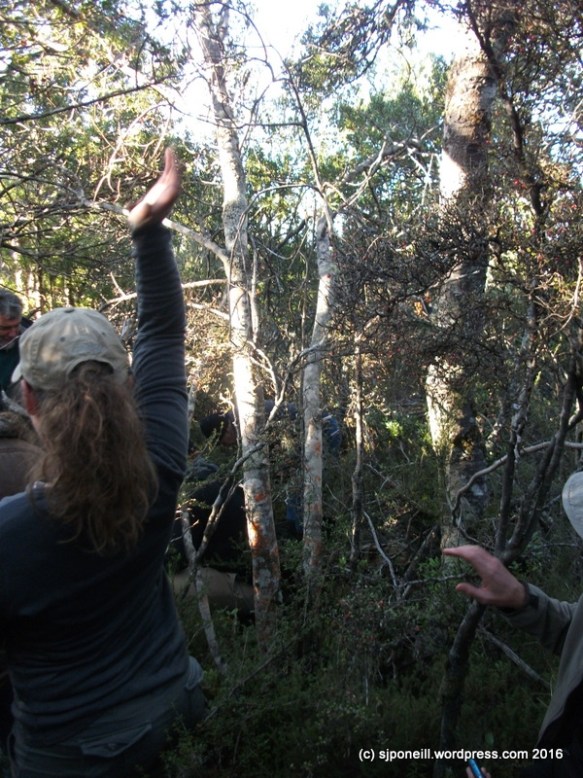
Some of the more mature trees in the dune field although only 3-4 metres high, and 3-400 years old
DSCF0051

The event that has had the most impact on the Rangipo area was the Taupo eruption some time between 182 and 250AD. It is not really known what this area was like before this eruption but it was certainly scoured clear of vegetation as a result. Since that event, man-made fire has probably been the biggest impactor on the state of the dune field, with periodic large lahars, on average about every 500 years or so, having the next most impact.

The dunefield is slowly expanding north and no one is quite sure why …

The dune field is a rugged challenging one for plant life and there is a clear succession that starts with growths like this…

DSCF0036.JPG

…around which the sand drifts and builds up. simple grasses like bristle tussock may then develop followed slowly, often over years or decades by more complex vegetation.

DSCF0035.JPG

It is a harsh unforgiving process…as dunes the surface is constantly shifting: the risk to developing vegetation is that it may be simply buried under the shifting sands, or have the sand around it uncut, exposing its roots…

DSCF0044-002.JPG

…either way not good for ongoing survival…

Even though there are substantial beech forests only a few kilometres away, the beech forest will probably not regenerate in the dune field because a fungus necessary to its growth is not in the soil there and is very difficult – read, close to impossible – to establish artificially.

The desired future for the Rangipo dune field is for it to regenerate naturally i.e. to its pre-settlement state. Replanting is not considered necessary, more a tool of last resort and it is considered of greater benefit to focus conservation efforts on the control of invasive weeds and pest animals like deer, rabbits, hares and possums.

The Army conducts its own pest control programmes across the Training Area, all 63,000 hectares of it, targeting pests like possums, rabbits and hares, and invasive weeds like the various forms of weed pines. Because the Area has an 85% usage rate – there were only three days this month in which we were able to get into Zone 1 for this study trip – and due to the number of hazards on and under the ground, much of this work is done by helicopter. As a part of this programme, the Army is also investigating source vectors for invasive weeds and sharing the results of this work.

DSCF0053.JPG

Smoko and networking

DSCF0055.JPG

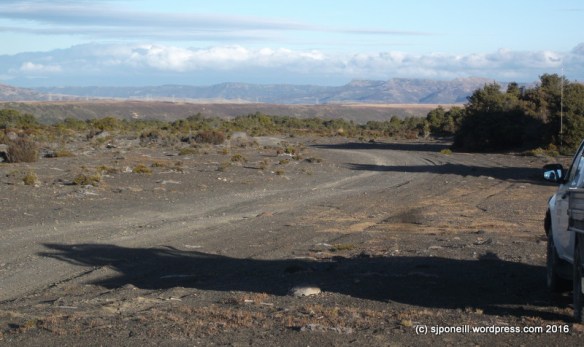
The road home…

In another life, I trudged all over the dunes ‘by day and by night, regardless of season, weather or terrain’…environmentally then, my main concern was the fine grit that, when wet, would stick to everything…one particle being all it took to convert rifle into not much more than a blunt instrument…none of us back then had any notion of the rarity, vulnerability or real harshness of this unique environment…I’m glad of this one last wander in my old stamping grounds…

Solitude | The Daily Post

Write a new post in response to today’s one-word prompt: solitude.

Source: Solitude | The Daily Post

This morning, I had big plans to clean up, do vacuuming and other such boring stuff…the sun streaming in, though, was too much of a temptation and I went off on another wander…this time, a little closer to home, Tupapakurua Falls just up the road in National Park Village…

There is a good, albeit slightly out of date, description of the route on the Taupo Tramping Club site, and also a good summary in the latest version of the DOC Walks in and Around Tongariro National Park (page 24). The track is pretty well-marked and does not pose any great navigational challenges so longs as normal common sense is applied, especially on the leg down to the base of the Falls.

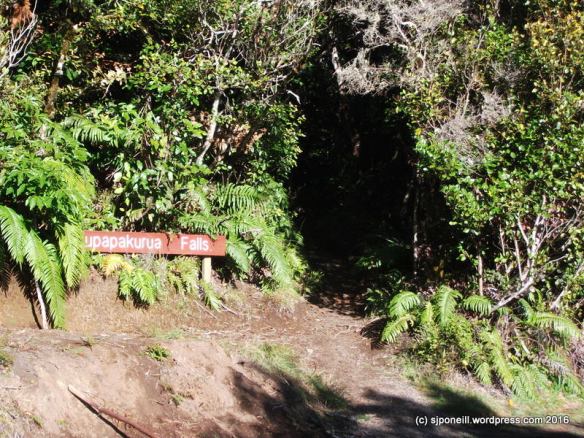
The track starts in National Park Village. Park where you like but you need to be looking at this in Carroll Street to get underway:

DSCF0014

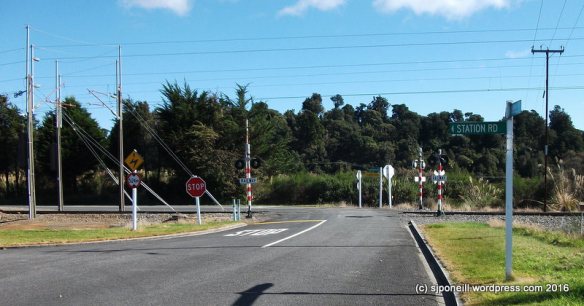
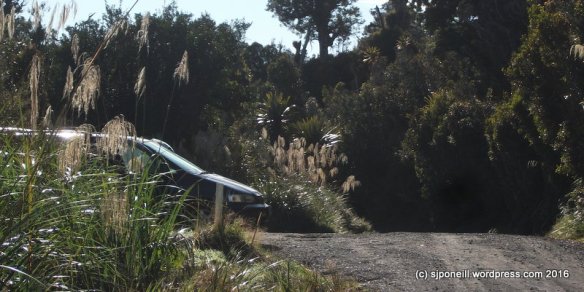
Cross the railway tracks – the BUSY railway tracks so take appropriate care – and follow the road round to the left…DSCF0012 …taking the first right down Fishers Road where…DSCF9968…after a couple of kilometres, you come to the start of the trail proper. Yes, you could just drive here but it’s a nice walk along the road and you wouldn’t want to drive only to find that the freedom campers have taken up all the parking:

DSCF9970

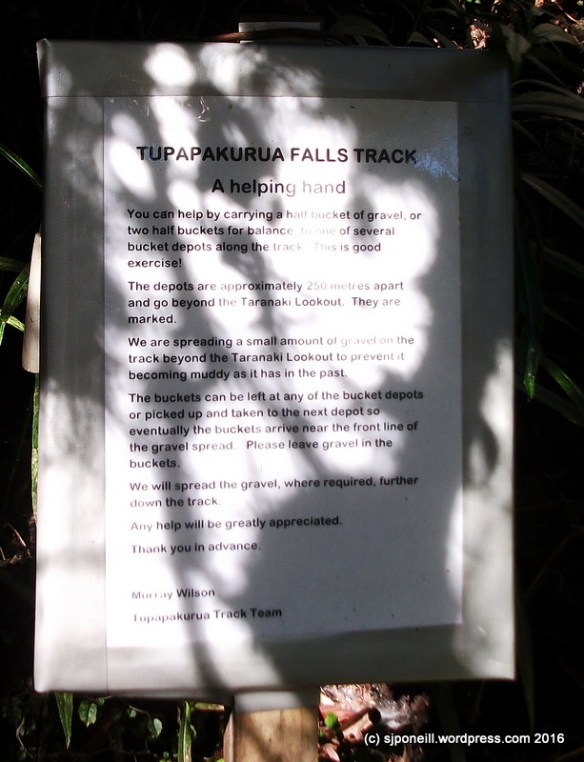
A short way along the track there’s a sign:

DSCF0008

This is a great way for walkers to contribute to the maintenance and ongoing development of tracks like this one: all you have to do is pick up a couple of buckets and carry them to the next bucket depot. Don’t stress: the depots are only a few hundred metres apart and the buckets aren’t too heavy.

DSCF9973

Grab two and start walking…

Along the sides of the trail, you’ll occasionally see traps for rats and stoats. Unless you are part of the community trapping programme, leave them alone…

DSCF9974

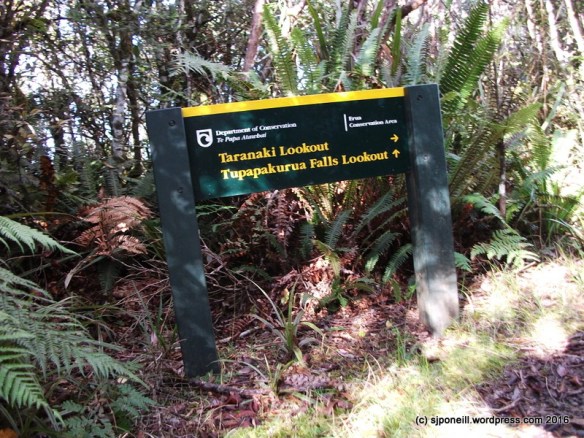
The track is well-marked and very easy to follow; the gradients are all quite gentle and after twenty minutes, I got to the Taranaki Lookout:DSCF9978

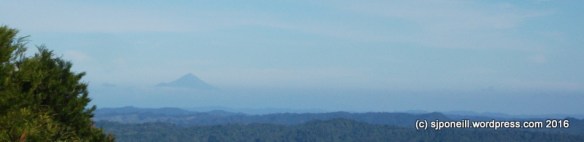
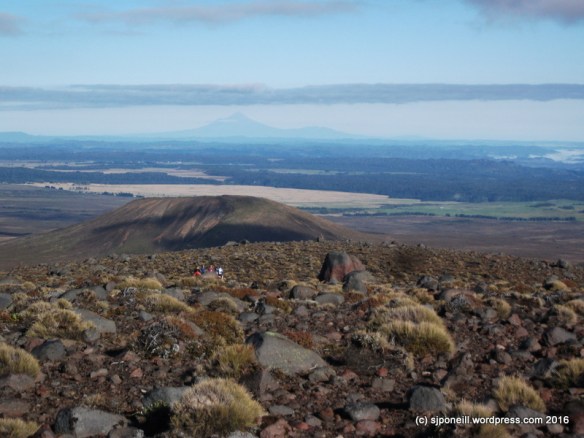
…with Mt Taranaki clearly visible on the coast about 120km away…DSCF9976-001

From the Taranaki Lookout to the Tupapakurua Falls lookout is about an hour of easy walking. The track is not quite so well-defined, marked or developed and there are a few roots and other potential hazards for the carelessly-placed foot. The climbs are a little less gentle but still doable for walkers with average health and fitness: just take care where you are placing your feet. This is original New Zealand rain forest that does not get a lot of sun through the canopy – the sort of environment over which Von Tempsky pursued Tītokowaru – smooth surfaces, wood and rock, can be slick and slippery: there is no cell coverage here and even satellite access can be dodgy at the bottoms of the canyons: if you are on your own you may have a long wait for assistance if you have a whoopsy.

DSCF9984 The lookout is a nice spot for the break…DSCF9980 …with good views of the Falls in the distance.DSCF9985

The Taupo Tramping Club notes recommend pushing a few minutes south-west of the lookout to the end of the ridge for a better view of the Falls and the valley. I really recommend doing this as the views are much better. Not mentioned in the notes is the more-recently developed track down to the base of the Falls. I almost gave this a miss as my destination for the day had been the Falls lookout but it was still morning, still sunny and I had come all this way…I’m glad I did as it was the highlight of my walk!!

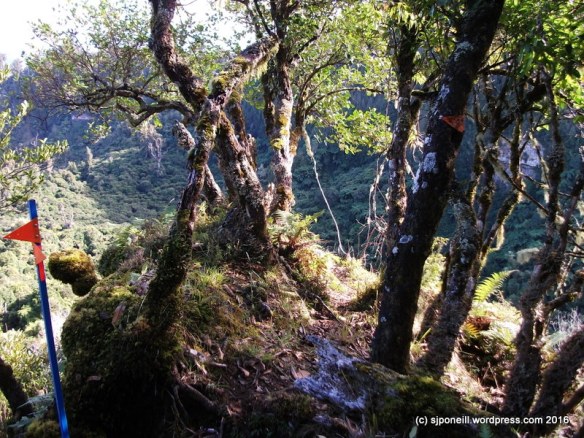
The track down to the base of the Falls is marked with the standard blue poles and orange arrows. It is not nearly as well-marked as the track to the lookout and walkers really need to be able to see the next marker before stepping off: there are many animal and hunting trails here as well and it is so very easy to follow what you think is the trail and find yourself geographically-embarrassed with no clue as to how to get back onto the actual trail…

Having said that, I found myself at the base of the Falls after a descent of around 15-20 minutes. Wow!! I need a better camera with a decent wide-angle lens to capture scenery like this…

The sun only gets into the valley later in the afternoon and it was not at all warm down in the base of canyon, plus the Falls throw up a fine mist that further drops the temperature: definitely NOT the spot for lunch..(or a swim!!)! But very much worth the extra walk and really made my impulsive activity worth the undone housework…

The climb back up to the lookout was not as arduous as I thought it might be on the way down BUT you do have to take care that you are actually on the trail as I found a couple of times

I still wasn’t that hungry when I got back up to the Falls lookout so pushed on back to the Taranaki lookout. I still wasn’t that hungry but felt I should eat something since I had carried it all this way: lunch was my standard walking lunch of a bannofee smoothie – tastes a lot more bananary with fresh bananas – and a couple of Jen Rice’s chewy spicy apple cookies – I always carry more but, as advertised, two is enough for a quick meal on the go.

From the lookout back to Fisher’s Road was only about ten minutes. Walking back down the road, I was welcomed back by a spectacular view of Mt Ruapehu through the trees…

DSCF0010

My total time for this walk was just under four hours: obviously I could trim this down quite a bit if I wanted but what would be the point. This is the first walk that I have done in this series where it was just me and the outdoors – solitude – and it was there to enjoy. The last two adventures that I have done, on Tongariro and Ngauruhoe, have been in open terrain and I was surprised just how comfortable I felt today returning to the close country of my roots…oddly, although was was the least strenuous of my three adventures to date, it is the only one that has left me with quite sore shoulders…really wish that I had that spa pump repaired now…

Carry a big stick…

…or to paraphrase Theodore Roosevelt “Tread carefully and carry a big stick“…two concepts directly related to my summit of Mt Ngauruhoe yesterday…

SCF9964

This is Stick. Stick is a little miffed that it missed out on going up Mt Tongariro last week, but that’s kinda what happens when you hide away in a dark corner of the garage. Stick is way more useful than lightweight aluminium walking poles which are too flimsy to brace your weight against. Stick is also really good as a counter-balance and a brace when descending scree slopes…

SCF9924-001

Tuesday and yesterday offered the best weather windows for another go at Ngauruhoe; yesterday had the least wind and Tuesday was off the list when I remembered that I had to speak to a visiting Duke of Edinburgh group from Karamu School. The day opening with a beautifully clear sunset that boded well for the day’s adventure.

Mt Ngauruhoe (thrower of rocks) is technically ‘only’ a vent on Mt Tongariro but because it is now higher than its parent and such a prominent feature, it is counted as a mountain in its own right. Don’t be fooled however, it is still an active volcano and carries with it, its own unique hazards: it is very steep (a consistent 30 degrees), very smooth and covered in loose rock.

SCF9925

It was pretty brisk at Mangatepopo car park with the normal number of Alpine Crossing walkers milling around. The sky was clear, and the sun beaming down but the temperature was barely above zero…the best way to keep warm: get moving…

Many walkers were way over-dressed and already shedding layers in the first couple of kilometres…a number, by Soda Springs, were already quite oblivious of their surroundings and had to be asked to allow faster walkers past…I don’t really see the point of doing a walk like the Crossing if you are going to zone out before the end of the first leg…

SCF9929

A decent frost crisped up parts of the track lying in the shadow of Mt Tongariro, a good reminder that winter is drawing closer and with it, winter ground conditions. Although there was quite a bit of frost on the board-walks, they weren’t slippery but that won’t be too far away…DSCF9893

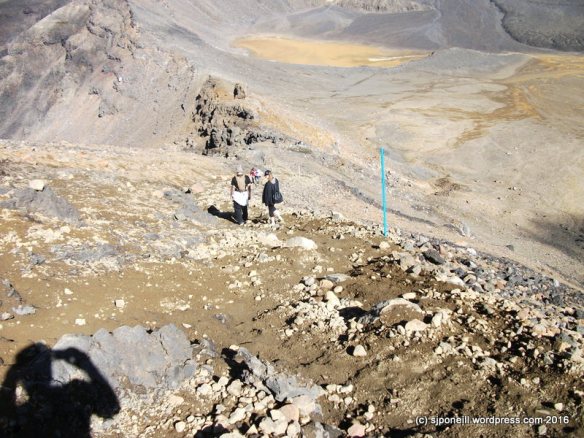
I made good time up to the top of the Devil’s Staircase, about 90 minutes. At this sign, turn right…in summer ground conditions, i.e. no snow on the ground, a trail has been worn from the sign towards the base of the volcano.

SCF9963

We’re not kidding!!

Because the sides of Ngauruhoe are so steep and smooth, any rocks knocked loose – and many of the surfaces aren’t that stable to start with – can roll hundreds of metres, picking up a lot of speed along the way. On my way up, I saw two torso-sized boulders crashing down the scree slopes: if they collected anyone on their way down, the results would be serious injury and a free helicopter ride…

SCF9938

As this peters out, a series of blue and orange track markers indicates the route to the beginning of the real climb…

The trick to a safe and successful ascent of Ngauruhoe is to work your way up the solid rock formations, avoiding the scree slopes as much as possible: they are really hard work going up and unstable to such a point that upwards motion, slipping and sliding, will generate lots of mini rock slides.

As a very young volcano, a lot of the rock on Ngauruhoe is very rough and sharp and this is more pronounced the closer to the summit that you get. Hard shell gloves are a good idea – your nice wool Icebreaker gloves will last about five minutes – and I’ll be digging out my leather shooting gloves before I come back up here.

Another incredibly highly recommended piece of kit for Ngauruhoe is a climbing helmet. Unless you are fortunate to strike a day when you have the mountain to yourself (unlikely to occur with decent weather conditions), there is a consistent trickle of small (and not so small) rocks coming down from climbers ahead of you. In addition some of the rock faces on the way up are quite steep with potential drops of a few metres: you may be the best rock scrambler in the world, the that mightn’t help you if you get wiped out by someone less experienced ahead of taking a tumble.

climbing helmet

Something like this…

…and, no, I didn’t wear a helmet myself…something that a. my school group from Karamu School called me on when I caught up with them at Soda Springs on my way back and b. that I intend to do something about before I return…I only saw one group up there with helmets but lots of near misses…

Stick was really useful as a brace on the ascent and there was only one time where I needed to use both hands for climbing…everybody that I saw with walking poles struggled with them: they are too flimsy to be used as a brace and, more often than not, tend to just get in the way: you do need at least one hand free for climbing. I carried a set of poles up for a young American lady who had come expecting a walk not a climb and who was reduced to throwing her poles ahead of her as she used both hands to climb…

This young lady had also been left behind by the rest of her group which is pretty untidy – if you start as a group, you go as a group and finish as a group – more so, when she did not have any water on her. I carry heaps and was happy to share, bolster her confidence and encourage her to the summit but she was not prepared for this sort of activity and was having a pretty miserable time – which defeats the whole point of doing things like this…

SCF9943

It took me about two hours to the summit: spectacular views!! But all that rock is very hard and very sharp with a some big potential drops of the unwary or unsteady of foot..

SCF9948

The top of the cloud was sitting around 1400 metres but all the good stuff was visible, looking here across Red Crater to Blue Lake; lower centre, you can see the Tongariro Alpine Crossing heading up towards its highest point of 1868 metres, and the trail to the summit of Mt Tongariro. climbing off to the left…
SCF9939

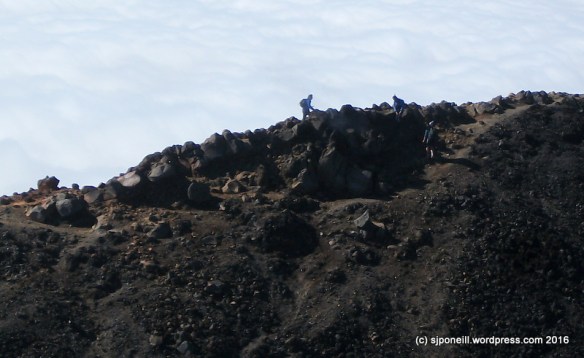
There are active vents (fumaroles) on Mt Ngauruhoe and steam was clearly visible from this one on the summit: you can just make it out at four o’clock from the left-hand figure on the skyline…
SCF9949

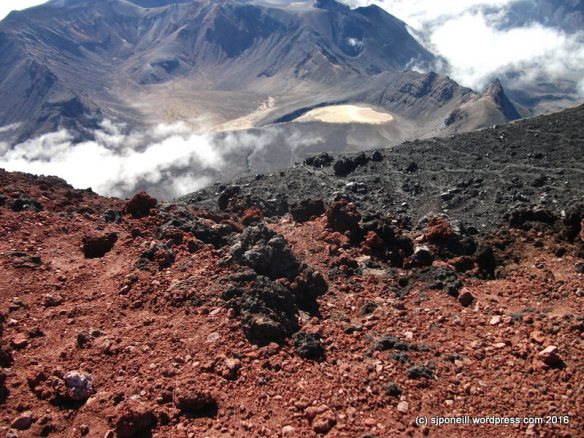
Without wanting to repeat myself, this volcanic rock is hard and sharp…about three steps into my descent, I slipped and slip a couple of metres and have some nice skin to grow back on my left wrist…slow and steady is the way…

SCF9956

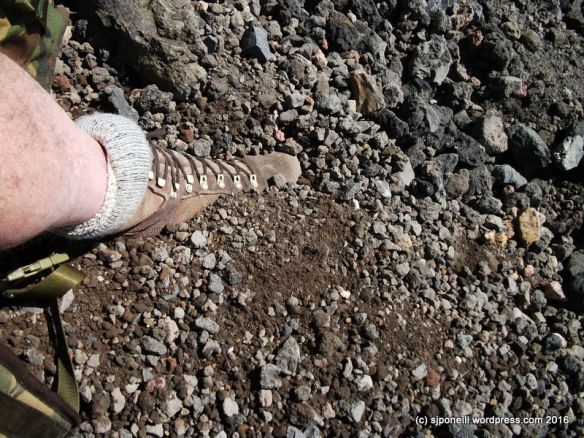
The easiest and safest way to descend Mt Ngauruhoe is down the scree slopes to the west of the rock that you climbed up on. Avoid the rocky surfaces: they are not very stable and you WILL set off rock slides!! Stick to the channels of already disturbed scree where there are less rocks.
SCF9954

Stick was really useful for bracing myself on the scree…this is soft and loose…if you are wearing ankle boots or runners/trainers (really?), gaiters would be a good idea as you will be sinking into this stuff up to and over your ankles. Don’t be an idiot and leap your way down the scree slopes: not only are you kicking loose a lot of loose material that hazards those below you, but if you strike a fixed rock beneath the surface, you are likely to lose your balance and become your own rock slide…you can descend quickly and safely without being an idiot…

Be aware of your surroundings…I spent a lot of my descent time watching behind me for rocks knocked loose by other people…not everyone calls ‘rock’ when they set one loose…think a couple of steps ahead as to where you will go if a rock comes in your direction…

Mt Ngauruhoe Summit climb April 2016 -026

…and finally back on the trail just before the junction with the Alpine Crossing…I was tempted to carry on up to Red Crater, across to Mt Tongariro and come back down the way I went up last week but I didn’t fancy descending down through that cloud on an unmarked trail…

Mt Ngauruhoe Summit climb April 2016 -028

A final shot from just short of Mangatepopo car park…perversely the view was clear with that little cloud rolling in in the time it took me to get out my camera…

Total time was about 6 1/2 hours but that includes a decent break for lunch, assisting the young American lady and stopping to talk to groups along the way. My total walking time, with just breather breaks would have been in the region of 5 1/2 hours…

Insights

  • Gloves – a good set of well-fitting leather gloves will save you skin
  • Helmet – may save your life.
  • Decent sturdy footwear – not runners! Consider gaiters to keep the scree out of your boots/shoes.
  • If you must take walking poles: either take only one of have a backpack that will let you carry them if you don’t need them.
  • Tread carefully: be sure you are stepping onto firm ground before you transfer your weight…
  • Jeans make the climb – and it is a climb not a walk – hard work. I was comfortable in shorts and an Icebreaker T-shirt all day BUT I had good clothing for cold/wet weather on me if I needed it…

BE AWARE OF YOUR SURROUNDINGS – YOUR SAFETY IS YOUR RESPONSIBILITY!!!

It was disappointing to observe the number of people who were physically and psychologically unprepared for Mt Ngauruhoe…many thought it was just a walk and struggled with the climb and the height – one loud American complained the whole way up about his fear of falling – others got up all right but had no idea how to get down…here’s a hint: it’s easy to climb UP the rock; climbing down the same way is not nearly as easy and you’re making people still coming up work around you…

This, I think, puts a lot of the responsibility back onto us locals to ensure that we are setting visitor expectations appropriately in all our contact with them, and through our websites, and social media engagement…Mt Ngauruhoe is not a place where ‘just do it’ is a good or safe philosophy…



Fog | The Daily Post

Today’s one-word prompt: Fog.

Source: Fog | The Daily Post

Clouds can form at many different altitudes. They can be as high as 12 miles above sea level or as low as the ground. Fog is a kind of cloud that touches the ground. ~ SciJinks

These one word prompts from WordPress always strike me as quite lazy: if the muses can’t be bothered putting any effort into the prompt, I feel less inspired to apply myself to any response…all too often my response is graphic (graphic imagery-wise, not graphic colourful in the semantic sense!) but while I am set-a-foot for the next week or so, I’m determined to write something once a day, even if it is not in response to that day’s prompt….

Fog here, just is…it is more common than not in the morning, often beautifully so, filling in the low ground and giving rise to impressions of great inland lakes, around which the road skirts – or sometimes descends into…

Raurimu-010

On the mountains, it is common for fog to form rapidly, catching out the unwary walker or climber. Often visibility will deteriorate to a point where the next marker pole on a track is no longer visible; or the landmark you are using as a point of reference of exploring off-trail just disappears…

DSCF9856

It is actually quite cool to be sitting up high and watching clouds and fog form in front of you, or below you…often around mid-morning as the sun burns off dew on the rocks from the previous night, the water vapour created will only rise a few metres and then drift off, slowly (sometimes not too slowly) thickening into a thick mist…

DSCF9864

Sometimes it is only a matter of minutes before clear skies are obscured, and navigation is hindered + it is cold in the cloud as well: another trap for the unwary…

DSCF9865

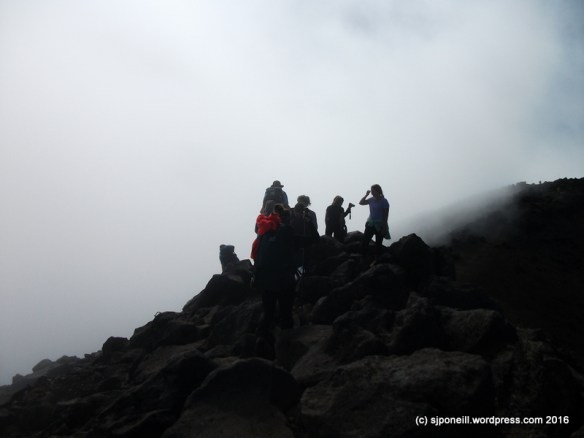
…and from there to here, on the summit of Mount Tongariro, where walkers are wisely waiting for the fog to clear enough for the poles marking the trail back to Red Crater to be visible again…it normally doesn’t take too long…best to wait than to wander off and find you cannot see any sign of civilisation when the fog clears..!


Tongariro – the back way

Wow! I haven’t had such a good day on my own for a long time…

I have two weeks off to consume accumulated public holidays and time in lieu…with three days of fine weather forecast this week, normally I’d be working on the Lodge but this week I’m letting my muse drive me…

Today – and I am trying to write this while the memories are fresh and before I face-plant the keyboard as I am  just a little jaded – to venture up the ‘alternate’ route up to Mt Tongariro from Mangatepopo, across to Red Crater and then back down the Crossing trail to Mangatepopo. It’s probably a by-product of my green journey and its muse that I feel attracted back to the outdoor environment; that, and wanting to get some me time away from people ( natural enough when you work with hundreds of visitors every day).

An early start to make sure I could get a park at or near the Mangatepopo car and I was legging it towards Mangatepopo Hut by 7-30. No pix of the car park: although it wasn’t nearly as chaotic as it can be there were still heaps of people milling around and I just wanted to get underway.

The hut is only about fifteen minuets from the car park. I made a quick stop there to enter my trip into the hut book – you can never be too careful – and away I went…

DSCF9841

Mangatepopo Hut

There is quite a well-formed track that heads off north-eastish from the hut down to the stream. Some parts of the track towards the stream are quite heavily eroded and you need to be a little careful especially when it is a bit damp/slippery, as some of gouges are a metre or so deep. I followed that across the stream and up the opposite slope where the track is still pretty clear. From the sign it is fairly well-used.

DSCF9849

Target for today: Mount Tongariro

The climb up is pretty easy but already the day was warming up well past the forecast 0-5 degrees.

DSCF9852

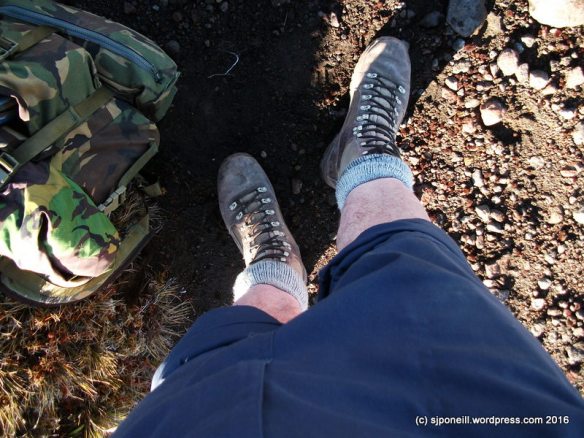
I had dressed for the the forecast and was already feeling a tad warm so converted my trousers into ‘shorts’ with some judicious folding. Much more comfortable.

DSCF9845

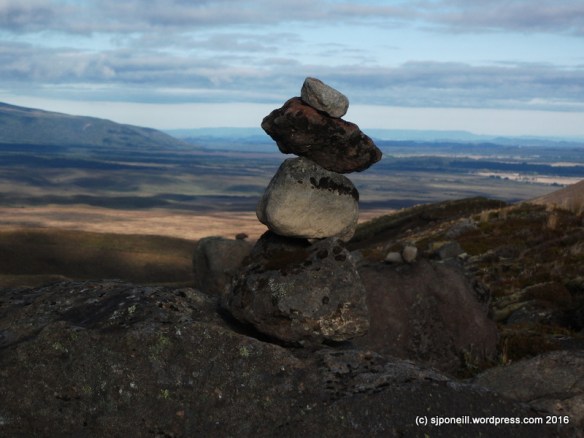
It looks pretty but…

Why do people persist in build cairns in the Park, especially things like that that are purely decorative? Do they not get that it is a national park and the whole is to do no harm. The environment here is very delicate and even moving one rock exposes fresh soil to the elements and leads to the erosion that already devastates parts of the Park.

DSCF9850

Oh, great, people!!!

I was looking forward to some quiet introspection time so the sight of a group following me up was not welcome. I stopped to let them pass me but we ended up pacing each other and then travelling together. They were a group of Duke of Edinburgh students from Thames High School whose objective this week was four summits in four days. They’d missed out on Ruapehu two days previously as the weather had closed in and they’d decided to pull the pin – good move – but had summitted Taranaki and Ngauruhoe successfully.

DSCF9853

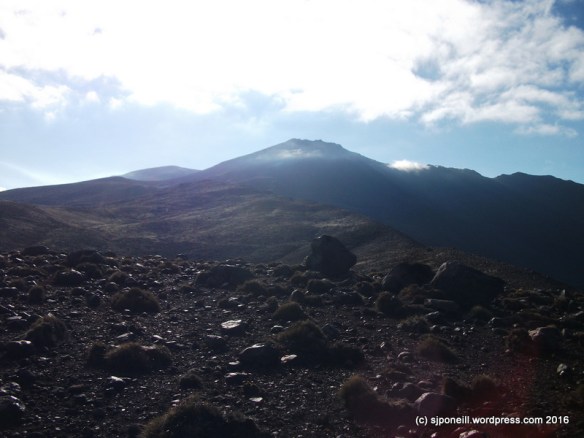
The lava flows from the more recent eruptions on Mt Ngauruhoe are very clear from across the valley. When (not if) Ngauruhoe erupts again, the historical lava route has been down the north-western slopes and we’ll need an alternative route like the one I walked today to keep the Tongariro Alpine Crossing open.

You can also see cloud forming off Ngauruhoe as the morning sun evaporates dew off the rocks. The same thing was happening on the other side as we walked up. Many people are surprised by just how quickly cloud can form up here and how thick it can be. As people found once we were on the summit, when the cloud is so thick that you can see the trail properly, the best thing to do is just sit it out.

DSCF9857

How erosion starts 101

I encountered a number of gouges in the surface like this as I climbed further up. There were clearly man-made as some of them ran perpendicular to the flow of water off the slopes. Some of them looked like campers had carved out a little drain to divert water around their campsite; others looked like rocks had been rolled or dragged down the slope. The surface up here is that delicate that interference like this will channel rainwater and cause serious erosion in a very short time.

There is not a trail all the way to the summit but the route is fairly intuitive with only one significant scree slope just below the summit. The trick is to aim slightly left as you approach the peak and this will take to directly to the summit. The climb itself is pretty Goldilocks: not so long that you get into ‘are we there yet?’ syndrome but not so short that you don’t feel like you haven’t done any work. Cresting the summit is really “OMG, we’re here!!”

DSCF9863

Thames High DofE group


DSCF9864

The cloud closed in as soon as we reached the summit…

…restricting views to just the top of Ngauruhoe.

DSCF9861

Lunch

Lunch for me was one of my bannofee smoothies and a couple of Jen Rice’s chewy apple spiced cookies – Jen says that two of these cookies are a meal and she is absolutely right: even after walking for three hours, two were more than enough to fill me up. I would have brought one of her turmeric coconut and pineapple smoothies except I’m out of pineapple until my next trip to civilisation.

DSCF9867

As I finished my lunch the cloud closed right in…while we waited for it to clear as it usually does relatively soon, I enjoyed talking with other waiting walkers about the Park, Lord of the Rings – always a safe subject – and the volcanoes.

DSCF9866

A minute ago this was all cloud

Even quicker than it had appeared, the cloud disappeared and it was off down the marked trail to Red Crater

DSCF9882

Skirting around the rim of South Crater down to Red Crater…

DSCF9880

Looking down into Red Crater

Most Crossing walkers had already passed this point so I didn’t encounter too much traffic in the other direction heading down towards South Crater

DSCF9885

Enter a caption

A late walker heading up to Red Crater…the route is quite steep and uneven but easily negotiable in either direction so long as walkers take care and watch their foot placement.DSCF9887

Looking back across South Crater: the route up to Red Crater runs about halfway up the ridge line that runs out the left edge of the image…

DSCF9896

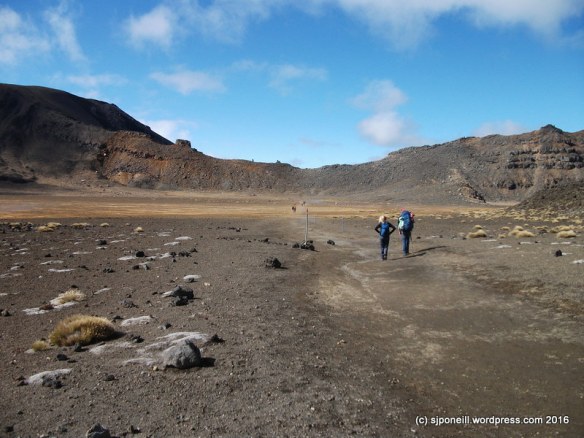
Looking down from the top of the Devil’s Staircase, over Soda Springs to the beginning of the Crossing. Mangatepopo Hut can just be made out centre left. The route down the Staircase is quite windy but easily negotiated at speed over most of its distance.
DSCF9904

From Soda Springs to the hut is very flat with many ‘highway’ quality board walks. I always hate this leg as it is, IMHO, quite boring and rather administrative in nature.

Today was the first time that I have been out in the Park for a couple of months. Although the solitude was not as I expected, I enjoyed meeting and talking with other walkers and exploring a path less travelled.

DSCF9856

Target for tomorrow..?

That will probably depend on whether I can get out of bed in the morning…some joints are having a bit of a bitch tonight…

Seasons | The Daily Post

This week, let’s embrace the season: share an image that embodies the world or the weather where you live.

Source: Seasons | The Daily Post

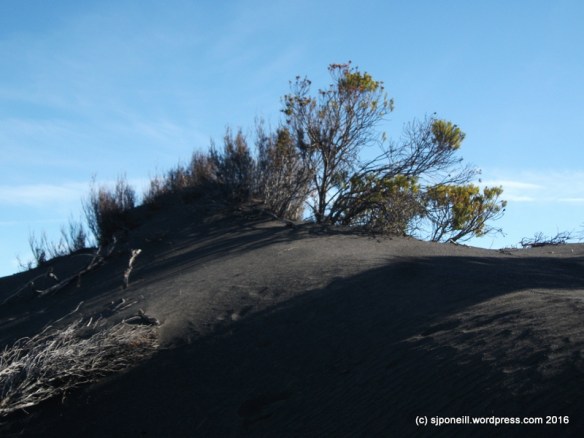
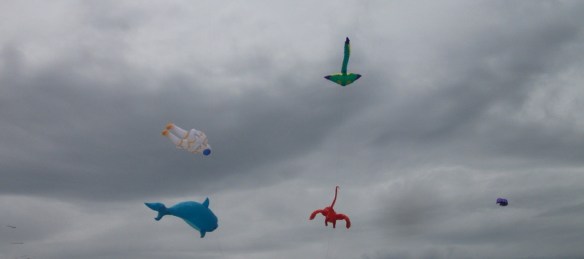
Every January, the Department of Conservation and Project Tongariro host the local Mahi Aroha Summer Programme, a month-long calendar that encourages people into the outdoors and showcases local conservation projects…DSCF9471The first activity each year, on New Year’s Day, is the family kite day…
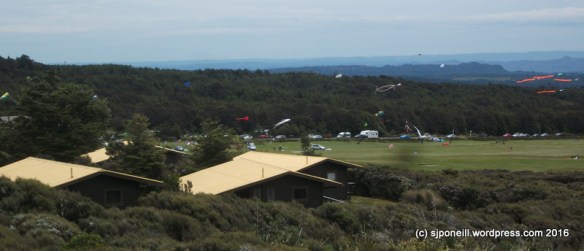
DSCF9481Even though the first of January is technically in the middle of summer, true summer here often does not kick in until February….
DSCF9486Pleasant but overcast days like this are common for this period of the season…DSCF9476

…and are no obstacle to everyone getting out and having a good time…DSCF9487

A bonus this New Year’s Day, was the first mistletoe in Whakapapa Village…