The Odyssey…

(c) The World According To Me 2011
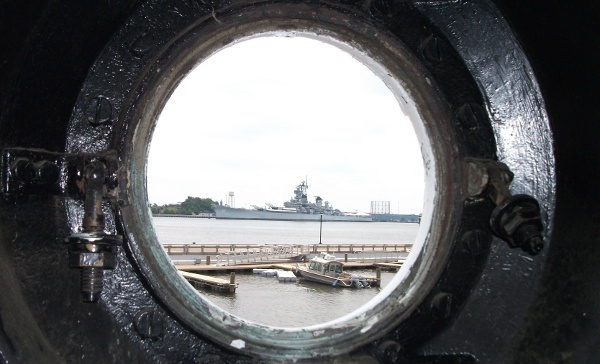
USS New Jersey (one of the last) from USS Olympia (one of the first).

Yes…the blog has been quite quiet of late…I’ve been on the road for the last fortnight and it has been both stimulating and challenging…a normal day consists of participating in the day’s activities, any after dinner networking and then spending a few hours logged-in on Kiwi time to keep up with events back home…doesn’t leave much time for scintillating insightful blog entries…

Still I have learned a lot in my various engagements since I arrived in Las Vegas two and bit weeks ago…I was last in Vegas in 1988, young and single, and it rocked!! Vegas when you’re married and a grandad and on your own after the rest of the team depart, ain’t much fun at all and is kinda boring…is that really boring, or just an opportunity for introspection and consolidation…? From Nevada, I arrived at Reagan International at some awful hour but got to the Marriott in time to catch Josh for a couple (or more!!) of beers before the Irregular Warfare Summit…

So…bubbling away in my mind are a number of insights relating to Unmanned Systems (sorry, ladies, the name ain’t changing anytime soon!) and Irregular Warfare – again the name ain’t changing anytime soon…yes, there are also irregular challenges, activities and threats and yes, we’d really like to intervene before irregularity becomes warfare…but let’s just go with the flow on this one. At least, it’s a big step up from the COINology that pervaded all aspects since 2004…and, sure, the official definition (a la DoD) will catch up…and no, the operators seem to be copying off the same sheet of music…not sure what language some of them might be scribing in but we’re getting there…

In the meantime, I am churning away…I try to maintain SA through FB mainly, supported by email although correspondents will have noticed that response might be a bit tardy (lax) at times…Skype’s handy too but it parasitically consumes bandwidth and that’s not good when I’m on a data cap (hotels with free wireless rock!!). One coup from this trip is that I bought a VirginMobile USB modem which has been a Godsend for mobile connectivity – a few more hotels charging USD12-15 a night for wireless access and it will have paid for itself AND the first months net access…The VirginMobile deal is far better than that offered by Cricket or T-Mobile and I really recommend it….

Last weekend, I caught the Amtrak to Philadelphia for bilateral discussions with Dean @ Travels with Shiloh on divvying up the world post-world domination day…I chose the USS New Jersey (tied up across the Delaware in Camden) as the venue as I figured that all that steel would cramp Doc Karma…ooops, I mean, Dean’s mind control powers…probably just as well that I did as he was showing off his power of mind-reading at lunch…you know, that thing super-villains do to show-off…”oh, I might just have…the thing in the menu you’re looking at – now!‘ Talks went well so look out world!

Honestly, it was a great day for a range of reasons…firstly, when you travel as much as I do, it’s always nice to be met on arrival – and not by a hoard of shovel-toting molemen (Dean, are you sure they didn’t follow you?!); secondly, I had no idea how to get from 30th Street Station to my hotel; and it was great to meet in person someone whose work I have admired and followed for a number of years…it was also well into summer, an awesome hot sunny day, a boat ride across the river…Philly cheesesteak for dinner…how could you go wrong…?

So more of the next few days of my adventures…and I’ll start to blend in some commentary on current events and my discoveries while here…

Memorial Day Remembrance

and I am thinking how to say

“and” and whether “and”

is the word for the way, beyond

the swamp, the ghosts of pines

and skeletal cypresses march for

miles in haze.

– Rosanna Warren

To Doc who got it in the neck and bled out.

And to B.

And the triple-stack that left his leg on me.

And Gunny, without his throat, gurgling on the tarmac to rush that pos.

And Rob, my fellow boot, in Samarrah and nothing left, not really.

Except Samarrah.

*****

I hear you still screaming from the far country, calling your roll.

And the rest of us will be there real soon.

I promise we’ll cover down.

And align.

It’s Memorial Weekend here this weekend, and all over the country, people are remembering in their own ways, those who have fallen…I wasn’t going to post anything on the subject but the words above were posted on Carl Prine’s Line of Depature and the link pushed out on the Doctrine Man! Facebook page…they cut to the bone regardless of nationality….

Weekly Photo Challenge: Water

I’m sure there’s a road here somewhere…

The Great Thailand-Singapore Bike Ride…it’s 1988…some of the lads from Charlie Company, the First Battalion, the Royal New Zealand Infantry Regiment take up the challenge to ride from the Malaysia-Thailand border back to their base at Dieppe Barracks, Singapore…why? Because they could…Day 1 of the ride was also Day 1 of the eastern monsoon and from there life became interesting…

Kota Bahru, like most of the region, flooded out but most took it in their stride…

…and after many adventures, the final destination was reached…

The final leg…coming onto the Causeway…

This week’s WordPress Photo Challenge...and an interesting exercise in hearts and minds as we worked our way down the east coast staying on beaches and in small kampongs each night…much as I would have liked to have been riding, someone had to take the photos…plus I didn’t have a bike anyway…and I was just back from six weeks in the States…and it looked like hard work…these really were the good ‘old’ days…

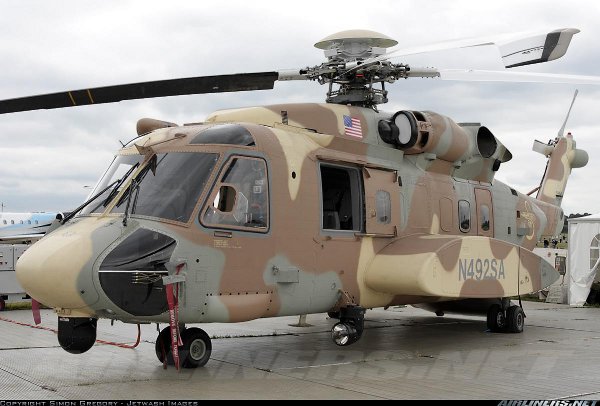
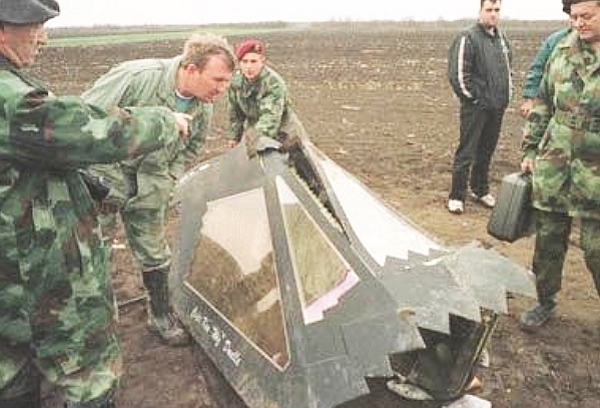
StealthHawk enters production – in China

Great news for aviation and specops aficionados  to read in Time that bulk production of the H-60-based StealthHawk revealed in the OBL takedown has commenced…not so great news that production is in China…

Fortunately, production is also also only in 1/144 scale, so while small boys of all ages will be happy to find two in the box, the Specops balance of power remains stable…

I have got to get me one of these!

It is, though, a credible effort on the part of Dragon to design, tool, produce and distribute this model in only a few weeks since the May 1 raid where the new design was revealed…Dragon pulled off a similar coup in 1989 by releasing the first close-to-accurate models of the F-117 and B-2…

Edit: Some interesting analysis from over at Paper Modelers (the rest of the pictures referred to below are there):

I worked at Sikorsky for 9 years. That being said,that model is really “funny”. It is much like the old Aurora models of stealth aircraft that looked nothing like the real thing.

I think it is a variant of the S-92. The drive shaft for the tail rotor is far too long to be off of a Blackhawk, and they don’t even remotely look like that. Also, that picture of the tail rotor is not what it appears, as far as it is mounted to the helicopter.. In the attached picture, it looks like the tail rotor assembly flipped over from the torque of the drive shaft. On the helicopter facing from the rear, that tail rotor is probably on the left side. The black tiny parallelogram is the top and the flat spot is the back of the helicopter you are looking at. The 2 men of the picture hint at the scale. That is definitely not based on a Blackhawk, it’s huge. 

The S-92 is all that’s left, it is also the most modern helicopter in the world. New standards had to be developed as it exceeds every standard for a helicopter of that class by that much.

The LHX75 is just for reference and rules any variation of that helicopter out because it is too small.

The S-92 SAR looks like the likely candidate. IMHO.

Boeing-Sikorsky S-92 SAR

Joining the dots…

Obviously air power has a most important role to play in combating an irregular force.
The purpose of this seminar is to ask you how you would consider employing air power in
such capacity. Not an easy question!

QUESTION
How would you consider employing Air Power in combating an irregular Force?

I would use air power to sense, move and engage..

I was really disappointed in this week’s seminar, especially since it’s closely related to the topic of my current research trip where I have been spending a lot of time with people who deal with the irregular environment every day and have done for years.

I’d also consider asking some questions that better explore the issues and challenges that air power faces in the irregular environment, and not limit it solely to irregular warfare i.e. explore the USMC concept of irregular threats or even better the UK one of irregular activity, against which air power is employed on a close to daily basis. I’d also find some readings that explore these issues and that are not simply regurgitated products from the school.  There are ample writings available in the international IW community that would led to some good robust discussion (unfortunately only in a virtual forum) to peel back these issues and apply them to a national or regional context…

That might seem a bit harsh but it’s not because the time I can spare at the moment is around midnight…this seminar comes across as a last-minute bolt-on without much thought or preparation…a deviation from the path of true and pure i.e. real air power i.e. MCO. It should probably be one of the more important topics of the course that might lead into a module on ‘What Future For Air Power?’….some ideas for what could have been…

Two air forces: MCO and COIN? or a single air force for MCO and let partners handle COIN/IW…? Should we just toss COIN/IW into the SO box?

The advent of unmanned and now autonomous UAS.

How might we handle the proliferation of miniature (and smaller) UAS which are the greater threat to manned aircraft?

What are the challenges of ISR and strike in an IW coalition?

Are the days of MCO over?

Is there a place for air power in war amongst the people?

What happens when the ‘other guy’ gets UAS?

Will cyberwar replace or supplement traditional air power roles and functions? Should cyber even be an air role?

Is the current IW focus on PGM an ‘a’ war or ‘the’ war lesson?

What effects might events like wikileaks have on air power? Or do they have an effect at all – maybe we just tend to over-classify anyway…?

What effects might current outsourcing/contracting philosophies have upon air power in an IW environment?

As ISR collection capabilities expand exponentially, what changes might we need to make to ensure that air forces can optimise the terabytes of information now available – will we need a larger analysis ‘tail’ to support a shrinking number of teeth?

Do the OBL raid, Op BARRAS, and ISAF cross-border drone strikes lead towards an era where more smaller (possibly unilateral) cross-border incursions more more common as a tool of National power?


Axle-wrapping

This seminar considers the international laws and conventions that should limit the application of air power. Humanity, proportionality, and military necessity remain the underlying tenets of the application of air power. Should international law ever be overlooked in order to achieve a military victory? Some think so, do you? This seminar is a vital and most important segment of the course. 

Questions

Does international law favour the offensive air campaign?

Most absolutely…offensive ≠ indiscriminate or disproportionate.

In 1928 the Chief of the Air Staff RAF wrote in his paper The War Object of an Air Force’What is illegitimate, as being contrary to the dictates of humanity, is the indiscriminate bombing of a city for the sole purpose of terrorising the civilian population’. Would you regard this as evidence that the higher command of the RAF was fully aware of jus in bello?

Possibly…looking at the history of papers and articles written by air forces leaders, it is clear that there is a difference between what may be written in a paper, perhaps to foster or provoke debate and what actual policy and doctrine might be. Without context and supporting evidence, this constitutes little more than opinion.

In February 1942 the Chief of the Air Staff, RAF, Sir Charles Portal wrote to the C-in-C Bomber Command …’I suppose it is clear that the aiming points are to be the built up areas, not, for instance, the dockyards or aircraft factories….This must be made quite clear if it is not already understood’. Would such a directive constitute a war crime today?

Again, this is a brief statement with no supporting context and thus rather meaningless. Is it a case of national survival? It states ‘built-up areas’, not centres of population…are such ‘built-up areas’ inhabited or just convenient and/or practical centres of mass for applying force? Today, without an operational context and much more information, the legality of this approach cannot be considered; certainly it does not call for direct attacks against the population and could in fact easily be employed as part of the much-vaunted Warden ‘doctrine’.

Do you think the provisions of Protocol 1 unduly hamper the proper use of air power?

No. That would entirely depend upon what effects are desired/required in support of national objectives, and what means might be available to create those effects.

Was the principle of Proportionality contravened with the destruction of the Republican Guard by air power while retreating from Kuwait at the end of the First Gulf War?

No, not really…firstly the Republican Guard was not destroyed and many of those killed in those attacks were just poor sods in the wrong place at the wrong time. If any ‘law’ was contravened it was more likely that of discrimination. But, then again, that unbridled use of air power may have discouraged a few of the other kids on the block from misbehaving so, in the global scheme of things, may have achieved a larger purpose in which it probably fell within accepted rules…which is just a bit unfortunate if you’d decided to take the new Merc for a spin up to Basra that week…

Can Protocol 1 be reconciled with Sherman’s view that war is cruelty and cannot be refined?

Easily…Sherman never said that it only applied to civilians or non-combatants; and it also takes into account that only a small proportion of combatants actually pay much more than lip service to accepted rules of war…

I found these questions very superficial and simplistic in regard to the weight of the actual issues which are neither superficial nor simple…and this didn’t really feel that compelled to develop the themes any further…the bottom lines remains the weighting added to national interest in determining the conduct of any campaign and while it may be easy to leap onto the moral high ground, it is quite another matter to conduct an effective campaign from that location. It may even be that an over-emphasis on one aspect proportionality, for example, simply shifts the moral breach to another area, perhaps the well-being of one’s own forces and nation…?

OBL is Dead! Let Us Rejoice? — Not so fast. . .

OBL is Dead! Let Us Rejoice? — Not so fast. . .. I just thought that this post was so good that there is nothing meaningful I could add to it other than ‘have a read‘ and then ‘have a think‘…

Edit: this post (mine not Cecilia’s excellent piece) was just a little too minimalist (first time I have used ‘Press-It” so know for next time) so I have added a lead-in image with a  Reflections theme…

PDF: OBL is Dead! Let Us Rejoice_ — Not so fast. . . – Inspired Vision

A legend in its own mind

This week the air campaign in Kosovo is examined. The gradualist/risk strategy was employed despite its apparent discrediting in the Vietnam War. This led to a conflict between the commanders. General Short wished for the implementation of a punishment theory. It remains true that ground forces were not committed. However, was it the air campaign alone that achieved the favourable outcome or is there other factors? Was this a true convergence of ‘effects’ generated by the fortuitous or planned combination of offensive military action and the actions of a range of non-military players?

The gradualist (graduated escalation?) strategy was discredited in Vietnam? The elements of strategy and tactics that were discredited in Vietnam (and other conflicts where the same has occurred) were those that were separated from the professionals in those fields and dictated largely by powerful but inexperienced (in warfare) politicians.

Ground forces were not committed in Kosovo? So which famous armoured brigade crawled over narrow mountain roads into Kosovo? (Clue: its emblem is a rodent) Who raced the Russians for Pristina airport? Who’s still there now? While the air campaign may have helped set the scene for a relatively successful positive outcome to the Kosovo campaign, let’s not forget that the other instruments of the DIME (Diplomatic, Informational, Military, Economic) model were also decisively engaged in regional, domestic and international fora; and that these elements also deserve recognition for the roles they played in the campaign.

Russian vehicles mount a road block at Pristina Airport. A British armoured fighting vehicle and Landrover provide assistance

It might actually be argued that Serbian land forces would have been more decisively engaged had a land campaign been conducted in the traditional manner. The ability of the air component to engage Serbian land forces proved to be far more difficult than in the super-optimal environment of Kuwait and southern Iraq, and there is considerable evidence that a large number of targets engaged were ‘spoofs’. As events in the Falaise Gap (1944), Quang Tri province (1972) and the road to Basra (1991) showed, land forces in contact and on the move are significantly easier to engage with aerial fires.

Questions

Given that the first Gulf War concluded with a notion of air power being capable of winning wars, how has the employment of air power since then challenged that assumption?

This notion existed in a very few minds and if there is one single reason for air power’s lack of traction as an equal component of military power, it is the constant assumption of achievements that do not exist. Air power did not win the Kosovo campaign, Gulf War 1,or the Battle of Britain any more than my three-legged floppy-eared Spaniel. Not only do the domains operate together as part of the joint environment, there is no solely military solution to conflicts and these military options are employed as part of a whole of government inter-agency and broader comprehensive approach.

The notion that dominated military thinking after DESERT STORM was that of the revolution in military affairs, the dreaded RMA, but not one in air power. DESERT STORM was the first conflict where information had been employed as a decisive tool. As it turned out as the 90s unfolded, much of the hype from that conflict was simply just that, hype; but at the time it had swayed the minds of the world to justify both the conflict and the methods by which it was conducted. While the application of air power may have influenced the withdrawal of Iraqi forces from Kuwait, that movement did not actually start until after the commencement of the ground war. This action offered an unacceptable threat to Iraqi land forces and forced the withdrawal, or maybe rout would be more accurate. While air power advocates may crow over the road to Basra, it is arguable whether that level of destruction was actually necessary or that it contributed anything meaningful to the conclusion of the conflict. For whatever reasons, air power was also unable to deter Iraqi repression of Shia in southern Iraq.

So how have events since March 1991 challenged the assumption that air power won the 1991 Gulf War? Quite simply there has not been a single campaign or conflict that could claim to have been ‘won’ by air power. To flip that around, every conflict since March 1991 has required ‘boots on the ground’ (or ‘boats in the water’ in the case of counter-piracy campaigns) to force a conclusion:

Somalia. 1992-95 and current. Air used for ISR and mobility; a strong air bridge into Mogadishu during the former campaign. All decisive actions fought on the ground with air in support.

Bosnia. Resolved by the deployment of a powerful US force prepared and empowered to play the warlords at their own game, meeting force with force. Primarily a land mission during the decisive post-Dayton phase with air in support.

Rwanda. Air could have played a decisive supporting role here in 1994 by enabling the mass airlift of troops to reinforce the small UN force and reduce if not halt the genocide.

Kosovo. See above: possibly a contributor to the scene setting before the deployment of land forces, however there are arguments that the air campaign was largely counter-productive and actually strengthened Serbian resolve.

Bougainville. The 1997 deployment of peacekeepers (withdrawn in mission success in 2003) was supported by air for ISR, local mobility and maintenance of an air bridge for resupply and reinforcement.

Solomon Islands. 2000, 2003, 2006-current. Land force deployment supported by air for ISR, local mobility and maintenance of an air bridge for resupply and reinforcement; air transport also employed during various NEO during these periods.

East Timor. Major ground force deployment (division level) supported by air for ISR, local mobility and maintenance of an air bridge for resupply and reinforcement; kinetic air support also stood to during the lodgement phase in 1999.
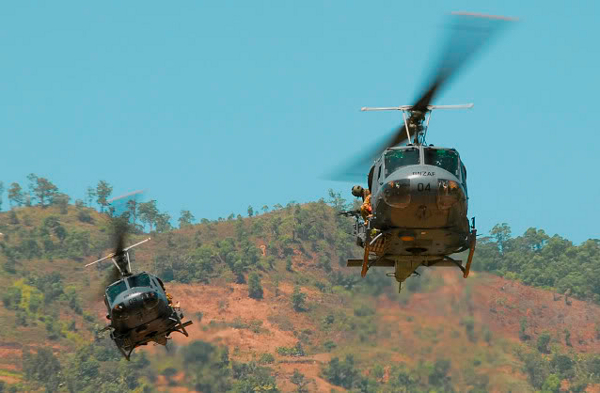
RNZAF Iroquois helicopters fly Australian troops in Dili, Timor-Leste.

South Ossetia. Major, albeit one-sided land force on force confrontation between Russia and Georgia, with air in support (primarily on the Russian side after Day1) for ISR, strike, mobility and CAS.

Chechnya. Primarily a land conflict between conventional Russian forces and irregular Chechan forces; significant air resources employed by Russia to no discernible positive value.

Iraq. The primary effect of the no-fly zone campaign and its associated sporadic strikes into Iraq 1991-2002 was to keep the wounds between Iraq and the US open and festering. While the ‘shock and awe’ aspect of the opening of OIF was feted, the reality is that a decisive land campaign was always identified as the decider in this campaign, both the Plan A campaign to May 2003, and the insurgency to mid-2010. While ‘shock and awe’ can trace its roots through the Powell Doctrine of the 90s back to the ‘triumph’ of Gulf 1, the primary driver behind it was SECDEF Rumsfeld’s belief that greater reliance on technology would reduce defence costs by eliminating large numbers of expensive personnel.

Afghanistan. Neither the British (between the wars) nor the Russians (1979-89) were able to quell local tribesmen by air. OEF was always predicated on a strong land campaign supported by air. The air bridge into Kabul in the earliest days of the campaign was a key enabler for early successes however air has remained in a supporting role to the land campaign. The mission to take down OBL was a land mission supported by air i.e. no UAV-delivered PGM through the window.

Sierra Leone. Primarily a land-based peacekeeping operation. The British JPR mission in 2002(?) was a land force mission supported by air for mobility and CAS however use of kinetics was hindered by misperceptions of proportionality with the rules of engagement.

Israel v Hizbollah. A classic example of how not to do it. Not only would any other aspect of the DIME model been better employed to counter HIzbollah rocket attacks into Israel from Gaza and Lebanon, but the use of air power as Israel’s tool of choice not only illustrated how behind the times Israeli military thinking was but also had the opposite effect to that desired, regionally and in the court of world opinion.

Libya. The ultimate (so far) example of how not to employ air power. Not only has this meddling extended a minor internal conflict into one likely to drag on for years, but it has seriously damaged the credibility of air power as a decisive force and its advocates. Already some NATO nations are trickling land forces (under the guise of training and liaison) into Libya to attempt to recover the situation. This is what happens when you start to believe your own press.

It is to our benefit that the one strategic scenario where the use of the air and space would have had a direct and decisive effect on the outcome of a conflict is the one that has never come to pass…
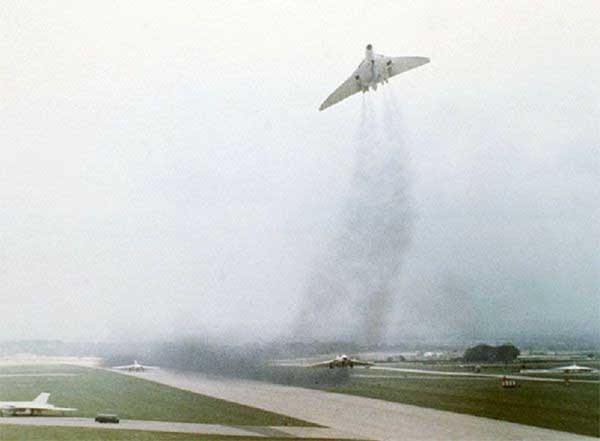
Good use of colour

(c) Lily aged 4

A new release by ‘Lily aged 4’. displaying exceptional use of colour with clear direct and subliminal imagery which gets her message across in manner which is crisp, concise and to the point…it’s a pity that we can not expect the same from the socalled professional media…

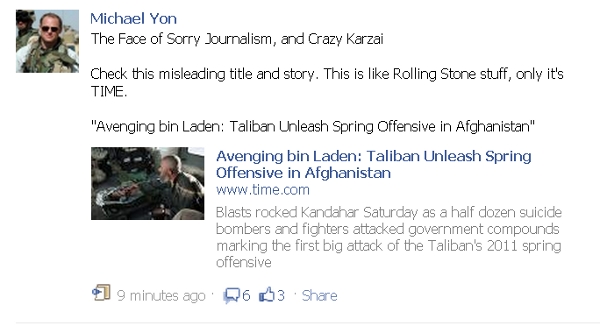
Michael yon yanks Time’s tail for if not directly telling porkies, then definitely playing fast and loose with reality…the Taliban have initiated a spring offensive!!! Wow!! What have they done every other spring since 2003…? If Time wanted any credibility at all in this article it might have found a source better than Hamid Karzai whose grip on reality is tenuous at best…

And still on the Yon trail – in a good way again(Wow!! twice in a row – is Mike reforming?) – while I accept Nancy Colasurdo’s point in Spotlighting Loyalty and Our ‘Confirmation Bias’, I don’t agree that Mike was wrong in calling for a boycott of Rolling Stone magazine for its Kill Team story. I do not believe that the positioning of the Kill Team story with the roadside checkpoint video was an accident or an error – the intent was for readers to join the dots and form a totally erroneous opinion – that is both dishonest and not in the best interest of those at the sharp end of this conflict – certainly not those in US uniform – and I assume that Rolling Stone still considers itself an American magazine? No matter what one might think of the conflict in Afghanistan, how we got there or where it’s going, these are issues to be raised with politicians not targeted against those who serve… (a fine distinction perhaps – is what politicians do regarded as ‘service’?)

Yon’s call for a boycott of Rolling Stone advertisers became even more timely when the results of the Pentagon’s investigation into the circumstances leading up to the dismissal of GEN McCrystal by President Obama following another skewed Rolling Stone article were released last month…

Pentagon investigation clears McChrystal of all wrongdoing | The 

Pentagon Investigation Casts Doubt on Rolling Stone’s McChrystal 

General McChrystal did not violate US military policy, Pentagon 

SURPRISE, SURPRISE: Pentagon internal investigation of “Runaway 

General McChrystal did not violate US military policy, Pentagon 

So..until such time as Rolling Stone tidies up its act, it should be hit where it hurts the most – while is not in the court of the media where the more controversy the better the ratings but in the bank account…as Michael Yon discusses in Rolling Stone: Boycotting Advertisers

Getting back to the Spotlighting Loyalty story…I do like the point that she raises in regard to confirmation bias…a year ago, I had no idea that such things existed; well, certainly not that such a body of social science existed around them. I have been doing a lot of reading about this and other biases and am planning an article on some aspects of them and their employment…or the practical employment of that supporting science anyway…

In other news

FM 3-24 is being critiqued again…when will it register with some people that this was the right book at the right time – FOR IRAQ – and that it was never intended as the universal panacea for all thing not major combat operations…

Fighting Al Qaeda To Fight Liberalism, that I got from Dean at Travels with Shiloh…has given some food for thought but with all the big words, it’s become a bit of a mouthful…some more digestion required nefore I draw any conclusions from it…

Over at the new Unofficial Airfix Modellers Forum, I have started to populate my work area and also started a build (which I may finish) of Trumpeter’s 1/34 128mm PAK 44


(Un)reality Check

The Gulf conflict is considered with regard to Warden’s five ring model and the concept of the self-contained air campaign. The criticisms of Warden’s theory of parallel warfare will be analysed as will its relevance to a smaller air force such as the RAAF.

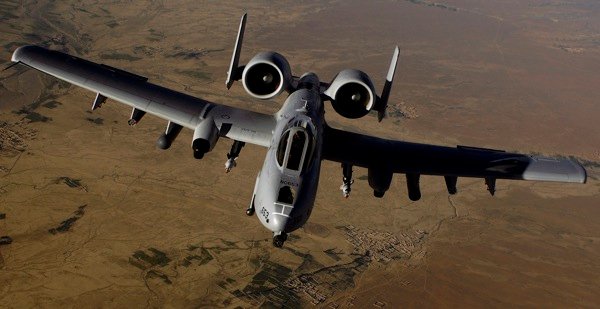
The 1990 Gulf War was a little more, from an air power perspective, than Warden’s largely discredited theories. It saw the first real demonstration of the US’ global air power reach with B-52 missions launched from CONUS; it demonstrated the rift between USAF and USN where the only common ATO format was printed paper; it validated the role of CAS aircraft like the A-10A, to the immense disgust of the fast jet fraternity; it proved the value of SEAD as a key enabler and tactical alternative to low-level strike e.g. the RAF Tornado airfield attacks on Day One; it saw the advent of stealth and practical information technologies; and it saw the birth of the myth of surgical warfare….

Questions

1. Warden & the self contained air campaign – is it now possible for air power alone to force a favourable conclusion to any conflict?

Only as an exception to proven rules. The number of times where air power alone had a strategically decisive effect on the outcome of a conflict could be counted on the fingers of one hand:

The Doolittle Raid which provoked strategic stupidity (Midway) on the part of the Imperial Japanese Navy.

The Battle of Coral Sea which ended the Japanese advance south.

The two USAAF atomic bomb missions against Japan.

The Berlin Airlift was the first major Cold War confrontation and proved Western resolve to stand up to Uncle Joe.

The Linebacker II campaign which lead directly to the settlement under which US forces withdrew from South Vietnam.

2. Warden sees wars as essentially discourses between policy makers on each side. Is the implication that all actors are rational and will achieve rational results, a valid one?

There is not much evidence to support any proposal that any aspect of human behaviour is governed by rationality. Discourse between policy makers is diplomacy, not war.

3. The mind of the enemy and the will of his leaders are targets of far more importance than the bodies of his troops. Does Warden differ from Clausewitz with this assertion?

No. Warden’s ‘theory’ is nothing more than the popular interpretation of Clausewitz’s Trinity (government, people, military; or, for the COE, leadership, people and action arm) with icing on it but not adding much of anything new. Warden’s take on this has been described as “…if you hit enough things with a hammer, eventually there will be a reaction…” i.e. Warden’s application of force in Gulf War 1 was not a precise surgical application of force and there is yet to be any connection shown between the ‘Warden’ campaign and the eventual eviction of Iraqi forces from Kuwait. On the other hand, the systematic obliteration of those forces and those in southern Iraq was definitely a key factor in the Iraqi withdrawal.

Ultimately, an history bears this out time and again, it is the will of the leader(s) than is the ultimate target and determinator.

4. Did a special set of political circumstances allow the Gulf air war to be so seemingly successful?
Not really. Gulf War 1 was the first real information war when a large part of the conflict was ‘fought’ on the television screens of the world. A disproportionate amount of coverage depicted the socalled surgical strikes; considerably less was devoted to the proportionally more attritive air campaign conducted against Iraqi land forces in and around Kuwait.

If so, would it be wise to draw universal conclusions from it?

No but unfortunately, many did, adopting as doctrine (or maybe dogma?) that a clean surgical war was now possible. After the air power false triumphs in Bosnia and Kosovo, this culminated in the ‘shock and awe’ campaign that opened Operation IRAQI FREEDOM in March 2003. Eight years down the track, this misperception still exists although with reduced popularity and it is currently being disproved again in Libya. It may be that Ghaddafi reads and applies more air power doctrine than NATO…

5.  Do Warden’s theories as employed in the Gulf War only have application in state-on-state conflict?

If ‘If you hit something often enough, it should break’ is the theory, then, no, it can be applied more broadly; whether it will be any more effective than it was in 1991 though is debatable. It would more doctrinally sound and have a greater chance of success to stick with targeting Clausewitz’s attributed trinity: leadership, people, action arm.