Remember…

Courtesy of DoctrineMan!! Like Pearl Harbor…a day that changed all our lives and set the world on a new course…no doubt lots will bleat about about the super-hero imagery…but the US is still like Ghostbusters: when it all hits the fan, who ya gonna call…?

Also courtesy of DM, a sad note that actor Cliff Robertson passed away today, aged 88…veteran of greats like PT-109, 633 Squadron, Brainstorm,  and Too Late The Hero

One of my all time favourite movies and books – the first one anyway – maybe, after The Dambusters, Peter Jackson will remake this, especially now that it looks like we will have at least one flying Mossie down here soon…
 

The application of FM 3-24 principles and success in COIN

Staying up lat-ish last night to watch Torchwood: Miracle Day when I knew I had a 0300 start this morning was probably not the best idea I ever had but, like many, things, it seemed like a good idea at the time and I know that if I record something I only rarely go back and actually watch it…

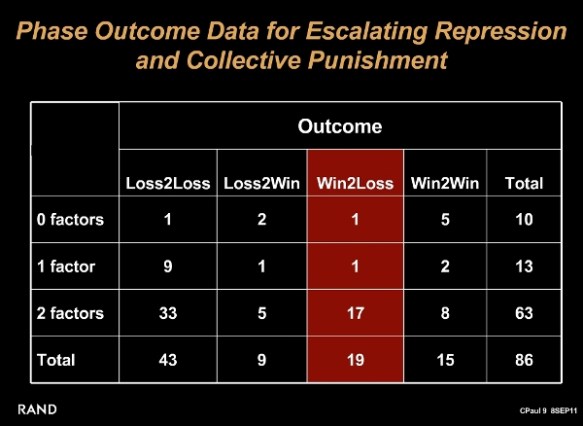
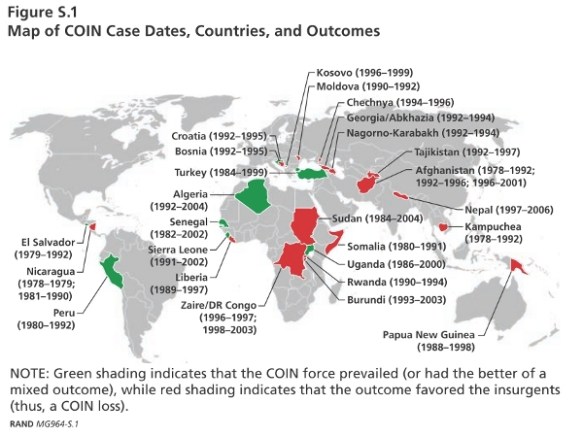
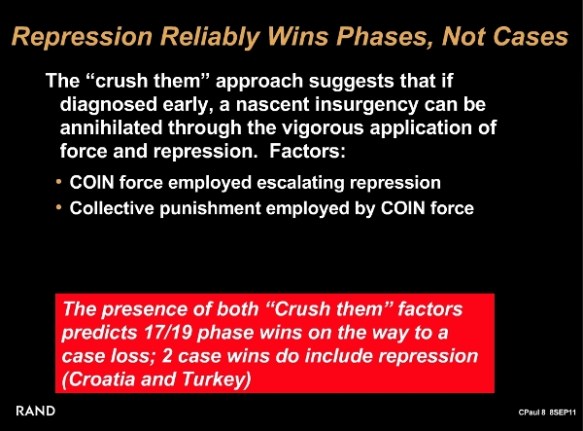
It’s still very dark outside and the webcast from the COIN Center at Fort Leavenworth has just ended…the topic for discussion this morning related to principles identified in the RAND study Victory Has A Thousand Fathers and their application to FM 3-24, specifically from the perspective of what an updated FM 3-24 might include.

I really don’t like Victory Has A Thousand Fathers – the idea is good: to study historical COIN campaigns and determine what truisms or principles can be derived from those campaigns.  This, I believe, is a necessary and long overdue step in the development of useful doctrine for the contemporary environment as for too long there have only really been two dominant schools of thought in this area:

  • The false prophets of Malaya who fail to truly understand that campaign and whom only glean the most superficial principles from it, namely a misapplied emphasis on ‘hearts and minds’, and who ignore the context in which that philosophy was applied and how it was applied.
  • The COINdinsta who forget that FM 3-24 was a seminal, timely and truly useful publication – for the situation that the US faced in Iraq, in 2006 and 2006. It has limited applicability as writ for dogmatic application in other campaigns.

Although I agree with the findings of Victory Has A Thousand Fathers as briefed this morning, they are weakened by the paper’s overly narrow and selective focus:

  • The scope of the study is restricted to only 1978-2008, omitting the post-WW2  ‘golden age’ of counter-insurgency and many other critical campaigns of thus nature. While there would have been a need perhaps to keep the initial sample size to a manageable number, this arbitrary period omits a large proportion of relevant campaigns.
  • The list of COIN campaigns 1978-2008 is somewhat limited: missing are any of the campaigns fought in Southern Africa in this period, as are those from the Middle East including Israel v Palestinians, and Iraq v Kurds;  East Timor is not listed, nor is the campaign in Southern Thailand – while it is flawed in other ways, at least both of these campaigns appear in David Kilcullen’s The Accidental Guerrilla.
  • Kiwis and Australians will be surprised to see that Papua New Guinea 1988-1998 which must be the Bougainville campaign is listed as ‘red’ i.e. a failure for the host nation government. The island of Bougainville is still very much part of PNG and that the world has heard little from that part of the world since the withdrawal of the monitoring force in 2002, is a testament to the effectiveness of that force 1998-2002.

The principles for COIN derived from Victory Has A Thousand Fathers were on slides that I missed during the discussion (too slow with the screen grabs) so I’ll cover those in a couple of days once they are posted on the COIN Centre events page.  What follows are some of the other insights from this morning.

There is a case for the use of force in Irregular Warfare but first, let’s stop calling this COIN. As we know, COIN is a very specific and very narrow slice of the broader realm of IW: the continuing abuse of the term ‘COIN’ to describe operations in the contemporary operating environment unhelpfully muddies the waters. Specifically. these slides discuss the repressive use of force but we need to consider this just as much as we have to consider the other side of the pendulum that it’s all about being nice to everybody.

One of the most refreshing things about FM 3-24 during our review of COIN doctrine in 2007-08 was that it acknowledged the need for use of force within a campaign, a most realistic diversion from other nations’ COIN doctrine which was based upon either experience in peace-support operations (whole different ballgame), super-localised internal issues (go Northern Ireland!), or Malaya (myth city). If there was no potential for the application of force, then the military is not needed i.e. the military is not a cheap labour force, nor an easy substitute for the other government agencies and non-government organisations that should be there.

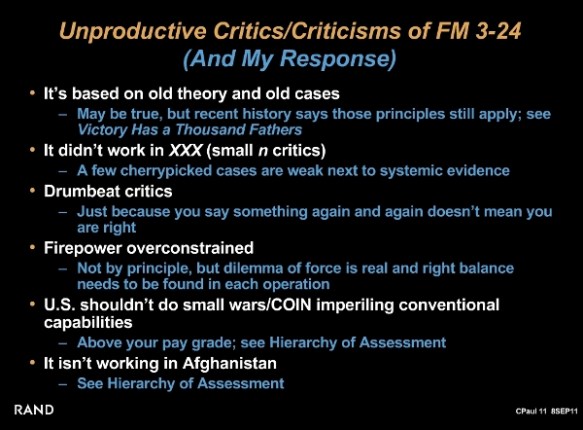
While FM 3-24 does have a strong population-centric element, it was written for a specific campaign (Iraq) in a specific period (2005-6). That notwithstanding, the population-centric elements are well-balanced with other key principles and truisms for irregular warfare and I think that many critics only cherry-pick thos easpects they want in order to criticise and few if any consider the publication as a whole.

This is the Hierarchy of Assessment referred in the last two points:
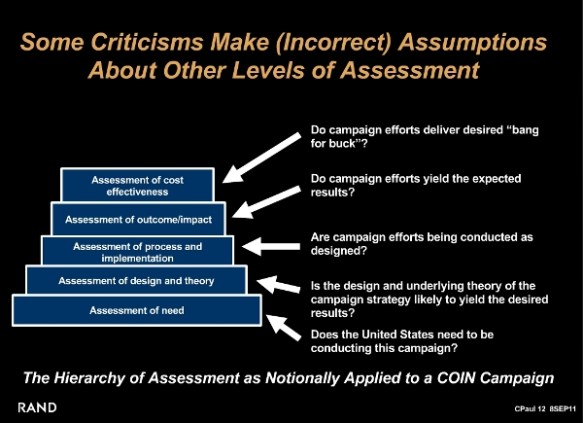
In simple terms, it all comes down to national interests linked to campaign objectives and being able to measure the same; and at the tactical level, specifically, as recommended below,  link development objectives to those campaign objectives and national objectives i.e. no more AID for its own sake. This just creates legacy dependency issues.

One of the questions asked this morning was “…I’ve recently returned from RC-S .  Agree with HNG but it does not to have a national flair to it.  If a specific district enforces the govt rep there, the HNG should be deemed endorsed…” This is the real rub in Afghanistan where the role and legitimacy of central government are in an entirely different context to that of Iraq. Shifting the emphasis for effective government from a central to a district government focus can produce strong district/regional government but usually at the expense of the central government. But then as we discussed in the opening day of the IW Summit in May, a ‘horses for courses’ approach to Afghanistan might find that a federalist system of strong provinces and weak central government might be the best for Afghanistan – after all, it seems to have worked OK for the last two millennia…

As the US Army and USMC gear up to update FM 3-24, the time is ripe for some robust discussion on the content of its next iteration. Most definitely the sections of air and maritime power need to be expanded and updated. The forum for thoughts on this topic is at the COIN Centre Blog….

The earth moves

The US Parks Department reported some minor cracks on the pyramid at the top of the 555ft monument. Photograph: Chip Somodevilla/Getty Images

The unknown and unexpected is always scary…as we have learned this year, the Richter scale is very relative to proximity and depth so 5.9 could ‘mere’ or ‘frightening’ – if unexpected, more so in an area not noted for its earthquakes, probably closer to ‘frightening’ especially if in buildings without windows and/or a long way up…my favourite balcony near the top of the Holiday Inn Rosslyn doesn’t seem quite so appealing now…

Irregular activities needn’t be man-made nor that destructive to be destabilising…to sow that seed of doubt in things that only minutes before may have seemed safe and secure…to wonder what will be next (it’s probably named Irene!)…now is probably a good time to consider some bottled water and canned food (and a can-opener) for the basement and you really never do know…

A couple of elements of light humour though, from the quake, courtesy of Michael Yon…

Breaking News: it’s just been established by the administration that the DC earthquake occurred on a rare and obscure faultline, apparently known as “Bush’s Fault”.

Got an email from a friend that the Pentagon evacuated, and I see reports saying the same. Get back to work you Pentagon shammers! If the military panics, everybody panics. The Pentagon took a direct hit from an airliner and is still there. The Japanese will be laughing at the Pentagon. Get back to work you bunch of Pentagon ninnies. We have wars to run.

So while West Coasters might laugh, much as we all sniggered at Auckland’s ‘No lattes were spilled‘ 2.78 attempt, this was a very real fright in the supposedly stable DC area and will cause some ongoing inconvenience as buildings are checked for structural damage and robustness – better safe than sorry…

Who dares…

Have been offline since leaving home yesterday morning for a weekend in the big smoke…it was only a chance meeting of an old friend at the Expo this morning, ironically while chatting about Patient Tracking systems, that I learned that a member of the NZSAS team in Kabul had been fatally wounded during a rescue mission…

Our condolences to CO, officers and all members of the unit, another fallen in the line of duty, doing the business…a reminder that this is a dangerous but necessary business…

When Good UAVs Go Bad

I came across this article this morning, courtesy of the Marine Corps Gazette’s Facebook Page; it’s titled UAVs’ next challenge: Bad guys shooting back [PDF: UAVs’ next challenge – Bad guys shooting back] and I thought that it might offer some interesting perspective on counter-UAS philosophies…

Counter-UAS is an area that hasn’t got much press yet as the last three decades of growing UAS use, back as far as Israeli’s excursion through the Bekaa Valley in 1982, have all been in very benign airspace conditions where almost without exception, any air defence has been ruthlessly snuffed from the missionspace. But sooner rather than later, we will have to come to terms with various means of countering the West’s UAS advantage…

Unfortunately, the article doesn’t deliver and is a disappointing rant about how the nasty old USAF is holding back the rest of the world from autonomous freedom by selfishly insisting that its next bomber at least have the option of a human crew. I mean, who do they think they are? Autonomous strategic weapons have been around since the days of Snark, Mace and Pluto so what’s really that new about it? Didn’t we have those cruise missiles in DESERT STORM that were so smart as they rocketed down the empty boulevards of Baghdad that they obeyed the road rules..?

Well, I guess, maybe one of the key differences between those systems and manned bombers since the 1930s is that you can always turn a manned bomber around; a manned bomber can also, by virtue of the squidgy bits sitting up front, think for itself if someone forgets to pay the datalink account this month…

To state “…where you might be able to develop a new UAV quickly, in relative terms, an optionally manned bomber will be a good bill-payer for years, requiring all the time, money and effort of a human-operated airplane. Look how long it took, and how much it cost, to develop the B-1 and B-2…” and  imply that either of these systems took as long and as much money as they did because they were manned platforms, and that the main driver behind an optionally manned bomber is its cash-cow-ability, is simply dishonest.

The simple fact is that, in comparison to a manned aircraft, even the smartest UAV today is still pretty dumb – even the pathological mono-focus of The Terminator’s Hunter-Killers is a long way off, let alone the true learning ability of Stealth‘s EDI – in the meantime, the squidgy bits, in the air or on the ground, offer the best option not just for smart weapons but smart, devious and cunning weapons…

Ethics and Legal Implications of Military Unmanned Vehicles

Someone sent me a copy of this document for review…it’s a bit dated but got me thinking on some issues…

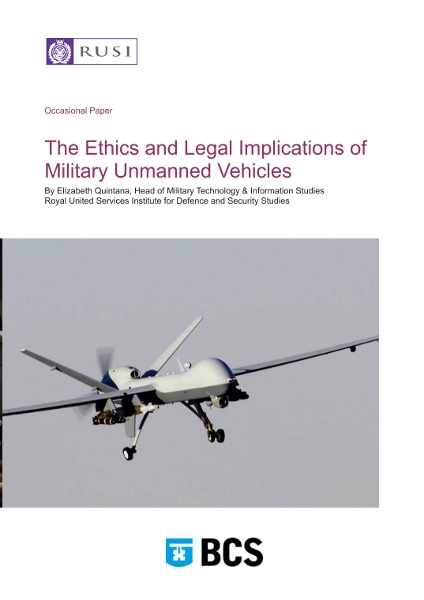
The Ethics and Legal Implications of Military Unmanned Vehicles by Elizabeth Quintana, Head of Military Technology & Information Studies,  Royal United Services Institute for Defence and Security Studies, 2008?

I’ve had to question mark the date as there is no actual date in the document except for a couple of references to the RUSI Ethics and Legal Implications of Military Unmanned Vehicles Conference in February 2008. The RUSI website lists it as 27 January 2008 even though the conference did not occur until February. It’s unsure whether this is just untidy publication or indicative of an aspiration that the document has a more enduring status.

While released under the RUSI umbrella, the document is actually produced by the British Computer Society (BCS) which not recognised as a major influence or actor in either the unmanned vehicle nor the ethics or legal communities.

Although presented as an ‘Occasional Paper’, there are numerous gaps in descriptions of unmanned vehicle development and this  is more a compilation of material presented at the conference and not a consideration of relevant issues across the spectrum of unmanned vehicle development, capability and operation, or encapsulating potential ethics and legal issues other than those presented.  I think that this is slightly dishonest and indicative of the ‘publish or perish’ and ‘quantity over quality’ philosophies that dominate in some of these NGO centres, agencies and institutes.

There is some discussion of unmanned ground and maritime systems in what is probably a timely reminder that there is more to unmanned capabilities than just the high profile aerial system that get 90% of the coverage. This is pertinent as forces consider their approach to unmanned capabilities. Much of the information on unmanned systems is out of date which is probably more indicative of the rate of change and development in unmanned systems than any fault of the document’s authors.

The ethics section is rather generic and speculative and I do doubt just how much engagement those responsible have had with the actual various unmanned vehicle communities especially on the operating front. It’s been my experience that there is considerable and very robust discussion within such communities on these issues. Again, much water has gone under the bridge between Feb 08 and the present day in this area as well and so much of the content is dated.

Some contemporary unmanned vehicle ethics and legal issues worthy of discussion might be…

…at what point do civil airspace rules become overruled in favour of a greater good, especially for HADR operations?

As general rule, civil airspace rules in the western world are risk-adverse and preclude operations of UAS outside of tightly controlled areas of restricted airspace. The track record of UAS involvement in mid-air incidents is very good and even with the higher attrition rate of unmanned versus manned aircraft, UAS still have to even come close to the death and damage rates arising from manned platform incidents.

…the belief that UAV strikes, especially across national borders, are somehow different from the same strikes conducted by manned aircraft.

There appears to be a strong element of Pollyanna-ism, aka ‘she’ll be right –ism’ down-under, that so long as a strike is delivered by a UAV, the accepted rules of international conduct i.e. respecting inconvenient things like national boundaries, international and domestic law, etc, do not apply. How might this apply in the backyard of the South/South West Pacific?

…defining the lines for combatants when key actors are based half a world away outside the mission theatre.

In his January 2000 novel, The Lion’s Game, Nelson De Mille describes an Libyan operation that targets the surviving crews of the F-111s employed in Op ELDORADO CANYON, the 1986 strikes against Libya. A recent C4ISR Journal article raises the issue of whether  US UAS operators conducting ‘remote split operations’ (RSO) from the continental US are subject to the same targeting protocols as pilots (or other military personnel) actually in-theatre. Clearly military personnel in an airbase environment like Kandahar or Bagram are as targetable as personnel conducting operations from Sigonella in Italy against Libya; but what of the US-based MQ-9 pilot driving home to suburbia after a shift conducting strike/CA operations over Afghanistan, Iraq, Libya or Pakistan…? Do such personnel cease to be targetable when they drive off-base…? Would it be unethical or morally wrong for these personnel to be targeted – the West seems pretty comfortable taking the war to where its enemies live…?

Even though this document has a number of flaws and is somewhat out of date, being over three years old, it serves a useful purpose as a ‘firestarter’ for professional discussion on the ethics and rules of not just unmanned vehicle operation but also for the broader complex contemporary operating environment.

Getting it….

Not getting it…

One of my ongoing beefs with ‘modern’ COIN is the misperception is that successful COIN is all about being nice, of waging war without casualties (although casualties amongst one’s own soldiers appear to ‘OK’), and this great expectation that one day ‘the people’ will just rise up, out of gratitude for the niceness shown them by the security forces and cast out the insurgents…

The simple fact is that this ‘doctrine’ is all lala-land, cloud cuckoo vunderland fantasy. That’s pretty much the theme of Wilf Owen’s article in the Spring 2011 edition of the British Army Review (I’d post a link to BAR but it seems that it is a highly classified publication and not one suited to easy intuitive location via the Power of Google), titled Killing Your Way To Control. [PDF: bar-151-killing-your-way-to-control2] He takes particular issues with statements like

Effective counterinsurgency provides human security to the population, where they live, 24 hours a day. This, not destroying the enemy, is the central task. (from Kilcullen’s The Accidental Guerrilla)

Unlike in general war, the objective is not the defeat or destruction of the enemy, but neutralisation of a threat to stable society. (from JDP 3-40)

And guess what? He is absolutely 100% correct! Was it Douglas MacArthur, addressing the cadets at West Point, who said something like “Your duty is clear and inviolate: to win our nation’s wars”? Something about “Victory, always victory”? Even if victory might mean achieving your objectives on your terms as opposed to victory always equating to absolute, grinding under the steel-shod boot, unconditional victory…

Use of the military is, should be, the final option in execution of national policy to achieve national objectives…because it is brutal and unpleasant – and effective when employed properly. The military should be used when other instruments in the DIME construct are not effective. That is not to say that once the military deploys, the rest of DIME takes for some time out; it just means that the lead agency has changed.

And what is it about the military that both makes it an option of last resort and one so effective? Simply…the use of force…brutal force, whether blunt or surgical, but brutal none the less because force can only be brutal. Who talks about let alone attempts to develop and  apply ‘nice’ force? And this is Wilf’s point, and, for an irregular environment,  encapsulated nicely in the extract he selects from the UK’s 2005 Land Operations

Neutralising the insurgent and in particular the leadership forms part of a successful COIN strategy. Methods include killing, capturing, demoralising and deterring insurgents and promoting desertions. This is an area in which military forces can specialise and should be a focus for COIN training. The aim should be to defeat the insurgent on his own ground using as much force as is necessary, but no more.

Now we know that there are times, especially immediately following an intervention and lodgement when the only people who can realistically maintain and provide essential services like power, water, electricity, sewage and security are the military. Forget about some imaginary gendarmerie with shovels that will miraculously appear and relieve the military of such onerous and unpleasant tasks…never happen…

Nor is anyone saying that forces optimised for high-end force on force  major combat operations can successfully instantly reconfigure, collectively and individually, into an irregular warfare scenario. If there was one myth that was majorly debunked in the last decade it was the “If you train up (for MCO), you can easily step down (for COIN)”. Thus, a choice must be made between a dual force optimised one side for MCO and irregular warfare on the other: just to be real clear, two forces – NOT one size fits all; or a deliberate acceptance that one’s forces will only be capable of engaging in one form of conflict OR the other. Most nations forced towards the latter choice will probably tend towards a specialisation in irregular warfare up to a limit of national capability on the spectrum of operations.

And while the logical threads in population-centricity unravel, this does not mean that the military should isolate itself from ‘the people’. GEN Petraeus was right in Baghdad in 2006 when he brought the troops back in amongst ‘the people’ and ended the daily tactical commuting/sallying from the FOBs. The military is not some horde to be hidden away – if ‘the people’ is where the adversary(s) are, then that’s where the military should be – configured and trained for the application of force in that specific environment just as they would/should be for any other unique environment.

And on the spectrum of operations…let’s not forget that it is NOT the linear progression from peacetime to all-out warfare that is it portrayed as…a more accurate model would have peace in the middle, surrounded by a ring that includes peacetime engagement (a smidgen up from peace), peacekeeping, peacemaking, irregular warfare, HADR, limited war (e.g. the Falklands War), major war (DESERT STORM, OIF Part 1) and full-on all-out war (Red Storm Rising).

Imagine that ring being like a trembler switch (who didn’t used to watch Danger: UXB or The Professionals“Steady, it’s a trembler!”?) from which a nation can flick from peace to any state around that ring, and from that state then flick to another and another or back to the stable centre. Accepting that there are two clear extremes, peace and all-out war, most nations would assess the planning for one, peace, carries too much risk as it would naïve to expect peace to remain constant in the most benign scenario. Similarly few nations can afford to truly step up to the full range of capabilities required for the other extreme. Thus most opt for a point in-between.

But regardless of where that point may lie, the primary role and output of that national military force is the application of force. That is why the lead group in the Air and Space Interoperability Council is the Force Application group, with six important but supporting groups. That is why, in the continental staff system, the staff branches are NOT all created equal – operations leads, supported by whatever combination of numbers floats your boat – whoever heard of logistics or intelligence supported by operations? That is because the ops branch is all about creating and delivering effects – and the effect that the military delivers best…is…force.

So you might imagine just how it felt as I scrolled through my ‘most recent’ view on Facebook to see the link to Wilf’s paper first from DoctrineMan! (still not sure about people who include punctuation in their name) and a ways further down, the original post at Small Wars Journal.  Even more so when I realised that Wilf, who I have spent more time at Small Wars disagreeing with than ever agreeing, had authored it.

What was disappointing was the number of people on both DoctrineMan! And Small Wars fixated on pulling every literal point of contention from the article. I was sadly reminded of the 45k+ morons who ‘liked’ the Boycott Macsyna King Book page; or the moral minority who all ‘just know’ that Casey Anthony killed her daughter and that there was no need for all that legal due process stuff: let’s just string her up!! I wonder sometimes if western society is descending to a point where the capacity for independent thought is lost…and we all just become drones circling the brightest, loudest light…

The irony in his article that he does not point out is that while British Army doctrine in 2005 included the quote above from Land Operations (now that I think about it, I was working at Uphaven on CLAW 1 when it was released and got to bring the first copies back home), this was the same period that the UK was trumpeting the success of Malaya and the triumph myth of ‘hearts and minds’ that set irregular warfare back decades. If only the UK had read and applied its own doctrine… (What’s that? You read doctrine? And apply it?)

So where does this leave us? Wilf has articulated what we have probably known along, what the dead Germans told us is right, that the military is about the application of force, not the application of ‘nice’, as an extension of policy. That force may be applied to create the conditions where others can see to the building of a stable society, hopefully where such existed at some stage before; equally as much it may be applied to simply attrite an adversary to the point where further resistance is either untenable or impossible.

But, harking back to the dead Germans again, the ultimate target for force is one specific part of what is popularly accepted as the Clausewitzian Trinity: of ‘the people’, the action arm and the leadership of any collective entity, military force ultimately targets the leadership to either eliminate it as the driving force behind the organisation, or convince it to consider and change its ways. That’s what the military is for….

Breaking Silence

In Get Smart, this was funny…

The zone of silence put up by the Kahui and King families around the deaths of the three-month old Kahui twins in 2006 is not.

Debate has raged this week over the proposed publication of a book, Breaking Silence, based on the recollections of the twins’ mother, Macsyna King, and authored by locally well-known conspiracy theorist and wannabe whistle-blower Ian Wishart, described in one contemporary blog item as

…writing investigative books about spaceships piloted by lock ness monsters that are really demons disguised by Satan to implement global control via global warming legislation because global warming is a hoax created by the Free Masons told what to do by a Greenpeace lesbian Trans Gendered Queen who secretly runs the world…

He’s probably not that bad but having read a few of his Investigate magazine articles, there is some substance to the description. That notwithstanding, he fronted up and presented very well on RadioLive this afternoon with Willie Jackson (JT opted out due to previous ‘issues’ with Wishart – what a woossy).

The catalyst for this debate is a Facebook page Boycott the Macsyna King Book that seeks to ensure that

…Somebody like this should not be allowed to profit from preaching her perverted view of the horrific events which led to the deaths of the only two children who hadn’t already been taken from her by CYF’s…

At the time of my writing 45,911 people have ‘liked’ it on, although I do note that in the last couple of minutes at least one of my friends who had ‘liked’ it had dropped off the list…common sense starting to break out perhaps? To my mind, that means that there are at least 45, 911 Facebook members who are a guilty as the King/Kahui family of sustaining that wall of silence around the deaths of these children.

Now let’s get some facts down-range…

No one has been convicted of any crime relating to the deaths of the twins. I have no doubt that someone should be convicted not just for the deaths but also for the neglect of the babies prior to their admission to Starship Hospital and for obstructing justice after their deaths.

It is a big step from 45, 911 morons ‘knowing’ that Macsyna King is directly responsible for the deaths of the twins i.e. she ‘did it’, to having the evidence to prove that beyond reasonable doubt in court. Last time I looked, the mob DIDN’t rule in this country…

While it is illegal for anyone in this country to profit directly from their offence e.g. by publishing a book on it (although Steven Anderson managed to get a couple of grand out of North and South for ‘his’ story on why it wasn’t his fault he killed six people in a shooting rampage in 1997 but N&S is hardly Newsweek…), it is not illegal for anyone, especially before any court proceedings are completed, to comment on that issue in any way they please, including blogs and books, especially if they do not promote or incite hate or violence (I note that Facebook doesn’t appear overly concerned about the threats and intimidatory statements and attacks on the Boycott the Macsyna King Book page).

Pressuring book retailers to not stock the book only reinforces the wall of silence obstructing any ongoing Police investigation of the deaths – yes, that’s right you, 45, 911 plonkers, you’re just as bad, if not worse because the height of your moral bandwagons would indicate that you know better, than the original Gang of Twelve family members that cowered behind their right to silence in 2006 and throughout the investigation.

PaperPlus and Warehouse need to grow a set and stock the book on their shelves lest they become as tainted as the Stoopid 45, 911 – this is a topic of national interest that deserved as much coverage from all quarters so that interest does not die like those babies.

The guy who claimed on RadioLive on Wednesday night, Chris-not-his-real-name, to have set up the page, also claims to have set up the Facebook page for the KFC DoubleDown burger (a work of art in my opinion – the burger not the FB page) that saw national stock of the DoubleDown burger run out in less than two days. This means that he is a. a spin doctor and/or b. a meddling dickhead who has no personal stake in this debate i.e he’s just doing it for shits and giggles. That he lacks the mortal courage to front up under his own name is a fairly good combat indicator to his own personality.

A lady rang RadioLive this afternoon and challenged all the 45, 911 pitchfork and torch crew to donate a small amount to Women’s Refuge or a similar organisation that stands against family violence – if they feel so strongly on this issue. Hey, guess, what? None of those organisations will see the slightest spike in their donations this month.

I don’t buy into or support Macsyna King’s lifestyle up to and possibly past the death of the twins – Ian Wishart says that she has now turned herself around – she has exactly the same right as anyone else in this country to state her case in any legal media she chooses to. She even has the same right to earn money stating her case if people are prepared to part with it. She has not been convicted of any crime, regardless of the 45, 911 loony-toons who just ‘know’that she is guilty – and who would be the first to bleat if their own civil liberties were attacked in this manner.

John Tamihere is playing fast and loose with the law when he incites people to buy a copy of the book, scan it and distribute it online…dumb-arse, going into detail on exactly how people should not do this is incitement…what a hypocrite as he bleated on yesterday about how Ian Wishart had employed equally dubious (but not illegal) journalistic tricks to secure an interview with him (“...but it was off the record...”) – can I call you a dumb-arse twice in the same paragraph?).

Will I buy the book? Probably not, I have no doubt that it will be sold somewhere because there is money involved but it’s not really the sort of book I buy and I’m also kinda ‘off’ buying books at the moment because a. I have such a massive backlog of stuff to read, b. Scale Model Expo is at the end of August and I need to focus, and c. I’m attracted to this EPUB format once local retailers stopping screwing us by selling e-books for the same price (but considerably reduced overheads) and normal hard copy books.

Will I read it if I come across a copy? Certainly I’ll have a browse and see where I go from there…

And a final parting shot to the 45, 911 – you all strike me as the sorts that need to be told things more than once before they sink – if this crime remains unsolved, you need to stand up and accept some responsibility for that…you are nothing more than the sad flotsam of the information age, what Paul Henry described on Tuesday afternoon (yes, he’s back!!) as “…those who are so desperate to be outraged…

Be ashamed…

The Princess Leia Doctrine

(c) 2011 Graham Art Productions

Doctrine Man!’s Facebook page this morning links to a Politico article Robert Gates’s Final Act: Slow Afghan Drawdown

As his final act before leaving the Pentagon, Defense Secretary Robert Gates is working to build support for what he is calling a “modest” drawdown in Afghanistan, even though a war-weary Capitol Hill wants more.

Gates, who retires June 30, is hoping that his 12th and final trip to Afghanistan will help steer the Washington debate subtly away from the number of troops that will come home next month — a figure that is almost certain to disappoint the growing number of Washington critics of the war.

I’m a big fan of Doctrine Man! – and not just because he is a ‘doctrine’ guy (clearly some very very bad karma in a previous life!!) – his ‘life on the staff’ cartoons are great,and  his FB output is not only prolific, but also spurs robust debate. Some of the comments on the Gates’ article include:

 I don’t think we are going to get a choice here. Politically these wars have been milked to death, and I think regular old Americans are actually pushing this. A collective “sick and tired of war” let’s bring them home has settled in. I remain on the fence as to whether it is good or not, but I count myself in the “sick and tired of war”. You know some idiot will start spouting about win/loss war, but we all know it’s just ego. Military did their job, state department failed miserably.

With other examples of leaders making some very negative comments on their way out the door, this is one that can be seen as very consistent with the profile of the man (who, by the way, warned against Libyan intervention). Good stuff.

 However brilliant one might think Gates is, you never hear any of this drawdown talk discussed in the same context with objectives. Either we are saying objectives are unachievable and we drawdown anyway, or we are drawing down for the pure political gain the appearance gives. Either way, the American people need to hear specifically what we are trying to achieve, in clear, unambiguous terms.

Of course, that comes on the heels of being asked (by a planner) what the difference was between tasks and objectives. For the third or fourth time. If deep-seated rage is a symptom of PTSD, then DM probably needs to get checked out.

It would help me be a little more positive about staying if I knew in measurable terms (a) what the desired end-state is, (b) how much that’s likely to cost in death, injury, and treasure, (c) how long it’s likely to take, and (d) where the money is going to come from.

To those who say “this is war, we can’t tell you these things,” I say that we do these kinds of multi-variable plans all the time in the civilian economy; now go back and get us some answers.

Failing those sorts of answers, I’d rather see us stick to the drawdown plan we have — or accelerate it. I don’t want to see one more American service member or NGO person come home in a box or on a gurney than is absolutely necessary and the thing that haunts me most is the memory of those who died in my war while Henry Kissinger and Le Duc Tho were arguing the merits of round table vs. square table in Paris.

Re tasks and objectives, whatever happen to the Princess Leia doctrine “When you broke in here, did you have a plan for getting out?”

The last comment is, of course, mine…I have been a staunch proponent of the Leia doctrine for years and wonder  if, with the fall of Saigon only two years previous to the release of Star Wars, George Lucas was actually slipping in some very insightful commentary on recent history…some ammunition for pub trivia: Saigon fell on April 30 1975, Star Wars was released on an unsuspecting world on May 25, 1977.  His 1973 American Graffitti has clear parallels today of a nation in war but possibly not at war in Vietnam, as perhaps it is today with Afghanistan…

In conducting my typically superficial research for this article (Google is our friend, as is Wikipedia) I was caught by this paragraph from the Wikipedia item on the Fall of Saigon…

Among Vietnamese refugees in the United States and in many other countries, the week of April 30 is referred to as Black April and is used as a time of commemoration of the fall of Saigon. The event is approached from different perspectives, with arguments that the date was a sign of American abandonment, or as a memorial of the war and mass exodus as a whole.

No one can argue that South Vietnam was abandoned in 1975 but it is unfair and inaccurate to label this as solely ‘American abandonment‘ . America was not the only nation involved in Vietnam, nor the only one that walked away…let’s not forget that the only nation that was there to the very end was America…everyone else had just quietly drifted away…With the benefit of 20/20 hindsight, the application of US air power (like anyone else was going to ante up) in 1975 would only have prolonged the pain of and for Vietnam…

Abandonment is also the word that springs to mind when discussing drawdowns in Afghanistan…the true failure in Afghanistan has not been one of tactics or capability but quite simply one of having no clear idea what it’s all about. If there is only one lesson we learn from a decade (come November this year) in a nation that NO ONE have ever managed to pacify over millennia, it surely must be the Leia Doctrine…

Before you go in, have a plan for getting out.

This is such a fundamental of life, NOT just the military…as any teenage boy in his girlfriend’s room knows where he hears her father’s footsteps outside the door…how can it be that it has been purged from our doctrine and our thinking for so long? Of conflicts since the end of WW2, the 1982 Falklands War and DESERT SHIELD/ STORM in 1991 are the only two that I can remember  where the strategic objectives were clearly stated, adhered to and achieved…

And while contemporary planning doctrine may prattle on about metrics and measureables, it rarely if ever links these to decision points and from there to exit strategies. During one of my irregular warfare engagements in this trip, we used an analogy of the campaign plan as a freeway and each off-ramp along the journey being both a decision point and a potential exit…depending upon how well a driver understands where they are going and why, they will consider off-ramps along the way and opt to drive off or stay the course…

It also just struck me that the freeway analogy also works quite well as an analogy for unilateral, alliance and coalition warfare:

When you are the only driver on the freeway, it is quite easy to select your course, speed and direction.

When you are driving with habitual partners of which you normally only have a small number and who all generally sing off the same sheet of music, it’s much the same.

When you have a coalition, all driving with different national rules and customs, most if not all free to join and depart the coalition at will, and many for whom the use of indicators is totally alien, you have potential chaos, traffic jams and pile-ups..

That’s something I will explore further in another item…today’s takeaway is to promote and encourage adoption and application of the Leia Doctrine to hopefully avoid replays of this…

Never again?

Strangelove has re-entered the Building

(c) FPA 2011

As a headline, this one that concludes the Time article  According to new Pentagon cyber strategy, state-of-war conditions now exist between the US and China, was too good to pass up…coupled with this SECDEF quote that Michael Yon put up on Facebook a couple of hours ago, it looks like lunacy has well and truly returned…

Just got this from Office of SecDef

“Secretary Gates believes that for the United States, once committed to a NATO operation, to unilaterally abandon that mission would have enormous and dangerous long-term consequences.

You think he might be talking about Libya? A campaign even more ill-advised than OIF? In all fairness, though, at least America had the courage and integrity to see OIF through as her allies and apparent friends slowly bailed on her…she had done the right thing in withdrawing her foot sharply from the (blood) bath of Libya as soon as it was apparent that NATO was getting the wibbles. That there will be ‘…enormous and dangerous long-term consequences…” is without a doubt but those consequences will be for NATO as it finds that it might have to ante up and see it’s own war through to a conclusion without a US safety net…yesterday I heard for the first time the phrase ‘...NATO’s Vietnam...’

I agree with the theme of the Time article that MAD actually = sanity in that it essentially rendered the irretrievable impossible – so long as we kept Peter Sellers out of the White House…As the Cold War staggered to a close in the 80s, Ronald Reagan declared a policy based on ‘you can run, but you can not hide‘ and indeed authorised and conducted a number of kinetic actions against those he perceived had crossed the line in the sand…

Those however were all kinetic actions against specific kinetic targets to send very specific messages…what targets might a kinetic strike against Chinese cyber-warriors hit…a server in downtown Shanghai or Beijing? The same fibre link that carries the world’s communications and commercial traffic? Some geeky buck-toothed nerd who needs a bath and some dress sense?

One of the biggest and most-frequently stated concerns at the Irregular Warfare Summit here last week was that the takedown of OBL and the (so far) successful drawdown from Iraq is leading to a growing sense of relief at senior levels that the aberration of COIN is over and ‘…now we can get back to real war...’  This ‘real war’ dogma seems to be set in the minds of those who just missed Vietnam and spent the larger part of their careers preparing for World War III – which, if anyone was paying attention, never happened.

Thus, possibly more by circumstance, the leaders in the ‘new war’ (which is really an old war) are those who were on the ground in Iraq when the pendulum was shoved all the way from clean surgical shock and awe to dirty messy complexity and irregularity…names like Petraeus, Mattis, Chiarelli, Casey…to name a few. It’s no accident these names are all from the land forces because this new war, at the moment, is very much land-centric (sorry, air power guys) because that is where the people are…and while I am noted as not being a uber-proponent of population-centric warfare, this war is one between beliefs which live amongst the people and not platforms which can be anywhere…

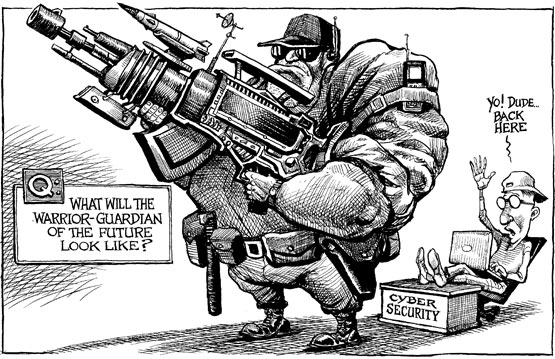
Cyberwar is much the same…there are no clearly-distinguishable platforms at which to strike: it is a game of skill and knowledge not fixed to key infrastructure or platforms,,,that guy next to you on the bus, playing with his iPhone could be a node in the attack network…the ‘enemy’ doesn’t even need to be in their own country which leads to thoughts of retaliation for spoofed cyberattacks against countries that only appeared to be guilty – how many times can a cruise missile accidentally hit the Chinese Embassy in Belgrade…?

Cyberwar is elusive, diffuse and evasive…it’s another facet of complexity and irregularity, warfare conducted by ‘the people’…releasing the kinetic dogs of war on it will achieve no more than ‘shock and awe’ did in Iraq…like any other operating environment, this one will only be conquered by those who get their (cyber)boots dirty and adapt to it…in the mean time we need to THINK a lot more before we commit ourselves to careless policies promising kinetic attack against cyber-strike…regardless of how many cruise missiles and JDAMs might be nearly their ‘use by’ date…

As David Hoffman concludes in The cyber arms race:

The offensive cyber battlefield promises to be far more chaotic than in the nuclear arms race, with many smaller players and non-state actors, and the risks of retaliation against the United States might be quite high. We need good defenses, no question. But should we be fighting back with cyber warheads and real missiles? Are we ready for what could follow? Is there an alternative?