The Myth of Force Ratios as core to COIN

Randomly-selected COIN-themed header pic

“The best way to become acquainted with a subject is to write a book about it. Benjamin Disraeli”  

This little gem was the random quote that WordPress threw up when I published the item on Definitions in COIN and never were truer words spoken – if all we get from the FM 3-24 revision project is a better understanding of the irregular environment (of which COIN is a subset), then it will have been a valuable and useful activity to have participated in…

Today we discuss the second issue paper produced as part of the project…IP2 Force Ratios…This topic really narks me as the presentation of pseudo-scientific mumbo-jumbo (yes, that is a doctrinal term!!) as supportable fact…as you read on, you’ll probably get the impression that I’m not a big supporter of this concept…my comments are in two parts: the first refers to related questions in the original FM 3-24 Revision Questionnaire the responses to which lead to the three issues papers, the second addresses the content of IP2 itself…

Part 1 – Answers to initial review questions

The ratio of counterinsurgents to the population is one of the more oft-cited portions of the current FM. A study by the Institute for Defense Analysis concludes that twenty counterinsurgents for every 1000 residents in the area of operations leads to a 54% probability of success. If, however, the density increases to 40 for every 1000, the probability increases to 83%. Another study by the Harvard Kennedy School,  however, concluded that increases from 5 to 80 troops per 1,000 inhabitants caused the probability of success to increase by less that fifteen percentage points. Most studies caveat 2 results by stating that no level of force density will guarantee success. Based upon these studies and any others of which you might be aware, how should force ratios in the FM be adjusted?

The ratio model is an over-simplistic take on a very complex environment, driven by those seeking a checklist/template solution to COIN/IW. Even if it could be proven that  there is an optimal ratio of counterinsurgents to residents, we would then have to further define structural ratios within ‘counterinsurgents’, even first define what the optimal counterinsurgent is: in Baghdad 2005, the optimal counterinsurgent may be a heavily armed and supported combat soldier, whereas in Bamiyan 2005, it might be a CIMIC specialist. In most COIN/IW circumstances, the wrong type of force could be as damaging to the campaign as too little of the right kind of force.

The force ratio model does also not consider that the probability of success may also decline if the counterinsurgent/resident ratio is too high. The wrong sort of force or wrong ratio for any given COIN environment stands to contribute to creation of Kilcullen’s accidental guerrillas – while the book may have drawn some somewhat dubious conclusions, the concept of the accidental guerrilla is sound.

Should force ratios even be addressed in the FM? 

The force ratio discussion in the FM might be more useful in offering considerations for the internal force structure ratio for a given environment. Either way, the content should emphasise that there is no templated or generic optimal force ratio.

The current FM quotes Galula who posited “that revolutionary war was 80 per cent political action and only 20 per cent military.” The sentence that follows caveats that remark. Does the 80/20 ratio have any historical validity, other than being cited as noted?

As above, defining any ratio is only likely to do more harm than could and will encourage a template/checklist approach to COIN. Of greater importance and relevance is what might comprise, against a given COIN/IW environment the specific political/OGA/NGO and military components of the COIN force.

The key lesson to be derived from the Galula quote is that a successful COIN campaign requires a blend of military and other capabilities. DIME (diplomatic, informational, military, economic) and JIM (joint, inter-agency, multi-national) are commonly accepted constructs for effective campaigning and it is well accepted that there are few if any contingencies that might be addressed by only one branch of the service or by the military in isolation from other elements of national power.

If not, should there be any reference to a political/military percentage in counterinsurgency warfare?

Other than to re-emphasise that long term success requires more than a military solution, probably not: introducing any specific metrics into a publication at this level leads to the template/checklist mindset. The bottom line must remain that each COIN/IW scenario must be considered on its own merits.

One way of leading to acceptance and understanding of this might be to retitle the publication to “The Military Contribution to Counterinsurgency” – this would make it clear from the get-go that there are other aspects than purely military to this form of conflict.

Part 2 – Issues arising from IP2

Recommendation 1. The fact that the force ratio theory was mentioned in the 2006 version of FM 3-24, a publication drafted in some urgency in response to an operational crisis, is not sufficient reason to automatically include it in the updated FM. It is a common occurrence for doctrine developed against operational urgency to be substantially revised on first or subsequent revision. In the Australian Army doctrine development model, doctrine specifically identified as ‘developing’ is meant to be reviewed after twelve months and there is often substantial difference between the initial ‘developing’ version and the more enduring developed version. ‘We’ve always done it’ (in this case only since 2006) is more akin to dogma than doctrine.

The new FM 3-24 not only could work around the perceived constraint in recommendation 1 but it should and this can be achieved by simply noting the lack of any substantive evidence supporting either general forces to population or to insurgent ratios

Recommendation 2. The logic in this recommendation applies equally to identifying members of the population – it is a fair assumption that not all insurgents will be recorded members of a region’s population i.e. that they have deployed into that region because it offers some specific advantage or attraction from an insurgent perspective. Ergo, not all insurgents are locals.

The same logic also applies to determining optimum force ratios within the counterinsurgent forces – as it is often difficult to identify at any one point which is the most effective force structure for a given scenario, the usefulness of any discussion on force ratios, other than to discount the force ratio as a viable counterinsurgency metric or approach, is moot.

Recommendation 3. The same issues mentioned above under recommendation 2 apply to recommendation 3. That only the latest study of insurgency found a correlation between the number of counterinsurgents to population indicates that this theory is still unproven. Neither recommendation takes into account the physical geography or size of the area of operations which may offer a range of advantages or constraints to both insurgents and their adversaries.

Recommendation 4. If this recommendation is implemented, the publication must offer clear guidance on the considerations for determining the optimum force size and structure for any given counterinsurgency environment; and also for determining when that ratio may requirement adjustment up or down. Considering the example given involving host nation security forces, it should alos be considered that the state of those forces will also be a modifier on the optimum force ration e.g. if the host nation forces are ineffective and/or possibly corrupt, then this, regardless of the population size, may modify the counterinsurgency force to population ratio up. Conversely if the host nation forces in a given area are quite effective this may modify that figure down.

Some guidance on the granularity of the force ratio must also be given if these recommendations are adopted i.e. does the force ratio apply across the whole operating environment, across individual AOs or units, or across just the most contested areas?

Recommendation 5.  The proposed paragraph 1-67 promotes the employment of what remains an unproven theory that simply has too many variables to add value. The proposed paragraph 1-68 on its own provides adequate guidance on force ratios in counterinsurgency. Notably it offers no guidance as to the ‘optimum’ force ratio and leaves this to be determined by a robust planning/campaign design process which is where it should lie.

Bottom line: there is no templated shake’n’bake solution to force structures for COIN – each force must be generated against the specific environment that it is going to operate in….there is no substitute for victory thinking….

Definitions in COIN

Randomly-selected COIN-themed header pic

In December 2006, the US Army and USMC co-published FM 3-24 Counterinsurgency, a publication specifically intended to align US forces with the needs of operations amongst ‘the people’ in Iraq. Some of the ideas were new, others harked back to well-established truisms from the eras of Vietnam and Malaya – the aim was a decisive shift in how US forces conducted themselves in the new operating environment where force and ‘the big stick’ weren’t the ultimate arguments.

The COIN Center at Fort Leavenworth is now taking the lead in a two year project to review the content of the original FM 3-24 and update it as a tool for less-specific i.e. not Iraq, operating environments. As part of the project, the Center is seeking comment from a broad spectrum of stakeholders and interested parties and thus is conducting a large portion of its work in the public forum. From this part of the world, that means some odd hours to participate in the regular webcasts that discuss aspects of the project but it is well worth the lost sleep.

The Center has produced three Issue Papers on key aspects of the publication – these are available on its public website – and over the next while, I’ll share my thoughts on those issues…IP1 is Definitions

Accepting that irregular warfare is sufficiently different from conventional conflict to warrant specific definitions and doctrine, possibly the first question to be considered is whether insurgency is sufficiently different from other subsets of irregular warfare to require specific doctrine and definitions i.e. would targeting irregular warfare as the primary subject also satisfactorily cover insurgency as a subset of IW?

In examining the definitions under paragraph 3 of IP1, the answer is probably ‘yes’ and of all the definitions, the French one is probably the most accurate, closely followed by the Spanish and USG definitions if they dropped the word ‘political’. The key elements of the environment that FM 3-24 seeks to describe are the use of armed conflict/guerrilla warfare/terrorism and the objective of control. Whether that control is political or other is largely moot as the net result is control over a geographic area and/or a group of people.

Recommendation 1 could read “That the US Government should adopt a single definition of Irregular Warfare, of which insurgency is a subset”; this renders a specific definition of counterinsurgency moot. Considering that the ultimate objective of a campaign to counter irregular warfare is stability, it may be that the countering definition comes closer to stability operations that it does any other type of operation. This, of course, would lead to a review of more fundamental doctrinal principles, in particular whether stability operations are actually distinct from offensive and defensive operations per se, or whether that distinction is more from major combat operations or conventional operations e.g. the Fulda Gap.

With reference to paragraph 4, this argument is moot and largely doctrinal semantic hair-splitting unless there is some previously unrecognised body of knowledge proving that all the types of IW conflict listed under that paragraph are uniquely and distinctly different from insurgency and that the responses to those forms of conflict are equally uniquely and distinctly different from those employed to counter insurgency. I would offer that they are probably not and even postulate that it would not be uncommon for two or more of the forms of IW to exist in the same theatre. The finding that “…the approved definition should distinguish  insurgency from the types of conflict listed [below paragraph 4]…” i.e. recommendation 2 is incorrect.

Recommendation 4 is correct in not recognising the use of the term ‘grievances’ which immediately leads to a ‘righting wrong’ mindset. While the definition of counterinsurgency gains little from incorporation of ‘root causes’ into the actual definition, it is rather dismissive of ‘root causes‘, as an element of any campaign countering insurgency. The simple definition of counterinsurgency is “those steps and measures employed to counter insurgency” and care must be applied to ensure that the definition does not prescribe or imply the specific steps and means of countering insurgency – these should be defined and refined in the substance of the publication itself.  Thus the definition of counterinsurgency is less important than the definition of insurgency i.e. there is a whole publication in which counterinsurgency will be defined, but this will only add value if the core definition of insurgency is ‘got right’. Our broader concern is that such sentiment will shape the content of the publication itself.

Caution should be applied, however, in dismissing ‘root causes’ from any approach to counterinsurgency. Cause should be considered in its classic causal sense and not in the narrower context of a political or other cause. To not consider root or underlying causes in an insurgency environment promotes the apparently practical and reasonable mindset that there is such thing as a successful military approach to countering an insurgency i.e. good versus bad, us versus them, friendly versus enemy, defeat the enemy. Even if the action arm (translating Clausewitz’s three elements of a problem into an IW environment where the government, the armed forces and the people become the leadership, the action arm and the people) of the insurgent elements is defeated, it is almost bound to rise again if the underlying causes, be they political, criminal, economic, egotistical, etc are not addressed. An underlying issue is clear in the five examples of ‘non-compliant’ insurgencies listed under recommendation 4.

A cynical exception to this would be where it is necessary to temporarily defeat or suppress an insurgency as an enabling action for a higher objective i.e. national objectives, and where upon attainment of that objective the course of the insurgency is no longer a national concern.

Recommendation 5 is a little misleading. I agree that the term does not need to be included in the definition of counterinsurgency but for the reasons stated above in regard to not including ‘root causes’ in the definition i.e. that this specificity is not necessary in the definition where considerations for and approaches to counterinsurgency can be discussed at length within the text of the publication – assuming that the actual definition of insurgency is ‘got right’. The broader concern is that such sentiment will shape the content of the publication itself.

However, recommendation 5 as a whole implies that it is possible to successfully prosecute a counterinsurgency campaign without employing a comprehensive/JIM (joint, inter-agency, multi-national) approach. Unless the objective of the campaign is short-term suppression or stability to enable a higher objective, one would be hard-pressed to find too many examples from history of successful counter-insurgency or broader irregular warfare campaigns that have relied on a solely military approach; in fact, it is likely that historical review would find that most conflicts of any nature or scale have required a broader engagement for ultimate success. Identifying a comprehensive or JIM approach as the optimum method to a counterinsurgency campaign does not commit one to automatically have to seek or comply with the full scope of the JIM model; it definitely would not “…result in the US not being able to declare that it is countering an insurgency unless all organization types are involved…” This is the checklist/template approach to counterinsurgency and irregular warfare, in fact to all forms of warfare, that is an inadequate substitute for critical thinking and consideration of each conflict challenge in its own right.

I only have two comments on the actual proposed definition of insurgency. The first is that the word ‘minority’ should be removed as its use implies that only minority groups can conduct insurgencies. The insurgencies in South Africa and Rhodesia, and the current situation in Fiji (although only instability, not insurgency) are examples of majority groups that have initiated insurgencies or that have the potential to do so. The second is that ‘de facto’ should be removed as a descriptor for the at risk system of government due to its ambiguous meaning as either ‘genuine’ i.e. legitimate or ‘actual’ which could possibly be taken to refer to an effective shadow system of government competing with the actual system of government. Consideration could be given to replacing ‘de facto’ with ‘legitimate’ to recognise that the initial point for any campaign of this nature is probably in support of the existing government (where such exists) however this brings with it other issues. It is not considered that, for the definition, system of government requires any qualifier and that any issues of governing relating to a specific operating environment should be identified and considered in the early stages of campaign planning.

I have no major issues with the definition of counterinsurgency however it is rather wordy and the list of adjectives preceding ‘actions’ appears contrary to the concerns expressed in recommendation 5 regarding the perceived risks of prescribing solutions if the word ‘comprehensive’ was to be employed. It could more simply expressed as ‘Those actions taken by military and government agencies to defeat insurgencies’. The qualifier of ‘civilian’ for government agencies is a given with the existing qualification of ‘military and’, and, in any case, it creates a grey area for the employment of paramilitary forces which might be considered neither truly military nor truly civilian. The rationale behind including ‘over a protracted period of time’ is understood however it creates at the highest level of doctrine a perception that all campaigns will occur over a protracted period which while the most common occurrence, may not always be the case, especially if as above, the campaign seeks short-term suppression of an insurgency to enable a higher objective to be achieved. The use of ‘of time’ after period is also redundant: period by definition is ‘of time’.

I think that it is vital that we get the doctrinal and semantic foundations of this publication right – to not do so leaves layers of potential ‘get out of jail free cards‘ where a situation may not meet the specific nature of ‘insurgency‘ as defined in this publication and those that refer to it. Inherent in this is to break COIN away from the self-licking ice cream and commercial cash cows that it has become over the last decade and to set it in its right place under the general mantle of irregular warfare….

Next time…IP2 Force Ratios

Weekly Photo Challenge: Hope

Off the back roads of faith and onto the super-freeway of hope....

Had to think quite hard for this (actually last) week’s photo challenge until I stumbled across this memory from Exercise VELVET TOUCH which deployed a large chunk of the Army and Air Force from respective bases to Stewart Island (drive to the bottom of the South Island and keep on going) which, it was felt would offer some more practical challenges than the more routine drive to Waiouru or Tekapo training areas…

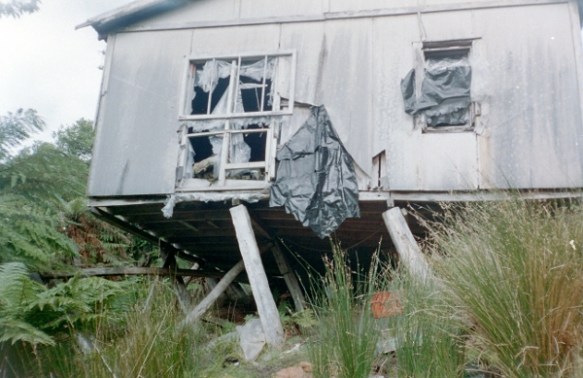
This fine building became Headquarters Alpha Company for the duration – it was warm and dry and that, for us, made it safe (enough). We swapped some ration pack boxes for a couple of bins of fish from a boat that pulled into the inlet one afternoon: they were well over fish and we were well over canned food so it worked out well for everyone although our warm and dry accommodation almost became warmer and drier when our artillery forward observer party started a roaring blaze in the coal range to start cooking up our kai moana haul. As it turned out the stove hadn’t been used in years and the reason that the fire was roaring so well was that the base of the range had burned through long ago and the floor board and joists were quite happily contributing to the blaze…every wonder just quickly a burning stove can be ripped out of the wall and ejected from a building…?

They’re reading my stuff there…

Colleague Josh Wineera is off on his travels again after being selector as the sole Kiwi to attend a US STAe Dept-sponsored Programme in the US. Details from Massey University

Massey University lecturer and soldier Major Josh Wineera has been invited by the United States State Department to participate in a high-profile study programme examining US national security policy and current threats facing the United States.

Major Wineera was chosen by the United States Embassy in Wellington as the sole New Zealand nomination from a very competitive national pool. He went on to be selected by the State Department in Washington from a range of worldwide candidates whose areas of expertise included foreign affairs and international relations. 

The intensive post-graduate level programme begins later this month in Amherst, Massachusetts, and brings together around 20 international participants. It includes study sessions at Harvard University as well as study tours to the University of California in San Diego and Washington D.C. 

The six-week programme will examine such issues as energy policy, economic stability, cyber-security, chemical and biological weapons, nuclear weapons and infectious diseases. The United States Government will meet all costs of the programme. 

Major Wineera says he feels humbled to be representing New Zealand, the Defence Force, and Massey University’s Centre for Defence and Security Studies. 

“This will be an excellent opportunity to deepen our understanding of the way the US formulates its national security policy,” he says. “I think this is especially relevant for us in New Zealand given the recent announcement by President Barack Obama that America will renew its focus in the Asia Pacific region.”

In addition to lecturing at Massey University, Major Wineera speaks to many Defence Force contingents preparing for overseas deployments, particularly to Afghanistan. His extensive operational experience includes missions to Bosnia, Bougainville, East Timor and more recently Iraq. He is also a member of the New Zealand forum of the Council for Security Cooperation in the Asia Pacific.

“2012 will be a big year for me,” Major Wineera says. “I start with this incredible invitation to deepen my understanding of US national security policy and it will continue as I embark on a PhD. By total coincidence my doctorate will examine New Zealand’s approach to international security and will compare it to other nations, including the US.”

And also covered in the Manawatu Standard.

Good luck to Josh on his latest excursion – a real coup for a local lad and for Massey’s Centre for Defence Studies – expect to see a new face on the domestic commentator scene on his return to New Zealand…

Josh and I attended the Irregular Warfare Summit is Washington last year to come up to speed on contemporary thinking on the irregular environment. It was a long way to go from the quiet (but windy) Manawatu and we weren’t too sure what we were getting ourselves into. I think that many of the other participants probably felt the same but once the ice was broken, engagement at all levels was frank and honest. There weren’t any great epiphanies for either of us and the main lesson that we brought home was probably that everyone is facing the same essential problems and that no one has the monopoly of solutions for the way ahead.

Lunch was provided for the main days of the Summit. The first day was funny: there was no seating plan (probably part of the mix and mingle ice-breaking strategy) and so people just sat where they could find a seat. As the Kiwi delegation (all both of us) approached a table, we could see two guys on the other side eyeing us up with some quite animated conversation. Uh-oh, maybe we shouldn’t have taken the last of the coffee from the urn! One says “Are you THE Josh Wineera?” Josh looks at me, turns back “Well, the only one I know…” “The one who briefed at the COIN Centre a couple of years ago? Wow, we’re using some of your stuff in out school…!” Turns out these guys are contractors providing training on the COE to the US Army. Just like Steinlager: They’re drinking our beer reading my stuff there…

Josh with Colonel Dan Roper

....and with Dr Rich Kiper...

Col Roper (who had just retired as Director of the COIN Center at Fort Leavenworth, KS) and Rich (who’s on the staff at the Centre) were staying at the Marriott as well – While they weren’t in Kansas any more, these guys were great hosts to two Kiwis a long way from home and we had some significant post-dinner networking sessions…

It’ll all be over soon…

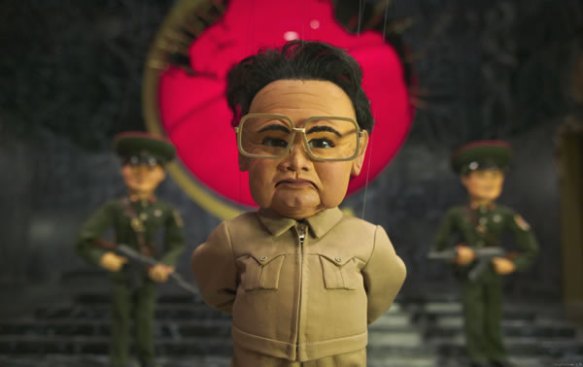
…well, the working year anyway…and two other big ‘over’ milestones this week…the War in Iraq is ‘over’ (uh-huh) as is the reign of North Korean tyrant, Kim Jong-il, whose main claim to fame was a rather wooden cameo in Team America – World Police

At least he’ll be remembered for something…

Certainly I’m looking for a bit of slower time between Christmas and New Year to recharge batteries and consider how to do things smarter in 2012 – I don’t think that current tempo is sustainable – although spending two months of the year overseas sounds all very nice and exotic it is actually a real grinder that generates its own burden of work on getting home…I think I’ll be mandating periods of down time from January onwards to chase that elusive work/life balance – apart from reading and stash acquisition, hobbies have definitely take a back seat in 2011 and that’s neither healthy nor satisfying – I have enjoyed meeting the challenge of the WordPress weekly photo and expect see see this last couple of challenges caught up before the end of the year…I hope WordPress keep this up into 2012 as it is a great way of trying to maintain a steady pulse of posts…

Also expect a surge of more professionally-based posts too as I wade through the morass of draft posts sitting here and in MS Live Writer and select those which still may have a little life left in them…

Right then, that’s that surge of creativity suppressed…back to shifting offices…

Weekly Photo Challenge: Waiting

Waiting…this week’s WordPress photo challenge theme

Waiting…something soldiers do a lot  of…above the the iconic painting by Graham Braddock of a soldier shivering at the Waiouru train station in the company of those who have gone before…it is not the most hospitable of places especially in the middle of winter, and less so when the duty driver forgets to meet the train…have walked down the tracks into the camp a few times…

Waiting for something to happen, waiting for something to stop…waiting to march on to a battalion parade after having already been at work for two hours (theme variation: hurry up and wait!), waiting for a reviewing officer whose driver got lost, waiting to see if the boss gets his words right this time…huddling on an icy hill in Pureora, waiting for the damn sun to come up so we can find out where we are…waiting for the chopper home only to find it’s been cancelled…waiting for the camp duties to call the RP Section to close the Baggies bar coz it’s a bit rowdy…

More waiting below…all cleaned up with our good gears on waiting for the Herc to take us back to Burnham…the two Scorpions are not back to back in al-round defence: one is towing the other – bloody tankies abusing the Jag engine and gear box again, most likely!

HEREKINO SAFARI was was of the best exercises I ever did…a full Ready Reaction Force deployment to Northland to clear the dreaded Musorians out again…HMAS Tobruk wasn’t available so to replicate an across-the-beach landing all the vehicles bar a couple of Rovers and Scorps that were flown in, were assembled on Ninety Mile Beach just as if they had been marshalled off the landing craft.  It really demonstrated the utility of the Scorp as a light fire support vehicle – one would trundle just behind the lead section as it advanced on foot – action on contact was to break off to the sides of the road and let the Scorp barrel up and start thumping away.

And on the topic of waiting, our section was tasked to conduct an OP over the enemy main position for a couple of days, returning back to the company lines just before the battalion moved out on a night march to the form-up point for the ever-popular dawn attack. The OC stood us down to secure the company’s kit that had been left behind but he may have omitted to run this by our platoon commander (some guy Keating who may have subsequently gone on to bigger and better things!!) – when informed that we’d been excused dawn attacks for the day, he had a fit of junior officer bravery and went storming off to  “…see about this...” No doubt he did but we still got the night off, harboured up by the local community hall where they just happened to be having a shindig of some sort…the lovely local ladies probably slipped more kai out the kitchen window to us than went into the hall itself as we waited for sun-up and Aunty Huia…

Waiting to see Wigram as we descended through cloud on the way home –  just a flash of concrete and a thud as the main gear hit the runway – waiting to see if anyone up the pointy end could actually see where we are going in those pre-GPS days…the good old days…

How an iPhone revolution could turn the Army upside-down

Unfortunately, if you remember from when it may have happened to you as a child, being turned upside-down is often neither a good thing nor much fun…

I was reading this article which opines that the US Army needs to get with the programme and starting issuing smart phones to soldiers to improve their access to information…yeah, nice but…

Where’s all the bandwidth going to come from? In fact, where is the cell net going to come from? Will the Army be relying on commercial/civilian networks in the host nation? will it be forced to develop and deploy its own portable cell networks?

The term ‘host nation’ implies that we will be continuing to engage in the type of warfare we have been doing since DESERT STORM i.e. with the semi-consent of the current governing body…where’s the cell net going to be if/when we return to good old-fashioned major combat operations?

Who’s making all these smartphones? Who’s going to guarantee that they don’t come with a hard-wired ‘go dumb in event of war’ function much like that the US was suspected of installing in military equipment it sells to potentially unreliable customers?

How will these phones offer the degree of security necessary when you really do want to keep something a secret? Similarly, what’s the lock-out going to be when one gets lost? And how will that be designed so that the security protocols don’t risk lives e.g. ‘please insert your 17 character alphanumeric password that must include upper and lower case, digits and special characters in order to access the emergency call for fire screen’…

How will soldiers maintain situational awareness and still be able to follow all the miltwits (take that anyway you want) on the smart phone screen…?

How will soldiers be able to recharge the damn things? Or will they just mean yet more batteries to be carried?

How will they connect with the range of current and legacy information systems and tools? Or will the Army just toss everything into the “…cloud…”?

Has anyone done a check to see if they will work in all areas of the world when boots may be on the ground? Or will ‘no service’ = ‘no war’?

How will the endless stream of updates and patches be applied in an operational arena?

I’m sorry but I think that the blingophiles need to think this through a little more. While the military development and acquisition definitely needs work, outfitting your Army at Radio Shack seems a sure way to set oneself up for a mighty fall against a smarter opponent who just needs to work out how to turn the lights off…

Weekly Photo Challenge: Sunset

I guess the trick in this week’s challenge is to know whether a pic is really sunset or someone slipping in a dodgy sunrise…

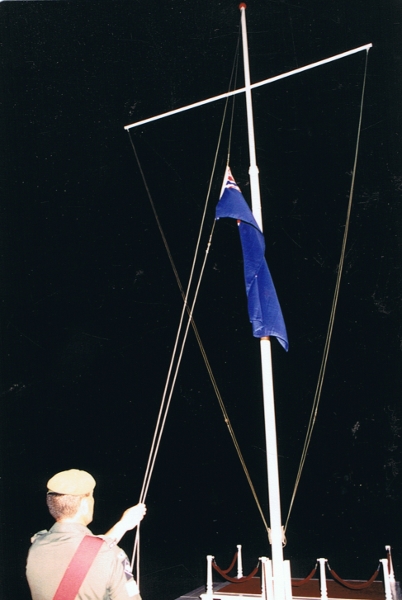
But Sunset has another significance for soldiers, more than simply the going down of the sun and the closing of the day but a time to remember those who have gone before and sometimes to also mark the end of an era…here Sunset is a sad but beautiful tune played during Beating the Retreat as the flag is lowered…

This photo was taken on July 20, 1989 at the closing ceremony for the home of the First Battalion, Royal New Zealand Infantry Regiment, at Dieppe Barracks in Sembawang, Singapore. The following month, in our own version of East of Suez, the battalion and its supporting force, began its relocation back to New Zealand, ending 32 years of continuous service in South East Asia.

As the battalion marched off that parade ground, a place of so many memories, for the last time, the roll of honour of those who had not gone home was read – a particularly sad moment for many of us as we had lost a number of friends through accidents in that last tour…remembering is particularly poignant here at the moment with the news on Wednesday of the death in combat of a second NZSAS soldier near Kabul…

Michael Yon wrote this on 24 September after a young soldier from his tent in 4-4 Cav was killed…

This whole tent is empty now. Chazray is gone and his buddies must be checking their emails in another tent. There were two more KIAs who were shot and so the internet was blacked out. One was shot in the chest and the other in the stomach. Very saddening. Families have been notified and so the internet is back on. It’s strange to see Chazray on the news and then look over at his empty cot and see his picture taped to the door. The video says he ran over the IED but he actually stepped on it but that doesn’t matter. All that matters is that he is missed by so many people.

While a soldier can always be replaced – no one is ever indispensable – the gap they leave is a different story altogether…the empty bed space, the position in the Prezzies rugby team, that spot in the bar where they always sat, the spot in family photos where Dad should be…

I didn’t know LCpl Leon Smith who was killed during a pre-emptive operation against insurgents near Kabul last week. I did know Cpl Doug Grant who was killed a few weeks earlier while doing the business against insurgents in Kabul. I remember him as a young soldier, third from the right in the back from of this photo, quiet and professional with the burning desire to learn demonstrated by many young soldiers of that period – when the camp library was shifted to a new building around that time, someone did some analysis of library loan patterns and found that the large proportion of professional military book loaning was done by JNCOs and soldiers, creating more than few ripples in the pond – the sort that so often answer a higher calling and earn the sand beret and winged dagger…in Dougie’s case, going back for a second time…

We are the Pilgrims, Master…We shall go always a little further…It may be beyond the last blue mountain barred with snow…Across that angry or glimmering sea…

Sunset can mean so much more than the simple disappearance of a ball of burning hydrogen and helium…

Stupid is…

Forrest Gump had it so right…some classic examples of practical application of the Gump Doctrine in the last couple of weeks…

First prize must go to the Taliban which persists in stirring up trouble in Kabul. How hard is it to sit on your hands for a couple of years, tour the world, read a book and THEN take over the country once NATO and the US have packed up and gone home, secure in the knowledge that Afghanistan has worked…?

The Tea Party are always Top Ten ‘Gump-ers’ and this example, albeit from Mother Jones, is a classic…let’s not build any more infrastructure because Al-Qaeda will just blow it up – this would be the same AQ that got lucky ONCE in the US, once in Madrid and struck out badly in the UK with attacks on physical infrastructure?

If anyone doesn’t believe me—England and Spain. Now, if we have a more decentralized mass-transit system using buses, if the terrorists blow up a single bus, we can work around that. When they blow up a rail, that just brings the system to a grinding halt. So how much security are we going to have on this rail system, and how much will it cost?

Yeah, dude, let’s just take the horse instead…more telling is this rebuttal from The Onion:

Here’s what Al Qaeda’s new leader, Ayman al-Zawahiri, said in a video released in July: 

The al-Qaeda network is fully prepared to continue the jihad against the American infidels by launching deadly attacks, but your outdated and rusting transportation infrastructure needs to be completely overhauled for those strikes even to be noticed. We want to turn your bridges into rubble, but if we claimed credit for making them collapse, nobody would ever believe us.

And in this week’s third place, just when you thought he might be ‘getting it’ here’s Mike Yawn lipping off again…if anyone ever doubts whether there really are some dumb-as (second ‘s’ optional) people (the much-vaunted ‘the people’?) around, just check out his fan base like some of the clowns posting on this Yawn FB post:

One Day this American Soldier May Try to Kill Me

He’s stationed now at Kandahar Air Field. I’ve warned the Army about him numerous times. I have little doubt that he will attempt to kill me if he gets the chance. He’s a US Soldier named CJ Grisham. He published this on Facebook this week in regard to me: “I want to rip his head off and piss down his windpipe!”

I cannot warn the US Army loud enough that this Soldier is unstable. They ignore my back channel warnings.

And again today…

Criminal American Soldiers

Only a small percentage of US troops become murderers, but it happened here and it happened in Iraq.

The warning signs were there. I have cautioned only twice about dangerous American soldiers. The first one committed suicide last year after my repeated warnings that he was dangerous. I told numerous key people that this soldier might want to kill me. He’s dead now. The second one is Master Sergeant CJ Grisham, now stationed and armed at Kandahar Airfield. Our military is playing with fire by keeping this man armed and in uniform.

Let’s not forget that Mikey is currently embedded with a US unit in Afghanistan – and has been doing some good work – and so, you might think, would be less likely to snap at the hand currently (literally) feeding him…What’s CJ Grisham’s real sin? He dares criticise Saint Mikey…that’s it.

Mikey, there is a big difference between someone fantasing about what they would like to do to you “I want to rip his head off and piss down his windpipe!”,  threatening to do so…”I ‘m going to rip his head off and piss down his windpipe!”, and then actually  acting on those wordsOne of these days, you’ll be a big kid and understand…in the meantime, try not to cry too much if you get disembedded again…or maybe even slapped with a libel suit yourself…I mean, you are after all abusing your position to make unsubstantiated allegations about a serving member of the force that is currently supporting you – how big do you think its sense of funny really is?

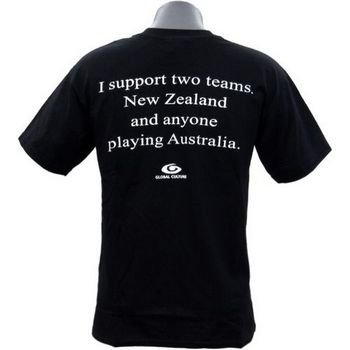
And finally, Australia which, having been thumped at the Global Oval Ball Competition (speaking of stupid…Rugby World Cup has been so heavily copyrighted that we can’t use the three words in close proximity to each other!) by Ireland, promptly resorted to accusing everyone of being mean to it…not like when the boot might be on the other foot, eh, Diggers? Even more embarrassing when, just like the much-reported misbehaving Government Ministers on opening night, not a single shred of evidence could be found to back up the bleating….so just for you guys, Seven Tips For Fans Going To Matches in New Zealand

So get over it!!

Ten truths

I was motivated to write something this morning by this item from Tom Ricks  10 truths from the last decade that you could tattoo on an arm — or maybe a leg, based in turn on an article in the August issue of Marine Corps Gazette.  I’ll get to them in a minute.

As you all know, I like to head up each post with a picture (adding, of course, considerably to the drafting burden but a that’s a sacrifice I’m happy to make for you the reader!). In searching for a truth-themed image that was neither religious nor X Files in nature, I stumbled across Tip Top Tens, specifically it’s take on 10 Truths10 Truths That Will Change Your Life:

01 : The full name of Donald Duck: Donald Fauntleroy Duck.

02 : A giraffe can clean its own ears with its tongue.

03 : Millions of trees in the world are accidentally planted by squirrels who bury nuts and do not remember where they were hiding them.

04 : Eating an apple is more effective than drinking coffee to stay awake.

05 : blue tooth brushes are used more than the red.

06 : Nobody can lick his own elbow, it is impossible to touch it with his tongue.

07 : The pig is the only animal that burns with the sun more than man.

08 : Right-handers live, on average, nine years longer than lefties.

09 : Laughing during the day makes you sleep better at night.

10 : Approximately 75% of people who read this article try to lick your elbow.

And, no, I neither attempted 02 nor 06! I take no issue with any of these truths however I can not quite say the same with the ones summarised by Tom Ricks:

— Take the high ground at night so you own it in the morning.

Yep…an oldie but a goodie…

— It may be counterintuitive, but you are probably safer dismounted than in your vehicles, preferably before contact.

Situational – depends on the vehicle and the war; also very land-centric thinking (shame, Marines!) aviators and sailors would probably not agree…except for the old Iraqi doctrine of flying with one hand on the stick and the other on the little yellow handle.

— The bait and ambush is a classic from the ancient Greeks up to today.

Yep…because people STILL keep falling for it.

— Why do we keep using the column formation in what is clearly an advance to contact, rather than using wedges and echelons?

Because we are fixated on staying on the roads? Or…the roads are the only places our vehicles will go? Every in the J, there is an overwhelming temptation to follow tracks and trails – never a good idea…

— Every Marine a rifleman, and every NCO a leader and fire support coordinator.

Marine/soldier/sailor/airman when on the ground ‘someone else’ will not bail you out…!

— These are seasoned fighters with a wealth of experience fighting against Jomini-type tactics and a sense of personal honor and bravery that means they are looking to close and kill, not snipe and run.

The difference between a war and peace support…don’t go to either seeking to do the other…

— If you are not using Small Wars Journal and Company Command, you should be.

If no one is giving you PME, then DIY…only you can make you smarter…

— Afghanistan is a battle for the provision of governance from the ground up, from the outside in, not from the top down, Kabul out.

True, but not really a ‘truth’ per se…fight the war you’re in, not the war you want…

— The Taliban, while at some level perhaps associated with al Qaeda, is not al Qaeda.

As above…fight the war you’re in, not the war you want…

— Is this the right war?

The squiggly bit on the end (?) makes this not a truth at all but a question – clearly not enough attention paid (nor wooden ruler applied) during Miss Brown’s Year 2 English classes…

So only five truths really and five elements of political grandstanding that aren’t really that useful at the tactical level…the first five though are well worth picking up and running with as they are proven, if not learned or applied…