
Uh-oh...
This week’s WordPress Weekly Photo Challenge…what happens when you get an unseasonal southerly…a little like the Big Bad Wolf: one huff and a puff and there goes the top of the water tank imploded….


Uh-oh...
This week’s WordPress Weekly Photo Challenge…what happens when you get an unseasonal southerly…a little like the Big Bad Wolf: one huff and a puff and there goes the top of the water tank imploded….
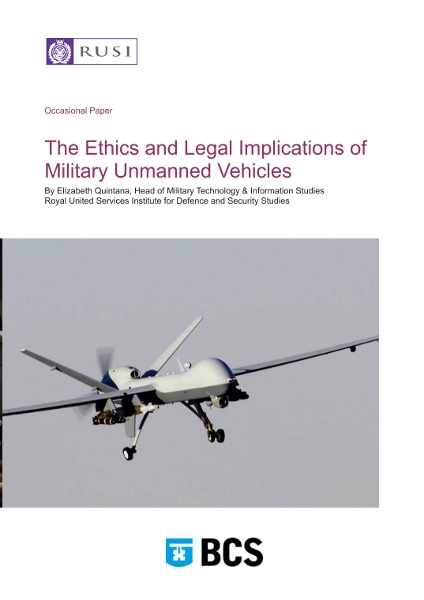
Someone sent me a copy of this document for review…it’s a bit dated but got me thinking on some issues…
The Ethics and Legal Implications of Military Unmanned Vehicles by Elizabeth Quintana, Head of Military Technology & Information Studies, Royal United Services Institute for Defence and Security Studies, 2008?
I’ve had to question mark the date as there is no actual date in the document except for a couple of references to the RUSI Ethics and Legal Implications of Military Unmanned Vehicles Conference in February 2008. The RUSI website lists it as 27 January 2008 even though the conference did not occur until February. It’s unsure whether this is just untidy publication or indicative of an aspiration that the document has a more enduring status.
While released under the RUSI umbrella, the document is actually produced by the British Computer Society (BCS) which not recognised as a major influence or actor in either the unmanned vehicle nor the ethics or legal communities.
Although presented as an ‘Occasional Paper’, there are numerous gaps in descriptions of unmanned vehicle development and this is more a compilation of material presented at the conference and not a consideration of relevant issues across the spectrum of unmanned vehicle development, capability and operation, or encapsulating potential ethics and legal issues other than those presented. I think that this is slightly dishonest and indicative of the ‘publish or perish’ and ‘quantity over quality’ philosophies that dominate in some of these NGO centres, agencies and institutes.
There is some discussion of unmanned ground and maritime systems in what is probably a timely reminder that there is more to unmanned capabilities than just the high profile aerial system that get 90% of the coverage. This is pertinent as forces consider their approach to unmanned capabilities. Much of the information on unmanned systems is out of date which is probably more indicative of the rate of change and development in unmanned systems than any fault of the document’s authors.
The ethics section is rather generic and speculative and I do doubt just how much engagement those responsible have had with the actual various unmanned vehicle communities especially on the operating front. It’s been my experience that there is considerable and very robust discussion within such communities on these issues. Again, much water has gone under the bridge between Feb 08 and the present day in this area as well and so much of the content is dated.
Some contemporary unmanned vehicle ethics and legal issues worthy of discussion might be…
…at what point do civil airspace rules become overruled in favour of a greater good, especially for HADR operations?
As general rule, civil airspace rules in the western world are risk-adverse and preclude operations of UAS outside of tightly controlled areas of restricted airspace. The track record of UAS involvement in mid-air incidents is very good and even with the higher attrition rate of unmanned versus manned aircraft, UAS still have to even come close to the death and damage rates arising from manned platform incidents.
…the belief that UAV strikes, especially across national borders, are somehow different from the same strikes conducted by manned aircraft.
There appears to be a strong element of Pollyanna-ism, aka ‘she’ll be right –ism’ down-under, that so long as a strike is delivered by a UAV, the accepted rules of international conduct i.e. respecting inconvenient things like national boundaries, international and domestic law, etc, do not apply. How might this apply in the backyard of the South/South West Pacific?
…defining the lines for combatants when key actors are based half a world away outside the mission theatre.
In his January 2000 novel, The Lion’s Game, Nelson De Mille describes an Libyan operation that targets the surviving crews of the F-111s employed in Op ELDORADO CANYON, the 1986 strikes against Libya. A recent C4ISR Journal article raises the issue of whether US UAS operators conducting ‘remote split operations’ (RSO) from the continental US are subject to the same targeting protocols as pilots (or other military personnel) actually in-theatre. Clearly military personnel in an airbase environment like Kandahar or Bagram are as targetable as personnel conducting operations from Sigonella in Italy against Libya; but what of the US-based MQ-9 pilot driving home to suburbia after a shift conducting strike/CA operations over Afghanistan, Iraq, Libya or Pakistan…? Do such personnel cease to be targetable when they drive off-base…? Would it be unethical or morally wrong for these personnel to be targeted – the West seems pretty comfortable taking the war to where its enemies live…?
Even though this document has a number of flaws and is somewhat out of date, being over three years old, it serves a useful purpose as a ‘firestarter’ for professional discussion on the ethics and rules of not just unmanned vehicle operation but also for the broader complex contemporary operating environment.

…through the streets of Wellington…
…but we looked a lot better than these guys…yes, really…
A group of us who had all been young (and in some cases, not so young) officers together, concentrated in Wellington last night for a bit of a get-together, in some cases we had not seen each other for a good seven or more years…apart from a grey hair or two, we were all as slim and sharp as we’d been back then…
Josh from CDSS and I drove down together yesterday afternoon and the drive both ways gave us a good opportunity to discuss a bunch of current affairs topics – we stayed at the Halswell Lodge in Kent Terrace: as Josh said, we really want to be focussing about where we want to end up and less about where we’re starting from. A very good point as my thought had been to stay at someplace like the James Cook but the natural progression of a staff ride through night-time Wellington is invariably towards the bottom end of Courtney Place i.e. just round the corner from the Halswell Lodge…
It’s a good lesson and one that obviously links directly into the Princess Leia Doctrine – before you come in, have a plan for getting out!! Somewhat topical in a week where the US recognises the rebel “government” in Libya, just as France states that it can see a path where Ghaddafi stay in power…as some have said, a clear application of two of the three stages of the France Doctrine:
– Start war.
– Surrender.
– Claim all glory.
It’s not actually clear who or what the US has actually recognised or what the mid- to long-term results will be when that “government” comes to power – almost assurably there will be a number of score-settling activities to ensure that any and all Ghaddafists are dealt to as well as anyone else that the new “government” feels they need to square away as part of their consolidation of power…It is pretty certain that one of the big lessons of Iraq, that existing governance and other structures should be kept in place as much as possible during transitional phases, will be learned again should this “government” come to power…
It’s interesting to note as well that NATO’s appetite for social and moral justice has yet to extend to Syria where protest and suppression continue unchecked; and that hardline Islamic elements may be gaining the whip hand in Egypt…will the call be made “Hey, Hosni! Holiday’s over, dude! Get back in there and sort your country out again!” ?
Anyway, back to the Seven…we’d hoped a few more might come out of the woodwork but it was a crappy Wellington winter night and there’s a rematch tonight but we could only do the one night…so very good to catch up again with some of those who helped make me who I am now (Yes, guys, it’s all your fault!!) and to have a night out in NZ – normally any big nights I have out are ‘post-dinner networking’ activities while I am working overseas. Very impressed to see that there are still pubs in NZ that not only serve beer in jugs but big glass jugs as well – good effort, the Green Man Pub – great pizzas and fries too!! Of course, we almost didn’t get to the Green Man after leaving St Johns in Cable Street as our SOF rep ‘led’ us in the opposite direction!! “Yeah, I know where I’m going…trust me…” Never a Tui billboard around when you need one…
I think we finished up around 2-30ish after a fun few hours in Boogie Wonderland, a retro disco-era bar (“Don’t touch the glitter balls – puhleeeease!!” Well, don’t put them in arm’s reach then!). Post-pizza I’d had a top-up pie along the way but Josh hadn’t and we grabbed some horrible Chinese food from someplace at the bottom end of Courtney Place – the sole redeeming thing about that was that I bought a bottle of Coke that was well sited for post-crash out dries this morning…
So bit jaded this evening with an early start to get back to the Lodge before it gets snowed in – probably our first snow there this year…watching the reports coming out of Norway…just one nutjob…as one tweet stated ‘Oklahoma City, not 911’…a brutal reminder than in this environment of complexity, you can’t predict and interdict all ‘the people’…sometimes the measure of success is how well you respond…
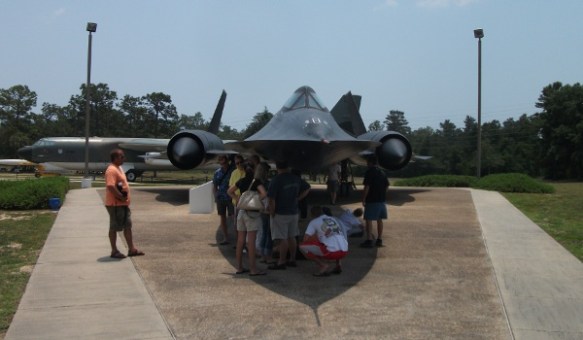
A baking Florida day...
This week’s WordPress Weekly Photo Challenge…
I snapped this at the USAF Armament Museum just outside the West Gate at Eglin AFB in early June…a scorching hot day where the heat hit you like a wall; this group were on a guided tour and sheltered under the Blackbird while their guide passed on some classic aviation lore about this legendary aircraft…
This museum is a great way to kill a few hours both in the heat of the outside displays and the airconned comfort of the interior. There’s an interesting selection of aircraft outside and the displays inside include most US aerial weapon systems employed since the Lewis Gun first took to the skies…more pictures here
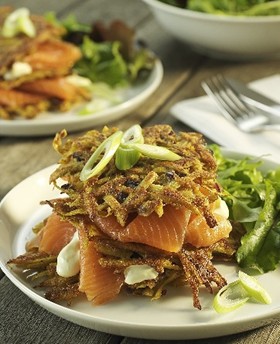
I think mine looked better than these from the Greggs website…
Picked up the award for the best two course meal served in our house ever last weekend…just one of those chance ideas that rolled through the in-box a few weeks ago, curried kumara fritters with smoked salmon…simple as a simple thing to prepare…
Serves: makes 12 large fritters so 2-4 people depending how hungry they are – this is very filling…
Preparation Time: 5 minutes
Cooking Time: 7 minutes
Ingredients
Method
Place the kumara, red onion, curry powder, eggs and sea salt in a bowl. Mix well.
Heat the oil in a frying pan over medium heat. Place tablespoonfuls of the prepared mixture into the pan; cook for a few minutes on each side or until the fritters are cooked through and golden brown.
Serve as a layered stack, alternating the fritters, sour cream and salmon slices.
Garnish with spring onion, slamon and a dob of sour cream on top.
Serve with salad.
I had enough smoked salmon left over for a decent omelette for two the following night – Carmen felt that the salmon tatse didn’t quite come through enough so I’d recommend using the fill 100 grams of salmon across the four stacks.
Dessert was pears poached in red wine from our very old ‘Favourite Desserts’ book (also the home of our world-famous in Raurimu butterscotch pudding):
Serves: two
Preparation Time: 5 minutes
Cooking Time: 20 minutes
Ingredients
Method
Dissolve sugar in wine and water in a saucepan over medium heat.
Add pears, cloves and cinnamon stick.
Simmer until pears are cooked through
Remove pears and serve with ice cream. Pour wine juice to taste over ice cream.
The remaining juice makes a great semi-mulled wine served hot on very cold nights.
The original recipe called for six whole pears coooked whole with proportionally more ingredient – the first time I made this, the wine juice only penetrated less than 1/4 inch into the pears which didn’t really pick up the flavour plus there were way too many pears for just the two of us. This time we found that half a pear each i.e. two quarters with ice cream was heaps especially after the fritters…

Scale Models Wellington IPMS is pleased to be able to invite the modeling public to participate in the 2011 Scale Models Expo Model.
The event is to be held in the centre of Lower Hutt (approx 15minutes drive north of Wellington, New Zealand) in the Horticultural Hall adjoining the Town Hall in the civic centre. The expo will also feature a separate competition for the IPMS Nationals which will gather some of the countries top modelers as they battle it out for top honours.
In addition to the competitions we have lined up some interesting displays and a full complement of trade stands from the regions leading retailers and manufacturers.
Entries must be delivered and registered between 9am – 11am Saturday 20 August in the foyer of the Lower Hutt Horticultural Hall. Please remember to bring your completed entry form to speed up registration. Spare forms will be available on the day. Late entries will be at the sole discretion of the Contest Chairman.
There is no entry fee for models and modelers may enter as many eligible models as they wish.
Previous place getting models in the Wellington Scale Models Expo (ie 1st, 2nd or 3rd) are not eligible to re-enter the Scale Models Expo competition but may enter the IPMS Nationals if eligible. Similarly previous place getters in an IPMS Nationals (ie 1st, 2nd, 3rd, Gold, Silver or Bronze) are not eligible to re-enter the Nationals but may enter the Scale models Expo if eligible.
Entries may be comprised of any generally accepted modeling material (ie plastic, resins, wood, metal). All models must have been built and painted by the entrant.
Final class and category placement of models is at the discretion of the Contest Chairman.
Junior class entrants must be under the age of 17 (ie not reached their 17th birthday) at the time of the competition
Any entries that are considered offensive to generally held standards of taste and acceptability may be excluded at the discretion of the Contest Chairman.
Entries may not be removed from the tables until 4pm Sunday at the earliest unless prior consent is given by the Contest Chairman.
All entrants in the competition shall receive a free pass to the venue for the duration of the event.
Prize giving for the competition will be 4pm Sunday. Competitors must be present to accept any awards or prizes. Awards will be made for 1st, 2nd, 3rd and Highly Commended ( as applicable) in each of the categories along with overall best in Class.
To be eligible for “Best NZ Subject” the model must be entered in the appropriate NZ section. The only exceptions to this will be NZ subjects in Diorama, Ships Sci Fi/Miscellaneous and Junior classes.
Models will be judged by Scale Models Wellington IPMS appointed judges. Entries shall be judged according to Scale Models Wellington IPMS judging criteria. All judges decisions are final. No correspondence will be entered into.
Scale Models Expo/ IPMS Nationals Classes 2011 Unless stated all categories refer to all scales.
Class A: Aircraft
A1 NZ Aircraft
A2 Aircraft smaller than 1/48 – prop
A3 Aircraft smaller than 1/48 – Jet
A4 Aircraft 1/48 – prop, single engine
A5 Aircraft 1/48 – prop, multi engine
A6 Aircraft 1/48 – jet
A7 Aircraft larger than 1/48 – prop
A8 Aircraft larger than 1/48 – jet
A9 Helicopters
A10 Box Stock
Class B: Military Vehicles
B1 NZ military vehicles
B2 Smaller than 1/48 – military vehicles and equipment
B3 1/48 – military vehicles and equipment
B4 1/35 and larger armoured vehicles – WW2 and earlier
B5 1/35 and larger armoured vehicles – Post WW2
B6 1/35 and larger softskin vehicles
B7 Towed artillery and misc military equipment
B8 Box Stock
Class C: Civilian Vehicles
C1 NZ vehicles
C2 Vehicles – Open wheel competition
C3 Vehicles – factory stock
C4 Vehicles – modified (custom/hotrod/tuner)
C5 Vehicles – closed wheel competition
C6 Motorcycles
C7 Box Stock
C8 Trucks/Commercials
Class D:Dioramas
D1 Diorama – All types
Class E: Ships
E1 1/500 and smaller
E2 Larger than 1/500
E3 Submarines
Class F: Figures
F1 NZ Figures
F2 Under 120mm (1/16)
F3 120mm (1/16) and larger
F4 Busts
Class G: Science, Sci Fi and Misc
G1 Fictional craft, real spacecraft, missiles and vehicles
G2 Any subject not covered elsewhere
G3 Collections
Class J: Junior
J1 Aircraft
J2 Military
J3 Civilian vehicles
J4 Figures
J5 Ships
J6 Sci Fi & Misc
J7 Diorama
Collections will consist of 5 or more closely related items (eg five different WW2 fighters would not be a collection but five Spitfires would). Past place getters may be entered as part of a collection but must not constitute more than 40% of the group. The collection must be the sole work of the entrant.
Bases are allowed in all categories. They will not be considered in the judging except in the diorama classes or where 2 models are tied for a placing. Any models entered on bases must be securely fixed to the base.
A diorama shall generally be vehicles or figures on a single scenic base depicting a scene. Note a single figure, vehicle or aircraft displayed on a base with ground cover will not usually constitute a diorama.
Box stock classes are intended to recognize excellent models produced from the materials provided in the box from the manufacturer. For those entering Box Stock please note the following:
– Original instructions must be supplied with your entry.
– Alternative decals may be used.
– No aftermarket or scratch built detailing allowed.
– The modeler may fill gaps and seams, sand off rivets, drill out gun ports, exhausts pipes or other appropriate openings; thin to scale such parts as trailing edges, flaps and doors; and add rigging and antennas
– Panel lines may be repaired if damaged during construction. Extensive rescribing of panel lines is not permitted.

If NASA had any guts, they would dress the landing crew at Edwards as Apes to receive the Astronauts on their last Shuttle Landing.
Cheers to Dean@Twiloh for making me snort my coffee this arvo….!

Not getting it…
One of my ongoing beefs with ‘modern’ COIN is the misperception is that successful COIN is all about being nice, of waging war without casualties (although casualties amongst one’s own soldiers appear to ‘OK’), and this great expectation that one day ‘the people’ will just rise up, out of gratitude for the niceness shown them by the security forces and cast out the insurgents…
The simple fact is that this ‘doctrine’ is all lala-land, cloud cuckoo vunderland fantasy. That’s pretty much the theme of Wilf Owen’s article in the Spring 2011 edition of the British Army Review (I’d post a link to BAR but it seems that it is a highly classified publication and not one suited to easy intuitive location via the Power of Google), titled Killing Your Way To Control. [PDF: bar-151-killing-your-way-to-control2] He takes particular issues with statements like
Effective counterinsurgency provides human security to the population, where they live, 24 hours a day. This, not destroying the enemy, is the central task. (from Kilcullen’s The Accidental Guerrilla)
Unlike in general war, the objective is not the defeat or destruction of the enemy, but neutralisation of a threat to stable society. (from JDP 3-40)
And guess what? He is absolutely 100% correct! Was it Douglas MacArthur, addressing the cadets at West Point, who said something like “Your duty is clear and inviolate: to win our nation’s wars”? Something about “Victory, always victory”? Even if victory might mean achieving your objectives on your terms as opposed to victory always equating to absolute, grinding under the steel-shod boot, unconditional victory…
Use of the military is, should be, the final option in execution of national policy to achieve national objectives…because it is brutal and unpleasant – and effective when employed properly. The military should be used when other instruments in the DIME construct are not effective. That is not to say that once the military deploys, the rest of DIME takes for some time out; it just means that the lead agency has changed.
And what is it about the military that both makes it an option of last resort and one so effective? Simply…the use of force…brutal force, whether blunt or surgical, but brutal none the less because force can only be brutal. Who talks about let alone attempts to develop and apply ‘nice’ force? And this is Wilf’s point, and, for an irregular environment, encapsulated nicely in the extract he selects from the UK’s 2005 Land Operations…
Neutralising the insurgent and in particular the leadership forms part of a successful COIN strategy. Methods include killing, capturing, demoralising and deterring insurgents and promoting desertions. This is an area in which military forces can specialise and should be a focus for COIN training. The aim should be to defeat the insurgent on his own ground using as much force as is necessary, but no more.
Now we know that there are times, especially immediately following an intervention and lodgement when the only people who can realistically maintain and provide essential services like power, water, electricity, sewage and security are the military. Forget about some imaginary gendarmerie with shovels that will miraculously appear and relieve the military of such onerous and unpleasant tasks…never happen…
Nor is anyone saying that forces optimised for high-end force on force major combat operations can successfully instantly reconfigure, collectively and individually, into an irregular warfare scenario. If there was one myth that was majorly debunked in the last decade it was the “If you train up (for MCO), you can easily step down (for COIN)”. Thus, a choice must be made between a dual force optimised one side for MCO and irregular warfare on the other: just to be real clear, two forces – NOT one size fits all; or a deliberate acceptance that one’s forces will only be capable of engaging in one form of conflict OR the other. Most nations forced towards the latter choice will probably tend towards a specialisation in irregular warfare up to a limit of national capability on the spectrum of operations.
And while the logical threads in population-centricity unravel, this does not mean that the military should isolate itself from ‘the people’. GEN Petraeus was right in Baghdad in 2006 when he brought the troops back in amongst ‘the people’ and ended the daily tactical commuting/sallying from the FOBs. The military is not some horde to be hidden away – if ‘the people’ is where the adversary(s) are, then that’s where the military should be – configured and trained for the application of force in that specific environment just as they would/should be for any other unique environment.
And on the spectrum of operations…let’s not forget that it is NOT the linear progression from peacetime to all-out warfare that is it portrayed as…a more accurate model would have peace in the middle, surrounded by a ring that includes peacetime engagement (a smidgen up from peace), peacekeeping, peacemaking, irregular warfare, HADR, limited war (e.g. the Falklands War), major war (DESERT STORM, OIF Part 1) and full-on all-out war (Red Storm Rising).
Imagine that ring being like a trembler switch (who didn’t used to watch Danger: UXB or The Professionals…“Steady, it’s a trembler!”?) from which a nation can flick from peace to any state around that ring, and from that state then flick to another and another or back to the stable centre. Accepting that there are two clear extremes, peace and all-out war, most nations would assess the planning for one, peace, carries too much risk as it would naïve to expect peace to remain constant in the most benign scenario. Similarly few nations can afford to truly step up to the full range of capabilities required for the other extreme. Thus most opt for a point in-between.
But regardless of where that point may lie, the primary role and output of that national military force is the application of force. That is why the lead group in the Air and Space Interoperability Council is the Force Application group, with six important but supporting groups. That is why, in the continental staff system, the staff branches are NOT all created equal – operations leads, supported by whatever combination of numbers floats your boat – whoever heard of logistics or intelligence supported by operations? That is because the ops branch is all about creating and delivering effects – and the effect that the military delivers best…is…force.
So you might imagine just how it felt as I scrolled through my ‘most recent’ view on Facebook to see the link to Wilf’s paper first from DoctrineMan! (still not sure about people who include punctuation in their name) and a ways further down, the original post at Small Wars Journal. Even more so when I realised that Wilf, who I have spent more time at Small Wars disagreeing with than ever agreeing, had authored it.
What was disappointing was the number of people on both DoctrineMan! And Small Wars fixated on pulling every literal point of contention from the article. I was sadly reminded of the 45k+ morons who ‘liked’ the Boycott Macsyna King Book page; or the moral minority who all ‘just know’ that Casey Anthony killed her daughter and that there was no need for all that legal due process stuff: let’s just string her up!! I wonder sometimes if western society is descending to a point where the capacity for independent thought is lost…and we all just become drones circling the brightest, loudest light…
The irony in his article that he does not point out is that while British Army doctrine in 2005 included the quote above from Land Operations (now that I think about it, I was working at Uphaven on CLAW 1 when it was released and got to bring the first copies back home), this was the same period that the UK was trumpeting the success of Malaya and the triumph myth of ‘hearts and minds’ that set irregular warfare back decades. If only the UK had read and applied its own doctrine… (What’s that? You read doctrine? And apply it?)
So where does this leave us? Wilf has articulated what we have probably known along, what the dead Germans told us is right, that the military is about the application of force, not the application of ‘nice’, as an extension of policy. That force may be applied to create the conditions where others can see to the building of a stable society, hopefully where such existed at some stage before; equally as much it may be applied to simply attrite an adversary to the point where further resistance is either untenable or impossible.
But, harking back to the dead Germans again, the ultimate target for force is one specific part of what is popularly accepted as the Clausewitzian Trinity: of ‘the people’, the action arm and the leadership of any collective entity, military force ultimately targets the leadership to either eliminate it as the driving force behind the organisation, or convince it to consider and change its ways. That’s what the military is for….

An old fashioned method of getting...

...from here...

...to here...

...to get these...
The WordPress Weekly Photo Challenge is ‘Old Fashioned’…there photos were taken at Purakanui. on the Otago Peninsula between Waitati and Port Chalmers, just north of Dunedin…it’s a lovely little settlement at the end of a winding no-exit road. We stayed in the cottage in the ‘from’ picture for a couple of nights. The channel runs right by the veranda and it has an external bathroom – at night one has to counts one’s steps very carefully lest one step once too many and goes for a swim! In the morning you can wake up and see the tide racing in or out through the channel and get the impression that the cottage itself is moving – very cool!!
Edit: Oh, yes…there were enough cockles there for a bowl of soup each…
Later on that day we saw restauranteurs from the city come out and hoover up dozens of cockles for commercial use – the limit per person per day is only about forty – this abuse should be banned!!
MacChick Academic
Savour, Relax & Enjoy
A home for us all.
Scattered to the Chaos of Life
Don't be bullied
Inspiration through my thoughts, experiences and travels
Indulge- Travel, Adventure, & New Experiences
My random musings and whatnot
Because stress is fattening and life is just too short
Lost and Found: rediscovering books, writing, destinations, childhood memories and more
mixing it up, one great recipe at a time...
I hope you dance....





 The World According to Me...