Unknown's avatar

About SJPONeill

Retired(ish) and living on the side of a mountain. I love reading and writing, pottering around with DIY in the garden and the kitchen, watching movies and building models from plastic and paper...I have two awesome daughters, two awesome grand-daughters and two awesome big dogs...lots of awesomeness around me...

The application of FM 3-24 principles and success in COIN

Staying up lat-ish last night to watch Torchwood: Miracle Day when I knew I had a 0300 start this morning was probably not the best idea I ever had but, like many, things, it seemed like a good idea at the time and I know that if I record something I only rarely go back and actually watch it…

It’s still very dark outside and the webcast from the COIN Center at Fort Leavenworth has just ended…the topic for discussion this morning related to principles identified in the RAND study Victory Has A Thousand Fathers and their application to FM 3-24, specifically from the perspective of what an updated FM 3-24 might include.

I really don’t like Victory Has A Thousand Fathers – the idea is good: to study historical COIN campaigns and determine what truisms or principles can be derived from those campaigns.  This, I believe, is a necessary and long overdue step in the development of useful doctrine for the contemporary environment as for too long there have only really been two dominant schools of thought in this area:

  • The false prophets of Malaya who fail to truly understand that campaign and whom only glean the most superficial principles from it, namely a misapplied emphasis on ‘hearts and minds’, and who ignore the context in which that philosophy was applied and how it was applied.
  • The COINdinsta who forget that FM 3-24 was a seminal, timely and truly useful publication – for the situation that the US faced in Iraq, in 2006 and 2006. It has limited applicability as writ for dogmatic application in other campaigns.

Although I agree with the findings of Victory Has A Thousand Fathers as briefed this morning, they are weakened by the paper’s overly narrow and selective focus:

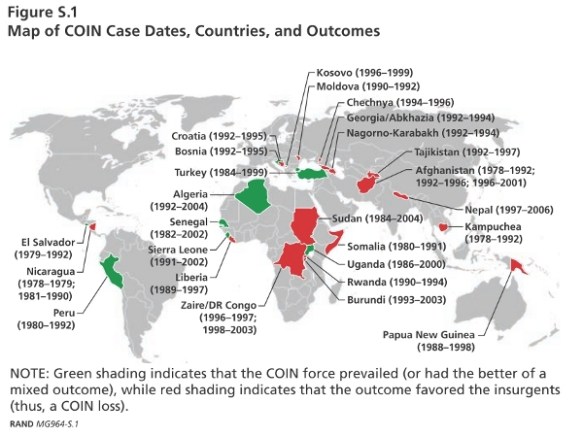
  • The scope of the study is restricted to only 1978-2008, omitting the post-WW2  ‘golden age’ of counter-insurgency and many other critical campaigns of thus nature. While there would have been a need perhaps to keep the initial sample size to a manageable number, this arbitrary period omits a large proportion of relevant campaigns.
  • The list of COIN campaigns 1978-2008 is somewhat limited: missing are any of the campaigns fought in Southern Africa in this period, as are those from the Middle East including Israel v Palestinians, and Iraq v Kurds;  East Timor is not listed, nor is the campaign in Southern Thailand – while it is flawed in other ways, at least both of these campaigns appear in David Kilcullen’s The Accidental Guerrilla.
  • Kiwis and Australians will be surprised to see that Papua New Guinea 1988-1998 which must be the Bougainville campaign is listed as ‘red’ i.e. a failure for the host nation government. The island of Bougainville is still very much part of PNG and that the world has heard little from that part of the world since the withdrawal of the monitoring force in 2002, is a testament to the effectiveness of that force 1998-2002.

The principles for COIN derived from Victory Has A Thousand Fathers were on slides that I missed during the discussion (too slow with the screen grabs) so I’ll cover those in a couple of days once they are posted on the COIN Centre events page.  What follows are some of the other insights from this morning.
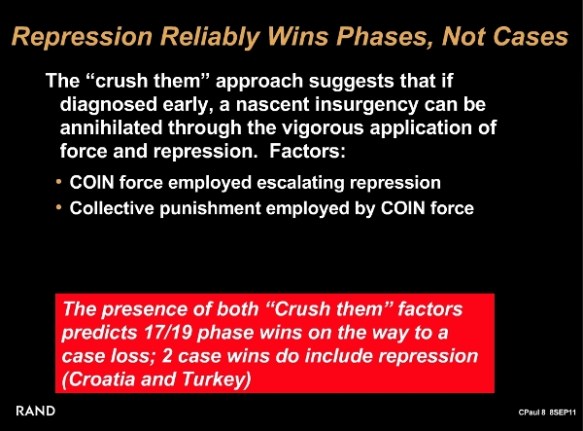
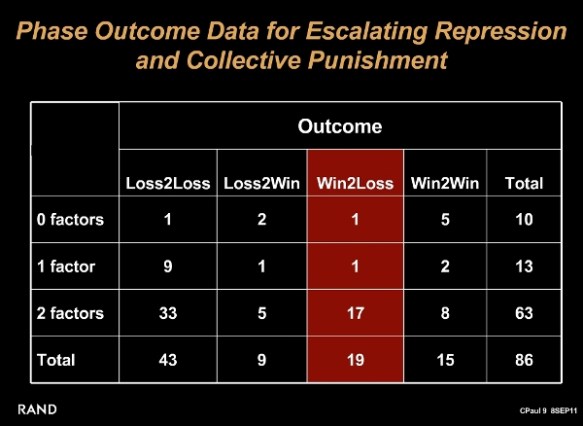
There is a case for the use of force in Irregular Warfare but first, let’s stop calling this COIN. As we know, COIN is a very specific and very narrow slice of the broader realm of IW: the continuing abuse of the term ‘COIN’ to describe operations in the contemporary operating environment unhelpfully muddies the waters. Specifically. these slides discuss the repressive use of force but we need to consider this just as much as we have to consider the other side of the pendulum that it’s all about being nice to everybody.

One of the most refreshing things about FM 3-24 during our review of COIN doctrine in 2007-08 was that it acknowledged the need for use of force within a campaign, a most realistic diversion from other nations’ COIN doctrine which was based upon either experience in peace-support operations (whole different ballgame), super-localised internal issues (go Northern Ireland!), or Malaya (myth city). If there was no potential for the application of force, then the military is not needed i.e. the military is not a cheap labour force, nor an easy substitute for the other government agencies and non-government organisations that should be there.

While FM 3-24 does have a strong population-centric element, it was written for a specific campaign (Iraq) in a specific period (2005-6). That notwithstanding, the population-centric elements are well-balanced with other key principles and truisms for irregular warfare and I think that many critics only cherry-pick thos easpects they want in order to criticise and few if any consider the publication as a whole.
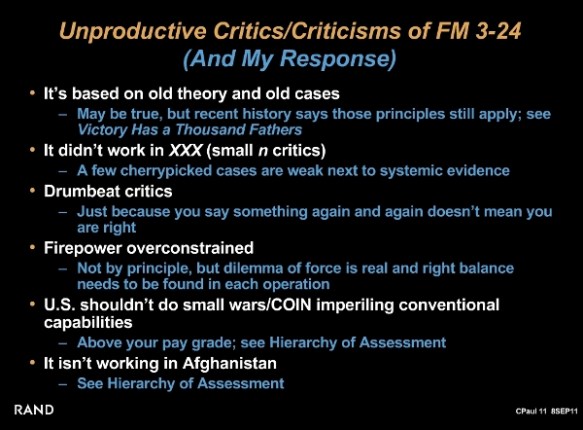
This is the Hierarchy of Assessment referred in the last two points:
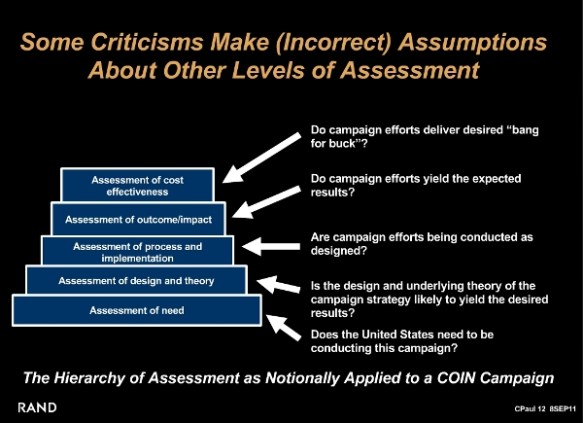
In simple terms, it all comes down to national interests linked to campaign objectives and being able to measure the same; and at the tactical level, specifically, as recommended below,  link development objectives to those campaign objectives and national objectives i.e. no more AID for its own sake. This just creates legacy dependency issues.

One of the questions asked this morning was “…I’ve recently returned from RC-S .  Agree with HNG but it does not to have a national flair to it.  If a specific district enforces the govt rep there, the HNG should be deemed endorsed…” This is the real rub in Afghanistan where the role and legitimacy of central government are in an entirely different context to that of Iraq. Shifting the emphasis for effective government from a central to a district government focus can produce strong district/regional government but usually at the expense of the central government. But then as we discussed in the opening day of the IW Summit in May, a ‘horses for courses’ approach to Afghanistan might find that a federalist system of strong provinces and weak central government might be the best for Afghanistan – after all, it seems to have worked OK for the last two millennia…

As the US Army and USMC gear up to update FM 3-24, the time is ripe for some robust discussion on the content of its next iteration. Most definitely the sections of air and maritime power need to be expanded and updated. The forum for thoughts on this topic is at the COIN Centre Blog….

Weekly Photo Challenge: Path

Purakanui Steps

This week’s challenge shows the path from the road down to a little whaling cottage we used to own in Purakanui – the little village I also used in the ‘Old Fashioned’ challenge.

The cottage was really small...

...with a rusticly basic kitchen and two small bedrooms...

...but it had pretty cool views across the inlet - even though this one's on a crappy day...

Avast, me hearties…

With effect yesterday, a new law comes into effect here that introduces penalties for people detected downloading copyrighted material off the internet…

Driving home from Wellington last night, I was listening to Radio Live as I do until I find the headphones for my MP3 so I can go back to my Audible books – still bracing myself to carry on listening to the current one with George Friedman prattling on about how Turkey, Mexico and Poland are the next generation of regional powers…Anyway, of course, this new law – which is no surprise as it was well socialised before becoming law – was the hot topic of discussion, as it was on breakfast TV yesterday morning…

It amazes me how InternetNZ and TUANZ can blatantly bleat about how unfair it all is that current international copyright law does not allow free downloading of copyrighted content and how copyright is all just one big conspiracy by US interests (ho-hum…yawn) to maintain the current outdated copyright system that expects that users might actually have to pay for copyrighted product…

Disinformation was rampant from both InternetNZ and TUANZ but the simple bottom line is that both need to ante up and accept that illegal access to copyrighted material, even under the pseudo-glamour of piracy, is nothing more than plain and simple, black and white THEFT!!! Just the same as hopping a fence and helping themselves to stock and produce just because there is no big sign written in geek that says ‘Private Property’; or bowling into someone’s house because they left the front door open and again just helping themselves…

The reason that they are all worried is because the Government has introduced some quick hefty penalties – in fairness, with a graduated system of warnings – for offending account holders…up to $15,000 per offence – don’t want a $15k fine? Then DON’T STEAL, you THIEVING geeks…!!!!

Worried that your neighbour will tap into your wireless and download copyrighted material? Then you are too dumb to have an internet account…

Worried that your kids will earn you a $15k fine? They will probably find a way to do this anyway – at least illegal downloads don’t involve fire, explosives or fast cars…

Worried that your employees will abuse the work account? Introduce individual accounts and police them like you should be doing anyway…

Laziness and stupidity are no excuses for THEFT.

Want to see the latest series of Castle, Justified, Thunderbirds, etc before it arrives here? Either breakaway from the box and get a life or buy it from Amazon et al – YOU LOSERS!

It sickens me that the me-me-me generation just don’t get that there are no freebies and that there is this thing called work that means to get get money to buy you things…the internet does not = Notting Hill style help yourself…I’ve been around enough activities creating intellectual property for long enough to have a healthy respect for those who create and nothing but contempt for those who steal be it with a brick through the window or a dodgy file sharer somewhere in Eastern Europe…

In other news

Happy Feet the Emperor Penguin {PDF: Penguin Happy Feet becomes a Wellington celebrity] is off home again. This was a bigger national story than a pensioner who laid dead in his flat for over a year.

The cost of the Christchurch earthquakes has almost doubled to just over $7billion – to counter this the government has invented discovered significant oil and gas under the southern ocean…

Teams for the Rugby World Cup have started to land this week – gee, I hope there is a ‘not-rugby’ channel for the next six weeks….

Weekly Photo Challenge: Up

It’s a long way up to the cockpit of the surviving North American XB-70 Valkyrie prototype, on display in the Research and Development Hall at the National Museum of the United States Air Force, near Dayton, Ohio. I snapped this when I visited in May this year – overseas visitors don’t forget to bring your passport if you want to get into the R&D and Presidential Halls as they are in the overflow section of the Museum that’s on Wright-Patterson Air Base itself; booking early for the bus over is also recommended, as is having a plan for loking around as you only have around 45 minutes per trip to cover both halls.

There’s lots of weird and wonderful macinery in the R&D Hall but there are all parked real close to each other so it is difficult to get a good look at any one aircraft without having your view blocked by something else. All the more reason to support the Museum (which is free access) so it can add on some more display halls to the Museum proper and better display the Presidential aircraft and those in the current R&D Hall. It would also mean that the collection of aircraft still displayed aoutside could be better protected from the elements. These include a number of significant aircraft like Prison Taxi, the C-141 that repatriated the first of the Vietnam POWs; one of the few remaining C-125 Raiders designed just in case this whole helicopter thing didn’t work out; a Junkers Ju-52, trusty Tante Ju; and the first NKC-135, the first working airborne laser system…

The Myth of Population-centric Counterinsurgency

Gentile_dl-vertical4I just sat in on a very interesting virtual presentation and Q&A session at the COIN Center at Ft Leavenworth with COL Gian Gentile…

He is a professor of military history at the United States Military Academy, West Point. COL Gentile has written and spoken extensively about the need to revise Army COIN doctrine (FM 3-24). He states “Population-centric COIN doctrine needs fundamental revision. The Army’s current fixation on COIN is a “straightjacket” that prevents thinking about alternative models of irregular conflict and, more importantly, encourages the atrophy of combined arms warfare skills.

A quick bio and summary of COL Gentile’s views can be found in Micah Zenko’s interview Ten What’s With…Col. Gian Gentile from June of this year.

This morning he discussed his belief that “…Population-centric COIN doctrine needs fundamental revision. The Army’s current fixation on COIN is a “straightjacket” that prevents thinking about alternative models of irregular conflict and, more importantly, encourages the atrophy of combined arms warfare skills…” Unfortunately, the session ended before I could copy’n’paste the insightful questions and comments out of the chat screen (hopefully I will be able to get them from someone who was a little faster than I), however here are some of the insights from COL Gentile:

“…learning and and adapting is not an output in itself – if an Army can do combined arms, then it should be all over ‘learning and adapting’…” Yes and no – it should be able to do combined arms well – no argument there – but the key enabler that may be drawn from combined arms that contributes to the irregular arena could very well be the ability to work and play well with others, not just from one’s own service, nation or even extant alliance but from those ‘strange bedfellows’ that irregular warfare seems to attract. I suppose I should also hammer the point home that combined arms is actually a joint construct, not simply all the land forces able to work and play well together.

“…the COIN ‘wave’ is perceived as the ‘new way’ of doing war which is just as wrong as the over-focus in the 80s on major conventional operations…” Agree totally with this but less with the implied statement that an Army that can do MCO well (combined arms?) can easily step into an irregular scenario. Well, it can step into one easily enough e.g. Russia in Afghanistan, the US and UK in Iraq: managing it is quite something else and I do think that one of the enduring lessons of OIF is that a force that is good, great even at MCO, can not easily step ‘down’ into an irregular environment without reroling and retraining. In 2004, when the Iraqi insurgency really went ballistic, the US Army was still clearly the last of the really great warfighting armies i.e. geared up and fully competent at major force-on-force corps- and army-level conventional warfare, the last of the big hitting sticks. Was that much use to it stepping from a general-led conflict to one focussed on corporals and captains? Not really, no  more than the UK’s belief that IT was still up there as a ‘big hitting stick’ and also a master of COIN – when it was no longer either…

“…FM 3-24 should be broken apart, delinked from the concept of pop-centricity and nation-building – too narrow an option – then consider operational methods of COIN to provide a range of options and approaches…” When all is said and done, FM 3-24 Counterinsurgency, a product of rare (at the time) cooperation between the US Army and the USMC, was the right doctrine for ‘the’ war at the time, specifically the irregular conflict that the US was ensnared in across Iraq – and it worked. Does this mean that it is inherently transferable to other irregular conflicts? Not even! One of the most vital but most ignored COIN truisms is that every campaign or potential campaign has to be assessed on its own merits. Doctrine must provide a range of options and considerations for thinking operators, not just be Checklist Warfare for Dummies

“…State-building is not a key part of COIN – maybe the military could just do interdiction and disruption of insurgent forces…” This could just be as drawn-out and open-ended – is then part of the problem that we talk about COIN when we mean something else under the IW umbrella….? This also directly contradicts his answer to the question below in regard to whole of government and comprehensive approaches.

“…Essential question of strategy…” Ergo the right tools for the job; ergo identifying the core issues and addressing those via whatever is the necessary approach, i.e. Diplomatic, Informational, Military or Economic (DIME) being the Big Four lines of operation at the strategic level, noting, of course, that the strategic level extends well outside of the military which is, as the Dead Germans clearly identified, just another instrument of national power…

“…COG is not automatic but something to be discovered…” Oh so true…centres of gravity are not always – if at all – thing that can be discovered and targeted during endless planning sessions. pre-identified COGs, like ‘the plan’, often survive barely past the first rounds going downrange post-H Hour…

I was surprised by his answer to the question “Is part of the problem that the military feels that it must fill the (perceived?) vacuum left by non-engagement by other agencies, host nation, government and non-govt?” in that the answer was no, nature of the beast is that the military must/should do this unless the nation has mobilised fully (in war v at war) a la WW2…this seems to contradict COL Gentile’s stand that we are going too far down the population-centric path – if we are going to pick up this additional role we would need an army that is much more than “…able to do combined arms well…”

While I agree totally with COL Gentile that COIN is not the new war and that ‘old wars’ will still be popular, and that FM 3-24 is not the new FM 3-0 or MCDP 1-0, I found him a little confusing this morning: on one hand, he states that the military should be, in the absence of national mobilisation, steeping in to fill OGA/NGO role i.e. the population-centric nation-building that he decries; on the other, state and nation building is not what the military should be doing a la “…maybe the military could just do interdiction and disruption of insurgent forces…”

These are discussions that we need to have as FM 3-24 commences its Army review at Ft Leavenworth and the USMC gear up to develop their own, more littorally-focussed USMC-specific version; and as we all face major budget reviews in which the voices of the COINdinistas may be heard as the more fiscally-‘do-able’…

MCDP 1-0

I mentioned this publication above – the Marines have just released a significantly updated version of this capstone document…from Small Wars

Marine Corps Doctrinal Publication (MCDP) 1-0, Marine Corps Operations, has been revised and is now posted at the Marine Corps Combat Development Command, Combat Development and Integration Division’s webpage.  The original edition, developed just prior to 9/11, reflected language and constructs prevalent within joint doctrine at that time. The revision discusses the use of smaller MAGTFs and other nonstandard formations that are increasingly employed across the range of military operations. It provides concise descriptions of the various operations Marines may conduct and it records changes to Marine Corps as determined by the 2010 Force Structure Review.

The earth moves

The US Parks Department reported some minor cracks on the pyramid at the top of the 555ft monument. Photograph: Chip Somodevilla/Getty Images

The unknown and unexpected is always scary…as we have learned this year, the Richter scale is very relative to proximity and depth so 5.9 could ‘mere’ or ‘frightening’ – if unexpected, more so in an area not noted for its earthquakes, probably closer to ‘frightening’ especially if in buildings without windows and/or a long way up…my favourite balcony near the top of the Holiday Inn Rosslyn doesn’t seem quite so appealing now…

Irregular activities needn’t be man-made nor that destructive to be destabilising…to sow that seed of doubt in things that only minutes before may have seemed safe and secure…to wonder what will be next (it’s probably named Irene!)…now is probably a good time to consider some bottled water and canned food (and a can-opener) for the basement and you really never do know…

A couple of elements of light humour though, from the quake, courtesy of Michael Yon…

Breaking News: it’s just been established by the administration that the DC earthquake occurred on a rare and obscure faultline, apparently known as “Bush’s Fault”.

Got an email from a friend that the Pentagon evacuated, and I see reports saying the same. Get back to work you Pentagon shammers! If the military panics, everybody panics. The Pentagon took a direct hit from an airliner and is still there. The Japanese will be laughing at the Pentagon. Get back to work you bunch of Pentagon ninnies. We have wars to run.

So while West Coasters might laugh, much as we all sniggered at Auckland’s ‘No lattes were spilled‘ 2.78 attempt, this was a very real fright in the supposedly stable DC area and will cause some ongoing inconvenience as buildings are checked for structural damage and robustness – better safe than sorry…

Weekly Photo Challenge: Flowers

Flowers for this week’s WordPress Weekly Photo Challenge are still a bit sparse in this part of the world at this time and they’re not really one of my more common photo subjects – although we have just had our heaviest snowfall in a few years (like, a whole three days worth!!), I noticed this morning some flowers already blooming under one of the maples…they were kinda straggly though…instead I found this much hardier flax flower up the top of the driveway…

…and it must be spring – just as I posted this I heard the first blowey for the season start droning around the light…time to get some natural pyrethrins back in the air…go, go Robo-Can…

Who dares…

Have been offline since leaving home yesterday morning for a weekend in the big smoke…it was only a chance meeting of an old friend at the Expo this morning, ironically while chatting about Patient Tracking systems, that I learned that a member of the NZSAS team in Kabul had been fatally wounded during a rescue mission…

Our condolences to CO, officers and all members of the unit, another fallen in the line of duty, doing the business…a reminder that this is a dangerous but necessary business…

When Good UAVs Go Bad

I came across this article this morning, courtesy of the Marine Corps Gazette’s Facebook Page; it’s titled UAVs’ next challenge: Bad guys shooting back [PDF: UAVs’ next challenge – Bad guys shooting back] and I thought that it might offer some interesting perspective on counter-UAS philosophies…

Counter-UAS is an area that hasn’t got much press yet as the last three decades of growing UAS use, back as far as Israeli’s excursion through the Bekaa Valley in 1982, have all been in very benign airspace conditions where almost without exception, any air defence has been ruthlessly snuffed from the missionspace. But sooner rather than later, we will have to come to terms with various means of countering the West’s UAS advantage…

Unfortunately, the article doesn’t deliver and is a disappointing rant about how the nasty old USAF is holding back the rest of the world from autonomous freedom by selfishly insisting that its next bomber at least have the option of a human crew. I mean, who do they think they are? Autonomous strategic weapons have been around since the days of Snark, Mace and Pluto so what’s really that new about it? Didn’t we have those cruise missiles in DESERT STORM that were so smart as they rocketed down the empty boulevards of Baghdad that they obeyed the road rules..?

Well, I guess, maybe one of the key differences between those systems and manned bombers since the 1930s is that you can always turn a manned bomber around; a manned bomber can also, by virtue of the squidgy bits sitting up front, think for itself if someone forgets to pay the datalink account this month…

To state “…where you might be able to develop a new UAV quickly, in relative terms, an optionally manned bomber will be a good bill-payer for years, requiring all the time, money and effort of a human-operated airplane. Look how long it took, and how much it cost, to develop the B-1 and B-2…” and  imply that either of these systems took as long and as much money as they did because they were manned platforms, and that the main driver behind an optionally manned bomber is its cash-cow-ability, is simply dishonest.

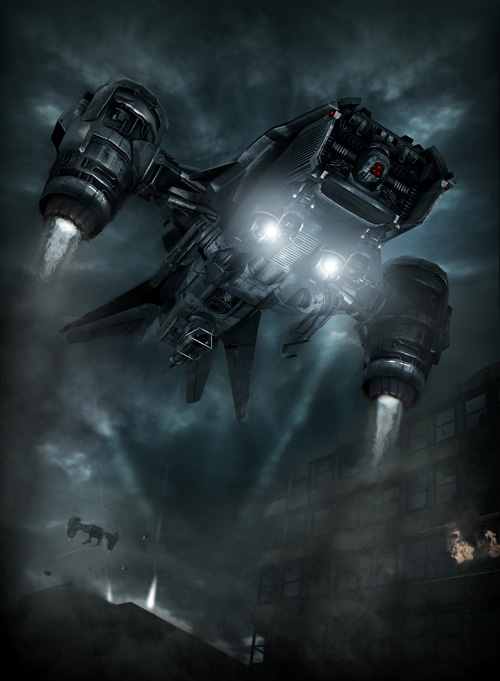
The simple fact is that, in comparison to a manned aircraft, even the smartest UAV today is still pretty dumb – even the pathological mono-focus of The Terminator’s Hunter-Killers is a long way off, let alone the true learning ability of Stealth‘s EDI – in the meantime, the squidgy bits, in the air or on the ground, offer the best option not just for smart weapons but smart, devious and cunning weapons…

Weekly Photo Challenge: Entrance

The entrance to the Lodge when we arrived in 2004...

...and as it is now, looking back the other way...

Yes, sports fans, it’s another WordPress Weekly Photo Challenge post…all that maintains my presence in the blogosphere recently…I’m enjoying my first real weekend off since February and so, apart from checking for booking requests for the Chalet, have been staying offline and recharging batteries… This is the busy period for ASIC and so much of my time is spent hammering the keyboard managing our part of the programme and also drafting various products…maybe too much of this work has got me in a mindset of thinking I need blog posts to be more like articles so I might look at going back to more but smaller items just to keep up the steady patter of ambient noise… Please don’t forget though that it is the bi-ennial Scale Model Expo in Lower Hutt, Wellington this weekend, where this will be on display (with Hawkeye UAV sponsoring a prize as well)… …from the 2009 Expo…

By land...

...by air...

...and by land again (couldn't find any good shots of ships from 2009 ( they were there just my dodgy photos)...