Unknown's avatar

About SJPONeill

Retired(ish) and living on the side of a mountain. I love reading and writing, pottering around with DIY in the garden and the kitchen, watching movies and building models from plastic and paper...I have two awesome daughters, two awesome grand-daughters and two awesome big dogs...lots of awesomeness around me...

Better than the beach…

As we near the end of the 2017 snow season, I took the opportunity for one last run on the free bus that has run from National Park Village to Whakapapa skifield this season.

P70922-100054

Signage is still non-existent: even with the special restrictions on signage in the Village, this is a little too minimalist. There was no indication where to go from SH4, and no sign that this was the right place to be for the bus – nice coffee and cake inside while waiting for the bus though…

P70922-100003

The car park still needs work. Even for a transport ‘experiment’, this is pretty rough – at least it’s not still covered in ice.

P70922-110144

The bus was a nice new 22-seater with rear bins for skis, poles and boards which otherwise might become hazardous inside – people have to be encouraged to use them though, otherwise it defeats the purpose.

It’s about a 20 minute drive from National Park Village up to the ski field – sit on the right side of the bus for great views of Ruapehu. One of the best things about catching the bus is that it drops you right at the top of the road and you don’t have to worry a. about navigating up from the car parks, b. getting skittled while navigating up from the car parks, or c. finding the car parks have filled and the road has been closed after you’ve departed National Park Village in the car.

Get the bus!should have been the RAL mantra this season. I’m not sold on the idea of the free (with caveats) bus although I’m most happy to use it while it’s there. It’s not clear what RAL was trying to achieve with this experiment when there is already an existing solid transport infrastructure  on the western side of the Mountain. If the problem it sought to address was inexperienced drivers on the approach roads, then reducing the number of car parks at the Top of the Bruce and allowing the existing transport operators to carry the load (literally) would have mitigated this hazard, especially if coupled with an effective information campaign.

Enough with the logistics though…a glorious bluebird day…and not too busy on a Friday, although everybody was bracing for a big weekend…!

P70922-110159

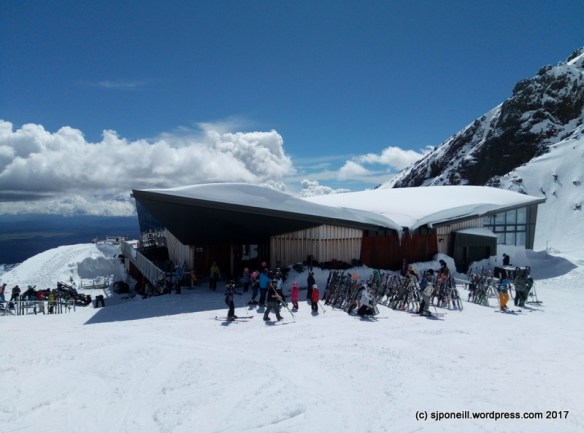
Lorenz cafe and Vertical Retail front, ticket sales and lost and found (more on this later!) on the right. getting a ticket was fast and painless – the big screens over each counter display most of the information you need…

The first lift up to Knoll Ridge cafe goes from the left of the shop/cafe building…an easy walk in the snow…regardless of the day, though, be warm for the lift…

P70922-111319-001

Looking back at the top of the first (Rangatira) lift…
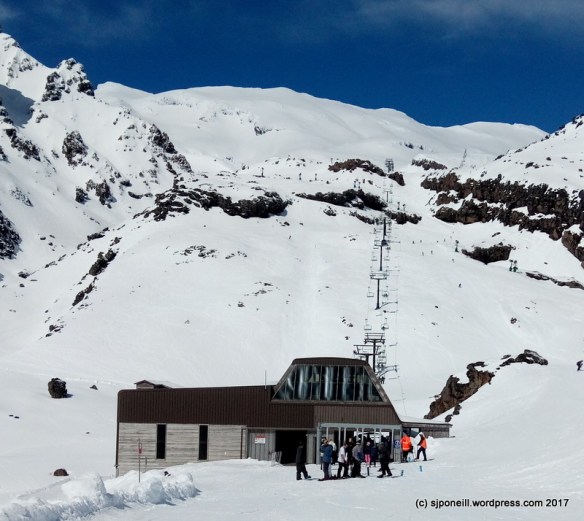
P70922-111322-001

…and walking towards the Waterfall Express lift for the final leg up to Knoll Ridge…
P70922-112006

There’s a short slope from the top of the Waterfall Express down to Knoll Ridge cafe…this needs a little care if it’s icy and also being aware of skiers and boarders around you in various states of control…

P70922-112647.jpg

Coffee!! Yes!! And, contrary to much of the social media cry-babying, prices are reasonable…in fact, no much different from those at the Station cafe while I was waiting for the bus…

FB_IMG_1506036593104-001

Just plant a chair in the snow and enjoy the view north…

P70922-122312

…and over my right shoulder…I think I dropped my lift pass when I paid for my coffee – you don’t need one to get back down but you do need one for the bus home to stay free – no drama, the young lady at the counter just smiled and handed me another: I am probably neither the first nor the last…

P70922-134806

Starting back down on the Waterfall Express – an image cleverly cropped to eliminate the fingers that filled most of the frame: I may have been a little worried about dropping my phone…I could happily have stayed another hour but I had a mission to complete before heading home…

A fried had been skiing with a mate a few days earlier…”post-ski beers” had prevented her mate clearing his gear from his locker in Happy Valley…could I please see if I could recover it for him? Armed only with my wits and what might have been the locker number (it wasn’t), I set off…

Happy Valley is the big success story from the Whakapapa 2017 snow season. The beneficiary of a multi-million dollar investment, it was able to open a month earlier than the tradition first week of July (and that usually with crappy rock-studded snow). The enabler for this early opening was a new-tech snow-maker that’s able to operate effectively in temperatures up to 24 degrees C. Thus not only was snow guaranteed for Queen’s Birthday Weekend, it was guaranteed to be rock-free…

P70922-110554

Looking down into Happy Valley from the plaza area in front of Lorenz’ and Vertical…the new elevators on the left and a far sharper means of ingress and egress; rentals at the base on the left and the revitalised Bistro cafe on the right; in the left distance is one of the new magic carpets to bring punters back up to the top of the Valley, on the right is the old chair lift that will hopefully disappear over summer.

P70922-141535

The top ends of two of the carpets…very smooth, very slick…

P70922-141603

…looking back up the elevator tower…

P70922-141815

…and the outside dining area in front of the Bistro…

So…my mission…onwards…actually it was pretty simple. I explained my challenge to the nice staff at the rentals counter in Happy Valley – again, not the first time they’ve managed this issue – once they were satisfied with my bona fides, senior staff member bypassed the locking mechanism to open what we had determined was the actually locker in question. I was soon in possession (thankfully temporary) of a Hunting and Fishing top, and some stinky sox and runners…

Getting the bus back to National Park is a little more complex than getting to Whakapapa…there aren’t any more signs but the staff are really helpful and make sure everyone knows which bus to aim for…

The Transit bus back to National Park was packed, not even standing room only. With the weight of skis, boards, boots, etc on a busy day, I wonder how close they get to overloaded..? I also wasn’t too fussed about the number of people carrying their ski/boarding gear on the bus with them: untidy in the event of an accident…

Strangely after all the hype about needing a valid pass for the day for the return bus to be free, there were no checks at the ski field or the transit stop in Whakapapa Village. I’d heard that this was the case with some drivers and I wonder why a ticket check is a. hard and b. how much this added to the total loss generated by this season’s ‘free’ transport experiment…?

As days go, my day on the mountain was great…blue skies, no wind, good coffee and awesome views… #betterthanthebeach

(…in fact, so much better than the beach, I’m seriously considering a an early season ticket for 2018…at the current early bird price, it would pay for itself just coffeeing @ Knoll Ridge…)

P70922-112006-001

Winter Office 2018..?


MHAW Photo-a-day Challenge – Oct. 3 – Light

P71003-194643.jpg

Last light

Snapped after dinner outside Schnapps…almost forgot…

The Challenge

Mental Health Awareness Week in New Zealand is 9-15 October this year. Each year, the Mental Health Foundation of New Zealand runs and sponsors a number of awareness activities.

The MHAW Photo Challenge runs from 1-15 October  Each day participants post an image that is their take on that day’s theme:

Oct. 1 – My view
Oct. 2 – Gratitude
Oct. 3 – Light
Oct. 4 – Water
Oct. 5 – Small treasures
Oct. 6 – Nature indoors
Oct. 7 – Bush walk
Oct. 8 – Art
Oct. 9 – Pop of colour
Oct. 10 – MHAW Lockout
Oct. 11 – Papatūānuku (Mother Earth)
Oct. 12 – Creature
Oct. 13 – Spring
Oct. 14 – Love my backyard
Oct. 15 – Nature is key to…

#MHAWNZ

MHAW Photo-a-day Challenge – Oct. 2 – Gratitude

I’m not sure if the doggie theme will last throughout the MHAW Challenge but it survived to Day 2 – Gratitude

P71002-123901

Aaaah…a chance to rest without that little cannonball…

P71002-130635

At last…just me and MY bone without that Monster giving me crazy eyes…

The Challenge

Mental Health Awareness Week in New Zealand is 9-15 October this year. Each year, the Mental Health Foundation of New Zealand runs and sponsors a number of awareness activities.

The MHAW Photo Challenge runs from 1-15 October  Each day participants post an image that is their take on that day’s theme:

Oct. 1 – My view
Oct. 2 – Gratitude
Oct. 3 – Light
Oct. 4 – Water
Oct. 5 – Small treasures
Oct. 6 – Nature indoors
Oct. 7 – Bush walk
Oct. 8 – Art
Oct. 9 – Pop of colour
Oct. 10 – MHAW Lockout
Oct. 11 – Papatūānuku (Mother Earth)
Oct. 12 – Creature
Oct. 13 – Spring
Oct. 14 – Love my backyard
Oct. 15 – Nature is key to…

#MHAWNZ

Bosch – Season 2

bosch-588a63a336191

After being impressed by Season 1, I was looking forward to Season 2 of Bosch when Mighty Ape hammered $30 off the shelf price…I was underwhelmed…

A dead body found in the trunk of a car on Mulholland Drive appears to have mob connections and leads LAPD homicide detective Harry Bosch down a dangerous trail of corruption and collusion that stretches to Las Vegas and back. As the case becomes more complex and personal, and Bosch’s search for the truth more relentless, the dark side of the police department is brought to light.

That is a description of Michael Connelly’s Bosch novel Trunk Music. I’ve read Truck Music a number of times: it is a fast-paced story with plenty of plot twists and turns and the novel in which Eleanor Wish re-enters Bosch’s life. It doesn’t need any additional sub-plots to beef up the story and it certainly doesn’t need to marginalise The Last Coyote by adding that plot line to the last few episodes of the Season 2 story. Coyote is one of the best Bosch novels and deserving of its own season – it resolves a number of Bosch issues and sets the scene for the next few novels.

I really like the idea of adapting a  novel to a ten (or so) episode TV series and appreciate that there will always be some literary license applied. I don’t mind that the Bosch-verse has been updated to the current day or that he’s no longer a Vietnam veteran. I do mind when a great story is marginalised for no apparent reason; it’s certainly no improvement on Michael Connelly’s original (although I noted that he is listed on the series production team).

Recommend Bosch Season 1? Absolutely!

Season 2? Meh…maybe if you haven’t read the books or once it turns up on Netflix…

MHAW Photo-a-day Challenge Oct. 1 – My view

P71001-065526.jpg

OK…it’s morning now…let’s go..!!!!

This is Kala (Kar-la), a young rescue Rottie that I picked up last weekend. She is the tiniest Rottie that I have ever seen – apparently she is almost three years old! – only a quarter the size of Louie.

She has made such massive progress in the last week. At first she was shy and afraid of everything and very defensive. She hadn’t spent much time indoors and until her initial rescue had been poorly-fed and -treated…

After a week, she is much more confident and this is how she woke me this morning – ‘my view’ of that wake-up…

The Challenge

Mental Health Awareness Week in New Zealand is 9-15 October this year. Each year, the Mental Health Foundation of New Zealand runs and sponsors a number of awareness activities.

The MHAW Photo Challenge runs from 1-15 October  Each day participants post an image that is their take on that day’s theme:

Oct. 1 – My view
Oct. 2 – Gratitude
Oct. 3 – Light
Oct. 4 – Water
Oct. 5 – Small treasures
Oct. 6 – Nature indoors
Oct. 7 – Bush walk
Oct. 8 – Art
Oct. 9 – Pop of colour
Oct. 10 – MHAW Lockout
Oct. 11 – Papatūānuku (Mother Earth)
Oct. 12 – Creature
Oct. 13 – Spring
Oct. 14 – Love my backyard
Oct. 15 – Nature is key to…

#MHAWNZ

A nutty two in one…three even…

I think this idea first fell from a recipe that popped up in my or a friend’s Facebook feed for no bake cranberry energy bites from Life Made Sweeter

I liked the sound of it – ‘cept the peanut butter part. Almonds I’m reserving for coconut almond milk: it’s getting warmer here and porridge has dropped on the breakfast menu (pending more snow!) in lieu of muesli, which uses more milk.

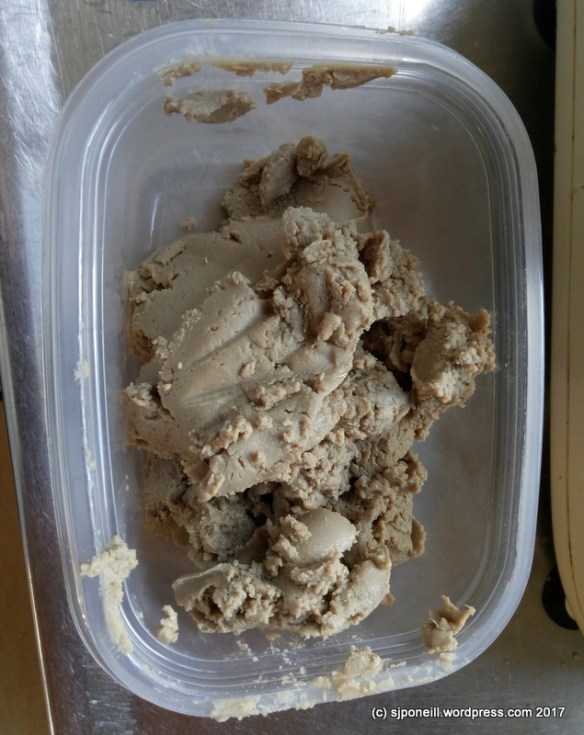
Looking at the nuts available, sunflower seeds looked promising and a quick Google led me to this recipe at Pretty Prudent. It is so simple. The only crucial ingredient not listed in the recipe is patience: depending on your food processor, it may take a while for the powdered nuts to cream into butter

P70923-124031

Not yet..keep going

….just keep the faith, follow the directions and it will turn out OK. Three cups of seeds = about two cups of sunbutter.

P70923-124304

It’s fairly solid but spreads with care…more oil would make it creamier but compete with the sunflower seed flavour…the solution, as offered in the comments on the original recipe, may be to use sunflower oil for the creaming…

Keeping the butter in the fridge also contributes to the harder consistency and I’m wondering if my Mad Millie Ceramic Butter Keeper will keep it cool to enough to stop it going off too early but warm enough to be more spreadable…

P70927-103832

Why doesn’t someone invent a straight banana…?

Fresh banana and sunbutter on herb bread toast has been part of breakfast the last two mornings. Very filling with an interesting combination of sweet banana and stick nut…nice…but I would probably go for it more if the sunbutter was a little more creamy and a little less sticky – always my one big objection to most peanut butter…I may sub the sunbutter in instead of peanut butter in one of our peanut rice dishes to see how it goes…

So, getting back on track for the energy bites…again a recipe so simple…just follow the directions….too easy…

P70924-200638.jpg

My only deviations from the original recipe were subbing in the sunbutter and using almond coconut meal (leftover from almond coconut milk) in lieu of coconut…if you’ve got, I say, use it…

As writ, the recipe is good for about 20-25 bites. They store well in the fridge and are tasty and very filling: ideal for fending off attacks of the munchies…

Next time around, I will double the dried fruit – not necessarily cranberries – and use normal rolled oats instead of the quick cook oats – I just don’t think they add a lot of value – and/or I may sub in a not-oat-based alternative…not because I am particularly concerned about the gluten thing but because, again, I can…

And there you go, an easy three-fer….

Salmon with Spicy Tomato Rice

P70917-204000.jpg

Spur of the moment invention dinner…

As part of my green journey, I have been slowly reducing the number of production steps between me and the raw materials. Last week, I used the last can of tomatoes from the pantry and resolved henceforth to only use fresh tomatoes where previously I would have used the canned variety.

Obviously this means a little more planning ahead due to the shelf life of fresh tomatoes v their tinny competition. So the tomatoes I bought last we were starting to scream for attention and tonight was the night. I wanted to do something a bit different and also empty out the freezer a little more – still don’t have much space for frozen soups and TV dinners after giving up the chest freezer in the garage.

I took some salmon steaks out and only once they were committed to defrosting did I stop to consider how tomatoes might figure in tonight’s dining experience. I got some ideas from Google, selecting this one for Mexican tomato rice and beans from Fine Foods as my base.

It looked like – and was – a quick cook so I got the rice on first. Now that the last of the white rice is gone, it’s all brown from here on – I’m using a mix of long and short grain – with black held in reserve for special occasions. The spicy tomato bit has this in it:

  • 1 teaspoon of oil (grapeseed tonight)
  • 6 cloves of garlic, finely chopped
  • 1 generous tablespoon of jalapenos, also finely chopped
  • 1 teaspoon of black salt (the colour doesn’t really mean anything)
  • 2 teaspoons of cumin powder
  • 1 teaspoon of curry powder
  • 1 can of red kidney beans (also the last can)
  • 440 grams of fresh tomatoes, blended
  • 1 heaped teaspoon of oregano
  • 1 heaped teaspoon of coriander powder (will use crushed seeds next time)

I started by frying the garlic and jalapeno in the oil til the flavours were really strong – about a minute – before stirring in the spices and salt. After a couple of minutes add the tomato and beans, followed by the herbs. If it looks a tad dry, add about half a cup of water (I rinsed  the bean tin into the pan).

Once this is simmering away, I added the salmon steaks, and let it all simmer away until the rice was done.

Nice a simple. Hot and spicy. Brought out a good sweat on a cold wind wet night…

Took out some more fish to do again with the leftovers tomorrow…

Thinking peer v peer conflict again…


cove spike dm.JPG

This post arose from a Doctrine Man comment, referring to the Australian Army’s The Cove, an online public discussion forum for military matters.

The subject at had was a case for the SPIKE Non-Line Of Sight (NLOS) missile system as a key enabler for distributed forces. I’ve uploaded the actual paper as a PDF here as well to maintain context after losing a load of linked material after the US Army binned its Colloquium files and the discussion fora that lived under the COIN Center.

A point on formatting…the staff paper double-spaced format makes for easy marking but less for easy reading. Different audience, different format, especially if you’re trying to sell something. Rather than posting a document as a native Word doc, a PDF is more compatible with a range of devices.

Anyway, academic nitpicking aside…

This paper leaps directly to a solution without really defining the capability requirement or discussing alternative solutions. Distributed combat capability needs remote targeting and engagement, probably with a higher degree of autonomy and data fusion than that defined in this paper. Any system like but not necessarily Spike cannot be discussed in isolation from other offensive and defensive systems, if for no other reason that to define Spike’s place in the bigger scheme of things.

Some things we carefully tap-dance around when discussing high-tech solutions to tactical and operational challenges are the cost of the system, in practical terms, how many are actually sitting on the shelf, how long can we sustain their use, and what happens when they run out, many of these system not have massive rates of production. Also needing to be discussed is countering counter-measures, especially with any system that relies on remote input, and even more so in a peer v peer conflict i.e. when the ‘other guy’ might be as good as or possibly, Lord forbid, better than us. That is a situation that we down under have not seriously faced on a large scale since the Second World War.

Spike is without doubt a good weapon system. Is it the only answer? Unlikely. If we’re going to adapt back in to the harsh world of peer v peer conflict, we need to first (re)define that environment. If there is nothing that we have not learned the hard way since 911, it should be not to underestimate our opponents or those arguments inconvenient to our own.

Just as our transition from ‘thing’-based conflict to people-focused conflict was less than smooth, we need to work to ensure that the reverse path is clear (as much as possible) of myths, assumptions, or biased thought. We have not faced a truly equal opponent in peer v peer conflict since the Second World War, a conflict that began with a harsh three year learning curve.

The Cove resource that the Australian Army established on the public internet is an innovative adaptive tool to promote these discussions with a broader audience. It is open to anyone to not only constructively comment but to also contribute papers on contemporary topics.

Like many others on this side of the ditch, I’ve also migrated ti The Cove with the demise of the NZDF’s equivalent, The Hub. The Hub ran as a twelve month experiment to engage current and former servicepeople – at the end of that period, someone decided to can it. True, the interface was a little clunky and it still existed behind a secure firewall – seriously, what do you have hide? – but it was a significant step in the right direction. Sad to see it go but happy to virtually commute across the Tasman to carry on the discussion…


Alpine guide frustrated at casual attitudes – Tongariro Alpine Crossing

Truly awesome to see that the national media have picked up this story…the full text of Andrea’s story can be seen here with the current safety messages for the Tongariro Alpine Crossing in winter here

We need to see more of the guiding community telling their stories and sharing their experiences on the Alpine Crossing as part of educating visitors to the Tongariro district.

Year-round this is a beautiful place, one of the only areas in New Zealand that you can explore an active volcanic, but it is always a place to be respected. Respected for its cultural heritage and because it is unforgiving towards to the unprepared, ill-informed and complacent…

One of the best sources of current information on the Crossing is the Tongariro Alpine Crossing app that was released this year…available in the Google Playstore and iTunes…is your life, and the lives of your family and friends worth a small fee…? We would hope so…

15871674_564913907048354_5369840645284961921_n.jpg

Get the app…

This pic is, of course of the Crossing in summer. In winter, this is what you will encounter:adrift fb winter 4.jpg

Know Before You Go

If You Don’t Know, Don’t Go

or

Go With A Guide

Field observations TAC 26/8/2017

Yesterday afternoon, I received this email from a  good friend who is an experienced guide in Tongariro National Park. The initial target audience was the visitor information centres around the Central Plateau – that audience has now grown…

To whom it may concern,

I am an alpine guide, currently working on the Tongariro Alpine Crossing. This is my fourth season on the TAC. My primary duty of care is to the safety and well-being of the clients on my trip, however I am often asked by freedom walkers for information and advice. Far too many people recreating in Tongariro National Park are uninformed about the hazards on the TAC and are unprepared for the conditions they will encounter. In some cases, people are putting themselves in harms way or endangering those around them and I feel obliged to intervene. This is actually quite common, but most of us guiding in Tongariro see that we act as kaitiake for the people and the land and don’t hesitate to offer assistance. This is an ongoing problem and the number of people putting themselves in danger increases exponentially each season. This is a problem that many people involved in tourism, recreation, and the outdoors community in Central Ruapehu are well aware of.

I would like to make it clear that I am not against freedom walking the TAC in winter, but that I am against trail users getting bad advice or no advice, going unprepared, and exposing themselves to unnecessary risks.

I am writing this letter because of what I saw while I was guiding on the TAC on Saturday, 26 August 2017. The number of people walking the track in completely inappropriate gear with no clue and no humility was SHOCKING. People dressed only in sneakers and blue jeans, without rain jackets or warm hats and gloves. There was a much higher than average number of freedom walkers on the track that day. At a guess, I would say that there were a few hundred. Tongariro Expeditions were operating their transport only service that day, as well as a large number of groups both large and small providing their own transport.

It is my opinion that when transport only services operate in winter, the public is watching. They see “no risk” when in reality there exists a “low risk”. Understanding that difference is critical. It is also imperative that people understand the difference between a forecast and a guarantee. Weather in New Zealand mountains is unpredictable and rapidly changeable. I believe that the greatest danger to people on this day was the weather, and the perceived risk.

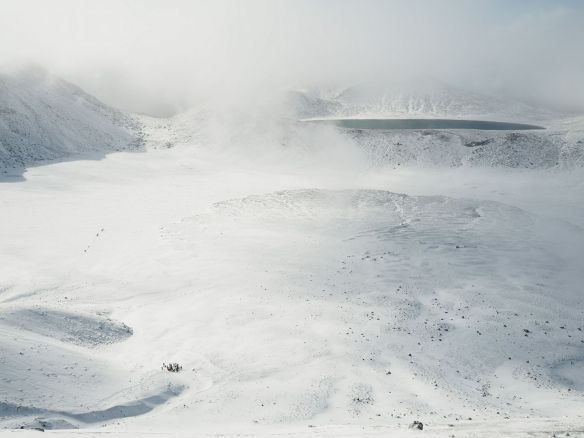
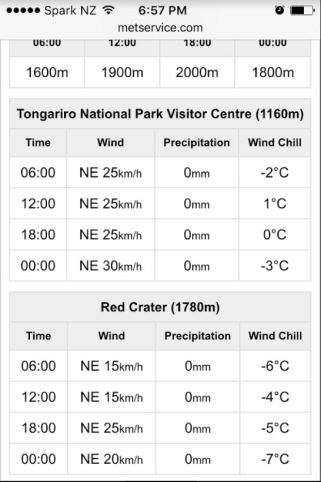
The forecast on Saturday 26 August 2017, according to Metservice, called for fine conditions and light winds. On paper, truly a beautiful day! My observations on track told a very different story. The lenticular clouds capping Ngauruhoe meant winds were much stronger than the 15km/h in the forecast for the Red Crater. Metvuw charts showed rain to the northwest of Tongariro, so I knew that those stronger than forecast winds would also bring clouds. In spite of the forecast I could see that we were in for a cold day, with no sun, strong winds, and white-out conditions. Which is exactly what we got. The Red Crater was being hit by 50km/h winds and the wind chill was hovering around -8. Cloud in the Central Crater caused poor visibility, fluctuating between 50 meters and 500 meters of visibility. These are challenging and hazardous conditions.

One unprepared (cold and scared) freedom walker was rescued (from Shelter Rock) by other hikers on their descent from the summit of the TAC and given extra gear and guidance back to the start of the track (Mangatepopo Car Park).  People were observed walking on cornices on the Red Crater, walking out onto the ice on the Emerald Lakes, onto the ice on the Blue Lake, and were advised of the dangers they were putting themselves into. Many people without proper attire continued to walk into worsening conditions in spite of warnings from myself, other guides, and members of a local tramping club.

Waikato Tramping Club was on their annual winter Tongariro trek and spent lot of time and energy trying to warn people of the risks involved in trekking in alpine conditions without proper gear or know-how. They attempted to turn around many people on this day that were unaware of the danger they were putting themselves in and unaware of the hazards on the TAC. I have reached out to the club and encouraged them to write a letter with their observations.

I am passionate about the outdoors. I love Tongariro. I love creating safe experiences that are fun and memorable. If I can, I want to help more people come home safe and happy after a day in our mountains. I am reaching out to your organisation with my field observations because I believe that we are allies in this goal. I have provided below descriptions of the hazards, risks and consequences that are common on the TAC in winter, as well as the MetService forecast for the day. I personally observed people exposing themselves to each of the hazards below on this day. It is my sincere hope that this letter is useful in some way.

Thank you for your consideration,


TAC 26 aug 17 - 2TAC 26 aug 17

Below is a list of some hazards that exist on the TAC in winter. I have omitted to speak about avalanche hazards, as the Backcountry Avalanche Advisory does an excellent job of detailing the risks and hazards on a daily basis.

Walking on cornices

-large cornices exist around the rim and summit of the Red Crater. There are many others throughout the TAC but these are the cornices that are easiest to walk onto without realizing what you’re doing

-the risk is that by walking onto a cornice you will cause it to break and you will fall

-the consequences of breaking a cornice are VERY HIGH and potentially life-threatening, as you would fall 50+ meters and likely be buried in snow from the falling debris

Walking on the ice covering the Emerald Lakes

-the lakes are not well frozen and are currently thawing, so the risk of breaking the ice and falling into the lakes is VERY HIGH

-consequences of of falling through the ice into the lake are SERIOUS and potentially life-threatening, as both drowning and hypothermia are likely outcomes

Walking on the ice covering the Blue Lake

-the risk posed by walking on the Blue Lake is precisely the same as the Emerald Lakes, but the consequences are higher, as the size and depth of the lake would pose much larger problems for rescue

Not having the appropriate gear

-sunglasses, warm hats and gloves, boots, rain jackets, and intelligent layers are a must in an unpredictable alpine environment such as the TAC. To venture out unprepared is to risk frostbite or hypothermia, or in the case of not having sunglasses you are risking snowblindness

Not having the appropriate equipment

-at the very least it is necessary to carry a topographic map and compass (and know how to use them), the risk is that you will get lost. Poor visibility and featureless snow-fields (such as the Central and South Crater) create navigational challenges. Additionally, the summer track is generally considered unsafe in common winter conditions and an alternate track exists, many people aren’t even aware that they may encounter more than one track and this creates confusion

-often it is necessary to carry (and know how to use) crampons, ice-axe, and helmet. Without this gear you risk sliding down steep and long icy surfaces. Sliding can carry high consequences.

The feelings expressed here are shared by many of us who live up here: as much as we want people to come here and enjoy this wonderful location, we want them to do it safely.

Many of our visitors – and not just the international ones – don’t have any frame of reference for the hazards of an alpine environment…the closest many of them will get is watching Cliffhanger or Everest in FullHD with the woodburner fully cranked up…

Know Before You Go

If You Don’t Know, Don’t Go…

…Or Go With A Guide