Wiki…whatever….

Julian Assange’s latest exploits from Wikileaks have caused about as much real news as Y2K on 1 January 2000…after all the hype and expectation-massaging, the latest torrent of leaked documents is about as inspiring and memorable as George Lucas’ attempt at a prequel trilogy to the Original Trilogy…I once heard somewhere that the body doesn’t remember pain: it’s not that great at remembering boredom either and hopefully once the ripples in the pond subside, Assange will be marginalised by the growing realisation that he has actually done anything…all the risk was taken by those who actually leaked the quarter of a million documents in question and anyone who believes that one disgruntled PFC who’s just been dumped by his boyfriend can steal such a range of classified documents is living in Lala-land (much, in fact, like those in my previous post…)…

Michael Yon puts it all in perspective on his Facebook Page by linking Assange to other nutjobs….

It is HIGHLY doubtful that the United States government would kill Assange. If Assange is killed, the hit more likely would come from a lone wolf or someone else’s government. The conspiracy theorists might then “prove” that it was a CIA hit ordered by the same people who killed Kennedy, and that we didn’t really land on the moon but we do have a secret moon base. And 9/11 was a Jewish plot…

Never really thought about that before either…that the same people who deny the moon landings are the same ones who think the US/UN World Government has a secret Moonbase…but then again, when I was 10 I was a big fan of Gerry Anderson’s UFO and thought that building a secret Moonbase (complete with chicks with purple hair – the penny relating to the benefits of the short skirts hadn’t really dropped when I was that old) was a. pretty cool and b. pretty simple…

Dean covers it all pretty well in Wikileaks and ‘cablegate’ and I share his desperate plea to stop adding ‘gate’ to everything that has the slightest potential whiff of scandal attached to it…much the same as could we please stop referring to every campaign or initiative as a ‘war’ unless we really mean to fix bayonets, send in the Marines and let Air Combat Command off the leash…

And on ‘wars’, let’s not forget that, rhetoric aside, we’re not really at war at the moment…in at least one…yes, certainly…but ‘at’ war…no, not really: we’re not harnessing all the instruments of national power to quell the adversary and most definitely, we are not acting against those who seek to undermine the ‘war’ effort through accident or deliberate action. And that, boys, girls and family pets, is why people like Assange get away with what they do: because they are not breaking any laws…that their motives and actions are reprehensible is beyond question but even if it can be proved in the World Court (where else would have jurisdiction?) that the wikileaks were directly responsible for deaths in Afghanistan or elsewhere, it is not an offense to publish leaked material – not unless perhaps there is some form of court-ordered suppression order in effect. Even then, with the internet being what it is, it is unlikely that this would be that enforceable or provable…

But that notwithstanding, the lunatic fringe is out there demanding that Assange be arrested, assassinated or otherwise jabbed in the calf by a ricin-loaded umbrella. There’s a good thread at Small Wars Journal that hammers out the why-nots of this issue. In fact, Small Wars seems to be all over this one…WikiLeaks, Round Three provides a comprehensive list of links to various comments and reports on Assange’s latest non-event: note the DoD caveat at the top of the list, two or more wrongs DO NOT make a right:

Department of Defense personnel should not access the WikiLeaks website to view or download publicized classified information nor should they download it from anywhere, regardless of the source. Doing so will introduce potentially classified information on unclassified networks. Executive Order 13526 states ‘Classified Information shall not be declassified automatically as a result of any unauthorized disclosure of identical or similar information.

Digital security problem is bigger than Assange and PFC Manning discusses the likelihood of kneejerk reactions to PFC Manning’s indiscretions (so just how does one PFC access let alone copy 250,000 classified military and diplomatic documents between making coffee, sweeping the floor and being unappreciated?) leading to balkanisation of military and government information systems ( and Dean raises this as well)…might as well since most of them can’t talk to each other anyway, but doing so effectively cedes the public information domain to the other guys – which is probably not the sharpest move we’d want to be making…

And finally a word from our sponsor for the current ‘war’, Secretary Gates, once again courtesy of Michael Yon :

I’ve heard the impact of these releases on our foreign policy described as a meltdown, as a game-changer, and so on.  I think — I think those descriptions are fairly significantly overwrought. The fact is, governments deal with the United States because it’s in their interest, not because they like us, not because they trust us, and not because they believe we can keep secrets.  Many governments — some governments deal with us because they fear us, some because they respect us, most because they need us.  We are still essentially, as has been said before, the indispensable nation.

So other nations will continue to deal with us.  They will continue to work with us.  We will continue to share sensitive information with one another.

Is this embarrassing?  Yes.  Is it awkward?  Yes.  Consequences for U.S. foreign policy?  I think fairly modest.

The sooner we forget about Assange and let him be consumed by his own insignificance, the better…the real problem raised by the unauthorised release of close to half a million classified documents is what are we going to do a. about those who are releasing them in the first place (there can’t be THAT many briefcases and thumb drives left on the train each night)? and b. how do we train and educate their replacements that doing these is the wrong thing to do…?

Pike River

The church bell rang 29 times, so we knew it was final and the end of the line. Now 29 miners are at Heaven’s gate, with coal silt dirty faces asking “Is it too late?” God replies with half a grin “No my children, come in.” They place their mining lights gently on Heaven’s floor, and God says “Job well done, leave your boots at the door”


Staying focused in Afghanistan

A couple of months ago, in The Information (R)evolution, I made comment on an article in the Sept 10 C4ISR Journal, Shifting Terrain (After the C4ISR JOurnal site was taken down the only record of the original article I have is my original scribbled on one). On later reflection, I thought that it might be more constructive to offer a counterpoint to this article in the Journal as a means of furthering discussion and awareness of the nature of the contemporary operating environment. C4ISR Journal was happy to pick up my commentary and have just published it in the November 2010 issue…so, with no further ado, may I present for your professional information and review…Staying focused in Afghanistan…

The version published is actually the penultimate version but technology conspired against us while I was on the road last month and neither myself nor Ben Iannotta, the C4ISR editor, were able to close off the last few loose threads before the closure of the publishing deadline. I have a copy of the final version and will upload it here in a couple of weeks so as not to steal any fire from the Journal’s current issue…

I haven’t had a chance to read through the other articles yet except for NATO integrates ISR at all levels which I think is still a largely aspirational goal but at least someone senior is forcing the debate. While the lowest common denominator approach may have been successfully employed in peacekeeping operations in the 90s, where possibly the driving force within the operation is the number of national flags waving at the table, it remains patently unsound for operations to the right of peacekeeping on the spectrum of conflict. More complex campaigns require entry bars to be set across a range of key enablers that might include language, doctrine, technical interoperability in communications, C2 and information systems, and levels of training in selected key skills…


Hit the road, Jack…

…and don’t you come back no more, no more, no more…

I remember Liz Mullane from working on the Lord of the Rings trilogy ten or so years ago…a sharp operator and a top lady…

…a meeting of Wellington film technicians came together within 3 hours and over a thousand people came – then when they decided to turn up at the equity meeting to put their point of view to Simon Whipp it was cancelled! – they are now at Parliament with some basic demands – take off the International boycott and MEAA get out of NZ!
Feel free to send this to everyone you know so they realise that there are consequences! This is much more than an actors issue! This is about a militant Australian union trying to take control of our film industry!
Over a thousand people are challenging the action taken by 400? (reported Akld meeting turnout) and that’s just in Wellington alone (Wgtn meeting 80 tops?). Do the math!
Liz Mullane

Bugger off, Skippy! We neither want nor need your ‘help’…

Today’s COIN Center VBB

As below, Dean presented at the COIN Center’s Virtual Brown Bag session this morning…the slides and audio file will be posted on the Center’s website in the next few days…I may be offline for a week or so as I am off globetrotting again but will link them in when I get an opportunity…in the meantime I strongly recommend that anyone with a personal or professional interest in contemporary intel issues, key an eye of the site and download both files when they become available. This is very good stuff and at least on a par with MG Flynn’s Fixing Intel paper from earlier this year…

Top effort from Dean and it is great to see a compadre’s efforts paying off like this….

As a taster, here’s some of the questions that were asked during the session (to hear the answers, you’ll need to download the files…)

MAJ Decker BCTP – guest: Coming in loud and clear

Peter Sakaris – guest: To understand the environment over time shouldn’t we be getting better more reliable HUMINT through increased population interaction? I would think that the example of a new officer working with a veteran police officer in the CONUS as you described would help to do this in the COIN environment. Obtaining the institutional knowledge of an environment can come from people that live in that environment because they live it every day and are in areas of the local community where it would be difficult for us to get into.

Kevin Frank JIWC – guest: Not will ing give up on the analysis issue- believe that if we collect the correct data and present it to the analyst correctly, we’ll get better analysis at the current training levels, especially if the commander is asking the right questions…comments?

DK Clark, DTAC/CGSC – guest: Did you use the pattern-analysis plot, activities matrix, association matrix, and societal considerations in FM 3-24.2? If so, could you comment on problems with these methods/techniques of framing and displaying the intel analysis in COIN?

MAJ Decker BCTP – guest: Afghanistan Reintegration Program (ARP) is now doing the same as the Boston Gun Project by providing retraining opportunities to former insurgents

HOMBSCH, DAVID G Lt Col : Comment only (no need to repeat):   I love the quote – “analysts to be historians, librarians, journalists” – spot on.   I also totally agree, with exploiting reach back – generate staff with expert knowledge on specific regions, who understand normality, and can interpret important changes (indicators and warnings) to cross cue counter insurgent forces.  Hypothesis – there is a place for more foreign nationals in analysis teams in CONUS and allied intelligence agencies?

CPT Linn – guest: how are we integrating analysis into Data collected from FETs and HUMINTs in theater?

Peter Sakaris – guest: The Stability Academy, Kabul (formerly the COIN center of Excellence) is a COIN Academy that the leadership of deploying BCTs cycle through as part of their RIP/TOAs. They recommend the ASCOPE/PMESII-PT crosswalk as an analytical tool for helping gain the needed detailed understanding of the “complex human terrain”. Are you familiar with this, or other tools like it such as TCAPF and do you find them useful for this purpose? Have you seen other approaches not discussed that are/have been in use?

CPT Linn – guest: also how is that data utilized in targeting packages?

MAJ Allen Smith – guest: Do you vet and confirm info from gang leaders using SIGINT?  How do you build trust on a Narc?

Kevin Frank JIWC – guest: There are many units out there reporting data (CATs, FETs, PRTs, unit reports etc) . But are they getting the right information? ASCOPE is one guide- are there other collection guides out there that can help us get better data? Does the LE community have anythi

Kevin Frank JIWC – guest: anything that can help?

RODRIGUEZ, ISMAEL R USA  2: Any thoughts on the application of GIS in a police intelligence role? Do you think these techniques could translate well in COIN?

Managing Land Conflict in Timor-Leste

This item just popped into the inbox…a great example of the sort of irregular activities that potentially threatens national or regional stability…using an interpretation of irregular that equates to ‘potentially destabilising’….

Dili/Brussels, 9 September 2010: Measures to resolve land disputes in Timor-Leste must go beyond a draft law on land titling if they are to comprehensively reduce the risks posed, otherwise the law could bring more problems than solutions.

Managing Land Conflict in Timor-Leste,* the latest briefing from the International Crisis Group, examines the country’s current tangle of land ownership claims, and recommends that the government and its partners act now to supplement titling with clear public information, clarify protections for those who will be evicted or resettled, and strengthen support to local mediation.

The need to balance land rights inherited from previous Portuguese and Indonesian colonial administrations with the reality of customary law, as well as the implications of a history of population displacements, have delayed the creation of a land administration system. Confusion over the present and future basis of property claims is widespread.

“Establishing legally enforceable property rights will inevitably create winners and losers,” says Cillian Nolan, Crisis Group South East Asia Analyst. “Unless the implications of this law are clearly understood, and protections developed for those who will be negatively affected, it risks being ignored or, even worse, becoming unenforceable”.

The current draft land law, approved by the Council of Ministers in March 2010 and awaiting parliamentary debate and approval, would establish the country’s first property ownership rights. Both the technicalities and the implications of the complex law are poorly understood. Sensitive issues include the fate of those Timorese who occupied empty properties in the violence following the 1999 referendum, the rights of Timorese living abroad to reclaim old property, and the holdings of the political elite. While passage of the draft law will help resolve many land disputes, further public information and debate should be a prerequisite for approval. Previous attempts to enforce laws on state property have often failed due to local resistance.

Though most disputes have to date been either resolved or frozen without recourse to violence, and many people are happy with the status quo, the issue will take on new urgency in light of ambitious new plans for government-driven development. Clarification of basic protections and resettlement plans for illegal or displaced occupants should be a priority, as should continued support to informal dispute mediation processes. The government should take initial steps now towards developing a comprehensive land use and housing policy, as well as to engage communities on sustainable ways of managing customary tenure systems.

“Timor-Leste cannot afford to wait much longer to establish a working mechanism for resolving property disputes as this is a key building block of the rule of law”, says Jim Della-Giacoma, Crisis Group’s South East Asia Project Director. “Failing to do so could instead plant new seeds for future disputes.”


The Information (R)evolution

I’ve been marking papers for the last week or so, some good, some indifferent and a couple, well, you know…I handed the last lot back on Friday and, on my way out of the office on Friday, tossed the September issue on C4ISR Journal in my bag to snap my mind back into reading structured material by people who at least know how to write…

I haven’t been disappointed in the content in this issue, although it has made me long somewhat for the free time to be able to read more if not ALL of the journals that we receive each month…the title of this thread comes from the editorial in this month’s issue…Keep the revolution on course…

In this item, editor Ben Ianotta, applauds the US Army’s initiative to adopt commercial ‘smart’ phones as means of distributing and sharing (they ARE two different functions) information to troops on the ground. The idea came from Army Vice-Chief Peter Chiarelli last year “Give troops the same power over information enjoyed by the average commercial iPhone user.” While I’m sure that Apple enjoyed the iPhone plug, it will have to move fast if it wants any significant share of this initiative. Already competitors using competitive operating systems like Google’s Android are hitting the streets and at considerably LESS cost than iProducts. Apple, I think, seems to have a habit of misjudging the market and relying on customer loyalty for expensive products that offer LESS interoperability for vague and illusory benefits.

Much like, perhaps, some military product developers…who have still not figured out that, since the end of the Cold War, primacy in technological development has reversed from military R&D leaders to the commercial sector…that it has taken two decades from the turning point for the Army to accept distributing commercial communication devices to soldiers as something that it MUST do is mildly disturbing and also somewhat ironic in that the information-based revolution in military affairs, the long-vaunted RMA, focussed on massive bloated central information systems that never really delivered. In the meantime, there was this thing called the internet…

Another change heralded by this programme is a long overdue acceptance that classifying any and all information relating to operations does NOT have to be classified up the wazoo, and even less so if you actually want it to get to those who need it…what was that definition of knowledge management, sorry…information management…that we use…

…the right information…

…to the right people…

…at the right time…

…AND ensuring that they know what to do with it…?

Of course, this does NOT mean that everything should be tossed on the intranet and levels of classification done away with – although it would be an interesting experiment post-Wikileaks to see if the sudden flood of information could ever be processed by an adversary fast enough to act decisively on it.

On page 12 of this issue, there’s a short item on a mobile 3G network access system known as MONAX that would allow soldiers to access information with less reliance on commercial cellular systems. MONAX base stations “…could be positioned as fixed mast antennas on the ground, on vehicles, or in airborne assets such as aerostats, C-130 transport aircraft or – potentially – unmanned planes…” immediately below this item, is another on a Google Android-based wearable computer known as Tactical Ground Reporting or TIGR. It’s intended to facilitate situational awareness for individual soldiers and although currently designed to work over a tactical radio network, Android is designed for smart phone connectivity so it’s probably not too hard to join the dots here.

And speaking of joining the dots, page 8 reports on the first flight of the AeroVironment Global Observer. Weighing in it less than 10,000lbs but with a wingspan of 175 feet and a payload of 380lbs, the Global Observer is intended to fly at 65,000 feet for 160+ hours (that’s over a week!) for customers who might range from weather services to cell phone companies and others that need persistent coverage over an area.

More and more commercial off-the-shelf is the way to go, simply to get something out there now, instead of tediously slow, often bloated and inefficient, development projects…

The cover article starting on page 16 advises that Global Hawk will probably NOT be able to meet the current target date of 2013 to replace the venerable U-2 for high altitude long-range surveillance and reconnaissance. The problem is not so much that there is anything wrong with Global Hawk except it was never designed to replace the U-2 and thus has not been integrated with a number of the key collection systems employed by the U-2. This all dates back to a 2005 directive by the Rumsfeld administration in the US DoD to retire a number of older aircraft types including the U-2 and hammered home in 2007 with Rumsfeld’s certification that the U-2 was “…no longer needed to cover intelligence gaps…” I wonder which of that administration’s cronies might have stood to gain the most from contracts for a fleet of new S&R platforms..?

Unfortunately there is no even any agreement that Global hawk is a suitable replacement for the U-2…another go-round of the efficiency (cheaper) versus effectiveness (does the job) argument in which the chair polishing advocates of efficiency still demonstrate that they simply do not get that people are actually useful…SKYNET has nothing on some of these drones in diminishing the value of the human component of military, and thus national, power…

Woman to woman

MG Michael Flynn, 2Lt Roxanne Bras

I’m a little cynical about this next item, leading off on page 34, written by MG Michael Flynn, of Fixing Intel fame/notoriety (I thought it was both very good and long overdue but many consider otherwise) and 2Lt Roxanne Bras on the value of Female Engagement Teams (FETs). The one question that kept coming back to me as I read and then re-read this article was ‘What do FETs really do?’ Don’t get me wrong…I’m sold on the concept as it’s one that was used to considerable good effect during the six year BEL ISI mission on Bougainville (giving the lie to the description in the article of FETs as “…the newest tool to emerge from battlefield innovation…”) and was also described as a key enabler in a recent brief here by a visiting UK psyops practitioner.

My first concern with this paper is that it feels like ‘spin’ – maybe I’m just a bit too set in my ways but I’m having trouble understanding why a two-star general and a junior officer would need to collaborate on a two page article (two and a half if you include the pictures) – paper? Yes perhaps. A book, definitely but this just doesn’t feel right or genuine. Perhaps a better approach would have been to have write the paper and the other provide comment from their own perspective? I always remember an instructor at Tac School who hammered into us the concept of ‘task with a purpose’ – what is something there to do. Reading this article, I wonder what the intent of the author’s is. Clearly there has been some resistance to the FET concept but I’m not sure that this article is going to help any…

The FETs are described as key to gathering information within Afghan village culture but are specifically excluded from collecting intelligence. This implies that there is some distinction between intelligence and information but surely ANY information on adversaries and competitors (once known as the enemy), the weather and terrain (physical, human, informational, whatever) might fall under the heading of intelligence…? And surely, by mere virtue of engaging Afghan women in conversation, FETs will be gathering elements of actionable information be it actionable in training, targeting, situational awareness, etc, etc…

The article even goes so far to distinguish between FETs and Human Terrain Teams which also gather information on social and cultural terrain on the grounds that “…FETs have not been trained in information gathering and they do not know how to vet the information they gather…” Huh? So a FET is not trained to vet information that it is not trained to gather but which is the primary raison d’etre for its existence in the first place i.e. “…the FET can provide valuable information to the commander…”. Moreover while FETs are (quite rightly) not “…working to change Afghan culture and ‘liberate’ the women…”, they “…are a strategic asset…” and  “…should be applied using the very same inkblot strategy applied to [the] wider COIN strategy…” However the inkblot in COIN is indicative of spreading change, typically in growing (hopefully) support for the government and security forces…so what FET-inspired effect will be inkblotted across Afghanistan?

I’m sorry but as much as I think MG Flynn hit the nail fair on the head with Fixing Intel at the beginning of the year, in this case, I think he would have achieved more stepping back and allowing 2Lt Bras to promote the case for FETs based on her own experiences than with this top-level ‘spin’.

Shifting Terrain

Enter a caption

Following immediately on from the FET article is a rather superficial one criticising both Flynn’s Fixing Intel and the human terrain concept by “…US Army experts Paul Meinshausen and Schaun Wheeler…” In arguing that “…information about the human terrain is not the information that decision makers need to be able to work with local populations or defeat insurgencies…” They argue (weakly) that “…more important than data…is an understanding of the influences that drive behaviour…”

As near as I can figure, their concept is that physical terrain and, more broadly, the physical environment is the key factor that affects a population and if we understand that environment, we can not only understand but influence the population. “The US and its allies need to let go of the assumption that conventional operations are somehow fundamentally different from counterinsurgent operations and consider the possibility that the population is just another group of people that adapts to its terrain just like any other friendly, neutral or enemy…” Ya think? Is that the arrogant ill-informed assumption that the flawed shock and awe doctrine was based on; the same doctrine that proved so bloodily ineffective in the first three years in Iraq ? Are these two “…experts…” really trying to say that it’s that simple, that all the work in the last five years on the shift from platform-based to individual-based warfare was just wrong and we had it right all along? Give me a break, please…

Nowhere in this article do the authors actually define where such understanding might come from, more so in the absence on what they claim is worthless ‘data’. I wonder if they might stop to think one night about the simple concept that perhaps understanding might be based upon analysis of lots and lots of bits of data and the application of that data against the context of the local environment. While dismissing the means by which we learn about cultures, including the old chestnut about anthropologists specifically criticising the human terrain system programme (in reality only a very small proportion of very vocal anthropologists have done so – the remainder seem happy to go about their anthropological business), they tell us that we need to learn about those same cultures in order to be able achieve our objectives in Afghanistan.

In the last paragraph before the ‘The Human Terrain Fallacy’ heading, the article states that an abundance of information on Afghanistan already exists from a vast range of non-military sources. This is absolutely correct but it is false to say this removes any requirement for the intelligence community to collect its own information. If anything the real problem that the authors allude to but never pin down in this article is that the problem is not in the collection but in the processing and analysis of this data, as both individual data sets and/or as a collated fused national data set. That the authors don’t ‘get’ this is clear when they follow on to declare a finding (in isolation) like “Dispute resolution must remain adaptive and flexible to setbacks and changes” as “…uselessly vague…”. As a statement on its own, this does seem like a statement of the blindingly obvious but then so do many other doctrinal statement – which is probably why they are espoused in doctrine in the first place. Examining that “uselessly vague” finding through a doctrinal lens, one might expect the context from which it has been ripped to include:

Examples of how dispute resolution processes have been applied with varying degrees of success.

A description of how that finding was derived.

Some distilled best practice guidelines, tips and techniques to assist the practitioner in getting it right.

Having spent a decade or so in the lessons learned game, some many clear and distinct observations and issues are ultimately distilled into similarly “uselessly vague” lessons which then form the basis of doctrinal change and evolution. Nowhere has this been more or better validated than through the ABCA Coalition Lessons Analysis Workshop (CLAW) process which was first implemented in 2005 and is now a key driver in ABCA processes.

This paper actually (painfully) reminds me of some of the less sharp papers I have graded in the last week or so. Instead of tasking itself with a clear purpose, it has the feel of a couple of first-year students more focused on being clever and impressing the staff with their brilliance…or what we call IntCorps-itis: always searching for the crucial piece of intelligence that will win the war instead of focusing on simply delivering good solid intelligence product…

I note that on Page 42, C4ISR itself awards this article a red ‘DANGER’ comment in its Attitude Check column and I wonder if someone else cancelled and this was all the C4ISR staff could find to fill the gap…it’s an article that’s not just immature but outright wrong and which would struggle to get an ‘F’ for ‘Fantastic’ on the marking scale….

In other news (in this issue)

There’s also some interesting updates on semi-autonomous EOD robots, iris scanning biometrics, the Blue Heron airborne multi-spectral imager and US Cyber Command and its challenges and opportunities.

On irregularity

We’ve had a bit of a beating in this little nation down-under in the last week or so…more speed wobbles than one might reasonably expect in a year…I’ve mentioned on a number of occasions how the UK phrase Countering Irregular Activity offers a more relevant construct for current and near-future periods of uncertainty and complexity than either the Marines’ Countering Irregular Threats or the overly-simplistic and over-used COIN. Who would have thought that in the space of a week we might experience four significant irregular and potentially destabilising events of such magnitude? It was only on Friday night that I was down at the local, discussing this item and observing that whether it would remain an issue into the next week would very much depend on what happened over the weekend – normally here, that means we either get or dish out a thumping on one sports field or another…

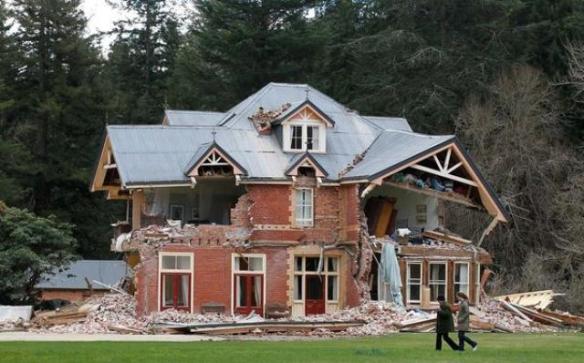
At around 4-30am on Saturday morning, our second largest city, Christchurch in the South Island was severely shaken by a 7.2 Richter earthquake centred some 30km west of the city. This area is not generally noted as a high-risk for earthquakes, more common problems being occasional seasonal snow, flooding and smog. As a result, people were not as physically nor psychologically prepared as they might have been in other areas. This is the most powerful earthquake ever recorded here and, although no lives were lost, the final repair bill will be in the billions and a number of heritage buildings will have to be demolished due to irreparable damage.

Deans Homestead (c) NZ Herald

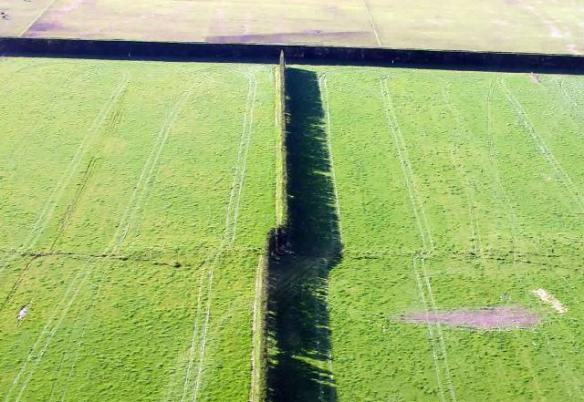
This image is one of a series taken during an early scientific survey of the fault line area (the Youtube file of the overflight is linked through the image). To give an idea of the lateral and vertical ground movement during the main quake, the lateral shift in this image is around four metres, and vertically around 1.5 metres. Only a tenth of that degree of movement would be a nasty jolt! This image was sent to us as an example of some of the underlying issues that might have to be resolved in the wake of the quakes (after shocks up to 5.2 Richter are still rolling in, on top of the obvious tasks of rebuilding and reinforcing,  in terms of changes to boundaries and potentially ownership, to say nothing of the requirement to update every digital and hard copy map of the region. It’s resolving this little issues that may be the bigger long term problem…

Exploring new boundaries (c) geonet.org.nz 2010

While Canterbury was coming to grips with its devastated major city, the lower North Island braced itself against a series of floods that swept through a number of small towns, further stretching Civil Defence and infrastructure agencies that were already focussed on deploying aid south. We got lucky and the front that dumped all this rain hit everywhere BUT Canterbury sparing Christchurch from further damage from rising water levels.

The Mangatainoka river in flood, with the old Tui Brewery building in the background.

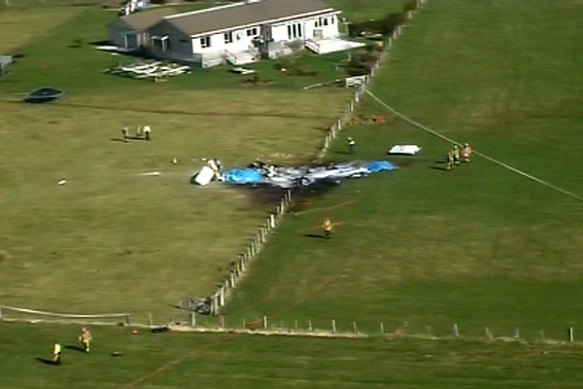
At 1-30pm on Saturday, a light aircraft conducting skydiving operations at Fox Glacier on the other side of the South Island, crashed on take-off killing all nine occupants: the pilot,  four divers-master;  and four tourists from Ireland, England, Germany and Australia. This is the worst air disaster in national history in decades, the worst being the 1963 DC-3 crash in the Kaimai Ranges that killed 23. Any other weekend, such a tragedy would bring to nation to a halt but against the backdrop of the Canterbury earthquake it didn’t even get to lead the 6 O’clock News.

Skydive aircrash kills nine (c) TVNZ 2010

Earlier last week, the Government announced a NZ$1.7billion bail-out for the crumbling South Canterbury Finance (SCF) empire…although some had protested that the Government’s approach was heavy-handed and had helped causer the problem.I think that the simple truth is that it has acted responsibly to prevent the loss of people’s saving due to the doddering of an aging business magnate. I recall not so long ago seeing SCF advertising 8-8.5% interest rates on 18 month investments. At the time, I (rather naively) thought this must be a sign of recovery for this company but of course it wasn’t…it was a last gasp grab for cash flow to bail it out of its current problem – by creating another one 18 months out…I have to admit only a small degree of sympathy for investors who fail to apply the ‘Is it too good to be true?’ rigor test to such proposals and who then get bailed out by the government. The national cost per capita of this bail-out is $372 each so South Canterbury, please note, i don’t expect to be buying too many beers next time I pass through…mine’ll be a Tui…!

The cost (c) TVNZ

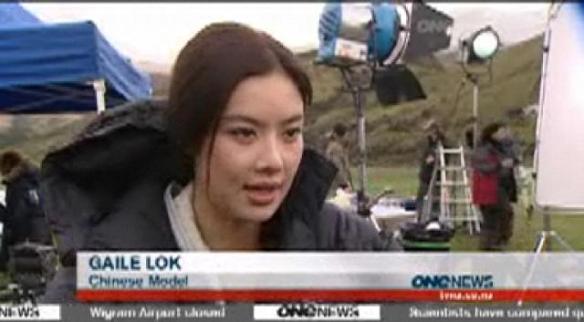
And it goes on…there has been for some time, concern over how much of the country is being bought up by offshore investors and what the potential risks are if we opt for short-term gain without really considering long-term pain…a Chinese consortium has offered to buy a large number of dairy farms, ostensibly as part of a move to introduce high-quality dairy products to the Chinese domestic market. I had no idea that cows couldn’t grow in China or that our national output of dairy produce would be anymore than a drop in the milk bucket of China’s internal market’s…and I do wonder if anyone has actually wargamed what the impact might be on domestic dairy markets if the new owners (if approved by Government) perhaps decide to move cease dairy production on that land…already Fonterra milk product exports have linked domestic dairy prices to overseas prices with the result that the price of milk and cheese has effectively doubled – it IS actually cheaper to feed your children Coke than milk so watch for the destabilising effects of declining dental health on future Government health budgets – or will it just be easier and more pragmatic to swap out your natural teeth for some nice handmade wooden items?

Model Gaile Lok promotes Chinese dairy project in New Zealand (c) TVNZ 2010

My point in all of this is that we can not count on the destabilising cataysts we may face to be purely of man-made origin, or that they might be Militant in nature. What if our adversaries, or competitors, opt to employ the three other components of the DIME construct: Diplomatic, Informational and Economic, perhaps catching the wave of a natural disaster or two….?

And on the subject of considering endstates, Mr Wineera has written another commentary, speculating on the end state sought by our PRT in Afghanistan

Cultural awareness 101

I caught this on Michael Yon‘s Facebook page last week but forgot to post it…

Friday Cultural Lesson: Calling a Woman “Pig” Tonight in Thailand, I was over at the home of a Thai family. The woman of the house was rather…stout. Her nickname is “Moo,” and when I heard the nickname I asked quietly, “Why did you call her pig!?” After a flurry of conversation I was informed that pigs are cute and pink and it’s g…ood to call a stout woman Moo. I said, whoa whoa, whoa. Please never call an American woman pig! Which was met with equal disbelief. What? American women don’t like to be called pig if they are heavy? No, no, please never do! 🙂

A great example of how we carry our cultural truisms around with us and how quickly they might get us into strife before we even realise…at one level we might tend to associate democracy with something both good and useful which still gives us little right to inflict upon societies with other ideas…and at another level, the personification of an animal can be good or bad…

This is a great example of Michael Yon doing what he does so very well, illustrating the human level of the contemporary environment, maybe decomplexing it just a little…certainly providing food for thought for those who have to work in it….

This is for real

HMS Victory in paper

This is for real – details on PM here…

…but are these guys?

There have been a growing number of reports from Afghanistan that senior ISAF commanders are losing in their desperation to win the information war with the Taliban on collateral damage. Two of the latest ‘initiatives’ include the creation of a medal awarded for not using lethal force during war and ordering soldiers to conduct patrols without a round chambered in their weapons. It seems clear that the ‘commanders’ fail to grasp that the role of the military in this environment is the application of force in support of national objectives – everything is subordinate to this role, unique to the military amongst other instruments of national power.  If the situation in Afghanistan is now so benign that soldiers no longer need to keep their weapons in an ‘action’ state, then we should be seeing an immediate transition from a military campaign to a civil campaign.

Of course, the fact that applying restraint in the use of lethal force in Afghanistan implies that there is still a significant threat against which lethal force might be used; and both ‘initiatives’ are is stark contrast to the indifference to collateral damage inherent in current cross-border UAV strikes into Pakistan. Possibly the further you are, and can keep the media, from collateral damage, the more palatable it is.

The Rules of War provide for the right of every soldier to use force in their own defence should they believe this to be warranted. Both of these ‘initiatives’ seek to undermine this right. Training provides both the means of applying that force and the means to determine a proportionate level of response. This training builds upon the organisational ethos and values developed throughout an individuals career. Maybe, in seeking to win what appears more and more tobe an unwinnable war, ISAF commanders are leading their own ethos and values be eroded in placing their soldiers at risk in favour of a population that doesn’t appear to be particularly supportive of either ISAF or the Karzai government.

One of the reports quotes one source linking this to the rules of engagement that contributed to the 1983 Marine Barracks bombing in Lebanon: this line is interesting…”…do not chamber a round unless told to do so by a commissioned officer unless you must act in immediate self-defense where deadly force is authorized…” …and we all saw how well that turned out…There’s never an officer around when you need one which is why most credible armies rely on the training and experience of their NON-Commissioned Officers to apply their judgement to any particular tactical situation. There must be a balance between experience and qualification which is a point that Dusty discusses in Security NZ this week.

On reconstruction

I see a recent note in the Marine Corps Gazette (real land forces have professional journals) that “…officials told lawmakers in Washington Thursday the reconstruction of Afghanistan is poised to become the largest overseas rebuilding operation in U.S. history…” Is there any point in rebuilding anything that is unlikely to last beyond that last helicopter lifting off the Embassy roof…? Who really gains from this rebuilding operation, the people of Afghanistan – or the corporate parasites clambering over them in search of profit before President Obama turns off the tap…?

Incidentally, I’m not sure that rebuilding Afghanistan will be a larger operation that the rebuilding of Germany and Japan and the Marshall Plan post-WW2…possibly only in terms of modern dollar levels…?

On networking…”

Michael Yon has been reporting from Bangkok and offering a distinct contrast to the pro-Red Shirt line taken by most of the mainstream media. One thing I have noticed is that large number of Thai people commenting on his Facebook page posts. Even accepting that Thailand is far more connected than Afghanistan, it is interesting to compare this with the number of Afghans commenting on his page which appears to be minimal at best. The  Sicuro Group report from 19 May states that there are 3.8 million Afghans subscribed to Roshan, the largest telecommunications operator in Afghanistan. You’d really think that if any of those 3.8 million people cared, they might offer up some comments; that they don’t might be an indicator to the true level of support for ISAF and the fantasy of a central government led by Karzai or anyone else.