Good Answer

Nice one, Mike!!

Just when I was about to write Michael Yon off after his disembedment, he comes up with a comment that is both insightful and relevant…

The father of a veteran now in Afghanistan emailed with a question: “Michael: What would you say to a group of US soldiers if you were a company commander (and it’s easy for me to imagine you in this role) if after a briefing you gave them as you and they were about to participate in the BfK – when after inviting questions a soldier asked: “Sir, are we being asked to risk our lives to prop up Wali Karzai and if so, is he a good man or just my generation’s Diem? (Or some such question.) A beneficiary of the drug industry, a thug, feared and hated by the people of Kandahar City? How would you Michael Yon answer this US soldier?”

Answer:
I would likely say, “Yes, we are being tasked to prop up a drug lord. That’s our orders. Let’s get to work.”

It’s a good point – as much as some elements continue to portray the war in Afghanistan as a ‘nice’ war in which no harm really befalls anyone, except the bad guys, and which is conducted according to the highest moral principles….which, of course, is totally false…if what is going on in Afghanistan was anything close to nice, then there would be no need for the thousands of combat troops, strike aircraft, etc, etc, etc…NGOs and aid agencies could run rampant over the country to do-good their little hearts out…but it’s not like that and we shouldn’t be kidding ourselves that it is…

On the same theme are the bedfellows that we might have to partner up with in order to achieve our national objectives…let’s NOT forget that the reason that all these forces are in Afghanistan in the first place is not an overwhelming concern for the wellbeing of the nation or people of Afghanistan…some nations are their for flag-waving purposes, others because the rest of their gang is there, others again perhaps hoping to secure trade or commercial gains…whatever the underlying motives, there is little room for altruistic partnerships based on niceness and the moral high ground. To be blunt about it, most of the nice people that you might be able to partner up with are probably amongst the least effective…

To get the job done, your partners of opportunity will more than likely be those whom you would NOT bring home to meet Mother or the voters but they are way more likely to advance your aims and objectives…

The other insight that falls from Mike’s comment is that these issues of lawful or unlawfulness generally exist at levels stratospherically above the tactical level where the down and dirty fighting occurs…as Mike implies, these issues are not things that the troops on the ground need to be worrying about – so long as someone has taken the time out to remind them why they are face down int eh dirt and the sand, listening to bullets zing by, just over their heads…the direction and ownership of said bullets is largely irrelevant when you’re face down in the sand and the dirt….

Sallying Forth

My brief foray out into civilisation last week went very well. I had (another) great visit to the Air Power Development Centre @ RNZAF Ohakea and am looking forward to doing a lot more work with them. I overnight in Ohakea this time and must comment on the standard of the rooms in the Mess, even for a casual guest like myself…my room had all the amenities necessary for someone working away from home…especially the little details like an alarm clock, towel, bathrobe, iron and ironing board, even a Do Not Disturb sign for the door and some of those little soap and shampoo thingies…all the little details that are such a PITA to lug around with you on the road…very nice…

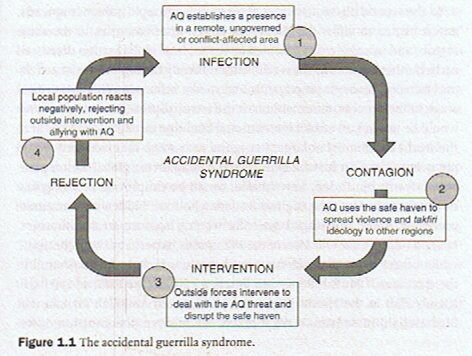
The following morning I drove down to Wellington – catching the early bird parking deal @ the James Cook by less than two minutes – to listen in on Josh Wineera’s lecture The Contemporary Operating Environment to Victoria University’s Counter-Terrorism course; after which I delivered  Doctrine, COIN and Kilcullen (critiquing The Accidental Guerrilla). It went OK but only OK and I am really annoyed that I ran overtime (despite numerous rehearsals to the big dogs at home) and had to skim over the Kilcullen section. Hopefully I will have other opportunities to polish up my delivery for this type of work as I think that part of the problem is that I haven’t had any opportunities this year to practise let alone hone presentation skills.

I’m now converting the elements of that PowerPoint brief into a loose paper, combining the images with the accompanying words, for Jim Veitch at Vic as a record of those thoughts. I found last year that both MS Word and OpenOffice’s Writer are sub-optimumal tools for this and have opted to try this using a dedicated desktop publishing application called Scribus. It’s open source as well and like much of these open source apps has an almost vertical learning curve (the reason I uninstalled it last year) but I cracked it last night and am now making pretty good progress. The result for this project probably won’t win too many marks for prettiness as I am learning as I go but progress is progress….

The Little Orange Book

I visited the Centre for Defence and Security Studies (CDSS)at Massey University a week or so ago. The nice people there loaned me a copy of Roberto J. Gonzalez’ American Counterinsurgency: Human Science and The Human Terrain so that I might gain a better understanding of those who oppose Human Terrain Systems (HTS). Gonzalez (RJG) is one of the main opponents of HTS and the application of social science techniques in counterinsurgency campaigns.

I started to read this book, The Little Orange Book, at Massey while I was waiting for a meeting to wrap up (not one that I was in!). It’s only 130 pages and I managed to chew through 80-odd then. I use the term ‘chew through’ deliberately as some of the first three chapters was pretty difficult to digest. It’s published by Prickly Paradigm Press which claims to give “…serious authors free rein to say what’s right and what’s wrong about their disciplines and about the world, including what’s never been said before…” The result, certainly in this case, is not as the Prickly Paradigm website claims “…intellectuals unbound, writing unconstrained and creative texts about meaningful matters...” This Little Orange Book, is more a soapbox for a rambling rant than a considered exposition of  RJG’s professional or intellectual opinion.

There are many logical disconnects and inconsistencies in the first three chapters and I think that some rigorous external editing could have helped make this flow and read much better. Part of the problem is that RJG does really define his objections to HTS until the last few pages of the book, forcing the increasingly frustrated reader to wonder ‘where’s this guy coming from?’.

It was a week later that I took a deep breath and dove into the second half of the book. Chapter 4 is certainly a step up from the previous chapters, possibly because I found myself in broad agreement that the US DoD is in cloud-cuckoo-wonderland in its desire for a technologically brilliant system that will take in all the relevant information and punch out all the answers for the complex environment. Maybe it will – someday – but only once a person gets off their butt, gets their boots dirty and figures out what the questions are.

Such a system might have been possible in the heyday of the Cold War when the moving parts were mainly based on platforms with easily quantifiable measurables – had the necessary computing power been available. In fact, had this system been available to Cold Warriors, it probably would have foreseen the Soviet invasion of Iceland that so surprised Pentagon planners when Tom Clancy and Larry Bond released Red Storm Rising in 1986. But the Cold War is over and, as Michael Scheiern identified in 2005, we have now shifted from platform-based tracking to tracking individuals. Not only has the number of trackable entities increased by a factor of hundreds but the individual ‘measurability’ of each entity has increased by a similar amount, and the entities lack the centralised direction inherent in platform-based conflict.

This is not to say, though, the social sciences, anthropology and HTS’ don’t have a role to play in the complex contemporary environment – anything but. What it does mean is that we will have to accept and take risk, develop and rely upon judgement to employ and apply this information. It also means that we need to evolve away from thinking of complex intelligence as being predictive in nature as it may have been around the Fulda Gap. In their place we must develop more responsive intelligence systems support responses to the largely unpredictable activities that erupt across the operating environment.

Organisations like the FBI’s Behavioural Analysis Unit are founded upon a blend of the principles and practices of social sciences and this responsive philosophy. Rarely if ever will the BAU predict the first in a series of attacks, although once on the trail of a specific adversary will often very rapidly develop accurate profiles of that adversary, be it an individual or group. Yes, I watch Bones too and am well aware of the timeless struggle between the forces of anthropology and psychology to prove which isn’t merely pseudo-science. This is a false distinction and both disciplines must work together, focusing on individuals AND groups in order to provide a commander with employable insights.

Herein lies the problem with This Little Orange Book. RJG is so intent on ring-fencing social sciences that he can not see that no science or discipline can usually function in isolation. He is so fixated on HTS in Iraq and Afghanistan that he forgets that social sciences are subject to (potential) abuse across society every day: as I remarked at Massey after reading the first half of this book, it would be interesting to compare the outputs of the schools of marketing, politics and anthropology at Massey and see whether they are more alike than different.

RJG states again and again that the deployment of HTS to support military operations breaches various understood ‘contracts’ in that social science should do no harm. He totally misses the point that, regardless of how or why these wars started, HTS might actually be doing more good than harm in adding elements of precision, if not perfection, to campaigns where blunt force may be one of the few viable options.

It is not until the Chapter Five that the readers finds the real reasons for this. RJG is making a standing on moral principle – he’s up on a political soapbox to attack the American Empire which he sees as an evil bent on taking over the world. If the evilly bad American Empire was not involved in its evil wars in the Middle East , RJG would be quite happy for social sciences to feed the same predictive machine he denounced in Chapter Four – which would of course only be used for good.

It’s ironic that an ardent proponent of social science is intent upon suborning these tools that focus upon ‘the people’ to the same technological philosophy that drove the platform focussed Cold War. Conceptually this evolved into the Powell doctrine that built upon the false lessons of the 1991 Gulf War and culminated in the ‘shock and awe’ campaigns that failed to produce the goods in Kosovo, Serbia or Iraq. RJG’s campaigns against HTS has driven the Government to seek more technical solutions towards understanding the contemporary environment and to steer away from the blindingly obvious truth.

That truth is that it’s all about people and that includes people doing (at least some of) the collection and people applying judgement to that information, raw and processed, to develop useful (timely, relevant) information. An example is the enhanced Video Text & Audio Processing (eViTAP) tool that was successfully trialed on CWID in 2007. Evitap is a very sharp tool that processes video, audio and digital files for predetermined cues that have been identified (by a person) as potential indicators of an impending incident. When those cues are identified, a person is notified in order to make a decision on actions that may or may not be taken.

Where is all goes wrong is that we have become so fixated on the technology providing the answers that we have stopped teaching people to think critically, to apply professional judgement, make a decision and run with it. By using This Little Orange Book as a soapbox for a raving rant (or ranting rave) instead of coherent consideration of the issues, RJG has actually scored more points for the technocrats and undermined his beloved social science…

Sadness and gladness of the Last Post

Lest We Forget

This was an editorial in one of the national newspapers for Anzac Day 1997…I can’t find any notes I may have made identifying the paper or the author…

The Last Post always makes me cry. I can’t help it. There is something in those crisp clear notes ringing out in the sharp-edged air of ANZAC morning that takes my breath away. It sets up a curious chemical reaction in the soul, where sadness and gladness are fused together and one is lifted out of oneself and into the unending reverberations of history.

The bugler speaks to the dead – the “glorious” dead – inscribed on countless cenotaphs and roadside memorials from one end of New Zealand to another. Not that there is anything glorious about dying. In the paintings of our country’s battles, the death of young men, far from home, in agony and fear, is seldom portrayed with much accuracy. We spare ourselves the horrors of war – and rightly so. Veterans of the real thing seldom speak of what they have seen and heard lest their words conjure up again the screams, the blood, the shattered flesh, the cries of “Mother!”.

The Last Post speaks to the silence beyond death; the space in which we contemplate the meaning of the final “sacrifice”. The Last Post asks us to ask ourselves “What did these young men die for?”

When I was a little boy, I would spend my ANZAC Days drawing pictures of soldiers climbing up the rocky hillsides of the Dardanelle’s. And, over the vivid colours of the battle scenes, I would print in the laborious hand of the young: “For King and Country”.

I do not think that there are many today who would die for the House of Windsor. But, in the silent crowds of young New Zealanders – more every year – who join the old diggers on ANZAC morning, I sense a longing to serve, to sacrifice, to give something back to their country.

The generations of New Zealanders born after World War II have been spared what the United Nations charter calls “the scourge of war”. It is a mixed blessing. To be sure, we have never had to hold our friends in our arms and watch them die or receive a telegram informing us of the death of a loved one. But neither have we experienced the powerful sense of unity with which a nation at war is infused, not the bonds of comradeship forged when men and women from all walks of life are brought together and transformed into a  fighting force.

Most importantly, the post-war generations will never know what it feels like to play for history’s highest stakes – when the issues of ultimate significance hung in the balance.

I often ask myself: “Is political activism a substitute for war?” “What is it that we go on protest ‘marches’?” “Why do we seek out those moments of ‘confrontation’?” When we see that line of helmeted police officers, their long batons drawn; when we experience that lonely thrill of fear, that sudden rush of adrenalin, are we not, in our own way, playing soldiers?

People often ask me: “What’s wrong with today’s young people? Why aren’t they protesting like we did?” My answer is brutally simple: “Because of what we did” Our generation has reduced those “issues of ultimate significance ” – Roosevelt’s “four freedoms” (freedom of speech, freedom of conscience, freedom from want, freedom from fear) down to just one: the freedom to buy and sell. Once a year, on ANZAC Day, we call forth the dead and invoke the myths that animate our nation. In the half-light of dawn, as the bugler draws out our tears and we “remember them”, remember the living also, and never forget that there are greater things to die for than a balance sheet.

And remembering other soldiers in another war…


On Curzon

I started Leonard Mosley’s Curzon in January and only finished it early this morning. It’s not a big book, only some 300 or so pages, but it is a very good book and I have been savouring it as one might a fine wine or one of our butterscotch puddings. Even the paper in was printed on in 1960 is of a quality far removed from the recycled egg-crate material used in publishing today.

I found Curzon an interesting read, more so against the current backdrop of more former colonies descending back into anarchy and chaos. As untrendy or politically palatable that colonialism may be perceived today, there is a certain inescapable logic in his belief that “… that Englishmen, let alone Scotsmen, Welsh, Indians and other lesser breeds, had [not] earned the right to equality with those who had spent their lives and their brains in learning to rule them…” as I commented in January. Funnily enough, as  speak, it is just being announced on Breakfast that New Zealand is signing up to the UN declaration on the Rights of Indigenous Peoples…

Curzon covers a period of British history, the early 20s, that is not well-known nor particularly well covered in popular media. Whether Curzon himself would have been a better Prime Minister than Baldwin, Law or Lloyd-George whom he despised, is debatable but his biography offers a fascinating insight into some of the other key players and events of this time. Mosley is scathing about the (lack of) ability of A.J. Balfour, of Balfour Declaration notoriety “…for rarely in the history of British statesmanship can there have been a man who cared less about the eventual results of the aims and objects of the policies he espoused…” So very right as we still reap the results of Balfour’s ambivalence in the Middle East…

I see in the search results in the blog stats page that someone today was searching for “…curzon by leonard mosley…“. If that person revisits this blog, I’d love to learn more of their interest in Curzon…

Afghanistan’s new owners?

In the inbox last night was an update from Sicuro Group covering Iran’s call for NATO and ISAF to withdraw from Afghanistan in favour of a regionally based force. Normally I take articles from this source with a pinch of salt, more because their ‘assessment’ is usually a statement of the blindingly obvious stated with the pretension of original thought. But I thought that this call from Iran was interesting…

The Iranian president has called on the US to withdraw its troops from the Gulf region and Afghanistan.

“The region has no need for alien troops and they should return home and let the regional states take care of their own affairs,” President Mahmoud Ahmadinejad said in a speech marking the country’s annual Army Day on Sunday.

“They must leave the region and this is not a request but an order and the will of the regional nations,” he said.

The president said the deployment of US and NATO troops in Iraq and Afghanistan under the pretext of fighting terrorism had not only failed but also increased insecurity in both countries.

Assessment : The US–NATO campaign in Afghanistan receives brickbats and laurels at the same time. While some countries are opposed to the US withdrawal beginning next year, Iran mounts attacks on the US, urging it to withdraw immediately from Afghanistan and the Gulf region. Turkey also threatens to disassociate with NATO forces if more civilian casualties occur in military offensives.

Maybe Iran is doing a France and looking for a colony in which to test its new nukes…? Could be a win-win situation for everyone…

Bursting Bubbles

I subscribed to Fast Company ten years ago and collected 4-5 years worth of the magazine. The trouble was that it is very advertisement-heavy which is not necessarily a bad thing in itself as many of the ads were insightful and thought-provoking in their own right; the problem was that each issue was really thick and at 12 issues + specials every year, the stacks weren’t getting any smaller. As stimulating as the articles were (and I assume still are) and despite my own proclivity for accumulating paper, something had to go and so Fast Company disappeared off my radar. I suppose I could have tried to keep track of it online but, dial-up connection or not, I struggle to maintain situational awareness with the current blog roll and distribution lists…

Curzon @ Coming Anarchy [a link to this article is at the bottom of the page, just in case end of the world, loss of Wayback machine etc] asks some questions about a Fast Company finding that the gap between our social and economic beliefs is much the same as when we are teenagers just setting out in the world, and when we hit middle age, even though the beliefs themselves are diametrically opposed. I think the answer to his question is pretty simple and that is consequences. As young people, we are often oblivious to the concept of consequences and wreak merry havoc with our lives and often those of others. If you took the Fast Company survey further, it is likely that you would find that the same permissive approach extends to just about every aspect of a young person’s life, not solely social and economic… in fact, the social and economic head line is a bit of a red herring

So the real finding is actually a lot simpler – when we are young, we take more risks, and are less considerate of consequences…by the time we hit middle age, we have been burned a few times, may be a lot of times and are only too familiar with the Newtonian inevitability of consequences…

Perhaps the real story behind the Fast Company report is the issue that I commented on at Travels with Shiloh earlier this morning…

Regardless of the topic, I think that root cause behind the issues you raise is that for well over a decade now, maybe two or even more, we have stopped teaching people how to think critically and objectively. Today the ‘rule’ is to seek that information that supports the case you want to put up and to ignore or mitigate that which does not. Once upon a time, we would consider all the information and draw a conclusion based upon what was, not what we wanted it to be…and if that meant our report did not reflect the beauty of the Emperor’s new cloths then so be it. Better a sour mouthful up front than a diet of sand later on…perhaps if some senior ‘thinkers’ had been more objective, the mess in Iraq would never have occurred and the campaign in Afghanistan would have been a done deal one way or another by the end of 2004.

The superficiality of many contemporary researchers and their reports was something we saw again and again in the lessons learned world; and it was only when ABCA developed the CLAW that some light appeared at the end of the tunnel. As of the 2009 CLAW, that light was clearly brighter as many participants already had their heads around the processes and the need to disregard the symptoms on the surface and drill into the core issues.

I keep harping on about the CLAW (and the follow-on OUTLAW process) because they are the only ones I have seen in ten years in the LL game that actually work and get to the heart of an issue. The key however is that you still need people with the honesty and courage to run with oft-unpopular and unpalatable findings…perhaps if the authors of this report in New Jersey gangs had stepped back from the issues a bit more and been a bit more open-minded they would have produced something more worth reading?

Maybe I’m on a bit of a roll today (possibly the effects of a long weekend and/or a number of large G&Ts last night – ran out of beer and it’s 40km to the local) but this also ties into my hobby-horsing over at Neptunus Lex about my most-hated quote “…amateurs study tactics, professionals study logistics…“

I don’t think this post is really about logistics at all but I just have to add my 2 cents re that amateurs and professionals line…it is an absolute crock!! The log fraternity have spent two decades crowing from the top of their dung heap about how THEY won the Gulf War and have forgotten that, in the final outcome, they are but a supporting act to operations…

This is a theme that I have come across a number of times in my work in the last couple of weeks and I think that it is way past time that the loggies dragged themselves out of the Fulda Gap Railway Station and got into the 21st Century; stopped dictating what can and can not be done got into the game of supporting operations. My current bug bear is the falseness of ‘one fuel’ policies which might look all very nice and efficient in the hallowed halls of the G-4 (anyone’s G-4 not just that in the five-sided building) but which reduces effectiveness at the sharp end where operators are unable to introduce the niche capabilities needed for operations because they won’t run on the ‘one’ fuel…

In 2000, a MAJ Morris from the USMC wrote a staff paper on contemporary use of flying columns as part of OMFTS doctrine In it, he debunks many of the logistic myths/obstacles to operations, using Rommel and Monty as examples of a. just getting on with the job and b. keeping log staffs in their subordinate boxes…This is not to diminish the importance of logistics to successful operations just to keep it in perspective with other supporting functions like personnel, intel, plans, comms, training, and doctrine/lessons.

The Morris paper is a great read and I recommend it without reservation and more so because it was written pre-911 but still holds true through the lessons of Afghanistan and Iraq. It is delivered in three parts:

  • A general history of the use of flying columns in the 20th Century.
  • A dedicated case study on the SADF’s Operation MODULAR into Angola in 1984.
  • An exploration of how the flying column/bubble concept might be applied in a MEU or MEB.

Thinking out of the square, getting the facts and bursting conceptual bubbles…that’s what we need more off…

NOTE: updated 29 Aug 2022 to upload title graphic, update Coming Anarchy article link to the Wayback Machine, and add a PDF version of the article should the original link break again.

Getting it together?

Afghan police officers and the U.S. soldiers, bottom, gather at the scene of a suicide attack in Kandahar south of Kabul, Afghanistan on Monday, March 1, 2010. A suicide car bomber attacked a NATO convoy Monday outside the major southern Afghan city, killing one NATO service member and four Afghan civilians, officials said. (AP Photo/Allauddin Khan)

On Michael Yon’s Facebook page this morning:

Sad and Sickening: A General Officer should be fired.

This morning, we lost a soldier to a suicide bomb on a bridge just a short drive from this massive military installation called Kandahar Airfield. The bridge, which is important to us, was badly damaged and remains impassable to military traffic. Meanwhile, on this bustling base, under-employed soldiers from various nations crowd around hockey games, live bands, and coffee shops. The damaged bridge is just a bicycle ride away from soldiers who are too busy celebrating Olympic medals to safeguard this bridge. The bridge is so close that I felt the explosion and saw the mushroom cloud. Our mission, and no doubt others, was cancelled because we could not get over the bridge.

The General in charge of security for this bridge should be fired.

Coupled with another attack in Kabul involving NZSAS troops, one wonder if there might not be something to the idea of secondary effects of the surge in Afghanistan?

On ‘science’

Coming Anarchy discusses the ‘science’ of global warming, a topic that has also been slammed by Neptunus Lex. Portable Learner while covering another example of misapplied science, “…In an interview for On The Media, The Lancet’s editor Dr. Richard Horton weighs in on the state of open scientific debate:

We used to think that we could publish speculative research which advanced interesting new ideas which may be wrong, but which were important to provoke debate and discussion. We don’t think that now. We don’t seem able to have a rational conversation in the public space about difficult controversial issues without people drawing a conclusion which could be very averse….The 19th-century days where you could sit in the salon at the Royal Society and have a private conversation amongst your fellows just doesn’t exist anymore. So I think yeah, too much information in this particular case is a bad thing, which seems to go against every kind of democratic principle that we believe in. But in the case of science, it seems to be true.

But it is not. I can’t help but wonder if we had had this conversation, in public, ten years ago when the study was still “speculative research” we may well have averted the flawed decision to publish it in the first place. We need more information, not less, and more inclusive conversations, not narrowly confined to the medical community. The public may well have to engage the medical community in the public space “difficult conversations without drawing a conclusion that could be very averse…“

I tend to agree – far better to have the discussion early and draw out all of the available information out to make as informed a decision as possible than to disregard potentially relevant stakeholders and abdicate responsibility what may be perceived as an overly-elite group.

‘The people’ can be really dumb at times…

The Strategist comments on the ignorance and stupidity of those who opted to ignore tsunami warnings along New Zealand’s coast after the earthquake in Concepcion. One might argue that this is only natural selection in action and I might have agreed if it were not for the risks implicit to those who might have to attempt to rescue these losers and to the children they took to the beach with them; at best, it is wasting Police time, at worst, manslaughter. An interesting discussion at NZ Herald here and I wonder if this naivety and complacency is linked to the questions asked in the Timings paper mentioned above? Are we a nation that only learns the hard way…after a punch in the nose…?

People ignore tsunami warning at Mount Manganui. Photo/ Christine Cornege.

A good way of doing business

Peter also has an interesting item on the Byzantine Lessons Learned process…1500 years ago, the Byzantines developed theatre-specific handbooks for each of their current and likely mission spaces…if they could do it then, it really makes you wonder why it appears so hard today. I’ll have more on this when I complete my paper on GEN Mattis’ comments re obsolete thinking.

Progress

I made my first pastry ever yesterday afternoon and my first all homemade pies last night…some tuning still required but very YUM!!!

Accepting risk

Who hasn’t heard this answer to a curly question “We’ll carry the risk“? Yeah, that’s nice but who’ll be accepting the responsibility?

Introduction

This is the first in a series that will progress throughout 2010. The idea comes from Dean at Travels with Shiloh who has invited a group of commentators to discuss the twelve questions asked in this article Changing Homeland Security: Twelve Questions From 2009 from the Homeland Security Affairs Journal (HSAJ). Yours truly is one of those privileged to be invited to contribute to this discussion.

The first question is Why is it so difficult to make risk-based decisions in homeland security? Other contributions on this question so far are:

Risk based decisions in homeland security issues

I’ve been working on this for over a week and, to be honest, have really struggled with it. What follows is still tortorously prolonged but I’ve left it ‘as is’ to show the process by which I got to the answer. In a couple of weeks, I will rework it into something a little more coherent.

Defining the question

Before launching into discussion on the topic at hand, I first thought it would be an idea to define my interpretation of the terms in the question.

  • Difficult is the opposite of easy although it may be more correct to swap out ‘difficult’ for ‘simple’ and the degree of difficulty is directly linked to the level of complexity now common in such equations.
  • I cast the net pretty wide to define risk-based decisions. Although there were few, if any, military or HLS examples in first 100 hits when I searched ‘risk-based decisions’ on Bing; the most common seemed to those relating to auditing, insurance, health and event management. There was enough material there for me to comfortable with the R = T x V x C; Risk is the product of Threat, Vulnerability, and Consequence equation in the original HSAJ article.
  • Homeland Security is very much a US term with specific definition, membership and connotations. For our more global audience, I am using ‘HLS’ as the collective grouping of domestic, i.e. non-expeditionary,  military, security, intelligence, law enforcement, and emergency management agencies. I don’t believe that the establishment or not of an overarching agency like HLS affects the decision making process either way.

The Question

My first thought is whether it is actually difficult or, as implied in the question, if it is correct that risk-based decisions are not being made in homeland security. I would argue that they actually are, across our nations, thousands and thousands of them daily.

One approach I have found very useful when working through issues relating to the Contemporary Operating Environment (COE) by establishing a comparison with the more traditional and conventional environment that many of us are still more comfortable with or in.

If we were gearing up for yet another defence of the Fulda Gap at the operational level or even analysing intentions at the state on state level, such assessments are relatively simple and we still get them wrong with monotonous regularity, as Argentina found soon after taking Port Stanley in 1982, and Saddam found after reclaiming Kuwait in 1990. Characteristics of assessments at this level and in this environment might include:

  • Limited number and type of threats.
  • Gradual build-up and lead-in indicators.
  • Motivators/catalysts are usually understood strategies, policies and philosophies.
  • Most players are known values.
  • Big hands, big arrows, small maps.
  • Platform-based i.e focused on tracking ships, units, and formed groups; less focus on personality than major capability.
  • Unified organisations on both sides.
  • Geographic areas and boundaries are well defined.
  • The three organisational functions/groups derived from Clausewitz (people, leadership, action arm) are clearly defined and visible.

‘Simple’ as used in the paragraph above does not necessarily mean easy, just less complex in comparison to today’s environment.

Compare then this model against that faced in the HLS environment. The most obvious change is that we now need to track individuals a la the Scheiern model, not just those that we know might be players or even those who might be, but also those who might just have had a bad day, or just have had ‘enough’. The most recent example of this might be the shootings in Ft Hood and Seattle last year. Although some commentators immediately heralded the Ft Hood incident as the beginning of a domestic 4GW campaign, there has been no evidence to support such claims. Both incidents instead are illustrative of both the unpredictable and micro natures of the domestic environment.

HLS organisations are also not formed and formal organisations like the DoD, NATO, or even the Warsaw Pact. At best it is a bureaucratic umbrella sitting over a diverse collection of agencies all with their own priorities and outputs, and generally very tactically focused. Certainly there is not the same degree, not even a hint thereof, of the command and control arrangements to be found in a single agency in its own right or a large organisation like the DoD with defined roles and responsibilities

Mix in with this nature’s fickleness, for example, earthquakes in Haiti, bush fires in Australia and snow in the Washington DC area. Although the probablity of such incidents is a given, assessment of incidence and severity leans more to the arcane than the scientific: for now, Poughkeepsie Phil probably remains our best indicator for seasonal change.

To use a household analogy, you used to have three dogs and a couple of cats that normally got on with each other. The causes of discord were well-known and it wasn’t too much of a task to prevent major conflict. Then Great Aunt Anastasia dies and left you her ant farm and  ‘tame’ wasp hive; for various reasons, and as tempting as it is at times, investing in a couple of gallons of Raid is not a socially acceptable option. You’re stuck with it. You’re not impressed, the dogs and the cats aren’t impressed, and most likely the ants and wasps aren’t that thrilled either. Oh, and the boiler’s sprung a leak, taxes have just gone up, and old Mrs Grey next door has just lopped off her leg with a chainsaw. Welcome to the world of homeland security – please start your risk-based decision-making process HERE.

HLS as an entity will always find it difficult at best to conduct risk assessment as we and Third Shock Army (8th Guards for some folk) understand them from the Fulda Gap. But that is not to say that risk based assessment does not occur daily across the spectrum of homeland defence in law enforcement, emergency response, security and intelligence fields. I doubt that there are any agencies under the homeland security umbrella where the staff just sit back, bite into another donut, sip on their lattes and just wait around for something to happen. Just because it doesn’t happen in the comfortable macro format that many of us are used to, doesn’t mean that it doesn’t happen…it just happens at the micro level necessary for these agencies to fulfill their primary roles

At that’s the thing, most homeland security agencies have local or regional responsibilities and meeting these is their main priority. Unlike perhaps military organisations which generally devote a reasonably large proportion of time and resources to things that might happen, most HLS agencies are fully committed to meeting real-time outputs like catching bad guys, saving lives, fighting fires and rescuing kittens (think that last one isn’t important? – try telling that to old Mrs Smyth and still keep ‘the people’ on side). Most of them do this well.

Their world may be too complex for precise prediction but something else they also do well is respond. Within those contingencies that they know from past experience are most likely, these agencies can and do turn out and perform credibly thousands of time every day…and against these contingencies there is quite robust risk-based assessment and decision-making…why do police surge for New Years Eve activities, firejumpers have winter leave and paramedics specific tools and treatments over others? These people think, with some justification, that they are quite good at such decisions within their respective areas of expertise and responsibility.

Where they are weaker perhaps in in working and interfacing with each other beyond local relationships, especially where there may be issues of command and control or jurisdiction. HLS is never going to be the uber-C2 construct that DoD is – I think that FEMA perhaps tried this and we all saw how well that worked. Where HLS might begin to add real value is in championing the interoperability cause and facilitating communications, cultural awareness and information sharing between agencies.

An interesting insight from the 2004 Manawatu flooding (look it up – it made the top ten natural disaster list for the year) is that the civil defence plan went out the window only 30 seconds after the state of emergency was declared. BUT the value of the plan was in the planning; in bringing the various agencies together prior so that at least key staff had met, there was a general awareness of potential resources, and an awareness of issues from other perspectives. We saw the same again when the Mt Ruapehu lahar (finally) went in 2007. The event itself was almost anticlimatic because all the agencies involved (none of whom could agree on the probability or severity of the lahar happening) had been required to hammer out their difference and develop a collective response to the threat.

Where risk-based decisions really are difficult in HLS is on the terrorism side of the house. This won’t be news to Europeans, most of whom have endured domestic and/or third-party terrorist acts on their territory for decades. Terrorism itself is still subject to the same variables of complexity and uncertainty found across the HLS functional spectrum. What changes with terrorism is the false assumption that terrorist attacks can be prevented and the resulting pressure upon to HLS make this so. King Canute might offer some topical observations on this after his seashore experiments went wrong.

The Answer

The R = T x V x C equation for risk-based decision making is of little value so long the only acceptable answer is zero. Risk based decisions are made thousands of times every day in HLS – we’re just not interested in the answers. Perhaps the question that should have been asked is not Why is it so difficult to make risk-based decisions in homeland security? but When will we learn to accept risk in HLS?

The CoGs in the war go round and round…

Anyone with small children knows how invasive and persistent THAT tune is…

In Do Ideas Matter? Some thoughts… I commented on Adam Elkus’ paper on interpretation and application of the Centre of Gravity construct, and Adam and I have batted some comments back and forth since.. This has had me thinking more and more about centres of gravity, both generally and in specific regard to the complex environment. I think that we are wrong to consider a centre of gravity as a point of strength.

Many years ago, in the good old days (and they were!!) when I was a young soldier and we maintained a substantial presence in Singapore, I stumbled across a UK-based military book club that accepted overseas subscribers and offered a flat rate for shipping. The deal was that you had to buy so many books each year and – much like my current approach to Audible – I would get busy and let my obligation lapse until the last safe moment when I would have to make some snap selections from whatever was available in the most recent catalogue in order to stay in the club. As a result, I built up quite an eclectic library. One of the books that I acquired was David G. Chandler’s The Military Maxims Of Napoleon (Greenhill Books, 1987, ISBN 0947898646) It contains all 78 Maxims, the original 19th Century commentary and a new commentary by David Chandler applying “…the 20th Century perspective of two world wars, Vietnam, the Falklands and other conflicts…“. At the time, I read it, thought it of minor interest and it’s been on the shelf ever since. However one point, not even from the Maxims, has stuck with me in the succeeding two and a bit decades.
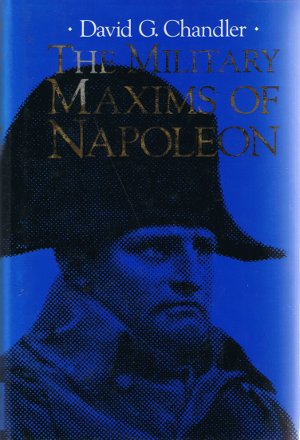
It regards what Chandler describes as one of Napoleon’s best known sayings “The principles of war are the same as those of a siege. Fire must be concentrated on a single point and as soon as the breach is made the equilibrium is broken and the rest is nothing.” The commentary in the book offers that most who seek to apply this ‘rule’ get it wrong in that they fixate on the word ‘point‘ and miss the whole implication of ‘equilibrium‘.

Chandler offers that it is highly probable that Napoleon actually meant the ‘joint’ or ‘hinge’ of enemy dispositions. There will always be issues of translation and interpretation when we seek to learn from those who gone before, especially when there is a significant temporal air gap – poor old Clausewitz and Mahan suffer in the same manner as does Douhet, when I ever get round to reading The Command of the Air.

Sometimes we fixate a little too much on the purity of original text and not enough on the actual content of the interpretation – to quote one of our Principles of Lessons Learned “Focus on what is being said and less on who is saying it“. One of the greatest examples of this is the Clausewitzian Trinity which is popularly accepted as ‘the people, the action arm, and the leadership’ – the actual Trinity from the original texts, as Adam and others have pointed out is much more ethereal. Regardless, the popular version of the Trinity still holds true, remains applicable today and, when you get right done to it, is probably more useful as a model than the original.

The modern definition of ‘centre of gravity’ is, according to FM 3-0,:

The source of power that provides moral or physical strength, freedom of action, or will to act. The center of gravity is a vital analytical tool for designing campaigns and major operations. It provides a focal point for them, identifying sources of strength and weakness at the strategic and operational levels of war. Centers of gravity are not relevant at the tactical level; the tactical equivalent is the objective. At the strategic level, the center of gravity may be vulnerable to an operational-level approach; at the operational level, the center of gravity may be vulnerable to tactical actions. The enemy may shift a center of gravity to protect and sustain a source of power. Similarly, changes in the operational environment may cause centers of gravity to shift. Therefore, analysis of friendly and enemy centers of gravity begins during planning and continues throughout a campaign or major operation.

This is very much a Fulda Gapist definition and even then, in the context of Third World War, Red Storm Rising-like, high intensity conventional conflict, it is somewhat flawed. It neither states nor implies any of the characteristics one might expect of a centre of gravity like pivot, balance, or equilibrium. In describing the centre of gravity as a ‘source of power’ and equating it with a tactical objective, it logically but incorrectly follows that the centre of gravity is something that is struck. While it may be correct that centres of gravity apply only at the operational and strategic levels in conventional conflict, this does not apply in the much higher fidelity/granularity microcosms of the complex environment where influence may be applied at all levels. Now compare the military definition of a centre of gravity with an aeronautical one based upon the Archimedean centre of mass principle:

The center-of-gravity (CG) is the point at which an aircraft would balance if it were possible to suspend it at that point. It is the mass center of the aircraft, or the theoretical point at which the entire weight of the aircraft is assumed to be concentrated. Its distance from the reference datum is determined by dividing the total moment by the total weight of the aircraft. The center-of-gravity point affects the stability of the aircraft. To ensure the aircraft is safe to fly, the center-of-gravity must fall within specified limits established by the manufacturer. When the center of gravity or weight of an aircraft is outside the acceptable range, the aircraft may not be able to sustain flight, or it may be impossible to maintain the aircraft in level flight in some or all circumstances.

Placing the CG or weight of an aircraft outside the allowed range can lead to an unavoidable crash of the aircraft. When the fore-aft center of gravity is out of range, the aircraft may pitch uncontrollably down or up, and this tendency may exceed the control authority available to the pilot, causing a loss of control. The excessive pitch may be apparent in all phases of flight, or only during certain phases, such as take-off or descent. Because the burning of fuel gradually produces a loss of weight and possibly a shift in the center of gravity, it is possible for an aircraft to take off with the center of gravity in a position that allows full control, and yet later develop an imbalance that exceeds control authority. Calculations of center of gravity must take this into account (often part of this is calculated in advance by the manufacturer and incorporated into CG limits).

‘Strike the weak joint‘ is the defining point that I took away from Napoleon’s Maxims all those years ago and it has stood me in good stead since. During my very junior intelligence training ( which occurred as DESERT STORM was flashing across our screens, adding a whole new real-time perspective to intelligence doctrine), a common CCIR was to identify the boundaries between enemy elements. The answer to questions regarding the ‘why’ behind this was that it helped determine unit identities…but why? I’d ask again – I got to spend a lot of time sitting in the corner…

A few years later, on the Infantry Minor Tactics (so what? I like the old name!!) course, the other guys (this was before we had guyesses in the Regiment) ‘got it’ and we always paid extra attention to the boundaries between elements as potential weaknesses.

Consider the CoG construct against Napoleon’s advice to strike the weak point to break the equilibrium and the physical definition of a centre of gravity. You find a model that is considerably more robust and applicable to both conventional high-intensity traditional conflict and the complex microcosms of the COE. The centre of gravity is NOT a source of power, nor is it a weakness per se – it is an area that might be influenced by one of a number of simultaneous or sequential actions that create a higher potential for instability.

The effects may be incremental as those of Keenan’s theory of Containment or as immediate and catastrophic as the assassination of Archduke Ferdinand or the 2003 invasion of Iraq. In chaos theory, this is also known as the Butterfly Effect where the slightest flap of the butterfly’s wings in time leads to unexpected and unpredictable results. Newton’s law of equal and opposite reaction does not apply as it is unlikely that there will be a direct proportion correlation between the size of the action and the subsequent effect(s).

Influencing one or more centres of gravity creates a tipping point, the physical definition of which is “…is the point at which an object is displaced from a state of stable equilibrium into a new equilibrium state qualitatively dissimilar from the first…” Although some definitions of tipping point consider the point tipped when the new state of equilibrium becomes permanent or irreversible, achieving and maintaining this state can not be taken as a given. Sometimes the effects are temporary, either because the influencing actions have ceased prematurely, because of other influences having a contrary effect, or simply because the inertia of ‘normalcy’ is too great to be overcome long term.

Even though a nuclear device might achieve critical mass, there are any number of factors that may prevent a full detonation. In COIN, there is a temptation to perceive positive change as steady state, and withdraw the critical influences before the changes in equilibrium and environment have fully taken hold. Hence, one of the core truisms of COIN and peace support operations is that success takes time, probably generations, before it can be safely said that peaceful equilibrium has been achieved.

A more practical definition of centre of gravity may be:

The point which, when subjected to influences or actions, effects change in the equilibrium or balance of an object, group of individual. The center of gravity is a vital analytical tool for designing campaigns and major operations. It provides a focal point for them, identifying sources of strength and weakness.

Centres of gravity may not be static and some may be in a state of constant flux. Similarly, changes in the environment may cause centers of gravity to shift. Therefore, analysis of friendly and enemy centers of gravity begins during planning and continues throughout a campaign or operation.

To achieve the desired ultimate effect, it may be necessary to be influence multiple centres of gravity sequentially and/or simultaneously.

The second point is important in all types and levels of activity and is endemic of weaknesses in intelligence apparatus. A snap shot of centres of gravity is only as current as the time it was taken; current apparatus are probably adequate for maintaining current pictures of centres of gravity in conventional platform-based activity but they have yet to adapt in any significant manner to the much higher granularity, global scope and complexity of individual-based activity and operations.

The final part of the definition requires a perceptional adjustment in how centres of gravity have been defined previously. While still holding true in traditional platform-based activity, it becomes vital in environments of complexity and uncertainty. Traditionally we speak of THE centre of gravity; now we must think and talk in terms of centres of gravity. Consider many cogs rotating in a machine: by applying subtle influences to specific cogs at specific points in their rotation and relationship to other cogs, the machine can be made to run faster, or smoother, or slow down or fly apart catastrophically…

Or, using the planetary model in Interbella, significant effects can sometimes only occur when the planets are in alignment….

Curzon on Government

Lord Curzon of Kedleston as Viceroy of India (wikipedia)

A couple of weeks ago, Coming Anarchy posted this item Curzon’s Dunbar. I had no idea who Curzon was apart from being the nom de plume of one of the Coming Anarchy authors (you can find out more on Wikipedia). We went to my parents’ in Oamaru for Christmas, and Mum had boxed up some books for me to take back as part of her project to declutter the house (project completion date sometime around 2030). As we were flying, I only grabbed a small selection for my check-in bag and one of those was Curzon – End of an Epoch (Leonard Mosley, Readers Union, 1961)

“…His attitude towards the common people was that of a benevolent patrician. He did not even believe that Englishmen, let alone Scotsmen, Welsh, Indians and other lesser breeds, had earned the right to equality with those who had spent their lives and their brains in learning to rule them. To the masses he was fitting himself to control and direct he determined to bring food sufficient for their needs, the opportunity of health and decent lives, and every freedom thery desired except the freedom to rule themselves. To Balfour’s dictum that ‘people only too often prefer self-government to good government’ he had on one reply: ‘More fools they! They should not be encouraged to encompass their own doom’… “

Curzon also voted against a move in the House of Commons to give Members of Parliament a small salary “…it will bring into the House shallow and ambitious careerists bent on making a business of the duties and obligations of Government…” One wonders if this is what eventually led to Pournelle’s Iron Rule of Bureaucracy:

“…in any bureaucratic organization there will be two kinds of people: those who work to further the actual goals of the organization, and those who work for the organization itself. Examples in education would be teachers who work and sacrifice to teach children, vs. union representative who work to protect any teacher including the most incompetent. The Iron Law states that in all cases, the second type of person will always gain control of the organization, and will always write the rules under which the organization functions…“

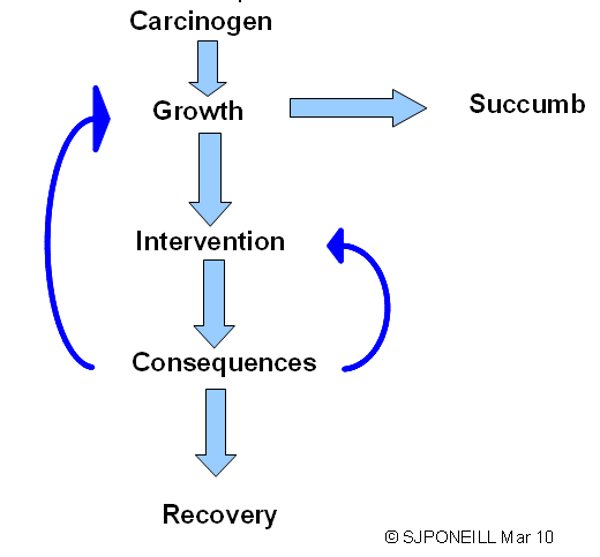
Hands up anyone who HASN’T seen any the cancerous application of this rule across national and local government…

But anyway, Curzon’s thoughts on global governance seemed quite topical as we slap a few more billions worth of Band-Aids on Haiti, knowing full well that once the current disaster is cleaned up, it will revert back to type in less than a year; as the number of failing and at-risk states continues to rise; as more and more experiments in self-government flounder in unimaginable debt and growing populations dependencies; as we focus more on the ‘now’ than the future…

One of the topics for discussion in the recent Cheeseburger Gothic discussions on the next iteration of the Axis of Time Birmoverse was how a forewarned timeline might manage post-WW2 colonies, in particular those sitting on resource deposits. I wonder if the Anglosphere (US, UK, Canada, Australia and New Zealand, possibly South Africa and Rhodesia) might not have adopted a more ‘involved’ strategy where colonies become ‘territories’ under control? Of course, this is just blatant Imperialism but, when you sit down over a good coffee and think about it, how many of those former colonies are better off under their own rule? I’d suggest that success stories like India, Singapore and Malaysia are very much the exceptions and the Haitis, Zimbabwes, and Myanmars are very much the rule.

Are we getting to the point where aid now comes not so much with conditions but with escalating forms of compulsion and accountability? I asked the same question on To the Stars… but regarding global warming – at what point do protests and sanctions become compulsion for the greater good…? Maybe not so much the global nanny-state but certainly stepping towards benevolent dictatorship…or just do haves unite in self-interest and let the have-nots, specifically the won’t-help-themselves to their own devices. Sooner of later we need to start making some tough calls as no nation can afford to repeatedly bail out those who can not succeed…in other words, let’s start getting real. How real it is to expect that we will be able to do much about small island nations that are slowly disappearing beneath rising waves (regardless of cause)? Build a Waterworld-like wall around them – noting that the original sank anyway…?

Perhaps Curzon was right after all and it is time to start learning from a century of mistakes; however well-intentioned, mistakes nonetheless…is it now time to start developing rulers once more…?