Welcome, Star…

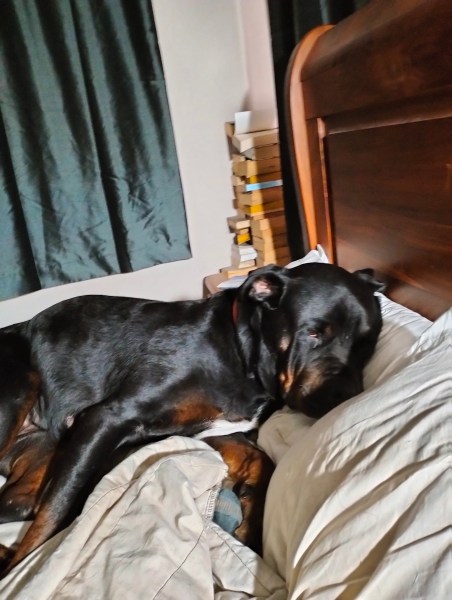
This is Star, our latest Rottie baby…

oplus_0

She’s a rescue who was surrendered coz she was grossly over-weight (almost 70kg compared to her now 45kg); she was fostered out but had to go back to the shelter where she wasn’t doing so well in an institutional environment, even with great carers…so they asked if we could look after her…

oplus_32

She came up on the pet bus (who knew there is a bus for pets that runs the length of the North Island?) and we picked her up in Taupo. That was in March and she was initially super hyperactive and reactive to everything. It’s taken til now for her to mostly adapt to the sights and sounds of semi-rural life and not start at every sound. She has also discovered mice – as winter finally arrives – and is like a 45kg cat when she gets a scent…

oplus_32

Gallantry case progress

Kathy Stewart, the mother of Private David Stewart, with Chief of Army Major General John Boswell at the dedication ceremony. Photo / NZ Defence Force

From WO1 (rtd) Bob Davies, via ONWARD BAR…please note that this is massive progress but not a battle won yet…

For non-Kiwi followers, David Stewart gave his life on Mt Ruapehu in August 1990 to ensure that other soldiers in his group survived the blizzard that had trapped them on the mountain…

David Edward Whawhai Stewart NZBM

The Minister received us warmly and listened carefully to our arguments. It was clear he was aware of the issues and had familiarised himself with the facts. He let slip that he had been talking to a number of people including our late friend and champion, Sir Wira Gardiner, whose influence clearly stretches beyond the grave.

Besides the three of us it has been a real team effort that included Dr Jim Mather (ex-RNZA officer), David Samuels (ex-RNZIR officer), Brigadier (Rtd) Phil Gibbons, Hon Col 1 RNZIR, Lt Col Logan Vaughan, CO 1 RNZIR, WO1 Chad Halley, RSM 1 RNZIR, Rear Admiral David Ledson, Chief of Navy (Rtd), Sir Jerry Mataparae, GG (Rtd) and Karl du Fresne (journalist).

Whereas before I was not optimistic. I am now. But no whooping and hollering yet. We should hear by the New Year. Here was our argument in a nutshell:

On 13 August 2022, 32 years after the tragedy, David Stewart’s sacrifice was recognised when the theatrette In Wellington Lines, home of his unit, the First Battalion, the Royal New Zealand Infantry Regiment, was named after him.

https://www.nzherald.co.nz/whanganui-chronicle/news/army-honours-private-david-stewart-who-died-saving-others-in-ruapehu-blizzard/SARNYNWKOO4V3IWWXM7TO7VZAU/

https://karldufresne.blogspot.com/2022/08/its-taken-32-years-but-david-stewarts.html

Hopefully, by New Year, or possibly in the New Year’s Honours List, David Stewart’s New Zealand Bravery award will be elevated to the New Zealand Cross.

It’s long overdue…

The Last View

For the last four years, my rear view on the way home has been something like this…not always wet, sometimes icy or, in the first year, snowing…

Last night was my last…

What was meant to be a six or so month gig to learn a bit more about hospo turned into a four year rollercoaster…learned so much from Spud and Davo, Jase, Keely and Carleen, El Loco, Elise, Caoimhe, Herve, Lydia, Toby, G-man, Koletso and Eddie…

Staff or customers, you get to socialise with the most eclectix mix…Schnapps is an icon not just in National Park Village but across the Central North Island, possible the world, the only pub with views of three active volcanoes, the best burgers and the best crew…

Going off to do some other stuff for a couple of months and then see what happens next…

I didn’t know Jake

This is Jake. Jake Millar.

I didn’t know Jake, In fact, until yesterday morning, his name was unfamiliar to me, although I had heard of his business, Unfiltered.

Jake was a young Kiwi entrepreneur who leveraged success with a high school business into Unfiltered. Unfiltered’s “thing” was interviewing high profile business leaders and making those interviews commercially available as training resources. It must have been a good idea as Unfiltered attracted around $4.9million in investor support.

Jake died a couple of days ago. Allegedly by his own hand. He was 26.

He had recently sold Unfiltered for a small sum, around $80k, possibly plus some stock in the purchasing company. The Otago Daily Times understates the response from investors as “Investors expressed some frustration at the sale of the business“. Overnight, Jake went from golden boy to devil’s spawn.

Investors and media hounded him around the world. They threatened friends who stood up for him. They attacked and attacked and attacked. Leading this assault was the rabid pack of hyenas known as the New Zealand media.

The fourth estate has some brilliant dedicated insightful writers but as a business group, our media has long side sold itself for click-based gratification, ambush journalism and gotcha articles.

It’s always easier to attack than to help, to push down than to pull up.

Startups fail. It’s a rule. Not all of them but a lot of them. Investors in start-up need to acknowledge risk. They need to do due due dligence and accept that the outcome may not be that which they desire.

Life in the fast lane.

The circumstances surrounding failure may be deliberate or environmental. Some times an idea just doesn’t find its place or time. Some time a decision goes the wrong way. Soem imes the markets changes. Sometimes a great whopping global pandemic comes along. Always though there is risk.

Life in the fast lane.

Many of the hyenas have accused Jake of living a high life, and of squandering investors’ money on that high life. But they present no evidence to support those accusations. When challenged, they threatened and attacked Jake’s friends and supporters.

They didn’t like the way Jake dressed or the shoes he wore. So what…? Business skill and dress sense are irrevocably linked. This is a young guy who sold his first business for six figures to the notoriously frugal New Zealand Government – while he was still at school. His list of interviewees is long and distinguished.

As an invest prospect, Jake and Unfiltered probably looked pretty good. But there’s always risk.

And no one deserves to be hunted and hounded just because they struggle to maintain initial success, certainly not by those who haven’t taken or can’t take- that’s you, NZ media – the plunge into high-end entreprenuralism.

When I was doing lesson learned, one of the early ephiphanies was that the best incentive for learning was a good punch in the nose. You don’t learn by walking, you learn by stumbling and getting back up again and stumbling and getting back up again.

Unfiltered was probably not Jake’s final destination. It was more likely a stepping stone on the way to something else. There is nothing to indicate that he wasn’t capable to picking himself up and starting over. He was only 26. Many of his attackers would have already had the same experience, some numerous times.

Except for the media hyenas. Those who cannot. But who choose to judge. Who stalk and and harass. Who threaten and attack when challenged.

Hardly the most professional of communication

National Business Review can say it was just doing its job, that it has to push hard to get the facts but really, all it was doing was bullying under the guise of journalism. Every good journo in New Zealand should be calling this behaviour out. Not just the publication but the individual staff that are doing it and the management that are allowing it.

If you;re going to read aout Jake, read the ODT. Or read Jenene’s post on the nasty side of this. Or read both.

Ignore NBR. But do contact your MP and shadow MP and ask then what they are going to do to introduce New Zealand’s media (or elements thereof) to the concepts of accountability and responsibility.

Do it for Jake.

Someone’s brothers, someone’s sons

Below is the text of an address delivered by former Sergeant-Major of the New Zealand Army, Bob Davies, at the Onward Bar in Taupo on ANZAC Day 2021.

“This morning I will to relate to you an action that upheld the finest traditions of one of the New Zealand Army’s premier fighting units, the 1st Battalion, the Royal New Zealand Infantry Regiment, the only battalion that has added a Battle Honour to its colours since World War 2. Unlike most stories this Anzac Day though this is not one about combat in far-flung fields. It is a story that played out very close to here some thirty years ago. A story as epic as any that will be told this Anzac Day and unfortunately a story too few in New Zealand know much about. It is a story about two senior soldiers and another young man who demonstrated they are cut from the same cloth that the finest of this Regiment has seen. These soldiers were involved in an incident that claimed more lives than any other single action since WW2.

On the morning of Thursday 9 August 1990, 10 soldiers from B Company, 1 RNZIR, together with a Naval rating and two instructors from the Army Adventurous Training Centre, commenced a mountaineering course on Mount Ruapehu. 13 personnel departed Waiouru Camp that morning. Only seven returned.

The weather on the 9th of August was very good, with clear skies and light winds. The group spent the first day, a Thursday, climbing to the summit and conducted some practical training.On Friday, the group spent the day constructing two snow caves and a snow dome and then slept that night in those shelters. The next morning, Saturday, the weather deteriorated significantly, with very strong northerly winds and very low visibility. The group remained sheltering in their snow caves for a second night. On the following day (Sunday), the decision was made by the instructors to move back to the Dome Shelter. It was from then on that serious difficulties began to develop.

On leaving the shelter of their snow caves, the group was exposed to the full force of the storm that had now developed. Visibility was reduced to a few meters and the wind had significantly increased to an estimated strength of around 150kph; strong enough to lift members of the group off the ground. The decision was made to halt and attempts made to dig trenches and use the packs to provide some shelter from the wind. The group was now on the flat Col, approximately 200 meters from the Dome Shelter; probably the most exposed position on the mountain at that time.

After remaining in this location for two to three hours, a second, unsuccessful attempt was made to find the Dome Shelter. It was then that the first hypothermic cases became apparent. The group stopped whilst casualties were attended to and attempts were made to construct a snow shelter. This proved impossible due to the ferocity of the storm. The group then attempted to “dig in” in that location. At this point, two members of the group were hypothermic, one was suffering from frost bite and a number of others close to exhaustion. A decision was made to seek assistance and the senior instructor, Sgt Snowden, together with Pte Brendon Burchell, departed down the mountain. The time was now approximately 1630hrs.

Throughout that night, the storm continued with the same ferocious intensity. By this time, the soldiers were without any experienced leadership, as the lone instructor left on the mountain had become non-effective. Ptes David Stewart and Sonny Te Rure (now known as Sonny Tavake) constantly moved about the group, offering encouragement and attempting to alleviate the suffering by giving over some of their own clothing and equipment. They were assisted in their efforts by LCpl Culloty and Pte Berger.

In the words of LCpl Culloty “….word filtered back that an instructor had gone for help and for the remainder to break out their sleeping bags. By the time this reached Pte’s Stewart, Tavake, and myself, those that were able had done so, however 3 – 4 soldiers displaying signs of hypothermia, were incapable of this. We gathered them into a group and Ptes Stewart and Tavake went in search of packs to get the sleeping bags out. This was no easy task as visibility was near zero and many packs were buried in snow that became ice in a very short period or had blown away. Each time a sleeping bag was found, they came back to the group and took one away and put him in a sleeping bag as best they could.

They left finding sleeping bags for themselves until last. They came back to find the last person there (myself) had collapsed. Pte Stewart dragged me to a bag and managed to get my legs and lower torso into it. He then put a survival bag around my upper body. There was by then only one sleeping bag for Ptes Stewart and Tavake as no other packs could be found. They covered themselves as best they could.As the night progressed the direction of the wind changed constantly, resulting in large amounts of snow building up on my chest then freezing solid. As the weight increased, I began to have difficulties breathing and called for help. Pte Stewart leaned over and eventually was able to clear the snow and ice off my chest allowing me to breathe normally. He did this approximately six times during the night. Later, a soldier not far from me had his bag blown away and I got him to join me, and in doing so, my survival bag blew away, so we used the remainder of my sleeping bag to cover our heads and shoulders.

Later a soldier from the end of the group crawled over and said that the person he had been sharing a bag with had died. We told him to go back, remove the body from the bag, and get in, and he left to do so. He then came back and said that he could not find his sleeping bag (I assume it had already been covered with snow). He asked if he could join me and the soldier with me, and I told him no, as there was no room and that he should find somebody with a bag to themselves. He returned a short time later having found no shelter, and again asked for help. At this point, Pte Stewart told him to join him and Pte Tavake in their single sleeping bag. In doing this, their sleeping bag was blown away and the three of them were without any shelter whatsoever.

After this, we began to grow weaker and weaker. The soldier who had been with Ptes Stewart and Tavake crawled over beside my head and began talking incoherently and died. Some hours later the soldier who was sheltering with me became delirious and died also.After many hours, when I occasionally called out and received no reply, I assumed that all but myself had perished. Later the weather, though still extreme, lessened in intensity for a while and I made contact with others and we were subsequently rescued. As we were brought into the Dome Shelter, I was surprised and pleased to see Pte Tavake, and we were both shocked that only five of us had survived. It seemed impossible that Pte Stewart, given his physical and moral strength, leadership and selflessness, should have died.

I have no doubt in my mind that if he had chosen to take care of himself he would be here today. He chose instead to put others before himself and to risk time and again, his own survival to help those unable to help themselves. All this in an extreme environment where we novices were left to our own devices. I would not be here today but for his actions. That is the man he was.

Around 0530hrs on Monday Sgt Snowden and Pte Burchell having walked some 13 hours through the night, made physical contact with an Alpine Lift staff member who contacted the Duty DOC Ranger. The search and recovery then commenced. The first recovery team reached the Dome Shelter at approximately 1300hrs, and on finding nobody there, descended to the Col where they located the group. They found only 5 survivors who were then moved to the Dome Shelter.

In due course a Court of Inquiry was established to investigate the loss of life. Among other findings, the Court noted the “outstanding courage and bravery” shown by a number of the group, namely Ptes Stewart, Tavake and Burchell. In the case of Pte Burchell, the Citation noted that “..Private Burchell not only had to cope with the most extreme conditions but, because of his lack of experience, he had no knowledge of how to overcome them. His courage and determination and perseverance to continue in the face of extraordinary adversity not only brought great credit on himself, but certainly assisted in the rescue of the survivors…” The Court recommended they be formally recognised with an appropriate bravery award. In the case of Stewart that was to be with the award of the George Cross. Under the imperial honours system then extant, the level one award, and now the New Zealand Cross. Some nine years later Ptes Stewart, Tavake and Burchell were finally awarded the New Zealand Bravery Medal, a level 4 award, the lowest that recognises bravery. Of significance, the Citation noted that, despite the dreadful conditions, “…Privates Stewart and Tavake maintained a continual vigil over their companions throughout most of the night, providing what assistance they could.” The Citation further noted that “.. Private Stewart would have been fully aware that his actions in continually moving out of shelter and the warmth of his sleeping bag to assist those with hypothermia, meant he had an increased chance of also becoming a casualty. He was also aware that he was becoming increasingly exhausted by continually battling the elements.” It added that “Privates Stewart and Tavake displayed selfless care of the casualties and their sense of responsibility to their companions testify to their bravery”.

It is also worthy of note that both Stewart and Tavake had spent most of their soldiering in the tropical conditions of SEA from which they had only relatively recently returned. Moreover, these soldiers battled the life-threatening conditions for almost two days without concern for their own safety. In doing so Stewart died and Tavake still suffers from the effects of severe frost bite.

The following are so far the only two recipients of the New Zealand Cross:

On 24 April 1992 Jacinda Margaret Amey was one of five members of a Meteorological Service team, stationed on the remote sub-Antarctic Campbell Island, who were snorkelling when one of them, Mr Mike Fraser, was attacked by a shark, believed to be a white pointer. The other swimmers, apart from Ms Amey, swam to shore. Ms Amey waited until the shark moved away from Mr Fraser and then went to his aid and towed him to shore. Mr Fraser had lost his right forearm and his left forearm was severely lacerated and appeared to be broken. He was having trouble breathing and required urgent medical treatment. Having got him to shore, Ms Amey then joined the rest of the team in doing what they could for Mr Fraser until he could be flown to New Zealand. Ms Amey displayed great courage and bravery with complete disregard for her own safety in going to Mr Fraser’s assistance.

And the second recipient:

On 9 June 1995, Reginal John Dixon, aged 47, and his wife were passengers on Ansett New Zealand Flight 703 when the aircraft crashed in the Tararua Ranges near Palmerston North. Mr Dixon escaped from the wreckage with fractures. However, despite his injuries, he returned to the aircraft to help other passengers trapped in the wreckage. As a result of this selfless action, he was critically burned when a flash fire broke out on the left wing of the aircraft near a hole in the fuselage from which he was helping passengers escape. He was hospitalised and underwent surgery and skin grafts. Mr Dixon remained in a coma, and although he made some initial improvement, his condition worsened and he died two weeks later, the fourth victim of the crash. The situation in which Mr Dixon found himself was extremely dangerous and he displayed great bravery in returning to the aircraft, although injured, to help other passengers which subsequently resulted in the loss of his own life. His bravery undoubtedly ensured that the loss of life was not greater.I ask you were David Stewart’s actions over almost two days not equally as heroic as these two New Zealand Cross recipients? If so why then was he not appropriately recognised with a level one award.

There was another climber on the mountain that day, a Japanese George Iwama, who remained there for 5 days during the same blizzard. He related: ‘There was a white-out and terrible freezing conditions 20 or 35 minutes after I left the snow cave… ‘I couldn’t locate where I was walking and I decided to dig another snow cave.’ He of course survived.

I ask you: was it that the award of the New Zealand Cross would have brought undue attention to the very real shortcomings of the New Zealand Army and its Army Adventurous Training Centre?

I’ll let you decide.

The latest Listener has an excellent 5 page article on this tragedy by Karl Du Fresne.

More to follow…
The ethical divide

…or, as we locals know it, the Tasman Sea, that large wild body of water that separates Australia from New Zealand. The big blue thing that keeps everything known to mankind that can kill you in Australia, and keeps New Zealand clean and green…

…except for banking where the process is reversed and the bad practices now being exposed by Rebecca Orr and the Australian Banking Royal Commission propagate across the Tasman into our fair land… Conversely, it would seem that remedial action, however slow, in Australia, doesn’t swim…

These principles are from ANZ’s 2017 Corporate Sustainability Review. It is largely focussed on ANZ operations in Australia but its scope includes ANZ New Zealand. Sadly, as you can see below, such initiatives by ANZ seem to be only limited to ANZ Australia – where is ANZ New Zealand’s Customer Fairness Advisor?

The former Australian Commonwealth Ombudsman, Colin Neave, was appointed as ANZ’s Customer Fairness Advisor. The Customer Fairness Advisor role is focussed on minimising reputational risk, and the risk of regulatory intervention, which may arise from:

• the retention or development of products which have an unfair impact on our retail and small business customers;

• shortcomings in the way in which we manage customers in financial difficulty and assess suitability for lending; and

• broader stakeholder concerns about the culture and values of large financial institutions.

During the year, Colin Neave developed customer remediation principles to assure our customers that ANZ will acknowledge and compensate for any failures quickly

ANZ corporate sustainability review 2017 p21

It’s not that bold a statement to suggest that ANZ New Zealand’s only awareness of the concept of reputational risk comes from the highly-critical Financial Markets Authority and Reserve Bank’s reports last month on banks’ culture and conduct in New Zealand. They are both worth a read: Culture and Conduct and Bank Incentive Structures.

ANZ New Zealand is:

  • a bank that loaned vast amounts to a borrower recovering from a serious head injury; 
  • a bank that failed to determine if the loans were repayable. When I first found out about them in 2013, the accrued debt was just over $400k, with a company that had assets scarcely half that amount.
  • a bank that failed to to disclose this lending to me as the guarantor of that lending, even though by every standard of conduct, it should have.
  • a bank that, when challenged about this debt, lied about being authorised to disclose this information to me as the guarantor.
  • a bank that continued to lie by claiming that the Credit Contracts and Consumer Finance Act prevented that disclosure to me.
  • a bank that kept on lying when it made up information from the Code of Banking Practice to support its argument that disclosure obligations for guarantees and security are different. (they may be for some banks but for ANZ, by its own definitions, guarantees are part of security.)
  • a bank that, even when we said we could beat the sole tender offer and when there was other interest in the property, still accepted that single low tender offer.

So…ANZ New Zealand, where is your Customer Fairness Advisor? God knows you need one (at least)…

View from the Top

AW- ANZ.jpg

We all scoff at LinkedIn and question its true usefulness for anything, well, useful…yeah, we do…it’s like social media but just for the boring stuff…apart from keeping in touch with one or two people who don’t do the social media thing, LinkedIn is rather ‘yup’…

It has its uses though and, last week, I was able to use my one free month introductory special offer of LinkedIn Pro, specifically the InMail credits that come with the demo, to engage ANZ New Zealand board of directors….you can’t really reach much further than the very top…

From an academic perspective, I was interested to see if I even got a response, and if I did, how long it would take, noting the loooong time it takes ANZ staff to respond, especially if the subject matter is not to their liking. Recently the CEO of ANZ Australia – a Kiwi – said that  he “…answers every email he gets and responds to all written correspondence from customers usually on the same day…” So there’s a standard of sorts…

In all fairness, the board of ANZ New Zealand responded in less than two days. Disappointed in their response? Actually no and not surprised either…this is an organisation that has lost its way so badly that it can no longer see the moral forest for the trees. If the board had suddenly turned against ANZ’s position for the last five years on this issue, you would have to seriously question its competence as a major banking institution.

Today, Stuff posted a story “ANZ makes almost $2b from New Zealand banking” That, apparently, represents 40% of the total banking profit in New Zealand in that twelve month period. 40%! From a single bank! Are the others doing something wrong…or perhaps are they doing things right…? $1.99 billion dollars. Almost $5.5 million dollars EVERY day – by afternoon smoko on any given day, ANZ could clear RAL’s loss for 2018 – and not even blink. For that money, it could probably operate the Defence Force…

The culture of Gordon Gecko springs to mind…
gekko greed.JPG

I think banks have, like a lot of companies, we did lose our way.

“We became unbalanced in terms of the pursuit of financial metrics and success which again are very seductive.

“It is like anything — people in any industry or any team want to win and if the score is about profit or return it becomes really easy to focus on that at all costs.

Shayne Elliot, CEO ANZ, 2018

My situation aside, it’s clearly time for change…let’s kick it off with our own Banking Royal Commission and go from there….

Please sign and share our petition of change in the New Zealand banking industry


We did this!!

Screen-Shot-2017-08-05-at-7.59.07-AM-600x323.png

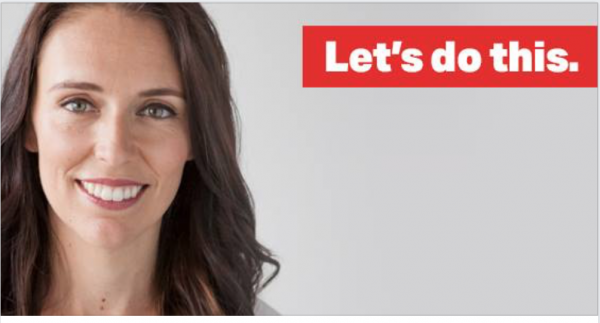
“Let’s do this!” was the slogan for the New Zealand Labour Party as it headed into the 2017 election.

22528090_10155077146916452_6884563744921161225_n.jpg

That changed to “We did this!” last night when party leader Jacinda Ardern announced the successful negotiation of a coalition alliance with the Green Party and New Zealand First, nudging out the National Party. National had only to reach agreement with other party to secure the clear majority needed to form a government. After weeks of negotiation, it proved unable to do so.

Simply, it is time for change. National may have still secured a record fourth term in office but in the end it was probably let down by the behaviour of some of its members and supporters. New Zealand was just tired of the arrogant conduct of those members, and for many the smear campaigns of the election were the final straw.

What made the outcome more interesting was that New Zealand couldn’t decide who it was to take the reins:

A. Labour

B. The Green Party

C. New Zealand First

D. All of the above

Last night we got D, All of the above.

Many lament that one party with only seven seats was able to wield the balance of power like a blunt instrument but, sorry, that’s how MMP works. In the end, as trite as it sounds, it is about consensus and working together – because it will only work that way.

As we have found increasingly since the end of the Cold War and the (for better or worse) resurgence of the UN, coalitions have become the norm. No long does one power get to wield its will without fear of dissent or opposition. Sharing, cooperation and liaison are all core functions of effective coalition. So is compromise.

There are interesting times and big challenges ahead. National did sterling work rebuilding after the big earthquakes of 2011 and 2016 but is free rein to big business has left us with some uneasy alliances.

Who knows what change will come? But come it will, it has…and for these little green dots in the middle of the big blue thing at the bottom of the globe, that’s not a bad thing…

It’s not time to get on with the job. For many there will be the temptation to follow the lead from some in the US and continue to protest the legal result of this election, to start their own little ‘we resist’ campaigns…

Simple, don’t….gp-cement-australian-400x_.png

…if you need to, take two teaspoons and harden up…but we don’t need any of the same style media-driven division and conflict the media shows us in the contemporary US…

Say no to sugar taxes

sugar nanny state.jpg

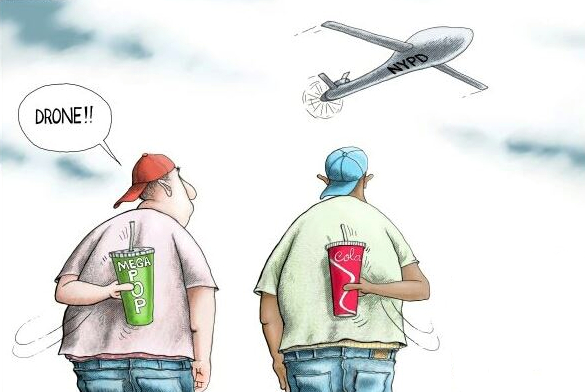
Drone alert in more ways than one…

Healthy Food Guide reports today that

“A petition calling for a tax on sugar-sweetened beverages that collected nearly 10,000 signatures was presented to Maori and Green Party MPs in Parliament last week”

That’s on the HFG site that is so paranoid that it has blocked the right mouse button function to prevent people copying or printing its articles and recipes. Heads up, team, all that does is force people to other sites more friendly (you’re not that unique), to use the browser drop-down menu, and/or just give you a miss: most, if not all of your recipes are available elsewhere (it’s not called the world-wide web for nothing you know)…just Google the recipe title to see if you can’t find the same -or often a better – recipe elsewhere…

But…back to the sugar thing…dear food fun Nazis, please get a grip…taxes don’t stop people using commodities they want to use…increasing taxes hasn’t drastically changed usage stats for spray paint, petrol, alcohol or nicotine, nor, had the legislation been enacted, would it have stopped sheep farting…all taxes on products like these is make them more expense so that people waste more money on them (less the sheep farting – sheep farts will always be free).

If you really want to stop people using something, then ban it and make it totally unavailable, except of course, for the bootleg and black market alternatives that will spring into existence the second the ban goes into effect. Bans – certainly where the market mass is most of the population – are rarely (not really!!) effective.

Ongoing effective education is the solution. Not anti-sugar propaganda because even kids can see through that. Tell it like it is. Put the truth – not truth, not your truth – out there. Be first with the truth. It’s not perfect but have a read of That Sugar Story anyway. Damon Gameau is a bit OTT at times but his basic premise is pretty good and pretty healthy – and you don’t need any laws or taxes to make it work. Consume less sugar. Avoid hidden sugars: quick tip, if it’s in a plastic wrapper that says it’s healthy, don’t touch it…you DON’T have to give up food fun to be healthy…there’s more to healthy food than water and lentils …

(lentils get a bad rap sometimes)

Stop trying to protect everyone from themselves. Nanny-stating has an opposite effect in the long term: instead of protecting the people from themselves, the increasing absence of challenge turns them into mindless drones incapable of applying judgement, solving problems or thinking for themselves.

I caught up with an old friend last week – someone who I had not physically seen 2007 but whom the miracle of Facebook had kept me in touch with. She made the very telling comment that the more support services we offer, the more people demand AND the less capable they become of thinking and fending for themselves. More and more people expect everyone to be nice to them and for ‘someone else’ to doing all think and supporting for them as well…

The truth is that sometimes life throws up challenges; life is sometimes a bit hard; things do not always go according to plan. ‘The people’ need to make their own decisions and accept the consequences of those decisions. They need to be given opportunities every day to exercise and practise those skills. Taking away their ability, indeed their right, to make lifestyle decisions for them and their families doesn’t make us smarter or healthier as a nation…

Look askance at any politician babbling in support of a sugar tax…


Know Before you go; if you don’t know, don’t go…

‘Tis the season…for inexperienced (in New Zealand conditions) and poorly-prepared trampers to ‘walk’ the Tongariro Alpine Crossing…and every year Police and volunteer rescue teams put themselves at risk to rescue these wallies

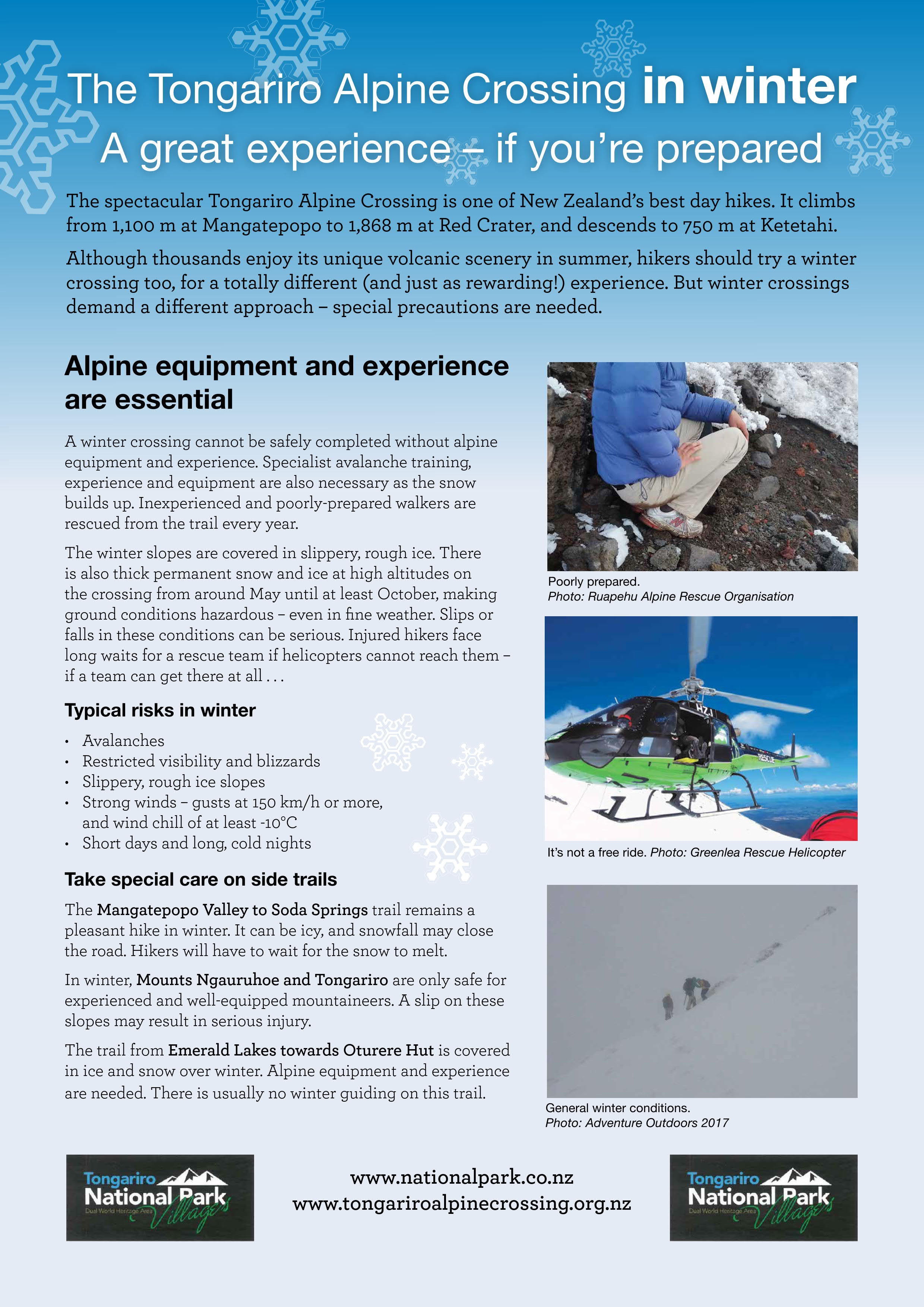
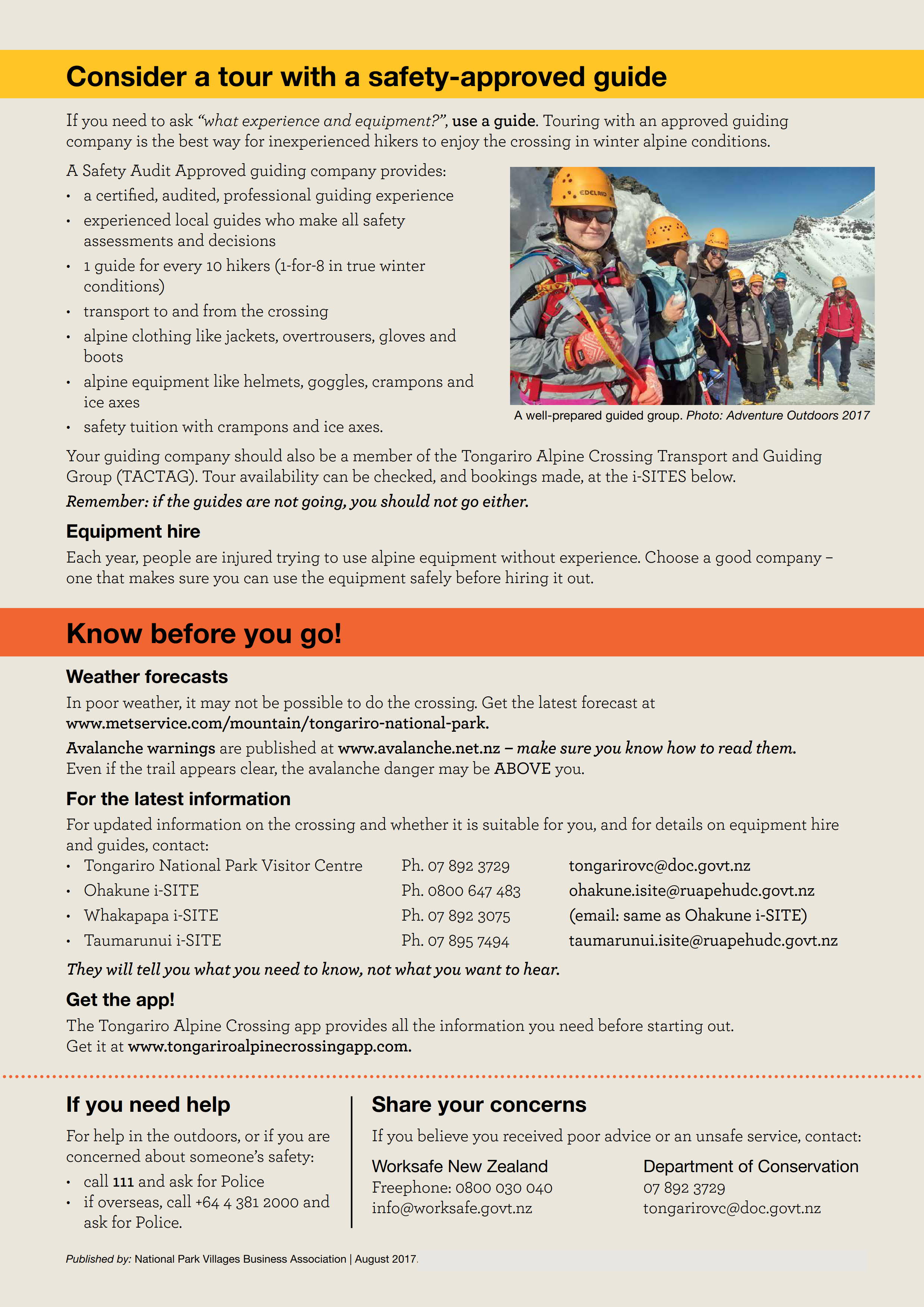
Last week, this brochure was released to get the message to national and international visitors to Tongariro National Park. That message is really quite simple:

Know before you go:

Know the weather AND ground conditions

Know what to do in alpine conditions

Know what to do in avalanche terrain

Know what to do when the plan goes wrong

If you don’t know: don’t go – or go with a guide…


Tongariro Alpine Crossing_winter 1Tongariro Alpine Crossing winter 2

A lot of the information online and offered by staff in the hospitality line is well-intentioned but ill-informed. Many people, especially those off the mountain or not ‘mountain’ people, do not understand the hazards of the Crossing in winter, or during bad weather. Many think it is just a case of ‘giving it a go‘, of ‘going harder‘, or just ‘will-powering’ themselves over the snow and ice. Others think that it is more important to promote ‘tourism’ at all costs…

“…the trampers were lucky to escape with their lives…”

“…not sticking together caused the group to inadvertently separate…”

“…All their clothing was wet…they didn’t have it in waterproof packing…”

“…they didn’t call for help until it was very dark and one tramper was unable to walk…”

We don’t say these things, we don’t make the Crossing sound dangerous to scare visitors off, to try to keep the place for ourselves, to discourage commercial operations in the Park.

We say this because we want visitors to come here, enjoy themselves and leave safely.

We say this because we don’t want our people putting their lives on the line for rescues that are unnecessary; being dragged from their beds or jobs at all hours because of good intentions and poor information…

Don’t become a statistic

Know before you go

If you don’t know, don’t go

…or go with a guide…