The Myth of Force Ratios as core to COIN

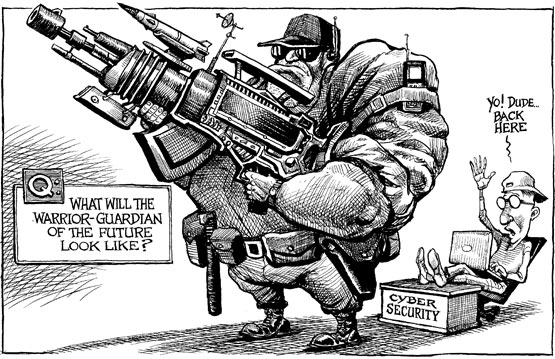
Randomly-selected COIN-themed header pic

“The best way to become acquainted with a subject is to write a book about it. Benjamin Disraeli”  

This little gem was the random quote that WordPress threw up when I published the item on Definitions in COIN and never were truer words spoken – if all we get from the FM 3-24 revision project is a better understanding of the irregular environment (of which COIN is a subset), then it will have been a valuable and useful activity to have participated in…

Today we discuss the second issue paper produced as part of the project…IP2 Force Ratios…This topic really narks me as the presentation of pseudo-scientific mumbo-jumbo (yes, that is a doctrinal term!!) as supportable fact…as you read on, you’ll probably get the impression that I’m not a big supporter of this concept…my comments are in two parts: the first refers to related questions in the original FM 3-24 Revision Questionnaire the responses to which lead to the three issues papers, the second addresses the content of IP2 itself…

Part 1 – Answers to initial review questions

The ratio of counterinsurgents to the population is one of the more oft-cited portions of the current FM. A study by the Institute for Defense Analysis concludes that twenty counterinsurgents for every 1000 residents in the area of operations leads to a 54% probability of success. If, however, the density increases to 40 for every 1000, the probability increases to 83%. Another study by the Harvard Kennedy School,  however, concluded that increases from 5 to 80 troops per 1,000 inhabitants caused the probability of success to increase by less that fifteen percentage points. Most studies caveat 2 results by stating that no level of force density will guarantee success. Based upon these studies and any others of which you might be aware, how should force ratios in the FM be adjusted?

The ratio model is an over-simplistic take on a very complex environment, driven by those seeking a checklist/template solution to COIN/IW. Even if it could be proven that  there is an optimal ratio of counterinsurgents to residents, we would then have to further define structural ratios within ‘counterinsurgents’, even first define what the optimal counterinsurgent is: in Baghdad 2005, the optimal counterinsurgent may be a heavily armed and supported combat soldier, whereas in Bamiyan 2005, it might be a CIMIC specialist. In most COIN/IW circumstances, the wrong type of force could be as damaging to the campaign as too little of the right kind of force.

The force ratio model does also not consider that the probability of success may also decline if the counterinsurgent/resident ratio is too high. The wrong sort of force or wrong ratio for any given COIN environment stands to contribute to creation of Kilcullen’s accidental guerrillas – while the book may have drawn some somewhat dubious conclusions, the concept of the accidental guerrilla is sound.

Should force ratios even be addressed in the FM? 

The force ratio discussion in the FM might be more useful in offering considerations for the internal force structure ratio for a given environment. Either way, the content should emphasise that there is no templated or generic optimal force ratio.

The current FM quotes Galula who posited “that revolutionary war was 80 per cent political action and only 20 per cent military.” The sentence that follows caveats that remark. Does the 80/20 ratio have any historical validity, other than being cited as noted?

As above, defining any ratio is only likely to do more harm than could and will encourage a template/checklist approach to COIN. Of greater importance and relevance is what might comprise, against a given COIN/IW environment the specific political/OGA/NGO and military components of the COIN force.

The key lesson to be derived from the Galula quote is that a successful COIN campaign requires a blend of military and other capabilities. DIME (diplomatic, informational, military, economic) and JIM (joint, inter-agency, multi-national) are commonly accepted constructs for effective campaigning and it is well accepted that there are few if any contingencies that might be addressed by only one branch of the service or by the military in isolation from other elements of national power.

If not, should there be any reference to a political/military percentage in counterinsurgency warfare?

Other than to re-emphasise that long term success requires more than a military solution, probably not: introducing any specific metrics into a publication at this level leads to the template/checklist mindset. The bottom line must remain that each COIN/IW scenario must be considered on its own merits.

One way of leading to acceptance and understanding of this might be to retitle the publication to “The Military Contribution to Counterinsurgency” – this would make it clear from the get-go that there are other aspects than purely military to this form of conflict.

Part 2 – Issues arising from IP2

Recommendation 1. The fact that the force ratio theory was mentioned in the 2006 version of FM 3-24, a publication drafted in some urgency in response to an operational crisis, is not sufficient reason to automatically include it in the updated FM. It is a common occurrence for doctrine developed against operational urgency to be substantially revised on first or subsequent revision. In the Australian Army doctrine development model, doctrine specifically identified as ‘developing’ is meant to be reviewed after twelve months and there is often substantial difference between the initial ‘developing’ version and the more enduring developed version. ‘We’ve always done it’ (in this case only since 2006) is more akin to dogma than doctrine.

The new FM 3-24 not only could work around the perceived constraint in recommendation 1 but it should and this can be achieved by simply noting the lack of any substantive evidence supporting either general forces to population or to insurgent ratios

Recommendation 2. The logic in this recommendation applies equally to identifying members of the population – it is a fair assumption that not all insurgents will be recorded members of a region’s population i.e. that they have deployed into that region because it offers some specific advantage or attraction from an insurgent perspective. Ergo, not all insurgents are locals.

The same logic also applies to determining optimum force ratios within the counterinsurgent forces – as it is often difficult to identify at any one point which is the most effective force structure for a given scenario, the usefulness of any discussion on force ratios, other than to discount the force ratio as a viable counterinsurgency metric or approach, is moot.

Recommendation 3. The same issues mentioned above under recommendation 2 apply to recommendation 3. That only the latest study of insurgency found a correlation between the number of counterinsurgents to population indicates that this theory is still unproven. Neither recommendation takes into account the physical geography or size of the area of operations which may offer a range of advantages or constraints to both insurgents and their adversaries.

Recommendation 4. If this recommendation is implemented, the publication must offer clear guidance on the considerations for determining the optimum force size and structure for any given counterinsurgency environment; and also for determining when that ratio may requirement adjustment up or down. Considering the example given involving host nation security forces, it should alos be considered that the state of those forces will also be a modifier on the optimum force ration e.g. if the host nation forces are ineffective and/or possibly corrupt, then this, regardless of the population size, may modify the counterinsurgency force to population ratio up. Conversely if the host nation forces in a given area are quite effective this may modify that figure down.

Some guidance on the granularity of the force ratio must also be given if these recommendations are adopted i.e. does the force ratio apply across the whole operating environment, across individual AOs or units, or across just the most contested areas?

Recommendation 5.  The proposed paragraph 1-67 promotes the employment of what remains an unproven theory that simply has too many variables to add value. The proposed paragraph 1-68 on its own provides adequate guidance on force ratios in counterinsurgency. Notably it offers no guidance as to the ‘optimum’ force ratio and leaves this to be determined by a robust planning/campaign design process which is where it should lie.

Bottom line: there is no templated shake’n’bake solution to force structures for COIN – each force must be generated against the specific environment that it is going to operate in….there is no substitute for victory thinking….

Definitions in COIN

Randomly-selected COIN-themed header pic

In December 2006, the US Army and USMC co-published FM 3-24 Counterinsurgency, a publication specifically intended to align US forces with the needs of operations amongst ‘the people’ in Iraq. Some of the ideas were new, others harked back to well-established truisms from the eras of Vietnam and Malaya – the aim was a decisive shift in how US forces conducted themselves in the new operating environment where force and ‘the big stick’ weren’t the ultimate arguments.

The COIN Center at Fort Leavenworth is now taking the lead in a two year project to review the content of the original FM 3-24 and update it as a tool for less-specific i.e. not Iraq, operating environments. As part of the project, the Center is seeking comment from a broad spectrum of stakeholders and interested parties and thus is conducting a large portion of its work in the public forum. From this part of the world, that means some odd hours to participate in the regular webcasts that discuss aspects of the project but it is well worth the lost sleep.

The Center has produced three Issue Papers on key aspects of the publication – these are available on its public website – and over the next while, I’ll share my thoughts on those issues…IP1 is Definitions

Accepting that irregular warfare is sufficiently different from conventional conflict to warrant specific definitions and doctrine, possibly the first question to be considered is whether insurgency is sufficiently different from other subsets of irregular warfare to require specific doctrine and definitions i.e. would targeting irregular warfare as the primary subject also satisfactorily cover insurgency as a subset of IW?

In examining the definitions under paragraph 3 of IP1, the answer is probably ‘yes’ and of all the definitions, the French one is probably the most accurate, closely followed by the Spanish and USG definitions if they dropped the word ‘political’. The key elements of the environment that FM 3-24 seeks to describe are the use of armed conflict/guerrilla warfare/terrorism and the objective of control. Whether that control is political or other is largely moot as the net result is control over a geographic area and/or a group of people.

Recommendation 1 could read “That the US Government should adopt a single definition of Irregular Warfare, of which insurgency is a subset”; this renders a specific definition of counterinsurgency moot. Considering that the ultimate objective of a campaign to counter irregular warfare is stability, it may be that the countering definition comes closer to stability operations that it does any other type of operation. This, of course, would lead to a review of more fundamental doctrinal principles, in particular whether stability operations are actually distinct from offensive and defensive operations per se, or whether that distinction is more from major combat operations or conventional operations e.g. the Fulda Gap.

With reference to paragraph 4, this argument is moot and largely doctrinal semantic hair-splitting unless there is some previously unrecognised body of knowledge proving that all the types of IW conflict listed under that paragraph are uniquely and distinctly different from insurgency and that the responses to those forms of conflict are equally uniquely and distinctly different from those employed to counter insurgency. I would offer that they are probably not and even postulate that it would not be uncommon for two or more of the forms of IW to exist in the same theatre. The finding that “…the approved definition should distinguish  insurgency from the types of conflict listed [below paragraph 4]…” i.e. recommendation 2 is incorrect.

Recommendation 4 is correct in not recognising the use of the term ‘grievances’ which immediately leads to a ‘righting wrong’ mindset. While the definition of counterinsurgency gains little from incorporation of ‘root causes’ into the actual definition, it is rather dismissive of ‘root causes‘, as an element of any campaign countering insurgency. The simple definition of counterinsurgency is “those steps and measures employed to counter insurgency” and care must be applied to ensure that the definition does not prescribe or imply the specific steps and means of countering insurgency – these should be defined and refined in the substance of the publication itself.  Thus the definition of counterinsurgency is less important than the definition of insurgency i.e. there is a whole publication in which counterinsurgency will be defined, but this will only add value if the core definition of insurgency is ‘got right’. Our broader concern is that such sentiment will shape the content of the publication itself.

Caution should be applied, however, in dismissing ‘root causes’ from any approach to counterinsurgency. Cause should be considered in its classic causal sense and not in the narrower context of a political or other cause. To not consider root or underlying causes in an insurgency environment promotes the apparently practical and reasonable mindset that there is such thing as a successful military approach to countering an insurgency i.e. good versus bad, us versus them, friendly versus enemy, defeat the enemy. Even if the action arm (translating Clausewitz’s three elements of a problem into an IW environment where the government, the armed forces and the people become the leadership, the action arm and the people) of the insurgent elements is defeated, it is almost bound to rise again if the underlying causes, be they political, criminal, economic, egotistical, etc are not addressed. An underlying issue is clear in the five examples of ‘non-compliant’ insurgencies listed under recommendation 4.

A cynical exception to this would be where it is necessary to temporarily defeat or suppress an insurgency as an enabling action for a higher objective i.e. national objectives, and where upon attainment of that objective the course of the insurgency is no longer a national concern.

Recommendation 5 is a little misleading. I agree that the term does not need to be included in the definition of counterinsurgency but for the reasons stated above in regard to not including ‘root causes’ in the definition i.e. that this specificity is not necessary in the definition where considerations for and approaches to counterinsurgency can be discussed at length within the text of the publication – assuming that the actual definition of insurgency is ‘got right’. The broader concern is that such sentiment will shape the content of the publication itself.

However, recommendation 5 as a whole implies that it is possible to successfully prosecute a counterinsurgency campaign without employing a comprehensive/JIM (joint, inter-agency, multi-national) approach. Unless the objective of the campaign is short-term suppression or stability to enable a higher objective, one would be hard-pressed to find too many examples from history of successful counter-insurgency or broader irregular warfare campaigns that have relied on a solely military approach; in fact, it is likely that historical review would find that most conflicts of any nature or scale have required a broader engagement for ultimate success. Identifying a comprehensive or JIM approach as the optimum method to a counterinsurgency campaign does not commit one to automatically have to seek or comply with the full scope of the JIM model; it definitely would not “…result in the US not being able to declare that it is countering an insurgency unless all organization types are involved…” This is the checklist/template approach to counterinsurgency and irregular warfare, in fact to all forms of warfare, that is an inadequate substitute for critical thinking and consideration of each conflict challenge in its own right.

I only have two comments on the actual proposed definition of insurgency. The first is that the word ‘minority’ should be removed as its use implies that only minority groups can conduct insurgencies. The insurgencies in South Africa and Rhodesia, and the current situation in Fiji (although only instability, not insurgency) are examples of majority groups that have initiated insurgencies or that have the potential to do so. The second is that ‘de facto’ should be removed as a descriptor for the at risk system of government due to its ambiguous meaning as either ‘genuine’ i.e. legitimate or ‘actual’ which could possibly be taken to refer to an effective shadow system of government competing with the actual system of government. Consideration could be given to replacing ‘de facto’ with ‘legitimate’ to recognise that the initial point for any campaign of this nature is probably in support of the existing government (where such exists) however this brings with it other issues. It is not considered that, for the definition, system of government requires any qualifier and that any issues of governing relating to a specific operating environment should be identified and considered in the early stages of campaign planning.

I have no major issues with the definition of counterinsurgency however it is rather wordy and the list of adjectives preceding ‘actions’ appears contrary to the concerns expressed in recommendation 5 regarding the perceived risks of prescribing solutions if the word ‘comprehensive’ was to be employed. It could more simply expressed as ‘Those actions taken by military and government agencies to defeat insurgencies’. The qualifier of ‘civilian’ for government agencies is a given with the existing qualification of ‘military and’, and, in any case, it creates a grey area for the employment of paramilitary forces which might be considered neither truly military nor truly civilian. The rationale behind including ‘over a protracted period of time’ is understood however it creates at the highest level of doctrine a perception that all campaigns will occur over a protracted period which while the most common occurrence, may not always be the case, especially if as above, the campaign seeks short-term suppression of an insurgency to enable a higher objective to be achieved. The use of ‘of time’ after period is also redundant: period by definition is ‘of time’.

I think that it is vital that we get the doctrinal and semantic foundations of this publication right – to not do so leaves layers of potential ‘get out of jail free cards‘ where a situation may not meet the specific nature of ‘insurgency‘ as defined in this publication and those that refer to it. Inherent in this is to break COIN away from the self-licking ice cream and commercial cash cows that it has become over the last decade and to set it in its right place under the general mantle of irregular warfare….

Next time…IP2 Force Ratios

Ten truths

I was motivated to write something this morning by this item from Tom Ricks  10 truths from the last decade that you could tattoo on an arm — or maybe a leg, based in turn on an article in the August issue of Marine Corps Gazette.  I’ll get to them in a minute.

As you all know, I like to head up each post with a picture (adding, of course, considerably to the drafting burden but a that’s a sacrifice I’m happy to make for you the reader!). In searching for a truth-themed image that was neither religious nor X Files in nature, I stumbled across Tip Top Tens, specifically it’s take on 10 Truths10 Truths That Will Change Your Life:

01 : The full name of Donald Duck: Donald Fauntleroy Duck.

02 : A giraffe can clean its own ears with its tongue.

03 : Millions of trees in the world are accidentally planted by squirrels who bury nuts and do not remember where they were hiding them.

04 : Eating an apple is more effective than drinking coffee to stay awake.

05 : blue tooth brushes are used more than the red.

06 : Nobody can lick his own elbow, it is impossible to touch it with his tongue.

07 : The pig is the only animal that burns with the sun more than man.

08 : Right-handers live, on average, nine years longer than lefties.

09 : Laughing during the day makes you sleep better at night.

10 : Approximately 75% of people who read this article try to lick your elbow.

And, no, I neither attempted 02 nor 06! I take no issue with any of these truths however I can not quite say the same with the ones summarised by Tom Ricks:

— Take the high ground at night so you own it in the morning.

Yep…an oldie but a goodie…

— It may be counterintuitive, but you are probably safer dismounted than in your vehicles, preferably before contact.

Situational – depends on the vehicle and the war; also very land-centric thinking (shame, Marines!) aviators and sailors would probably not agree…except for the old Iraqi doctrine of flying with one hand on the stick and the other on the little yellow handle.

— The bait and ambush is a classic from the ancient Greeks up to today.

Yep…because people STILL keep falling for it.

— Why do we keep using the column formation in what is clearly an advance to contact, rather than using wedges and echelons?

Because we are fixated on staying on the roads? Or…the roads are the only places our vehicles will go? Every in the J, there is an overwhelming temptation to follow tracks and trails – never a good idea…

— Every Marine a rifleman, and every NCO a leader and fire support coordinator.

Marine/soldier/sailor/airman when on the ground ‘someone else’ will not bail you out…!

— These are seasoned fighters with a wealth of experience fighting against Jomini-type tactics and a sense of personal honor and bravery that means they are looking to close and kill, not snipe and run.

The difference between a war and peace support…don’t go to either seeking to do the other…

— If you are not using Small Wars Journal and Company Command, you should be.

If no one is giving you PME, then DIY…only you can make you smarter…

— Afghanistan is a battle for the provision of governance from the ground up, from the outside in, not from the top down, Kabul out.

True, but not really a ‘truth’ per se…fight the war you’re in, not the war you want…

— The Taliban, while at some level perhaps associated with al Qaeda, is not al Qaeda.

As above…fight the war you’re in, not the war you want…

— Is this the right war?

The squiggly bit on the end (?) makes this not a truth at all but a question – clearly not enough attention paid (nor wooden ruler applied) during Miss Brown’s Year 2 English classes…

So only five truths really and five elements of political grandstanding that aren’t really that useful at the tactical level…the first five though are well worth picking up and running with as they are proven, if not learned or applied…

The application of FM 3-24 principles and success in COIN

Staying up lat-ish last night to watch Torchwood: Miracle Day when I knew I had a 0300 start this morning was probably not the best idea I ever had but, like many, things, it seemed like a good idea at the time and I know that if I record something I only rarely go back and actually watch it…

It’s still very dark outside and the webcast from the COIN Center at Fort Leavenworth has just ended…the topic for discussion this morning related to principles identified in the RAND study Victory Has A Thousand Fathers and their application to FM 3-24, specifically from the perspective of what an updated FM 3-24 might include.

I really don’t like Victory Has A Thousand Fathers – the idea is good: to study historical COIN campaigns and determine what truisms or principles can be derived from those campaigns.  This, I believe, is a necessary and long overdue step in the development of useful doctrine for the contemporary environment as for too long there have only really been two dominant schools of thought in this area:

  • The false prophets of Malaya who fail to truly understand that campaign and whom only glean the most superficial principles from it, namely a misapplied emphasis on ‘hearts and minds’, and who ignore the context in which that philosophy was applied and how it was applied.
  • The COINdinsta who forget that FM 3-24 was a seminal, timely and truly useful publication – for the situation that the US faced in Iraq, in 2006 and 2006. It has limited applicability as writ for dogmatic application in other campaigns.

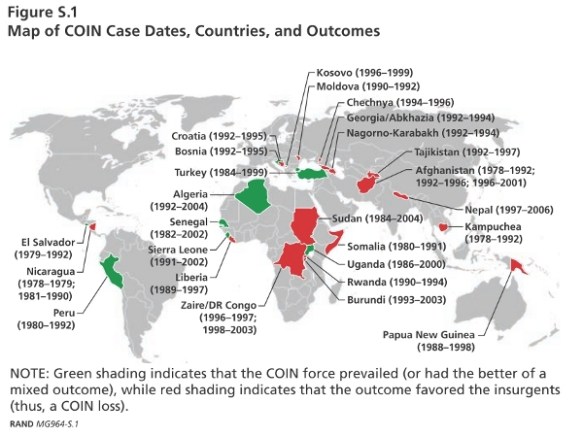
Although I agree with the findings of Victory Has A Thousand Fathers as briefed this morning, they are weakened by the paper’s overly narrow and selective focus:

  • The scope of the study is restricted to only 1978-2008, omitting the post-WW2  ‘golden age’ of counter-insurgency and many other critical campaigns of thus nature. While there would have been a need perhaps to keep the initial sample size to a manageable number, this arbitrary period omits a large proportion of relevant campaigns.
  • The list of COIN campaigns 1978-2008 is somewhat limited: missing are any of the campaigns fought in Southern Africa in this period, as are those from the Middle East including Israel v Palestinians, and Iraq v Kurds;  East Timor is not listed, nor is the campaign in Southern Thailand – while it is flawed in other ways, at least both of these campaigns appear in David Kilcullen’s The Accidental Guerrilla.
  • Kiwis and Australians will be surprised to see that Papua New Guinea 1988-1998 which must be the Bougainville campaign is listed as ‘red’ i.e. a failure for the host nation government. The island of Bougainville is still very much part of PNG and that the world has heard little from that part of the world since the withdrawal of the monitoring force in 2002, is a testament to the effectiveness of that force 1998-2002.

The principles for COIN derived from Victory Has A Thousand Fathers were on slides that I missed during the discussion (too slow with the screen grabs) so I’ll cover those in a couple of days once they are posted on the COIN Centre events page.  What follows are some of the other insights from this morning.

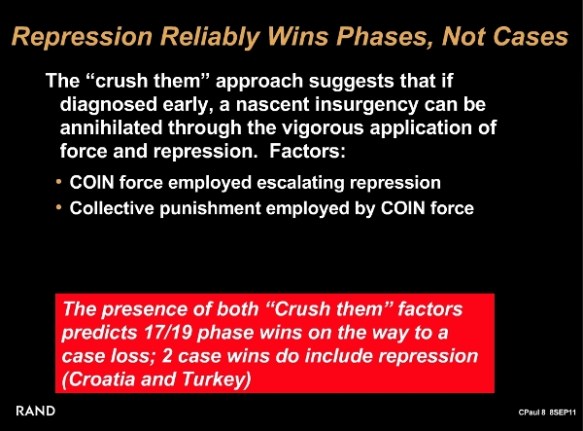
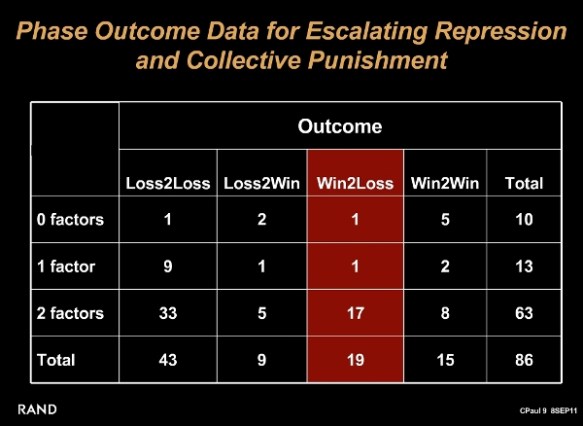
There is a case for the use of force in Irregular Warfare but first, let’s stop calling this COIN. As we know, COIN is a very specific and very narrow slice of the broader realm of IW: the continuing abuse of the term ‘COIN’ to describe operations in the contemporary operating environment unhelpfully muddies the waters. Specifically. these slides discuss the repressive use of force but we need to consider this just as much as we have to consider the other side of the pendulum that it’s all about being nice to everybody.

One of the most refreshing things about FM 3-24 during our review of COIN doctrine in 2007-08 was that it acknowledged the need for use of force within a campaign, a most realistic diversion from other nations’ COIN doctrine which was based upon either experience in peace-support operations (whole different ballgame), super-localised internal issues (go Northern Ireland!), or Malaya (myth city). If there was no potential for the application of force, then the military is not needed i.e. the military is not a cheap labour force, nor an easy substitute for the other government agencies and non-government organisations that should be there.

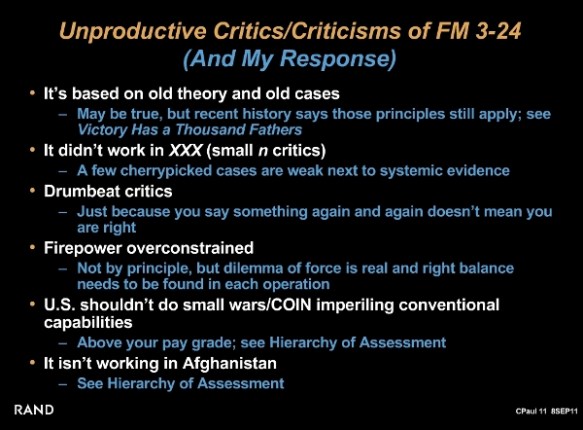
While FM 3-24 does have a strong population-centric element, it was written for a specific campaign (Iraq) in a specific period (2005-6). That notwithstanding, the population-centric elements are well-balanced with other key principles and truisms for irregular warfare and I think that many critics only cherry-pick thos easpects they want in order to criticise and few if any consider the publication as a whole.

This is the Hierarchy of Assessment referred in the last two points:
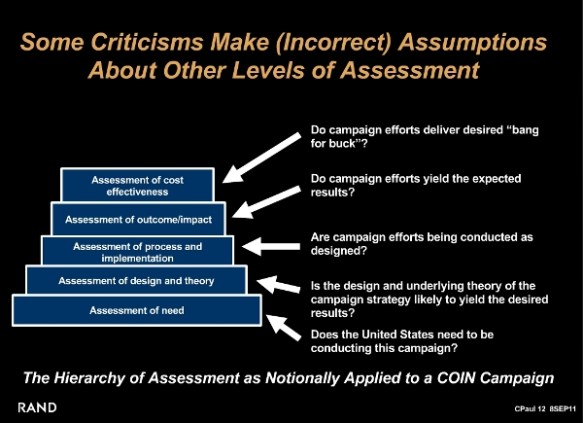
In simple terms, it all comes down to national interests linked to campaign objectives and being able to measure the same; and at the tactical level, specifically, as recommended below,  link development objectives to those campaign objectives and national objectives i.e. no more AID for its own sake. This just creates legacy dependency issues.

One of the questions asked this morning was “…I’ve recently returned from RC-S .  Agree with HNG but it does not to have a national flair to it.  If a specific district enforces the govt rep there, the HNG should be deemed endorsed…” This is the real rub in Afghanistan where the role and legitimacy of central government are in an entirely different context to that of Iraq. Shifting the emphasis for effective government from a central to a district government focus can produce strong district/regional government but usually at the expense of the central government. But then as we discussed in the opening day of the IW Summit in May, a ‘horses for courses’ approach to Afghanistan might find that a federalist system of strong provinces and weak central government might be the best for Afghanistan – after all, it seems to have worked OK for the last two millennia…

As the US Army and USMC gear up to update FM 3-24, the time is ripe for some robust discussion on the content of its next iteration. Most definitely the sections of air and maritime power need to be expanded and updated. The forum for thoughts on this topic is at the COIN Centre Blog….

Getting it….

Not getting it…

One of my ongoing beefs with ‘modern’ COIN is the misperception is that successful COIN is all about being nice, of waging war without casualties (although casualties amongst one’s own soldiers appear to ‘OK’), and having this great expectation that one day ‘the people’ will just rise up, out of gratitude for the niceness shown them by the security forces and cast out the insurgents…

The simple fact is that this ‘doctrine’ is all lala-land, cloud cuckoo vunderland fantasy. That’s pretty much the theme of Wilf Owen’s article in the Spring 2011 edition of the British Army Review (I’d post a link to BAR but it seems that it is a highly classified publication and not one suited to easy intuitive location via the Power of Google), titled Killing Your Way To Control. He takes particular issues with statements like

Effective counterinsurgency provides human security to the population, where they live, 24 hours a day. This, not destroying the enemy, is the central task. (from Kilcullen’s The Accidental Guerrilla)

Unlike in general war, the objective is not the defeat or destruction of the enemy, but neutralisation of a threat to stable society. (from JDP 3-40)

And guess what? He is absolutely 100% correct! Was it Douglas MacArthur, addressing the cadets at West Point, who said something like “Your duty is clear and inviolate: to win our nation’s wars”? Something about “Victory, always victory”? Even if victory might mean achieving your objectives on your terms as opposed to victory always equating to absolute, grinding under the steel-shod boot, unconditional victory…

Use of the military is, should be, the final option in execution of national policy to achieve national objectives…because it is brutal and unpleasant – and effective when employed properly. The military should be used when other instruments in the DIME construct are not effective. That is not to say that once the military deploys, the rest of DIME takes for some time out; it just means that the lead agency has changed.

And what is it about the military that both makes it an option of last resort and one so effective? Simply…the use of force…brutal force, whether blunt or surgical, but brutal none the less because force can only be brutal. Who talks about let alone attempts to develop and  apply ‘nice’ force? And this is Wilf’s point, and, for an irregular environment,  encapsulated nicely in the extract he selects from the UK’s 2005 Land Operations

Neutralising the insurgent and in particular the leadership forms part of a successful COIN strategy. Methods include killing, capturing, demoralising and deterring insurgents and promoting desertions. This is an area in which military forces can specialise and should be a focus for COIN training. The aim should be to defeat the insurgent on his own ground using as much force as is necessary, but no more.

Now we know that there are times, especially immediately following an intervention and lodgement when the only people who can realistically maintain and provide essential services like power, water, electricity, sewage and security are the military. Forget about some imaginary gendarmerie with shovels that will miraculously appear and relieve the military of such onerous and unpleasant tasks…never happen…

Nor is anyone saying that forces optimised for high-end force on force  major combat operations can successfully instantly reconfigure, collectively and individually, into an irregular warfare scenario. If there was one myth that was majorly debunked in the last decade it was the “If you train up (for MCO), you can easily step down (for COIN)”. Thus, a choice must be made between a dual force optimised one side for MCO and irregular warfare on the other: just to be real clear, two forces – NOT one size fits all; or a deliberate acceptance that one’s forces will only be capable of engaging in one form of conflict OR the other. Most nations forced towards the latter choice will probably tend towards a specialisation in irregular warfare up to a limit of national capability on the spectrum of operations.

And while the logical threads in population-centricity unravel, this does not mean that the military should isolate itself from ‘the people’. GEN Petraeus was right in Baghdad in 2006 when he brought the troops back in amongst ‘the people’ and ended the daily tactical commuting/sallying from the FOBs. The military is not some horde to be hidden away – if ‘the people’ is where the adversary(s) are, then that’s where the military should be – configured and trained for the application of force in that specific environment just as they would/should be for any other unique environment.

And on the spectrum of operations…let’s not forget that it is NOT the linear progression from peacetime to all-out warfare that is it portrayed as…a more accurate model would have peace in the middle, surrounded by a ring that includes peacetime engagement (a smidgen up from peace), peacekeeping, peacemaking, irregular warfare, HADR, limited war (e.g. the Falklands War), major war (DESERT STORM, OIF Part 1) and full-on all-out war (Red Storm Rising).

Imagine that ring being like a trembler switch (who didn’t used to watch Danger: UXB or The ProfessionalsSteady, it’s a trembler!?) from which a nation can flick from peace to any state around that ring, and from that state then flick to another and another or back to the stable centre. Accepting that there are two clear extremes, peace and all-out war, most nations would assess the planning for one, peace, carries too much risk as it would naïve to expect peace to remain constant in the most benign scenario. Similarly few nations can afford to truly step up to the full range of capabilities required for the other extreme. Thus most opt for a point in-between.

But regardless of where that point may lie, the primary role and output of that national military force is the application of force. That is why the lead group in the Air and Space Interoperability Council is the Force Application group, with six important but supporting groups. That is why, in the continental staff system, the staff branches are NOT all created equal – operations leads, supported by whatever combination of numbers floats your boat – whoever heard of logistics or intelligence supported by operations? That is because the ops branch is all about creating and delivering effects – and the effect that the military delivers best…is…force.

So you might imagine just how it felt as I scrolled through my ‘most recent’ view on Facebook to see the link to Wilf’s paper first from DoctrineMan! (still not sure about people who include punctuation in their name) and a ways further down, the original post at Small Wars Journal.  Even more so when I realised that Wilf, who I have spent more time at Small Wars disagreeing with than ever agreeing, had authored it.

What was disappointing was the number of people on both DoctrineMan! And Small Wars fixated on pulling every literal point of contention from the article. I was sadly reminded of the 45k+ morons who ‘liked’ the Boycott Macsyna King Book page; or the moral minority who all ‘just know’ that Casey Anthony killed her daughter and that there was no need for all that legal dues process stuff: let’s just string her up!! Wonder sometimes if western society is descending to a point where the capacity for independent thought is lost…and we all just become drones circling the brightest, loudest light…

The irony in his article that he does not point out is that while British Army doctrine in 2005 included the quote above from Land Operations (now that I think about it, I was working at Uphaven on CLAW 1 when it was released and got to bring the first copies back home), this was the same period that the UK was trumpeting the success of Malaya and the triumph myth of ‘hearts and minds’ that set irregular warfare back decades. If only the UK had read and applied its own doctrine… (What’s that? You read doctrine? And apply it?)

So where does this leave us? Wilf has articulated what we have probably known along, what the dead Germans told us is right, that the military is about the application of force, not the application of ‘nice’, as an extension of policy. That force may be applied to create the conditions where others can see to the building of a stable society, hopefully where such existed at some stage before; equally as much it may be applied to simply attrite an adversary to the point where further resistance is either untenable or impossible.

But, harking back to the dead Germans again, the ultimate target for force is one specific part of what is popularly accepted as the Clausewitzian Trinity: of ‘the people’, the action arm and the leadership of any collective entity, military force ultimately targets the leadership to either eliminate it as the driving force behind the organisation, or convince it to consider and change its ways. That’s what the military is for….

Strangelove has re-entered the Building

(c) FPA 2011

As a headline, this one that concludes the Time article  According to new Pentagon cyber strategy, state-of-war conditions now exist between the US and China, was too good to pass up…coupled with this SECDEF quote that Michael Yon put up on Facebook a couple of hours ago, it looks like lunacy has well and truly returned…

Just got this from Office of SecDef

“Secretary Gates believes that for the United States, once committed to a NATO operation, to unilaterally abandon that mission would have enormous and dangerous long-term consequences.

You think he might be talking about Libya? A campaign even more ill-advised than OIF? In all fairness, though, at least America had the courage and integrity to see OIF through as her allies and apparent friends slowly bailed on her…she had done the right thing in withdrawing her foot sharply from the (blood) bath of Libya as soon as it was apparent that NATO was getting the wibbles. That there will be ‘…enormous and dangerous long-term consequences…” is without a doubt but those consequences will be for NATO as it finds that it might have to ante up and see it’s own war through to a conclusion without a US safety net…yesterday I heard for the first time the phrase ‘...NATO’s Vietnam...’

I agree with the theme of the Time article that MAD actually = sanity in that it essentially rendered the irretrievable impossible – so long as we kept Peter Sellers out of the White House…As the Cold War staggered to a close in the 80s, Ronald Reagan declared a policy based on ‘you can run, but you can not hide‘ and indeed authorised and conducted a number of kinetic actions against those he perceived had crossed the line in the sand…

Those however were all kinetic actions against specific kinetic targets to send very specific messages…what targets might a kinetic strike against Chinese cyber-warriors hit…a server in downtown Shanghai or Beijing? The same fibre link that carries the world’s communications and commercial traffic? Some geeky buck-toothed nerd who needs a bath and some dress sense?

One of the biggest and most-frequently stated concerns at the Irregular Warfare Summit here last week was that the takedown of OBL and the (so far) successful drawdown from Iraq is leading to a growing sense of relief at senior levels that the aberration of COIN is over and ‘…now we can get back to real war...’  This ‘real war’ dogma seems to be set in the minds of those who just missed Vietnam and spent the larger part of their careers preparing for World War III – which, if anyone was paying attention, never happened.

Thus, possibly more by circumstance, the leaders in the ‘new war’ (which is really an old war) are those who were on the ground in Iraq when the pendulum was shoved all the way from clean surgical shock and awe to dirty messy complexity and irregularity…names like Petraeus, Mattis, Chiarelli, Casey…to name a few. It’s no accident these names are all from the land forces because this new war, at the moment, is very much land-centric (sorry, air power guys) because that is where the people are…and while I am noted as not being a uber-proponent of population-centric warfare, this war is one between beliefs which live amongst the people and not platforms which can be anywhere…

Cyberwar is much the same…there are no clearly-distinguishable platforms at which to strike: it is a game of skill and knowledge not fixed to key infrastructure or platforms,,,that guy next to you on the bus, playing with his iPhone could be a node in the attack network…the ‘enemy’ doesn’t even need to be in their own country which leads to thoughts of retaliation for spoofed cyberattacks against countries that only appeared to be guilty – how many times can a cruise missile accidentally hit the Chinese Embassy in Belgrade…?

Cyberwar is elusive, diffuse and evasive…it’s another facet of complexity and irregularity, warfare conducted by ‘the people’…releasing the kinetic dogs of war on it will achieve no more than ‘shock and awe’ did in Iraq…like any other operating environment, this one will only be conquered by those who get their (cyber)boots dirty and adapt to it…in the mean time we need to THINK a lot more before we commit ourselves to careless policies promising kinetic attack against cyber-strike…regardless of how many cruise missiles and JDAMs might be nearly their ‘use by’ date…

As David Hoffman concludes in The cyber arms race:

The offensive cyber battlefield promises to be far more chaotic than in the nuclear arms race, with many smaller players and non-state actors, and the risks of retaliation against the United States might be quite high. We need good defenses, no question. But should we be fighting back with cyber warheads and real missiles? Are we ready for what could follow? Is there an alternative?

The Odyssey…

(c) The World According To Me 2011
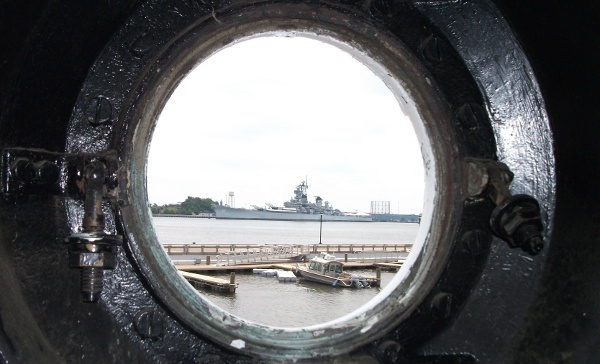
USS New Jersey (one of the last) from USS Olympia (one of the first).

Yes…the blog has been quite quiet of late…I’ve been on the road for the last fortnight and it has been both stimulating and challenging…a normal day consists of participating in the day’s activities, any after dinner networking and then spending a few hours logged-in on Kiwi time to keep up with events back home…doesn’t leave much time for scintillating insightful blog entries…

Still I have learned a lot in my various engagements since I arrived in Las Vegas two and bit weeks ago…I was last in Vegas in 1988, young and single, and it rocked!! Vegas when you’re married and a grandad and on your own after the rest of the team depart, ain’t much fun at all and is kinda boring…is that really boring, or just an opportunity for introspection and consolidation…? From Nevada, I arrived at Reagan International at some awful hour but got to the Marriott in time to catch Josh for a couple (or more!!) of beers before the Irregular Warfare Summit…

So…bubbling away in my mind are a number of insights relating to Unmanned Systems (sorry, ladies, the name ain’t changing anytime soon!) and Irregular Warfare – again the name ain’t changing anytime soon…yes, there are also irregular challenges, activities and threats and yes, we’d really like to intervene before irregularity becomes warfare…but let’s just go with the flow on this one. At least, it’s a big step up from the COINology that pervaded all aspects since 2004…and, sure, the official definition (a la DoD) will catch up…and no, the operators seem to be copying off the same sheet of music…not sure what language some of them might be scribing in but we’re getting there…

In the meantime, I am churning away…I try to maintain SA through FB mainly, supported by email although correspondents will have noticed that response might be a bit tardy (lax) at times…Skype’s handy too but it parasitically consumes bandwidth and that’s not good when I’m on a data cap (hotels with free wireless rock!!). One coup from this trip is that I bought a VirginMobile USB modem which has been a Godsend for mobile connectivity – a few more hotels charging USD12-15 a night for wireless access and it will have paid for itself AND the first months net access…The VirginMobile deal is far better than that offered by Cricket or T-Mobile and I really recommend it….

Last weekend, I caught the Amtrak to Philadelphia for bilateral discussions with Dean @ Travels with Shiloh on divvying up the world post-world domination day…I chose the USS New Jersey (tied up across the Delaware in Camden) as the venue as I figured that all that steel would cramp Doc Karma…ooops, I mean, Dean’s mind control powers…probably just as well that I did as he was showing off his power of mind-reading at lunch…you know, that thing super-villains do to show-off…”oh, I might just have…the thing in the menu you’re looking at – now!‘ Talks went well so look out world!

Honestly, it was a great day for a range of reasons…firstly, when you travel as much as I do, it’s always nice to be met on arrival – and not by a hoard of shovel-toting molemen (Dean, are you sure they didn’t follow you?!); secondly, I had no idea how to get from 30th Street Station to my hotel; and it was great to meet in person someone whose work I have admired and followed for a number of years…it was also well into summer, an awesome hot sunny day, a boat ride across the river…Philly cheesesteak for dinner…how could you go wrong…?

So more of the next few days of my adventures…and I’ll start to blend in some commentary on current events and my discoveries while here…

Rapid Fire

3 cups of tea

Literally a storm in a teacup…I doubt there is anyone who ever published a book than was 100% honest in EVERY way and which did not lean towards one agenda or perspective or another in some way…

Greg Mortenson shot to worldwide fame with the book “Three Cups of Tea: One Man’s Mission to Fight Terrorism and Build Nations … One School at a Time,” which describes his getting lost in an effort to climb K2, the world’s second-highest peak, being rescued by Pakistanis in the village of Korphe and vowing to return there to build a school for local girls.

Now it appears that it wasn’t quite as he says which is causing a little embarrassment around the traps for those who may have supported his initiatives financially or, like the US DoD, who may have extracted insights from Three Cups of Tea for use in COIN doctrine and TTPs…personally I agree with the headline, if not all of the content, of the Wired article on the subject Does It Matter If The Military’s Fave Do-Gooder Sells Three Cups of Snake Oil?  When an organisation like the military moves out of its comfort zone, in this case, of large very structured kinetic military operations like Grandad used to do, it has to cast its net wider for ideas…

Let’s not forget that the COIN effort in Iraq got off to a false start as too many people heralded the false zealots of COIN the Malaya way, the US in particular, picking the wrong time to listen to its vocal but fickle ally from the other side of the Atlantic…it was only the efforts of David Petraeus, David Kilcullen et al who turned the tide towards a COIN strategy that would (and did) work in Iraq, this being encapsulated in the December 2006 version of FM 3-24 CounterInsurgency (don’t knock it unless you have actually read it!!). But, however applicable that FM 3-24 might have been in the Iraq of 2006, it was less applicable to the almost-forgotten Afghan war which had been festering away since March 2003 and which, as a problem, bore little resemblance to Iraq.

So, more power to those who cast the net wide in their attempts to get a better handle on the specific of the Afghan problem…Jim Gant with his One Tribe at a Time paper was one; those promoting Three Cups of Tea were others…and so what if Mortenson streamlined his experiences or even made them up? Are we still so template-ridden from the Fulda Gap that we can not think for ourselves and extract the nuggets from the rough…it’s just slipped my mind but one of the tenets that I referred to often in my work in the late 90s came a from a source that I eventually tracked back to one of Don Pendleton’s The Executioner pulp paperbacks…someone that I was working with at the time was mortified that I might draw real world insights from such a ‘disreputable‘ source but so far as I was, and am, concerned, it is not who the source is that is of prime importance but what it is saying…One area in which this has become very apparent and implemented in SOPs is in the Lessons Learned world where collection teams will endeavour to draw observations, issues and lessons (OIL – yes, it’s still all about OIL!!) from as close to the horses mouth as they can get – the trick, of course, being to avoid the equine’s other end…

On failed states

Got the cue on this article from Michael Yon’s Facebook page…always a good source of links to interesting articles…as well written as it is, I think it’s all semantic smoke and mirrors…three decades ago our biggest threats came from established states like France, the Soviet Empire and Maoist China…once again we need to resist the temptation to slap a template on a nation and use that to determine their level of potential threat or risk or not…as above, we should be able to consider each form or threat and risk on its own merits or or lack of thereof and draw our own conclusions…this sort of pseudo-analytical, ‘Eureka!‘ style of writing really leaves me cold…

Kiwi Gunners

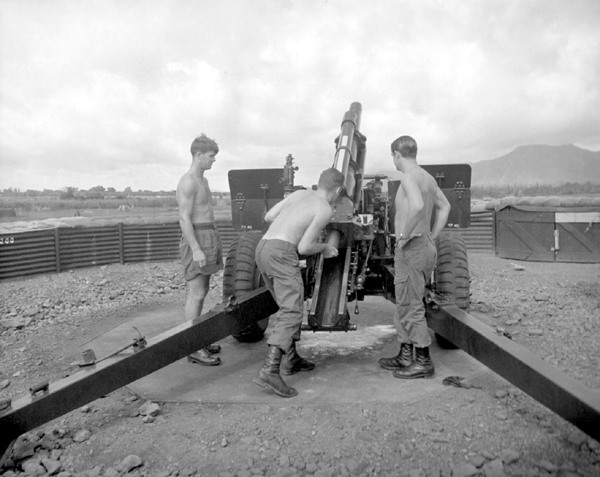
On a positive note, I came across this great written snapshot of a Kiwi gunner’s perspective on Vietnam and the New Zealand of the time, again drawing the cue from someone’s (sorry, can’t remember the source) Facebook page….it’s not that well known that our artillery was in Vietnam well before there was any infantry deployment…and especially topical when one remembers that yesterday was ANZAC Day…

Loose lips…

Grow UP, Mike, you're 44 and running out of time...

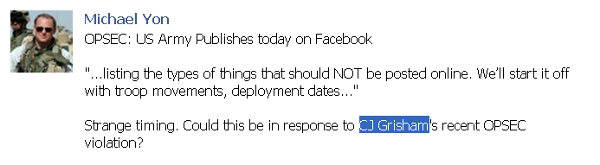
While Mike Yon crows on Facebook about milblogger CJ Grisham from A Soldier’s Perspective apparently being shut-down for a potential OPSEC breach, the US Army reinvigorates an OPSEC awareness campaignvia its Facebook page …an  use of social media interesting and contemporary enough that I’ve include a slice of the comments below…
Show off your knowledge of operations security, or OPSEC, by listing the types of things that should NOT be posted online. We’ll start it off with troop movements, deployment dates & weapons capabilities…
    • FYI-not all bases are listed on the internet.Not all Soldiers movements,and not all equiptment is known to the general public.There are secrets you and I will never know still in this modern day of the internet.

      about an hour ago ·  
    • Anything that anyone could post on Facebook has probably already been front page in the newspaper or breaking news on TV…it kills me to see all these wives posting where their husbands are…I’m CONSTANTLY talking to my husband about these issues. So many times I see soldiers doing the same things and it irritates me to no end. People don’t understand that they’re compromising their loved ones safety. When I see a post on Facebook by an army wife or soldier, I usually respond by writing OPSEC. I don’t want my husband dying because someone couldn’t keep their mouth shut. And, those of you saying they don’t have Facebook – you’re just foolish. They have Intel just like we do and if you think we don’t use Facebook to get Intel on people and track what they’re doing, you’re ignorant. And to add, just because they aren’t American, doesn’t mean they aren’t intelligent, technology savvy, and just fly by the seat of their pants to figure out what our troops are doing.
      about an hour ago ·  
    • You all keep bringing up how a photo is so bad. Listen, people, if you didn’t know that we are scattered across Iraq and Afghanistan then you have been in a dark whole…military or not. They aren’t going after a single soldier. The dead giveaway over there is we come off our own bases wearing OUR UNIFORM. Crybabies.

      about an hour ago ·  
    • ROE ROE ROE ROE ROE

      about an hour ago
    • Per OPSEC: Current and future operations, Travel Itineraries, Operation planning information, Entry/exit (security procedures), Capabilities and limitations, Address and phone lists, Budget information, Building plans, Port calls (current, future and past port calls in a current deployment), Readiness, General morale, VIP/ distinguished visitor movements, People’s names and billets in conjunction with operations, Past operations of a current deployment. (You cant say my husband left Spain yesterday but you can say my husband left port. You cant say my husband left for deployment yesterday because you can generalize an area off one day.) You may however post any of the above if you have a media link to prove the information has been released. Halfway points or referring to how many months are left in the deployment. Also no discussing how long your SO has been extended. This includes discussing percentages left on a deployment. (example: There is only 20% left on this deployment), Flight times or pilots schedules. No placing such info in your siggy and/or title. If you post any picture that includes your SO in uniform please make sure that their name tag has been edited out. You may not make a post showing your paper chain or any other kind of object you personally use to count down.
      about an hour ago ·  
    • It sad to see that you can pull up google earth and people have labeled buildings such as hq’s on bases in iraq and Afghanistan

      about an hour ago ·  
    • pictures of you in the TOC on facebook…

      about an hour ago ·  
    •  list things that should not be posted online…..but….this IS online…..

      about an hour ago · 
    •  bragging how awesome you are on sensitive equipment like counter IED stuff.

      about an hour ago
    • who is the commanding officer,his military record ,does he compromise easily under enemy pressure,he experience and which engagements he was involved in

      about an hour ago
    • Perry Bennett T,O, & E!!!…and your MOS….Hell, Don’t even have any pix or info available on FB. “SCOUTS OUT!”

      about an hour ago
    •  This is a great idea. Family members need to know what they can and can’t say on facebook. Almost everyone has facebook now and keeping our troops should always be on the minds of military families, friends, or those serving. I’m in my AIT course right now, and didn’t realize what all is and isn’t releasable.

      about an hour ago ·  
    •  the national guard members have been pretty bad at POSTING pics of Current locations, and some dont give exact locations, but most have huge LANDMARKS to go off of…… one pic i saw had about 100+ soldiers in the building a very well known building…..

      about an hour ago ·  
    • Grid references of FOBS and PBs VIP visits it happend to prince harry and they stopped his tour of afgan because it was leaked all over the media.

      about an hour ago ·  
    • Intelligent people who care about our forces safety and well being would be aware of every word they speak or post as well as any photos or videos that may hold the seemingly minor but actually major sensitive bit of intelligence that could…See more
      about an hour ago ·  
    • I don’t want this to come off harsh, but here is my take on the reason why so much is posted with such haste. I’ve been out a long time, and in law enforcement since then. Some recent training I had indicated one extremely relevant trait o…See more
      about an hour ago · 
    • Be sure and tell CNN.

      about an hour ago ·  
    •  WW2 poster: The Enemy is looking for information~guard your talk!’

      about an hour ago ·  
    •  WWw2 poster: ‘Your PEN and TONGUE can be enemy weapons~WATCH what you WRITE and SAY!’

      about an hour ago ·  
    • First perhaps you should attack the History Channel and the Military channel that gives away our weapons capabilities. Then go to the US Army website and take troop movements from there and take off the structure from there…..hey just get rid of the entire US army website, because it has vital information there…or the US army website should carry an access page for those in the armed forces etc.

      about an hour ago ·  
    • last, but not least…’What you see here, what you do here, what you hear here, When you leave here…let it stay here’. (personally, I hate to see our troops names posted on these sites by their friends and family~they’re in Harm’s WAy enough)

      about an hour ago ·  
    •  Oh yeh, then the many You Tube videos with overseas military information should be taken down.

      about an hour ago
    • ‎@Diesel-Power, don’t forget the BA-1100-November.

      This isn’t exactly related, but I get pissed when I see people in BDU’s or with other identifying gear in airports (high and tight plus assault pack w/nametape, e.g.). I want to chokeslam them and ask if they’ve ever had an S-2 briefing in their lives. If I were a foreign intel service officer I would just hover around those jabronis all day waiting for them to drop sensitive info.

      about an hour ago
    • Everyone should use common sense. If you wouldn’t give the information to an enemy then don’t ever let it leave your mouth no matter what. The other thing i hate is when soldiers always are saying their deploying but have never had official orders. It gets out that a deployment could be coming up when its not true. you should get at least the same punishment as someone who impersonates a government employee because being in the military you should know full well not to lie about orders or tell when you get them
      56 minutes ago
    •  If we’d had today’s media in WW2, we’d’ve never won…

      56 minutes ago ·  
    •  Then perhaps you should go to the US ARmy Flickr page and take down captions that say things like this;Firefight
      “””U.S. Soldiers with 2nd Battalion, 327th Infantry Regiment, 101st Airborne Division return fire during a firefight with Taliban forces in Barawala Kalay Valley in Kunar province, Afghanistan, March 31, 2011. U.S. Army photo by Pfc. Cameron Boyd/Released”””…

      53 minutes ago ·  
    •  and your asking us to not post troop locations? just look through Flickr captions and you see our troop locations, training, formations explained etc. Remember if you want others to change, the ones asking for change need to be the first ones to lead by example.

      51 minutes ago · 
    •  and then it gives the soldiers name who took the photos.

      50 minutes ago
    •  Names of Generals’ mistresses

      50 minutes ago ·  
    •  Frequency modulation of the deflector shields

      49 minutes ago ·  
    •  You should never ever never ever post (redacted)

      47 minutes ago
    •  your soliders name, do not show name in pics!

      43 minutes ago
    •  The net is a GREAT place for MIS~information….

      42 minutes ago · 
    •  just a thought… but wouldn’t posting what we know about OPSEC, in fact be an OPSEC violation? just thinking outside the box here…

      41 minutes ago
    •  lmfao..frequency modulation

      41 minutes ago
    •  All of your comments seem to agree with my statement that America as a whole has a problem with the big mouth syndrome.

      33 minutes ago ·  
    •  heres a thought… wouldn’t posting what we know about OPSEC in fact actually be an OPSEC violation… just saying…. lets think here people….

      31 minutes ago · 
    • one of our spouses’ support facebook groups was just going over this. Soldier’s name, rank, job, unit, deployment date, deployment location, length of deployment, relocation within theatre, daily operations, any operation outside the wire.

      30 minutes ago
    • Maybe it would be a good thing for the enemy to read this then they would truely believe America lets ALL secrets outta the bag.I see many people assuming things here,there is soooooo much we don’t know.Media coverage is slow and poor to relate what is going on,that is for a reason.We have the BEST Military in the World and there is a reason for that!Always support our troops and if you know SPECIFIC dates,rank,location fine do not jeapordize our Soldiers travels to and from deployment-be vaugue like( “this month”)Many of the photo’s you see are on American ground.The things you can’t see I assure you are very securely kept from your eyes and ears.
      30 minutes ago
    • A lesson in no-no’s was a spouse who didn’t have her Facebook profile locked, so anyone coming on it saw everything even if they weren’t a friend yet. On her page in her friends, it has Married to: Her Hubby’s name and FB link, his FB pageis open too, so you could see not only that he was in the Army, but listed in Employment: his MOS by number designator and job name and his rank. Her FB page had her current location, her wall was open and had all these gushy mushy postings to her hubby and boohooing about him being gone and way too much stuff that could be totalled up to a lot of handy info to the wrong person.
      24 minutes ago
    •  Stop stop stop posting pictures of your loved ones on here. I know youre excited and so proud but you dont know who is seeing and stealing the pictures and using them for who knows what. Keep them to yourself. Pictures give away sooo much. Basically opsec works like this….if you wouldnt tell al qaeda…why the heck would you put it online or even open your mouth about it? HUSH!!!!!

      18 minutes ago
    • Yeah I think this was a terrible idea for a post…

      15 minutes ago
    •  exactly amber the wives have the pics of their loved ones and their putting their loved ones in trouble.. the troops are fighting for us and the wives do not care about it.. omg the enemy is online.. how stupid are they..

      15 minutes ago
    •  loose lips sink ships . . . still holds true . . .

      13 minutes ago ·  
    • this got redundant….

      12 minutes ago
    • Sensitive info must always be kept hidden from outside due to fact this kind of intelligence could be use by our antagonist against us. Like in fighting this small war, never ever divulge what you brought in the theater otherwise some other power would know and prove this as a fact and know what will they bring in case we collided with them. in short, keep your pie hole shut from saying where youd been, what you did, how you did it, what kind of thing enables you to succeed in the mission, etc. Thus this prove intelligence wins wars. the more the enemy is kept in the dark, the more fear would overcome his will. A man overwhelmed by fear is not as thinking man. is he now?
      11 minutes ago
    • capture of enemies

      6 minutes ago
    •  How about not being the source who has “leakage” of classified information on unclassified sources.

      2 minutes ago

Your phone, laptop and i-pad are dead. Can you make it through an entire day?

Just for a day…

The WordPress Daily Post challenge…I usually don’t play but this one is easy – and it’s 0449, I’ve just had a mega-coffee and can’t go back to sleep after an early start to listen in on Dr Sarah Sewall’s presentation at the COIN Center on civilian casualties and their mission effect. It references her recent report ‘Civilian Casualties’ however the link provided for the report either either broken, mistyped or CAC access coz it doesn’t work for me…

I was sufficiently intrigued by her comments that reducing civilian casualties is not a binary ‘me or them’, ‘either/or’ equation and that there are ‘win/win’ approaches that do not prescribe operational effectiveness in reducing civilian casualties. An insight gleaned from some of the text comments made during the presentation is that there has to be a balance between force protection and achieving the mission which I think we all accept but what do you do when your force protection measures themselves jeopardise the mission i.e where those measures undo or erode the force’s credibility or acceptance with ‘the people’…? More to follow on this if I can source a copy Dr Sewall’s report….

Anyway back to the Challenge “...Your phone, laptop, tab, ipad and desktop are dead. Will you make it through a normal working day and evening? What would you miss the most?...” The answer is so simple…quite simply: none of the above…it’d a be a great opportunity to catch up on professional reading, go to the gym, go for  a staff wander and doing some face-to-face networking and maybe even tidy my desk (apparently there is one there somewhere under the accumulated detritus) but I only have a day so maybe not…

I remember a few years back an organisation-wide email asked for feedback on the likely impact if email got switched off for an unspecified period…every other response including much gnashing of teeth and predictions of the collapse of civilisation as we know it…our boss simply asked if the ‘switch-off’ could start that week: “…we’ll just have to fall back on good old-fashioned written correspondence, signal traffic, and maybe even picking up the phone or getting out of the office to actually talk to people…don’t see it as a biggie at all...” As handy and convenient all this e-connectivity may be, we should be letting it endanger personal communication nor should we rely on it to such an extent that we become dysfunctional if we lose it…I wonder if the drop-off in physical letters is one reason that NZ Post is set to close shops…? I don’t practise what I preach here but I firmly believe that there is a ton more value in a physical written letter than the tending-to-casual nature of email….