Unknown's avatar

About SJPONeill

Retired(ish) and living on the side of a mountain. I love reading and writing, pottering around with DIY in the garden and the kitchen, watching movies and building models from plastic and paper...I have two awesome daughters, two awesome grand-daughters and two awesome big dogs...lots of awesomeness around me...

Curzon on Government

Lord Curzon of Kedleston as Viceroy of India (wikipedia)

A couple of weeks ago, Coming Anarchy posted this item Curzon’s Dunbar. I had no idea who Curzon was apart from being the nom de plume of one of the Coming Anarchy authors (you can find out more on Wikipedia). We went to my parents’ in Oamaru for Christmas, and Mum had boxed up some books for me to take back as part of her project to declutter the house (project completion date sometime around 2030). As we were flying, I only grabbed a small selection for my check-in bag and one of those was Curzon – End of an Epoch (Leonard Mosley, Readers Union, 1961)

…His attitude towards the common people was that of a benevolent patrician. He did not even believe that Englishmen, let alone Scotsmen, Welsh, Indians and other lesser breeds, had earned the right to equality with those who had spent their lives and their brains in learning to rule them. To the masses he was fitting himself to control and direct he determined to bring food sufficient for their needs, the opportunity of health and decent lives, and every freedom thery desired except the freedom to rule themselves. To Balfour’s dictum that ‘people only too often prefer self-government to good government’ he had on one reply: ‘More fools they! They should not be encouraged to encompass their own doom’…

Curzon also voted against a move in the House of Commons to give Members of Parliament a small salary “…it will bring into the House shallow and ambitious careerists bent on making a business of the duties and obligations of Government…” One wonders if this is what eventually led to Pournelle’s Iron Rule of Bureaucracy:

…in any bureaucratic organization there will be two kinds of people: those who work to further the actual goals of the organization, and those who work for the organization itself. Examples in education would be teachers who work and sacrifice to teach children, vs. union representative who work to protect any teacher including the most incompetent. The Iron Law states that in all cases, the second type of person will always gain control of the organization, and will always write the rules under which the organization functions…

Hands up anyone who HASN’T seen any the cancerous application of this rule across national and local government…

But anyway, Curzon’s thoughts on global governance seemed quite topical as we slap a few more billions worth of Band-Aids on Haiti, knowing full well that once the current disaster is cleaned up, it will revert back to type in less than a year; as the number of failing and at-risk states continues to rise; as more and more experiments in self-government flounder in unimaginable debt and growing populations dependencies; as we focus more on the ‘now’ than the future…

One of the topics for discussion in the recent Cheeseburger Gothic discussions on the next iteration of the Axis of Time Birmoverse was how a forewarned timeline might manage post-WW2 colonies, in particular those sitting on resource deposits. I wonder if the Anglosphere (US, UK, Canada, Australia and New Zealand, possibly South Africa and Rhodesia) might not have adopted a more ‘involved’ strategy where colonies become ‘territories’ under control? Of course, this is just blatant Imperialism but, when you sit down over a good coffee and think about it, how many of those former colonies are better off under their own rule? I’d suggest that success stories like India, Singapore and Malaysia are very much the exceptions and the Haitis, Zimbabwes, and Myanmars are very much the rule.

Are we getting to the point where aid now comes not so much with conditions but with escalating forms of compulsion and accountability? I asked the same question on To the Stars… but regarding global warming – at what point do protests and sanctions become compulsion for the greater good…? Maybe not so much the global nanny-state but certainly stepping towards benevolent dictatorship…or just do haves unite in self-interest and let the have-nots, specifically the won’t-help-themselves to their own devices. Sooner of later we need to start making some tough calls as no nation can afford to repeatedly bail out those who can not succeed…in other words, let’s start getting real. How real it is to expect that we will be able to do much about small island nations that are slowly disappearing beneath rising waves (regardless of cause)? Build a Waterworld-like wall around them – noting that the original sank anyway…?

Perhaps Curzon was right after all and it is time to start learning from a century of mistakes; however well-intentioned, mistakes nonetheless…is it now time to start developing rulers once more…?

Return of the King

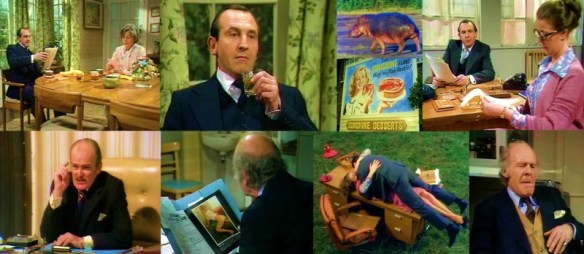
reggie perrin new

No…not some soppy sagawith hobbits, dwarves and elves…the king of the cutting comment, wielder of the blunt blade of too-honest comment, hero of 70s counter-culture, Reggie Perrin is back on TV One. When first screened in about 1976, it was just after my bedtime so I was never quite current on it and had to experience it vicariously through those of my friends with more enlightened parents…

reggie perrin oldWhat a pleasant surprise to find it screening tonight immediately after Doc Martin – well worthy of some really good laughs although you really can help feeling sorry for – and perhaps identifying a bit with – poor old Reggie. A word of warning though, it doesn’t appear that a second season has been picked up yet so a whole new generation may miss out on Grot!

To the stars…

@ The Geek, John Birmingham lashes the global warming denial crew i.e. the big business that stands to lose so much if unrestrained pollution and reliance on fossils (from under the ground and in office) continues unchecked. Money talks and twice as loud when Al Gore is the leader of the opposition. To paraphrase Barnesm’s comment “…this way of life is unsustainable, but after millions of years of evolution and hundreds of years of science and engineering the best we can come up with is “Ride bicycles everywhere, grow and eat only local vegetarian food and essentially go back to living like we did before the industrial revolution”. This is not how you build a star spanning civilisation…” Barnesm goes on to list some technologies that they think could advance both the global warming cause and that of general civilisation. You’ve got to admit, we have become a bit stagnant and stuck in the rut over the last two to three decades…a little too focussed on the now and not the future…if I was to classify myself (while still able to tell you stuff without self-terminating), it would probably be as more a technological utopiast than a ‘grow more veges’ sort of greenie…

At the Chief of Army’s Seminar at Massey last year (note that the Massey site has a ‘less is less‘ approach to pushing information out – hardly doing its bit to win the information battle) , Dr Adrian Macy, the NZ Ambassador for Climate Change,  spoke on New Zealand’s approach to global warming in the international arena. The question that only popped into my head on the drive home afterwards, and noting that this presentation was at a defence forum, was “At what stage might we need to start considering compelling compliance with global warming accords?” Perhaps the NZDF might consider what part it may play in actively saving the planet… After all, we do only have the one…

Had more to say but it’s a beautiful day outside already so I’ll be back later – off now to flea bomb the house, let the goats and sheep loose on the back garden (fitted, of course, with state of the art methane filters), spray more buttercup, and mow the front lawns…

Do Ideas Matter? Some thoughts…

I really enjoyed Adam Elkus’ article Do Ideas Matter? (full PDF) on the Small Wars Journal blog – right up to the paragraph before the conclusion. The author articulated and made his points well, concluding with logical sentence: “… For better or worse, American strategic culture embraces an engineering mindset, and the joint doctrine conceptualization of COG may or may not be the best tool for American strategy…

I thought from here he might be going to connect the dots between whatever doctrinal constructs you adopt and the need for a responsive delivery system to get that doctrine to where it is needed. Nope…what follows is a disintegration of the original issue into a mishmash of random thoughts and ideas. I get the feeling that the author had a bunch of lines that he’d been hanging out to use and hit us with all of them at once. The conclusion is almost a separate article and scarcely relevant to the good points made in the first two pages – the purpose of a conclusion is to conclude, not introduce new material.

I wonder if this was bounced off anyone else before it was published or just churned out in isolation, maybe after too many coffees and very late at night or early in the morning…That’s been a theme of mine here pretty consistently: the need for a good editor to cause an impartial eye over a draft BEFORE there is any thought of it hitting the streets. Even if it only picks up a couple of minor typos (one of my idiosyncrasies is transposing ‘now’ and ‘not’ – hands up if you can see that causing some strife?) or some logical disconnects, sharing your work with someone else before going live is a good thing.

Typos, errors in grammar, loose logic, inconclusive conclusions…all minor details that can irretrievably harm the (possibly quite valid) argument that you are making. This post originally started out as a comment on this post at the SMJ but after reading and rereading the absolutely crap conclusion in this paper, I had such a head of steam up, I figured I’d achieve more with it here. Bottom line: Mr Elkus needs an impartial sounding board before he launches off again…this paper gets a mark of D for Do it again…

The other reason I got so wound up about his non-conclusion was that it takes so much away from the first two and half pages which discusses the relevance of the Clausewitzian trinity to US centre of gravity doctrine. I don’t agree with his bottom line “… For better or worse, American strategic culture embraces an engineering mindset, and the joint doctrine conceptualization of COG may or may not be the best tool for American strategy…” because it reeks for building an Army best suited to fight itself – but I like the way he got there, especially in reminding us what Clausewitz really defined as his trinity and describing quite well the minefield that it interpreting Clausewitz.

I like Clausewitz, or at least those interpretations and translations of his work that I have read – certainly I would rate his influence as far greater than the homogenised drivel that Sun Tzu has become in the last decade or two. I think that most if not all of Clausewitz’s ideas remain applicable today and any that may not, are only temporarily out of vogue – doctrine never really dies, it just fades in and out of relevance from time to time. But, applicable or not, the issue that Adam Elkus was trying (I think) to unravel is that it’s all well and good developing all these new ideas and concepts – or polishing up old ones – but it’s largely irrelevant unless we  have a responsive and effective system to ‘inject’ for want of a better word those ideas and concepts into how we think and behave. FM 3-24 is a great publication but only useful for keeping the dust off the shelves if the ‘education (theory)and training (doctrine)’ (as defined by Phil Ridderhof in his comments on this paper on SWJ) doesn’t pick up on and deliver them before they are actually needed. Remember Simon’s soapbox…It’s all about the right information, to the right people, at the right time – and ensuring that they know how to use it.

I use that phrase regularly in discussions on intelligence, lessons learned, doctrine, training, and knowledge management. I wonder if they are all somehow connected?

Friends in High Places – review

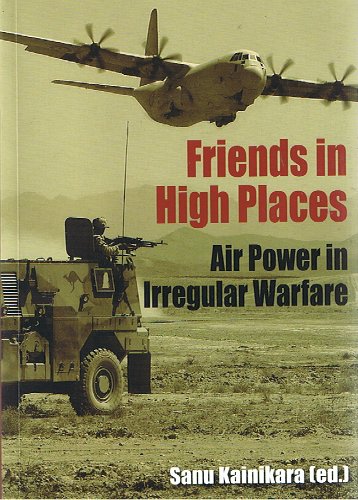
The cover raised such expectations

Friends in High Places – Air Power in Irregular Warfare was published in July 2009 by the RAAF Air Power Development Centre. It has been edited by Dr Sanu Kainikara, a former Indian Air Force pilot who is now the Air Power Strategist at the Air Power Development Centre in Canberra. Including the preface and glossary, the book has 267 pages divided into nine sections:

  • Foreword. Group Captain Rick Keir, AM, CSC. July 2009.
  • Introduction. Dr Sanu KainiKara. July 2009.
  • The War of the Running Dogs: The Malayan Emergency. Air Commodore Mark Lax, CSM (rtd). An edited version of the paper originally presented at the RAAF History Conference in Canberra, 1 April 2008.
  • Offensive Air Power In Counterinsurgency Operations: Putting Theory Into Practice. Wing Commander Glen Beck. An edited version of Air Power Development Centre Paper #26 published in August 2008.
  • Air Power and Special Forces: A Symbiotic Relationship. Wing Commander David Jeffcoat. An edited version of Air Power Development Centre Paper #14 published in February 2004.
  • Taking It To The Streets: Exploding Urban Myths About Australian Air Power. Wing Commander Gareth B.S. Neilsen. An edited version of Air Power Development Centre Paper #23 published in October 2007.
  • Air Power and Transnational Terrorism: The Possibilities, Advantages and Limits to using Australian Air Power in the ‘War on Terror’. Mr Sam Gray-Murphy. An edited version of Air Power Development Centre Paper #20 published in October 2005.
  • The Role of Air Power in Irregular Warfare: An Overview of the Israeli Experience. Dr Sanu Kainikari.
  • Conclusion. Dr Sanu Kainikari.

My initial visual impression of this book was “Yes! the Aussies have ‘got it’!”: the cover very positively shows a C-130 at low level over a Bushmaster Infantry Mobility Vehicle and not the F/A-18 and M-1/ASLAV combination that might be indicative of a conventionally focused publication. Unfortunately this warm buzz did not last beyond the second page of the foreword which notes the ‘…predilection towards precision strike…‘ in the collected papers as ‘…one of our key asymmetric capabilities against a typically asymmetric foe…(1)’

These comments set the scene for the remainder of the book. While various CIA(2) truisms appear through the papers, they are not supported by the text which largely drives towards supporting the maintenance and further development of current air power capabilities with continuing focus upon kinetic operations. Although it makes a case of a balanced spread of air power capabilities, the truth today is that only a very small number of nations can actually do this – the rest of us have to make some tough decisions about what capabilities we need to maintain nationally and what we may have to give up to do so.

Friends In High Places does not consider the lessons of allies and partners in coalition operations since WW2. Its conclusions focus on what was i.e. offensive kinetic air power and not upon what is and will be: a blended mission-specific capability mix drawn from national and coalition military, government and civilian sources – to use an obsolescent but appropriate term: Joint, Inter-agency, Multi-national and Public (JIMP)(3).

This publication has been written around a pre-assumed conclusion: that traditional kinetic air power will remain as the premier ADF air power output. While this may or may not be the case, by approaching this publication with that belief as a given, all the content is badly skewed from the reality of the COE. A more effective approach would have been to consider the COE and what makes it different from  the more comfortable traditional forms of warfare and then apply these findings to the employment of air power. Applying an open mind to the complexities and nuances of the COE may have produced a volume that lives up to the promise of its cover.

Although the foreword notes the minimal consideration of air power in contemporary COIN doctrine like FM 3-24 and LWD 3-0-1, there does not seem to have been any attempt to engage the COIN/CIA(2) community of interest (COI) in Australia or offshore. This is doubly disappointing as agencies like Force Development Group in Puckapunyal, the NZ Army’s Interbella Group, or the COIN Center at Ft Leavenworth could have added considerable value to relevant aspects of this book without detracting from its air-centric theme. As a result, both the land and CIA aspects of this book are very weak. Similar comment can be made regarding the Special Operations and Urban Operations chapters.

The editorial staff has not included any discussion of maritime considerations, from general or air-specific perspectives which is a significant omission for a nation surrounded by water, which is reliant upon the sea ways for trade and industry, and whose major military operations are far more likely to be expeditionary than domestic.

In considering how air power can best operate in a CIA environment, there has also been no mention of the aviation branches of either the Australian Army or RAN apart from a couple of inaccurate paragraphs on ARH (the Eurocopter Tiger Attack Recon Helicopter adopted by the Australian Army). There is also no mention of integration with other government or civilian air assets or those of likely operational partners like New Zealand or Singapore; nor any acknowledgement of the vital role of all sources fusion when discussing aspects of ISR.

The papers included in this collection do not have a good nor consistent grasp of the irregular environment and thus any conclusions they may draw are developed on a somewhat shaky foundation. By the time that the original portions of this book were drafted i.e. those that are not rehashed staff papers, vast quantities of analysis, comment and intellectual horsepower had been expended on defining the COE. Had these resources been tapped, Friends in High Places would be a must-read. As it stands at the moment, its most effective message is the cover photo.

(1) Page xii
(2) The UK term Countering Irregular Activity (CIA) is used instead of the more popular but less accurate term Counterinsurgency (COIN) to describe the complex Contemporary Operating Environment (COE).
(3) I think that I may have inadvertently helped kill off this term a few years back when I made a number of public comments along the lines of ‘Bring out the JIMP‘ from Pulp Fiction.

Once was a rail service

Along the Kapiti Coast

I have ‘borrowed’ this great picture from Peter over on The Strategist – the background to the picture is in Peter’s own post Saturday evening reflection: from a railway carriage – it’s a great little story about boys and their dads.

It’s only January but already this picture is a contender for my picture of the year. Every time I look at it, it brings up a range of images and feelings. The scenic beauty of our little nation – that’s the Kapiti Island Nature Reserve on the horizon – although this is one of the few places now where a passenger trains runs along the coast for any length of time. Once upon a time when the Southerner still ran daily on the ChristchurchInvercargill run, one of the best sections was where the rail wound through hills and along the coast between Oamaru and Dunedin with views much like this. Of course the powers that be decided that we didn’t need a passenger rail link any further south that Christchurch a few years back and so anyone wanting to head south now has to contend with being cramped onto a bus with minimal facilities, getting a rental car or hitching (although the South Island natives are generally friendlier and more hospitable than in the north.

I see the cool Capri on the trailer in the foreground – immediate memories of Bodie and Doyle – must-see TV in the late 70s and early 80s. I like to see icons from past eras being restored and I wonder what story surrounds this car – lovingly restored in a garage over time? Captured memories of frantic back-seat fumblings and youth now gone? Maybe a father-son project while mum and the girls do ballet and horse-riding. Maybe a journey off to a show for the weekend where others display their pride and joys too…?

Most of all I am sad at the way in which successive governments have allowed rail services to be hacked to bits. While there is probably more freight going on rail than every before – the Raurimu Spiral is visible from my window and there are big (for NZ anyway) freights going through every couple of hours – and congestion would be a major problem if we tried to return to the passenger schedules of three or four decades ago, I’d love to see the Overnighter return to the Auckland-Wellington run – even if only as a rail car much like the old Silver Fern. I see that the wikipedia entry on the Silver Fern mentions its fatal crash in 1981 – a friend of mine was the Orderly Officer in Waiouru that night and was telling me about when we had a farewell drink before he departed for a new posting down south only a week or so ago. The day after the accident, a very reserved and polite Englishman approached him, identified himself as an RAF officer and asked if it might be at all possible, if it wasn’t any trouble, to send a signal off to the UK advising that his return from leave would be delayed by a few days due to the accident.  The tone and gist of the signal was “…IN NZ ON HONEYMOON STOP BRIDE KILLED IN TRAIN CRASH STOP REQUEST ADDITIONAL LEAVE FOR ADMIN PURPOSES STOP…” Sad…

I remember meeting the railcar in Oamaru on Friday nights with my parents as various cousins studying in Dunedin or Christchurch would visit for the weekend for home-cooked meals and a decent bed. Later in life, I used to take the train the other way to link up with student mates in those cities for a weekend of chaos. South Island railcar services were withdrawn in the 70s and not replaced by another overnight rail service. In 1983, a fast Invercargill-Christchurch bus service was introduced that did the run in twelve hours – this was in the days of the 80 kmh speed limit and it was soon pointed out pretty bluntly by the Ministry of Transport that it simple was not possibly to meet this schedule AND comply with open road speed limits – the schedule was amended accordingly but I don’t think the speeds every dropped much. I was a regular on this run and as a result discovered, as did Peter in his tale, the rich resources of the railway station bookshops. Here I found such ‘classics’ as Martin Walker’s A Mercenary Calling (not much info on AMazon but I can’t belive the prices this book is going for!), David Gerrold’s War Against the Chtorr and Jerry Pournelle’s Janissaries – the latter two becoming eventual disappointments as, even three decades later, both authors still drag the chain on concluding respective series.

In 1983, the bus would drop me at the corner of Riccarton and Ilam Roads in Christchurch around 6 in the morning and I would stagger (restoring circulation after twelve hours bus-bound – staggering due to other causes would come later in the day) through the mist and rain to Rochester Hall where I always crashed with my mate, Paul. We’d go hard all weekend, then I’d sadly unwind the rubber band on the Sunday or Monday (if I gave myself a long weekend) back to the sunny South…

In other journeys, my trip to Otorohanga yesterday went really well. There is a small business just up the road from Carmen’s work week flat that makes a range of hard-wearing, colourful bags and items of clothing – Danzbags, if you want to Google/Bing for it. They only sell from the factory shop but they have such a great range of items (and NZ made!!) that Carmen got us together so I can do some marketing for them on Trademe and possibly elsewhere if it takes off. Small businesses here (and elsewhere, I guess) are under mega-pressure from big chains like Warehouse that kill off smaller enterprises wherever they set themselves up so I’m more than happy to support them where I can – and, as Carmen has been quick to point out, it keeps me off the streets.

Chiefs supporters should be able to work out the anagram.

I had a lot to do with this type of industry in New Zealand when I was project manager for a range of projects looking at military clothing and personal equipment in the mid-90s and it has been quite interesting getting back into the periphery of this area again, Even something as simple as a pencil case, which I never gave much thought to until I stopped at the Warehouse in Te Kuiti on my way home and saw the absolute crap being sold there and the prices they ask for it…

Support Kiwi made

When a plan comes together…

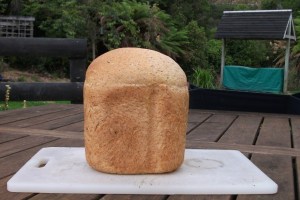
….or, in this case, a recipe…

I don’t have many bread making disasters nowadays but it’s not often a loaf comes out as perfect as this – if only I knew what I got right this time!! Was it the fresh herbs or shaking up the flour that little bit extra…? Kinda like COIN when you think about it – even when you get it right, there’s no guarantee that it’ll work out OK next time…

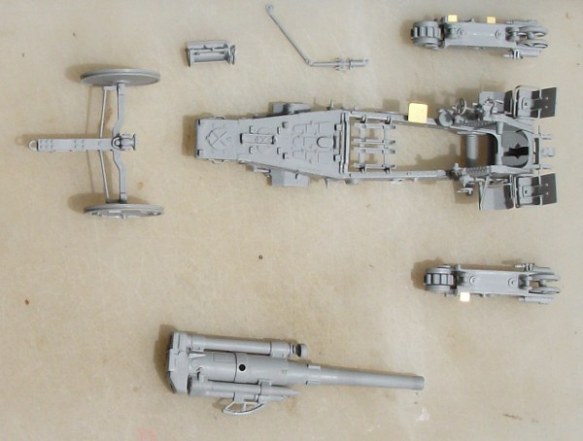
And speaking of things going according to plan, the big Russian cannon, Trumpeter’s B-4 203mm monster, is progressing really well and is pretty well ready for its first coat of paint.

As I have mentioned previously, this is a delightful kit to build: it looks complex while being relatively straightforward; it is big (about 30cm long when complete) without being a shelf hog; and it was relatively inexpensive (in Singapore anyway) at $44.50.

Gripes? Only a few…the brass plates as a waste of time and couple be done as well in plastic – they would also stick in place a lot better – extra detail is nice but only if it actually adds some value and isn’t there for its own sake; the parts layout needed some more thought: although there are a number of very fiddly little pins in some places, they could just have easily been molded in place as they only represent a small bump on the model – on the other hand, the pins that hold the gun in place are fixed so that you can not add the gun as part of final post-painting assembly. This means that there are small detail parts that can not be added until after painting (Grrrr!) or you have to try to paint the gun on its mount which will be almost impossible. I’m going to paint it pretty much as you see it (once I replace the two detached – again! brass plates and trim back the gun mounting pins just enough so that I can pop the gun in as a final assembly…

Gripes aside, this is a great kit, interesting subject and good value for outlay. Good on Trumpeter for one again taking a punt and bringing us some a little different…tempted as I am but a what-if SP version on a JS-III chassis as suggested by the evil Mr Regan this early in the year would not be in keeping with my ever so sincere NY resolution regarding model procurements…I’m completing it in its towing configuration so am now on the hunt for any info as to what might have towed this beast…who knows – it might be something that I already have int eh stash…?

Next cab off the rank for production in the plastic media will be Trumpeter’s 1/32 A-10B Kiwi-ised

Holy hailstones, Batman!

So this is summer?

Only a short update this morning as I have to shoot away up the road and check out a business opportunity in Otorohanga – hopefully the weather will be better than yesterday!! It is meant to be summer down here…

Yemen – the good oil

There has been much talk recently about the War on Terror shifting its focus down to Yemen however before we go in and bomb and/or invade it, perhaps we might want to make sure:

  • Our intel is right this time.
  • If we go in, we have a plan for getting out
  • We actually understand what it is that we are there to do.

Coming Anarchy has a very interesting background item on the situations (note plural) in Yemen that helps set it in perspective.

One comment states “…What the US really needs to do is avoid relying on the Yemenis and Saudis for identifying persons and groups of interest…” It is way past time that the intel community got back in the saddle to provide the quality analysis and assessment that are so necessary for good decision making. While you would think that this is pretty much ‘common dog’ common sense, recent events like the Flynn intel paper and Steven Pressfield’s establishment of a Tribal Engagement tutorial indicate that this simply isn’t happening at either end of the scale.

Parting shot

For all the furore a couple of years about urban ops being the new war (war amongst the people, yeah, yeah, yeah…), has any one noticed that we are back fighting out in the boonies again…?

Acts of Desperation

The WordPress Blog Stats page has a web part that displays what search terms have brought visitors to your blog. I couldn’t help but notice this one yesterday:  “leadership lessons from chicken run movie“. This can only be an act of true desperation, I thought…the whole idea of gleaning lessons on leadership or much else from movies, especially these over-rated voice-starred animations, is a bit dodgy from the start…even dodgier is the fact that some people think that cartoons like this help develop a sense of reality amongst their children…

Mr Birmingham gets angry

It’s not often I’d pull on my angry pants and launch a giant boot into the arse of the ABC. I’d be a bit like going an old lady who’d wandered into a cage wrestling death match at an ultimate fighting tournament by accident. But sometimes even old ladies need to feel the pain. And Aunty? I’M BRINGIN’ THE PAIN!

Over at The Geek JB goes ABC for trying to enslave book reviewing bloggers for free – he lists all the reasons why young bloggers should receive some form of incentive to review books online, and none, understandably in support of ABC. Like Havock in the comments, I also have some minor issues with the age discrimination issue raised although I think this may be a not so subtle attempt by ABC to tap a more naive (in their perception) segment of the blogspace…

If you haven’t tried it, book reviewing is bloody hard work: for me to review a book properly, keep notes and come up with a review more substantial than ‘it’s crap – burn it’, I’m looking at 3-5 days work – and I am a pretty fast reader. While I believe that the power of the Information Militia rests mainly in the unpaid intellectual horsepower that constitutes most of the current blogspace and forumville, I think that it is only right that commercial organisations that wish to tap this resource for their own gain, front up with at least a little of the crinkly stuff. JB also makes a very good point that even if the ‘pay’ is half a pittance, it then constitutes works and opens up a range of other benefits in terms of tax losses and claimable costs…perhaps…ABC, it probably doesn’t pay to aggravate the Information Militia lest they a. turn their attention to you and/or b. transform into that other form of militia – you know the one  with guns, pitchforks and torches…

And in the Birmoverse

Battles still rage on Cheeseburger Gothic over the why and how of an Uptimer President in 1952…feel free to climb into the fight…

And now the weather…

While the forecast today is for scattered showers with outbreaks of sun, a storm of another sort approaches…yep, the Twins are back for the weekend so hatch battening begin…