Just been up the road for a coffee and endured yet another nutjob spouting off about why New Zealand just has to have fast jets if it hopes to have any credibility internationally. I’m not going to get into that argument although I will admit I do kinda miss the sound of tortured air as 75 Squadron crank across the Rangipo Desert…but…this nutjob made the comment that the Skyhawks are just rusting away, neglected and forgotten, down in Woodbourne. And that’s not true….so just for the record…
A while back, someone emailed me a PDF that had clearly been a copied and pasted Word document drawn from an internet or print article – there were no identifying links, or names or anything to give away the source. If anyone does recognise the source, please let me know so that I can credit the source and link to the original item…so, just for the record, everything from here on in italics and the pictures are all someone else’s work…not mine, not at all…but I do think it’s all pretty cool…
“There has been lots of rumblings in the military aviation community about the future of the Black Diamond Jet Team and the possible establishment of a commercial adversary support arm of the group, known mysteriously as Draken International. It is now clear that Draken International and its team, which sports famous names like a Dale Snodgrass in its roster, is deadly serious about jumping into the fickle commercial adversary support/contractor air services industry, with an armada of blazing afterburners to prove it.
I have written at length about the coming storm of demand for commercial adversary support services. As America and her allies transition into an almost all 5th generation fighter inventory, fighter wings will not be able to afford to accomplish all their required training tasks using “in-house” aircraft as they have done in decades past. 5th generation fighter capability comes at a huge cost, not just in the upfront purchase of the aircraft, which will cost at least twice as much as a comparable fourth generation fighter, but the operational and sustainment costs of these cutting edge machines will be absolutely crushing for users around the globe. It simply does not make sense to send an F-35 up to train on basic radar intercept procedures against another F-35. Incredibly valuable airframe hours are consumed
needlessly by doing so and aircraft operating costs for such sorties will be astronomical. Further, having a state of the art 5th generation fighter mimic an inferior threat is not only inefficient but it is also somewhat problematic. This is precisely where commercial adversary support providers will come in to alleviate these fiscal and operational pressures, providing simulated threats and other support duties that can be tailored cost effectively to each individual sortie’s training goals. Further, outsourcing such duties instead of expanding current military adversary support squadrons or establishing new ones will create an elastic on-demand force that will be much more cost-effective than a standing military force alternative. In other words, by outsourcing adversary support duties to a commercial entity an air arm only needs to pay for exactly what it wants, when it wants it. If they become dissatisfied with their provider or someone else shows that they can provide the same service better or cheaper than they can take their business elsewhere. Such an arrangement is a proven economic and operational win-win for all those involved, the problem is that there is simply not enough supply of these services right now to fulfill what will become a huge demand by the end of the decade. This is where companies like Draken International are beginning to step into the picture, possibly taking what has been a niche industry and thrusting it into the mainstream international defense marketplace. Draken International’s fleet of aggressors is simply eye watering:
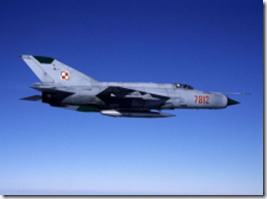
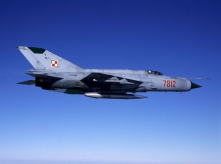
29 MiG-21BIS/UM: This is a lot of supersonic threat simulation aircraft! The majority of these jets are ex-Polish birds and are equipped with the dated by today’s standards, yet still capable RP-22 radar set, as well as a radar warning receiver. The MiG-21 in this configuration is roughly similar to the F-5Ns currently serving in the aggressor role for the US Navy. With the addition of a capable electronic warfare/jamming pod, the MiG-21 is known to be a dangerous jet to engage with on an air to air level even in modern times.
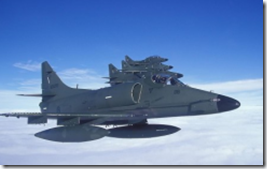
8 Ex-Royal New Zealand Air Force A-4K: Yes, some of the New Zealand’s Skyhawks have finally been sold to a loving new home after years of busted deals and “tire-kicker” inquiries. These are the most capable Skyhawks ever produced and sport an advanced version of the F-16A’s APG-66 pulse- doppler phased array radar, hands-on-throttle-and-stick pilot interface, a full-fledged heads up display, a capable radar warning receiver, 1553 digital bus which will allow for carriage of advanced stores, and even mid-air refueling pods. These A-4Ks will obviously be Draken International’s high-end threat simulation mainstay and will bring a capable radar set to the commercial adversary support industry for the first time, which is a true game-changer. Also, seeing as these jets are equipped with refueling stores, they can offer that capability for fleet training or to enhance their own aggressor capabilities where “time-on-station” is a big selling point for potential customers. The A- 4Ks are slated to be operational by early 2013.
3 A-4L Skyhawks: Currently wearing “zebra’ camouflage and Draken International titles.
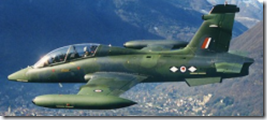
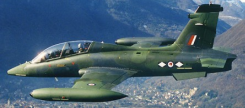
9 Ex-Royal New Zealand Air Force MB-339: These advanced jet trainers are equipped with similar sub-systems as their A-4K cousins, such as an advanced HUD and 1553 digital bus, albeit without the APG-66 radar and other combat oriented gear. Slated to be operational by the fourth quarter of 2012.
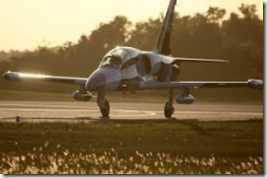
5 L-39: Presumably these are the same aircraft that are flown by Draken International’s non-profit aerial display and exhibition team.
When you look at this fleet in comparison to other contractor air services/commercial adversary support providers you realize that Draken International has procured a diverse and flexible combination of aircraft that matches more advanced threats, and in greater volume, than what is currently available on the market today. The MiGs are fairly cheap to procure and are a good match for simulating enemy anti-ship and cruise missiles, some of which now possess solid supersonic performance. The Skyhawks will be a an affective “jack of all trades” and will be especially useful at presenting a cost-effective fourth generation fighter threat in the beyond visual range arena, a capability that is currently sorely lacking in the CAS industry. The MB-339s, and even the L-39s to a certain extent, will be good for lugging around jamming pods and presenting rudimentary radar targets for aircraft and ships, as well as providing close air support training for JTAC/FAC schools at home an abroad.
What is most astounding about Draken International’s business plan is the sheer amount of aircraft in their inventory and the endless
potential of how they could be mixed and matched together to form an incredibly diverse and capable aggressor force. With so many airframes of different capabilities, including those which can mid-air refuel and supply a persistent radar picture for their red air team, Draken International will have the ability to supply an enemy air force “on demand” for large force employment exercises that mirror the capabilities of many potential adversary nations.
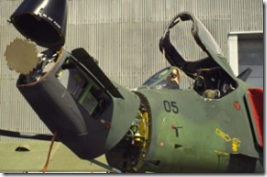 In business they say timing is everything, and in Draken International’s case that key ingredient may remain illusive due to a faltering F-35 program and shrinking defense budgets both at home and abroad. Yet these same factors, which may seem negative at first glance, could very well end up being Draken International’s proverbial ace in the whole, as the F-35 program is almost unstoppable at this point and costs related to it will continue to balloon, thus resulting in smaller fighter fleets than originally planned for most nations involved in the program and less cash available to fly the jets once they are purchased. As a result hiring companies like Draken International will be absolutely necessary for providing continuous training support at comparatively minimal cost.
One thing is for certain, with firmly entrenched contractor air service providers like Top Aces and ATAC already holding substantial market-share and burgeoning new startups like ECA Program and Draken International just stepping onto the stage, the biggest dogfights for these companies may no happen high in the sky but in corporate boardrooms and DoD contracting offices instead. Competition will be furious for the as yet to grow adversary support pie, but once a new, much bigger pie, in the form of the F-35 program, finally gets served it will be good eating for many for years and years to come…”
PS: Why place this in ‘The Thursday/Friday War‘ category and not ‘Playing with Toys‘? Easy…I think that the relationship between commercial and traditional military providers of capabilities to nation-states et al is just getting started and won’t stop til it gets us to the days of Falkenberg’s Legion and Hammer’s Slammers (look ’em up)…
-39.121821
175.394487



 …and the orginals…






 The World According to Me...