The Myth of Force Ratios as core to COIN

Randomly-selected COIN-themed header pic

“The best way to become acquainted with a subject is to write a book about it. Benjamin Disraeli”  

This little gem was the random quote that WordPress threw up when I published the item on Definitions in COIN and never were truer words spoken – if all we get from the FM 3-24 revision project is a better understanding of the irregular environment (of which COIN is a subset), then it will have been a valuable and useful activity to have participated in…

Today we discuss the second issue paper produced as part of the project…IP2 Force Ratios…This topic really narks me as the presentation of pseudo-scientific mumbo-jumbo (yes, that is a doctrinal term!!) as supportable fact…as you read on, you’ll probably get the impression that I’m not a big supporter of this concept…my comments are in two parts: the first refers to related questions in the original FM 3-24 Revision Questionnaire the responses to which lead to the three issues papers, the second addresses the content of IP2 itself…

Part 1 – Answers to initial review questions

The ratio of counterinsurgents to the population is one of the more oft-cited portions of the current FM. A study by the Institute for Defense Analysis concludes that twenty counterinsurgents for every 1000 residents in the area of operations leads to a 54% probability of success. If, however, the density increases to 40 for every 1000, the probability increases to 83%. Another study by the Harvard Kennedy School,  however, concluded that increases from 5 to 80 troops per 1,000 inhabitants caused the probability of success to increase by less that fifteen percentage points. Most studies caveat 2 results by stating that no level of force density will guarantee success. Based upon these studies and any others of which you might be aware, how should force ratios in the FM be adjusted?

The ratio model is an over-simplistic take on a very complex environment, driven by those seeking a checklist/template solution to COIN/IW. Even if it could be proven that  there is an optimal ratio of counterinsurgents to residents, we would then have to further define structural ratios within ‘counterinsurgents’, even first define what the optimal counterinsurgent is: in Baghdad 2005, the optimal counterinsurgent may be a heavily armed and supported combat soldier, whereas in Bamiyan 2005, it might be a CIMIC specialist. In most COIN/IW circumstances, the wrong type of force could be as damaging to the campaign as too little of the right kind of force.

The force ratio model does also not consider that the probability of success may also decline if the counterinsurgent/resident ratio is too high. The wrong sort of force or wrong ratio for any given COIN environment stands to contribute to creation of Kilcullen’s accidental guerrillas – while the book may have drawn some somewhat dubious conclusions, the concept of the accidental guerrilla is sound.

Should force ratios even be addressed in the FM? 

The force ratio discussion in the FM might be more useful in offering considerations for the internal force structure ratio for a given environment. Either way, the content should emphasise that there is no templated or generic optimal force ratio.

The current FM quotes Galula who posited “that revolutionary war was 80 per cent political action and only 20 per cent military.” The sentence that follows caveats that remark. Does the 80/20 ratio have any historical validity, other than being cited as noted?

As above, defining any ratio is only likely to do more harm than could and will encourage a template/checklist approach to COIN. Of greater importance and relevance is what might comprise, against a given COIN/IW environment the specific political/OGA/NGO and military components of the COIN force.

The key lesson to be derived from the Galula quote is that a successful COIN campaign requires a blend of military and other capabilities. DIME (diplomatic, informational, military, economic) and JIM (joint, inter-agency, multi-national) are commonly accepted constructs for effective campaigning and it is well accepted that there are few if any contingencies that might be addressed by only one branch of the service or by the military in isolation from other elements of national power.

If not, should there be any reference to a political/military percentage in counterinsurgency warfare?

Other than to re-emphasise that long term success requires more than a military solution, probably not: introducing any specific metrics into a publication at this level leads to the template/checklist mindset. The bottom line must remain that each COIN/IW scenario must be considered on its own merits.

One way of leading to acceptance and understanding of this might be to retitle the publication to “The Military Contribution to Counterinsurgency” – this would make it clear from the get-go that there are other aspects than purely military to this form of conflict.

Part 2 – Issues arising from IP2

Recommendation 1. The fact that the force ratio theory was mentioned in the 2006 version of FM 3-24, a publication drafted in some urgency in response to an operational crisis, is not sufficient reason to automatically include it in the updated FM. It is a common occurrence for doctrine developed against operational urgency to be substantially revised on first or subsequent revision. In the Australian Army doctrine development model, doctrine specifically identified as ‘developing’ is meant to be reviewed after twelve months and there is often substantial difference between the initial ‘developing’ version and the more enduring developed version. ‘We’ve always done it’ (in this case only since 2006) is more akin to dogma than doctrine.

The new FM 3-24 not only could work around the perceived constraint in recommendation 1 but it should and this can be achieved by simply noting the lack of any substantive evidence supporting either general forces to population or to insurgent ratios

Recommendation 2. The logic in this recommendation applies equally to identifying members of the population – it is a fair assumption that not all insurgents will be recorded members of a region’s population i.e. that they have deployed into that region because it offers some specific advantage or attraction from an insurgent perspective. Ergo, not all insurgents are locals.

The same logic also applies to determining optimum force ratios within the counterinsurgent forces – as it is often difficult to identify at any one point which is the most effective force structure for a given scenario, the usefulness of any discussion on force ratios, other than to discount the force ratio as a viable counterinsurgency metric or approach, is moot.

Recommendation 3. The same issues mentioned above under recommendation 2 apply to recommendation 3. That only the latest study of insurgency found a correlation between the number of counterinsurgents to population indicates that this theory is still unproven. Neither recommendation takes into account the physical geography or size of the area of operations which may offer a range of advantages or constraints to both insurgents and their adversaries.

Recommendation 4. If this recommendation is implemented, the publication must offer clear guidance on the considerations for determining the optimum force size and structure for any given counterinsurgency environment; and also for determining when that ratio may requirement adjustment up or down. Considering the example given involving host nation security forces, it should alos be considered that the state of those forces will also be a modifier on the optimum force ration e.g. if the host nation forces are ineffective and/or possibly corrupt, then this, regardless of the population size, may modify the counterinsurgency force to population ratio up. Conversely if the host nation forces in a given area are quite effective this may modify that figure down.

Some guidance on the granularity of the force ratio must also be given if these recommendations are adopted i.e. does the force ratio apply across the whole operating environment, across individual AOs or units, or across just the most contested areas?

Recommendation 5.  The proposed paragraph 1-67 promotes the employment of what remains an unproven theory that simply has too many variables to add value. The proposed paragraph 1-68 on its own provides adequate guidance on force ratios in counterinsurgency. Notably it offers no guidance as to the ‘optimum’ force ratio and leaves this to be determined by a robust planning/campaign design process which is where it should lie.

Bottom line: there is no templated shake’n’bake solution to force structures for COIN – each force must be generated against the specific environment that it is going to operate in….there is no substitute for victory thinking….


Definitions in COIN

Randomly-selected COIN-themed header pic

In December 2006, the US Army and USMC co-published FM 3-24 Counterinsurgency, a publication specifically intended to align US forces with the needs of operations amongst ‘the people’ in Iraq. Some of the ideas were new, others harked back to well-established truisms from the eras of Vietnam and Malaya – the aim was a decisive shift in how US forces conducted themselves in the new operating environment where force and ‘the big stick’ weren’t the ultimate arguments.

The COIN Center at Fort Leavenworth is now taking the lead in a two year project to review the content of the original FM 3-24 and update it as a tool for less-specific i.e. not Iraq, operating environments. As part of the project, the Center is seeking comment from a broad spectrum of stakeholders and interested parties and thus is conducting a large portion of its work in the public forum. From this part of the world, that means some odd hours to participate in the regular webcasts that discuss aspects of the project but it is well worth the lost sleep.

The Center has produced three Issue Papers on key aspects of the publication – these are available on its public website – and over the next while, I’ll share my thoughts on those issues…IP1 is Definitions

Accepting that irregular warfare is sufficiently different from conventional conflict to warrant specific definitions and doctrine, possibly the first question to be considered is whether insurgency is sufficiently different from other subsets of irregular warfare to require specific doctrine and definitions i.e. would targeting irregular warfare as the primary subject also satisfactorily cover insurgency as a subset of IW?

In examining the definitions under paragraph 3 of IP1, the answer is probably ‘yes’ and of all the definitions, the French one is probably the most accurate, closely followed by the Spanish and USG definitions if they dropped the word ‘political’. The key elements of the environment that FM 3-24 seeks to describe are the use of armed conflict/guerrilla warfare/terrorism and the objective of control. Whether that control is political or other is largely moot as the net result is control over a geographic area and/or a group of people.

Recommendation 1 could read “That the US Government should adopt a single definition of Irregular Warfare, of which insurgency is a subset”; this renders a specific definition of counterinsurgency moot. Considering that the ultimate objective of a campaign to counter irregular warfare is stability, it may be that the countering definition comes closer to stability operations that it does any other type of operation. This, of course, would lead to a review of more fundamental doctrinal principles, in particular whether stability operations are actually distinct from offensive and defensive operations per se, or whether that distinction is more from major combat operations or conventional operations e.g. the Fulda Gap.

With reference to paragraph 4, this argument is moot and largely doctrinal semantic hair-splitting unless there is some previously unrecognised body of knowledge proving that all the types of IW conflict listed under that paragraph are uniquely and distinctly different from insurgency and that the responses to those forms of conflict are equally uniquely and distinctly different from those employed to counter insurgency. I would offer that they are probably not and even postulate that it would not be uncommon for two or more of the forms of IW to exist in the same theatre. The finding that “…the approved definition should distinguish  insurgency from the types of conflict listed [below paragraph 4]…” i.e. recommendation 2 is incorrect.

Recommendation 4 is correct in not recognising the use of the term ‘grievances’ which immediately leads to a ‘righting wrong’ mindset. While the definition of counterinsurgency gains little from incorporation of ‘root causes’ into the actual definition, it is rather dismissive of ‘root causes‘, as an element of any campaign countering insurgency. The simple definition of counterinsurgency is “those steps and measures employed to counter insurgency” and care must be applied to ensure that the definition does not prescribe or imply the specific steps and means of countering insurgency – these should be defined and refined in the substance of the publication itself.  Thus the definition of counterinsurgency is less important than the definition of insurgency i.e. there is a whole publication in which counterinsurgency will be defined, but this will only add value if the core definition of insurgency is ‘got right’. Our broader concern is that such sentiment will shape the content of the publication itself.

Caution should be applied, however, in dismissing ‘root causes’ from any approach to counterinsurgency. Cause should be considered in its classic causal sense and not in the narrower context of a political or other cause. To not consider root or underlying causes in an insurgency environment promotes the apparently practical and reasonable mindset that there is such thing as a successful military approach to countering an insurgency i.e. good versus bad, us versus them, friendly versus enemy, defeat the enemy. Even if the action arm (translating Clausewitz’s three elements of a problem into an IW environment where the government, the armed forces and the people become the leadership, the action arm and the people) of the insurgent elements is defeated, it is almost bound to rise again if the underlying causes, be they political, criminal, economic, egotistical, etc are not addressed. An underlying issue is clear in the five examples of ‘non-compliant’ insurgencies listed under recommendation 4.

A cynical exception to this would be where it is necessary to temporarily defeat or suppress an insurgency as an enabling action for a higher objective i.e. national objectives, and where upon attainment of that objective the course of the insurgency is no longer a national concern.

Recommendation 5 is a little misleading. I agree that the term does not need to be included in the definition of counterinsurgency but for the reasons stated above in regard to not including ‘root causes’ in the definition i.e. that this specificity is not necessary in the definition where considerations for and approaches to counterinsurgency can be discussed at length within the text of the publication – assuming that the actual definition of insurgency is ‘got right’. The broader concern is that such sentiment will shape the content of the publication itself.

However, recommendation 5 as a whole implies that it is possible to successfully prosecute a counterinsurgency campaign without employing a comprehensive/JIM (joint, inter-agency, multi-national) approach. Unless the objective of the campaign is short-term suppression or stability to enable a higher objective, one would be hard-pressed to find too many examples from history of successful counter-insurgency or broader irregular warfare campaigns that have relied on a solely military approach; in fact, it is likely that historical review would find that most conflicts of any nature or scale have required a broader engagement for ultimate success. Identifying a comprehensive or JIM approach as the optimum method to a counterinsurgency campaign does not commit one to automatically have to seek or comply with the full scope of the JIM model; it definitely would not “…result in the US not being able to declare that it is countering an insurgency unless all organization types are involved…” This is the checklist/template approach to counterinsurgency and irregular warfare, in fact to all forms of warfare, that is an inadequate substitute for critical thinking and consideration of each conflict challenge in its own right.

I only have two comments on the actual proposed definition of insurgency. The first is that the word ‘minority’ should be removed as its use implies that only minority groups can conduct insurgencies. The insurgencies in South Africa and Rhodesia, and the current situation in Fiji (although only instability, not insurgency) are examples of majority groups that have initiated insurgencies or that have the potential to do so. The second is that ‘de facto’ should be removed as a descriptor for the at risk system of government due to its ambiguous meaning as either ‘genuine’ i.e. legitimate or ‘actual’ which could possibly be taken to refer to an effective shadow system of government competing with the actual system of government. Consideration could be given to replacing ‘de facto’ with ‘legitimate’ to recognise that the initial point for any campaign of this nature is probably in support of the existing government (where such exists) however this brings with it other issues. It is not considered that, for the definition, system of government requires any qualifier and that any issues of governing relating to a specific operating environment should be identified and considered in the early stages of campaign planning.

I have no major issues with the definition of counterinsurgency however it is rather wordy and the list of adjectives preceding ‘actions’ appears contrary to the concerns expressed in recommendation 5 regarding the perceived risks of prescribing solutions if the word ‘comprehensive’ was to be employed. It could more simply expressed as ‘Those actions taken by military and government agencies to defeat insurgencies’. The qualifier of ‘civilian’ for government agencies is a given with the existing qualification of ‘military and’, and, in any case, it creates a grey area for the employment of paramilitary forces which might be considered neither truly military nor truly civilian. The rationale behind including ‘over a protracted period of time’ is understood however it creates at the highest level of doctrine a perception that all campaigns will occur over a protracted period which while the most common occurrence, may not always be the case, especially if as above, the campaign seeks short-term suppression of an insurgency to enable a higher objective to be achieved. The use of ‘of time’ after period is also redundant: period by definition is ‘of time’.

I think that it is vital that we get the doctrinal and semantic foundations of this publication right – to not do so leaves layers of potential ‘get out of jail free cards‘ where a situation may not meet the specific nature of ‘insurgency‘ as defined in this publication and those that refer to it. Inherent in this is to break COIN away from the self-licking ice cream and commercial cash cows that it has become over the last decade and to set it in its right place under the general mantle of irregular warfare….

Next time…IP2 Force Ratios

The application of FM 3-24 principles and success in COIN

Staying up lat-ish last night to watch Torchwood: Miracle Day when I knew I had a 0300 start this morning was probably not the best idea I ever had but, like many, things, it seemed like a good idea at the time and I know that if I record something I only rarely go back and actually watch it…

It’s still very dark outside and the webcast from the COIN Center at Fort Leavenworth has just ended…the topic for discussion this morning related to principles identified in the RAND study Victory Has A Thousand Fathers and their application to FM 3-24, specifically from the perspective of what an updated FM 3-24 might include.

I really don’t like Victory Has A Thousand Fathers – the idea is good: to study historical COIN campaigns and determine what truisms or principles can be derived from those campaigns.  This, I believe, is a necessary and long overdue step in the development of useful doctrine for the contemporary environment as for too long there have only really been two dominant schools of thought in this area:

  • The false prophets of Malaya who fail to truly understand that campaign and whom only glean the most superficial principles from it, namely a misapplied emphasis on ‘hearts and minds’, and who ignore the context in which that philosophy was applied and how it was applied.
  • The COINdinsta who forget that FM 3-24 was a seminal, timely and truly useful publication – for the situation that the US faced in Iraq, in 2006 and 2006. It has limited applicability as writ for dogmatic application in other campaigns.

Although I agree with the findings of Victory Has A Thousand Fathers as briefed this morning, they are weakened by the paper’s overly narrow and selective focus:

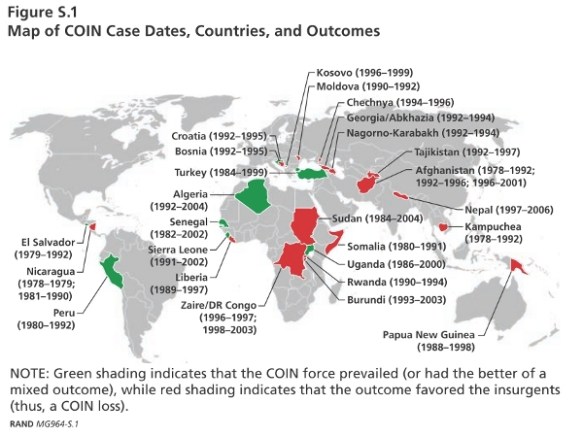
  • The scope of the study is restricted to only 1978-2008, omitting the post-WW2  ‘golden age’ of counter-insurgency and many other critical campaigns of thus nature. While there would have been a need perhaps to keep the initial sample size to a manageable number, this arbitrary period omits a large proportion of relevant campaigns.
  • The list of COIN campaigns 1978-2008 is somewhat limited: missing are any of the campaigns fought in Southern Africa in this period, as are those from the Middle East including Israel v Palestinians, and Iraq v Kurds;  East Timor is not listed, nor is the campaign in Southern Thailand – while it is flawed in other ways, at least both of these campaigns appear in David Kilcullen’s The Accidental Guerrilla.
  • Kiwis and Australians will be surprised to see that Papua New Guinea 1988-1998 which must be the Bougainville campaign is listed as ‘red’ i.e. a failure for the host nation government. The island of Bougainville is still very much part of PNG and that the world has heard little from that part of the world since the withdrawal of the monitoring force in 2002, is a testament to the effectiveness of that force 1998-2002.

The principles for COIN derived from Victory Has A Thousand Fathers were on slides that I missed during the discussion (too slow with the screen grabs) so I’ll cover those in a couple of days once they are posted on the COIN Centre events page.  What follows are some of the other insights from this morning.

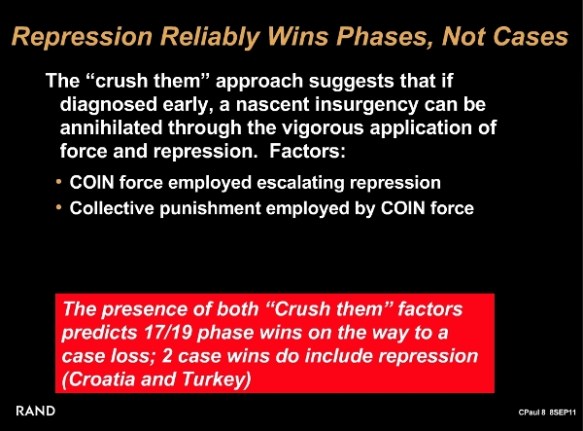
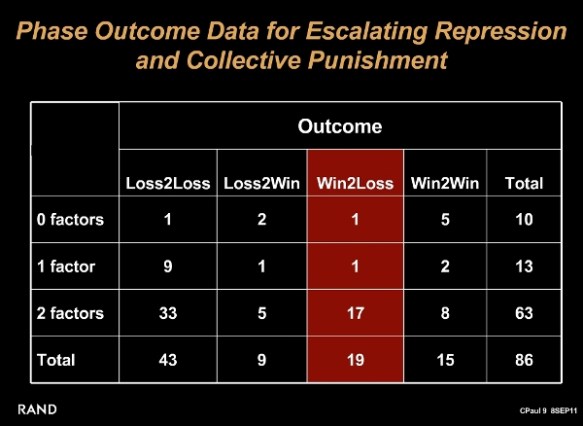
There is a case for the use of force in Irregular Warfare but first, let’s stop calling this COIN. As we know, COIN is a very specific and very narrow slice of the broader realm of IW: the continuing abuse of the term ‘COIN’ to describe operations in the contemporary operating environment unhelpfully muddies the waters. Specifically. these slides discuss the repressive use of force but we need to consider this just as much as we have to consider the other side of the pendulum that it’s all about being nice to everybody.

One of the most refreshing things about FM 3-24 during our review of COIN doctrine in 2007-08 was that it acknowledged the need for use of force within a campaign, a most realistic diversion from other nations’ COIN doctrine which was based upon either experience in peace-support operations (whole different ballgame), super-localised internal issues (go Northern Ireland!), or Malaya (myth city). If there was no potential for the application of force, then the military is not needed i.e. the military is not a cheap labour force, nor an easy substitute for the other government agencies and non-government organisations that should be there.

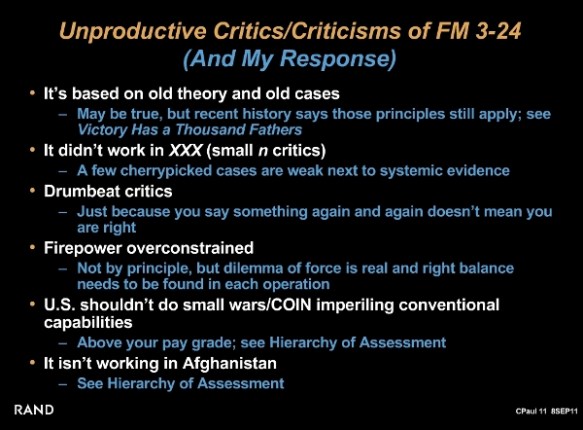
While FM 3-24 does have a strong population-centric element, it was written for a specific campaign (Iraq) in a specific period (2005-6). That notwithstanding, the population-centric elements are well-balanced with other key principles and truisms for irregular warfare and I think that many critics only cherry-pick thos easpects they want in order to criticise and few if any consider the publication as a whole.

This is the Hierarchy of Assessment referred in the last two points:
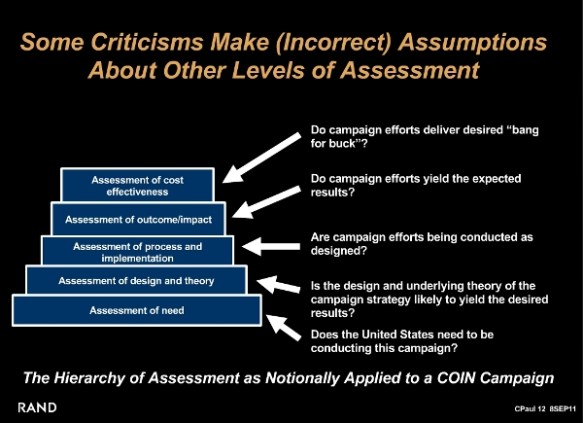
In simple terms, it all comes down to national interests linked to campaign objectives and being able to measure the same; and at the tactical level, specifically, as recommended below,  link development objectives to those campaign objectives and national objectives i.e. no more AID for its own sake. This just creates legacy dependency issues.

One of the questions asked this morning was “…I’ve recently returned from RC-S .  Agree with HNG but it does not to have a national flair to it.  If a specific district enforces the govt rep there, the HNG should be deemed endorsed…” This is the real rub in Afghanistan where the role and legitimacy of central government are in an entirely different context to that of Iraq. Shifting the emphasis for effective government from a central to a district government focus can produce strong district/regional government but usually at the expense of the central government. But then as we discussed in the opening day of the IW Summit in May, a ‘horses for courses’ approach to Afghanistan might find that a federalist system of strong provinces and weak central government might be the best for Afghanistan – after all, it seems to have worked OK for the last two millennia…

As the US Army and USMC gear up to update FM 3-24, the time is ripe for some robust discussion on the content of its next iteration. Most definitely the sections of air and maritime power need to be expanded and updated. The forum for thoughts on this topic is at the COIN Centre Blog….

Good use of colour

(c) Lily aged 4

A new release by ‘Lily aged 4’. displaying exceptional use of colour with clear direct and subliminal imagery which gets her message across in manner which is crisp, concise and to the point…it’s a pity that we can not expect the same from the socalled professional media…

Michael yon yanks Time’s tail for if not directly telling porkies, then definitely playing fast and loose with reality…the Taliban have initiated a spring offensive!!! Wow!! What have they done every other spring since 2003…? If Time wanted any credibility at all in this article it might have found a source better than Hamid Karzai whose grip on reality is tenuous at best…

And still on the Yon trail – in a good way again(Wow!! twice in a row – is Mike reforming?) – while I accept Nancy Colasurdo’s point in Spotlighting Loyalty and Our ‘Confirmation Bias’, I don’t agree that Mike was wrong in calling for a boycott of Rolling Stone magazine for its Kill Team story. I do not believe that the positioning of the Kill Team story with the roadside checkpoint video was an accident or an error – the intent was for readers to join the dots and form a totally erroneous opinion – that is both dishonest and not in the best interest of those at the sharp end of this conflict – certainly not those in US uniform – and I assume that Rolling Stone still considers itself an American magazine? No matter what one might think of the conflict in Afghanistan, how we got there or where it’s going, these are issues to be raised with politicians not targeted against those who serve… (a fine distinction perhaps – is what politicians do regarded as ‘service’?)

Yon’s call for a boycott of Rolling Stone advertisers became even more timely when the results of the Pentagon’s investigation into the circumstances leading up to the dismissal of GEN McCrystal by President Obama following another skewed Rolling Stone article were released last month…

Pentagon investigation clears McChrystal of all wrongdoing | The 

Pentagon Investigation Casts Doubt on Rolling Stone’s McChrystal 

General McChrystal did not violate US military policy, Pentagon 

SURPRISE, SURPRISE: Pentagon internal investigation of “Runaway 

General McChrystal did not violate US military policy, Pentagon 

So..until such time as Rolling Stone tidies up its act, it should be hit where it hurts the most – while is not in the court of the media where the more controversy the better the ratings but in the bank account…as Michael Yon discusses in Rolling Stone: Boycotting Advertisers

Getting back to the Spotlighting Loyalty story…I do like the point that she raises in regard to confirmation bias…a year ago, I had no idea that such things existed; well, certainly not that such a body of social science existed around them. I have been doing a lot of reading about this and other biases and am planning an article on some aspects of them and their employment…or the practical employment of that supporting science anyway…

In other news

FM 3-24 is being critiqued again…when will it register with some people that this was the right book at the right time – FOR IRAQ – and that it was never intended as the universal panacea for all thing not major combat operations…

Fighting Al Qaeda To Fight Liberalism, that I got from Dean at Travels with Shiloh…has given some food for thought but with all the big words, it’s become a bit of a mouthful…some more digestion required nefore I draw any conclusions from it…

Over at the new Unofficial Airfix Modellers Forum, I have started to populate my work area and also started a build (which I may finish) of Trumpeter’s 1/34 128mm PAK 44


Be First With The Truth

Who hasn’t seen these 38 minute long gun camera clip that this still was taken from? Released by Wikileaks this week, the clip graphically displays the killing of two journalist by a US Army Apache gunship crew in Iraq in 2007. The first thing to note is that these people were killed by the helicopter’s crew, the gunship is just the tool and without EDI-like artificial intelligence, the crew is the decision-making engine that decides to pull the trigger or not…in this case they opted to fire, based on what appears to be the flimsiest of ‘evidence’…

Wikileaks has established a specific site for this topic, named appropriately Collateral Murder, that has links to the full and abbreviated clips and the transcript of communications between the two crew members and US troops on the ground in the vicinity. It is certainly worth a look to draw your own conclusions.

While I don’t think that the smugness of Wikileaks founder, Julian Assange, (see wiki on Wikileaks) did anything to enhance his own credibility nor add anything to the story, I have to agree that, in this case, he is in the right to be blowing the whistle on this incident. It appears that the DoD was well aware of the incident at the time and cleared the gunship crew in an internal review process at the time. If that is the case, then there is clearly more to this story than meets the eye as they is nothing in the footage nor the transcript to support the this use of force.

No one denies that operations in any environment are challenging and often tough decisions have to made in a  split-second but this doesn’t seem to be one of those times. This is the warzone that Iraq was in 2004 and 2005 – this incident occurred post-surge in 2007 when, theoretically, the US had a good handle on both TTPs for the contemporary environment AND in training its people for that environment.

That the DoD chose to sit on this incident after conducting an internal whitewash is a clear indication that many of its staff still don’t ‘get it’ so far as this new and complex environment that we operate in. At the very least, this incident should have been reported as one of those things that happen in war, with apologies, condolences and reparations where applicable. However it is not unreasonable, noting the cavalier attitude of the gunship crew, that there is a case for willful negligence in these deaths – one definitely gets the feeling that both men were just looking for any excuse (not reason) to squeeze the trigger and nowhere is this made clearer than in the comment passed when ground troops reported that children had been injured “…Roger. Ah damn. Oh well…Well it’s their fault for bringing their kids into a battle…” With friendly troops on the ground, there appears no reason that other courses of action could not have been adopted to at the very least confirm the targets before engaging them…

While the use of force is a legitimate tool in Countering Irregular Activity, and ISAF’s squeamishness about directly engaging targets in the vicinity of hostile forces is another example of not ‘getting it’, this incident violates everything we try to teach about getting ahead in the contemporary environment….

Afterthought: how come the Marines never seem to have these kind of problems…?

Do Ideas Matter? Some thoughts…

I really enjoyed Adam Elkus’ article Do Ideas Matter? (full PDF) on the Small Wars Journal blog – right up to the paragraph before the conclusion. The author articulated and made his points well, concluding with logical sentence: “… For better or worse, American strategic culture embraces an engineering mindset, and the joint doctrine conceptualization of COG may or may not be the best tool for American strategy…

I thought from here he might be going to connect the dots between whatever doctrinal constructs you adopt and the need for a responsive delivery system to get that doctrine to where it is needed. Nope…what follows is a disintegration of the original issue into a mishmash of random thoughts and ideas. I get the feeling that the author had a bunch of lines that he’d been hanging out to use and hit us with all of them at once. The conclusion is almost a separate article and scarcely relevant to the good points made in the first two pages – the purpose of a conclusion is to conclude, not introduce new material.

I wonder if this was bounced off anyone else before it was published or just churned out in isolation, maybe after too many coffees and very late at night or early in the morning…That’s been a theme of mine here pretty consistently: the need for a good editor to cause an impartial eye over a draft BEFORE there is any thought of it hitting the streets. Even if it only picks up a couple of minor typos (one of my idiosyncrasies is transposing ‘now’ and ‘not’ – hands up if you can see that causing some strife?) or some logical disconnects, sharing your work with someone else before going live is a good thing.

Typos, errors in grammar, loose logic, inconclusive conclusions…all minor details that can irretrievably harm the (possibly quite valid) argument that you are making. This post originally started out as a comment on this post at the SMJ but after reading and rereading the absolutely crap conclusion in this paper, I had such a head of steam up, I figured I’d achieve more with it here. Bottom line: Mr Elkus needs an impartial sounding board before he launches off again…this paper gets a mark of D for Do it again…

The other reason I got so wound up about his non-conclusion was that it takes so much away from the first two and half pages which discusses the relevance of the Clausewitzian trinity to US centre of gravity doctrine. I don’t agree with his bottom line “… For better or worse, American strategic culture embraces an engineering mindset, and the joint doctrine conceptualization of COG may or may not be the best tool for American strategy…” because it reeks for building an Army best suited to fight itself – but I like the way he got there, especially in reminding us what Clausewitz really defined as his trinity and describing quite well the minefield that it interpreting Clausewitz.

I like Clausewitz, or at least those interpretations and translations of his work that I have read – certainly I would rate his influence as far greater than the homogenised drivel that Sun Tzu has become in the last decade or two. I think that most if not all of Clausewitz’s ideas remain applicable today and any that may not, are only temporarily out of vogue – doctrine never really dies, it just fades in and out of relevance from time to time. But, applicable or not, the issue that Adam Elkus was trying (I think) to unravel is that it’s all well and good developing all these new ideas and concepts – or polishing up old ones – but it’s largely irrelevant unless we  have a responsive and effective system to ‘inject’ for want of a better word those ideas and concepts into how we think and behave. FM 3-24 is a great publication but only useful for keeping the dust off the shelves if the ‘education (theory)and training (doctrine)’ (as defined by Phil Ridderhof in his comments on this paper on SWJ) doesn’t pick up on and deliver them before they are actually needed. Remember Simon’s soapbox…It’s all about the right information, to the right people, at the right time – and ensuring that they know how to use it.

I use that phrase regularly in discussions on intelligence, lessons learned, doctrine, training, and knowledge management. I wonder if they are all somehow connected?

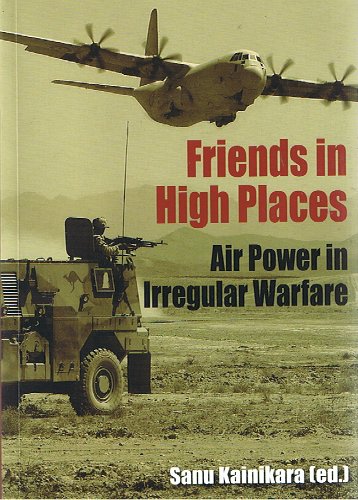
Friends in High Places – review

The cover raised such expectations

Friends in High Places – Air Power in Irregular Warfare was published in July 2009 by the RAAF Air Power Development Centre. It has been edited by Dr Sanu Kainikara, a former Indian Air Force pilot who is now the Air Power Strategist at the Air Power Development Centre in Canberra. Including the preface and glossary, the book has 267 pages divided into nine sections:

  • Foreword. Group Captain Rick Keir, AM, CSC. July 2009.
  • Introduction. Dr Sanu KainiKara. July 2009.
  • The War of the Running Dogs: The Malayan Emergency. Air Commodore Mark Lax, CSM (rtd). An edited version of the paper originally presented at the RAAF History Conference in Canberra, 1 April 2008.
  • Offensive Air Power In Counterinsurgency Operations: Putting Theory Into Practice. Wing Commander Glen Beck. An edited version of Air Power Development Centre Paper #26 published in August 2008.
  • Air Power and Special Forces: A Symbiotic Relationship. Wing Commander David Jeffcoat. An edited version of Air Power Development Centre Paper #14 published in February 2004.
  • Taking It To The Streets: Exploding Urban Myths About Australian Air Power. Wing Commander Gareth B.S. Neilsen. An edited version of Air Power Development Centre Paper #23 published in October 2007.
  • Air Power and Transnational Terrorism: The Possibilities, Advantages and Limits to using Australian Air Power in the ‘War on Terror’. Mr Sam Gray-Murphy. An edited version of Air Power Development Centre Paper #20 published in October 2005.
  • The Role of Air Power in Irregular Warfare: An Overview of the Israeli Experience. Dr Sanu Kainikari.
  • Conclusion. Dr Sanu Kainikari.

My initial visual impression of this book was “Yes! the Aussies have ‘got it’!”: the cover very positively shows a C-130 at low level over a Bushmaster Infantry Mobility Vehicle and not the F/A-18 and M-1/ASLAV combination that might be indicative of a conventionally focused publication. Unfortunately this warm buzz did not last beyond the second page of the foreword which notes the ‘…predilection towards precision strike…‘ in the collected papers as ‘…one of our key asymmetric capabilities against a typically asymmetric foe…(1)’

These comments set the scene for the remainder of the book. While various CIA(2) truisms appear through the papers, they are not supported by the text which largely drives towards supporting the maintenance and further development of current air power capabilities with continuing focus upon kinetic operations. Although it makes a case of a balanced spread of air power capabilities, the truth today is that only a very small number of nations can actually do this – the rest of us have to make some tough decisions about what capabilities we need to maintain nationally and what we may have to give up to do so.

Friends In High Places does not consider the lessons of allies and partners in coalition operations since WW2. Its conclusions focus on what was i.e. offensive kinetic air power and not upon what is and will be: a blended mission-specific capability mix drawn from national and coalition military, government and civilian sources – to use an obsolescent but appropriate term: Joint, Inter-agency, Multi-national and Public (JIMP)(3).

This publication has been written around a pre-assumed conclusion: that traditional kinetic air power will remain as the premier ADF air power output. While this may or may not be the case, by approaching this publication with that belief as a given, all the content is badly skewed from the reality of the COE. A more effective approach would have been to consider the COE and what makes it different from  the more comfortable traditional forms of warfare and then apply these findings to the employment of air power. Applying an open mind to the complexities and nuances of the COE may have produced a volume that lives up to the promise of its cover.

Although the foreword notes the minimal consideration of air power in contemporary COIN doctrine like FM 3-24 and LWD 3-0-1, there does not seem to have been any attempt to engage the COIN/CIA(2) community of interest (COI) in Australia or offshore. This is doubly disappointing as agencies like Force Development Group in Puckapunyal, the NZ Army’s Interbella Group, or the COIN Center at Ft Leavenworth could have added considerable value to relevant aspects of this book without detracting from its air-centric theme. As a result, both the land and CIA aspects of this book are very weak. Similar comment can be made regarding the Special Operations and Urban Operations chapters.

The editorial staff has not included any discussion of maritime considerations, from general or air-specific perspectives which is a significant omission for a nation surrounded by water, which is reliant upon the sea ways for trade and industry, and whose major military operations are far more likely to be expeditionary than domestic.

In considering how air power can best operate in a CIA environment, there has also been no mention of the aviation branches of either the Australian Army or RAN apart from a couple of inaccurate paragraphs on ARH (the Eurocopter Tiger Attack Recon Helicopter adopted by the Australian Army). There is also no mention of integration with other government or civilian air assets or those of likely operational partners like New Zealand or Singapore; nor any acknowledgement of the vital role of all sources fusion when discussing aspects of ISR.

The papers included in this collection do not have a good nor consistent grasp of the irregular environment and thus any conclusions they may draw are developed on a somewhat shaky foundation. By the time that the original portions of this book were drafted i.e. those that are not rehashed staff papers, vast quantities of analysis, comment and intellectual horsepower had been expended on defining the COE. Had these resources been tapped, Friends in High Places would be a must-read. As it stands at the moment, its most effective message is the cover photo.

(1) Page xii
(2) The UK term Countering Irregular Activity (CIA) is used instead of the more popular but less accurate term Counterinsurgency (COIN) to describe the complex Contemporary Operating Environment (COE).
(3) I think that I may have inadvertently helped kill off this term a few years back when I made a number of public comments along the lines of ‘Bring out the JIMP‘ from Pulp Fiction.

Resuming normal services

I, even if no one else has, have enjoyed my three days dedicated to the Birmoverse…however now it’s back to this time line, which does have as many cool toys but nor has it been liberally sprinkled with anthrax and radioactive dust…

Lay the old divisions to rest…

I got some more homework from my visit to the Air Power Development Centre last week…a copy of the latest RAF Air Power Review (Autumn 2009)…I see that each issue back to 2000 is available online so will have to add them to the library when I next visit broadband land. I’ve just read the first paper on the Future of British Air and Space Power by the current Chief of Air Staff, Air Chief Marshall Sir Stephen Dalton and am looking forward to working through the remaining six items…I do like the way Sir Stephen thinks (I’m sure that he is very relieved to hear this!) but his views are still very air-centric and I believe that this is a lesson that has yet to be learned…just as we need to cast off any perception that there is such a thing as a solely military option to a problem and embrace this  Comprehensive  Approach  concept, we also MUST forget about any one service (or branch of service if you want to take it down a level) that has primacy over the others – there is just military power as a blend of capabilities from air, land, maritime, SF, etc operating under a broader Whole of Government/Comprehensive Approach construct. It’s easy to talk the talk and adopt the doctrine but less easy to shake off the blankie of the Fulda Gap and decades of interservice sparring and competition. This message is further borne out in this article from the UK (courtesy of The Strategist) as Defence chiefs square up for a bit of biffo over who needs the best toys

The thing that the Brits (especially) need to realise is that playing in the big kids world costs real money e.g. as per the example yesterday about the evacuation chain for a British casualty from Afghanistan. They bleated, cried and sniped at the US all through the Iraq War – til they bailed rather ignominiously – and realised that perhaps instead of dumping on the Yanks, they should have been following them around, notebooks at the ready, hanging off every word and taking copious notes…because…the Americans have it together…like it or not…warts and all…they have it together. and in comparing their treatment by the US to that of Portugal, they only insult the Portugese…I’m not specifically Brit-bashing as these lessons apply to some degree to all of us…the world has changed, certainly since 911, probably way earlier but we just didn’t really notice…

Clean your room!

Neptunus Lex discusses obstacles to true democracy in Iraq – I think that it is high time that ALL of the Coalition of the Willing stand up and accept responsibility for the mess they created in Iraq. As I commented there, it was a decade before Germany and Japan were allowed to take off their democratic training wheels after World War 2 and that was without the internal divisions that tear at Iraq AND, in both cases, where THEY started ‘it’. ‘We’ started ‘it’ in Iraq and thus have a responsibility to see the clean-up through. Ironically Iraq under Saddam was less a threat to the world that Iraq as it is now post-intervention. Even more frustrating is that the US wrote the book(s) on COIN in FM 3-24 and then JP 3-24 but does not seem to have spent much time reading them:

Counterinsurgents Should Prepare for a Long-Term Commitment. Insurgencies    are    protracted    by    nature,    and    history demonstrates  that  they  often  last  for  years  or  even  decades. Thus, COIN normally demands considerable expenditures of time  and  resources,  especially  if  they  must  be  conducted simultaneously  with  conventional  operations  in  a  protracted war combining traditional and IW.

For some reason the WeRead app on Facebook keeps resetting my status on Accidental Guerrilla from ‘Read It’ to “Reading It’. In trying again to fix it once and for all (yes, I do tear my hair over minutiae, don’t I?), I noticed a review by ‘Sharif’, in particular, these words:

…Fits well into the perspective of Sir Edmund Hillary: “slowly and painfully we are seeing worldwide acceptance of the fact that the wealthier and more technologically advanced countries have a responsibility to help the underdeveloped ones, not only through a sense of charity, bu also because only in this way can we ever hope to see any permanent peace and security for ourselves.” Detail oriented, thorough and succinct. A must read to gain perspective of the challenges ahead…

Ultimately it’s all about stability. Countering Irregular Activities is a bit of a mouthful and Countering Destabilising Activities strays into double negativity – what they are is fact and in essence are stability operations conducted under the broad umbrella of the Comprehensive Approach. If you truly want stability, then go clean up your mess. If you truly want stability, follow the humanitarian assistance and disaster relief in Haiti with a stability programme to address the real problems there – you could probably start by kicking out, or at least reining in, the cargo cult do-gooder NGOs. Even encourage Bill Clinton to run for President (of Haiti!!).

On NOT profiling

An interesting comment last night on the failing of profiling as a technique and discussing methods of identifying people at risk and potential threat – there is some food for thought on the Aggression Management website and I would be most interested to hear supporting and dissenting comments…

Flying fingers (all both of them!)

I have decided that it is well past time that I taught myself to touch type as even though fingers can rely fly now, then just don’t go fast enough and when I’m on a roll I tend to lose ideas because I can’t get them down fast enough. I’m dead keen on exploring open source software at the moment and so I am starting off with TypeFaster. Today is Day One and so far I can type words only using ‘f’ and ‘j’ at 28.6 words per minute…I’m also becoming quite partial to PDF XChange Viewer as a faster more powerful alternative to Adobe’s Reader: the free version allows commenting and comment export on PDF files without (so far as I can see) any watermarking or other promotional material to ‘encourage’ an upgrade to the Pro version.

It’s Only Paper

On Paper Modelers today there is a note that noted Hollywood special effects artist, Hilber Graf, has just died aged 54. He worked on The Abyss, and was also an author, screenwriter, paranormal investigator, Halloween haunted house creator and noted plastic/resin model builder. Some years ago he published an article on Paper Modelling “It’s Only Paper” that is a good intro to anyone considering having  a crack at this art form – and having seen some of the Paper Replika free-to-download models in Playing with Knives the other day, who wouldn’t want to try it in the privacy of their own home…?

Starship Troopers

It is quite scary that there are people out there (apparently lots of them too!) who think that Starship Troopers is only a crap movie from the late 90s with a great shower scene…it would be interesting some day to consider the effects of digital media upon the depth of our society’s knowledge…whereas we once read books, we now wait for the movie; once we read the paper over breakfast or at work and got not only the news but insightful commentary, now we scan the headlines on out iPhones in search of the sensational or titillating…

There is a discussion on The Long War, Counterinsurgency Operations, and the Future of the Armed Forces on Sic Semper Tyrannis.  Based upon a short paper of the same name by Adam Silverman, It discusses among other things, the value or not of the draft and of legislative process in going to war (real war with shooting, guns and things, not war on obesity, drugs, poverty or other social ailments). While it is generally accepted that the draft, while nice to talk about, is not a viable option now, it does identify the need for “…A discussion and debate over the nature of service and the nature of what everyone is required to contribute as a citizen in exchange for our rights and responsibilities would be a long overdue public good…” The global  “me, me, me” society of today has forgotten that the relationship between the elements of Clausewitz’s Trinity is symbiotic and NOT geared solely for the pleasure and comfort of ‘the people’.

The discussion also touches upon the tiers of citizenship upon which Heinlein’s Starship Troopers society is built: there are citizens and civilians – to become a citizen with its attendant privileges AND responsibilities, a civilian must volunteer to serve. Although interwined with Heinlein’s own philosophies on life, politics and society, it is one of his better, less openly satirical reads and strikes on a number of levels. At face value, it is simply a ripping good scifi war yarn; at another, it delves into the relationships between those who serve and those who opt not to. At yet another  level, it provides an aspirational insight into the empty battlefield or distributed operations – IF you have the right combination and level of mobility, situational awareness, firepower and devolved decision-making to avoid simple defeat in detail. I would humbly submit that no military force has attain these goals yet and that those who may be closest are those who we currently face…

So…Starship Troopers…find and read a copy of the book – the whole unabridged version (no cheating with Reader’s Digest)…it is available via Audible so you can ‘read’ while on the commute or cycling/rowing/stepping in the gym…the movie is only good for some lightweight voyeurism, a not bad soundtrack and some cool spaceship designs of which the Rodger Young can be seen being built on Paper Modelers (not 1:1 though…).

Them’s the breaks

One thing that really bugs me about so much contemporary doctrine and writing is the way in which we as the ‘good guys’ are portrayed as inept numpties and the insurgents/criminals/terrorists are painted as unstoppable unbeatable uber-bogeymen. It was so very refreshing, then, to receive this paper by Lincoln  Krause on the mistakes that insurgents commonly make and as suggested in the paper, perhaps a gap in FM 3-24 that might be filled in the next go-round? These are the types of things that we need to be teaching in conjunction with the things that an adversary might do well and advantages that they may have over us, especially if we opt to let them maintain those advantages…

The Dark Side of the Information Militia

And probably the one we are the most familiar with…damn hackers…but the penny openly dropped for me this morning reading this Wired article Hackers Brew Self-Destruct Code to Counter Police Forensics which came in through Linked-In. Of course there is a dark to every light and I should have picked up on this way earlier…

Neptunus Lex calls it a travesty and he ain’t wrong. The rise and fall of a military blogger illustrates the difficulties of trying to restrain modern information technologies with rules and regulations designed for bygone days where paper and the typing pool ruled. no wonder the bad guys are all over us in the cybersphere. There is no way to protect our information now other than through education – the more draconian the rules we implement, the more chinks in the armour will be made – and exploited…In a very brief but uber-broad post, The Strategist links to a couple of articles on the whys and why-nots of taking the war to cyberspace – personally I think that the Guardian article on the why-nots is weak and bordering on pitiful – maybe the author was strapped for an idea and just churned it out to meet a deadline? Those same ‘citizens’ who bleat upon civil liberties are also those who bleat loudest when the fascist pig police don’t divert 100% of their resources to lock up the thugs who tagged their mailbox, and are those who would sacrifice the least for the common good…me, me, me…I agree totally with John Arquilla at Foreign Policy on the whys: so long as we cry about the adversaries’ use of information technologies against us and do nothing about it, we are artificially constraining ourselves and that’s a helluva way to run a war – the COIN Review found that mastering the COE will require us to master information fusion from a range and depth of sources the likes of we have never consider before. More so, as we adopt Michael Scheiern’s concept of individual-based tracking, cyberspace is where we must also find the individuals and track them…

I also agree with Peter’s crystal ball comment re the UK – a la Once Was An Empire which is symptomatic of the decay that is now becoming visible…

On the lighter side of the Information Militia, Steven Pressfield discusses the philosophy of Giving It Away – taking the plunge and not holding out for me, me, me direct physical rewards for one’s labours… looking at the big picture and the long game instead…

I wish WordPress had an Unpublish button as I hit Publish by mistake and now have to complete today’s post ‘live’ as it were….

Islam’s First Heretics

A brief by interesting article on Coming Anarchy

COIN, Training and Education

Small War Journal has a couple of good discussions going on: Counterinsurgency and Professional Military Education; Integrating COIN into Army Professional Education; The Army Capstone Concept: the Army wants your comments Feel free to leap in and value add…

Get over it!

I’m pretty picky when I subscribe to Facebook pages – last thing I really need is a constant stream of trivia through my Live Feed. I prefer to use Facebook as a situational awareness tool and so my limited number of subscribed pages includes Steven Pressfield, my favourite bach and the Small Wars Journal (note: you need to be a Facebook member to see these pages). Last night, there was a post headed Afghan Corruption Concerns US Policy Planners linking to this Voice of America ‘news’ item about which I thought Please!!! Get over it!! Some places they do things different to how we would like – is the war on terror or to inflict the moral high ground on another nation’s culture and mores?.
 
The responses were pretty scary (names have been removed to protect the stupid):
  • On the contrary – the international community’s insistence that government leaders adhere to some basic level of anti-corruption standards is because terrorism is less likely to be a course of action undertaken. It’s not that “they” do differently than “we” would like; corruption is not a part of any culture’s mores, it’s pretty well established in every culture that stealing from one’s people never turns out well. What? Have you ever been anywhere in the world? Across the non-Western world, ‘wheel greasing’ in some shape mor formed is not just tolerated by accepted.
  • I’m also pretty convinced that the “moral high ground” offers as much tactical advantage as the physical terrain’s high ground. Yeah, perhaps, but not if you bring your own high ground from home…
  • Remember, when some Afghan cop steals $ 2.00, he’s taken someone’s wages for a day. And the Karzai family steal millions. You’re wrong, Simon, we’re not trying to ‘inflict’ our culture on them, as you so incorrectly phrased it, we’re trying to keep them from stealing every dollar the West sends them. Then stop sending money and do something useful instead – the same thing would happen in the US, UK and Europe if all of a sudden somebody began handing out great dollops of cash.
OK, so it’s only three responses (but that’s a lot for the SWJ Facebook page) but they are fairly consistent with the self-righteous tone of the original article on VOA. There’s also an interesting article on a similar theme on Coming Anarchy, questioning why corrupt officials from Equatorial Guinea are allowed to live in palatial estates – in Malibu. Apparently US law forbids the granting of visas to ‘corrupt’ officials. My question is: Whose corruption laws/values do you apply? Outside of the First World, such practices are pretty accepted – to any extent that argues that they are at least as successful and sustainable than the squeaky-clean-green moral high ground philosophy.
 

Do these people just not ‘get it’?  You cannot go to someone else’s country, say we’re going to make everything better but you’re going to have to do things our way from now on? Isn’t that what we are (apparently) fighting the Taliban to prevent. Haven’t we gone to war over this very principle? In fact, it would not be unfair to say that a goodly lot of the wars we have engaged in have been in opposition to someone throwing their weught around and trying to enforce ‘their’ ways on someone else…?

The simple sad fact is that most of the world, including a sizable chunk of western societies, thrive on ‘wheel-greasing’. When I was in the UK in October, the Attorney-General was being pressured to press corruption charges against BAe for ‘greasing the wheels’ in order to secure international contracts. As BAe pointed out in its defence, ‘…this is how the world spins: if we don’t do it someone else from France, Israel, Eastern Europe etc etc etc, will wing-in in our place; if we don’t do it, then we will be forced to shut down a number of UK plants due to lack of work – and, if you smack us with a £1billion fine, we will just be forced to shut down more…‘ When you think about it, if the UK was really into this moral high ground thing, it wouldn’t be letting BAe sell weapons across the Middle East, Asia and Africa. Would they…?

COIN doctrine tells us a successful campaign needs to address the core issues behind the insurgency, ultimately giving the insurgents some or all of what they want but under controlled conditions.

5GW?
 
Meanwhile, back at the Real World Ranch, The Strategist has developed his alternate generations of war model:

1GW: the mercenaries
Early 16th century to late 18th century.
Powerful monarchies, supported by increasingly efficient state bureaucracies, field “hybrid” armies of elite professional troops, mercenary contingents and transnational military specialists (such as siege engineers and artillerymen). In the 18th century, hybrid armies evolve into more homogeneous forces of cavalry, artillery, and infantry regiments of the line, recruited from the aristocracy and the rural poor within a state’s territory. These forces owe allegiance to the sovereign, not society.


2GW: the conscripts
1790s to 1970s.

Nation-states fight each other with large armies of conscripted citizen soldiers. The nation becomes synonymous with the army – “the people-in-arms”, as Clausewitz described it. Universal conscription is a rite of passage for generations of young Europeans, who are animated to serve by patriotism, national and racial identity, and warrior myths.  The apogee of the nation-in-arms occurs in the two world wars of the 20th century, when nations mobilize all their resources – human and material – for total war.

3GW: the volunteers
1980s to early 21st century.

Armies become all volunteer and professional forces of career soldiers who are relatively well-educated and highly trained. These forces recruit people from ethic minorities, immigrant groups, decaying industrial cities and hardscrabble rural regions. These people enlist because they see the army as a route to advancement and acceptance in society, not out of patriotism. Meanwhile, the scions of the wealthy elite and the prosperous middle class shun military service.

4GW: the champions

Emerging in the early 21st century.

Armies become caste-based – an increasingly distinct and detached element within society. They comprise highly skilled “champions”, specialists in esoteric skills such as counterinsurgency, special operations, and cyber-war, who owe primary allegiance to their castes and combat leaders. The distinction between armies and civilian agencies blurs. The state outsources military responsibilities to private military companies. These also safeguard the interests of powerful corporations and wealthy elites.

Peter, in a week, has probably applied more real intellectual effort to the GW construct than did the originator! I really like it although I would offer that his 4GW is actually 5GW with 1GW being the Braveheart style, every tribesman for himself, hope-it-all-works-out-on-the-day form of warfare that kept the trade alive for millenia before it all got organised.

In terms of applying the generational model across history and societies, it DOES work if you apply to individual societies/cultures instead of taking a global macro approach e.g. while the Romans make have been at 3GW, many of their adversaries may only have be 1 GW. The model works even better if you remove the time frame from under each heading.

The Judge Dredd approach to COIN

So it’s out. The super-uber COIN strategy for Afghanistan. If you blinked, you may have missed it. Don’t worry, you didn’t miss much – kinda like finding you’ve fallen asleep in the car (as a passenger!) and missed Hamilton…we’re going to fortify the urban areas where the insurgents AREN’T, and only engage selectively in the rural areas where the insurgants ARE. I have visions of Afghanistan becoming a real word escapee from 2000AD: a few isolated Mega-Cities surrounded by the feral hordes of the Cursed Earth. Sylvester Stallone has already filmed in both locations: with some clever editing of Rambo 3 and Judge Dredd, we could have the movie out for Christmas…

John Dredd or Judge Rambo?