Weekly Photo Challenge: Big

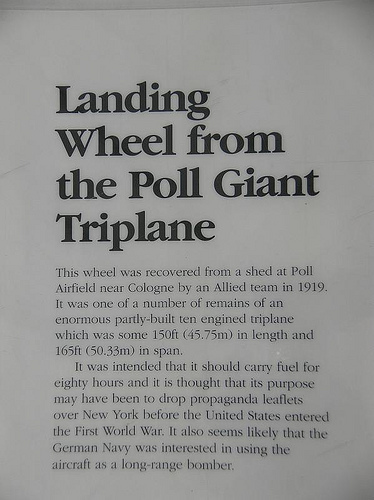
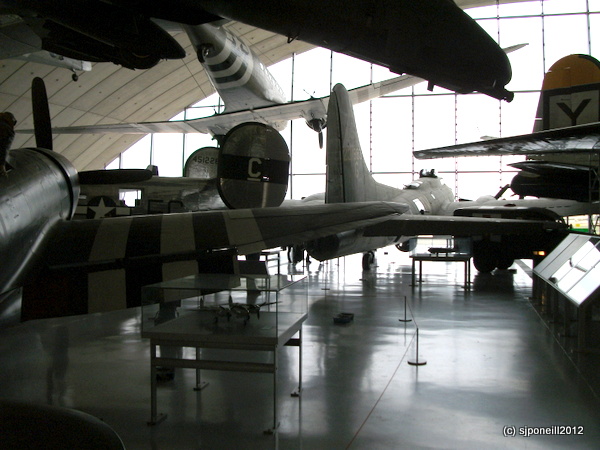
As soon as I saw the word ‘big‘ as last week’s WordPress Weekly Photo Challenge, this monster sprang to mind…it is an aircraft wheel on display at the Imperial War Museum at Duxford. At the time, I didn’t take that much notice of it hence the rather casual off-hand nature of the photos…but it is big…

Someone’s else pic of the accompanying placard in the museum (off the Net)

…and the mind boggles at how big the actual aircraft might have been if it was ever completed…

…when you extrapolate the size of the aircraft from the known size of the wheel…


…it says something for German engineering that it was trying to construct aircraft like this less than 20 years after Richard Pearse’s epic first flight…go the mighty Poll Giant Triplane…!!!

2012 ESRI International User Conference

This just popped into my inbox while I was on a break…who would have though that a couple of years ago, Hawkeye was two guys in an tiny back office between an accountant and a dentist?

Great to see this team getting into the big leagues…my comments in red (doctrine writers can’t resist red pens in any form…)…

Hawkeye UAV was fortunate enough to be invited to exhibit at this year’s ESRI GIS User Conference in San Diego.  With a sponsored booth in a prime position in Hall D we could only say “Yes, thank you!”  So in late July, Rowland and myself made our way across from New Zealand.  Rowland left the week prior to the UC in order to attend the preconference seminars, conduct some meetings and make our technology accessible to the Survey community.   Along with the two of us, and providing their expertise on the photogrammetry processing were Luke, Hayden and Sheryl from Areo.

The first big coup was ESRI’s invitation to have our display bird on the main stage for the duration of the weekend and Plenary sessions at the start of the Conference.  To put all this in perspective, the “main stage” is in front of a room in the region of 200m long, and is backed by three HUGE screens.  The room hosted 16,000 people at one time, so a lot of GIS professionals saw our UAV onstage and some of our data as part of the plenary presentations.

Hawk_onstage

An ESRI speaker talks about the AreoHawk onstage during the conference opening plenary

In fact many folks mentioned to us at the booth that they’d seen the AreoHawk onstage and asked about the content in the keynote presentation.  It was both humbling an exciting to have our technology out there in front of the world.

Supporting us this year at our first time attending the ESRI UC were Hawkeye UAV Americas (HUA) – our North American partners from Tactical Systems Engineering.  They were represented by Drew Gwyer, Dave Molthen and Ermie, and were brilliant in helping man the booth, collecting information and assisting people with their inquiries.  Their local knowledge of San Diego was of great benefit also!

Check out these guys’ website some very cool and innovative kit there – I really want to get my mitts on WINGMAN and DACTYL to have a play with – possibly why they’re part of HUA (is that a take off ‘Hoo-aahh!’?)….

Special mention must also be made of Mark Deuter, Director of Aerometrex our distributor in Australia.  He zoomed in from Australia to lend his vast expertise of all things aerial photography and provide a bit of Aussie contrast to the strong Kiwi flavour on the booth.

Monday before the conference start was our day to set up the booth before the Exhibitor Expo got underway Tuesday.   Tuesday started with a hiss and a roar – when we were allowed into the exhibition hall at 8am to do our final setup and start the demos rolling, we only just got in before the influx of people started.  It was soon apparent that we hadn’t printed nearly enough flyers to keep up with demand! If you were one of those who missed out, I’m very sorry. But we did get some more done to see us out until the end of the UC.  The candy ran out before the end of day one too!

booth_hawk2

Hawkeye UAV booth in the middle of “UAS Central” at the ESRI UC 2012

The UAV seen here in the flesh (and in the top pic) and on the screen is the Hawkeye UAV home-grown aerial vehicle, AreoHawk – for its size, it has some pretty impressive performance specs and it is interesting to note, just how short its gestation period from first thought to first flight…

The conference has been a huge success for us. We have literally been hand-launched (rather than catapulted) onto the World’s stage.  Interest from all over the globe and the United States has been tremendous and very encouraging.  HUA/TSE share our ethos and vision for leading the precision survey Unmanned Aerial System market.  It is also apparent to us that we not only have a world class system that’s been developed here in New Zealand, but the AreoGraph process is second to none.

We now expect our tempo to rise, and our global footprint to reach wider and further than before.  A large number of confirmed sales and survey jobs have already come from the ESRI UC and we expect more to follow as soon as demonstrations and follow ups can be arranged.

Rules and Regulations:

Simply put, to fly UAS’s in the United States today you must either be a Government, Federal or State agency or a ‘not for profit’ organisation, such as a University.  Federal Aviation Administration regulations currently require these parties to obtain a Certificate of Authorization (COA) before flight.  In conjunction with HUA/TSE we are actively working with FAA representatives to achieve an accreditation for the licensed commercial flight of the AreoHawk system within the United States.  We currently hold such accreditation in New Zealand with the Civil Aviation Authority (CAA) and are also underway with CASA (Civil Aviation Safety Authority) registration for Australia.  We strongly believe our unblemished record will stand us in good stead in this regard.

Good point, well made…regardless of the size or whether you picked it up at Toyworld or Foreign Military Sales’R’Us, UAS of all sized need to operated in a controlled manner, with rules that are clear, understood and complied with by all involved. Nowhere is this more vital that in this category of AVs below 6kg where the common popular (mis)perception is that they are too small to matter so you can do what you like with them…well, you ain’t in Iraq anymore, Toto: if something bigger and faster takes your battery down an intake or through a window, well…let’s just say that we hope you’ve keep your liability insurance payments current. This being the case, it is good to see a commercial operator expounding these principles…

It has always been our intention, especially as aviators ourselves, to comply with and exceed the expectations of the governing body where these matters are concerned.  Hence our emphasis on safety, failsafe systems, compliance and training.

Improved Areo Process:

We have found now that with the new and vastly improved AreoHawk processing software that we can re-process old jobs and archived imagery with great success.  Second time around the quality of the orthos and the density of the point clouds are an amazing contrast.

urban_sample

This Areo process is damn exciting to anyone with any interest in the shape of the ground and/or object on it – with the new processes and the upgraded sensors on Areohawk – what you are seeing here is not a simple 2D image of the area but a 3D manipulatable (if that’s not a word it should be, meaning able to be manipulated) model of the surveyed area [makes note to nag Hawkeye guys about a Flash-based user steerable demo model] so, if you’re say, a miner, it’ll let you calculate how much spoil you taken from your mine; if you’re a shooter, it’ll let you work out to a high degree of accuracy lines of sight from shooters to shootees…

Semi-urban data resampled under the new Areo process. Point cloud data only is currently being displayed

More pictures from San Diego:

Jack_Dangermond_ESRI_UC2012

With the big guy! Drew, Simon, Jack Dangermond (ESRI CEO) and Rowland at the close of this year’s User Conference

552709_10150956856117811_361825588_n

Hawkeye UAV Ltd booth at this year’s ESRI International User Conference

skyhawk

US Navy A4 on the deck of the museum aircraft carrier, USS Midway

Can’t pass up a visit to any handy museums while in loc – although an A4 is a piece of paper: an A-4 is a lot cooler and faster –

Weekly Photo Challenge: Urban

The lead for this theme was that the idea behind urban photography is to photograph your city and the streets where you grew up as they are but I’d sorta done that in Wrong the other week….I’ve loads of photos from cities all around the world but I struggled to find one that really said ‘urban‘ to me (What your photos DON’T talk to you? Crazy!!).

But just last night, through the miracle of the Picasa 3 screen saver app…this image flicked up onto my screen just as I logged off…fortunately I had just time to recognise it as from my visit to Duxford in 2009…it is in the American Hangar, a massive display of American aircraft all in one big hangar – getting them in and out must be a real act…

This one image is what urban is to me – well, what it was last night anyway…the old and the new, clutter, things standing still and things apparently moving fast, light but dark at the same time…all apparently moving in different directions…

Weekly Photo Challenge: Merge


Merge had me stumped for weeks – all I could think of was traffic lanes merging and my particular hate for the nanny-state merge lights on motorway on-ramps – are people really too dumb to figure it out for themselves? – but this challenge came through only a couple of days AFTER I got home from a recent work visit to Auckland where such silliness abounds…

Then…when we were exploring our property with the dogs over the weekend – been here eight years and still not even close to exploring it all – we stumbled a native tree (a couple of metres thick) that had collapsed over a small stream, creating this massive bridge a dozen or so feet above the trickle of water. We were amazed at how well it merged into the surrounding bush until we were right on top of it – didn’t have a camera with us, then it started to rain…

Finally I came back to this image, my first instinct, the Shuttle Enterprise where science fiction met science fact – only nine years after NCC-1701 first flashed across grainy black and white TV screens we were naming our first true spaceship after her…

Footnote: I first heard of the Star Trek: New Voyages project in early 2007. Carmen and I had stopped at Bosco’s Cafe in Te Kuiti (northern end opposite the Teak shop and before the Shell station and New World heading north) after another weekend working on Hell’s Holiday Home at Te Waitere on the West Coast, on the southern edge of Kawhia Harbour. The December 2006 issue of Wired carried an article on a group of Trek fans who had accumulated a few props and started to film their own Original Series episodes (kicking off their own Season 4) in a  barn. Bit by bit, they garnered more support and more cash including a bunch of unofficial support and assistance from Paramount Pictures. Working in the US later in 2007, I managed to download the two or three episode then available (couldn’t download at home – over the dial-up connection we had then, I’d still be waiting on it now) but never quite got round to getting them onto DVD and watching them.

It was only when reading a thread on developing Star Trek paper models that I stumbled across the link again and downloaded the seven available episodes – I think that the production team is aiming on one a year which is pretty good for a backyard effort – and worked out how to use MS Movie Maker to stitch the 4-5 files for each episode together and then convert this WMV file to an MK4 for the WD TV player in the lounge using Handbrake.

So last night – finally – I got to dim the lights and watch the first couple of episodes: Kirk is still going through his B-grade scifi stage so he sat up the front by the TV and watched as well. In Harm’s Way, episode 2, was, we thought, pretty damn good and at least to the standard of the original series. I understand that production and acting values get better as the series progresses so we’re off to check out another couple of episodes now…

Weekly Writing Challenge: From Mundane to Meaningful

WordPress has kicked off a new challenge to encourage more regular writing…the first challenge is themed From Mundane to Meaningful…the general idea is to take some mundane action from your day or week and lead it to a train of more meaningful thought…

Because we both often away from home, we have to always have a plan for looking after our dogs…there are big enough that we can leave them on their own for about a day and a half but anything over that, we have to make other plans…Our kennel of choice is Creature Comforts, just north of Sanson, under the approach to RNZAF Ohakea. We’ve been using it for many years and know that our ‘kids’ are well looked after there: we use them often enough that the drop-off is pretty routine for all of us.

Driving past the main gate of the air base, I glanced in just in time to see the Avenger out of its hangar – the first time I have seen it since it arrived. It’s great to see this aircraft fully restored and flyable: I sat and waited to see if they were going to fire it up but no joy this particular morning.

For me, this and the other flying warbirds are a link to a past that we don’t appreciate and are all to quick to dismiss and forget amidst the tempo of our modern world. The Avenger is particularly evocative of the massive naval air battles of the Pacific War that turned back the Japanese tide at odd-sounding and other insignificant places like Midway, Coral Sea, Leyte Gulf and the Marianas.

And the thousands of young men, all of whom had other aspirations, careers, plans, lives…who downed tools, quite school and signed up to fight for some basic values…The young, now old men, who flew for Bomber Command, Britain’s only means of striking back during those dark years from 1940 to 1942, who only now have been recognised for their sacrifice seven decades ago, recognition denied them for reasons of political tidiness.

And we shouldn’t forget that every day, other young men and women launch themselves into the skies from Ohakea and Whenuapai, into harm’s way because flying will remain an inherently dangerous act until such time as we can do it unaided…I understand the physics of what they do but remain in total awe of the way that they have mastered this unnatural act…slipping those surly bonds in such a way that it seems so natural and effortless…

An act as mundane as dropping our dogs at the kennel led to a sad nostalgic train of thought…


Skin in the Game

There’s been more dross in the popular media this week about ‘killer robot drones’ and this article from the Atlantic Journal got me thinking. Those thoughts didn’t really gel til tonight. After work – I almost always forget to turn on some ambient noise while I’m working – I put on a movie while doing some work around the house; you know, the cool stuff like laundry, dishes, bringing in wood, vacuuming, etc, etc…My selection was Stealth, a good bit of pounding hitech fun. I just happened to walk past the TV as the key players were discussing the implications of ‘robot’ war…the line went something like “…war is horrible, we know that and it’s the main reason that war is a last resort; but if we don’t have skin in the game any more, if it’s all machines – then we’ll have war all the time…”

So very true, and something that we seem to have forgotten – it’s not about cost-effectiveness, or superior precision, or any other military advantage that unmanned systems might bring to the party: it’s the cold but simple fact that unmanned systems relieve those that do not serve from the burden of, not guilt, but plain old inconvenient embarrassment in case some damn fool pilot decides to imitate Francis Gary Powers or get dragged through the streets of some dusty third world capital.

These distancing also takes the pilot out of the loop as well when it comes to pushing the button; contrary to what anyone might say, sitting in a room half a world away is not the same as being in the same missionspace as those he’s having a crack at…no skin in the game and we start to forget what it is that we are going, forget that there are actually people down there on the ground who may take some exception to being rudely bundled into some distant collateral damage calculation. It is one thing to strike a target in the heat of wartime and accidentally killing some bystanders or of striking the wrong building by accident while evading SAMs and AAA; and entirely another to grant yourself a license to strike where you want and when you want.

There are claims, well substantiated legally0-supported claims that the so-called drone strikes are conducted by legal right under international law, an inherent right to self-defence, and that your nation is at war. The trouble with that argument is that when you are the biggest by far kid on the block an argument of self-defence is difficult if not impossible to justify, even less so when you are not prepared to consider your end of the Drone Wars (and it does read like a bad Muppet-ridden George Lucas movie) as belligerents and subject to the same risks as your quarry. “Excuse us, Mr President, would it be OK if we lobbed a Hellfire missile at that Reaper pilot when he stops at the 711 for some milk on his way home from the war?” Skin in the game might take on a whole new meaning if someone decides to turn your rules against you – where do you want to draw the line? We won’t bomb your wedding parties if you don’t bomb ours?

Without skin in the game, we forget what war is really all about…that sort of complacency leads to weakness and weakness draws competition and predators (lower case predators, that is)…

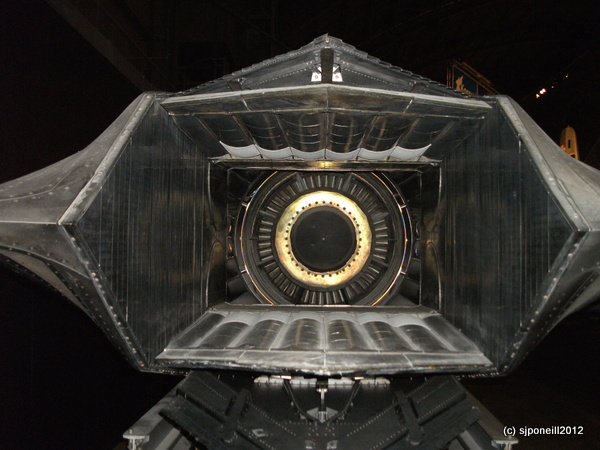
Weekly Photo Challenge: Inside

Image

A look inside the jet pipe of a F-22 Raptor at the USAF Museum near Dayton, Ohio…not a view you often see…

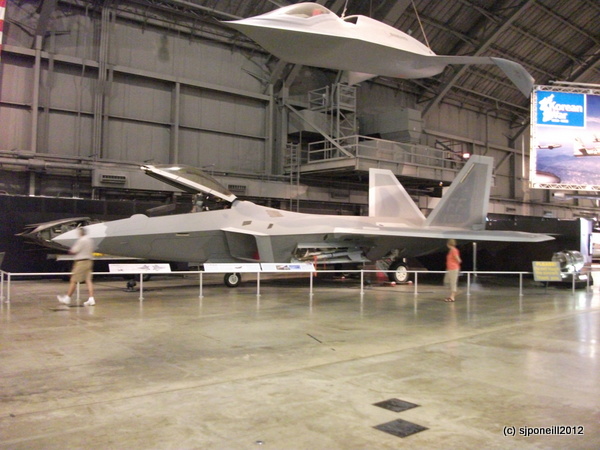
Image

How you would normally see a F-22…

It’s dorky, it’s ugly and…

…and it serves no useful purpose…

A solution in search of a problem

OK, so, yeah whatever, it’s technically very cool and it’s not REALLY an aircraft so you can let a couple of NCOs operate it – and of course save a bundle on what you would actually have to pay a proper crew…

I’m clearly a big fan of unmanned systems – in entirely the wrong job if I wasn’t – but it’s like they used to teach in the good old days at the Tactics School ‘..task with a purpose…’ that is, you don’t just do stuff simply because you can…

So what are my issues with the unmanned cargo aerial vehicle:

Even the acronym is dodgy as UCAV also represents unmanned combat aerial vehicle and I’m not sure we want to be getting to two confused. Maybe a good rule of thumb could be that if you have two acronyms that can be applied interchangeably but mean totally different things, then one of them has to change. Litmus test: would anyone be upset if the US announced it was deploying ‘UCAVs’ to Libya? (Let’s not go near the whole Syrian debacle…

It’s optionally manned i.e. the cockpit is still there and functional so that if required a pilot (one only as it is a single seater) can operate it. Sounds like someone is hedging their bets but who’d want to be flying a single seat unarmoured helicopter at low level in the badlands…possibly keeping it sellable so keep an eye out for some slightly used optionally manned K-Maxs on eBay.

It’s meant to save lives. How is not exactly clear. The greater numbers of casualties in a helicopter crash come from the passengers – this thing isn’t carrying passengers and it’s only doing ash and trash tasks which are not noted as being amongst the more dangerous helicopter missions unless all of a sudden boredom is actually a hazard.

Oh, I see, it’s meant to save lives by reducing the amount of ground traffic that needs to be exposed to the IED threat. But haven’t we been doing the airborne resupply thing for years now? What has K/Max really brought to the party except another aircraft type to maintain and operate?

This whole thing of we’ll only travel by air because of the IEDs gives the lie to ‘war amongst the people’: having come in and screwed up your country, we happy for us to have the luxury of free air travel…whoa, you locals step away from the aircraft – you still get to travel by land and risk the threat aimed at us. Yeah right, much as we don’t want our people to go in harm’s way, this is simply ceding the ground to the bad guys which bad. What’s worse is that validates IEDs as valid and effective tools to employ against ground forces. Expect to see (LOTS) more of them until they go the way of the Zeppelin and and made untenable as weapon systems. That means putting more resource into countering IEDs to the left, well to the left of the BANG. the K-Max UCAV isn’t going to help you there.

The K-Max might actually add to the problems created by ceding the land environment (great for air forces though!!) because every boring mundane MANNED ash and trash mission puts eyes on the ground, and the more that they cover the same area on a routine basis, the greater the familiarity they build up and the more likely they are to be able to detect and identify some form of anomaly or indicator that might need to be followed up.

Every manned helicopter currently doing the ash and trash mission can be reroled on the fly for emergency dust-off of casualties or to provide airborne ISR for troops in contact…can’t really do that with the K-Max UCAV. You also can’t use it to provide quick fires with its door guns because it doesn’t have doors let alone guns…can’t toss an airborne sniper up in it either…

There are hidden costs. This thing is not fitted with any form of self-protection system so its only really any good where there no air threat to helicopters. One also wonders how good the flight control system is once the aircraft has been damaged in flight – will it be able to autonomously divert to an alternate LZ or even opt to make an emergency landing in the field?

So sorry, close but no cigar…UAVs are useful but they are not a universal panacea for all ills and they certainly do make the IED issue ‘go away’…but everything has to actually contribute meaningfully to the war effort and, as writ to date, the K-Max UCAV simply doesn’t…

Weekly Photo Challenge: Close

Image

One of the neat things about my job is that I get to travel regularly and often that travel takes me to places with great aviation-themed museums…as a result I can get up close and personal with some aircraft that here, I could only ever enjoy vicariously from afar…

This is the ‘Great White Hope’ of the British aircraft industry in the mid-60s…in never got a name other than the TSR.2…only one ever flew and only two survive in the world after the Communist British Government decided that manned aircraft had little future in modern combat…whether all the new technologies incorporated into the TSR.2 would have come to fruition and it would have been the much-lamented Mosquito of the Cold War is debatable (and that debate still rages!) but it is very cool that museums such as the RAF Museum at Cosford let you get as close as this to such an icon.

Image

Still on a Cold War kick, the Vulcan bomber was one of the three ‘V’ bombers developed in the wake of WW2 and the early days of the (then) not-so Cold War that were technological and conceptual leaps ahead from the Lancasters and Lincolns that they replaced. The Vulcan was a massive delta wing that soldiered on until retirement in the 1980s – it was only in the twilight of its RAF service that it was ever employed in anger, being the mainstay of the Black Buck missions flown against the Argetine-occupied Falkland Islands in 1982. Very cool being able to get so close to the one in the Imperial War Musuem at Hendon that I could stand up in the bomb bay…even cooler that one last Vulcan, privately-operated, still flies in the UK air show circuit

I was really happy to be able to get this close to a Vulcan here and at Cosford as I (VERY) slowly wrestle with the pig that is the Heritage Aviation Vulcan in 1/32

Image

And finally…close up and personal with an oddity like the C-125 Raider…designed as a short take-off and landing utility aircraft after WW2 in case that whole ricketty shakey helicopter thing didn’t pan out…this one is parked outside at the USAF Museum near Dayton, Ohio – hopefully it will be moved inside once the new annex is built…

So there’s my non-schmaltzy (possibly unless you’re a fellow plane-spotter) take on ‘close‘…hit the link to see some more…

Weekly Photo Challenge: Blue

Eliminating ‘blue‘ sea and ‘blue‘ skies from my quest, I simply scrolled through my Picasa library and waiting for a ‘blue’ (no! not that sort of blue!!) picture to catch my eye…the winner was this Martin B-10 at the USAF Museum near Dayton, in the common pre-WW2 scheme of blue fuselage and yellow wings…

Then I became curious as to the ‘why’ of this colour scheme which seems counter-intuitive for operational military aircraft and found this explanation at War and Game:

BLU AND YELLA

 The use of two color schemes, Light Blue for trainers, and Olive Drab for tactical aircraft, caused logistical headaches for Air Corps maintenance facilities. Quantities of O.D. and Light Blue paints were required in stock at all time. Another problem was the need to know an aircraft’s ultimate destination before paint could be applied: examples of many aircraft served in the training roles, and thus could require blue fuselages.

 The solution, as recommended by the Chief of the Material Division in January 1934, was to standardize one paint scheme for all aircraft, regardless of role. His choice was Light Blue fuselages and Yellow wings and tails, reasoning that high visibility was essential for trainers, while temporary water paint camouflages made the lower-contrast Olive Drab for tactical aircraft unnecessary. Stocks of Olive Drab were at the reorder point, making a timely decision that much more important, and in February the recommendation was approved by the Chief of the Air Corps. Revised specifications and T.O’s were printed in May, and shortly afterward, tactical aircraft were noted with Light Blue fuselages.

OK, I can live with that….