Unmanned aircraft for Search and Rescue: not quite that simple, TV3…

(c) TV3 2014

(c) TV3 2014

There was an interesting item on Campbell Live last night about the use of ‘cutting edge’ unmanned aircraft for search and rescue applications (note the video in the linked article may not work for overseas readers). While it all looked very cool and exciting, it was a little misleading when it presented these small UAs as ‘…running on the spell of an oily rag…’, beyond the blindingly obvious fact that all the UA shown were electrically-powered and thus rather unimpressed by the proffered ‘oily rag’!

A reliable UA of any size is not cheap…your average Toyworld flying camera device may last for a while, but eventually you will end up with a large number of them scattered over the land- and seascapes. In addition they tend not to have the endurance necessary for any practical employment for search and rescue other than perhaps peeking into nearby spots not easily accessible by a person. You get what you pay for and if lives are relying on it, the device must be reliable and have sufficient endurance to be useful.

Unmanned aircraft systems are not really unmanned: it’s just that the flying component lacks seats in most cases. They all require at least one person to operate them and, for safe operation, generally at least two are required: one to control the aircraft, and others to observe the airspace for any other users and these may include not just other aircraft but para-surfers, kites and any of our feathered friends that may take offence at this noisy intruder into their domain. If operating at very low altitudes as shown in the video clip, the ground observers may also have to watch for vessels on the surface as well. Relying on volunteers is all very nice but UAS operators need to be trained and accredited to conduct any but the most limited flying.

The supporting infrastructure costs as well, not just in the cost of initial setup and acquisition but also in the ongoing maintenance including the regular replacement of critical components as they reach the end of their defined life. If supporting a SAR operation in a remote area, the unmanned aircraft system will probably need to include some form of vehicle, also not cheap.

All those video visors, laptops and viewing screens seen in the video clip? Again, not cheap.

It appeared that all the UA shown in the clip were flown directly from a controller similar to that used by the remote control aircraft community. While this may be practical for short (in time and distance) flights, this form of control for longer flights is inefficient and places a greater burden on the operator. All the flights shown in the clips appeared rather ad hoc and ‘zoomy’ i.e. all very cool looking but lacking the methodical search pattern essential in a for-real search and rescue operation. An effective autopilot allows the UA to maintain controlled flight and follow a methodical search pattern without constant operator input. Again, this necessary technology is not cheap; it’s not THAT expensive either but has to be reliable and also professionally integrated into the other systems that make up the UAS.

While I think that it is great that the national search and rescue community are researching the potential of unmanned aircraft for this role, and that there is a great potential for UA in this role, I also think that they would get a better return on their investment in time and money by not seeking to design their own UA or supporting the ‘I built a UAV in my garage‘ community and instead engaging directly with the existing (and growing) commercial UAS community both in New Zealand and overseas. I think that they would find that there would already be existing mature reliable designs that would meet all the requirements shown in the video item…and that reliability comes at a cost…

Strawberry Crisp in a Mug

#2 in the challenge after feeling suddenly peckish and all out of carrots and celery late on Saturday night…it is a very nice feeling to be able to just stroll out into the garden at night with a torch and pick some lovely fat juicy strawberries for a quick dessert…

My first go-round with this recipe came out OK but I cooked it in my Cosman cup just in case it went a bit crazy in rising or boiling over…I needn’t have worried as it didn’t but it was difficult to photograph as it lay in the depths of the cup…

For my second go-round, I decided to use up some blueberries, also from the garden, that were sitting in the fridge awaiting use or freezing…

Strawberry-Crisp-in-a-MugThis is how the original recipe with strawberries should come out…

DSCF7837

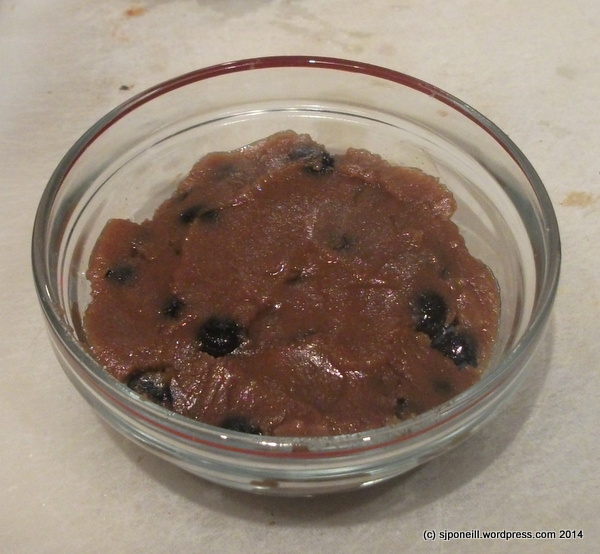
Before cooking…DSCF7838

When it came out of the microwave…I realised beforehand that the extra juicy blueberries would come out differently to the strawberries and they all by absorbed the crispy topping. Next time I will beef up the topping to counter this, preferably in some way that doesn’t involve proportionately increasing the sugar content…
DSCF7839

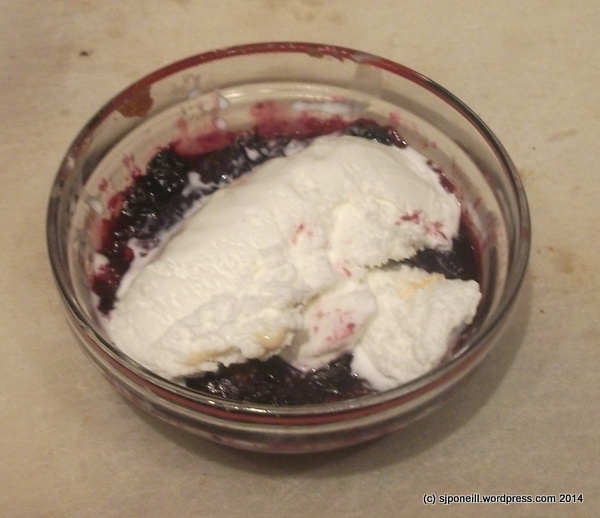
…and immediately pre-consumption with a dob of ice cream…

Tasted great and the once topping was even spread amongst the blueberries but as above, I would like to work some more on the topping…

What you need:

1/2 cup strawberries or blueberries – will try it with blackberries too

1 Tbsp sugar

1 Tbsp brown sugar

2 Tbsp flour

1 1/2 Tbsp melted butter

What you do:

Sprinkle the sugar over the berries in a microwavable cup.

Mix the other ingredients together in a separate bowlette and spread over the berries.

Microwave for two minutes on high.

Serve with ice cream and/or cream.

Simple!!

30 Cake in a Cup Challenge

1958174_730767173610011_1137288508_n

After my success with the chocolate dessert in a cup, I stumbled across a trove of microwave dessert in a cup recipes, and I have resolved to work my way through them this year.

As I am not really a desserty-type person when I am on my own, and I usually mighty only feel like a dessert if my main has left a bit of a space, this may take some time but I am determined to complete the challenge by New Year’s Eve.

While it is all about making desserts in a mug/cup, I opted for the cake in a cup challenge because it is more alliteratively aesthetic.

Watch this space…

So who didn’t pay the subscription for summer??

So here we are….only the fourth of March, with only two really summery days all year (a really summery day being one where it feels too hot to do anything), and already we have had our first snow for 2014…I guess the ‘crust’ on the water in the wheelbarrow from yesterday’s rain and the brittle white grass on the lawn should have been a clue at home this morning….

DSCF7835

Well, that wasn’t there when I went home last night…

DSCF7836

Not as low as the office yet but it was hailing when I left this evening which doesn’t bode well for this summer thing…

DSCF7834

…and a good dusting on Ngauruhoe and its offsider, Tongariro…

OK, so, yes, perhaps we were a little spoilt last year with a three month summer aka drought but SNOW IN MARCH! REALLY?

At a guess, this dusting won’t last long – although more is forecast for tonight – and normal summer services may be resumed but if you’re planning on visiting the Park, pack an extra layer of woollies, some really warm sox, good gloves and a decent beanie and take a few deep breathes before opening the door to step outside…

Cake in a cup

971094_10201520677445764_1832991792_nYou may have seen this image and the accompanying recipe doing the Facebook rounds…

Ingredients

4 tbsp. flour
4 tbsp. sugar (after experimentation, this can safely be reduced to 2 T)
2 tbsp. cocoa
1 egg
3 tbsp. milk
3 tbsp. oil
A small splash of vanilla extract
1 large coffee mug
3 tablespoons chocolate chips (optional)

Method

Add dry ingredients to mug, and mix well.

Add the egg and mix thoroughly.

Pour in the milk and oil and mix well. Add the chocolate chips (if using) and vanilla extract, and mix again.

Put your mug in the microwave and cook for 3 minutes at 1000 watts (high). The cake will rise over the top of the mug, but don’t be alarmed!

Allow to cool a little, and tip out onto a plate if desired.

It works!!! Out of the box, straight off the paper, it works!! No facebook scam here…

DSCF7715

The cake will rise A LOT out of the cup and totter in a Pisa-esque manner until slightly subsiding…DSCF7717

Serve with lots of ice cream and a dose of cream (forgot the cream the other night!)DSCF7719

This is seriously enough cake for at least two people…

Daily Prompt: Don’t You Forget About Me | The Daily Post

I used to have a jumper like that...

I used to have a jumper like that…

Daily Prompt: Don’t You Forget About Me | The Daily Post.

Just for a change, this post isn’t about me…well, maybe it is…

In Love Letters in the Attic, Caron mentions the destruction of what are now considered priceless items of cultural heritage…

“…I’ve been thinking about the idea that things must be saved for posterity since I was reminded recently of how much TV footage the BBC taped over or destroyed, including most of the British coverage of Apollo 11’s moon landing in 1969, which was the first time it had broadcast all night, for a start.

Today, it seems incomprehensible that the BBC also destroyed 97 early episodes of Dr Who in the 1960s and 1970s to save space…”

At the time, I intended (and still do) to base a post on the broader themes in her post, but these lines about the loss of early Doctor Who episodes has stuck with me in the month or so since Caron posted Love Letters in the Attic. There has been a lot of coverage of this issue since the recent recovery of some of the lost episodes from a vault in  Africa and this has highlighted the factors contributing to the loss of this material…

Ultimately, it seems that this was simply a case of the bureaucratic mindset the grows in monolithic organisations – not necessarily solely government-run agencies but they can provide lots of good case studies – when in the absence of a rule saying something is to occur, it simply doesn’t regardless of the short- or longer-term potential consequences. While at first glance, it may be considered that the commercial potential of older black and white material might have been minimal once colour television became common and affordable in the early 1970s, one only has to look across the Atlantic at the sheer quantity of American television that was archived in the same period and which is now still be both re-released AND watched, to wonder what exactly was being put into the water in the UK in the 60s and 70s…

While, in fairness, video tape in the early days of television, probably into the early 80s was a valuable AND reusable commodity, one would really thank that there might have been a plan to archive material onto film – and, that there would be a controlled environment storage vault for such archived material. In 1976, my school had a big fund-raiser activity to purchase its first video-based audio-visual system…I remember trudging door to door many afternoons after school selling chocolate bars for this. It wasn’t an unwanted task as I was highly incentivised by the prizes offered to the top sellers – I think I made the top ten – and what else was I going to do after school excerpt watch stuff like The Tomorrow People before Mum kicked us outside for fresh air and energy burning. The next year, one of our 3rd Form art projects was to make our own Doctor Who movie – I think, the class was split into groups of 5-6 for this and each ‘movie’ had to be around ten minutes long…move over, Sundance!!

I don’t remember much about our group’s version other than we filmed alot of it in the squash courts, a plotted struggle got out of hand and it featured the flaming demise of one of these…

RevellBoeingSSTPanAm BOX ART

…which I lamented for many years and. like many such Revell releases, it became a collector’s item until re-released a few years back (and, yes, there is one sitting safely in the garage stash!). Sadly, in true Beeb Doctor Who tradition, these creations were all erased at the end of the year so that the expensive video tape could be reused. I think that perhaps some photographs may have been taken of the screens as I have a vague memory still-shots of some of the scenes appearing perhaps in a school magazine around that period…

What prompted this post was the first screening of the rebooted The Tomorrow People series here last night. Having been a fan of the original series, I was dubious of how well it might survive translation into 21st Century television values i.e. ratings and profit, profit and ratings. While my jury is still out after the first episode, on doing a little research to jog my memory on the original this morning (I was looking for the same of the teleportation belts from the original series which have now been written out – jaunting belts, is what they were) I was surprised just how much of the original concepts have carried over. Even the inability of homo superior to kill (which I had rolled my eyes at last night as 21C ‘niceism’) was actually part of the original concept.

In reading the wiki on the original series, I came across mention of Timeslip which is a series that I have been trying to track down for a long time – another memory of 1970s black and white science fiction (although in our home in the 70s, ALL TV was B&W regardless of its source format!). I had been searching – not very hard admittedly – for variations on The Time Tunnel (which is, of course, the Irwin Allen series from the same stable as Lost in Space and Voyage to the Bottom of the Sea). In reading the wiki piece about the almost total loss of the original colour videotape of the series, I though immediately again of Caron’s comment above…as it turns out, the wiki piece does not quite tell the whole story – how surprising – seeking a title image for this post, I discovered that the full 26 episode series is available via Amazon, albeit only in B&W but that’s not a biggie for me as that is how I remember it…

So…coming back on topic, I think that it is important that we do today preserve as much as we can as, just like the Beeb drones of the 60s and 70s, we don’t really have any idea of what value may be seen in today’s apparent dross in decades to come…

Who really knows what their legacy to the future may be…?

My child has a peanut allergy. This is what a lunchbox did to her

nutz

My child has a peanut allergy. This is what a lunchbox did to her.

I’m sorry but, while not unsympathetic, this just annoys me…yes, it is really sad but trying lump responsibility on to the rest of the world for what happened to this little girl is just wrong. It is symptomatic of the “my problems are everyone’s problems” attitude that typify our growing inability to take responsibility for our own problems.

In this instance, the little girl did not eat any nuts but her allergy was triggered by exposure to another child who had eaten something nut-based.

Sorry, Mum, but if your children has a disability is is YOUR responsibility to keep them safe and ensure that they can live as normal a life as possible. Wrapping your little girl in cotton wool or glad wrap is not going to help prepare her for life especially if she does not  eventually outgrow her nut allergy. Even if all daycares, preschools, schools and after-schools totally ban all nut products and derivatives of nut products and and apply bio protective measure that CDC would be proud of, that will still not protect her from casual contact with nuts, nut derivatives or nut byproducts…

It may be that she does need to become like The Girl in the Plastic Bubble in order to avoid contact with the elements that trigger her allergy but it is your responsibility as a parent to implement the measures necessary to protect her from exposure to those triggers. Reasonably one might expect those with whom she is in regular contact to work with you to implement and apply those measures and to reduce as much is reasonably possible the opportunities for such exposure…But is is not reasonable, especially when it appears that she is so sensitive to the allergenic triggers to expect everyone that she may encounter during a day at school to also avoid all exposure to nut-based elements that may trigger her allergy…

We need to stop simply following our emotions in sharing such links and start thinking about what we are actually doing. This is a family that may actually be in need of some serious assistance to mitigate  the effects of this little girl’s allergy but that assistance is not going to come from some knee-jerk Facebook link sharing…use your brains, folks, they are there for more reason that to keep your ears apart…

Three things

1

DSCF7567

Paul Henry is back. Excellent! More excellent when they reunite him with Pippa to keep him honest…

2

DSCF7566

Stephen Hoadley has suggested that the best future for Afghanistan may be one split into North (for the normal people) and South (for the rabid nutjobs). This is one of the more coherent options to be put forward so far, especially as ongoing Karzai intransigence draws the US and NATO ‘zero option’ closer to reality…

dm claus…and in a timely and related comment, Doctrine Man reminds us that we need to think about outcomes before we launch into any knee-jerk good ideas for military deployments post- 2014 Afghanistan…like they used to say at the Tactics School “…every task must have a purpose…” i.e. it is not enough just to be or, worse, to be nice…

3

whaleHa-bloody-ha…there is such a thing as karma after all…while I don’t condone death threats at all – be nice to see proof of said threats though, Cam – I think that it is funny-as that this guy who quite happy lips off at all and sundry has been taken to task for being a dick…I can not believe that he had the gall to refer to someone else as ‘feral‘…

2013 in review

The WordPress.com stats helper monkeys prepared a 2013 annual report for this blog.

Here’s an excerpt:

The concert hall at the Sydney Opera House holds 2,700 people. This blog was viewed about 11,000 times in 2013. If it were a concert at Sydney Opera House, it would take about 4 sold-out performances for that many people to see it.

Click here to see the complete report.

The Road to Pipiriki

One of the reasons that I was interested in my current part-time role at the Whakapapa Visitors Centre was that I wanted to learn more about the area in which I’ve lived for the last decade. Just how unaware on my local area I was, was made clear last year when I was the census collector for the northern part of Mt Ruapehu. What kept going through my mind was that old Tourism NZ advertisement “Don’t Leave Home til You’ve Seen the Country”

So I have set a new category “Around and About” to capture my explorations but don’t be surprised if they deviate off into other (geographic) areas as well…

I attended a farewell dinner for a friend at RNZAF Ohakea on Thursday night and woke on Friday morning to a bright sunny day (I may have appreciated the brightness and the Vampire jet buzzing the airbase if the previous night hadn’t been quite so good!). After brunching at Wendy’s and doing a little shopping in the big smoke, I set off home up SH4.

About 30km north of Wanganui, there is a signposted turn-off to Pipiriki (didn’t think to take a photo at this point). I was quite keen to drive this road as a tourist on the Visitor Centre had asked about it in my first week and I had said that I didn’t think that there was a road along the Whanganui River besides the last few kilometres of SH4 and had to be set straight by another staff member.

DSCF7510

View of the Whanganui River from the lookout at the top of the first hill after you turn off SH4

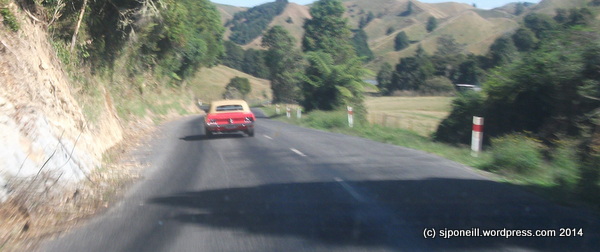
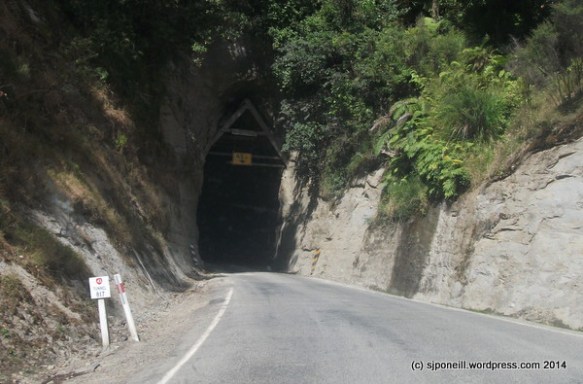
I found it to be a nice drive that follows the river for 60 km to Pipiriki where it turns inland for another 30 km to pop out on SH4 again at Raetahi. It is quite narrow (down to single lanes at some points) and winding but surprisingly busy so it is essential that a driver assumes that there is oncoming traffic around every corner and is prepared to stop in half the visible road.

DSCF7520

Obstacles…

DSCF7514

…and more obstacles…

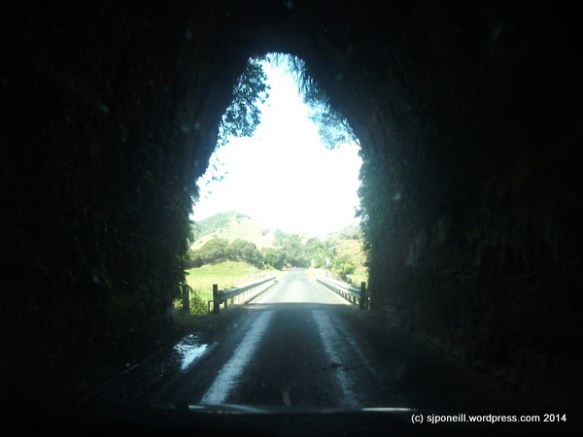
There are many single lane bridges and drivers need to be aware of who has the right of way and rural road etiquette e.g. the traffic coming up a hill generally has the right of way…

DSCF7527

The road is always at least ten metres above the river so I think it unlikely that it gets closed often by flooding…DSCF7512DSCF7516One of those single land bridges will bring you into the historic settlement of Jerusalem…

DSCF7517 DSCF7518

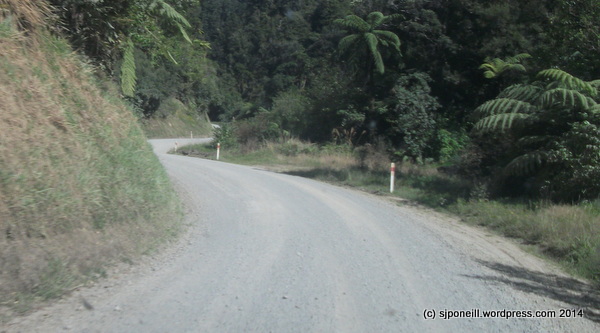
There is quite a long stretch of unsealed gravel road between Jerusalem and Pipiriki…

DSCF7519It is drivable in 2WD but the surface in some parts is quite loose so I popped the mighty Ssangyong into 4WD for better control and a smoother ride…

I couldn’t resist the TipTop icecream sign so popped into the Pipiriki store for a Trumpet…

DSCF7525

Pipiriki is a nice spot…

DSCF7523 DSCF7521 DSCF7522And then it was back on the road heading inland towards Raetihi…this road is probably more travelled and, while still narrow and winding at the river end, is certainly in better condition than the road south of Pipiriki…Halfway to Raetahi, the road breaks out onto the Central Plateau…

DSCF7529This is a drive that I would recommend to anyone looking to head south from the Ruapehu district with a little time to spare. I found it a nice change from SH4 direct to Wanganui or heading through Ohakune to pick up SH1 south to Wellington.

It is drivable by car i.e. 2WD but care has to be taken for other road users around the any many blind corners and single lane bridges. Small campervans i.e. those of people mover/SUV chassis would be OK but I would not be that keen on driving it in a large van-like campervan even though there are numerous small laybys where such vehicles can pull over to allow other vehicles to pass…

The scenery is nice and this drive provides and opportunity to see more of the Whanganui River than you can see from SH4 without actually having to get onto/into the river itself. If you want to get on to the river, there are opportunities to do this at Pipiriki with various canoeing, rafting and jetboating temptations…