Disaster | The Daily Post

Write a new post in response to today’s one-word prompt.

Source: Disaster | The Daily Post

…sometimes the measure of success is how well you respond…

That was my parting shot in The magnificent seven ride again…, the tale of a 2011 pub crawl against a backdrop of NATO’s Libyan ‘intervention’ and the  lone wolf terrorist attacks by Anders Behring Breivik in Norway in July 2011.

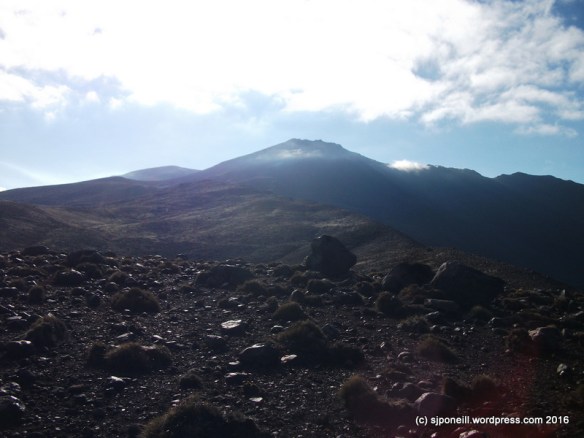
Mt Tongariro Summit Back Route April 2016-013.JPG

Five years later, those are still true words although I see response from a different perspective now…once, response was force projection, rapid deployment, targeting; now response is something we manage every day…

Today’s prompt is disaster…the biggest disaster to hit this region in the last 2000 years was the Taupo eruption around 182-300AD, depending on whose book you read. Of course, if disaster strikes and there is no one there to suffer from it, is it really a disaster or just a large scale natural event..? I mean, we’re talking seriously large scale here: the biggest explosion that the world has experienced in the last two, possibly more, millenia.

When we talk eruptions here, it is always in the context of when, not if: we know that the three volcanoes – Ruapehu, Ngauruhoe and Tongariro – will erupt again. The iffy bits are when exactly and how much…questions that can only be answered after the fact. Predicting eruptions is much like predicting earthquakes: often we can see a shift from what’s considered normal, maybe an increase (or decrease) in gas emissions, a cooling (or warming) of a crater lake, more (or less) volcanic tremors: but what it means is very difficult to determine.

Because prediction is problematic, a lot of resource goes into response. The timelines are pretty tight. A lahar (big volcanic mudslidey thing) coming down the western side of Ruapehu will hit Whakapapa ski field in about 90 seconds…that’s not enough time to check your phone  for directions, call a friend or update your Facebook page about the big black shadow coming down the mountain…part of the disaster response on the ski field is to ensure that people know what to do beforehand…

Further down the the hill, residents of Whakapapa Village have a whole twenty minutes to evacuate everyone from the danger area along the Whakapapanui Stream, essentially the Holiday Park and the housing area across State Highway 48 from the Chateau. Twenty minutes doesn’t sound like much time but after a fortuitous (probably didn’t seem like it at the time) series of false alarms in 2015, Whakapapa residents know they can do this at nine at night, in winter, after dinner and maybe a few beers.

Untitled.png

There may be no warning. An eruption may occur on a beautiful blue sky day, or in the middle of a black, freezing, sleeting, icy night. Luck ran twice when the Te Maare craters erupted in August 2012. Lucky once because an eruption at 11-30PM meant there were no walkers on the Tongariro Alpine Crossing as rocks hammered down onto the track. The biggest of these weighed three tonnes, enough to hurt if it landed on your toes. Lucky twice because, even though it was night, the bunk room at Ketetahi Hut was unoccupied as a rock slammed through the roof.

It’s been many years since we have had a disaster in Ruapehu – some tragedies, yes – but the last real disaster in terms of loss of life and damage was probably Tangiwai in 1953. Once of the reasons that we haven’t had any real disasters since then is our ability to respond. The March 2007 lahar had potential – it was certainly much larger – to be as deadly as its 1953 predecessor : that potential was mitigated, some might say neutered, by a effective well-planned, well-practised response. In fact, between exercises and false alarms, the disaster response was so well-practised that when the main event event occurred, it all seemed a bit boring…

So, when  you visit our maunga, take a moment to read the signs and be aware of what’s happening, what might happen around you…if you’re here for your fifteen minutes of fame, don’t let it be in 5000 years when some alien archaeologist chips you out of the remnants of the great Whakapapa Lahar…

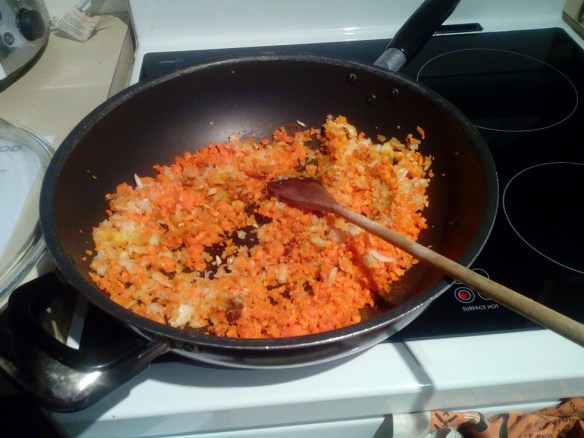
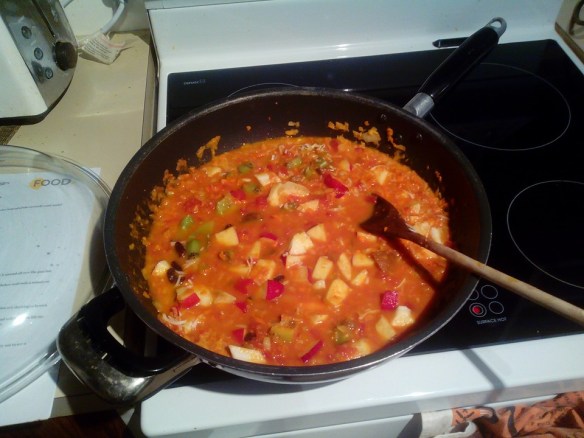
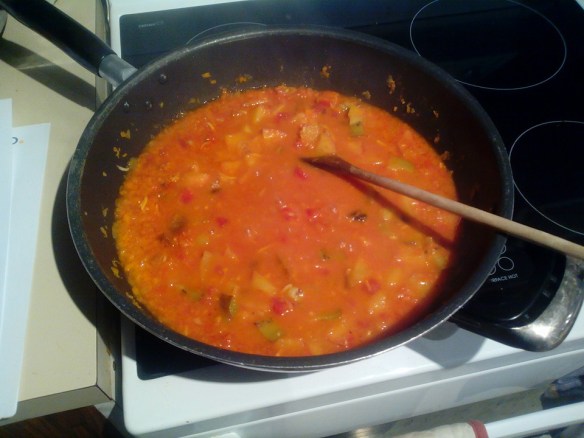
Fruit salad curry…

Fruit salad…what? Yep, that’s right, let me say it slowly…fruit…salad…curry…

Well, it’s not usually a curry – it was last night because I’ve allowed myself to run out of cumin…the core recipe is Food.com’s New Zealand Curried Sausages but I have found it to be as good, if not better, when the meat content is dropped out…I don’t mind sausages but am a little more suss about their contents now and tend to eat them way less than prior to my green journey…

Ingredients

  • 25 g butter (or any oil) I still use butter because I have heaps still in the freezer.
  • 1 -2 teaspoon ground coriander ( or 1-2 tsp curry powder instead of the coriander and cumin)
  • 1 -2 teaspoon ground cumin
  • 1 teaspoon turmeric
  • 10 -12 links pork sausage, each cut into about four pieces – or any other meat, really…so far I’ve tried it with chicken chunks, beef chunks and beef mince or just leave the meat out entirely
  • 1 -2 onion, chopped
  • 1 -2 carrot, chopped
  • 2 (400 g) cans chopped tomatoes
  • 1 (400 g) cans coconut cream
  • 2 tablespoons coconut
  • 2 tablespoons sultanas
  • 1 -2 banana, chopped, frozen is OK but fresh holds its shape better.
  • one chopped apple (optional) or any other fruit…so far adding chopped pears and kiwifruit has worked well
  • salt and pepper to taste but neither’s really necessary

Directions 

  • In a large deep frying pan or electric frypan, melt the butter. Don’t let it spread all over the pan but keep in a smallish area.
  • Place the spices over the butter and mix them into the butter and cook a minute or two till the spice flavour has expanded.
  • Stir the sausages (if used) through the butter and spice mix.
  • Add the onions and carrots and stir through also.
  • Cook a few minutes stirring every now and then, till the sausage and onion are starting to brown a little and the mix is sticking to the pan surface.
  • Add the tomatoes and stir through.
  • Add the coconut cream and stir through.
  • Add coconut, sultanas, bananas and any other fruit you are using.
  • Simmer all together till the mix is as thick as you want.
  • Season to taste and serve on rice.
13325673_10209473871266832_4350404713553169439_n

Onion and carrot just gone in on top of the spices

I used coconut milk powder this time as a potentially more flexible and additive-less alternative to canned coconut milk which has too many big words on the label. I used 4 tablespoons to 400 mls of water (using slightly warm water helps the mixing) and it tastes OK but I think that maybe another spoon or two with further beef up the coconut flavour.Similar, once I eventually run out of butter, using coconut oil may have a similar effect.

I don’t think that this would work well with ice cream i.e. it’s not (yet) a dessert curry but the coconut milk blends the flavours of the spices and fruit very smoothly. I’m also still using white rice until I finally run out of it – a 5 kg bag goes a loooong way..! – but will eventually switch to brown rice for more of my rice recipes and hold the black rice in reserve for special occasions…

13265876_10209473899307533_7922895066891326437_n

Fruit added

13325465_10209474089912298_3817432736192934111_n

Done after about 45 minutes


A study in growth…

On Thursday, I conducted an unintentional but educational experiment.

DSCF0084.JPG

In the interests of science

Mid-afternoon, I decided to drive to Taupo to do some shopping.

Having skipped lunch – not intentionally, I was just doing stuff and not feeling particularly hungry to that point – I stopped at the Turangi BK for a Big Feed; Whopper, fries, nuggets, caramel sundae and big Coke. I must admit I did hesitate slightly when the TV screen asked me “Coke for the drink?” – I would have opted out if I could have remembered what else BK had to offer but went with the flow, which is probably the whole idea of such a leading question. Later thought: I could have asked what other options they had to offer…

For old me, stopping for lunch at the Turangi BK was pretty much a habit on my way to points further…new healthy me had a brief think about the options – there aren’t many in Turangi and less when you’re hungry NOW and in a hurry (to get to Taupo before 5) – but habit won out..

Shopping in Taupo completed, once again habit took the helm and I found myself in the drive-in queue at the Taupo KFC – in the full knowledge that every time I have KFC, it reminds me why I don’t have KFC…a three piece quarter pack and a Big Snack burger…all that grease suppressed healthy conscience’s pricking as I drove back west…

Two things I noticed.

Firstly, how absolutely sweet both the BK and KFC offerings tasted to Way Less Sugar Me…coming up to six months along my green journey and this cynic is pretty much sold on the notion that there is a direct connection between sugar/sweetness in food and food craving…

Secondly, by the time I got home – 90 minutes max and that includes stopping at the Turangi New World and stocking up – on healthy food, I might add: baby beets, pineapples ($2.99 each!!!), pumpkin, kumara, ginger (yes, it’s time for that ripper soup again) and more, more, more bananas…Depending on my smoothie mix for the day and less any consumed in cooking, I’m averaging three bananas downrange each day now…Oh! And, almonds, in quantity as well: after reading the label on my store-bought almond milk  – all the words to big to pronounce in a hurry  – I am somewhat motivated to try my hand at making my own…

DSCF0085

Compensatory healthy stuff

Oh, I distract myself…hey, look, groceries..! do I need to get out more, I wonder..? So anyway, secondly, by the time I got home, my belt was distinctly tight and uncomfortable and I had this craving for sweet, sweet, sweet stuff. Now, when I stick to my healthy options, I can and do consume a lot but never, never, since I started this journey have I felt so bloated, yuk and uncomfortable as then…lesson identified…time will tell about it level of learnedness…

Inspiring Max liked my post Earth  this evening so, as I try to do, I checked out Max’s blog, it’s a tit for tat, you scratch my back bloggie thing for me…in  Coffee Catchup #6, Max asked readersIf we were having coffee I would ask you what you have been up to this last week, let me know in the comments.” Since the question had been posed, I did…and this discovery popped out as I burbled out my week in response…then I thought (it happens sometimes) “…well, if this is profound enough to contribute to someone else’s blog, it’s good enough for me as well…”

So here I am, at 8-30 in the PM, writing a post, after my first day back at work after three weeks off – and it went very well, thank you very much – when I should have dinner well under way…which is how I get to skip meals and then conducting unintentioned experiments like that above…still, dinner tonight will be quite simple: a reheat of the korma I made last night where I learned how much tastier food is when cooked in coconut oil than vegetable oils like Canola…

OK, now it’s time for food and a rewatch of Spectre, surely one of the better Bonds in the last five decades…?

spectre 007

Tongariro – the back way

Wow! I haven’t had such a good day on my own for a long time…

I have two weeks off to consume accumulated public holidays and time in lieu…with three days of fine weather forecast this week, normally I’d be working on the Lodge but this week I’m letting my muse drive me…

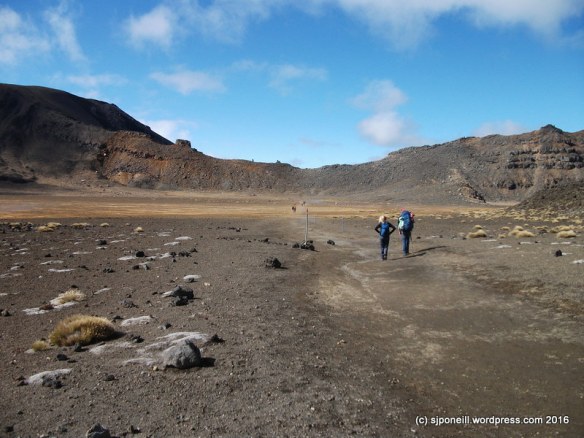
Today – and I am trying to write this while the memories are fresh and before I face-plant the keyboard as I am  just a little jaded – to venture up the ‘alternate’ route up to Mt Tongariro from Mangatepopo, across to Red Crater and then back down the Crossing trail to Mangatepopo. It’s probably a by-product of my green journey and its muse that I feel attracted back to the outdoor environment; that, and wanting to get some me time away from people ( natural enough when you work with hundreds of visitors every day).

An early start to make sure I could get a park at or near the Mangatepopo car and I was legging it towards Mangatepopo Hut by 7-30. No pix of the car park: although it wasn’t nearly as chaotic as it can be there were still heaps of people milling around and I just wanted to get underway.

The hut is only about fifteen minuets from the car park. I made a quick stop there to enter my trip into the hut book – you can never be too careful – and away I went…

DSCF9841

Mangatepopo Hut

There is quite a well-formed track that heads off north-eastish from the hut down to the stream. Some parts of the track towards the stream are quite heavily eroded and you need to be a little careful especially when it is a bit damp/slippery, as some of gouges are a metre or so deep. I followed that across the stream and up the opposite slope where the track is still pretty clear. From the sign it is fairly well-used.

DSCF9849

Target for today: Mount Tongariro

The climb up is pretty easy but already the day was warming up well past the forecast 0-5 degrees.

DSCF9852

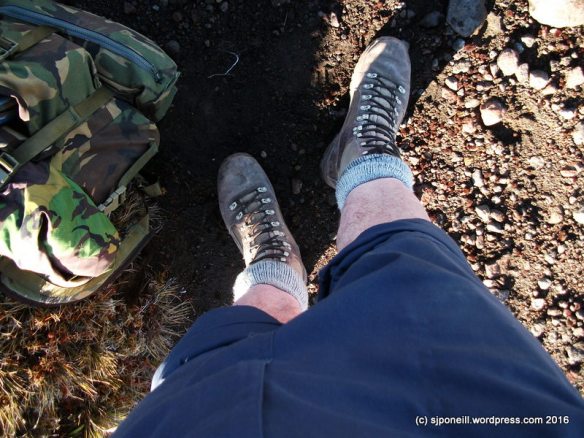
I had dressed for the the forecast and was already feeling a tad warm so converted my trousers into ‘shorts’ with some judicious folding. Much more comfortable.

DSCF9845

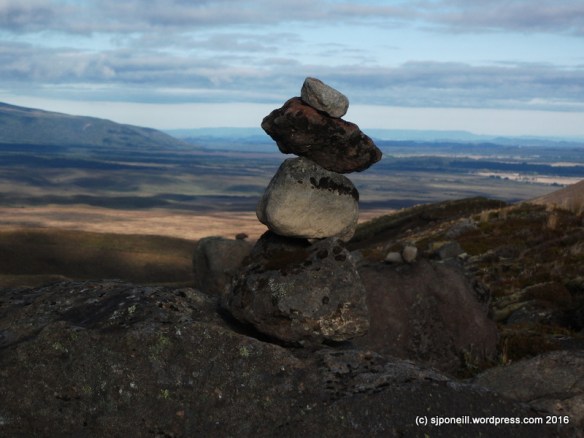
It looks pretty but…

Why do people persist in build cairns in the Park, especially things like that that are purely decorative? Do they not get that it is a national park and the whole is to do no harm. The environment here is very delicate and even moving one rock exposes fresh soil to the elements and leads to the erosion that already devastates parts of the Park.

DSCF9850

Oh, great, people!!!

I was looking forward to some quiet introspection time so the sight of a group following me up was not welcome. I stopped to let them pass me but we ended up pacing each other and then travelling together. They were a group of Duke of Edinburgh students from Thames High School whose objective this week was four summits in four days. They’d missed out on Ruapehu two days previously as the weather had closed in and they’d decided to pull the pin – good move – but had summitted Taranaki and Ngauruhoe successfully.

DSCF9853

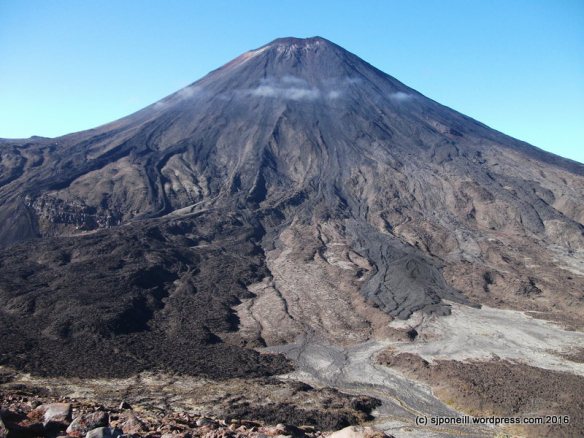
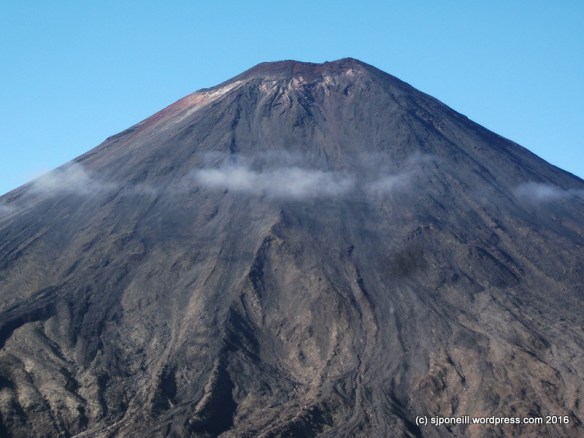
The lava flows from the more recent eruptions on Mt Ngauruhoe are very clear from across the valley. When (not if) Ngauruhoe erupts again, the historical lava route has been down the north-western slopes and we’ll need an alternative route like the one I walked today to keep the Tongariro Alpine Crossing open.

You can also see cloud forming off Ngauruhoe as the morning sun evaporates dew off the rocks. The same thing was happening on the other side as we walked up. Many people are surprised by just how quickly cloud can form up here and how thick it can be. As people found once we were on the summit, when the cloud is so thick that you can see the trail properly, the best thing to do is just sit it out.

DSCF9857

How erosion starts 101

I encountered a number of gouges in the surface like this as I climbed further up. There were clearly man-made as some of them ran perpendicular to the flow of water off the slopes. Some of them looked like campers had carved out a little drain to divert water around their campsite; others looked like rocks had been rolled or dragged down the slope. The surface up here is that delicate that interference like this will channel rainwater and cause serious erosion in a very short time.

There is not a trail all the way to the summit but the route is fairly intuitive with only one significant scree slope just below the summit. The trick is to aim slightly left as you approach the peak and this will take to directly to the summit. The climb itself is pretty Goldilocks: not so long that you get into ‘are we there yet?’ syndrome but not so short that you don’t feel like you haven’t done any work. Cresting the summit is really “OMG, we’re here!!”

DSCF9863

Thames High DofE group


DSCF9864

The cloud closed in as soon as we reached the summit…

…restricting views to just the top of Ngauruhoe.

DSCF9861

Lunch

Lunch for me was one of my bannofee smoothies and a couple of Jen Rice’s chewy apple spiced cookies – Jen says that two of these cookies are a meal and she is absolutely right: even after walking for three hours, two were more than enough to fill me up. I would have brought one of her turmeric coconut and pineapple smoothies except I’m out of pineapple until my next trip to civilisation.

DSCF9867

As I finished my lunch the cloud closed right in…while we waited for it to clear as it usually does relatively soon, I enjoyed talking with other waiting walkers about the Park, Lord of the Rings – always a safe subject – and the volcanoes.

DSCF9866

A minute ago this was all cloud

Even quicker than it had appeared, the cloud disappeared and it was off down the marked trail to Red Crater

DSCF9882

Skirting around the rim of South Crater down to Red Crater…

DSCF9880

Looking down into Red Crater

Most Crossing walkers had already passed this point so I didn’t encounter too much traffic in the other direction heading down towards South Crater

DSCF9885

Enter a caption

A late walker heading up to Red Crater…the route is quite steep and uneven but easily negotiable in either direction so long as walkers take care and watch their foot placement.DSCF9887

Looking back across South Crater: the route up to Red Crater runs about halfway up the ridge line that runs out the left edge of the image…

DSCF9896

Looking down from the top of the Devil’s Staircase, over Soda Springs to the beginning of the Crossing. Mangatepopo Hut can just be made out centre left. The route down the Staircase is quite windy but easily negotiated at speed over most of its distance.

DSCF9904

From Soda Springs to the hut is very flat with many ‘highway’ quality board walks. I always hate this leg as it is, IMHO, quite boring and rather administrative in nature.

Today was the first time that I have been out in the Park for a couple of months. Although the solitude was not as I expected, I enjoyed meeting and talking with other walkers and exploring a path less travelled.

DSCF9856

Target for tomorrow..?

That will probably depend on whether I can get out of bed in the morning…some joints are having a bit of a bitch tonight…

Three Zems walk into a bar..

Three Zems walk into a bar..

You’ve probably got no more idea of what a Zem is that I did only a couple of weeks ago…there I was just innocently passing my time on NZ Sale, scrolling through the forest of sales, when I spotted one for something I was totally NOT looking for…ZEMgear

I had vaguely heard of the concept of lightweight ‘natural’ foot wear but was unfamiliar with this company or any of its competitors/peers but as someone who had rashly stepped into the arena of Army footwear projects (starting a land war in Asia and marching on Moscow in winter had already been done), this piqued my interest.

The sale listed was obviously made up of largely end-run stock as most of the sizes were at the midget end of the scale but I managed to find one model in  US12 – it was listed as a man’s shoe but came in a cardboard sleeve marked Women’s US12….hmmm…not too worry, though, NZ Sale probably has a high rate of returns as its return system is pretty slick and painless but…you know how it is…they were cheap…they were here…and they weren’t pink…so I gave them ago…slipped off my shoes in the office and slipped on the Zems…

The fit was firm and comfortable: the main difference immediately apparent was the lack of any shock-absorbing in the heel. This is not a bad thing as it promotes shifting your weight on to the balls of your feet and thus walking naturally as you would/should when barefoot…

I wore them home, took the dogs for a walk, did some minor jobs about the house, cooked dinner, watched some TV…as an indication to how light and comfortable these are, by the time I was ready for bed, I had pretty much forgotten that I was wearing them and almost wore them to bed…

DSCF9771

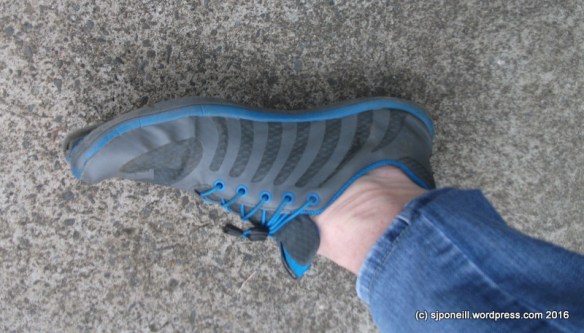
These were the first pair I bought and they remain my favs…they are a perfect fit and feel ‘just right’ in a very Goldilocks sort of way…they are my daily ‘stepping out’ Zems until it gets colder. I wear them to work where they often attract comment and questions from visiting school groups; the design encourages walking on the ball of the foot, not the heel that we are used to,  enabling agile manoeuvring around visitors and displays, very dance-like, very easily to stop or change direction…

DSCF9770

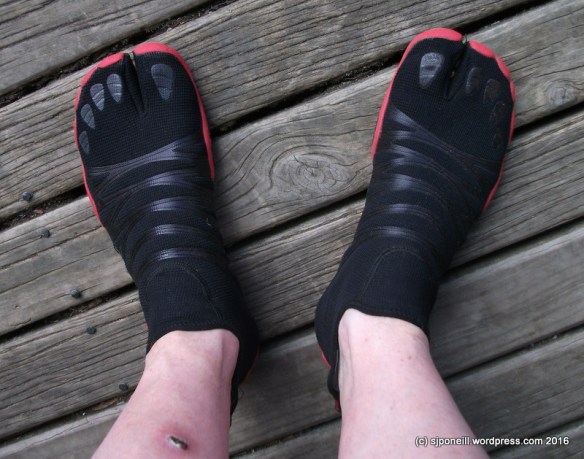
The split toe looks a little weird but is very comfortable and allows the foot to spread out for better balance and manoeuvrability. The only downer that I have found is that walking across long grass tend to attract the odd seed head that gets stuck between the toes, sometimes the occasional small stone.

The laces are elastic and I find that I don’t need to use the adjustment at all for tight comfortable fit. the seal around the ankle is firm but not tight and deters most stones and other ground debris getting into the shoe…

DSCF9774

Totally sold on the Zem concept, I ordered some more: one pair lighter and one pair heavier than the first ones I bought. I got them a half-size larger as I wrongly felt the blue ones were a little tight (adjust the laces, dummy!).

DSCF9662These are a heavy-duty Zem intended for more outdoors walking. They don’t really do it for me.  Although they are a little larger, they are very tight across the instep with no form of adjustment: this tends to force them forward on the foot and they always feel like they are going to come loose at the heel.
DSCF9664

They are OK – but only OK – to wear across open terrain but my feet will slide out of them walking up the track from the stream at home, especially if it is a tad slippery after rain. The heavier sole offers better protection against sharp rocks and roots but the extra heft also discourages walking on the balls of my feet and pushes my weight back on the heels. I use them for working around the house when I don’t need safety footwear and where it is fairly flat.

This model has been discontinued but I will keep an eye out for a new version with the elastic lace adjustment and a half size smaller…watch this space…

DSCF9667

Don’t judge me by my choice of movies

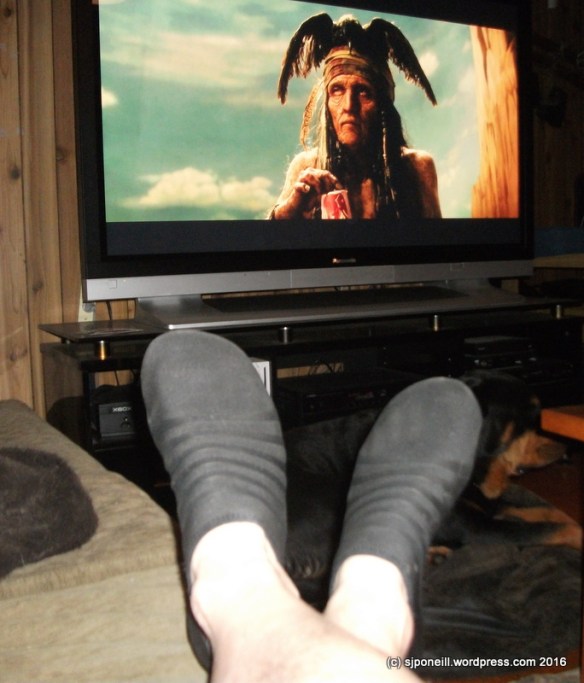
My sloth-around Zems, also bought a half-size larger but they always feel just a little on the tight side, again across the instep. These are for inside use only, maybe out to the car if it’s dry but not off the seal, not even to grab the dog bowls up off the lawn…They are very light and flexible; it is easy to scoop them up with a load of dirty washing and put them through the machine. I don’t think it hurts them but it is frustrating when searching for them…

These are the only Zems I have without the split toe and it actually feels a little strange to not have feature, much more so than when I wear ‘normal’shoes, possibly because the Zems’ tendency to push my weight onto the balls of my feet creates a different wearing and walking feeling where my big toes don’t get to rub alongside their mates…

Care and feeding is pretty simple: just wash them in warm soapy water and rinse them off. I dry them on the coat hooks just outside the front door – it doesn’t take long because they are so light. Going through the wash a couple of times doesn’t seem to have hurt my sloth-around Zems at all but it may be a bit rough for my other, more rigid models.

AS I SEE IT (19 Feb)

Waitaki Aquatic Centre

By Terry O’Neill.

swede

A Smorgasbord (Swedish) suggests sandwich and table, so we have a mixture today.

Regularly I am privileged to propel myself through the waters of the Waitaki Aquatic Centre, one of the district’s most used sporting facilities.

Waitaki Aquatic CentreAnd we are indebted to Adair and David Rush whose foresight and enthusiasm motivated the fund-raising for the complex. With the rise in drowning statistics and reduction in the number of school swimming pools, mainly due to lower funding, this pool is needed more than ever for basic life skills.

At the other end of the learn-to-swim focus it produces high class young swimmers including a number of qualifiers for the national junior age group championships in Auckland later this month.

Swimming demands discipline. Local competitive swimmers train usually from 6.00a.m to 7.30a.m with many from afar breakfasting at the pool before heading for a full school day, and back for a further training later with coach Narcis Gherca. It is interesting to note that North Otago will supply more swimmers to the coming national age group championships in Auckland than South Canterbury and Dunedin!

Is it time to look at establishing a sports complex to replace the Waitaki Recreation Centre in Orwell street? Its beginnings in the 1980s arose at a joint Oamaru Borough/Waitaki County meeting as an exciting compromise to meet community needs and the requirement for Waitaki Girls’ High School to replace its obsolete gymnasium. The Rec’s seen much better days.

Waitaki Boys’ High School and St Kevin’s College have gymnasia used also by community sports teams. The three schools are major contributors to North Otago’s economy and a new complex would certainly be an added attraction for pupils from outside the region as well as for locals. Maybe it will be thrown “into the too hard basket”, but we are the custodians of our future.

North Otago cricket won the Hawke Cup last weekend defeating Buller. Hearty congratualtions!

This trophy is competed for by the 22 minor cricket associations in New Zealand, and is divided into four zones. Each zone plays a round robin tournament and zone winners may challenge the current holder. North Otago first held the trophy in the 2009/2010 season appropriately 100 years after it was donated by Lord Hawke. Last weekend’s win means North Otago must prepare for its first challenge, from Hawkes Bay, in a week’s time.

Rugby League completes the smorgasbord. The competition begins on March 3rd with the Warriors playing West Tigers at Campbelltown Stadium at 9.30p.m. The “leaguies” also have new rules to interpret this season. There’ll be differential penalties for incorrect play of the balls. The old ploy of forming walls to prevent charge downs on field goal attempts will allow referees to penalise for such obstruction. The “shot clock” will be introduced with teams now having 30 seconds for scrums and 30 seconds for dropouts or the offending team has to concede a penalty.Now that’s something that rugby doesn’t have yet.

ENDS

NNNN

Onwards and upwards methinks.

ENDS

AS I SEE IT (5 FEB)

By Terry O’Neill.

The local rugby season kicks off on 2nd April. Leading up to it local clubs will mirror other Heartland clubs and battle to e


nsure full premier squads, an increasingly difficult assignment.

Polynesian players are an integral part of the Heartland scene. Many unions made derogatory comments about North Otago’s inclusion of Pacific Island players but North Otago was simply the forerunner of today’s necessity. A couple of seasons ago former All Black and Mid Canterbury lock  Jock Ross told me that some Mid Canterbury clubs only survived in premier ranks because of inclusion of Pacific Island players. Similar to all other Heartland unions.

The all-important necessary visas for Pacific Island players are not easily obtained and often are only for a set time. In some cases Pacific Islanders arrive on student visas to attend school, and play rugby, and others can apply for work visas under a skills’ shortage category or there is the specific purpose or event category, a rugby visa, for one year that may be renewed.

The North Otago Rugby Union does not actively recruit Tongans who generally arrive because of family or friends here. NORFU CEO Colin Jackson said the Union tended to go to Europe, USA or Canada for recruitment and over the past eight years more than 70 players have been under this scheme in North Otago.

Putting aside claims from some white rugby supremacists, without Polynesians there would be no premier rugby locally because of our small population base. Polynesians’ natural talents see many promoted to the top of the North Otago rugby tree to fill the gap created by the lack of other skilled young local players.

But it’s not one way traffic. Over the last two northern seasons local players, Jeremiah Shields, Keegan Anderson, Kayne Middleton, Thomas Shields and Jared Whitburn, all spent a rugby season overseas. It’s not only a rugby experience they benefit from, it’s a life-enhancing experience too.

In addition local rugby clubs Athletic, Kurow, Excelsior, Maheno and Valley have made direct contact with overseas rugby unions and clubs and obtained players.

It’s a conundrum how Immigration NZ treats Pacific Islanders. For instance, French, Italian or Argentinian players may live here for a year or eighteen months without any problem while most Pacific Island players work visas entitle them to be here for only six months and they’ve got to head home if they have no other suitable employment skills to offer in New  Zealand.

Clubs and minor unions don’t seem to receive much support from the New Zealand Rugby Football Union. When will NZRU boffins realise that to ignore the deterioration of New Zealand’s rugby base will not augur well for those higher up the rugby food chain? And in Tonga, Samoa and Fiji  how long will they be able to retain their World Cup status?

ENDS

AS I SEE IT (29J)

bowls

By Terry O’Neill

Bowls North Otago successfully completed its women’s pentangular tournament last weekend involving Senior women and Development women from the five Centres south of Christchurch: South Canterbury, North Otago, Central Otago, South Otago and Southland.

Teams played singles, pairs, triples and fours on two greens in Oamaru in over 100 games superbly organised by Brian Papps and umpires, Bruce Kelly and Graham Thorn, and with cooperation from the other four centres. The senior womens section operated smoothly.

And the “But” . . . Unfortunately Southland and South Canterbury, neglected to provide essential details of their development womens teams, and listed names only with not an iota of information about team composition and skips. As the tournament began on the Saturday morning, umpires had the additional stress of seeking this information. Hopefully a robust message educated those centres on their basic responsibilities.

This scenario may be indicative of a sports administration trend in which even more is expected to be done by the responsible, declining few. It’s an unfettered malaise that has evolved over the four decades I have been associated with bowls and other sports .

Blame may rest at the feet of professionalism whereby the national bodies tend more to be concerned with promotion of those exclusives at the top of the food chain. In too many cases the roles of governance and management are clouded. Let’s hark back to the days of the late Arthur Familton who, as North Otago secretary, ran bowls with a very firm hand although some might agree his  “firm” might have been be a tad lenient. Governance is the aspect of the committee which decides policy, and management involves those appointed to apply that policy to their sport. The two have become integrated to the detriment of sport. Only time hopefully, and a change in attitudes will ensure a more favourable response to the tasks demanded of administrators.

Can you imagine dealing with a multitude of bowls results on scorecards attributed to Tom, Sandy, Jude, Margie, and the like? These do not identify the players to anyone outside the intimacy of the green so it would be appreciated if full names of skips and players are always recorded.

Meanwhile it’s time to celebrate local sport. The North Otago Sports Bodies annual Sportsperson of the Year function is early March at the Opera House. Once again over fifty individuals have been nominated by their respective sports over a wide range of codes ranging from equestrian horse cutting through to trap shooting, motorcross and downhill mountain biking. Coaches are acknowleged too with Narcis Gherca (swimming), Owen Gould (Rowing), Ray Boswell (trap shooting and hockey),and Hamish McMurdo (cricket/rugby refereeing).

The traditional award for Administrator of the Year may be now be  covered by the Services to Sport award. Sports administration is often a thankless task.

Let’s salute these behind-the-scenes sports people who make things happen. Without their fastidious care, knowledge, humour and leadership, sports could not function.

ENDS

AS I SEE IT(22 /1)

liniment

By Terry O’Neill.

There are those who claim that to grow, one must change often.If this is true, the International Rugby Board would appear to have become almost rabid, when compared with its approach to changes in the past.Change for the sake of change has little chance of being accepted and when looking at rule changes to the game one might well ask,why?

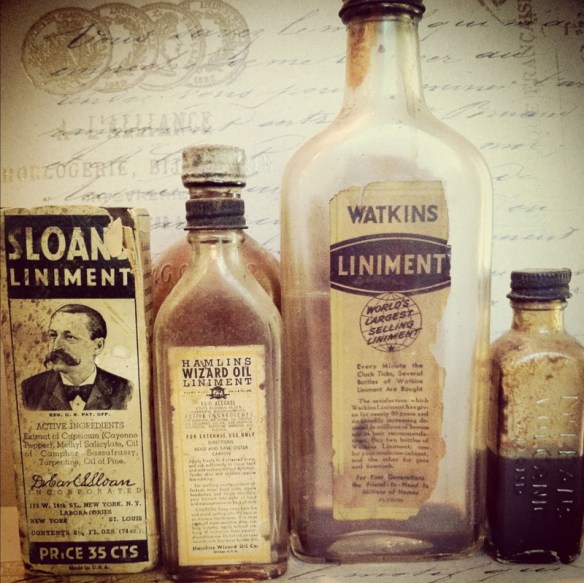
Whether it has been the drop in temperature at the beginning of this week or whether the build up of super rugby stories has been some motivation, I feel  that the 2016 rugby season is approaching, or maybe its just a throwback to the whiff of liniment used prolifically in my time.Today liniment would have been looked upon as an performance enhancing additive, although it could have quite an impact on tender parts of the anatomy!

The 2016 rugby season will bring law changes although not necessarily across the board. Why introduce law changes at the first class level before club level is a bit of a mystery to me but rugby fans will have to get used to the fact that the beloved  “ruck” will no longer be in the rugby vocabulary, replaced by “breakdown”.Hands will not be allowed by the tackler thus negating the skills of Richie McCaw and David Pocock.Get used to the idea that there will be two referees on the paddock and that penalty tries will be worth eight points,a try worth six points and a penalty is reduced to two points.

The new “breakdown” will form as soon as just one attacking player is over the ball on the ground.The old “gate” is gone and as long as players come from their side of the ball they may enter at any angle.At the breakdown  it is proposed  that the offside line will be a metre back from the hindmost foot of the hindmost player. It is expected that  this will encourage defending teams to contest the breakdown more often instead of just creating picket fence defensive lines. It is envisaged that the “lead” referee will look after the breakdown and the second whistle blower will scrutinise the offside line.

The proposed laws have been trialled in domestic competitions in Australia, South Africa and Wales.In Australia it was noticeable that kicks at goal were reduced and there was a lot more kicking for touch but a lot more tries were scored,although on the negative side there were more yellow cards issued as the value of penalties had been reduced.

With the local club rugby set down to kick off on April 2nd, the Saturday after Easter, the North Otago Rugby Union is waiting for information from the NZRU as to which,when and if the law changes will be invoked.

It appears that the Citizens Shield and other competitions will utilise only the change in points for tries and penalties.One problem that will arise with the two referee suggestion is that with four referees,two assistant referees(line umpires) and the two on field referees, required for each game it may mean  that lower grades could suffer.

For those looking further afield the Heartland competition will start a week later on the 22nd August with the finals set down for 29th October after Labour weekend.

AS I SEE IT (18Dec)


NO rugby against AS

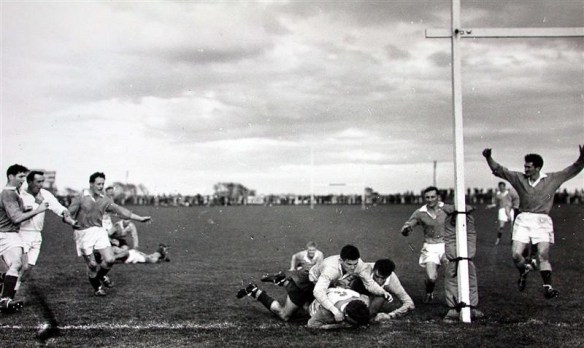
North Otago players celebrate as Bill Pile scores the game-winning try against Australia at the Oamaru Showgrounds in 1962. Photo from ODT files.

By Terry O’Neill.

This year’s North Otago’s sporting prowess is renowned despite the low population of this district . . .

Development of our swimming talent is the success story of 2015. Seventeen local swimmers under coach Narcis Gherca brought home a massive total of 45 medals, set 76 personal best times, and many qualified for the 2016 national age group championships. Take note of swimmers like Micah Hayes, Tandia Gooch, Jasmine Emery, Danny Gilbert, Iessha Mansfield, Tiana Mansfield and Imogen Keeling.

Oamaru rowing club administrator Peter Scott maintains the eighty active rowers on the water this season makes the club in the biggest in its 128th year and comprises School, Club, University and Masters rowers. Most satisfying for him is the great parent support and mingling of all local secondary schools.   At last weekend’s regatta Oamaru’s Mark Taylor, Charlie Wallis, Jared Brensell and James Scott were outstanding.

North Otago rugby’s consistency has been the key to significant performances over the last two decades. The playoff systems for initially divisional, and later the Heartland competitions, have been in existencefor nearly two decades.North Otago has made those playoffs on nineteen times since 1997 taking titles on four occasions. 2015 was no exception with Lemi Masoe and Ralph Darling again making the NZ Heartland XV.

The North Otago senior cricket side is currently only one match away from winning the zone four Hawke Cup challenge repeating last season’s effort. This season the team had two outright wins against  Otago Country and Southland. And there’s games coming up against South Canterbury (9/10 Jan) in Oamaru and Mid Canterbury(23/24 Jan) in Ashburton.

Winning the Ian Smith Trophy for only the fourth time was the feature of the North Otago mens hockey side this year. On an individual basis Logan Jopson and Jonty Naylor took a further step in their development being selected in the Southern under 18 side. On the club scene Waitaki Boys’ first X1 won the second division South Canterbury title beating Tainui B,3-0 in the final.

Valley Gold won the2015 premier grade netball title beating Waitaki Girls’ Wildfire in a thriller late in August. Wildfire led by four at the end of the first quarter, three at halftime, and two at three-quarter  time before Valley Gold stormed back to win 37-35. Jennifer O’Connell was impressive for the Waitaki Girls’. Her ability was further confirmed by her selection for the pathway to podium system developed by Netball New Zealand, one of three from the southern region, and she will play two games for the national development team in the Cook Islands this week.

Football Waitaki caters for over 480 children including teams from Twizel and Omarama. In competition, St Kevin’s U/18 finished second, Waitaki Boys’ U/16, second and Meadowbank U/14s finished fourth. Young players coming through the ranks and heading for senior ranks are Caleb Roberts, Riku Koyama and Tom Prestidge.

The highlight of the basketball season was the performance of the North Otago U/15 team which qualified for the nationals beating Otago in the process. Individually Harry Thorp and Tom Crutchley from Waitaki Boys’ are in Las Vegas with the Mainland Eagles Academy team while Matt Brien of St Kevin’s made the National Secondary Schools A tournament team.

ENDS