21st Century Military Operations

Martin Dransfield also presented at Massey on his return from commanding the New Zealand PRT in Bamiyan Province in Afghanistan in 2010. That was an insightful perspective into aspects of that operation well beyond what has been reported int he media and I am sure that this one will be equally enlightening…

Martin Dransfield 21st Century Operations

Centre for Defence and Security Studies Public Lecture

Colonel Martin Dransfield’s career has spanned five decades and has included tours to Northern Ireland and to the divided city of Berlin during the 1980’s, the Sinai as part of the Multinational Force and Observers mission, Timor as the second New Zealand Battalion’s Commanding Officer in 2000, and Afghanistan as the Commander of New Zealand’s Provincial Reconstruction Team in Bamyan during 2009 and 2010. He has just returned from a two year tour as the United Nations Chief Military Liaison Officer in Timor Leste, which culminated with the United Nations successfully closing down the mission in December 2012.

Based on these experiences he is well qualified to comment on today’s operational environment. Moreover, as New Zealand ends its missions to Timor Leste, the Solomon Islands and Afghanistan, Colonel Dransfield’s personal observations provide a useful insight into Joint, Multinational and United Nations approaches to operations. He will share these thoughts during a forum in Massey on 15 May 2013.

A DAMN good innings

544863_518655111514592_2080943450_n

Truly the end of an era…and covered very well in this article from the Foreign Policy Morning Brief email…

The first female prime minister in her country’s history, Thatcher came to embody a turn toward a free-market political program that sought to unleash economic dynamism through an aggressive program of privatizations and tax reductions. Thatcherism — as her political program became known to both her supporters and detractors — would throw off the heavy hand of the state and seek a Britain with greater vitality. Her perhaps defining moment came in 1984 when she broke a major strike launched by the miners union, a victory that consolidated her political power and represented a triumph over the country’s strike-prone unions.

The woman who came to be known as the Iron Lady matched her pioneering domestic agenda with a muscular foreign policy that saw Britain come to blows with Argentina over the Falkland Islands. And just as she refused to cede British sovereignty in the South Atlantic, she remained deeply skeptical toward the European project and laid the groundwork for Britain’s taciturn relationship with the European Union and its decision not to adopt the euro. Together with Ronald Reagan, a man who would become a close friend, she emerged as a canny leader in the Cold War, recognizing early on that Mikhail Gorbachev’s reforms presented an opportunity for the West.

But to her detractors, Thatcher’s free-wheeling market ideology came to embody an uncaring political philosophy, one willing to sacrifice at the altar of economic dynamism a state apparatus directed toward the common good.

Regardless, she is likely to go down in history as Britain’s greatest post-war prime minister.

scan0025

…and a couple of apt comments from Dan Drezner’s article on her influence

James011I didn’t respect all of her policies; but one thing I will say for Thatcher: she knew how to lead. No dithering, no faltering and she had a sometimes terrifying steely resolve. She was one of the last politicians you could look at and know exactly what she stood for. I can’t imagine any other politician, even during this recession who would make a statement like “The problem with socialism is that eventually you run out of other people’s money”. She spoke her mind and did what she promised to do when she was elected- I respect that and very few politicians do the same.

sasss31People can say a whole lot about Margaret Thatcher but no sensible person can deny her intelligence, wit, and influence. The fact is that she was Prime Minister for 11-years as a woman in the years of 1979-1990. She stood up to totalitarianism and was a force one did not want to reckon with. She was truly a transformative and vital leader of our time. Like her or hate her, the Iron Lady has her place cemented in the history books.

NorK posturing aside, in these times we forget sometimes – or never know for those under 35 – just what her time was like…the Cold War was in full force and there was a very real expectation that it might actually happen; wars were wars and lots of people died; terrorism was alive and active across Europe and in Great Britain; and unions ruled OK with little real concern for the rights or well-being of their members.

If she did nothing else, Margaret Thatcher created huge change by simply standing firm and she should be remembered for that. It is quite a sad thing really that she has been depicted as a doddering fool in the poor movie The Iron Lady, and that so many have seized the opportunity of her passing to leap on their own insignificant little soap boxes to belabour their own narrow opinions…

4559976587

And this from a Facebook post…

Tonight I shall go and have a drink for Margaret Thatcher’s death. I shall raise my glass to the night sky, and THANK HER, and celebrate her life. People on this seem to have a very strange view of history. So here are a few little nuggets with how and more specifically WHY a lot of industries were destroyed by her, and what’s more, destroyed with the MANDATE OF THE BRITISH PEOPLE.

The seventies were blighted by the trade unions waiting for winter and then coming out on strike at it’s heart. Holding the country to ransom for ANNUAL pay rises of up to 36% ABOVE inflation. This was the likes of Scargill and co. And they bled us dry. We were bankrupted by them. And then the Winter of Discontent happened. And they ALL came out. Miners, power workers, transport workers; even funeral directors, everything tied into the TGWU came out. My own grandparents lay on a slab for 2 months waiting to be buried. The entire country was a ruin. Rubbish not collected for months, rats everywhere. And the unions laughed, and brought down Callaghan’s Labour Government.

And Thatcher stood up at the General Election and made ONE SIMPLE PROMISE. Elect me. And THIS WILL NEVER HAPPEN AGAIN. ELECT ME AND I WILL DESTROY THEM. She won a landslide. On that promise.And she became the last elected Prime Minister to actually hold true to her election promise. She did exactly what she said. She utterly destroyed the unions. Obliterated them. The cost was those industries. We knew that would be the price. But we would not allow them to hold us to ransom again. What she did, she did with our BLESSING. The socialists and people who backed those strikes have only themselves to blame for what happened. Baroness Thatcher didn’t destroy those industries and communities for fun or as part of a class war. She did it to stop them holding the country to ransom again. And then she held the purse strings tight and re-built the economy and the country and Britain again stood tall and thrived. And we won back the global respect we had lost while the left wing ruled.

In the Falklands we were thankful for her being in office. Those of us who went ‘south’ in ’82 did so knowing we had a leader who would not – and did not- interfere. She sent the military and allowed us to do our job. Gave us the money, the equipment and most of all THE FREEDOM to get the job done. Our lands had been invaded. We had a gun up our nose. SHE led us. Frankly Thatcher took a very broken Britain by the hand like a strict old fashioned Matron and LED THE COUNTRY BACK TO WHERE IT HAD ONCE BEEN. We were the worlds 3rd major power in ALL respects. And as for the world, it has NEVER been safer than when Thatcher was in Downing Street, Reagan was in the White House and Gorbachev was in the Kremlin as the three spoke DAILY. They laid the ground for the fall of the Berlin Wall. The Russians were TERRIFIED of her. And the world again feared Britain.

And lets not forget that she gave people the full right to buy their own council property. Her vision was that the TENANT and the tenant alone could buy that property.As soon as her party stabbed her in the back the feeding frenzy began as under her the famous Tory grandee greed was held in check. So they stabbed her, led by the Europro traitor ponce Heseltine – who didn’t have the guts to face her openly and alone – they arranged her removal. And we have been a broken patsy for Europe ever since.

So yes, tonight I will celebrate the death of Baroness Thatcher, with thanks, with respect, and with sadness, because she allowed me to know what we could be, what we could achieve, what it meant to be BRITISH.

~ Credit to Steve Chiverton for this piece of writing

Margaret-Thatcher-1992-Ma-020

And in response to this insect…

541908_4654188755858_648395336_n

…You worry about what someone calling himself ‘citizen bomber’ says or thinks…? She will be laughing over a brandy with Churchill at how all the insects have had to wait til she passed before feeling brave enough to launch their soap box flotillas of jealousy…

…The British Government is making arrangements for all such left-wing insects to be emigrated to Albania where they will be happy. In an unintentional twist of irony, they will be transported on the aircraft carrier Iron Lady….

You do have to admit that HMS Iron Lady has a nice ring to it…


Attack from the Sea

attack from the seaI’ve always been interested in the ‘Let’s give it a crack’ design philosophies of the 1950s and ‘60s – long before the advent of computer-aided design took all the coolness out of aircraft prototyping (although not the cost, as the F-35 Flying Pig demonstrates every day). This was an era where, if you wanted to know how a new design might perform, you built it and flew it… Thus, the design philosophy and development saga of Martin’s P6 SeaMaster has interested me for some years. I bought the Airmodel 1/72 vacuform model of the SeaMaster in the 90s, started it in the early 2000s and plan to finish it ‘one day’ (Roger Fitch!). In the meantime, I enjoy researching about this and other aircraft of this era…

Late in 2006, I was in Norfolk (VA, not UK) for the first planning conference for the 2007 iteration of the Coalition Warrior Interoperability Demonstration (CWID). Having a spare hour or two of shopping time the day before I started to unwind the rubber band back home, I found myself in a Barnes and Noble in one of those big strip malls and stumbled across a copy of William Trimble’s Attack from the Sea. It hadn’t been released for very long and commanded a handsome price (this was also before our two dollars started to approach parity) I opted out of purchasing it.

Cut forward five years and I’m now not only regularly attending Air and Space Interoperability Council (ASIC) meetings in the US, but I have a contact in DC who was happy to receive and hold any US purchases for me until my next visit – almost a necessity for heavy and/or bulky items since the US Postal Service took it upon itself to no longer support international surface post – Hello? Just because you are the only nation that plays in the ‘World’ Series doesn’t mean that there’s not the rest of the planet out there!!!! Shortening a longer story, I finally acquired a hard copy of Attack from the Sea in March last year.

The Airmodel SeaMaster being a LONG term project, I didn’t actually get round to reading it until this year when I resolved to start reading more professionally oriented books as part of refocusing myself on the development of Air-related course work and also working towards more regular publication of such work.

So…the techo stuff…although listed as 196 pages only 142 are actually devoted to the text, the remainder being set aside for end notes and a bibliography. I’m always a bit wary of books that have been derived from a thesis as the thesis structure does not always translate into an attractively readable book format. Although both are comprehensive and possibly of use to other scholars and researchers, they are somewhat dry and add no value to the story other than listing sources used.

I especially hate those thesis-derived books that harp on and on about the research practices followed, i.e. following the research template, instead of employing this for the actual conduct of their research and then telling the story in the thesis proper. Fortunately, Attack from the Sea does not fall into this trap for young players and its narrative flows clearly and logically towards its inevitable unhappy ending – no spoiler alert needed here as the dust cover and introduction both make no effort to disguise the fate of the Seaplane Striking Force.

It is important to remember – and the text does not cover this – that the concept of a Seaplane Striking Force was independent of the infrastructure necessary to support both heavy land-based bombers AND carrier-based naval aviation. This was borne in a time space-based reconnaissance and surveillance was in the realm of Analog and Amazing Stories than practical military capability. Thus it was quite practical to consider a force of large fast seaplanes that could operate from lakes, fjords or open water, supported by ships, submarines and other seaplanes – fighters, patrol and resupply – and invisible to potential adversaries until committed to a strike. Today, modern ISR capabilities may render the original concept untenable in any conventional high-intensity symmetric conflict but then we haven’t seen many of those recently.

William Trimble details the Seaplane Striking Force from its inception between the Wars through to post-WW2 attempts to develop it into a practical part of America’s nuclear deterrent capability. Although the text on the larger programme gives the reader a good grasp of the SSF and how it could have been employed, it does not devote enough space (constrained by the limits of research templates?) to the development of each of the three main aircraft that would have been the mainstays of the SSF:

the Convair F2Y-1 Sea Dart fighter,
sea dart

the Convair R3Y-1 Tradewind patrol and logistic support aircraft, and

tradewind

the Martin P6M-1 SeaMaster heavy bomber.

seamaster plan

The SeaMaster receives the lion’s share of the coverage, followed by the Sea Dart with the Tradewind coming in a slow third; nor are the proposed supporting naval platforms covered in as much detail as the Seamaster. In some ways this is fair as a discussion on a seaplane striking force probably needs to cover the strike element in some detail but it does lead to a feeling that the problems with the Seamaster were the main reason that the programme was cancelled in 1959.

The actual reasons that the US Navy decided to axe the SSF (literally as none of the 14 Seamasters built survive today) were two-fold. Firstly, the programme’s costs had not been properly budgeted, nor had proper management processes been embedded in the programme to monitor and mitigate cost increases.

Secondly, by 1959, it was starting to become clear that nuclear submarines could provide an even more secure deterrent/counter-strike capability than any other platform and no role was seen for a naval heavy bomber capability.

What is surprising is that the advent of the nuclear ballistic missile submarine did not equally threaten air force nuclear heavy bomber capabilities, allowing the USAF to continue development of heavy nuclear strike options like the XB-70 in the mid-60s and the original B-1A in the 1970s. It is ironic that conventional attack has saved both the B-52 and the B-1 from the breaker’s yards. Had the B-70 gone into production, it would probably now be an expensive lemon unable to perform any roles other than nuclear stand-by and limited strategic ISR (but, then, that’s what we had the SR-71 for).

This begs the question whether the Seamaster would have been a credible and practical capability had it been introduced into service in its planned numbers of at least two strike complexes, each of 36 aircraft, one complex each for the Pacific and Atlantic theatres . The author alludes to other roles, but only as a passing thought in a brief mention of how it might have operated during the Vietnam War. This brevity is unfortunate in a book published in 2005 when numerous other employment contexts could have been examined to add contemporary context to what might have been.

“…the possibilities for such a force were virtually “unlimited”. It was easy to concentrate the numbers of aircraft needed to “saturate” the air over the landing force and protect the shore bases as they were built. The landing zone could be spread out over a wide area, complicating the enemy’s defense and decreasing the vulnerability of friendly forces to counter-attack…in the nuclear age dispersal was even more vital, because a single weapon could easily wipe out the entire force. Aircraft ranges could be enhanced by refuelling from a submarine or a surface ship, damaged aircraft could land anywhere offshore, and all-weather operations were easier because precise shipboard landings were not necessary… ”

US practical demonstrations of long range aerial force projection since 1990 remain impressive feats with flight times in excess of 24 hours. However these are only achievable at the cost of logistic support, mainly air to air refuelling, and expenditure of aircraft hours. With the last B-52 rolling out in 1962 and the last production B-1B in 1988, no matter how good the upgrade and zero hour programme, these aircraft remain finite resources. In addition, such long sorties extract a toll upon flight crews that must affect in-flight performance. Where national positions may preclude the use of regional airbases for heavy bomber forces, where such facilities are simply not available, or where they are not secure, there very well may be a greater role for a Seamaster-like capability than there ever was in the 50s. In addition, the example of Vietnam in Attack from the Sea, other regional deployment possibilities might include:

RAF Seamasters operated covertly from locations closer to the Falklands Islands operational theatre than those flown during the Black Buck missions. The Seamasters ability to base anywhere that sea or other waterway conditions permitted would have aggravated Argentina’s air defence problem by opening avenues of attack other than from the North.

Seamasters  deployed into the Mediterranean as part of ELDORADO CANYON as an alternative to the long flight around France, Italy and Spain to avoid hurting European sensibilities.

USAF Seamasters operating from secure locations in the Red Sea and Mediterranean provided more responsive heavy attack during DESERT STORM, and also easily surged into location during Saddam’s various sword rattling activities during the 90s.

Seamasters added another string to the bow of US ‘big stick’ diplomacy in the former Yugoslavia after the signing of the Dayton Accord in 1995; and again over Kosovo in 1999.

RAF Seamasters operated alongside the UK forces deployed to Sierra Leone in the lead up to the BARRAS rescue mission. Their ability to deploy both precision heavy aerial munitions up to 2000 pounds and mini-munitions weighing less than 5kg enabled the Seamaster force to provide local commanders a range of response options not available from any other strike platform in the UK armoury.

Seamasters provided a credible and more responsible heavy attack capability to ENDURING FREEDOM in 2001 and 2002, operating from secure locations much closer than the US bases from which the US heavy bomber force operated from. Ditto IRAQI FREEDOM from 2003 onwards.

While NATO forces established themselves in Poggia, Seamasters removed the requirement for RAF Tornados to sortie from UK bases to launch attacks on Libya in the early stages of ELLAMY in 2011.

In a myriad of small wars and irregular activities, the Seamaster’s ability to sea-base added a new obstacle to an insurgents ability to breach local defences and attack aircraft and crews directly as occurred at Camp Bastion in 2012, with the loss of six irreplaceable USMC Harrier attack jets.

Although aging by the early 21st Century, RNZAF Seamasters enabled ANZAC forces to deploy advanced ISR and precision attack capabilities into South Pacific theatres beyond the practical reach of ADF Super Hornets and F-35 Emus (they look like birds but don’t really fly that well!)

Yes, what never was and what might have been…

I enjoyed Attack from the Sea – it is well-researched and well-written and provides insights into operational concepts like the Seaplane Striking Force that are not well-known today; and also, and perhaps more topical, some insights into the dangers of inadequately managed development programme, with specific regard to cost overruns.

I see that someone else on WordPress also likes this book [Attack from the Sea — book review] and makes a point that I missed:

“…One thing, and probably the only thing, not explained was the USN’s decision to purposely destroy the remaining 16 SeaMaster aircraft but keep all the Sea Dart aircraft. This decision was either myopic or, maybe, shameful, but its rationale appears lost in the fog of history — especially so if Trimble could not make a determination…”

The same spiteful vandalism was also inflicted on the AVRO Canada CF-105 Arrow (leading to the RCAF’s interesting little dalliance with the Soviets) and the BAC TSR.2 – you have to ask yourself…WHY???

As they say down the hall in the Lessons Learned broom cupboard, those who do not learn from history are doomed to repeat it….

Knoco stories: Explicit knowledge is only valuable if it is accurate

Knoco stories: Explicit knowledge is only valuable if it is accurate.

These issues are symptomatic of rural lifestyles – we have exactly the same here: our phone apparently loops out into the lawn before heading up the short driveway (about 25 metres), under the long driveway (about 110 metres), up to the gate, back under the long driveway, does a few more loops outside the gate before ducking back under the fence to the Telecom connection point…


Raurimu 020

The ‘short’ driveway: the phone cable runs left to right across the base of the steps and then under the right side of the concrete…

Raurimu driveway Aug 04 - 1

The ‘long’ driveway…the phone cable burrows under the far end of this and meanders up the left side about a metre or so off the seal, before doing a few loops where the mighty Diamante is parked and then ducking under the to the Telecom connection point where the white marker is on the right…

At the time we put in our garage in 2007, we got the Telecom guy out to track the cable’s path before we did any serious digging – just in case – and marked it with some dazzle paint. Over time the dazzle paint became distinctly less dazzly, and eventually faded away before I got a Round Tu-it vis-a-vis actually mapping its path for next time that information was needed.

So I sympathise with Nick because we’ve been in exactly the same position and launched off on the advice of ‘well-informed’ and “knowledgeable’ locals and also ended up with recreations of the Somme. Maybe it’s symptomatic of us and knowledge guys, just like a mechanic always drives the crappiest old car, or the talented joiner you know hasn’t had a handle on his loo door for coming on five years (yes, you know which son-in-law you are!!), that we struggle to apply what we know professionally when we step through the gate of home sweet home…?

So in regard to the five lessons learned functions of collect, analyse, decide, implement and verify, it sound much like Nick has skipped what is probably the most vital function, that of Analyse. More often than not in lessons work, the raw OIL is not as it seems and when subject to a lens of rigorous analysis, the issue and the actual lesson are often totally different from that which you might expect at face value from the original OIL.

It is so very tempting, especially in metrics-fixated environments, to seize the apparent low hanging fruit and find that one very quickly goes from a mess to a really mess and all of a sudden you are reacting to your solution, somewhere in which is buried the original core issue. What’s that I hear from the cheap seats? Sounds like ‘COIN”? Absolutely!!! Those five same functions apply just as much in COIN, although we’d prefer to use Irregular Warfare when in polite company, as they do in lessons learned:

Collect as much information as you can about your problem.

Analyse it, ignoring you preconceptions and gut instincts; examine it from every angle, and develop some courses of action.

Decide which course of action you are going to implement – it’s OK to opt for none and go back to do more collection and analysis.

Implement your course of action, all the time ensuring that situation hasn’t changed around you, reverting you to dead-horse-flogging mode.

Verify that your solution has addressed the original issue AND that it hasn’t created a whole bunch more.

In the story that Nick tells, he does not provide much information regarding his neighbours reliability as an information source but it is probably a safe assumption that there was no malice involved. Taking a punt, it may have been that the map provided indicated the intended path of the drains until someone remembered the village story about a German bomb landing in that corner of the field and not making the right sort of bomb post-impact noises. Discretion being the better part of valour, the drain took the longer road – just in case – but a drain’s a drain and why bother the council with any explanation of why the permitted path wasn’t followed. Whose to know? Well, for starters, the guy who is out “…an extra day and half of digger hire and labour rates, 10 dead trees, and a garden that looks like the Somme at the height of World War One…”

This would be something that we would see time and time again in the ABCA Armies Coalition Lessons Analysis Workshops (CLAWs): We just can’t, well, shouldn’t anyway, take presented information at face value be it raw OIL or a map of the drains without asking some critical questions about it…and being prepared for some answers that might be both unexpected and unpalatable…

After Dire Sequestration Warnings, Skepticism Abounds | Defense News | defensenews.com

After Dire Sequestration Warnings, Skepticism Abounds | Defense News | defensenews.com.

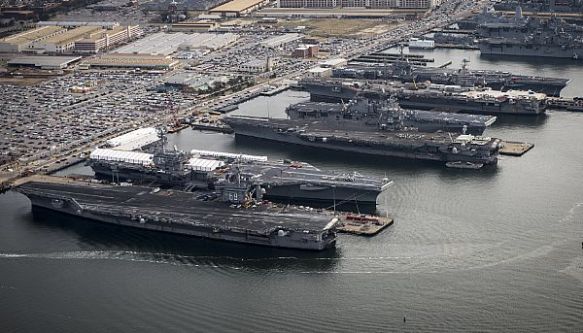
Five Carriers in Norfolk

The aircraft carriers USS Dwight D. Eisenhower (CVN 69), USS George H.W. Bush (CVN 77), USS Enterprise (CVN 65), USS Harry S. Truman (CVN 75), and USS Abraham Lincoln (CVN 72) are in port at Naval Station Norfolk, Va. US Navy Photo

Hmmmm….US service chiefs are promising/threatening/prediction the loss of major capabilities as a direct result of the US Congress’ inability to form a budget, and the now-implementing sequestration (even the word sounds painful) process…

“Decisions of particular concern include not deploying the USS Harry Truman to the Persian Gulf; not refueling the USS Abraham Lincoln, thus making it unavailable in a crisis; the suspension of mission-critical training and equipment maintenance; and withholding the deployment of Marines to strategic regions in the Pacific,”

I wonder if they have heard of the Law of Unintended Consequences? If suspending these capabilities has no direct near-term adverse impact on national security – noting the short memories of both politicians and ‘the people’ – it may be that all they have really achieved is to put these capabilities on the block instead…hubris is a dangerous thing and I am reminded of those, a decade or so ago, that said that Helen Clarke would never dare to disestablish our Air Combat Force….ummmm….hello?

Perhaps this is a clarion call to western militaries for a long overdue review of military acquisition and development programmes to ensure that they are actually meeting current or near-term most likely and most dangerous capability gaps and not merely existing for their own sake or to bolster sagging national economies…

I’ve just finished reading William Trimble’s history of the Seaplane Striking Force (review to follow), a 50s concept intended to provide a credible dispersed nuclear deterrent based upon a systems-based capability built around the Martin P6M Seamaster – a large four-jet seaplane bomber, very advanced for its time and even now. Unfortunately, resolving the technical issues around such a force took so long that the need was overcome by events. As cool as the Seamaster was and as useful as it may have been once all the bugs were ironed out, the programme was cancelled in 1959. Perhaps before critical capabilities are casually put up for grabs, it’s way past time to thin the herd…? Like, perhaps….

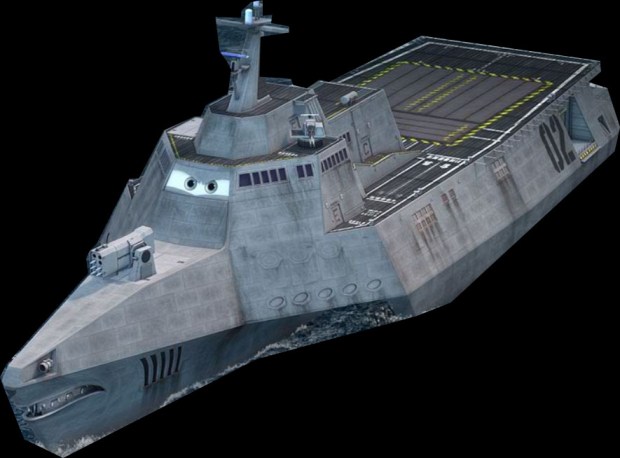
lcs cartoon

The ultimate stealth vessel – it appears to just fade away as you look at it. Or is that just what’s known in the trade as ‘galvanic corrosion’?

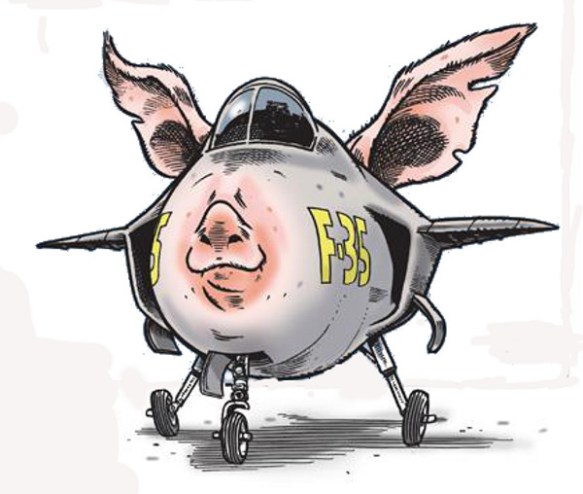
f-35 cartoon

Wasn’t this originally meant to be the LOW COST buddy to F-22? The lightweight ‘bomb truck” to replace the F-16, A-10 etc into the 21st Century…when and how did it become The Blob of modern military aviation?

If it’s no longer or never was fit for purpose, and/or or if the operating environment has dramatically changed then maybe , just maybe, it’s time for some tough decisions…?

Opinion: Training for war is not a precise science

…and Josh wrote another op-ed piece…

DSCF2067

Training for war is not a precise science.  By its very nature war is imprecise and unpredictable.  To make matters worse there tends to be an opponent who, in the words of American General George Patton, is trying his hardest to make you die for your country rather than him. Training therefore has to be relevant, intensive and invariably adaptive.

War since 9/11 has become increasingly characterised as being irregular in nature. Modern war has become less about the battles between states and their armies and more about defeating violent non-state groups. Terms and descriptions like peacekeeping missions or stability operations are often an attempt to re-categorise what are actually wars.

As military philosopher Carl von Clausewitz noted,  “The first, the supreme, most far-reaching act of judgment that the statesman and the commander have to make is to establish the kind of war on which they are embarking, neither mistaking it for, nor trying to turn it into, something that is alien to its true nature.”

While the term war may sit uncomfortably with many citizens, the fact is when bullets and bombs start to fly your way those on the front line have more regard for their survival than concerns for what their mission has been labelled.

The recent media reports about the training and the attitude of New Zealand forces deploying to Afghanistan raises a number of important issues. The fact that a soldier has raised concerns while observing the training of a contingent is actually a good thing. That is exactly the purpose of observing and making expert judgment on training for the contemporary warfare environment.

No doubt there have been training concerns in the past and there will be more in the future. Some may have missed the point that such observations are designed to make the team better, not worse. The response so far has been to put the comments into a wider context of training for Afghanistan, and rightfully so. What will be interesting however, is to see if any follow up by the Defence Force focuses on the message or the messenger.

Training in the military is a system. Those who present themselves for deployment are at the pinnacle of that system. The full suite of training courses and on the job experience they have previously undertaken is ultimately designed for them to deploy and succeed on operations. If things manifest as problems during the final training for operations it is sometimes difficult to recognise or even isolate where in the total system it may have gone astray. 

Attitude is acknowledged as affecting performance. A positive attitude tends to increase performance while a negative attitude can reduce it. Inextricably linked to attitude is confidence. Preparing for a military deployment requires confidence in those being deployed, confidence in the leadership of those deploying, confidence in those charged with providing the training and confidence in the training system itself.

Accepting that war is imprecise, and more irregular these days, it is hardly surprising that the training and attitude for today’s military forces is under immense and constant pressure. Ideally, the force will depart for their mission confident that they are well prepared. To assume that they are ready for anything however, discounts the actuality of unpredictability. There is always a very fine line between sureness and an hubristic approach. 

Having a winning, positive attitude, and implicit trust and conviction in your comrades and the training you have received are what define the profession of arms. While it is good to hear that the training is going well, it is not always a bad thing to hear that it is not. 

Josh Wineera is a teaching fellow at Massey University’s Centre for Defence and Security Studies and is planning to teach a new 200-level paper “Irregular Warfare”in the second semester.

Indicative of the articles referred to above are these:

Training for Army fighters blasted

Officer was ‘too aggressive’

Unfortunately, today’s media has of course selected deliberately inflammatory headlines without either considering or even probably understanding the core underlying issues…

Bad boys, bad boys…

…whatcha gonna do, whatcha gonna do when they come for you…? 

Ready or not, here we come...

Ready or not, here we come…

Dear Unit 61398

How do you hack the guidance on a ‘dumb’ Mk.84 low drag bomb once it (and its friends) are spiralling down towards you?

Sincerely

The Hacked (Off)

In this era of informal conflict i.e. one in which one or more or even all of the actors are the regular formed units or formations that we remember from the good old days of the Fulda Gap, this becomes a valid question.

In the good old days (GOD for short), if someone actively and physically attacked or took some form of physical action against a nation’s physical infrastructure or commercial structures, there would be options under the DIME construct (more D, M or E than I perhaps) through which one might register one’s national concerns about such activities and encourage the perpetrators to cease and desist.

In the case of Unit 61398, despite its mundane designation (F-117 sounded mundane until 17 January 1991), we have an identified military unit conducting, with guns more smoking than Saddam’s WMDs, offensive actions against national and commercial infrastructure around the world but especially targeting the US. If Unit 61398 was an active service unit, regular or irregular, operating within the borders of any western, and most if not all other, nations, it could reasonably be expected to be hunted down and neutralised physically. Similarly, if  it was as openly offensive as Saddam’s SAMs during the decade of no fly zones, or Iran’s Boghammers during the Tanker War, something loud and bad would probably happen to them.

But (yes,yes, I know, never start a sentence with ‘but’) in the convolutions of informality the smoking gun justifications are not as clear regardless of provocation. Just as US- and UK-based UAS operators blithely commute between domestic homes and respective UAS remote operating bases with a strong sense of security and little of risk of threat (in the UK, the IRA must be rolling in its unmarked grave after the security awareness it forced upon the UK military in its heyday of terror), members of Unit 61398 probably cycle home with a similar sense of blithe innocence…

So will it be that one day,maybe one day soon, and in true Dale Brown style, the stars at 65,000 feet will ripple as payback soars over Shanghai and releases some unhackable cease and desist notices (Lucasfilm lawyers eat your hearts out!!)…?

Note: Lucasfilms/LucasArts are the people who not only brought you the three worst science fiction movies of all time (certainly when viewed sequentially) but who also have a rep for being the Galactic Empire of the known legal cease and desist notice universe…

Two years ago…

538307_10151348546222737_1764438923_n

Cheers to Rikki W for the photo of flowers lining Chrsitchurch streets this morning…

Major Earthquake Strikes Christchurch, NZ « The World According to Me….

Photos are coming in of the devastation caused by today’s large earthquake, which occurred at 12.51pm in Christchurch

chch3

chch2

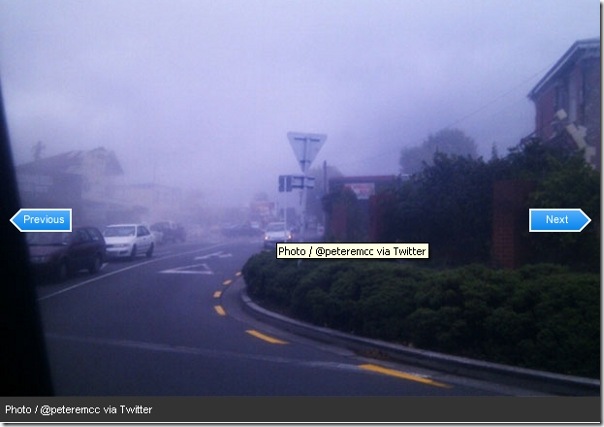
The dust cloud over the central city from damaged buildings is reminiscent of September 2001 – advice from authorities is to stay OFF the roads and OFF the phone – these are the life lines…

People will be afraid and frightened…check on neighbours and people around you…

BE SAFE!!

chch1

More images here

There have been ‘multiple fatalities’ after a shallow 6.3 magnitude earthquake in Christchurch this afternoon caused buildings to collapse, police have confirmed.

Police said fatalities had been reported at several locations and that two buses had been crushed by falling buildings.

Christchurch resident Jane Smith, who works in the central city, told the Herald a work colleague had just returned from helping rescue efforts after a building facade had collapsed on a bus on Colombo St.

“There’s people dead. He was pulling them out of a bus. Colombo St is completely munted.”

Police said there were reports of fires in buildings in the central city and of people being trapped.

All available police staff were helping with the rescue operation and the Defence Force had been called in to assist.

Triage centres have been established for the injured at Latimer Square in the central city, Spotlight Mall in Sydenham and Sanitarium in Papanui.

Shallow quake

GNS Science said the quake was centred at Lyttelton at a depth of 5km at 12.51pm.

GNS said the earthquake would have caused more damage than the original 7.1 earthquake on September 4 because of its shallow depth.

Its data centre manager Kevin Fenaughty said residents said the quake’s epicentre was located in the “worst possible location” for the city.

“It’s a nightmare. A lot of people were just getting back on their feet after the original quake.”

Another earthquake of 4.5 struck at 1.21pm, 10 km east of Diamond Harbour.

Streets flooded

Herald reporter Jarrod Booker said the shake lasted approximately a minute and was extremely violent – rocking buildings back and forth.

He said people had left buildings and were out on the streets where tarmac had cracked and water mains had burst, causing extensive flooding.

Tuam Street had become a river as water poured from ruptures in the road and was impassable in places.

The whole central city was in grid lock as people tried to evacuate central businesses to check their homes, Jarrod Booker said.

Most traffic lights are out and cars were also having to negotiate around hordes of people on foot.

Jarrod Booker said that he could hear sirens but that it would be difficult for emergency services to access the city because of the gridlock.

“Even sitting in a car you can feel continual shaking on a smaller scale than the original quake,” he said.

‘Great confusion’

Mayor Bob Parker said he was “thrown quite a distance” by the earthquake.

“That was, in the city central anyway, as violent as the one that happened on the 4th of September,” he told Radio New Zealand.

Mr Parker said there were scenes of “great confusion” on the streets, also saying the roads were jammed as vehicles sought to get out of the central city.

“I know of injuries in my building and there are unconfirmed reports of serious injuries in the city.”

Mr Parker did not know the extent of damage to the city’s infrastructure, but advised people not to drink the water supply.

“We’ve been through this before this once, we now need to think we did at that time.”

Buildings collapsed

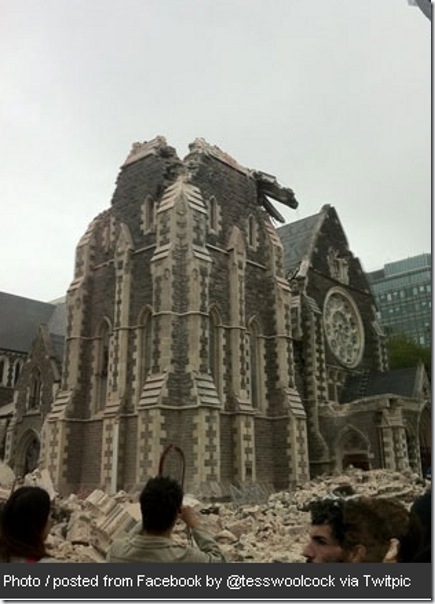
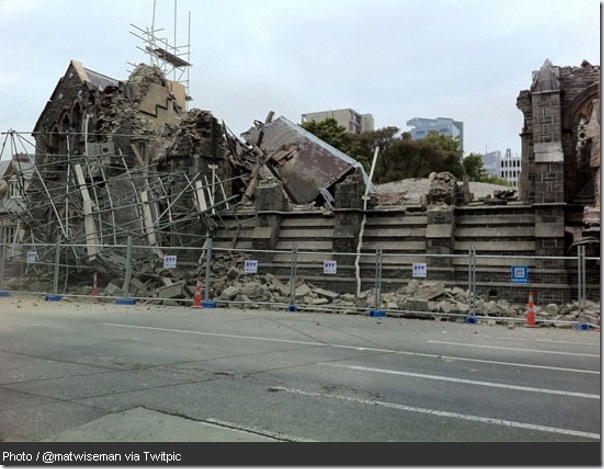
Jarrod Booker said Christchurch’s historic cathedral of the Blessed Sacrament on Barbadoes Street had half collapsed, with the remaining part of the building filled with cracks.

There was huge damage to other older buildings with large amounts of debris falling to the ground, he said.

He said the carpark at the Christchurch Star had turned into a river with huge cracks and that the roads had risen in areas.

People were comforting people outside amid a general state of shock as they tried to absorb what had happened, he said.

Radio New Zealand reported widespread damage to the city centre, with a church on Durham St collapsed and concrete lifted by up to a metre.

A Newstalk ZB reporter in Christchurch said liquefaction was spewing out of the ground at St Albans High School.

School kids had to be removed from the fields with liquefaction also spewing from the tennis courts.

Civil Defence response

Civil Defence spokesman Vince Cholewa said the National Crisis Centre had been activated and was preparing the Government response.

“The quake is significantly smaller than the previous Christchurch earthquake, however it was very shallow and might have been very close to the centre of the city,” he said.

Mr Cholewa was not aware of any casualties or the extent of the damage.

“We are still getting a picture of what has happened and we are aware of the details.”

Phone lines are down and calls are not being connected to emergency services. Telecom said it is working to understand which services have been affected by the earthquake and get these restored as soon as possible.

Christchurch Airport has been closed.

Today’s quake was shallower and closer to Christchurch than the original Darfield quake, which took place 30km west of the city at a depth of 33kms.

Civil Defence advice

The Civil Defence has issued the following advisory:

Check yourself first for injuries and get first aid if necessary before helping injured or trapped persons.

Assess your home or workplace for damage. If the building appears unsafe get everyone out. Use the stairs, not an elevator and when outside, watch out for fallen power lines or broken gas lines. Stay out of damaged areas.

Look for and extinguish small fires if it is safe to do so. Fire is a significant hazard following earthquakes.

Listen to the radio for updated emergency information and instructions.

Do not overload phone lines with non-emergency calls.

Help people who require special assistance – infants, elderly people, those without transportation, families who may need additional help, people with disabilities, and the people who care for them.

Detailed safety advice will come from local authorities and emergency services in the area. People should act on it promptly. MCDEM, local civil defence authorities and scientific advisors are closely monitoring the situation.

I hadn’t heard anything on this until Carmen called to tell me, hadn’t even felt the shake although it was apparently felt in Waiouru on the other side of the Mountain…unlike the stronger but deeper 7.1 that hit in September, today’s quake (think it is well beyond a ‘shake’) hit during a busy midday week day…the Cathedral has definitely been seriously damaged….

I thought the Prime Minister spoke well when he broke the news to the House and it looks like all the instruments of national power are swinging into action…that probably sounds a little trite but they have had quite a bit if for real practice in the last six months and Kiwis are fast learners…

The people that really count

What’s always puzzled me is that for all the bluster about these being population-centric wars, very few American reporters feel comfortable living with the people or listening to what they have to say.

These words were part of a comment by Carl Prine in response to the link posted up by Doctrine Man this morning  U.S. military to pass oversight of embedded reporters to Afghan security forces . My care factor over the subject of the article is fairly low – I think the whole embedded media idea is in need for a fairly severe overhaul to ensure that reporting is fair and truthful and that

a. isn’t simply a clumsy extension of the campaign information operations plan, and

b. protects the hosts from Mikey Yawn ‘biting the hands that fed them‘ or Paula Broadwell ‘I have ideas above my station‘ style embarrassments…

However, on the subject of population-centricity…

Image

…the Hector’s Dolphin population is much like the populations of in COIN theatres, places like Afghanistan, Iraq, Vietnam, Malaya, France, etc. Like those populations, the poor old Hector’s Dolphin can do what it likes to ensure the survival of its way of life but all that is largely meaningless without the support of the population(s) supporting the intervention/COIN campaign

In fact, when you think about it, much the same applies to the insurgent forces as well…without the support of the populations caring, caring nations like North Vietnam, Great Britain, Iran or Pakistan (yes, there will be a test later on to match up supporters with supported!), many, and most, insurgent campaigns would fade away like a five year old’s ice cream in the sun…and conversely, with the support of the COIN/intervention force domestic population, the same will occur. Perhaps, the melted ice cream could become the 21st Century version of the classic COIN inkspot, one that transforms rapidly into a sticky spot of the map that just attracts flies?

ImageSo, when we talk about population-centric warfare, we are not referring to the population of the nation, province or other area where the insurgency is physically occurring – or we shouldn’t be if we have a good handle on this COIN thing – but instead we should be referring to the populations that support their nation’s participation in any given COIN campaign. When these populations stop caring, either by simply allowing apathy to run its course, or by actively opposing support, that nation’s effective contribution to the campaign is doomed…

My Little Life: Live and Learn

My Little Life: Live and Learn.

In the link above, Mama M is angsting about apologies from two perspectives: one of considering that she had been over the top in criticising five day a week kindy, and another of educating her daughter on why an apology needs to be sincere and not just a compliance √.

Sometimes the bigger lessons of an apology are that little things that we can do may have longer and more lasting effects that we ever thought…

297247_2466759519196_1081767366_n

A teacher in New York was teaching her class about bullying and gave them the following exercise to perform. She had the children take a piece of paper and told them to crumple it up, stamp on it and really mess it up but do not rip it. Then she had them unfold the paper, smooth it out and look at how scarred and dirty is was. She then told them to tell it they’re sorry. Now even though they said they were sorry and tried to fix the paper, she pointed out all the scars they left behind. And that those scars will never go away no matter how hard they tried to fix it. That is what happens when a child bully’s another child, they may say they’re sorry but the scars are there forever. The looks on the faces of the children in the classroom told her the message hit home. Pass it on or better yet, if you’re a parent or a teacher, do it with your child/children.

Kinda trite but totally on the money, a mistake once made, deliberately or as an accident, be it an act of ommission or commission, can never be fully recalled and there will always be a slight edge where the wound once lay…Here’s an example of a good apology that I stumbled across the other night while considering this subject. Although we live rurally I’m no farmer (not one little bit) and so was scanning the pages of Straight Furrow for any potential useful bits of kit and equipment (aka farmer porn!)…

It’s been an awkward year for me, one of lost friends and shifting principles. I began the year as the dairy Farmers’ friend, saying they were doing all they could to clean up waterways.

I reeled off a list of on-farm clean-up actions they were taking to keep waterways clean. I quoted figures from the most recent report of the Clean Streams Accord, among them that casttle were fenced off from waterways on 84 percent of farms.

Then I found this figure was wrong.

Naively, perhaps, I did not realise that the accord relies on farmers honesty to report their own progress towards the agreement’s targets.

When the Primary Industries Ministry finally, after eight years, got round to checking for itself, its audit found a descrepancy. Only 42 percent of farms had fenced their waterways.

It was quite a shock. I beghan to think about the arguments from the Manawatu-Whanganui regional council for their prescriptive One Plan – that they’d had enough of asking farmers nicely to chnage their ways. They hadn’t listened and now it was tiem to force them to act.

After all, regulations had been needed to stop them pouring cowshed effluent into rivers some years earlier – they hadn’t voluntarily stopped that.

So, in March, just as the Land and Water Forum was meeting (unbeknownst to me), I changed my tune. I said:

“it’s seems obvious that we have too many cows in the most sensitive parts of the country – sandy, shingly, free-draining areas laced with streams, close to groundwater and big recreational rivers.

“and I think there’s no doubt that these cows are the main source of the excessive nutrients that are polluting rivers and lakes in these regions. The simple solution is to regulate a reduction in cow numbers.”

I suddenly found I had lost some of my old friends but gained a lot of new friends – all of the Green persuasion.

This was awkward. I’d railed against these people for years and here they were welcoming me as a new ally. I didn’t see it that way – still don’t. I’m not on their side. There’s much they say that I dodnot agree with.

The only side I’m on is that of you, my friend, the reader, who has the right to be as fully informed as possible about this important debate. And that’s been my intention all along. As the information – the science, expert views, farmers’ experience and other facts – has come to light I have given it to you. 

~ Over The Fence, Jon Morgan, Straight Furrow, Jan 22, 2013.

An example of a poor apology might be “Hey, Saddam, no WMD, huh? Our bad…” or “Maybe we could’ve thought this Arab Spring thing through a bit more…

  • It’s never too late to apologise but let’s be straight about it…sooner is better than later, and both a preferable to carry on as you’ve always done…how might things be different if:
  • People realised that when you have a hammer all you look for is nails and thus it took so long for common sense to break out in the prosecution of the campaigns in Iraq and Afghanistan?
  • The jet heads weren’t in control and the A-10 production line was not scrapped in favour of more fast jets – the same fast jets that are desperately seeking work..?
  • Someone said “F-35!! Enough already!!! Let’s can it!”

Hmmm….