It’s not logical…

On February 12th 1942, No 825 Squadron, based at RAF Manston, carried out a virtual suicide mission in an attempt lo damage or sink the Scharnhorst, Gneisenau, and Prince Eugen, and remove them from the Kriegsmarine’s order of battle when they made the infamous Channel Dash from Brest back to Germany. All six aircraft were lost for no effect on the enemy ships, but for the sheer courage shown in carrying out the attack, a posthumous award of the Victoria Cross was made to the CO of the Squadron Lieutenant Commander Eugene Esmonde, and the other aircrew were mentioned in dispatches, only five of the eighteen men involved in the attack survived. (c) http://www.marklittlejohn.com

@ Small War Council yesterday, I kicked off a thread The Dumbness of Oneness. Readers will, I’m sorry, have to pop over to Small Wars to view the original post and subsequent comments [edit: not anymore: PDFs below]. The short version is that I am challenging the industrial age mentality that is still so evident in much of our thinking, even after eight and a half years, 5000+ combat casualties and thousands of civilian victims of this ‘new war’ against takfiri jihadists of all races, religions and persuasions.

The Dumbness of Oneness pt 1 The Dumbness of Oneness pt 2

In the quotes in the thread, a theme emerged that perhaps the commanders from WW1 and WW2 actually had a far better handle on the art of war than those today who seek to make it a simple push-button science based more on Harvard Business School methodologies than the accumulated experience and lessons of history. War is not simple, not is it logical nor rational…it can not be distilled down to simple formulae and calculations that will determine the outcome of an engagement. War is about much more than a simple financial bottom line.

It was no more rational for 825 Squadron to fly into the German guns than it was for the New Zealand Division to break out from Minqar Qaim, the Marines to hold out at Wake, or for any of the hundreds of US CSAR missions in Vietnam and other conflict zones – these actions do not stack up in a balance sheet calculation that has no place for courage, camaraderie or commitment, no value that quantifies the human spirit. This is the myth of modern manoeuvre warfare – that achieving a position of dominance over a foe takes the place of actually defeating that opponent. History is as full of ‘sure thing’ plans that ended in tears as it is of desperate acts that paid off.

The myth of oneness is equally false. Although there is no dispute that there are advantages in common approaches and equipment, this should never be allowed to adversely affect effectiveness. Amanda Lennon stated at the New Zealand Chief of Army’s Conference last year that “…coalition interoperability requirements drive conceptual laziness…” and this is the risk of oneness as well: under the guise of interoperability, we create a bubble of dumbness that expands throughout an organisation. Driven by drives for efficiency, we forgot not so much how to do things but WHY we do them. We rationalise away the need for drill and colours and things as unnecessary in modern war, forgetting that they foster the courage, camaraderie and commitment that bolsters a force when the going gets really tough.

I surf the Get Frank site periodically, mainly because it has good competitions, and came across this editorial item Schama on New Zealand. In summarising, it states “…but beyond that, these people see only money. They measure the worth of a society solely in terms of GDP. As a result, they are utterly blind to our real achievements, and place no value on them…” This is not simply a question of core values although they are part of it. It is about remembering what is important in maintaining, nurturing and evolving the art of war…for there will come a time when we will face a foe is both prepared to and capable of going toe to toe with us in real War…where the blandness of oneness will be exposed at what cost?

Edit: 20 Nov 2018. The original Get Frank article is gone but I found a similarly-themed article from Simon Schama from the same period that also notes the value of diversity to New Zealand.

The New War #5 the new intelligences

…the game of chess, even three-dimensional chess, is simplicity itself compared to a political game using pieces that can change their minds independently of other pieces…” ~ Mr Spock, Garth of Izar, Pocket Books, 2003.

It being the twins’ birthday the weekend just gone, I was offline most of the weekend and it was only last night that I  saw a Stuff report of the contact involving Kiwi personnel in Afghanistan on Saturday “…a group using small arms fire and rocket-propelled grenades attacked a combined New Zealand and US patrol from the New Zealand provincial reconstruction team in the northeast of Bamiyan province…the patrol returned fire, driving the insurgents off after a 15-20 minute engagement…

There’s not much information in the Stuff article but with the recent changeover of Operation CRIB (the NZ PRT) contingents this might be simple cases of the local likely lads testing the mettle of the newest kids on the block – although ‘newest’ may be a bit of the stretch as some of these troops will be on their third or maybe even fourth deployment in this theatre…chatting with a colleague yesterday, the conversation turned to ‘what is an insurgent?‘ and ‘who says so?‘.

Obviously a lot of information on this contact has not been released but one wonders what confirmation there has been that the instigators of this attack were actually insurgents i.e. activists seeking to render political change through acts of violence. Or were they were something else? Perhaps…

a couple of lads out to impress some local lasses with their courage and prowess…?

or

some bored locals seeking to spice up a small ISAF patrol because they could…?

or

an attempt at ‘accidental insurgency’ to meet local quotas for attacks on the ‘infidel invaders’…?

As it appears in the Collateral Murder story released by Wikileaks last week, if you go out in the badlands looking for insurgents, then ‘insurgents’ are what you find, often with significant second order effects at both strategic and tactical levels. In all fairness, those who engaged the combined NZ/US patrol on Saturday may very well have been insurgents of some sort, possibly even more focused than accidental…but as attacks go in this theatre, it was in “…good country for ambushes…, “‘…driven off...” in “…15-10 minutes…” and was all over before air support arrived on the scene.

In places like Afghanistan, carrying an AK or an RPG does not necessarily an insurgent make, not does arcing up in the general direction of an ISAF patrol. So if the shooters have been confirmed as insurgents, which would be a an outstanding intel flash to bang noting the time between the attack and the NZDF media release, well and good…if not yet proven, then perhaps some less martial language would be more appropriate.

As David Kilcullen proposes in The Accidental Guerrilla and is further discussed in The New War #4 – Normalcy, the birth of an insurgent is a direct reaction to actions of host nation or foreign interventions…we need to understand not just the process of ‘accidentalisation’ but the local nuances and catalysts that often make incidents of  ‘accidentalism’ so distinct and different between different areas and groups.

I was interested to read in Wired that the UK is deploying its Defence Cultural Specialist Unit (DCSU) to Helmand Province. This may be an example of learning from the experiences of others, specifically the US Army’s Human Terrain Systems teams that have been operating for some years now. I was intrigued by the last paragraph in the Wired article “…the US Human Terrain System has seen its fair share of controversy. It will be worth watching this initiative as well to see if it provokes backlash among British social scientists…

I did some research into the HTS teams after mention of them appeared in one of the Interbella briefs. From what I saw then, I rated the HTS as a damn fine idea that’s time had definitely come; more so when it appeared to be a logical  consequence of Michael Scheiern’s platform- to individual-based transition model.

So, I was quite surprised to find the degree of active resistance within the anthropological community, or certainly a very vocal element within it, to the employment of HTS teams in operational theatres like Iraq and Afghanistan. I’ve yet to find a copy of Roberto Gonzalez’ Human Science and Human Terrain [note: I reviewed it later]. Gonzalez is reportedly critical of the US Army’s adoption of anthropological techniques to aid in the understanding and interpreting of contemporary operating environments. In all the reviews and articles I have read in the last day or so that support Gonzalez, I can find few threads of logic; instead I get a very real feeling of rampant prima-donnaism amongst what is really quite a small and relatively insignificant strand in the broader carpet of science. Indicative of this content are Fighting militarization of anthropology, The Leaky Ship of Human Terrain Systems, and The Dangerous Militarisation of Anthropology.

Another finding of the New Zealand COIN doctrine review was that intelligence in the complex environment will need to transformed to closer resemble police-style criminal intelligence (CRIMINT) focussed on a. individuals and b. providing fast and accurate response to an initiated action. This would require a clear shift, transformation even, from traditional military intelligence that is…

…focussed on conventional platforms and groupings, and

…driven largely by predictive philosophies.

Science and warfare have always gone together in an alliance that is both logical and inevitable. Eight years into the war on terror, there seems no reason why the CRIMINT finding does not stand true. We should also accept that sciences like anthropology offer us useful tools to assist with the uncertainty and complexity of the contemporary environment.

The moral objections of Manhattan Project scientists are somewhat strained when these same scientists were remarkably silent on such topics as the firebombing of German and Japanese cities, actions which causing far more civilian deaths than the atomic bombs ever did. The ‘do no harm‘ stance of Gonzalez and his fellow bleating liberal anthropologist cronies is sickening in both its naiveté and its preciousness. If this group really cared about those most likely to be harmed through misuse of social sciences, then surely they embrace the HTS concept as a practical and employable means of promoting greater precision of both information and effects in current theatres of operation?

Tied into the need to transform towards individually-focussed CRIMINT, was a need to better integrate operational analysis (OA) techniques into contemporary intelligence systems. These techniques would enhance and evolve pattern analysis processes to better grapple with the greater amounts of information in far greater detail than conventional intelligence systems were ever designed to manage. Unfortunately this finding seemed to die a death when the term ANALINT developed a perverse life all its own, alienating a proportion of the OA community.

In the last two decades, we have spent too long declaring war (lower case) on every real or imagined threat to western society that we have become somewhat blase and have forgotten what actual War really is. While the generation that sacrificed 5000 of its members in Afghanistan and Iraq may lead the way in remembering what War really is, it’s influence has yet to be felt…War is not nice, War is not safe…War is not a game…War is not something where we can artificially pick and choose based on what is convenient or suits at the time…

To artificially deny the utility of science like anthropology in winning the Wars we are in, to discard tools that save lives on BOTH sides, to dignify self-centred egotists like Gonzales is an insult to every one of those 5000…

http://www.stuff.co.nz/world/middle-east/3555243/US-military-can-t-find-its-copy-of-Iraq-killing-video

A busy chap

…that’s how I’d describe Curzon @ Coming Anarchy this week…in fact, I wonder if he was late getting his spring break leave app in and the other members of the team have bailed on him for a few weeks…? In Anyone Care For  A Burger?, he flags the decreasing public confidence and interest in global warming after a number of Climategate incidents that have called into question the science and method behind so much of the global warming literature and ‘studies’. I guess that ‘Be First With The Truth’ applies as much in the scientific community as it does elsewhere…
I saw the same STRATFOR article on Mexico as a failed state that Curzon comments in STRATFOR GOES CLINTONIAN ON MEXICO and had intended to make similar comments today (great minds…?). Like democracy and normalcy, failure is also in the eye of the beholder and totally subject to local conditions, expectations and cultures. One can actually sympathise with and even appreciate the Mexican Government’s pragmatic approach to a problem totally beyond its capacity to oppose, and one in which it is really on a way station between source and market. If the US is really that committed to the w(W)ar on drugs, then maybe it needs to look at turning off the tap at its end i.e. kill the market and thus the demand. Then the domestic and international distribution networks lose their raison d’etre – drugs is a business like any other and when the profits drop, the business dies…

If the US really is waging a War on drugs, then maybe someone in the Pentagon needs to reread Tom Clancy’s Clear and Present Danger for some tips on military means to stifle the flow of drugs. If we have little compunction about Predator and Reaper raids into various Middle East nations with varying levels of apparently acceptable collateral damage, then slipping a few extra lines into the ATO might give the cartels some food for thought…

And on the topic of ‘Truth’…

I stumbled across a link to the official report into the ‘accidental’ deaths of two Reuters reporters and a number of civilians in the Apache gunship attack discussed in Be First With The Truth the other day…it is an interesting read but one which ultimately reeks of whitewash. It notes that “…details that are readily apparent when viewed on a large video monitor are not necessarily apparent to the Apache pilots during a  live-fire engagement.  First of all, the pilots are viewing the scene on a much smaller screen…Secondly, a pilot’s primary concern is with flying his helicopter and the safety of his aircraft. Third, the pilots are continuously tracking the movements of friendly forces in order to prevent fratricide. Fourth, since Bravo Company had been in continuous contact since dawn, the pilots were looking primarily for armed insurgents. Lastly, there was no information leading anyone to believe or even suspect that non-combatants were in the area…” Taking each of those points in sequence…

Yes, the pilots were viewing the sensor imagery on a much smaller monitor in the Apache cockpit…but…the report also states that they were able to identify at least two other members of the group armed with AKMs and a RPG – detail that is not that discernible or obvious when the footage is viewed on a much larger monitor. Nitpicking but how does one discern between a AK-47 and AKM through graining gun camera footage?

Correct, a pilot’s primary concern is with flying his helicopter – that’s why the Apache and most other helicopter gunships since the damn things were invented carry a personality known as a gunner, or copilot/gunner (CPG), whose primary tasks is to manage the sensors, targeting and weapon systems.

OK, so the Apache crew is continuously tracking the movements of friendly forces. So what? That’s has nothing to do with the manner in which this incident played out other than in the avoid of fratricide which never seems to have been an issue here.

If the Apache crew was primarily looking for armed insurgents, then maybe they were only seeing what they expected and/or wanted to see – not what actually was there.

Why, after four years of fighting insurgency in Iraq would anyone not suspect let alone EXPECT the presence of non-combatants e.g. civilians, media, NGOs, etc in a large urban area. According to Chief of Operations at the time, MAJGEN Jim Molan in Running The War in Iraq, even during the final battle for Fallujah in 2005, US forces went out of their way to confirm the combatancy of targets before engaging them.

I’m sorry but this report reads as one where the objective from the start was clearly to butt-cover the Apache crew and not, in fact anything but, be first with the truth…

What was it all for?

Neptunus Lex provokes thought in Losing It…maybe America should just batten down and let the world go to hell in the proverbial hand-basket…? Somewhere down the track we need to objectively look at Iraq and Afghanistan, specifically the conduct of the wars there and LEARN for the next round – has anything really been achieved with these two long drawn-out campaigns or should the approach have more simplistically been “…just as soon as the invasion was done, we should have killed Hussein (and his sons), hand the reins over to the next guy, then said ‘don’t make us come back’….“?

Zombies Rule

I keep forgetting to post this link to a great show that Dean @ Travels with Shiloh put me onto…We’re Alive…that he has been following and that I have been downloading as my next big listen once I get through A Just Determination in a week or so…there’s at least twelve chapters to We’re Alive, each in three parts @20-30Mb, so you can only imagine fun I am having getting the parts – over the last fortnight I have so far managed to squeeze the first six parts through the dial-up straw…

So do Zulus…

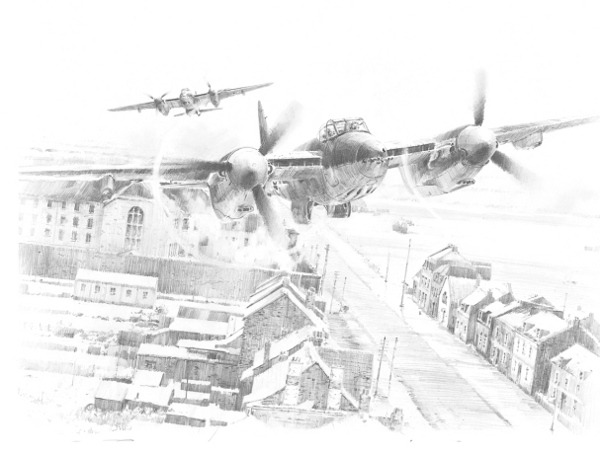
Peter @ The Strategist has a top review of Washing of the Spears, one of the best tellings of the Anglo-Zulu Wars of the late 19th Century that is well worth reading. One of the points that comes out in the comments regards the value of popular movies on historical events – regardless of the accuracy or even quality of the movie, it can often serve a useful secondary purpose in encouraging viewers to find out more about the back story. One example of this would be the 1969 movie Mosquito Squadron, a blatant rip-off of 633 Squadron (without even a rousing theme track), and not a good movie at all but one which has inspired many people, myself included to find out more about the real exploits of the Kiwi Mosquito squadrons in WW2 that pulled off precision strikes like the Amiens prison raid


Target Amiens Prison (c) Robert Taylor

…and here’s a list of links to the first six parts of Peter’s novel, The Doomsday Machine

Promises, promises

@ Small Wars there is a new article by Wilf Owen rather provocatively proposing that a ‘horde’ of 4WD armed with modern guided weapons could inflict significant damage to an Anglospheric brigade size force i.e. a Stryker Brigade or Armoured Cavalry Squadron. I’m not convinced – we have always been susceptible to myths of uber-weapons from the other side of the fence – remember the Hind super-helicopter killing machine that was going to sweep all before it in the 80s? – and think that we shouldn’t be selling ourselves short…

Wilf’s article is well-written and if the aim was to promote professional discussion, then it is probably successful and more power to anyone prepared to publicly put pen to paper rather than just lip off in the Mess/ O Club (if such things still exist).

If however, the aim was to actually promote a viable capability, then it has a long way to go. What really got my back up was the comment “…if any officer reading this cannot conceive of ways to inflict significant damage to a Stryker Brigade, or Armoured Cavalry Squadron; given 100 SUVs, 100 x ATGM + MANPADS and maybe 500 men; then they probably have no place in their chosen profession…” To me this is an unnecessary and somewhat arrogant (ignorant?) throwaway line that adds no value whatsoever. To turn it around, any officer that would allow such a force to do significant damage to a Anglospheric brigade probably needs to be relieved immediately, as does any unit commander in one of those formations that could wipe the floor with a Toyota horde.

The horde, if successful at all, would be a one hit wonder (anyone remember ‘Promises‘and Baby It’s You from the 70s – not just the lead singer’s ‘attributes’?) that would be easily countered. The terrain necessary for the horde to have any sort of practical mobility would also act against it and unless it could shelter behind the skirts of a large non-combatant population, it would be vulnerable to both ISR and engagement systems. Where the horde might be employable, would be a follow-on force to a more conventional ‘hammer’ to mop small outposts and stay-behind forces.

There is/will most likely be a place for swarming in near/far future conflicts but, at the moment, the concept still awaits some conceptual and technical developments. Ultimately, it could take us a number of steps closer to Heinlein’s Mobile Infantry concept that we aspired to in the mid-90s with the Empty Battlefield et al…

I had a long discussion with a compadre last night and one of the topics we touched on was the paucity of professional papers, other than those extracted by force as part of staff college compliance rituals, on topics of contemporary relevance, from authors down under – certainly there doesn’t seem to be any shortage of serving and former officers prepared to launch themselves into the arena in the Northern Hemisphere and the US Army probably leads in the development and publication of professional discussion, regardless of whether the concepts espoused follow political or doctrinal party lines. Having been privileged enough to have been invited to attend the Chief of Army’s Seminar at Massey University last year and corresponding with some of the speakers and attendees, I wonder, of the 200 or so uniformed attendees, how many have progressed any of the subjects discussed at the Seminar? It probably doesn’t help that the Massey web page for the Seminar exhibits a rather minimalist design philosophy and only links to recordings of the presentations with no transcripts or even speaker bios, let alone forums for further discussion – come on, guys, I think you need to up your game for the contemporary environment and the information age…!!!! It might be an interesting experiment, as I assume planning for the 2010 Seminar looms, to ask all the attendees for their two most enduring memories of the 2009 Seminar…

Oh, what to do…?

It’s all so confusing…I’m looking around for a portable computing device that lets me make notes and sketches away from the desktop PC in the study e.g. when I am away from home, even just popping down to the shop, or watching TV in the lounge so that the notes and sketches can be ported/synced directly back into the main PC. At the moment, I make a lot of my review notes on the good old legal pad and then manually transcribe them which takes more time that I have and eats significantly into productivity. I often forget to take a notebook with me when I leave the house as it always ends up back by the PC for transcription and stays there for my next foray out into the world…

I had thought that perhaps the iPad might be the answer but following up a link from Paper Modelers I’ve found that there are a range of new and impending technologies that might meet my needs…my gut feeling is that I’d be better off with something closer to a tablet than an iPhone so that I can read papers in closer to a traditional page format (am I turning into a fuddy-duddy?) and also so that I can also have a decent-sized work area for graphics…

Mmmmm….

Those from the Wellington IPMS community especially will know that I am a bit of an attention-seeker in my modelling procurements…in 2007, I was allowed to buy the Soar Art 80cm Railway Gun in 1/35 scale. It is very big and impressive – I can only just manhandle the box on my own – and I have been slowly assembling it. Like most people, I built the barrel first…

Yes, folks, the breech block is really the same size as a contemporary tank!! The barrel assembly is now painted and as complete as it needs to be for now and I have psyched myself up to start on the railway trucks that bear this monster but…somewhere in the course of domestic re-orgs that comprehensive instruction manual has gone west – no doubt it has been placed somewhere ‘safe’ – and I went to the Soar Art site to ask for a new manual. While there, I surfed through some of their partnered companies and stumbled into the world of Dust, a “…what-if world, a fictionary world based on our true history and mixed-up with science fiction…” and found this…

KV-152I Fury of Ivan – WOOF!!!!

…and I want one!!! Damn New Year’s resolutions….

Be First With The Truth

Who hasn’t seen these 38 minute long gun camera clip that this still was taken from? Released by Wikileaks this week, the clip graphically displays the killing of two journalist by a US Army Apache gunship crew in Iraq in 2007. The first thing to note is that these people were killed by the helicopter’s crew, the gunship is just the tool and without EDI-like artificial intelligence, the crew is the decision-making engine that decides to pull the trigger or not…in this case they opted to fire, based on what appears to be the flimsiest of ‘evidence’…
Wikileaks has established a specific site for this topic, named appropriately Collateral Murder, that has links to the full and abbreviated clips and the transcript of communications between the two crew members and US troops on the ground in the vicinity. It is certainly worth a look to draw your own conclusions.

While I don’t think that the smugness of Wikileaks founder, Julian Assange, (see wiki on Wikileaks) did anything to enhance his own credibility nor add anything to the story, I have to agree that, in this case, he is in the right to be blowing the whistle on this incident. It appears that the DoD was well aware of the incident at the time and cleared the gunship crew in an internal review process at the time. If that is the case, then there is clearly more to this story than meets the eye as they is nothing in the footage nor the transcript to support the this use of force.

No one denies that operations in any environment are challenging and often tough decisions have to made in a  split-second but this doesn’t seem to be one of those times. This is the warzone that Iraq was in 2004 and 2005 – this incident occurred post-surge in 2007 when, theoretically, the US had a good handle on both TTPs for the contemporary environment AND in training its people for that environment.

That the DoD chose to sit on this incident after conducting an internal whitewash is a clear indication that many of its staff still don’t ‘get it’ so far as this new and complex environment that we operate in. At the very least, this incident should have been reported as one of those things that happen in war, with apologies, condolences and reparations where applicable. However it is not unreasonable, noting the cavalier attitude of the gunship crew, that there is a case for willful negligence in these deaths – one definitely gets the feeling that both men were just looking for any excuse (not reason) to squeeze the trigger and nowhere is this made clearer than in the comment passed when ground troops reported that children had been injured “…Roger. Ah damn. Oh well…Well it’s their fault for bringing their kids into a battle…” With friendly troops on the ground, there appears no reason that other courses of action could not have been adopted to at the very least confirm the targets before engaging them…

While the use of force is a legitimate tool in Countering Irregular Activity, and ISAF’s squeamishness about directly engaging targets in the vicinity of hostile forces is another example of not ‘getting it’, this incident violates everything we try to teach about getting ahead in the contemporary environment….

Afterthought: how come the Marines never seem to have these kind of problems…?

Bursting Bubbles

I subscribed to Fast Company ten years ago and collected 4-5 years worth of the magazine. The trouble was that it is very advertisement-heavy which is not necessarily a bad thing in itself as many of the ads were insightful and thought-provoking in their own right; the problem was that each issue was really thick and at 12 issues + specials every year, the stacks weren’t getting any smaller. As stimulating as the articles were (and I assume still are) and despite my own proclivity for accumulating paper, something had to go and so Fast Company disappeared off my radar. I suppose I could have tried to keep track of it online but, dial-up connection or not, I struggle to maintain situational awareness with the current blog roll and distribution lists…

Curzon @ Coming Anarchy [a link to this article is at the bottom of the page, just in case end of the world, loss of Wayback machine etc] asks some questions about a Fast Company finding that the gap between our social and economic beliefs is much the same as when we are teenagers just setting out in the world, and when we hit middle age, even though the beliefs themselves are diametrically opposed. I think the answer to his question is pretty simple and that is consequences. As young people, we are often oblivious to the concept of consequences and wreak merry havoc with our lives and often those of others. If you took the Fast Company survey further, it is likely that you would find that the same permissive approach extends to just about every aspect of a young person’s life, not solely social and economic… in fact, the social and economic head line is a bit of a red herring

So the real finding is actually a lot simpler – when we are young, we take more risks, and are less considerate of consequences…by the time we hit middle age, we have been burned a few times, may be a lot of times and are only too familiar with the Newtonian inevitability of consequences…

Perhaps the real story behind the Fast Company report is the issue that I commented on at Travels with Shiloh earlier this morning…

Regardless of the topic, I think that root cause behind the issues you raise is that for well over a decade now, maybe two or even more, we have stopped teaching people how to think critically and objectively. Today the ‘rule’ is to seek that information that supports the case you want to put up and to ignore or mitigate that which does not. Once upon a time, we would consider all the information and draw a conclusion based upon what was, not what we wanted it to be…and if that meant our report did not reflect the beauty of the Emperor’s new cloths then so be it. Better a sour mouthful up front than a diet of sand later on…perhaps if some senior ‘thinkers’ had been more objective, the mess in Iraq would never have occurred and the campaign in Afghanistan would have been a done deal one way or another by the end of 2004.

The superficiality of many contemporary researchers and their reports was something we saw again and again in the lessons learned world; and it was only when ABCA developed the CLAW that some light appeared at the end of the tunnel. As of the 2009 CLAW, that light was clearly brighter as many participants already had their heads around the processes and the need to disregard the symptoms on the surface and drill into the core issues.

I keep harping on about the CLAW (and the follow-on OUTLAW process) because they are the only ones I have seen in ten years in the LL game that actually work and get to the heart of an issue. The key however is that you still need people with the honesty and courage to run with oft-unpopular and unpalatable findings…perhaps if the authors of this report in New Jersey gangs had stepped back from the issues a bit more and been a bit more open-minded they would have produced something more worth reading?

Maybe I’m on a bit of a roll today (possibly the effects of a long weekend and/or a number of large G&Ts last night – ran out of beer and it’s 40km to the local) but this also ties into my hobby-horsing over at Neptunus Lex about my most-hated quote “…amateurs study tactics, professionals study logistics…

I don’t think this post is really about logistics at all but I just have to add my 2 cents re that amateurs and professionals line…it is an absolute crock!! The log fraternity have spent two decades crowing from the top of their dung heap about how THEY won the Gulf War and have forgotten that, in the final outcome, they are but a supporting act to operations…

This is a theme that I have come across a number of times in my work in the last couple of weeks and I think that it is way past time that the loggies dragged themselves out of the Fulda Gap Railway Station and got into the 21st Century; stopped dictating what can and can not be done got into the game of supporting operations. My current bug bear is the falseness of ‘one fuel’ policies which might look all very nice and efficient in the hallowed halls of the G-4 (anyone’s G-4 not just that in the five-sided building) but which reduces effectiveness at the sharp end where operators are unable to introduce the niche capabilities needed for operations because they won’t run on the ‘one’ fuel…

In 2000, a MAJ Morris from the USMC wrote a staff paper on contemporary use of flying columns as part of OMFTS doctrine In it, he debunks many of the logistic myths/obstacles to operations, using Rommel and Monty as examples of a. just getting on with the job and b. keeping log staffs in their subordinate boxes…This is not to diminish the importance of logistics to successful operations just to keep it in perspective with other supporting functions like personnel, intel, plans, comms, training, and doctrine/lessons.

The Morris paper is a great read and I recommend it without reservation and more so because it was written pre-911 but still holds true through the lessons of Afghanistan and Iraq. It is delivered in three parts:

  • A general history of the use of flying columns in the 20th Century.
  • A dedicated case study on the SADF’s Operation MODULAR into Angola in 1984.
  • An exploration of how the flying column/bubble concept might be applied in a MEU or MEB.

Thinking out of the square, getting the facts and bursting conceptual bubbles…that’s what we need more off…

NOTE: updated 29 Aug 2022 to upload title graphic, update Coming Anarchy article link to the Wayback Machine, and add a PDF version of the article should the original link break again.

“Can’t handle half a year without a Whopper?”

J000117_2for10Whoppers_Website_Banner_Desktop_1800x760px_022

Today’s title is drawn from a comment in a Michael Yon Facebook item over the weekend:

Fast Food Purge in Afghanistan: It’s the end of the war as some people know it. In reality, there will be lots of places still open. There is a big pizza sit-down at KAF (the pizza is okay, too), and TGI Fridays and so forth. The shutdowns are limited. Most bases actually don’t have coffee shops, Pizza Huts and so forth. Only the mega-bases have such places.

It linked to this National Post article Tim Hortons escapes U.S. fast-food purge in Afghanistan. I have fond memories of the Tim Hortons on the Kingston waterfront. It was about the halfway point on our daily trek from our hotel to Fort Frontenac during the 2006 CLAW and a logical spot to stop off for our first real coffee each day.

I’m not sure if this ‘purge’ is part of the fallout from the Tarnak Bridge debacle where Michael Yon challenged the emphasis placed on maintaining the comforts of home on the FOB at Kandahar and, by implication, other mega-FOBs in Afghanistan; or whether GEN McCrystal, who maintains an austere lifestyle in Kabul, already intended to re-introduce a greater element of austerity into the mega-FOBs.

This move is long overdue. As McCrystal’s Command Sergeant Major states “…this is a war zone — not an amusement park…” By allowing some troops more of the comforts of home, typically those groups known endearingly as REMFs, pogues or fobbits, than other troops, typically those that go out to the sharp end, ISAF has introduced a major divisive element into its force. No matter how it is spun, it is simple human nature that such a disproportionate gap in the lifestyles of various groups of deployed soldiers will adversely affect morale and cohesion.

The article also makes a couple of other good points regarding the logistic effort needed to support these comforts, In case anyone hasn’t noticed, Afghanistan isn’t well-served by shipping lines or railways – most stuff that comes in, comes in by air “…what it comes down to is focus, and to using the resources we have in the most efficient and effective ways possible. Supplying non-essential luxuries to big bases like Bagram and Kandahar makes it harder to get essential items to combat outposts and forward operating bases, where troops who are in the fight each day need to be resupplied with ammunition, food and water…

I understand that the USAF faces similar issues with its US-based UAV operators who deploy virtually to the sharp end every day but return to the mundane issues and distractions of the real world at the end of each shift. Some operators were experiencing difficulty reconciling their work life where lives are often dependent on the UAVs to the stark contrast of domestic life each evening. It is now proposed that operators will deploy on-base for a ‘deployment’ period of some weeks in order to be able to better focus upon supporting the deployed forces.

The time for deployed troops to re-acquaint themselves with the niceties of the real world is when they go on leave out of theatre. Regardless of the length of deployment, trying to recreate these niceties in-theatre, unless at a secure leave centre, is just a recipe for disaster. That BK, Starbucks et al were ever allowed to establish themselves in the FOBs is indicative of the prevalent attitude in many sectors that Afghanistan is a war in lower case only. William Tecumseh Sherman had some thoughts on what war is…

You people speak so lightly of war; you don’t know what you’re talking about. War is a terrible thing!

I am sick and tired of fighting — its glory is all moonshine; even success the most brilliant is over dead and mangled bodies, with the anguish and lamentations of distant families, appealing to me for sons, husbands, and fathers …

Some of you young men think that war is all glamour and glory, but let me tell you, boys, it is all Hell!

Similarly, that Greatest Generation that defeated the Axis in World War 2 came to do a job, get it done and then go home again. They knew what they were there (wherever ‘there’ may have been) to do, and that to get home again, they had to do the job. Charles Upham commented once, when asked why he hated the Germans so much, that he just wanted to go back to his farm. The Germans stood between him and going back  to his farm. As he saw it, the sooner they ran out of Germans, the sooner he could go back to his farm. It’s tough to maintain that kind of commitment when the war has too many comforts…

Peace in our time?

Curzon @ Coming Anarchy comments on the results of the Iraqi elections. I suppose like many others, I daren’t hope that Iraq might actually pull this one off and stay the course it appears to be on. It would at least be some return on the investment in blood…

“Militias” – racist scum with wacky ideas

Read more at The Strategist – I agree with Peter on these nutjobs and the suggestion that they be harnessed as an instrument of national power…the instrument would probably be a banjo…I’m not so sure that I totally agree re citizen militia as the distinction between these and run of the mill nutjob militia is possibly a little fine. There is a mega-gap between citizen militia, a concept that probably did its dash with the gentlemen of Walmington-on-Sea, and the citizen armies that dealt to the Axis…

A ‘poor western to arab death ratio!’

Curzon @ Coming Anarchy recounts his adventures flying on local airlines around the Gulf…sounds like feigning sleep is the best option…and while on the topic of Curzon, I have yet to finish reading his biography. The reason that it is taking so long is not that it is hard work and difficult to read – if anything, exactly the opposite: although some of the content is quite dry, it is so well written that I find myself savouring it like a fine dessert…comparing it to more contemporary writing, I think that we have lost a lot in the fifty years since this book was published…

Also on Coming Anarchy, Younghusband reviews David Kilcullen’s The Accidental Guerrilla. He summarises:

For close readers of COIN and CT theory, I do not think this book will offer any new insight. Kilcullen’s contribution though is an excellent overview of the “social work with guns” theory of COIN, as well as a succinct presentation of the realist arguments for non-intervention and conservation of military power…The last few pages, where he presents his policy ideas, is really where practitioners can sink their teeth in. Lots of debating points there. For example:

    • develop a new lexicon to better describe the threat (rather than UW, COIN, irregular warfare etc)
    • discuss a new grand strategy (have an ARCADIA conference on terrorism)
    • balance capability (Why is DOD 210 times bigger than USAID and State?)
    • identify new “strategic services” (ie. a new OSS)
    • develop a capacity for strategic information warfare.

As readers will now from the work published here, these insights are nothing new although it is refreshing to see them in a mainstream publication. It’s unfortunate that the conceptual COIN effort in the US especially (most others are simply followers) is still largely fragmented and lies predominately in the domain of the information militia. The focus on the Iraqi insurgency in 2005-6 has caused the term COIN to be used interchangeably across the contemporary environment and that has caused many to apply inappropriate concepts, policies and doctrine to the issues they face. Our findings in 2007 were initially that the Marines had a better grip on the issue in developing the Countering the Irregular Threat (CIT) concept; and then that the UK encapsulated it even better with Countering Irregular Activity (CIA) which covers the broad spectrum of irregular (potentially destabilising) activities from all sources and causes, natural and man-made. The flip side of both CIT and CIA is the need for a comprehensive approach harnessing the appropriate and relevant instruments of national power including those on NGOs and commercial/corporate interests which usually fall outside the accepted definitions of NGO. These are all themes that we have been exploring in the series The New War.

Bears in the Air

QRA Scramble to Intercept Russian Blackjack_Aircraft MOD_45151233

Well…Blackjacks actually…in a timely reminder that there are more bad things out there than just some nutjob hiding in a cave inciting the masses with poor quality video…the Russian Bear is alive and well and still has aspirations of Empire, certainly under its current keeper…perhaps we ought not be so quick in cancelling programmes like F-22 and planning total reliance on a committee-designed one-size fits all hybrid like the F-35…wasn’t the last time we tried – and failed – at a ‘joint’ aircraft the infamous F-111 project that skewered the TSR.2, set back the Aussie strike programme by over a decade and saw a less-than-stellar combat debut in Vietnam…thank the maker for the F-4 Phantom that carried the resulting load for the better part of a decade.

And on the topic of potential threats, STRATFOR carries an item on Chinese speed wobbles as the US ramps up a comprehensive (or unified, if you went to that school) approach to a potential threat…like Japan, China has built an economy on a foundation of sand and hope and its starting to get wobbly…all the more reason to keep the F-22 fires stoked and warm up that A-10 production line (and do a naval variant this time round!)…on yes, and you might need some decent SPGs to replace the M109s that grandpappy used in Vietnam…and don’t be counting on your data links staying up all the time so have a think about leaving the seats in any new airfames you invest in for combat… Neptunus Lex also carries some comment on this article…

The top ten manly movies

John Birmingham has been busy…The Geek discusses what are the top ten manly movies…JB votes for these with my comments in red:

1. True Grit. (Yes, you must fill your hands with this sonofabitch). Absolutely!

2. Saving Pvt. Ryan. (Because war is hell good lookin’ on blu-ray wide screen). Nah!! Too much gratuitous violence in the beginning that adds nothing to the story and the meandering journey across France is just boring. Blackhawk Down delivers all the same messages better and is based on a true story.

3. Master and Commander. (Tips out Gladiator because nobody wears skirts). Agree re Master and Commander not Gladiator which I slot in below.

4. Casino Royale (the remake, and the manliest Bond flick EVAARRR!). Yep!

5. Treasure of the Sierra Madre. (Or any Bogart flick, except the ones with a love interest). Ummm…no…Bogey never quite did it for me…from this era I’d opt for The 39 Steps.

6. The Magnificent Seven. (Well duh. It is magnificent, you know). Yep!

7. The Dirty Dozen. (Or Kelly’s Heroes, if you prefer your war movies with a psychedelic twist). Or both…

8. Cool Hand Luke. (Because I say no man can eat fifty eggs). Hmmmm…whatever…ditch in favour of 633 Squadron, the best flying movie every made.

9. Raging Bull. (Or any movie about boxers or wrestlers. They’re all good.) Replace with Kelly’s Heroes.

10. 300. (Because this is Sparta). How come these guys get to wear skirts, JB? Replace with Gladiator.

Cheeseburger Gothic also hosts a nice piece of fan fiction from The Wave section of the Birmoverse.

Get it off!

Dean @ Travels with Shiloh has developed a new counter to female suicide bombers…I wonder if the cure might not be worse than the problem…?

In more serious news, he summarises a recent workshop at Princeton on Afghanistan – in terms of being out of AFG in 2011, I hope that someone is working on the chopper pad on top of the Embassy…I think we all must have slept through the lesson on COIN re the long haul – or maybe that lesson took place during the five year summer holidays in Iraq?

Where it all began

Peter has released a prologue to The Doomsday Machine…great to see a local lad doing so well at this authoring thingie…

I also like his comments re President Obama’s snub at Israel…but disagree on the credibility of commenting on a book one has not read…I used to be prone to making similar judgements especially on movies so missed Gladiator on the big screen and gave the first series of Dr Who a miss as well…that learned me!!

Who am I?

Portable Learner discusses ways and means of promoting oneself on LinkedIn, something that I have been wresting with recently as well. The options available are quite prescriptive and I don’t think that will change regardless of what’s on the list. Lists, I think, are an industrial age tools that we have yet to evolve away from and, like so much industrial age legacy material, they hold us back. I agree with Shanta that ‘internet’ is probably more descriptive of how one might think than its clinical definition might imply.

I also agree totally with her points re e-learning which is sliding back into industrial age slime instead of being the shining beckon of knowledge it once appeared to be. In order to “…design effective learn ing environments in a networked world…” we must sever the ties with industrial tools and focus on the information and it s nurturing and growth…This is one reason that I think that the US Navy may have ever so slightly lost it in merging its 2 (intel) and 6 (comms) branches into the Information Dominance Corps (IDC) – yes, for real!! I see a very real risk that the information under this structure will be overshadowed by the fears and rules of the technicians and we will lose that timely dissemination that we so desperately need…it maybe that the victims of this merger will see their op critical information become a commodity that is delivered IDC…In…Due…Course – a phrase straight from the repertoire of petty bureaucrats and mindless chair polishers…


Targeting

This STRATFOR article Jihadism and the Importance of Place arrived in the mail last night. It is so good that I believe it is worth repeating in its entirety. My only comment is that, while this report reflects success in the campaign against Al Qaeda and its affiliates, that is still but one campaign in the wider war against those who preach and practice takfiri phliosophies.

As an admin note, I have edited yesterday’s post because I realised this morning that I had skipped out the first paragraph….

STRATFOR Security Weekly March 25, 2010

By Scott Stewart

One of the basic tenets of STRATFOR’s analytical model is that place matters. A country’s physical and cultural geography will force the government of that country to confront certain strategic imperatives no matter what form the government takes. For example, Imperial Russia, the Soviet Union and post-Soviet Russia all have faced the same set of strategic imperatives. Similarly, place can also have a dramatic impact on the formation and operation of a militant group, though obviously not in quite the same way that it affects a government, since militant groups, especially transnational ones, tend to be itinerant and can move from place to place.

From the perspective of a militant group, geography is important but there are other critical factors involved in establishing the suitability of a place. While it is useful to have access to wide swaths of rugged terrain that can provide sanctuary such as mountains, jungles or swamps, for a militant group to conduct large-scale operations, the country in which it is based must have a weak central government — or a government that is cooperative or at least willing to turn a blind eye to the group. A sympathetic population is also a critical factor in whether an area can serve as a sanctuary for a militant group. In places without a favorable mixture of these elements, militants tend to operate more like terrorists, in small urban-based cells.

For example, although Egypt was one of the ideological cradles of jihadism, jihadist militants have never been able to gain a solid foothold in Egypt (as they have been able to do in Algeria, Yemen and Pakistan). This is because the combination of geography and government are not favorable to them even in areas of the country where there is a sympathetic population. When jihadist organizations have become active in Egypt, the Egyptian government has been able to quickly hunt them down. Having no place to hide, those militants who are not immediately arrested or killed frequently leave the country and end up in places like Sudan, Iraq, Pakistan (and sometimes Jersey City). Over the past three decades, many of these itinerant Egyptian militants, such as Ayman al-Zawahiri, have gone on to play significant roles in the formation and evolution of al Qaeda — a stateless, transnational jihadist organization.

Even though al Qaeda and the broader jihadist movement it has sought to foster are transnational, they are still affected by the unique dynamics of place, and it is worth examining how these dynamics will likely affect the movement’s future.

The Past

The modern iteration of the jihadist phenomenon that resulted in the formation of al Qaeda was spawned in the rugged mountainous area along the Afghan-Pakistani border. This was a remote region not only filled with refugees — and militants from all over the globe — but also awash in weapons, spies, fundamentalist Islamism and intrigue. The area proved ideal for the formation of modern jihadism following the Soviet withdrawal from Afghanistan in 1989, but it was soon plunged into Muslim-on-Muslim violence. After the fall of the communist regime in Kabul in 1992, Afghanistan was wracked by near-constant civil war between competing Muslim warlords until the Taliban seized power in 1996. Even then, the Taliban-led government remained at war with the Northern Alliance. In 1992, in the midst of this chaos, al Qaeda began to move many of its people to Sudan, which had taken a heavy Islamist bent following a 1989 coup led by Gen. Omar al-Bashir and heavily influenced by Hasan al-Turabi and his National Islamic Front party. Even during this time, al Qaeda continued operating established training camps in Afghanistan like Khaldan, al Farook and Darunta. The group also maintained its network of Pakistani safe-houses in places like Karachi and Peshawar that it used to direct prospective jihadists from overseas to its training camps in Afghanistan.

In many ways, Sudan was a better place for al Qaeda to operate from, since it offered far more access to the outside world than the remote camps in Afghanistan. But the access worked both ways, and the group received far more scrutiny during its time in Sudan than it had during its stay in Afghanistan. In fact, it was during the Sudan years (1992-1996) when many in the counterterrorism world first became conscious of the existence of al Qaeda. Most people outside of the counterterrorism community were not familiar with the group until after the August 1998 East Africa embassy bombings, and it was not really until 9/11 that al Qaeda became a household name. But this notoriety came with a price. Following the June 1995 attempt to assassinate Egyptian President Hosni Mubarak in Addis Ababa, Ethiopia (an attack linked to Egyptian militants and al Qaeda), the international community — including Egypt and the United States — began to place heavy pressure on the government of Sudan to either control Osama bin Laden and al Qaeda or eject them from the country.

In May 1996, bin Laden and company, who were not willing to be controlled, pulled up stakes and headed back to Afghanistan. The timing was propitious for al Qaeda, which was able to find sanctuary in Afghanistan just as the Taliban were preparing for their final push on Kabul, bringing stability to much of the country. While the Taliban were never wildly supportive of bin Laden, they at least tolerated his presence and activities and felt obligated to protect him as their guest under Pashtunwali, the ancient code of the Pashtun people. Al Qaeda also shrewdly had many of its members marry into influential local tribes as an added measure of security. Shortly after returning to Afghanistan, bin Laden felt secure enough to issue his August 1996 declaration of war against the United States.

The rugged and remote region of eastern and northeastern Afghanistan, bordered by the Pakistani badlands, provided an ideal area in which to operate. It was also a long way from the ocean and the United States’ ability to project power. While al Qaeda’s stay in Afghanistan was briefly interrupted by a U.S. cruise missile attack in August 1998 following the East Africa embassy bombings, the largely ineffective attack demonstrated the limited reach of the United States, and the group was able to operate pretty much unmolested in Afghanistan until the October 2001 U.S. invasion of Afghanistan. During their time in Afghanistan, al Qaeda was able to provide basic military training to tens of thousands of men who passed through its training camps. The camps also provided advanced training in terrorist tradecraft to a smaller number of selected students.

The U.S. invasion of Afghanistan radically changed the way the jihadists viewed Afghanistan as a place. U.S. military power was no longer confined to the Indian Ocean; it had now been brought right into the heart of Afghanistan. Instead of a place of refuge and training, Afghanistan once again became a place of active combat, and the training camps in Afghanistan were destroyed or relocated to the Pakistani side of the border. Other jihadist refugees fled Afghanistan for their countries of origin, and still others, like Abu Musab al-Zarqawi, left Afghanistan for the badlands of northern Iraq — which, as part of the U.S. no-fly zone, was out the reach of Saddam Hussein, who as a secular leader had little ideological sympathy for the jihadist cause.

Pakistan’s rugged and remote Pashtun belt proved a welcoming refuge for jihadists at first, but U.S. airstrikes turned it into a dangerous place, and al Qaeda became fractured and hunted. The group had lost important operational leaders like Mohammed Atef in Afghanistan, and its losses were multiplied in Pakistan, where important figures like Khalid Sheikh Mohammed were captured or killed. Under extreme pressure, the group’s apex leadership went deep underground to stay alive.

Following the U.S. invasion of Iraq in March 2003, Iraq became an important place for the jihadist movement. Unlike Afghanistan, which was seen as remote and on the periphery of the Muslim world, Iraq was at its heart. Baghdad had served as the seat of the Islamic empire for some five centuries. The 2003 invasion also fit hand-in-glove with the jihadist narrative, which claimed that the West had declared war on Islam, and thereby provided a serious boost to efforts to raise men and money for the jihadist struggle. Soon foreign jihadists were streaming into Iraq from all over the world, not only from places like Saudi Arabia and Algeria but also from North America and Europe. Indeed, we even saw the core al Qaeda group asking the Iraqi jihadist leader, Abu Musab al-Zarqawi, for financial assistance.

One of the things that made Iraq such a welcoming place was the hospitality of the Sunni sheikhs in Iraq’s Sunni Triangle who took in the foreign fighters, sheltered them and essentially used them as a tool. Once the largesse of these tribal leaders dried up, we saw the Anbar Awakening in 2005-2006, and Iraq became a far more hostile place for the foreign jihadists. This local hostility was fanned by the brutality of al-Zarqawi and his recklessness in attacking other Muslims. The nature of the human terrain had changed in the Sunni Triangle, and it became a different place. Al-Zarqawi was killed in June 2006, and the rat lines that had been moving jihadists into Iraq were severely disrupted.

While some of the jihadists who had served in Iraq, or who had aspired to travel to Iraq, were forced to go to Pakistan, still others began focusing on places like Algeria and Yemen. Shortly after the Anbar Awakening we saw the formation of al Qaeda in the Islamic Maghreb (AQIM) and a revitalization of the jihadists in Yemen, who had been severely weakened by a November 2002 U.S. missile strike and a series of arrests in 2002-2003. Similarly, Somalia also became a destination where foreign jihadists could receive training and fight, especially those of Somali or other African heritage.

And this brings us up to today. The rugged borderlands of Pakistan continue to be a focal point for jihadists, but increasing pressure by U.S. airstrikes and Pakistani military operations in places like Bajaur, Swat and South Waziristan have forced many foreign jihadists to leave Pakistan for safer locations. The al Qaeda central leadership continues to lay low, and groups like the Taliban and al Qaeda in the Arabian Peninsula (AQAP) have taken over the leadership of the jihadist struggle on the physical battlefield. As long as the ideology of jihadism persists, transnational and itinerant jihadist militants will continue to operate. Where their next geographic center of gravity will be hinges on a number of factors.

Geographic Factors

When one looks for prime jihadist real estate, one of the first important factors (as in any real estate transaction) is location. Unlike most home buyers, though, jihadists don’t want a home near the metro stop or important commuter arteries. Instead, they want a place that is isolated and relatively free of government authority. That is why Afghanistan, the Pakistani border region, the Sulu Archipelago, the African Sahel and Somalia have all proved to be popular jihadist haunts.

A second important factor is human terrain. Like any militant or insurgent group, the jihadists need a local population that is sympathetic to them if they are to operate in numbers larger than small cells. This is especially true if they hope to run operations such as training camps that are hard to conceal. Without local support they would run the risk of being turned in to the authorities or sold out to countries like the United States that may have put large bounties on the heads of key leaders. A conservative Muslim population with a warrior tradition is also a plus, as seen in Pakistan and Yemen. Indeed, Abu Musab al-Suri, a well-known jihadist strategist and so-called “architect of global jihad,” even tried (unsuccessfully) to convince bin Laden in 1989 to relocate to Yemen precisely because of the favorable human terrain there.

The importance of human terrain is very evident in the Iraq example described above, in which a change in attitude by the tribal sheikhs rapidly made once welcoming areas into hostile and dangerous places for the foreign jihadists. Iraqi jihadists, who were able to fit in better with the local population, were able to persist in this hostile environment longer than their foreign counterparts. This concept of local support is one of the factors that will limit the ability of Arab jihadists to operate in remote and chaotic places like sub-Saharan Africa or even the rainforests of South America. They are not indigenous like members of the Revolutionary Armed Forces of Colombia or Sendero Luminoso, and differences in religion and culture will impede their efforts to intermarry into powerful tribes as they have done in Pakistan and Yemen.

Geography and human terrain are helpful factors, but they are not the exclusive determinants. You can just as easily train militants in an open field as in a dense jungle, so long as you are unmolested by an outside force, and that is why government is so important to place. A weak government that has a lack of political and physical control over an area or a local regime that is either cooperative or at least non-interfering is also important. When we consider government, we need to focus on the ability and will of the government at the local level to fight an influx of jihadism. In several countries, jihadism was allowed to exist and was not countered by the government as long as the jihadists focused their efforts elsewhere.

However, the wisdom of pursuing such an approach came into question in the period following 9/11, when jihadist groups in a number of places began conducting active operations in their countries of residence. This occurred in places like Indonesia, Saudi Arabia, Morocco and even Egypt’s Sinai Peninsula, where jihadist groups joined al Qaeda’s call for a global jihad. And this response proved to be very costly for these groups. The attacks they conducted, combined with heavy political pressure from the United States, forced some governments to change the way they viewed the groups and resulted in some governments focusing the full weight of their power to destroy them. This resulted in a dynamic where a group briefly appears, makes a splash with some spectacular attacks, then is dismantled by the local government, often with foreign assistance (from countries like the United States). In some countries, the governments lacked the necessary intelligence-gathering and tactical capabilities, and it has taken a lot of time and effort to build up those capabilities for the counterterrorism struggle. In other places, like Somalia, there has been very little government to build on.

Since the 9/11 attacks, the U.S. government has paid a lot of attention to “draining the swamps” where these groups seek refuge and train new recruits. This effort has spanned the globe, from the southern Philippines to Central Asia and from Bangladesh to Mali and Mauritania. And it is paying off in places like Yemen, where some of the special counterterrorism forces are starting to exhibit some self-sufficiency and have begun to make headway against AQAP. If Yemen continues to exhibit the will to go after AQAP, and if the international community continues to enable them to do so, it will be able to follow the examples of Morocco, Saudi Arabia and Indonesia, countries where the jihadist problem has not been totally eradicated but where the groups are hunted and their tactical capabilities are greatly diminished. This will mean that Yemen will no longer be seen as a jihadist haven and training base. The swamp there will have been mostly drained. Another significant part of this effort will be to reshape the human terrain through ideological measures. These include discrediting jihadism as an ideology, changing the curriculum at madrassas and re-educating militants.

With swamps such as Yemen and Pakistan slowly being drained, the obvious question is: Where will the jihadists go next? What will become the next focal point on the physical battlefield? One obvious location is Somalia, but while the government there is a basket case and controls little more than a few neighborhoods in Mogadishu, the environment is not very conducive for Somalia to become the next Pakistan or Yemen. While the human terrain in Somalia is largely made up of conservative Muslims, the tribal divisions and fractured nature of Somali society — the same things that keep the government from being able to develop any sort of cohesion — will also work against al-Shabaab and its jihadist kin. Many of the various tribal chieftains and territorial warlords see the jihadists as a threat to their power and will therefore fight them — or leak intelligence to the United States, enabling it to target jihadists it views as a threat. Arabs and South Asians also tend to stick out in Somalia, which is a predominately black country.

Moreover, Somalia, like Yemen, has broad exposure to the sea, allowing the United Stated more or less direct access. Having long shorelines along the Indian Ocean and the Gulf of Aden, it is comparatively easy to slip aircraft and even special operations teams into and out of Somalia. With a U.S. base in Djibouti, orbits of unmanned aerial vehicles are also easy to sustain in Somali airspace.

The winnowing down of places for jihadists to gather and train in large numbers continues the long process we have been following for many years now. This is the transition of the jihadist threat from one based on al Qaeda the group, or even on its regional franchise groups, to one based more on a wider movement composed of smaller grassroots cells and lone-wolf operatives. Going forward, the fight against jihadism will also have to adapt, because the changes in the threat will force a shift in focus from merely trying to drain the big swamps to mopping up the little pools of jihadists in places like London, Brooklyn, Karachi and even cyberspace. As discussed last week, this fight will present its own set of challenges.

The New War #4 Ethos and Values

Peter McIntyre, The breakthrough, Minqar Qa'im, 27-28 June 1942

While searching for something totally unrelated, I cam across this extract from a Department of Corrections handbook which i think fits nicely into today’s item on ethos and values and their relevance and importance to successfully navigating the complexity and uncertainty of the contemporary environment. [yes, this paragraph was added AFTER the initial post when I realised that I had skipped off the opening paragraph from my original paper.]

What is culture?

Every culture:

  • has its own internal logic, coherence and integrity
  • has an intertwined system of values, attitudes, beliefs and norms that give meaning and significance both to the individual and group identity
  • is equally valid as a variation of human experience, and
  • provides the individual with some:
    • sense of identity
    • regulation of behaviour, and
    • sense of personal belonging.

All persons are to some extent bound by culture.

Our army relies upon other nations for a large proportion of its military doctrine, and has been referred to as the ‘doctrinal packrats of ABCA‘. This is a pragmatic and sensible approach based upon its limited resources to develop – and maintain – a complete library of national land operations doctrine; and upon the reasonable degree of conceptual commonality between the ABCA ‘Tight Five’. We are the only ABCA member to rely so heavily on externally sourced doctrine and thus have created a unique publication to manage this.

P(ublication) 50 Land Operations Doctrine consists of three parts:

Part One.  This details the management/development requirements and processes for Land Operations Doctrine.

Part Two.  An on-line dynamic database of authorised Land Operations publications.

Part Three. An on-line dynamic database of non-authorised Land Operations publications.

Why P50 and not 7, 42 or 657? No idea but rumour has it that the Army got a good deal on the original Lotto ball selector…

Part 2 is the authority for any land operations publication or other reference to be used i.e. if it’s not listed, it doesn’t get used. The flip side of this is that there is a short loop system in place for rapid approval of publications for general or specific use.

Right then, one of the trends we noted during the COIN Review was the high rate of turn-over of COIN/CIA/CIT-related concepts and that much of the cutting edge material was less in traditional doctrine publication format and more in the form of papers, blogs, articles, etc and short-loop doctrine notes. The operating environment was also noted as being far more complex and theatre-specific than in the good old days of the Fulda Gap. How then to control what and how doctrine was applied, managed and controlled by end-users?

In formal coursing in schools and units, it seemed fairly simple: the authority is Part 2 of the P50 as this is developing the science; similarly in collective training in units where there will be more flexibility to develop more the ‘art’, the Part 2 remains in vogue although is tempered by the experience and training of company and unit commanders; but what to do on operations? Clearly dogmatic adherence to the P50 failed to provide the flexibility to meet the demands of an operational contingency, but equally clearly there is a need to provide a degree of national guidance.

The penny dropped during a doctrine brief to a warrant officers course where this question was discussed. A student stood up and stated with total conviction that “…what counts when the heat is on, is what’s in the heart, not in the head…” He felt that you could have all the disciplinary and compliance mechanisms on the planet, but when the pressure is on, an individual, or even a group, will be most guided by their ethos and values. This is why setting and maintaining standards starts the minute a recruit steps off the bus at the recruit training centre and doesn’t stop until it is well embedded – ideally it will be an ongoing and enduring process throughout their career, be it for three or for thirty years…thus…

Doctrine is the body of knowledge on the nature, role and conduct of military operations. The Concise Oxford Dictionary defines doctrine as “…what is taught, body of instruction; religious, political, scientific, etc, belief, dogma, or tenet…” It is that simple: doctrine is the foundation of what is:

Developed in individual training,

Practised and further develop in collective training, and

Applied with judgement on the job.

Doctrine guides our actions in support of national objectives and is an important element of capability. Doctrine is not a black and white set of rules for success: it is guidance that should be tailored to account for the factors unique to each situation and requires judgment in application. Management and mitigation of risk is what we do and all personnel must be prepared to make decisions based upon the current situation but supported by the foundation of doctrine and experience developed through training.

When the situation is for real, be it on operations or in routine activity, it is the commanders and soldiers on the spot who must combine the science and art into making the right decisions and doing the right thing – here, where it really counts, it is how well we have embedded the ethos of Courage, Commitment, Camaraderie and Integrity (C3I) that ultimately defines how a solder or officer will react and respond under pressure.

Personally, I think that there should be a fourth ‘C’, for Competence, otherwise you may have a bunch of well-intentioned numpties running around the mission space but that’s another story…

The use of terminology like “…on the job…” and “…when the situation is for real...” instead of perhaps the original “…on operations…” recognises that real decisions are made very day, not juts when the start line is crossed, and that we want soldiers to make considered decisions all the time, to resist the easy path of least resistance…I’ve quoted Jerry Pournelle here before on this theme “…the hardest decisions is probably the right decision…

While ethos-driven decision-making may be a quality we would like to think that all soldiers apply all the time, it is far more vital in the contemporary environment than it ever was in the mass-oriented doctrine of the Fulda Gap. As covered in The New War #1 the new war is the war of the individual where one poor decision by one individual or group can have far-reaching and perhaps strategic consequences. Much as I hate compliance for its own sake, it may be that we accord ethos and culture the same level of emphasis in peacetime training as we do shooting and job-specific skills maintenance; AND that we practice it continually to both reinforce and develop the attributes and also to identify perhaps those who can’t make the cut…

When we talk about cultural sensitivity training for force generation, it’s already too late: force generation should focus on developing those mission-specific skills and capabilities for the assigned mission NOT on things that should be part of daily routine. If the ethos and culture is not embedded by the end of recruit or officer training, then it is not likely to ever truly take hold. When the bean-counters rock and want to cut training, ethos and culture has to be a keeper. I actually think we could save way more and become far more effective if we just got rid of the bean-counters…

Just like it is sometimes difficult to justify the retention of drill as a core skill, so it may be challenging to justify a high emphasis on intangibles like ethos and values…right up to the point where the brown stuff hits the spinny-round thing…