Unknown's avatar

About SJPONeill

Retired(ish) and living on the side of a mountain. I love reading and writing, pottering around with DIY in the garden and the kitchen, watching movies and building models from plastic and paper...I have two awesome daughters, two awesome grand-daughters and two awesome big dogs...lots of awesomeness around me...

Sadness and gladness of the Last Post

Lest We Forget

This was an editorial in one of the national newspapers for Anzac Day 1997…I can’t find any notes I may have made identifying the paper or the author…

The Last Post always makes me cry. I can’t help it. There is something in those crisp clear notes ringing out in the sharp-edged air of ANZAC morning that takes my breath away. It sets up a curious chemical reaction in the soul, where sadness and gladness are fused together and one is lifted out of oneself and into the unending reverberations of history.

The bugler speaks to the dead – the “glorious” dead – inscribed on countless cenotaphs and roadside memorials from one end of New Zealand to another. Not that there is anything glorious about dying. In the paintings of our country’s battles, the death of young men, far from home, in agony and fear, is seldom portrayed with much accuracy. We spare ourselves the horrors of war – and rightly so. Veterans of the real thing seldom speak of what they have seen and heard lest their words conjure up again the screams, the blood, the shattered flesh, the cries of “Mother!”.

The Last Post speaks to the silence beyond death; the space in which we contemplate the meaning of the final “sacrifice”. The Last Post asks us to ask ourselves “What did these young men die for?”

When I was a little boy, I would spend my ANZAC Days drawing pictures of soldiers climbing up the rocky hillsides of the Dardanelle’s. And, over the vivid colours of the battle scenes, I would print in the laborious hand of the young: “For King and Country”.

I do not think that there are many today who would die for the House of Windsor. But, in the silent crowds of young New Zealanders – more every year – who join the old diggers on ANZAC morning, I sense a longing to serve, to sacrifice, to give something back to their country.

The generations of New Zealanders born after World War II have been spared what the United Nations charter calls “the scourge of war”. It is a mixed blessing. To be sure, we have never had to hold our friends in our arms and watch them die or receive a telegram informing us of the death of a loved one. But neither have we experienced the powerful sense of unity with which a nation at war is infused, not the bonds of comradeship forged when men and women from all walks of life are brought together and transformed into a  fighting force.

Most importantly, the post-war generations will never know what it feels like to play for history’s highest stakes – when the issues of ultimate significance hung in the balance.

I often ask myself: “Is political activism a substitute for war?” “What is it that we go on protest ‘marches’?” “Why do we seek out those moments of ‘confrontation’?” When we see that line of helmeted police officers, their long batons drawn; when we experience that lonely thrill of fear, that sudden rush of adrenalin, are we not, in our own way, playing soldiers?

People often ask me: “What’s wrong with today’s young people? Why aren’t they protesting like we did?” My answer is brutally simple: “Because of what we did” Our generation has reduced those “issues of ultimate significance ” – Roosevelt’s “four freedoms” (freedom of speech, freedom of conscience, freedom from want, freedom from fear) down to just one: the freedom to buy and sell. Once a year, on ANZAC Day, we call forth the dead and invoke the myths that animate our nation. In the half-light of dawn, as the bugler draws out our tears and we “remember them”, remember the living also, and never forget that there are greater things to die for than a balance sheet.

And remembering other soldiers in another war…


Into the ether!!

I don’t monitor the release of these publications on a daily basis as I used to do when doctrine was my job and only became aware of this one when the link arrived in an email last night. I haven’t read it in full yet as I need to first finish Roberto Rodrigez’ little orange book (I don’t think Chairman Mao need worry about the competition) American Counterinsurgency: Human Science and the Human Terrain, and Amanda Lennon’s Fourth Generation Valkyries. However I do have some initial thoughts based upon the foreword…

The  assessment  indicates  that  the  Army’s  current  vocabulary,  including  terms  such  as computer network operations (CNO), electronic warfare (EW), and information operations (IO) will  become  increasingly  inadequate.    To  address  these  challenges,  there  are  three  interrelated dimensions  of  full  spectrum  operations  (FSO),  each  with  its  own  set  of  causal  logic,  and requiring focused development of solutions:

•   The  first  dimension  is  the  psychological  contest  of  wills  against  implacable  foes, warring factions, criminal groups, and potential adversaries.

•   The  second  dimension  is  strategic  engagement,  which  involves  keeping  friends  at home, gaining allies abroad, and generating support or empathy for the mission.

•   The  third  dimension  is  the  cyber-electromagnetic  contest,  which  involves  gaining, maintaining, and exploiting a technological advantage.

My first thought is why has this been produced as a single service publication when information cuts across service and other organisational boundaries and barriers – can one safely assume that the other services and JFCOM will be producing its own slant on challenges and conflict in cyberspace?

Thought #2 is that the first two dimensions above are really nothing more than the day-to-day rhythm of the contemporary environment, and have been for decades. The third dimension strikes me as being a new environment much 90-100 years ago as the military came to grips with operations in the air. It’s about much much more than mere technological advantages – it’s about strategy and tactics, training and equipment, and, above all, an open-minded approach a la that of Guderian, Fuller, Mitchell and de Gaulle…

Deserts are good

Territorial Force Annual Camp, January 84, Tekapo Training Area

…even the little ones we have down here…and so I’m a little aggrieved at the information in this editorial at Get Frank – although the picture in the article is rather inaccurate – the MacKenzie Country really is brown…good solid Kiwi tussock country and also home to a training area of which I have many fond memories (time dulls the pain of blistered feet, sunburned faces and fingers cracked and dried digging in the rock-filled ground). The last thing it needs is to be ‘developed’ so a few more investors can make a quick buck and shufty it offshore…

Shaken not Stirred

Not happy to hear that the next Daniel Craig 007 has been put on hold due to troubles aboard the MGM mothership…

High Adventure

Having a crack at chili sardines tonight – aptly enough it’s Masterchef night – if there aren’t any updates for a while, then the experiment didn’t go well…

Ethos of a rat

That was a search that got someone here yesterday…”Oh“, I thought, “someone else doing a search on Michael Yon…” Follow his Facebook page…the guy just gets better and better…and is better entertainment than Shortland Street

…he’s now decided that GEN McCrystal is mounting an information war against him – if so, he should remember who fired the first shots…

McChrystal’s crew has declared an information war on me. No complaints here. McChrystal’s attention is welcome. It indicates that my posts have hit steel further underlines that McChrystal is over his head. If McChrystal knew what he was doing, he would not be drawing attention to his staff. Will provide compelling evidence in due course. Some of the officers on McChrystal’s staff are my biggest helpers….

…he continues his vendetta against Canadian BGEN Daniel Menard for watching hockey, allegedly letting a key bridge be attacked, and now after BGEN Menard had an accidental discharge from his rifle at KAH…word on the street is he may have been trying to resolve Yon in a more direct manner! In typical Yon fashion, though, his accusations are riddled with errors: the incident did not occur aboard a US (or anyone else’s) helicopter nor was there any risk to VIPs who may or may not have been in the group…

A couple of interesting Canadians told me that Brigadier General Daniel Menard accidentally fired his rifle inside of an American helicopter. Sources said he nearly shot with automatic fire a high Canadian official at point-blank and hit the American helicopter while it was preparing to take off. The claim sounded wild, but I live on instincts and it sounded like it might have basis in fact. And so I began checking about a day ago.

I am intensely uncomfortable with this dishonest, incompetent general leading U.S. combat troops in a hot war. That Menard happens to be Canadian complicates matters. This is business for Secretary Gates. Today, I will write a letter to Secretary Gates and another to General Petraeus expressing my concerns as an American citizen.

…joining the anti-Yon conspiracy cabal is the milbloggers community none of whom have the credibility, knowledge or experience of Michael Yon…

Bottom line questions: How many milbloggers who were not on active duty (hence sent to the war as a troop) have spent more than a year in the wars? I know of zero. Does one exist? The milblogging community is largely a hurricane of hot air.

There are some good and responsible writers working milblogs but most of them are less accurate than the MSM they oppose.

Please name the top five milblogs — and one person from each — who has spent a year (less than 15% of the war) as a civilian journalist/writer inIraq/Afghanistan. Start with http://www.longwarjournal.org/ and Blackfive. People who are seriously tracking the war seriously don’t track these guys.

He also challenges The Guardian’s Alison Banville for daring to state “…the boast of “greater reality” attached to embedding is a falsehood which actually clouds the vision of anyone attempting to make sense of a conflict…” in Embedded war reporting cannot escape its own bias. It’s an interesting and on-target article and well worth reading…which is more than can be said for Yon’s latest series of diatribes against anyone who dares questions his Yonness…really, Mike, you make the information militia look soooo bad…

Really, I only bother with this guy because the shallowness and selfishness of his comments reminds me of me as a young lippy soldier with too much too say but then I grew up…although it was what one might call an ‘assisted’ growing up phase with a goodly chunk of the ‘assisting’ coming from the top soldiers of 8 Platoon, Charlie Company, 2/1 RNZIR in 1985…just realised that was a whole quarter of a century ago…I feel old now…

Heading Home – HEREKINO SAFARI – April 1985

On Curzon

I started Leonard Mosley’s Curzon in January and only finished it early this morning. It’s not a big book, only some 300 or so pages, but it is a very good book and I have been savouring it as one might a fine wine or one of our butterscotch puddings. Even the paper in was printed on in 1960 is of a quality far removed from the recycled egg-crate material used in publishing today.

I found Curzon an interesting read, more so against the current backdrop of more former colonies descending back into anarchy and chaos. As untrendy or politically palatable that colonialism may be perceived today, there is a certain inescapable logic in his belief that “… that Englishmen, let alone Scotsmen, Welsh, Indians and other lesser breeds, had [not] earned the right to equality with those who had spent their lives and their brains in learning to rule them…” as I commented in January. Funnily enough, as  speak, it is just being announced on Breakfast that New Zealand is signing up to the UN declaration on the Rights of Indigenous Peoples…

Curzon covers a period of British history, the early 20s, that is not well-known nor particularly well covered in popular media. Whether Curzon himself would have been a better Prime Minister than Baldwin, Law or Lloyd-George whom he despised, is debatable but his biography offers a fascinating insight into some of the other key players and events of this time. Mosley is scathing about the (lack of) ability of A.J. Balfour, of Balfour Declaration notoriety “…for rarely in the history of British statesmanship can there have been a man who cared less about the eventual results of the aims and objects of the policies he espoused…” So very right as we still reap the results of Balfour’s ambivalence in the Middle East…

I see in the search results in the blog stats page that someone today was searching for “…curzon by leonard mosley…“. If that person revisits this blog, I’d love to learn more of their interest in Curzon

Afghanistan’s new owners?

In the inbox last night was an update from Sicuro Group covering Iran’s call for NATO and ISAF to withdraw from Afghanistan in favour of a regionally based force. Normally I take articles from this source with a pinch of salt, more because their ‘assessment’ is usually a statement of the blindingly obvious stated with the pretension of original thought. But I thought that this call from Iran was interesting…

The Iranian president has called on the US to withdraw its troops from the Gulf region and Afghanistan.

“The region has no need for alien troops and they should return home and let the regional states take care of their own affairs,” President Mahmoud Ahmadinejad said in a speech marking the country’s annual Army Day on Sunday.

“They must leave the region and this is not a request but an order and the will of the regional nations,” he said.

The president said the deployment of US and NATO troops in Iraq and Afghanistan under the pretext of fighting terrorism had not only failed but also increased insecurity in both countries.

Assessment : The US–NATO campaign in Afghanistan receives brickbats and laurels at the same time. While some countries are opposed to the US withdrawal beginning next year, Iran mounts attacks on the US, urging it to withdraw immediately from Afghanistan and the Gulf region. Turkey also threatens to disassociate with NATO forces if more civilian casualties occur in military offensives.

Maybe Iran is doing a France and looking for a colony in which to test its new nukes…? Could be a win-win situation for everyone…

A little update

A month or so, I mentioned catching up with the designer of the FX bike, an ultralight-weight motorcycle that in addition to being a great fun tool, also has considerable potential for military and security work – certainly in any environment where there are obstacles that would defeat a normal size bike like a KLR, and/or where there may be a required for mobility within tight space/weight limits, for example, on small boats or light aircraft.

Since then, I have had a number of chats with Mike @ FX Bikes as he prepares to shift offshore to the more commercially viable US market…it’s not so much the size of the Kiwi market that’s the big issue but the lack of commercial production facilities down here… Mike is also preparing FX Bikes as an investment opportunity and is seeking professional investors to take FX Bikes to the next level. Professional investors are those types you see lined up on Dragon’s Den, grilling potential entrepreneurs til they are well done…

Having seen the FX Bike and as a former rider who struggled to negotiate logs, ditches, fences etc with his Army-issue XL250, I think it is a damn fine example of Kiwi ingenuity and one worthy of further development and investment…

The Renovations

The big job over the last week or so has been walling in the study so that we can secure it over those periods when we lease the Lodge out…really just converting it from a mezzanine to a room proper…it’s a pretty simple job but I’ve just spent most of today removing the first attempt at Gib-stopping as the seam paper has lifted in a  number of areas and to guarantee the seam from future cracks, it’s better to do it again. That means tons of sanding and oodles of dust all through the living area; between sanding and cleaning, I’ve not had much time for blogging and am not likely to for most of the week. Updates will be short and sharp until normal services are resumed…

The Pacific

Part Two starts in a  few minutes. I like it, although it’s not yet offering Band Of Brothers any competition in this family, and will be interested to see how it develops. My standard for tales of the Marines in the Pacific remains Leon Uris’ Battle Cry and I’m about to lend my latest copy (have worn out at least two previous copies) to #1 daughter to read…

Three strikes…

War journalist and active blogger, Michael Yon, has been disembedded from US forces in Afghanistan. As the saying goes, what goes around, comes around…while Yon offers a valuable hearts and minds service to families of deployed service people, his conduct as a precious prima donna with a predilection for shooting from the lip has obviously not made him any friends in GEN McCrystal’s headquarters.

The saga unraveled on Facebook (the dates may be a little out owing to the dodgy datestamps that Facebook applies to posts):

10 April. Got word from military today. Am being disembedded as of 30 April. No idea why. Not a big deal. Not going to fight it this time. Will cover Battle for Kandahar from outside the wire from the Afghan perspective. (Still some dispatches in the pipeline.)

Lunch with Afghans was not so good today. Just bread, rice and taters. The beans usually are good but they were out. Insofar as being disembedded, it’s been said that I’ve spent more time with the military at war than anyone in U.S. history. I do not know that this is true but it sounds good. It’s been a long road that I’ve been lucky to survive. Am looking forward to more work outside the wire.

11 April. Have sent a message to Public Affairs:

Response from military re embed cancellation just arrived. Important to consider that I invested heavily in time/expense to stay with 5/2 SBCT to the end. I came at invitation of 5/2 SBCT and they understood that I was coming for a long embed. Having done this work more than anyone during at least the last two wars, I strongly believe that this decision had to be blessed by a General officer. Will say it clearly: I do not trust General McChrystal or his PAO staff to honestly report to the American public.

I must leave Afghanistan to get a visa and will come back alone. Important to bear in mind that though I am best known for my work with troops, have spent a great deal of time outside the wire. Have written far less about that time, but it has informed my writing and the record is clear that I have called the trajectory of Iraq and Afghanistan as well or better than anyone, and typically far ahead of the pack. This comes from hard work and constant study of the people involved. (Not studying what they say, but what they do and who they are.)Operating with combat troops is very, very dangerous. It is in fact a relief to me (if unfortunate for readers) to get the boot; my chances of emerging from the war with all my arms, legs, eyes and life are probably 5x higher when going alone. There is a journalistic-swagger to going alone which is perpetuated by those who refuse or mostly refuse to go into combat. Reality is that danger and discomfort typically are far higher with combat troops. I know the military side very well. Contacts are vast and varied. Going alone will hardly diminish my access to intelligence, opinions, and operations. I just won’t be getting shot at or picking up arms and legs after a bomb.

So this is Adios to combat with the military, and Hello to streets of Afghanistan and elsewhere, and to halls of influence in power centers around the world where the decisions are made.

This email just in from Public Affairs:

First, thanks for all the great work you’ve done since arriving in February. I hope the three months you’ve spent here was what you hoped for and that you’ve gotten all the support you’ve needed.  Unfortunately, we have an extremely long wait list of other professional journalists (81!) that we need to give an opportunity. We’d love for you to come back at some point and I wish you the best in your remaining time here and safe travels in the future.

12 April. Got messages today from high level that military reversed decision on my embed and can stay. Unfortunately I have already made definitive moves to leave. To change now would be expensive and would likely upset others. This work is expensive in every way. Not smart to change directions so quickly. Too late. Also had to kindly decline to go back with British. Carpet has been pulled out from my feet for final time.

13 April. Email just sent to General McChrystal’s Media Man:

Rear Adm. Smith,
I’m a writer embedded with U.S. Forces in RC-South. RC-South PAO recently apprised me that the embed was ended. This happened precipitously and for dubious cause. Cited cause: embed overcrowding. I rarely see journalists. Those journalists I see have been doing drive-by reporting. Having embedded before, the PAO pattern is familiar and predictable.
Am with 5/2 SBCT. It was agreed, as prerequisite of my coming back with infantry, that I would stay with 5/2 to RIP. As a matter of business, these moves are expensive and time consuming. When the military fails to uphold its side, persistent problems are created from air.
After extracting from the field to KAF after PAO notification, was told by 5/2 Commander that I am welcome to stay. I am considering this offer but need assurance by your office that PAOs will go through you before disembedding me.
And so it’s down to you, Sir.
Shall I stay or shall I go?
Very Respectfully,


Michael Yon

15 April. Response came in from Rear Admiral Smith (General McChrystal’s Media Man): Michael, I understand both the IJC and HQ ISAF PA shops are aware and working to resolve. They should be back to you shortly. ATB, GjS

McChrystal’s crew has spoken: Embed is ended. This comes from McChrystal’s own spokesman (through one CPT Jane Campbell USN cc RADM Greg Smith and COL Wayne Shanks USA). This lends confirmation to ideas that the disembed came from McChrystal’s crew. (If not before, 100% now.) McChrystal cannot be trusted to tell the truth about this war. Packing my bags.

The disembed from McChrytal’s top staff (meaning from McChrystal himself) is a very bad sign. Sends chills that McChrystal himself thinks we are losing the war. McChrystal has a history of covering up. This causes concern that McChrystal might be misleading SecDef and President. Are they getting the facts?

Bottom line? Good riddance… Michael Yon needs to go away for a while, get a life and consider his relationship with the hand that feeds him. Maybe all the adulation from his fans has gone to his head and he actually has begun to believe that he is some kind of water-walking super-journo but he’s had his three strikes and then some with his public attacks on US allies in Afghanistan like Canada and Spain, his recent attacks on President Karzai (he is probably right but there are limits to what am embed can write), and his accusations of dishonesty in the highest echelons of GEN McCrystal’s headquarters. While I don’t agree with the current Cursed Earth strategy in Afghanistan, it is a big leap from there to the dishonesty and corruption claimed by Yon.

Perhaps when Michael Yon grows up a little, he may realise that the easiest way to deal with a thorn in one’s side is to rip it out and discard it. All the good Michael Yon has done promoting the human side of this war, has been undone by his inability to bite his tongue and see a bigger picture and a world that does not revolve around him. In time, I hope he does come back, but wiser and stronger…

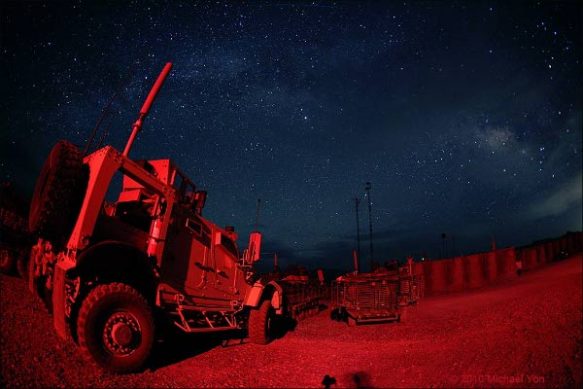
FOB Frontenac, Afghanistan. Under an early morning sky, a red glow is cast from the lights on an Air Force water drilling rig. (c) Michael Yon 28 March 2010

Edit: Michael Yon has pointed that my original Tui on his disembedment gave the impression that he had stated “I am a victim” which he had not so I have amended the ‘billboard’ accordingly.

It’s not logical…

On February 12th 1942, No 825 Squadron, based at RAF Manston, carried out a virtual suicide mission in an attempt lo damage or sink the Scharnhorst, Gneisenau, and Prince Eugen, and remove them from the Kriegsmarine’s order of battle when they made the infamous Channel Dash from Brest back to Germany. All six aircraft were lost for no effect on the enemy ships, but for the sheer courage shown in carrying out the attack, a posthumous award of the Victoria Cross was made to the CO of the Squadron Lieutenant Commander Eugene Esmonde, and the other aircrew were mentioned in dispatches, only five of the eighteen men involved in the attack survived. (c) http://www.marklittlejohn.com

@ Small War Council yesterday, I kicked off a thread The Dumbness of Oneness. Readers will, I’m sorry, have to pop over to Small Wars to view the original post and subsequent comments [edit: not anymore: PDFs below]. The short version is that I am challenging the industrial age mentality that is still so evident in much of our thinking, even after eight and a half years, 5000+ combat casualties and thousands of civilian victims of this ‘new war’ against takfiri jihadists of all races, religions and persuasions.

The Dumbness of Oneness pt 1 The Dumbness of Oneness pt 2

In the quotes in the thread, a theme emerged that perhaps the commanders from WW1 and WW2 actually had a far better handle on the art of war than those today who seek to make it a simple push-button science based more on Harvard Business School methodologies than the accumulated experience and lessons of history. War is not simple, not is it logical nor rational…it can not be distilled down to simple formulae and calculations that will determine the outcome of an engagement. War is about much more than a simple financial bottom line.

It was no more rational for 825 Squadron to fly into the German guns than it was for the New Zealand Division to break out from Minqar Qaim, the Marines to hold out at Wake, or for any of the hundreds of US CSAR missions in Vietnam and other conflict zones – these actions do not stack up in a balance sheet calculation that has no place for courage, camaraderie or commitment, no value that quantifies the human spirit. This is the myth of modern manoeuvre warfare – that achieving a position of dominance over a foe takes the place of actually defeating that opponent. History is as full of ‘sure thing’ plans that ended in tears as it is of desperate acts that paid off.

The myth of oneness is equally false. Although there is no dispute that there are advantages in common approaches and equipment, this should never be allowed to adversely affect effectiveness. Amanda Lennon stated at the New Zealand Chief of Army’s Conference last year that “…coalition interoperability requirements drive conceptual laziness…” and this is the risk of oneness as well: under the guise of interoperability, we create a bubble of dumbness that expands throughout an organisation. Driven by drives for efficiency, we forgot not so much how to do things but WHY we do them. We rationalise away the need for drill and colours and things as unnecessary in modern war, forgetting that they foster the courage, camaraderie and commitment that bolsters a force when the going gets really tough.

I surf the Get Frank site periodically, mainly because it has good competitions, and came across this editorial item Schama on New Zealand. In summarising, it states “…but beyond that, these people see only money. They measure the worth of a society solely in terms of GDP. As a result, they are utterly blind to our real achievements, and place no value on them…” This is not simply a question of core values although they are part of it. It is about remembering what is important in maintaining, nurturing and evolving the art of war…for there will come a time when we will face a foe is both prepared to and capable of going toe to toe with us in real War…where the blandness of oneness will be exposed at what cost?

Edit: 20 Nov 2018. The original Get Frank article is gone but I found a similarly-themed article from Simon Schama from the same period that also notes the value of diversity to New Zealand.

The New War #5 the new intelligences

…the game of chess, even three-dimensional chess, is simplicity itself compared to a political game using pieces that can change their minds independently of other pieces…” ~ Mr Spock, Garth of Izar, Pocket Books, 2003.

It being the twins’ birthday the weekend just gone, I was offline most of the weekend and it was only last night that I  saw a Stuff report of the contact involving Kiwi personnel in Afghanistan on Saturday “…a group using small arms fire and rocket-propelled grenades attacked a combined New Zealand and US patrol from the New Zealand provincial reconstruction team in the northeast of Bamiyan province…the patrol returned fire, driving the insurgents off after a 15-20 minute engagement…

There’s not much information in the Stuff article but with the recent changeover of Operation CRIB (the NZ PRT) contingents this might be simple cases of the local likely lads testing the mettle of the newest kids on the block – although ‘newest’ may be a bit of the stretch as some of these troops will be on their third or maybe even fourth deployment in this theatre…chatting with a colleague yesterday, the conversation turned to ‘what is an insurgent?‘ and ‘who says so?‘.

Obviously a lot of information on this contact has not been released but one wonders what confirmation there has been that the instigators of this attack were actually insurgents i.e. activists seeking to render political change through acts of violence. Or were they were something else? Perhaps…

a couple of lads out to impress some local lasses with their courage and prowess…?

or

some bored locals seeking to spice up a small ISAF patrol because they could…?

or

an attempt at ‘accidental insurgency’ to meet local quotas for attacks on the ‘infidel invaders’…?

As it appears in the Collateral Murder story released by Wikileaks last week, if you go out in the badlands looking for insurgents, then ‘insurgents’ are what you find, often with significant second order effects at both strategic and tactical levels. In all fairness, those who engaged the combined NZ/US patrol on Saturday may very well have been insurgents of some sort, possibly even more focused than accidental…but as attacks go in this theatre, it was in “…good country for ambushes…, “‘…driven off...” in “…15-10 minutes…” and was all over before air support arrived on the scene.

In places like Afghanistan, carrying an AK or an RPG does not necessarily an insurgent make, not does arcing up in the general direction of an ISAF patrol. So if the shooters have been confirmed as insurgents, which would be a an outstanding intel flash to bang noting the time between the attack and the NZDF media release, well and good…if not yet proven, then perhaps some less martial language would be more appropriate.

As David Kilcullen proposes in The Accidental Guerrilla and is further discussed in The New War #4 – Normalcy, the birth of an insurgent is a direct reaction to actions of host nation or foreign interventions…we need to understand not just the process of ‘accidentalisation’ but the local nuances and catalysts that often make incidents of  ‘accidentalism’ so distinct and different between different areas and groups.

I was interested to read in Wired that the UK is deploying its Defence Cultural Specialist Unit (DCSU) to Helmand Province. This may be an example of learning from the experiences of others, specifically the US Army’s Human Terrain Systems teams that have been operating for some years now. I was intrigued by the last paragraph in the Wired article “…the US Human Terrain System has seen its fair share of controversy. It will be worth watching this initiative as well to see if it provokes backlash among British social scientists…

I did some research into the HTS teams after mention of them appeared in one of the Interbella briefs. From what I saw then, I rated the HTS as a damn fine idea that’s time had definitely come; more so when it appeared to be a logical  consequence of Michael Scheiern’s platform- to individual-based transition model.

So, I was quite surprised to find the degree of active resistance within the anthropological community, or certainly a very vocal element within it, to the employment of HTS teams in operational theatres like Iraq and Afghanistan. I’ve yet to find a copy of Roberto Gonzalez’ Human Science and Human Terrain [note: I reviewed it later]. Gonzalez is reportedly critical of the US Army’s adoption of anthropological techniques to aid in the understanding and interpreting of contemporary operating environments. In all the reviews and articles I have read in the last day or so that support Gonzalez, I can find few threads of logic; instead I get a very real feeling of rampant prima-donnaism amongst what is really quite a small and relatively insignificant strand in the broader carpet of science. Indicative of this content are Fighting militarization of anthropology, The Leaky Ship of Human Terrain Systems, and The Dangerous Militarisation of Anthropology.

Another finding of the New Zealand COIN doctrine review was that intelligence in the complex environment will need to transformed to closer resemble police-style criminal intelligence (CRIMINT) focussed on a. individuals and b. providing fast and accurate response to an initiated action. This would require a clear shift, transformation even, from traditional military intelligence that is…

…focussed on conventional platforms and groupings, and

…driven largely by predictive philosophies.

Science and warfare have always gone together in an alliance that is both logical and inevitable. Eight years into the war on terror, there seems no reason why the CRIMINT finding does not stand true. We should also accept that sciences like anthropology offer us useful tools to assist with the uncertainty and complexity of the contemporary environment.

The moral objections of Manhattan Project scientists are somewhat strained when these same scientists were remarkably silent on such topics as the firebombing of German and Japanese cities, actions which causing far more civilian deaths than the atomic bombs ever did. The ‘do no harm‘ stance of Gonzalez and his fellow bleating liberal anthropologist cronies is sickening in both its naiveté and its preciousness. If this group really cared about those most likely to be harmed through misuse of social sciences, then surely they embrace the HTS concept as a practical and employable means of promoting greater precision of both information and effects in current theatres of operation?

Tied into the need to transform towards individually-focussed CRIMINT, was a need to better integrate operational analysis (OA) techniques into contemporary intelligence systems. These techniques would enhance and evolve pattern analysis processes to better grapple with the greater amounts of information in far greater detail than conventional intelligence systems were ever designed to manage. Unfortunately this finding seemed to die a death when the term ANALINT developed a perverse life all its own, alienating a proportion of the OA community.

In the last two decades, we have spent too long declaring war (lower case) on every real or imagined threat to western society that we have become somewhat blase and have forgotten what actual War really is. While the generation that sacrificed 5000 of its members in Afghanistan and Iraq may lead the way in remembering what War really is, it’s influence has yet to be felt…War is not nice, War is not safe…War is not a game…War is not something where we can artificially pick and choose based on what is convenient or suits at the time…

To artificially deny the utility of science like anthropology in winning the Wars we are in, to discard tools that save lives on BOTH sides, to dignify self-centred egotists like Gonzales is an insult to every one of those 5000…

http://www.stuff.co.nz/world/middle-east/3555243/US-military-can-t-find-its-copy-of-Iraq-killing-video

A busy chap

…that’s how I’d describe Curzon @ Coming Anarchy this week…in fact, I wonder if he was late getting his spring break leave app in and the other members of the team have bailed on him for a few weeks…? In Anyone Care For  A Burger?, he flags the decreasing public confidence and interest in global warming after a number of Climategate incidents that have called into question the science and method behind so much of the global warming literature and ‘studies’. I guess that ‘Be First With The Truth’ applies as much in the scientific community as it does elsewhere…
I saw the same STRATFOR article on Mexico as a failed state that Curzon comments in STRATFOR GOES CLINTONIAN ON MEXICO and had intended to make similar comments today (great minds…?). Like democracy and normalcy, failure is also in the eye of the beholder and totally subject to local conditions, expectations and cultures. One can actually sympathise with and even appreciate the Mexican Government’s pragmatic approach to a problem totally beyond its capacity to oppose, and one in which it is really on a way station between source and market. If the US is really that committed to the w(W)ar on drugs, then maybe it needs to look at turning off the tap at its end i.e. kill the market and thus the demand. Then the domestic and international distribution networks lose their raison d’etre – drugs is a business like any other and when the profits drop, the business dies…

If the US really is waging a War on drugs, then maybe someone in the Pentagon needs to reread Tom Clancy’s Clear and Present Danger for some tips on military means to stifle the flow of drugs. If we have little compunction about Predator and Reaper raids into various Middle East nations with varying levels of apparently acceptable collateral damage, then slipping a few extra lines into the ATO might give the cartels some food for thought…

And on the topic of ‘Truth’…

I stumbled across a link to the official report into the ‘accidental’ deaths of two Reuters reporters and a number of civilians in the Apache gunship attack discussed in Be First With The Truth the other day…it is an interesting read but one which ultimately reeks of whitewash. It notes that “…details that are readily apparent when viewed on a large video monitor are not necessarily apparent to the Apache pilots during a  live-fire engagement.  First of all, the pilots are viewing the scene on a much smaller screen…Secondly, a pilot’s primary concern is with flying his helicopter and the safety of his aircraft. Third, the pilots are continuously tracking the movements of friendly forces in order to prevent fratricide. Fourth, since Bravo Company had been in continuous contact since dawn, the pilots were looking primarily for armed insurgents. Lastly, there was no information leading anyone to believe or even suspect that non-combatants were in the area…” Taking each of those points in sequence…

Yes, the pilots were viewing the sensor imagery on a much smaller monitor in the Apache cockpit…but…the report also states that they were able to identify at least two other members of the group armed with AKMs and a RPG – detail that is not that discernible or obvious when the footage is viewed on a much larger monitor. Nitpicking but how does one discern between a AK-47 and AKM through graining gun camera footage?

Correct, a pilot’s primary concern is with flying his helicopter – that’s why the Apache and most other helicopter gunships since the damn things were invented carry a personality known as a gunner, or copilot/gunner (CPG), whose primary tasks is to manage the sensors, targeting and weapon systems.

OK, so the Apache crew is continuously tracking the movements of friendly forces. So what? That’s has nothing to do with the manner in which this incident played out other than in the avoid of fratricide which never seems to have been an issue here.

If the Apache crew was primarily looking for armed insurgents, then maybe they were only seeing what they expected and/or wanted to see – not what actually was there.

Why, after four years of fighting insurgency in Iraq would anyone not suspect let alone EXPECT the presence of non-combatants e.g. civilians, media, NGOs, etc in a large urban area. According to Chief of Operations at the time, MAJGEN Jim Molan in Running The War in Iraq, even during the final battle for Fallujah in 2005, US forces went out of their way to confirm the combatancy of targets before engaging them.

I’m sorry but this report reads as one where the objective from the start was clearly to butt-cover the Apache crew and not, in fact anything but, be first with the truth…

What was it all for?

Neptunus Lex provokes thought in Losing It…maybe America should just batten down and let the world go to hell in the proverbial hand-basket…? Somewhere down the track we need to objectively look at Iraq and Afghanistan, specifically the conduct of the wars there and LEARN for the next round – has anything really been achieved with these two long drawn-out campaigns or should the approach have more simplistically been “…just as soon as the invasion was done, we should have killed Hussein (and his sons), hand the reins over to the next guy, then said ‘don’t make us come back’….“?

Zombies Rule

I keep forgetting to post this link to a great show that Dean @ Travels with Shiloh put me onto…We’re Alive…that he has been following and that I have been downloading as my next big listen once I get through A Just Determination in a week or so…there’s at least twelve chapters to We’re Alive, each in three parts @20-30Mb, so you can only imagine fun I am having getting the parts – over the last fortnight I have so far managed to squeeze the first six parts through the dial-up straw…

So do Zulus…

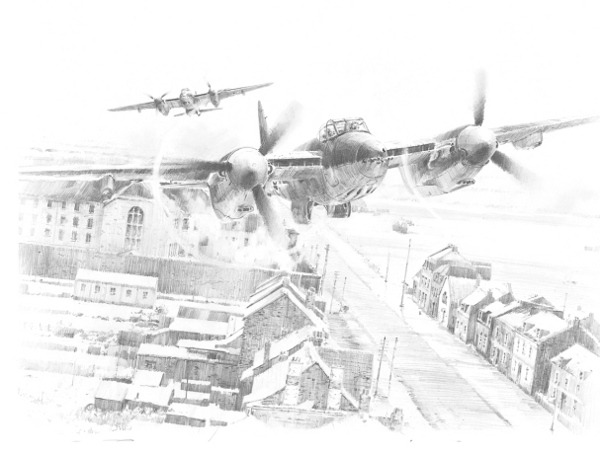
Peter @ The Strategist has a top review of Washing of the Spears, one of the best tellings of the Anglo-Zulu Wars of the late 19th Century that is well worth reading. One of the points that comes out in the comments regards the value of popular movies on historical events – regardless of the accuracy or even quality of the movie, it can often serve a useful secondary purpose in encouraging viewers to find out more about the back story. One example of this would be the 1969 movie Mosquito Squadron, a blatant rip-off of 633 Squadron (without even a rousing theme track), and not a good movie at all but one which has inspired many people, myself included to find out more about the real exploits of the Kiwi Mosquito squadrons in WW2 that pulled off precision strikes like the Amiens prison raid


Target Amiens Prison (c) Robert Taylor

…and here’s a list of links to the first six parts of Peter’s novel, The Doomsday Machine

Promises, promises

@ Small Wars there is a new article by Wilf Owen rather provocatively proposing that a ‘horde’ of 4WD armed with modern guided weapons could inflict significant damage to an Anglospheric brigade size force i.e. a Stryker Brigade or Armoured Cavalry Squadron. I’m not convinced – we have always been susceptible to myths of uber-weapons from the other side of the fence – remember the Hind super-helicopter killing machine that was going to sweep all before it in the 80s? – and think that we shouldn’t be selling ourselves short…

Wilf’s article is well-written and if the aim was to promote professional discussion, then it is probably successful and more power to anyone prepared to publicly put pen to paper rather than just lip off in the Mess/ O Club (if such things still exist).

If however, the aim was to actually promote a viable capability, then it has a long way to go. What really got my back up was the comment “…if any officer reading this cannot conceive of ways to inflict significant damage to a Stryker Brigade, or Armoured Cavalry Squadron; given 100 SUVs, 100 x ATGM + MANPADS and maybe 500 men; then they probably have no place in their chosen profession…” To me this is an unnecessary and somewhat arrogant (ignorant?) throwaway line that adds no value whatsoever. To turn it around, any officer that would allow such a force to do significant damage to a Anglospheric brigade probably needs to be relieved immediately, as does any unit commander in one of those formations that could wipe the floor with a Toyota horde.

The horde, if successful at all, would be a one hit wonder (anyone remember ‘Promises‘and Baby It’s You from the 70s – not just the lead singer’s ‘attributes’?) that would be easily countered. The terrain necessary for the horde to have any sort of practical mobility would also act against it and unless it could shelter behind the skirts of a large non-combatant population, it would be vulnerable to both ISR and engagement systems. Where the horde might be employable, would be a follow-on force to a more conventional ‘hammer’ to mop small outposts and stay-behind forces.

There is/will most likely be a place for swarming in near/far future conflicts but, at the moment, the concept still awaits some conceptual and technical developments. Ultimately, it could take us a number of steps closer to Heinlein’s Mobile Infantry concept that we aspired to in the mid-90s with the Empty Battlefield et al…

I had a long discussion with a compadre last night and one of the topics we touched on was the paucity of professional papers, other than those extracted by force as part of staff college compliance rituals, on topics of contemporary relevance, from authors down under – certainly there doesn’t seem to be any shortage of serving and former officers prepared to launch themselves into the arena in the Northern Hemisphere and the US Army probably leads in the development and publication of professional discussion, regardless of whether the concepts espoused follow political or doctrinal party lines. Having been privileged enough to have been invited to attend the Chief of Army’s Seminar at Massey University last year and corresponding with some of the speakers and attendees, I wonder, of the 200 or so uniformed attendees, how many have progressed any of the subjects discussed at the Seminar? It probably doesn’t help that the Massey web page for the Seminar exhibits a rather minimalist design philosophy and only links to recordings of the presentations with no transcripts or even speaker bios, let alone forums for further discussion – come on, guys, I think you need to up your game for the contemporary environment and the information age…!!!! It might be an interesting experiment, as I assume planning for the 2010 Seminar looms, to ask all the attendees for their two most enduring memories of the 2009 Seminar…

Oh, what to do…?

It’s all so confusing…I’m looking around for a portable computing device that lets me make notes and sketches away from the desktop PC in the study e.g. when I am away from home, even just popping down to the shop, or watching TV in the lounge so that the notes and sketches can be ported/synced directly back into the main PC. At the moment, I make a lot of my review notes on the good old legal pad and then manually transcribe them which takes more time that I have and eats significantly into productivity. I often forget to take a notebook with me when I leave the house as it always ends up back by the PC for transcription and stays there for my next foray out into the world…

I had thought that perhaps the iPad might be the answer but following up a link from Paper Modelers I’ve found that there are a range of new and impending technologies that might meet my needs…my gut feeling is that I’d be better off with something closer to a tablet than an iPhone so that I can read papers in closer to a traditional page format (am I turning into a fuddy-duddy?) and also so that I can also have a decent-sized work area for graphics…

Mmmmm….

Those from the Wellington IPMS community especially will know that I am a bit of an attention-seeker in my modelling procurements…in 2007, I was allowed to buy the Soar Art 80cm Railway Gun in 1/35 scale. It is very big and impressive – I can only just manhandle the box on my own – and I have been slowly assembling it. Like most people, I built the barrel first…

Yes, folks, the breech block is really the same size as a contemporary tank!! The barrel assembly is now painted and as complete as it needs to be for now and I have psyched myself up to start on the railway trucks that bear this monster but…somewhere in the course of domestic re-orgs that comprehensive instruction manual has gone west – no doubt it has been placed somewhere ‘safe’ – and I went to the Soar Art site to ask for a new manual. While there, I surfed through some of their partnered companies and stumbled into the world of Dust, a “…what-if world, a fictionary world based on our true history and mixed-up with science fiction…” and found this…

KV-152I Fury of Ivan – WOOF!!!!

…and I want one!!! Damn New Year’s resolutions….