Unknown's avatar

About SJPONeill

Retired(ish) and living on the side of a mountain. I love reading and writing, pottering around with DIY in the garden and the kitchen, watching movies and building models from plastic and paper...I have two awesome daughters, two awesome grand-daughters and two awesome big dogs...lots of awesomeness around me...

Six Days

6-Days.jpg

The SAS assault on the Iranian Embassy in April 1980 is still one of the seminal moments in special operations and counter-terrorism. Although the obvious inspiration for Lewis Collins’ 1982 Who Dares Wins, this action has been largely ignored by the entertainment community. Until the Bin laden raid in 2011, this lack of attention has probably not seen as a bad thing by the special operations community.

We had Ultimate Force with the bloke from EastEnders, and then The Unit led by the melting moments Terminator but it wasn’t until Six that we started to see some credible small screen special operations. On the large screen, Blackhawk Down was really an anyman story of soldiers at war, The Great Raid was pretty tame and also the tale of a large scale operation. The Odd Angry Shot is an Aussie classic but more COIN than SO. For the most part, the most significant of special operations have been largely ignored by credible story tellers…Even the first that I remember, Entebbe, has only been told  well once and that is the Israeli Operation Thunderbolt (still worth a watch if you can find it on Youtube)…

I read Bill McRaven’s (the ‘make your bed’ guy)  Spec Ops when it was first published – passing the time during a week in Waiouru Hospital in 1996 – and it must have been a tough decision to not include it as one of the case studies. It contains all the elements of McRaven’s theory of relative superiority and would certainly have survived scrutiny against his principles of special operations: simplicity, security, repetition, surprise, speed and purpose.

I was discouraged from buying Six Days for a long time because of its 90 minute run time – 90 minutes or less always suggests to me ‘made for TV’, never a good sign – and I was wary of whether it would be worth watching or just be loosely based on reality.

I need not have worried. It is very good and gets all the key elements of the story into 90 minutes without feeling crammed or forced. Watching the credits (as I do if the remote is beyond my reach), I could see why as I recognised, with surprise, some of the consultants’ names. More so when further credits revealed that this is very much a Kiwi movie production-wise as well: another result of Helen Clark’s decision to invest in and support our fledgling movie industry in the early days of the Lord of the Rings saga.

Six Days is a great account of a small team that pulled off a nigh impossible task under the most challenging conditions, not just those of a task never attempted before but one conducted under live TV cameras and global scrutiny. All part of Margaret Thatcher’s hard line on terrorism, and a harbinger of that same hard line two years later when Argentina invaded the Falkland Islands.

Searching for it just now, I was pleased to still be able to find Spec Ops on a shelf. When we Bookabached the Lodge while living in Waiouru, we pitched the library as one of its features. That was a little naive as library holdings diminished over that winter – a good reason to inventory everything so you actually know what might be missing and not just tearing the place apart looking for something that’s no longer there.

Nana doing Nana stuff 010.jpg

Moving here was the first time that I was able to have all my books unboxed and shelved since leaving home. Having to rebox it all up again for an indefinite period will be like losing a bunch of old friends:  Kindle just isn’t the same has holding old paper in your hands or glancing around for a reading target of opportunity…

Bill McRaven did much more than just write a book but it may be most remembered popularly for his ‘make your bed’ speech – better than ‘Wear Sunscreen’…

Part of the reason behind this big writing jag at the moment is that I was disappointed to see that my blogging efforts for 2018 fit onto a single WordPress preview page. The rescue helicopter campaign was unexpected – a reminder that stupidity can break out anywhere at anytime – and consumed way more time and effort than expected. I was writing so much in support of our helicopter bases, that it was a challenge to take up the keyboard for anything else…making up for that now…getting back into the swing of a post a day if I can…setting challenges to get me out of bed and keep me of the couch…

The little dog that ran away…

…pretty well sums up my day…three times I’ve been out in the rain chasing the little ratbag…I didn’t used to worry too much but she has been out on the road a couple of times now…

…she ran away at breakfast time, just in time for a fire call across to Whakapapa Village; got back to confiscate the tunnel and fill in the wooden horse…the next time, I was a little slow with the door bringing in firewood and was almost late – but definitely wet – for my FENZ annual health check; for the trifecta, she bolted past me as I was loading the RARO laptops for a SARTrack training session at the school, putting in an appearance at the gate and being confined – noisy little yap dog – in the back of the truck til I finished fire training – fun with extinguishers – tonight…

an138037646film-handout-the.jpg

Our movie treat – and it truly was a treat – tonight was Darkest Hour, the lesser known story of Britain’s darkest hour in May 1940 when all appeared lost, the German juggernaut unstoppable and poised to cross the Channel. When surrender, at best, negotiated terms, was entirely on the cards as Britain stood alone…when  the unpopular and anguished Churchill defined the fate of the nation…

I was singularly unimpressed by last year’s Dunkirk; the semi-comedy Finest Hour was more Dunkirk than DunkirkDarkest Hour captures that time, with France and the rest of Europe fallen, a disastrous and expensive campaign in Norway that achieved naught when Britain had to chose between standing and falling…

The pivotal underground scene probably never happened, some artistic license around the great man’s occasional habit of delving into the people. I don’t remember it from any of the histories or bios that I have read and we’ll probably never know what brought Churchill to the point of open defiance and the legendary speech that concludes:

…we shall not flag or fail. We shall go on to the end, we shall fight in France, we shall fight on the seas and oceans, we shall fight with growing confidence and growing strength in the air, we shall defend our Island, whatever the cost may be, we shall fight on the beaches, we shall fight on the landing grounds, we shall fight in the fields and in the streets, we shall fight in the hills; we shall never surrender, and even if, which I do not for a moment believe, this Island or a large part of it were subjugated and starving, then our Empire beyond the seas, armed and guarded by the British Fleet, would carry on the struggle, until, in God’s good time, the New World, with all its power and might, steps forth to the rescue and the liberation of the old.

The full text is on the Churchill Society site, or listen to it:

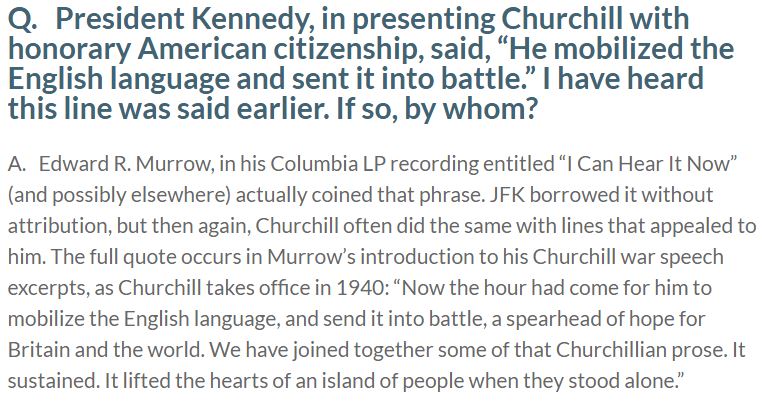
It’s worth a listen as Churchill describes the collapse of campaign in France. This is indeed mobilising language and sending it into battle, a rare art…

mobilise the language.JPG

Little dogs aside, it’s been a good day, a community day…I should have been writing letters and continuing the campaign but after so long, I’m just over it. Someone came up to me in the Village today and said that he used to be in the banking industry and knew a bit about it. He’d read something I had written a couple of days ago and just wanted to make sure that he’d understood it. “Here it comes” I thought, “finally the reverse smoking gun from someone who knows that points out an obvious hole in my campaign with ANZ”.

But no, he agreed with me, for personal and commercial lending, disclosure of additional lending to guarantors is expected and required. This is what is so frustrating…giving up and walking away is just not me, even less so when everything I know says that we;re in the right…but how do you poke the bully in the eye hard enough to divert it from its course?

Five years ago, this all started with an ANZ branch manager; now it’s been escalated all the way to the board of ANZ New Zealand Ltd who still intend proceeding on their juggernaut path; who had the gall to suggest that poor ANZ might not be able to recoup all the money it loaned so recklessly; who really don’t seem to get the concept of taking responsibility for their actions, or as leaders, the actions of their subordinates…

Voltaire said it first: With great power comes great responsibility. Others prefer a more-recent attribution, citing Peter Parker’s Uncle Ben in Spiderman. Churchill defined the price of greatness as responsibility…

…maybe Antonia Watson, David Hisco and their buddies on the board need to reflect on that and do the right thing

On not winning…

avengers-4.jpg

Always hating hanging around like a third wheel at open homes, so we  disappear on Sunday mornings…coffees and carrot cake at The Station Cafe today, then off to Taupo for a touch of Stress Induced Shopping Therapy (here on in referred to as SITS)…

Now that I’ve seen it, it’s a little ironic that this chapter of the Marvelverse is about not winning – not really a spoiler as I must be about the last person on the planet not to have seen Infinity War – being brought up on John Wayne and Thunderbirds, it’s always a little hard to accept that the good guys don’t always win…even in real life…

It’s actually quite tough, knowing that this battle is one that I’m probably not going to win. It’s not about being right. I’m pretty confident that I am right – just upgrading to my fourth lawyer and expecting his feedback tomorrow – that’s not arrogance or pollyannaism or bias…it’s the result of years of research, investigation and analysis work and having to present the results of that work to a fairly unforgiving audience…

It would be unpalatable to find the reverse smoking gun that proves me wrong but at least then I could suck it up and move on…but I can’t (find it, that is, not not move on…well, actually I can’t move on because I’m in the right but let’s not get wrapped around that)…the thing is that being right doesn’t always equal winning….

And it’s not really about winning or losing…that’s too black and white…I never wanted to know everything about counter-insurgency but on a dim dark Waiouru day (most Waiouru days and dim and dark) Gandalf aka Chris Parsons set me off on an unexpected journey into the world of COIN…and I still find daily parallels with that journey…

maxresdefault.jpg

…that there is no real victory in COIN..not in the sense of VE or VJ days…successful COIN is about a return to normalcy…not the normalcy that some might seek to inflict (certainly not ANZ ‘normal’ last week where it expected me to sympathise with any loss it may incur…) but normalcy for me…little things like being able to come home  and not have to worry about whether I will have a home or not next month; to not have to spend hours and hours researching legal and banking documents; to be able to dedicate time to relationships and hobbies and stuff; even little things like perhaps getting a roomie; not having to worry about the dogs if this goes wobbly(er)…normal’s all most people want…

In fact, the dogs are my biggest worry…Louie will probably rehome easier enough to people with no cats, good fences and who need a walking carpet…Kala Littledog still has a lot of issues to work through…

Not winning will be a new experience, certainly on this scale…with less that a fortnight til the hammer drops (literally), I’m still fighting…no real choice now to ride it on in and see what happens…

It’s just so damn frustrating that ANZ simply won’t man up – can I say that if the key point of decision is a woman? – admit its error and move on into fixing it up. But then, bullies rarely acknowledge their mistakes and just try to bulldoze their way on through and hope they will get away with it…

…and that’s all you are, ANZ, a bully that screwed up and that lacks the moral fibre to front up…


Should I stay or should I go now?


When this all blew up at the end of 2013, I’d just left the Air Force. Had I known of this mess before my departure, I may have looked at staying on but after eighteen months working for a sub-optimal boss, I pretty much just wanted to be gone…

OH 10-0696-002.JPG

Happy Air Force days…

Looking back, then, I wasn’t that attached to this place, the area, the district…the whole time that I had been living up here, just over nine years at that point, I had essentially been working out of the district – the only people I had any sort of relationship with was whoever was pumping gas at the National Park Service Station. Seriously…

Looking back through my albums, most of my pix are either here in Raurimu, or around New Zealand or the world…no pix of National Park Village at all

Washington DC 008.jpg

Not National Park…

I didn’t really want to move back to Auckland or Wellington…I still think that central Wellington is a great location centrally but after ten years here, Wellington’s become “…a great place to visit but wouldn’t want to live there…” I was applying for jobs in the provincial centres, mainly in my local or central government comfort zone…I saw myself eventually living in the rural periphery of someplace like Hamilton or Tauranga, possibly a South Island centre but never really looked that far…

DSCF7581.JPG

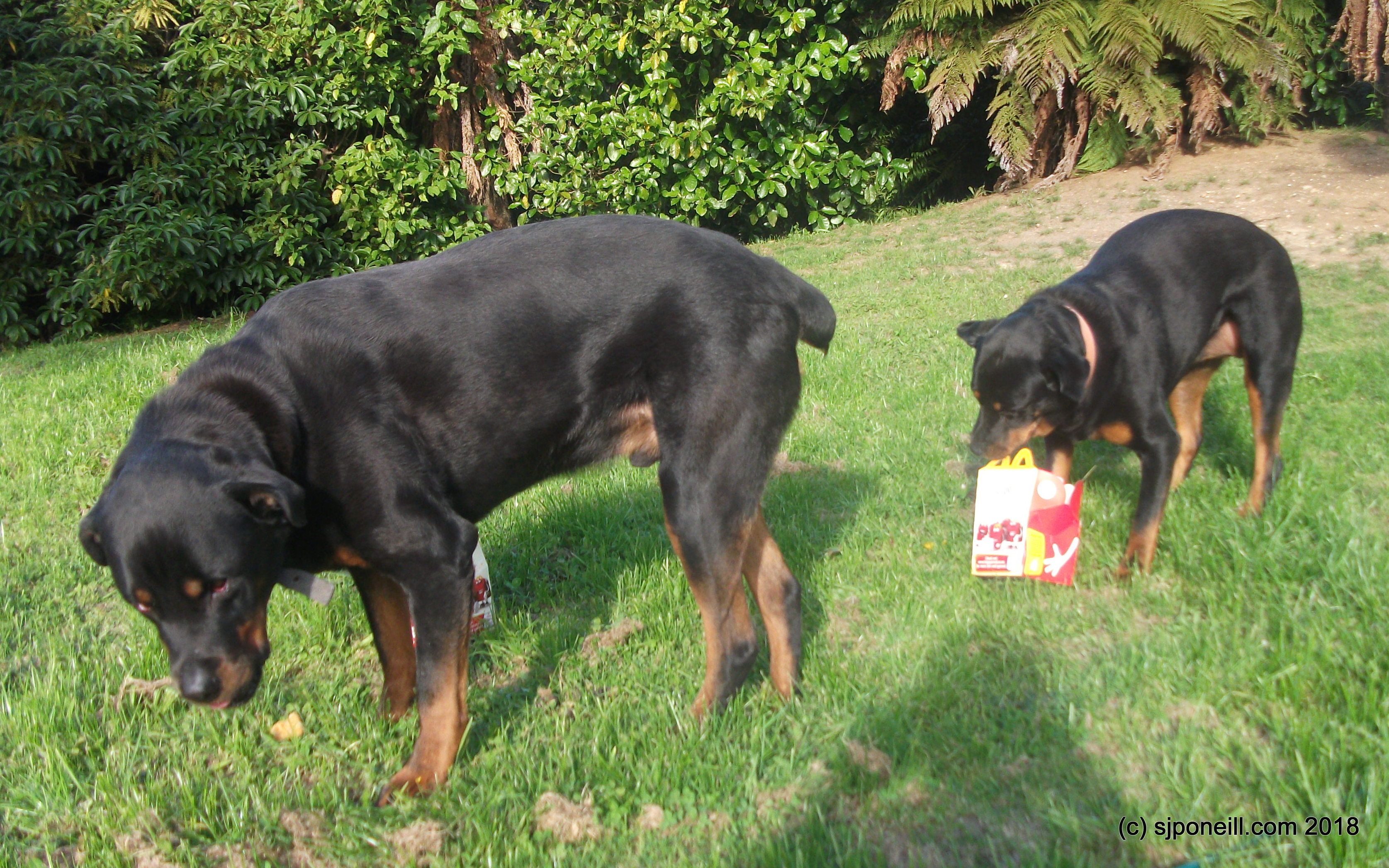
Happy Meal treat

Staying north or moving south…either way, it’s moving away from and towards family. It probably seems silly but a lot of the decision making revolved – then – around these guys…any solution that didn’t include them was unlikely to be a goer, more so since this was well before I discovered Tracy’s Rottweiler Rescue & Rehoming New Zealand as a means of rehoming the fur babies if it came to that…

My Air Force role had been pretty intense and so, like when I departed the Army, I granted myself some headspace time before actively seeking something new. I’d enjoyed working as a census collector for the 2013 census as this was a license to explore my local patch and so when DOC advertised a casual role , I thought it’d be pretty good to get paid to wander around the Park over summer 13/14. That’s when my roots started to grow in volcanic soil…

DSCF7836.JPG

I never thought for a second that I’d have been able to fend off ANZ this long and the uncertainty has been part of me over this five year campaign…now the question really looms…

Do I stay or do I go now…?

A bit of experience is a dangerous thing

Wilderness mag experience.JPG
I saw this article (PDF)on a friend’s FB feed. This is Wilderness magazine, a consistent purveyor of poor advice about Tongariro National Park.
 
The title of the article should be “when a bit of experience is a dangerous thing“. While there is always the opportunity for something to go wrong with the most experience people on the most well-planned activities, a rather common thread is ‘enough experience to be dangerous’ where true experience might dictate suppressing the reflex and letting a ski/pack/whatever slide to either be recovered in a planned methodical process or simply written off.
 
A large proportion of the people ascending Ruapehu in winter probably don’t have enough of the right experience. Remember that the experience counts, not when things are going right, but when they go wrong…
The best analogy for this is that of an airline pilot, paid a lot of money, for painlessly cruising from destination to destination on autopilot. It’s pretty cruisy…right up to the point where you lose both engines on take-off…
RTR23FP8-1024x620.jpg
That’s when real experience cuts in…not the experience that allows to walk with crampons to the Crater Rim….the experience that means that everything thing you do is a the result of a considered decision that takes into account all the factors in play in a given situation…that consideration might only take a split second but it still happens…
Experience is not doing a winter guided tour of the Crossing with crampons and ice axes under supervision. That may be the start of your alpine journey but a Hillary you’re not. No, it doesn’t make any difference or make you any more experienced watching Youtube how-to vids on cramponing and ice-axes…at best that is just technique…it ioffers nothing about the environment, reading the ground, reading the sky, being confident to tuyrn back…
…A 200km/h wind will blow anyone off a mountain. A slab avalanche will kill any skier who gets in its way, no matter how much avalanche awareness training they’ve done. A swollen river will consume any tramper who doesn’t respect its power…
No. They won’t…not if you have the knowledge and experience to avoid that environment in the first place. At that applies to rescuers just as much as rescuees: sometimes you just have to sit on your hands until the conditions are suitable for a risk-mitigated approach – not necessarily safe but where risks have been identified, discussed and mitigated before being accepted.
A little bit of knowledge is a dangerous thing…it breeds false confidence and complacency…that awesome feeling of being ten foot tall and bullet proof that every firefighter knows when they finish their recruit course…
But, in the light of cold hard reality, it’s just the start of the journey…

…Approaching Crater Lake, I could feel my skis starting to slide perilously. Conscious of the lake, I stopped to put on ski crampons for extra security. I almost didn’t.Let that sink in: I almost didn’t….

True experience isn’t going with the flow, it isn’t being swayed by peer pressure…it isn’t a careless reflex action…in an unforgiving environment, thought comes before action…that’s experience…

KBYG.JPG

The corollary to Know Before You Go is If You Don’t Know, Don’t Go. This video is a cautionary tale, not an instructional. Watch it as ask…what am I doing?

Wise words. I take this away with me: Climb hard, be kind and humble, and live fully.

Take this away. Is your experience good enough for what could happen?

That’s the real question…

No apologies if this sounds harsh and unforgiving. Rescues take too great a toll already on our small communities…volunteers pulled away from jobs, families and homes, all too often on rescues that were avoidable if people had only thought…

Wise-Men-Say.png

Elvis had it right


Saving our rescue helicopters

petition

Our communities care!!!

Signatures continue to roll in…read the comments and see how many lives have been touched and changed by this rescue helicopter…

This is one comment from a respected guide, ambulance officer and rescuer:

This helicopter, being based in Taupo means it responds quickly to the Central Plateau area when weather in other areas might prevent other helicopters from reaching this area. It is outfitted and equipped the way it is largely by public donations and suits the environments it operates in, servicing not just remote locations but also the highest altitude highways in the North Island, the two largest commercial ski-fields in New Zealand and the busiest one day hiking track in New Zealand and the largest area Lake in New Zealand.

NZ Mountain Safety Council identifies the Central North Island as an area where the highest number of outdoor activity incidents resulting in injury occur each year.

Most importantly, the intimate knowledge that has been accrued in terms of flying in local mountain weather conditions, the capabilities of the ground teams that the helicopter works with, their resources and team culture will simply not be able to be replicated by a helicopter and crew that is based out of district. This understanding of how people operates goes in both directions, with ground crews needing to train with the helicopter and crew frequently to make rescue and other emergency work go smoothly and safely.

On numerous occasions each year Greenlea Rescue is been one of several attending road crashes and other major incidents, so reducing the number of these resources is creating an unacceptable risk, especially should any of these machines experience any unforseen mechanical issues, having a quick substitute nearby will serve the public to a level that they deserve and expect.

Should an incident occur on our local mountains Greenlea can uplift a ground team and have them at the patient’s side before a Hamilton based machine could even get into the general area. Discontinuing funding for this helicopter and removing it from service will lead to lives being lost.

Local Members of Parliament, district councils, business groups and individual businesses have come out in support of the Greenlea Rescue Helicopter.

Following on from Keep the Taupo Rescue Helicopter and Joining the Rescue Helicopter dots…

On Thursday night, a colleague sent me a copy of the first part of the NASO Request for Tender document for the provision of air ambulance services across New Zealand. Friday, I was working all day on the Tongariro Alpine Crossing and so have only been able to examine this document this morning. Incidentally, while up on the Crossing, yesterday, the Greenlea Rescue Helicopter performed an evacuation of a hiker with a broken ankle.

Here, regardless of whether it is operating in an air ambulance or search and rescue role, we refer to these helicopters as rescue helicopters. We do this because that it what they do, regardless of whether they are operating at the time under and ambulance or search funding stream – the same service receives funding from various government agencies depending on its role at the time.

If yesterday’s broken ankle patient had been injured crossing the street, an ambulance would have been called. In this instance, the ambulance deployed was the Greenlea Rescue helicopter, based in Taupo. Let’s not get wrapped around the axle with semantics.

NASO AA coverage current

This is the original map used by the NZ Herald and included in Thursday’s post. This image is drawn directly from the RFP. The Statement that “…The figure below illustrates the 95 percent coverage from bases that currently provide Services…” is inaccurate. This map purporting to show the bases that currently provide [air ambulance] services omits the bases at Rotorua (229 missions) and Taupo (237 missions) , bases that, according to stats published by the Herald, are busier than the base at Tauranga (203 missions) that IS shown on this map.

This map implies that existing base locations are already capable of providing credible air ambulance services to the Central Plateau. Those of us who live and work here know that’s simply not true. Even if, under the new structure, each of the proposed bases supported multiple aircraft:

the additional flying time is still a factor that cannot be mitigated away.

The crews would still lack the intimate local knowledge that makes our local rescue helicopters so effective.

While our current fight is to retain the rescue helicopter bases at Taupo and Rotorua, it’s probably worthwhile to take a look at some other aspects of the RFP document.

PC1

Performance Class 1 essentially means that a twin engine helicopter can safely land, take-off or continue in flight if it suffers the loss of an engine.

Our current single-engine helicopters operate safely and effectively. Modern single-engine helicopters are not falling out of the sky on a regular basis, here or overseas. If anything, ongoing advances in engine technology are making modern engines more and more reliable – why do you think more modern airliners e.g. Boeing 757, 767, 777 and 787 can safely operate over large bodies of water with only two engines (no spares)?

Could NASO please share the statistics and data that support this call for twin-engined helicopters with no doubt greater capability but commensurately higher operating costs? You can ask NASO for this information here: airambulance@naso.govt.nz It’s interesting to note that of all the agencies contacted since this issue erupted, NASO is the only one to not respond.

The time to have developed a national helicopter fleet was in the mid-2000s when the RNZAF replaced its existing fleet. If government agencies at the time had been able to work together, it is quite possible that a larger fleet of aircraft could have been acquired to meet not only Defence needs but those of Police, SAR and medical services…

two patient cap

How often does a rescue helicopter in New Zealand have to carry two patients? My assumption  would be less commonly than cases where there is only a single patient. More than one patient increases the requirements for clinical crew, especially where a critical patient might require the ongoing attentions of two paramedics.

St John Ambulance is moving to a single stretcher ambulance fleet. Noting that land ambulances are similarly broadly distributed, it is interesting that St John does not perceive a trend for multiple patients per vehicle…

Could NASO please share the statistics and data that support this requirement? Again we can ask them here: airambulance@naso.govt.nz.

One of the objectives for the interim Emergency Air Ambulance Service that this RFP seeks to replace was “…That it is essential that people get the right care, at the right time, in the right place from the right person...” Will NASO still be able to meet this standard, especially in regard to AT THE RIGHT TIME…?

It’s nice that NASO wants to move to a single integrated air ambulance service across New Zealand. Certainly it might make the bureaucracy easier.

But is what we have at the moment really broken? Can we afford a shift to single provider model?

Is there a single provider than can provide this service across the country?

Is this RFP ultimately just blowing in the wind…?

That NASO failed to consult with affected communities is indicative that this RFP may be driven more by efficiency than effectiveness. Surely, as part of developing the requirements for the tender, NASO would need to talk to local communities e.g. councils, Police, SAR, etc to get a feel for the true need? Surely, a savvy government ofice would ensure that affected Members of Parliament were read into the plan before the story broke…?

Something smells…

Joining the Rescue Helicopter dots…

This Ministry of Health image illustrates the 95 percent coverage from bases that currently provide services. PHOTO/SUPPLIED

Following on from yesterday’s post on the planned demise of the vital Taupo rescue helicopter service

This image is taken from the NZ Herald story this morning confirming NASO plans to discontinue rescue helicopter services from Taupo and Rotorua. It is credited “This Ministry of Health image illustrates the 95 percent coverage from bases that currently provide services.”

It is misleading, perhaps deliberately so…It implies that this coverage is provided from the bases (red dots) shown on the map but omits the two bases in the central North Island at Taupo and Rotorua. Only the blindest of the blind could not see the bright smudge in the centre of the North Island that represents that Taupo rescue helicopter’s main operating area i.e. Tongariro National Park, Tongariro Forest Park and the Desert Road.

The NASO web page has provides some limited background on its new model for air ambulance services…apparently it will all be wonderful…further information is available on the government tenders page…

NASO.JPG

…but you have to be a registered supplier to actually access the tender documents…so much for open government…

More and more, this reeks of a bureaucrat-driven efficiency plan under the guise of ‘government’…

Rescue helicopters based in Tauranga, Palmerston North, New Plymouth and Hamilton cannot adequately service the Taupo and Ruapehu dependencies as well as their own.

  • They are already busy enough
  • Their response times, assuming availability, are too long.
  • They lack the intimate knowledge of the Ruapehu area that makes the Taupo rescue helicopter so successful.

Any presentation to the contrary is misleading and dishonest. Even if the numbers of helicopters at those more remote base locations are doubled, that does not address the issues of response times and local knowledge.

The Herald reports the following rescue helicopters stats from 2017:

Hamilton – 654
Palmerston North -286
Taupo – 237
Rotorua – 229
Tauranga – 203

Does NASO seriously expect Hamilton, Palmerston North, and Tauranga to absorb another 450+ flights each year…? Seriously…?

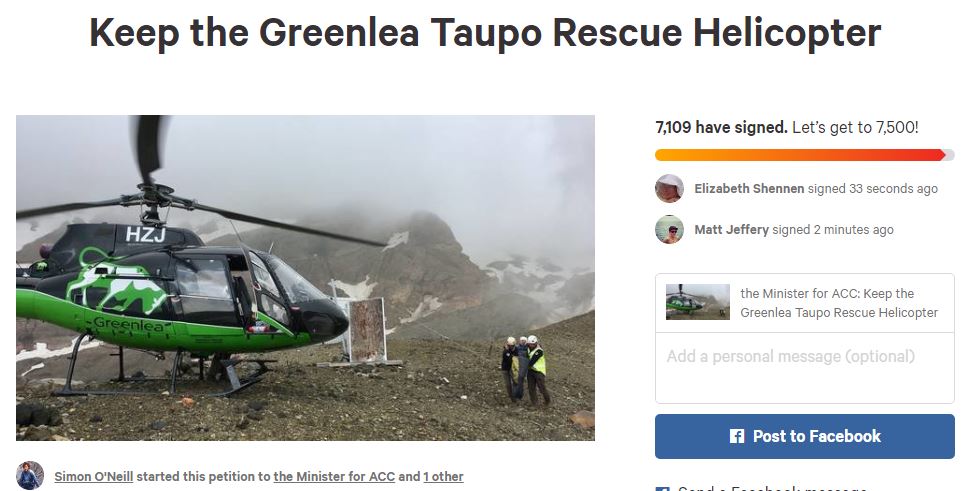
Visit the petition page. Read some of the comments. See how many lives have been touched by this vital and proven life-saving service.

When someone dies because there is no rescue helicopter, who carries the can? Not some faceless gnome in NASO, that’s for sure…

Keep the Taupo Rescue Helicopter

The Greenlea rescue helicopter at work on Mt Ruapehu. Photo / Supplied

Image (c) Greenlea rescue Helicopter

It never stops…the National Ambulance Service Office (NASO) is operated by the Ministry of Health (MoH) and the Accident Compensation Corporation (ACC). We learned this morning that the Taupo rescue helicopter has been excluded from the list of air ambulance services to be provided by NASO from November 2018.  The Rotorua rescue helicopter is, apparently, also off the list.

This means that air ambulance services for the Central North Island will now be dependent on helicopters based in Hamilton, Palmerston North, or New Plymouth; in extreme cases, support may be available on a longer notice to move from 3 Squadron, RNZAF, based at Ohakea.

Even cross-country, and assuming they are not already tasked in their own districts, there response time is considerable longer than that of the Taupo rescue helicopter. The crews of these other helicopters, no matter how capable, lack the same intimate knowledge of this district that enables the Taupo crews to slip in under the weather to pluck off the injured and infirm.

In some cases, this local knowledge means that the Taupo helicopter will be the first responding ‘appliance’ on the scene in isolated areas with challenging road access…often providing the confirmed location that allows those other services to navigate their way to the scene.

I could not count the number of emergency responses that I have been involved in over the four plus years since I started to work here where the Greenlea rescue helicopter has provided critical support and saved lives.

To protect this vital and proven life-saving capability, we need to reshape perceptions in the capital. At the moment, one of the lost effective ways to do this is to contact the Members of Parliament in the affected districts:

Louise Upston is the MP for Taupo

louise.upstonmp@parliament.govt.nz

@LouiseUpston

https://www.facebook.com/louiseupstonmp/

Ian McKelvie is our MP here in the Rangitikei district

ian.mckelvie@parliament.govt.nz

@ianmckelviemp

https://www.facebook.com/IanMcKelvieMP/

Submissions don’t need to be long and certainly not emotional (doesn’t help – trust me!). Keep it simple, something like:

I am writing to you with regard to this article in the Herald http://www.nzherald.co.nz/index.cfm?objectid=12025346&ref=twitter yesterday.

It pretty much speaks for itself. It looks like some efficiency-driven initiative that will have a massive impact on the Ruapehu and Taupo districts – I also understand that the intention is to no longer support the Rotorua rescue helicopter as well.

The Taupo rescue helicopter provides and vital and proven life-saving capability in the Ruapehu and Taupo districts. Helicopters from other areas like Palmerston North, New Plymouth and Hamilton are already very busy and their crews lack the intimate local knowledge necessary to operate in and around Tongariro National Park. Gone are the days when we could rely on a timely intervention from a RNZAF Huey, when civilian rescue helicopters are not available or cannot operate due to the weather.

It would be much appreciated if you could express the views of this community to colleagues in the Ministry of Health and Accident Compensation Corporation and promote the retention of this vital resource.

No one else will fight this battle for us. Email, Facebook, Twitter etc all give us the tools to stand up for ourselves. The loss of the Taupo rescue helicopter doesn’t just affect us who live here, it has negative implications for everyone who passes through Ruapehu and Taupo.

Let’s keep this flying…

Edit: Just in from Phillips Search and Rescue Trust, that operates that Greenlea Taupo rescue helicopter:

“Thank you for your expression of support for the Greenlea Rescue Helicopter.

Philips Search and Rescue Trust, operators of the Greenlea Rescue Helicopter, intend to fight to retain the base for the people of, and visitors to, the Taupo and Central Plateau region.

Taupo’s local MP is Louise Upston and you may like to write directly to her in support of retaining the Taupo based rescue helicopter service. As this is a Central Government issue you may also like to write to the Minister for ACC, the Honourable Iain Lees-Galloway.”

There you go, folks, the ball is in your court if this impending loss affects or concerns you…

iain.lees-galloway@parliament.govt.nz

@IainLG

https://www.facebook.com/ileesgalloway/

Garlic Shrimp on cauliflower mash

P80129-224705

A bit fuzzy 😦

Sugar Soil sowed the seed of this recipe a while ago but for some reason – possibly trying to work out the difference between prawn and shrimp – I stumbled across some other similar recipes that I amalgamated…sadly, and I’m normally pretty good at this now, I didn’t note the original sources….

I’m amazed at the broad range of things that we can do with the ever so humble cauliflower – and I need to pre-make a batch of cauliflower buffalo bites for late night munchie attacks – and this one is another quick and easy winner…

Ingredients:

Cauliflower Mash:

1 head of cauliflower, cut into florets

3 garlic cloves, minced

2 cups Vegetable Stock

Sea salt and freshly ground black pepper, to taste

2 tablespoons of coconut butter

2 teaspoons of fresh rosemary

1/3 cup of vegetarian Parmesan ‘cheese’

Garlic Shrimp:

500 grams of raw shrimp, shelled and de-veined

3 cloves garlic, minced

2 slices bacon

1/3 Cup red wine

1/2 onion, chopped

1 teaspoon of crushed red pepper flakes

 a pinch of dried oregano

Sea Salt and freshly ground Black Pepper, to taste

Directions:

Place the cauliflower florets in a medium sized saucepan with chicken broth and bring to a boil.

Reduce the heat to medium and cover, allowing to cook for 15-20 minutes or so, or until the cauliflower is very tender and easily mashed.

Once the cauliflower is tender and cooked through, pour off any excess stock that remains and reserve.

Using a food processor, puree the cauliflower with the coconut oil.

Add the parmesan ‘cheese’, rosemary, salt and pepper and mix well.

If needed, add a drizzle of the reserved broth if the cauliflower is too dense. Set aside.

In a large saute pan, cook the bacon until it’s crispy.

Set the bacon aside on paper towels until cool, then chop into small pieces.  Set aside.

In the bacon drippings, add the onion and cook over medium high heat until softened.

Add the minced garlic, red pepper flakes, and oregano, and saute for about a minute, stirring frequently.  Stir in the red wine.

Cook a minute or two, then add the shrimp.

Cook, stirring frequently to turn the shrimp, until the shrimp are pink and opaque on both sides.

Place the shrimp and sauce over the mashed cauliflower and top with crumbled bacon.

Season with salt and pepper and garnish with fresh oregano.

It’s pretty hard to go wrong with this one. It makes enough for two decent-size servings with enough of the mash left over for another meal.

P80115-212052

This is the left over mash the following night, with rissoles made from some left-over quorm and a pack of vegetarian mince I bought on a whim from the Taumarunui New World. I mixed the remaining bacon into the mash before I reheated it…

Taps Off – really…?

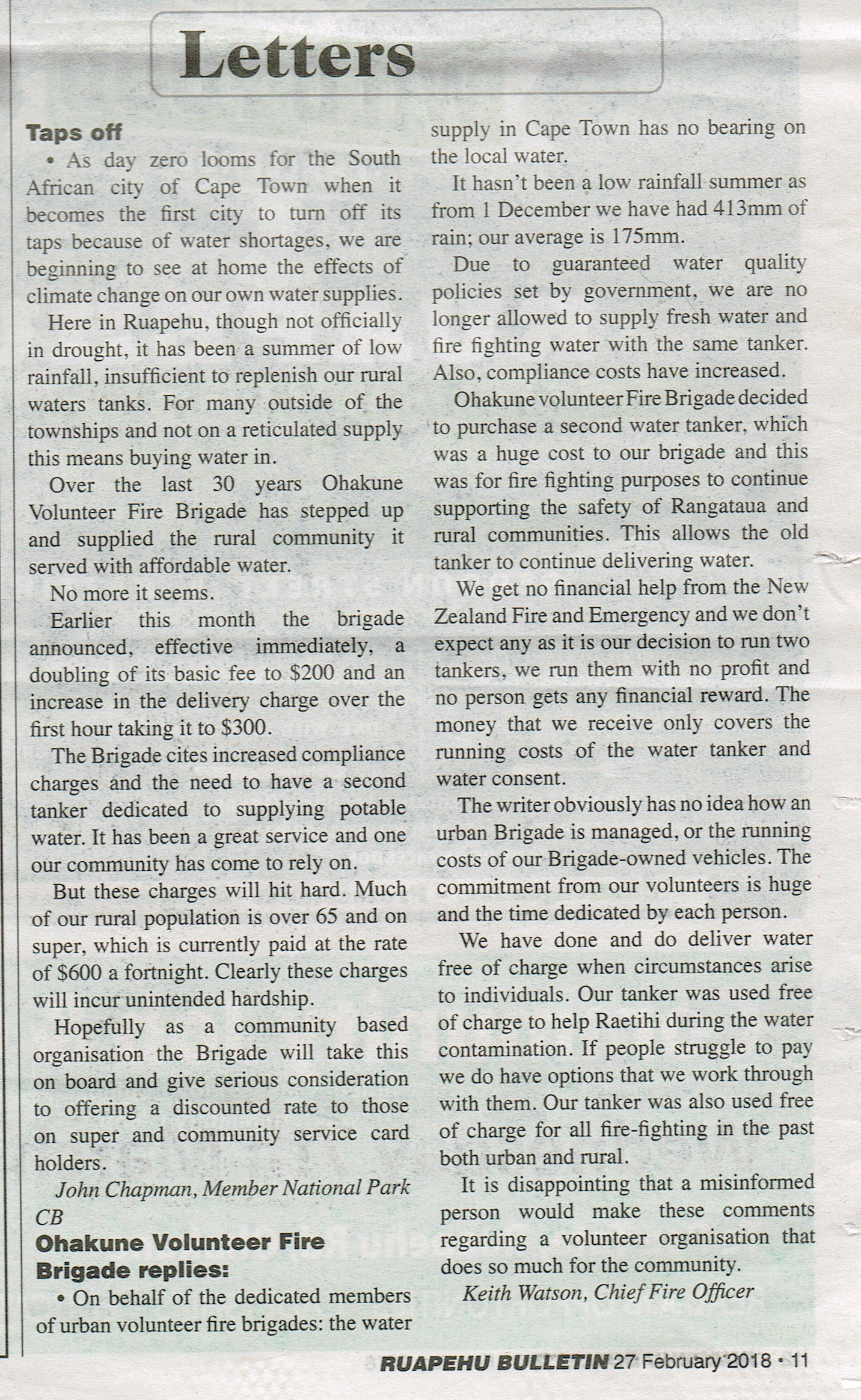
Chapman water_0001

This attack on the Ohakune Volunteer Fire Brigade was published in this week’s edition of the Ruapehu Bulletin. It is an apparent response to this notice published by the Ohakune Volunteer Fire Brigade a fortnight or so ago:

As of today our water delivery price will be going up to a minimum charge of $200 then anything over the 1 hour there will be an extra charge of $25/15 minutes.
We have had to renew our water carrier approval license and also now need to do regular water hygiene checks. With part of the requirement we need to do a yearly audit so now we also have to pay the council for the water, I do want to make it clear that this is not at the council’s request it’s a requirement for our certification.
We are no longer allowed to deliver water with the same truck that was used for fire service duties so as a brigade we still wanted to maintain servicing the community in both water deliveries and fire fighting capabilities so we purchased another tanker at a huge cost to the brigade.
This is still a voluntary and non profit making service with continued running costs rising we have been forced into these changes. Any outstanding invoices owed to the brigade you have 2 weeks to clear on old pricing then from the 1st March you will be charged the new rates.
Regards
CFO Keith Watson

The Ohakune Volunteer Fire Brigade is as its name suggests, and like all the other fire brigades in the Ruapehu District, a volunteer fire brigade. That means that all its members freely give of their own time to provide this essential service within our communities. This commitment comes at the cost of significant disruption to personal and professional lives, is not without frequent physical risk, and comes with the sole reward of a job well done.

On top of its significant commitment to maintaining (it’s not all riding on a fire engine under lights and siren: there’s a major training requirement for all members as well) and delivering an excellent firefighting capability in Ohakune and the broader Ruapehu District, the Ohakune Brigade voluntarily provides a water delivery service in the community. The only payment sought for this service is to cover the direct costs of compliance, certification and delivery: there is no profit margin and no person gets any financial reward for providing this service.

Just a little sidenote on the Ohakune Volunteer Fire Brigade’s tanker capability. This is community-funded i.e. the Ohakune community raised the funds for these tankers themselves. In addition to providing a great capability to Ohakune firefighting operations, the new 18,000 litre tanker (18,000 litres is about 9 times what a normal fire engine carries onboard) provides a reliable water supply for firefighting in areas not supported by mains water supplies and where there may not be an available alternate water source like a stream or water tanks.

14563427_542220202651800_3545440428665085669_n.jpg

18,000 litres of water on the hoof (c) Ohakune Volunteer Fire Brigade

To be this into a local context, while the main water supply in National Park Village is being repaired this week, there will be insufficient guaranteed mains pressure for firefighting in the Village. To ensure a viable water supply during this period, the big Ohakune water tanker will be ‘attached’ to any major firefighting callouts in the Village.

Chief Fire Officers are busy people. They have to:

maintain the same skills as their firefighters.

be prepared, at the beep of a pager, to deal with a range of contingencies including flooding, fallen trees, detaching roofs, assistance to ambulance, motor vehicle accidents, hazsubs spills and leaks, and  a whole raft of different firefighting challenges.

be on top of all the administration required to make a fire brigade function.

do all this without pay or reward beyond the knowledge of a job well done.

Chief Fire Officers have better things to do than endure and respond to vexatious and petty attacks from the likes of John Chapman.

John Chapman signed his letter as a member of the National Park Community Board. I have spoken with members of the National Park Community Board and at no time have any concerns regarding the water delivery service provided by the Ohakune Volunteer Fire Brigade been raised with the Board, let alone discussed at a Board meeting or progressed to a resolution of any form. I would think if the National Park Community Board was going to adopt any resolution regarding this service it would be one of support and appreciation.

Certainly, support and appreciation has been the unanimous and common theme amongst members of the National Park community since Mr Chapman’s letter was published.

It’s unlikely but perhaps some members of John Chapman’s own community in the Waimarino-Waiouru ward have some concerns about the increases in water delivery costs. This is something that they would need to raise with the Waimarino-Waiouru Community Board, a group quite capable of managing local issues within their own ward. Not only is in appropriate for John Chapman to (ab)use his position on the National Park Community Board to launch an attack on a matter in another ward, his actions implies that Community Board in that ward is unable to function without Mr Chapman’s input. That is most definitely not the case.

comment

This from comments on the letter on Facebook. John Chapman, it would appear, is actually a local firefighter himself, rural, I believe. One can imagine that his brigade’s next training session may be somewhat ‘interesting’, the conversation potentially robust…

This is not the first time that John Chapman has (ab)used his position as a community board member to launch petty attacks against local community members. Last year he conducted a campaign against the Chair of the National Park Community Board because she would not bow down before his (allegedly) superior political experience. His motion of no confidence in the Chair was soundly defeated with community members speaking on behalf of the Chair and acknowledging her long commitment and contributions to the community.

More recently, John Chapman took advantage of his position on the National Park Community Board to read out an interminable personal statement relating to his vendetta against anti-1080 signage at Waikune. This related to provocative statements he had made on the National Park Community Facebook page – this purports to be representative of the community but is really just another soapbox for John Chapman – which had resulted in some backlash from the community. His actions on this page are totally independent of his membership of the National Park Community Board and Mr Chapman needs to learn that actions have consequences and that the Community Board is not there to act as a shield when his actions generate consequences. The targets of this vendetta attended this meeting and it is a credit to them that they calmly opted to not rise to his provocation, leaving him alone in the mud.

Perhaps it’s time for Mr Chapman to consider whether he truly does represent the community of the National Park ward. If he hopes to do more for the community, then he needs to reconsider his game plan. If he hopes to use his Community Board activities as a springboard for higher office, he should realise that his current conduct is unlikely to endear him to the voting public.

If John Chapman thinks community board membership is just about lashing out at those who dare to disagree with him, maybe he needs to stand down and seek such solace in some overseas socialist nirvana…