Standing firm

Last week I was asked how I thought one might develop and implement a homeland security agency here. Dean’s initiative with the Homeland Security Round Table this year is proving an ideal catalyst for forming and shaking out those ideas…

In Risky Business, lunghu identifies a key factor in homeland security risk management and mitigation, that of personal self-preservation aka CYA. He also alludes to the flip side of this coin which is the hair-pulling cat-fight whenever there is any credit or praise due. The CYA factor is pure human nature and one of those things that has to be programmed out of people…organisations like the Marines do it especially well at the same time they embed the ethos of the Corps into each and every recruit. It doesn’t always need Gunny Leanin-Mean and a Smokey the Bear hat to do this but the points to take away are

  • that they do it.
  • they believe it is important to do it.
  • that they do it at the very beginning of a recruit’s career in the Corps.
  • those who don’t ‘get it’ are cycled out.
  • they do it as a part of embedding Marine Corps ethos and culture.

This is in stark contract to most, if not all, government agencies where there is little or no effort applied to developing and maintain a formal organisational ethos and culture to mitigate CYA and self-preservation instincts.

Overnight in a place I once worked, a series of  flyers appeared  on almost every vertical surface. I can’t remember the exact words now but they were along the lines of “Imagine how much we could achieve if we cared less who got the credit”. Of course, outrage erupted across the organisation the next morning and various delegations stormed through the new Chief of Staff’s door, demanding he “do something about it!” He responded that he fully intended to otherwise “…it’d be a waste of my time pinning them all up…” There was much gnashing of teeth, tearing of hair and whiny-babying around the coffee machine but he was as good as his word and drove a ‘we, us, ours‘ stake through the ‘I, me, mine‘ heart of that organisation, totally transforming it. Today I still cringe when I hear senior staff launching forth on ‘I, me, mine‘ soap boxes.

One of the fundamentals that feel out of our (←see?) work on COIN doctrine in the last few years is the importance of a well-embedded individual and collective culture and ethos across the organisation. When the heat is on in the real world i.e. on a broader front that purely ‘on operations’, we find that time and again the real driver behind a decision is not the formal consequences for any particular action e.g. the full force of The Law, be it civil, DM 69, UCMJ or other authorities; all the more often the driver behind a decision is the personal ethos of the individual. There are those who ethos will take them down the comfortable expedient path of least resistance; there are others who will take a stand. I think it was in Lucifer’s Hammer that Jerry Pournelle wrote “…the hardest decision is usually the right decision…

A number of years ago, some rocket scientist decided that Police didn’t need commanders, it needed managers. Fair enough you might think after looking up the Oxford English definition of ‘manage’, and so all Police district commanders became district managers. One day, the hard working Police officers in one such ‘managed’ district decided they had enough evidence to raid a suspected drug operation in the back blocks. To be successful, they needed helicopter support…but…it was getting near the end of the financial year and district managers had been promised a hefty bonus if they ended the year a certain percentage under their budgets.  So “…sorry, lads, can’t approve any choppers for this op…” The ‘lads’ however, being resourceful and highly PO’d with the concepts of management, arranged for a neighbouring district, still flush with $, to provide the necessary helicopter support – apparently there was some greyness regarding district boundaries – so the operation could proceed. It was a massive success and the ensuing media coverage brought out some interesting side stories…needless to say, Police here now have district commanders again…

Every organisation already has an ethos and a culture but they might actually be working against the aims and objectives of the organisation, in the manner that lunghu describes and others. Ethos and culture is a little more than signing off on the corporate code of conduct. At the very least, that code of conduct needs to be relevant to the organisation and practical in its application. It is more than anti-harassment, health and safety, and equal rights. To hit it with a very broad bat, it is ‘doing the right thing‘, standing firm under adversity. While that may mean a great many things to a great many people (including both readers of this blog), knowing where the delineation between personal and organisational interests lies is a good start point.

At Travels with Shiloh, Dean goes (IMHO) a little over the top in his initial comments on Accepting Risk the other day – if only he knew how worried I was that I might not make the grade for Round 1 of the HLS Round Table discussions. I always felt we were pretty much on  a par with each other and one of the reasons I added Travels with Shiloh to my blogroll was that I thought it set a standard for me to aspire to.

Anyway, Dean identifies another weakness in the current US HLS structure: in order to share in the post of federal gold allocation to HLS, many agencies, especially those that are smaller and less-resourced, have to proclaim a disproportionate degree of interest in big picture HLS issues. I’m reminded of the scam perpetrated in The Closer when, in order to keep all the detectives in the team to investigate homicides (real now problem) the team have to take time out to train in various counter-terrorism functions (may be, one day possibility). I’m sure that this was not pure fiction and also that it was not based upon an isolated incident.

I think it was Peter Drucker who said (possibly in On Management) that organisations should stick to their core functions: for example, churches should focus on saving souls and less on social services; the military should focus on ‘winning our wars’ and not upon saving troubled youth from themselves (unless said youth can make it through the recruiting process); lawyers should focus on the law and less on accountancy (might keep a few more of them from going behind bars too!), etc etc. Most of the agencies that make up the vast conglomerate known as HLS are pretty good at their core functions, not perfect perhaps but adequate. One might ask then what value HLS the actual organisation actually offers to either the individual agencies at one end of the scale or overall homeland and national security at the other?

I’m saving Dean’s comments re hope-based decision making for another post as it is  a good point but one which I’d like to tie into some other work.

Accepting risk

Who hasn’t heard this answer to a curly question “We’ll carry the risk“? Yeah, that’s nice but who’ll be accepting the responsibility?

Introduction

This is the first in a series that will progress throughout 2010. The idea comes from Dean at Travels with Shiloh who has invited a group of commentators to discuss the twelve questions asked in this article Changing Homeland Security: Twelve Questions From 2009 from the Homeland Security Affairs Journal (HSAJ). Yours truly is one of those privileged to be invited to contribute to this discussion.

The first question is Why is it so difficult to make risk-based decisions in homeland security? Other contributions on this question so far are:

Risk based decisions in homeland security issues

I’ve been working on this for over a week and, to be honest, have really struggled with it. What follows is still tortorously prolonged but I’ve left it ‘as is’ to show the process by which I got to the answer. In a couple of weeks, I will rework it into something a little more coherent.

Defining the question

Before launching into discussion on the topic at hand, I first thought it would be an idea to define my interpretation of the terms in the question.

  • Difficult is the opposite of easy although it may be more correct to swap out ‘difficult’ for ‘simple’ and the degree of difficulty is directly linked to the level of complexity now common in such equations.
  • I cast the net pretty wide to define risk-based decisions. Although there were few, if any, military or HLS examples in first 100 hits when I searched ‘risk-based decisions’ on Bing; the most common seemed to those relating to auditing, insurance, health and event management. There was enough material there for me to comfortable with the R = T x V x C; Risk is the product of Threat, Vulnerability, and Consequence equation in the original HSAJ article.
  • Homeland Security is very much a US term with specific definition, membership and connotations. For our more global audience, I am using ‘HLS’ as the collective grouping of domestic, i.e. non-expeditionary,  military, security, intelligence, law enforcement, and emergency management agencies. I don’t believe that the establishment or not of an overarching agency like HLS affects the decision making process either way.

The Question

My first thought is whether it is actually difficult or, as implied in the question, if it is correct that risk-based decisions are not being made in homeland security. I would argue that they actually are, across our nations, thousands and thousands of them daily.

One approach I have found very useful when working through issues relating to the Contemporary Operating Environment (COE) by establishing a comparison with the more traditional and conventional environment that many of us are still more comfortable with or in.

If we were gearing up for yet another defence of the Fulda Gap at the operational level or even analysing intentions at the state on state level, such assessments are relatively simple and we still get them wrong with monotonous regularity, as Argentina found soon after taking Port Stanley in 1982, and Saddam found after reclaiming Kuwait in 1990. Characteristics of assessments at this level and in this environment might include:

  • Limited number and type of threats.
  • Gradual build-up and lead-in indicators.
  • Motivators/catalysts are usually understood strategies, policies and philosophies.
  • Most players are known values.
  • Big hands, big arrows, small maps.
  • Platform-based i.e focused on tracking ships, units, and formed groups; less focus on personality than major capability.
  • Unified organisations on both sides.
  • Geographic areas and boundaries are well defined.
  • The three organisational functions/groups derived from Clausewitz (people, leadership, action arm) are clearly defined and visible.

‘Simple’ as used in the paragraph above does not necessarily mean easy, just less complex in comparison to today’s environment.

Compare then this model against that faced in the HLS environment. The most obvious change is that we now need to track individuals a la the Scheiern model, not just those that we know might be players or even those who might be, but also those who might just have had a bad day, or just have had ‘enough’. The most recent example of this might be the shootings in Ft Hood and Seattle last year. Although some commentators immediately heralded the Ft Hood incident as the beginning of a domestic 4GW campaign, there has been no evidence to support such claims. Both incidents instead are illustrative of both the unpredictable and micro natures of the domestic environment.

HLS organisations are also not formed and formal organisations like the DoD, NATO, or even the Warsaw Pact. At best it is a bureaucratic umbrella sitting over a diverse collection of agencies all with their own priorities and outputs, and generally very tactically focused. Certainly there is not the same degree, not even a hint thereof, of the command and control arrangements to be found in a single agency in its own right or a large organisation like the DoD with defined roles and responsibilities

Mix in with this nature’s fickleness, for example, earthquakes in Haiti, bush fires in Australia and snow in the Washington DC area. Although the probablity of such incidents is a given, assessment of incidence and severity leans more to the arcane than the scientific: for now, Poughkeepsie Phil probably remains our best indicator for seasonal change.

To use a household analogy, you used to have three dogs and a couple of cats that normally got on with each other. The causes of discord were well-known and it wasn’t too much of a task to prevent major conflict. Then Great Aunt Anastasia dies and left you her ant farm and  ‘tame’ wasp hive; for various reasons, and as tempting as it is at times, investing in a couple of gallons of Raid is not a socially acceptable option. You’re stuck with it. You’re not impressed, the dogs and the cats aren’t impressed, and most likely the ants and wasps aren’t that thrilled either. Oh, and the boiler’s sprung a leak, taxes have just gone up, and old Mrs Grey next door has just lopped off her leg with a chainsaw. Welcome to the world of homeland security – please start your risk-based decision-making process HERE.

HLS as an entity will always find it difficult at best to conduct risk assessment as we and Third Shock Army (8th Guards for some folk) understand them from the Fulda Gap. But that is not to say that risk based assessment does not occur daily across the spectrum of homeland defence in law enforcement, emergency response, security and intelligence fields. I doubt that there are any agencies under the homeland security umbrella where the staff just sit back, bite into another donut, sip on their lattes and just wait around for something to happen. Just because it doesn’t happen in the comfortable macro format that many of us are used to, doesn’t mean that it doesn’t happen…it just happens at the micro level necessary for these agencies to fulfill their primary roles

At that’s the thing, most homeland security agencies have local or regional responsibilities and meeting these is their main priority. Unlike perhaps military organisations which generally devote a reasonably large proportion of time and resources to things that might happen, most HLS agencies are fully committed to meeting real-time outputs like catching bad guys, saving lives, fighting fires and rescuing kittens (think that last one isn’t important? – try telling that to old Mrs Smyth and still keep ‘the people’ on side). Most of them do this well.

Their world may be too complex for precise prediction but something else they also do well is respond. Within those contingencies that they know from past experience are most likely, these agencies can and do turn out and perform credibly thousands of time every day…and against these contingencies there is quite robust risk-based assessment and decision-making…why do police surge for New Years Eve activities, firejumpers have winter leave and paramedics specific tools and treatments over others? These people think, with some justification, that they are quite good at such decisions within their respective areas of expertise and responsibility.

Where they are weaker perhaps in in working and interfacing with each other beyond local relationships, especially where there may be issues of command and control or jurisdiction. HLS is never going to be the uber-C2 construct that DoD is – I think that FEMA perhaps tried this and we all saw how well that worked. Where HLS might begin to add real value is in championing the interoperability cause and facilitating communications, cultural awareness and information sharing between agencies.

An interesting insight from the 2004 Manawatu flooding (look it up – it made the top ten natural disaster list for the year) is that the civil defence plan went out the window only 30 seconds after the state of emergency was declared. BUT the value of the plan was in the planning; in bringing the various agencies together prior so that at least key staff had met, there was a general awareness of potential resources, and an awareness of issues from other perspectives. We saw the same again when the Mt Ruapehu lahar (finally) went in 2007. The event itself was almost anticlimatic because all the agencies involved (none of whom could agree on the probability or severity of the lahar happening) had been required to hammer out their difference and develop a collective response to the threat.

Where risk-based decisions really are difficult in HLS is on the terrorism side of the house. This won’t be news to Europeans, most of whom have endured domestic and/or third-party terrorist acts on their territory for decades. Terrorism itself is still subject to the same variables of complexity and uncertainty found across the HLS functional spectrum. What changes with terrorism is the false assumption that terrorist attacks can be prevented and the resulting pressure upon to HLS make this so. King Canute might offer some topical observations on this after his seashore experiments went wrong.

The Answer

The R = T x V x C equation for risk-based decision making is of little value so long the only acceptable answer is zero. Risk based decisions are made thousands of times every day in HLS – we’re just not interested in the answers. Perhaps the question that should have been asked is not Why is it so difficult to make risk-based decisions in homeland security? but When will we learn to accept risk in HLS?

Eye in the Sky

Over the last few months, I have been keeping reporting developments in a local company gearing up to conduct commercial UAV/UAS operations (depending which school you went to) domestically and offshore. Just a quick note to report that all is still on track, and that the website has been further developed. Of particular interest to ISR types may be the two publications now available that offer more information on both operations and capability.

On the modelling front, a tres way cool find last night, reported via Paper Modelers, and available for download from the designer’s site in Russia…you do have to register to download but even with a dial-up download of the two 43Mb files, the wait is well worth it – can’t see Revell or Trumpeter knocking out something as cool as this any time soon…

That’s the update for today – it’s been a long day as we shot over to Turangi to catch up with the twins while Carmen had  a job interview; after we got home and survived the heat of the day (is this summer finally?), we decided to attack the jungle that had erupted around the spa deck – very stiff back now – had a late dinner of corn on the cob and rezapped lasagne before watching Will Smith in Seven Pounds: very heavy duty but highly recommended…

The CoGs in the war go round and round…

Anyone with small children knows how invasive and persistent THAT tune is…

In Do Ideas Matter? Some thoughts… I commented on Adam Elkus’ paper on interpretation and application of the Centre of Gravity construct, and Adam and I have batted some comments back and forth since.. This has had me thinking more and more about centres of gravity, both generally and in specific regard to the complex environment. I think that we are wrong to consider a centre of gravity as a point of strength.

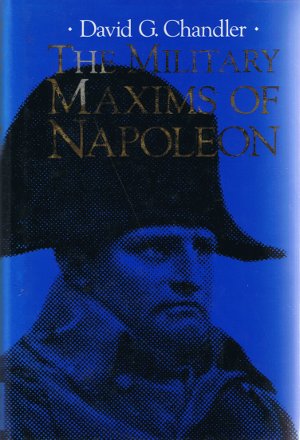
Many years ago, in the good old days (and they were!!) when I was a young soldier and we maintained a substantial presence in Singapore, I stumbled across a UK-based military book club that accepted overseas subscribers and offered a flat rate for shipping. The deal was that you had to buy so many books each year and – much like my current approach to Audible – I would get busy and let my obligation lapse until the last safe moment when I would have to make some snap selections from whatever was available in the most recent catalogue in order to stay in the club. As a result, I built up quite an eclectic library. One of the books that I acquired was David G. Chandler’s The Military Maxims Of Napoleon (Greenhill Books, 1987, ISBN 0947898646) It contains all 78 Maxims, the original 19th Century commentary and a new commentary by David Chandler applying “…the 20th Century perspective of two world wars, Vietnam, the Falklands and other conflicts…“. At the time, I read it, thought it of minor interest and it’s been on the shelf ever since. However one point, not even from the Maxims, has stuck with me in the succeeding two and a bit decades.

It regards what Chandler describes as one of Napoleon’s best known sayings “The principles of war are the same as those of a siege. Fire must be concentrated on a single point and as soon as the breach is made the equilibrium is broken and the rest is nothing.” The commentary in the book offers that most who seek to apply this ‘rule’ get it wrong in that they fixate on the word ‘point‘ and miss the whole implication of ‘equilibrium‘.

Chandler offers that it is highly probable that Napoleon actually meant the ‘joint’ or ‘hinge’ of enemy dispositions. There will always be issues of translation and interpretation when we seek to learn from those who gone before, especially when there is a significant temporal air gap – poor old Clausewitz and Mahan suffer in the same manner as does Douhet, when I ever get round to reading The Command of the Air.

Sometimes we fixate a little too much on the purity of original text and not enough on the actual content of the interpretation – to quote one of our Principles of Lessons Learned “Focus on what is being said and less on who is saying it“. One of the greatest examples of this is the Clausewitzian Trinity which is popularly accepted as ‘the people, the action arm, and the leadership’ – the actual Trinity from the original texts, as Adam and others have pointed out is much more ethereal. Regardless, the popular version of the Trinity still holds true, remains applicable today and, when you get right done to it, is probably more useful as a model than the original.

The modern definition of ‘centre of gravity’ is, according to FM 3-0,:

The source of power that provides moral or physical strength, freedom of action, or will to act. The center of gravity is a vital analytical tool for designing campaigns and major operations. It provides a focal point for them, identifying sources of strength and weakness at the strategic and operational levels of war. Centers of gravity are not relevant at the tactical level; the tactical equivalent is the objective. At the strategic level, the center of gravity may be vulnerable to an operational-level approach; at the operational level, the center of gravity may be vulnerable to tactical actions. The enemy may shift a center of gravity to protect and sustain a source of power. Similarly, changes in the operational environment may cause centers of gravity to shift. Therefore, analysis of friendly and enemy centers of gravity begins during planning and continues throughout a campaign or major operation.

This is very much a Fulda Gapist definition and even then, in the context of Third World War, Red Storm Rising-like, high intensity conventional conflict, it is somewhat flawed. It neither states nor implies any of the characteristics one might expect of a centre of gravity like pivot, balance, or equilibrium. In describing the centre of gravity as a ‘source of power’ and equating it with a tactical objective, it logically but incorrectly follows that the centre of gravity is something that is struck. While it may be correct that centres of gravity apply only at the operational and strategic levels in conventional conflict, this does not apply in the much higher fidelity/granularity microcosms of the complex environment where influence may be applied at all levels. Now compare the military definition of a centre of gravity with an aeronautical one based upon the Archimedean centre of mass principle:

The center-of-gravity (CG) is the point at which an aircraft would balance if it were possible to suspend it at that point. It is the mass center of the aircraft, or the theoretical point at which the entire weight of the aircraft is assumed to be concentrated. Its distance from the reference datum is determined by dividing the total moment by the total weight of the aircraft. The center-of-gravity point affects the stability of the aircraft. To ensure the aircraft is safe to fly, the center-of-gravity must fall within specified limits established by the manufacturer. When the center of gravity or weight of an aircraft is outside the acceptable range, the aircraft may not be able to sustain flight, or it may be impossible to maintain the aircraft in level flight in some or all circumstances.

Placing the CG or weight of an aircraft outside the allowed range can lead to an unavoidable crash of the aircraft. When the fore-aft center of gravity is out of range, the aircraft may pitch uncontrollably down or up, and this tendency may exceed the control authority available to the pilot, causing a loss of control. The excessive pitch may be apparent in all phases of flight, or only during certain phases, such as take-off or descent. Because the burning of fuel gradually produces a loss of weight and possibly a shift in the center of gravity, it is possible for an aircraft to take off with the center of gravity in a position that allows full control, and yet later develop an imbalance that exceeds control authority. Calculations of center of gravity must take this into account (often part of this is calculated in advance by the manufacturer and incorporated into CG limits).

‘Strike the weak joint‘ is the defining point that I took away from Napoleon’s Maxims all those years ago and it has stood me in good stead since. During my very junior intelligence training ( which occurred as DESERT STORM was flashing across our screens, adding a whole new real-time perspective to intelligence doctrine), a common CCIR was to identify the boundaries between enemy elements. The answer to questions regarding the ‘why’ behind this was that it helped determine unit identities…but why? I’d ask again – I got to spend a lot of time sitting in the corner…

A few years later, on the Infantry Minor Tactics (so what? I like the old name!!) course, the other guys (this was before we had guyesses in the Regiment) ‘got it’ and we always paid extra attention to the boundaries between elements as potential weaknesses.

Consider the CoG construct against Napoleon’s advice to strike the weak point to break the equilibrium and the physical definition of a centre of gravity. You find a model that is considerably more robust and applicable to both conventional high-intensity traditional conflict and the complex microcosms of the COE. The centre of gravity is NOT a source of power, nor is it a weakness per se – it is an area that might be influenced by one of a number of simultaneous or sequential actions that create a higher potential for instability.

The effects may be incremental as those of Keenan’s theory of Containment or as immediate and catastrophic as the assassination of Archduke Ferdinand or the 2003 invasion of Iraq. In chaos theory, this is also known as the Butterfly Effect where the slightest flap of the butterfly’s wings in time leads to unexpected and unpredictable results. Newton’s law of equal and opposite reaction does not apply as it is unlikely that there will be a direct proportion correlation between the size of the action and the subsequent effect(s).

Influencing one or more centres of gravity creates a tipping point, the physical definition of which is “…is the point at which an object is displaced from a state of stable equilibrium into a new equilibrium state qualitatively dissimilar from the first…” Although some definitions of tipping point consider the point tipped when the new state of equilibrium becomes permanent or irreversible, achieving and maintaining this state can not be taken as a given. Sometimes the effects are temporary, either because the influencing actions have ceased prematurely, because of other influences having a contrary effect, or simply because the inertia of ‘normalcy’ is too great to be overcome long term.

Even though a nuclear device might achieve critical mass, there are any number of factors that may prevent a full detonation. In COIN, there is a temptation to perceive positive change as steady state, and withdraw the critical influences before the changes in equilibrium and environment have fully taken hold. Hence, one of the core truisms of COIN and peace support operations is that success takes time, probably generations, before it can be safely said that peaceful equilibrium has been achieved.

A more practical definition of centre of gravity may be:

The point which, when subjected to influences or actions, effects change in the equilibrium or balance of an object, group of individual. The center of gravity is a vital analytical tool for designing campaigns and major operations. It provides a focal point for them, identifying sources of strength and weakness.

Centres of gravity may not be static and some may be in a state of constant flux. Similarly, changes in the environment may cause centers of gravity to shift. Therefore, analysis of friendly and enemy centers of gravity begins during planning and continues throughout a campaign or operation.

To achieve the desired ultimate effect, it may be necessary to be influence multiple centres of gravity sequentially and/or simultaneously.

The second point is important in all types and levels of activity and is endemic of weaknesses in intelligence apparatus. A snap shot of centres of gravity is only as current as the time it was taken; current apparatus are probably adequate for maintaining current pictures of centres of gravity in conventional platform-based activity but they have yet to adapt in any significant manner to the much higher granularity, global scope and complexity of individual-based activity and operations.

The final part of the definition requires a perceptional adjustment in how centres of gravity have been defined previously. While still holding true in traditional platform-based activity, it becomes vital in environments of complexity and uncertainty. Traditionally we speak of THE centre of gravity; now we must think and talk in terms of centres of gravity. Consider many cogs rotating in a machine: by applying subtle influences to specific cogs at specific points in their rotation and relationship to other cogs, the machine can be made to run faster, or smoother, or slow down or fly apart catastrophically…

Or, using the planetary model in Interbella, significant effects can sometimes only occur when the planets are in alignment….

Uh-oh

HMHUB654830

Oh the horror…the phone dinged once at 7:20 last night and that was the end of our connection with the outside world til midday today…I was quite surprised to find how much I missed having the means to communicate with the outside and to appreciate that sometimes it’s nice to have neighbours even if we don’t normally miss them…

The faulty line has disrupted normal services as I had quite a lot of online research planned for last night so am a bit behind the 8 ball today and playing catch up…also still waiting to find out what the problem was as 16 hour drop-offs are way not cool…and, yes, Telecom (of recent XT notoriety) is our telco and ISP…

I really must protest…

This was a comment on  Scale Modeling Nostalgia after the link to the Matchbox model fan site was posted…the stated reasons for the lack of fond memories was “…their heavy use of “trench” control and panel lines, and those multi-color parts…” This statement is sacrilege for so many of us who grew up with Matchbox and Corgi diecast cars – couldn’t afford the cooler Dinky range – and whom began to transfer our allegiances to the like of Airfix, Revell and Frog – Monogram and Tamiya also being well beyond the budget…

Then, 1973 Matchbox catalogue announced models, beginning the long wait until the first kits appeared in the window of Victor Nelson’s shop in Oamaru (still going strong as at Christmas 2009!). I think the Huey Cobra was the first one I built, followed in close succession by many others and somewhere in the garage I still have a Heyford awaiting its turn on the production line, slow as it is…

Far from being discouraged by the ‘trench‘ lines, that was detail!; and ‘those multi-color parts‘? You could be finished and ready to fly the same day you bought the kit without having to wait for paint to dry. The Matchbox range expanded to a range of aircraft from trainers (with authentic RNZAF markings) to four-engined bombers like the mighty Victor; then kicked off a range of military models, followed by ships and larger scale aircraft…which only really became accessible for many of us when we returned to the fold in middle age…

The attraction of the Matchbox range, besides the low cost and multiple colours, was that it opted for less usual subjects and marking options…sure there was the normal spread of Mustangs, Spitfires and Bf-109s but like the Huey Cobra, so many of it’s releases were unique…many like the 1/32 Lysander, Puma and Sea Vixen still are, thirty plus years later…it’s unfortunate that things didn’t quite work out as planned for the Lesney company and it folded in the early 80s. Revell has since picked up the torch and so most, if not all of these classics are still available under the Revell flag…

The fan site also mentions the Matchbox Tribute Book that “…in July/August 2007, members of the Unofficial Airfix Modellers Forum collaborated in a Group Build of Matchbox kits, specifically to celebrate the work of Mr. Maurice Landi. There were no rules, other than to try and recapture the joy of modelling that, for many, began with building Matchbox kits many years ago. This book is a record of the project….” I’ve seen this book and can only describe it as 48 pages of nostalgia and memories which is available from on-demand publisher Lulu. There’s also a link on the sidebar to the right of this page to the Unofficial Airfix Modellers Forum which is a great and very unpretentious site for modellers to show off their builds, especially of the classics without being picked over like some of THE modelling sites…

Enjoy…

Curzon on Government

Lord Curzon of Kedleston as Viceroy of India (wikipedia)

A couple of weeks ago, Coming Anarchy posted this item Curzon’s Dunbar. I had no idea who Curzon was apart from being the nom de plume of one of the Coming Anarchy authors (you can find out more on Wikipedia). We went to my parents’ in Oamaru for Christmas, and Mum had boxed up some books for me to take back as part of her project to declutter the house (project completion date sometime around 2030). As we were flying, I only grabbed a small selection for my check-in bag and one of those was Curzon – End of an Epoch (Leonard Mosley, Readers Union, 1961)

…His attitude towards the common people was that of a benevolent patrician. He did not even believe that Englishmen, let alone Scotsmen, Welsh, Indians and other lesser breeds, had earned the right to equality with those who had spent their lives and their brains in learning to rule them. To the masses he was fitting himself to control and direct he determined to bring food sufficient for their needs, the opportunity of health and decent lives, and every freedom thery desired except the freedom to rule themselves. To Balfour’s dictum that ‘people only too often prefer self-government to good government’ he had on one reply: ‘More fools they! They should not be encouraged to encompass their own doom’…

Curzon also voted against a move in the House of Commons to give Members of Parliament a small salary “…it will bring into the House shallow and ambitious careerists bent on making a business of the duties and obligations of Government…” One wonders if this is what eventually led to Pournelle’s Iron Rule of Bureaucracy:

…in any bureaucratic organization there will be two kinds of people: those who work to further the actual goals of the organization, and those who work for the organization itself. Examples in education would be teachers who work and sacrifice to teach children, vs. union representative who work to protect any teacher including the most incompetent. The Iron Law states that in all cases, the second type of person will always gain control of the organization, and will always write the rules under which the organization functions…

Hands up anyone who HASN’T seen any the cancerous application of this rule across national and local government…

But anyway, Curzon’s thoughts on global governance seemed quite topical as we slap a few more billions worth of Band-Aids on Haiti, knowing full well that once the current disaster is cleaned up, it will revert back to type in less than a year; as the number of failing and at-risk states continues to rise; as more and more experiments in self-government flounder in unimaginable debt and growing populations dependencies; as we focus more on the ‘now’ than the future…

One of the topics for discussion in the recent Cheeseburger Gothic discussions on the next iteration of the Axis of Time Birmoverse was how a forewarned timeline might manage post-WW2 colonies, in particular those sitting on resource deposits. I wonder if the Anglosphere (US, UK, Canada, Australia and New Zealand, possibly South Africa and Rhodesia) might not have adopted a more ‘involved’ strategy where colonies become ‘territories’ under control? Of course, this is just blatant Imperialism but, when you sit down over a good coffee and think about it, how many of those former colonies are better off under their own rule? I’d suggest that success stories like India, Singapore and Malaysia are very much the exceptions and the Haitis, Zimbabwes, and Myanmars are very much the rule.

Are we getting to the point where aid now comes not so much with conditions but with escalating forms of compulsion and accountability? I asked the same question on To the Stars… but regarding global warming – at what point do protests and sanctions become compulsion for the greater good…? Maybe not so much the global nanny-state but certainly stepping towards benevolent dictatorship…or just do haves unite in self-interest and let the have-nots, specifically the won’t-help-themselves to their own devices. Sooner of later we need to start making some tough calls as no nation can afford to repeatedly bail out those who can not succeed…in other words, let’s start getting real. How real it is to expect that we will be able to do much about small island nations that are slowly disappearing beneath rising waves (regardless of cause)? Build a Waterworld-like wall around them – noting that the original sank anyway…?

Perhaps Curzon was right after all and it is time to start learning from a century of mistakes; however well-intentioned, mistakes nonetheless…is it now time to start developing rulers once more…?