The plot thickens

The Strategist has released Part III of The Doomsday Machine…this story just gets better and better – I think Peter may be once of those hidden talents about to be discovered…

Holding the High Ground

Travels With Shiloh has a very insightful piece on torture…for me the quote from MAJ Nathan Hoepner says it all…

As for ‘the gloves need to come off’…we need to take a deep breath and remember who we are…Those gloves are…based on clearly established standards of international law to which we are signatories and in part the originators…something we cannot just put aside when we find it inconvenient…We have taken casualties in every war we have ever fought–that is part of the very nature of war. We also inflict casualties, generally many more than we take. That in no way justifies letting go of our standards. We have NEVER considered our enemies justified in doing such things to us. Casualties are part of war–if you cannot take casualties then you cannot engage in war. Period. BOTTOM LINE: We are American soldiers, heirs of a long tradition of staying on the high ground. We need to stay there.

Drop ‘American’ from his bottom line and this statement applies across the Anglosphere.

Dumbing Down

Neptunus Lex carries a disturbing item on a US initiative to reduce the number of common tasks that all soldiers must be capable of doing.. if it is as stated, it represents a major setback for the US Army – the list of tasks referred to is a distillation of lessons learned the hard way since 2003. For a long time it has been clear that there are two parts to US TRADOC – the hard-charging sharp thinkers in Ft Leavenworth and ‘the rest’ who produce bland corporate speak. Unfortunately there are probably those who will latch onto this as an excuse to slash back training, probably based on the false premise that they can always play catch up in PDT. So much for the non-contiguous mission-space and if we are not careful, the training pendulum will swing back to the good old days of the 1990s and the Fulda Gap…

Mattis on thinking

Meanwhile, back at this ranch, I am working up an essay on GEN Mattis’ comments last week on the need to revitalise the American officer corps…unfortunately the weather is too good and the nice folk at ITM Taumarunui dropped off a load of wood for Phase II of the man-cave so I am somewhat distracted…

Mattis: Obsolete Thinking Worse Than Obsolete Weapons

By John J. Kruzel

American Forces Press Service

WASHINGTON, Feb. 19, 2010 – The only thing worse than obsolete weapons in war is obsolete thinking, a top U.S. commander cautioned in remarks on revitalizing America’s military officer corps.

Marine Gen. James N. Mattis, commander of U.S. Joint Forces Command, yesterday emphasized the role education plays in enabling military officers to adapt quickly to strategic and tactical changes they encounter.

“It’s opening the aperture,” he said, describing the value afforded through education. “Once you stretch the mind open, it’s hard for it to go back to how it was before.”

Mattis delivered his remarks at an event hosted by the Center for a New American Security, a policy think tank, in conjunction with a study by the center on improving the way military officers are trained, evaluated and promoted.

“The U.S. military must develop a model that trains and educates officers for the complex interactions of the current threat environment while being agile and versatile enough to adapt to a swiftly changing world beyond,” contributors John Nagl and Brian Burton wrote in the CNAS study published ahead of yesterday’s panel discussion. Mattis underscored the importance of complementing experience operating as part of a coalition on a battlefield with study of history and wars of the past.

“Through education built on an understanding of history and through experience gained on joint coalition operations, and probably commencing earlier in officers’ careers,” he said, “we can create an officer corps at ease with complex joint and coalition operations.”

Mattis stressed the need for a new “strategic reawakening” among military officers, making an apparent reference to the design in place before the U.S. invasion of Iraq in March 2003.

“By setting the problem first and spending a lot of time up front getting it right, you don’t invade a country, pull the statue down and say, ‘Now what do I do?’” he said, in an allusion to the iconic image of deposed dictator Saddam Hussein’s likeness being pulled down by a U.S. military recovery vehicle.

Focusing on the culture of the senior military officer corps, Mattis bemoaned that senior-ranking military members aren’t allowed ample time to reflect critically on important issues.

“I believe the single primary deficiency among senior U.S. officers today is the lack of opportunity for reflective thought,” he said. “We need disciplined and unregimented thinking officers who think critically when the chips are down and the veneer of civilization is rubbed off — seeing the world for what it is, comfortable with uncertainty and life’s inherent contradictions and able to reconcile war’s grim realities with human aspirations.”

First thoughts are that the mind is more like a rubber band – you can stretch it open but if you don’t maintain the tension, it will snap shut again; and as I said in the previous item, there are places like Ft Leavenworth that are already well down this path…


Shared Experiences

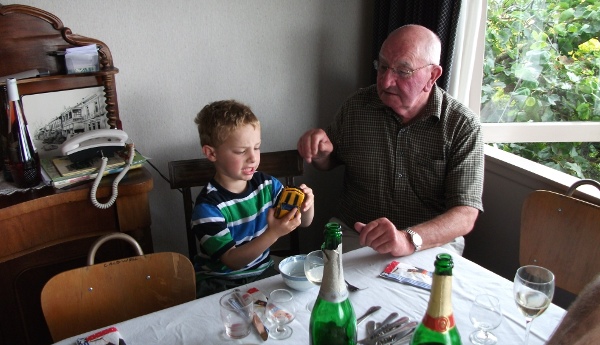
Toby and Granda – Christmas 2009 – Transforming Bumblebee (c) SJPONeill

The title of today’s post is drawn from Christopher Stasheff’s novella of the same name that was included in the Bolo anthology, The Unconquerable. The story is of a small group of Bolos fending off a horde of harpy-like adversaries; as each Bolo is overwhelmed, it passes on its lessons of combat against this foe to the surviving Bolos. In this way, the enemy is finally defeated. It is that ideal knowledge transfer that prompted this post.

Observant visitors may have noticed a new addition to the Blogroll (on the right →) last week, Portable Learner – this is one of those sites you just stumble across sometimes when you click accidentally on the wrong link. The first thing that caught my eye was the definition of Portable Learner…”Portable Learner, n. An individual who carries their knowledge and skills in their memory or in their social networks, spec. so that it can be employed in all sorts of circumstances…” This struck me as being similar to that ideal sought in knowledge management “…the right information to the right people at the right time – and ensuring that they know what to do with it…” especially if reworded ever so slightly to “…an individual who carries their knowledge and skills in their memory or in their networks so that it can be employed in all sorts of circumstances…” and this is reinforced by the quote at the top of the home page…

“The best thing for being sad,” replied Merlin, beginning to puff and blow, “is to learn something. That’s the only thing that never fails. You may grow old and trembling in your anatomies, you may lie awake at night listening to the disorder of your veins, you may miss your only love, you may see the world about you devastated by evil lunatics, or know your honour trampled in the sewers of baser minds. There is only one thing for it then — to learn. Learn why the world wags and what wags it. That is the only thing which the mind can never exhaust, never alienate, never be tortured by, never fear or distrust, and never dream of regretting. Learning is the only thing for you. Look what a lot of things there are to learn.” — T.H. White, The Once and Future King

The first post I read on Portable Learner was Knowledge is Out, Focus is In, and People are Everywhere which is short enough to repeat here in its entirety:

David Dalrymple thinks that in the net age, filtering, not remembering is the most important skill. In his response to Edge’s annual question for 2010, How is the Internet changing the way you think?, he says that those who are able to resist the distractions posed by a deluge of unrelated information and focus on what is important are better equipped than those who are knowledgeable. “Knowledge was once an internal property of a person, and focus on the task at hand could be imposed externally, but with the Internet, knowledge can be supplied externally, but focus must be forced internally.” The idea that an external information repository can replace human memory is interesting, but the dichotomy strikes me as a little extreme. We can’t turn off our memories, and there is value in serendipitous findings. Focus and distraction work in concert in any undertaking. We’ll just have to be more mindful of which one is leading the quest for knowledge.”

This was a one of the themes of our discussion with the Centre for Defence Studies at Massey on Monday – how do you filter the deluge of contemporary doctrine, publications, reports, commentary, opinion, PowerPoints, etc, etc, etc in order to deliver timely, practical and relevant training. It is simply not reasonable to expect force elements to train themselves, or worse, figure ‘it’ out for themselves as a twisted form of empowerment and mission command. This is an easy out for doctrine staffs, too often employed as an excuse for failing to step up to the plate and accept some responsibility for what is taught. There was a general feeling that there is a need for an organisation that sits above doctrine and training staffs to filter the deluge, in accordance with national policy and mission-specific criteria, to ensure what is passed on for doctrinal development and delivery and development in training is actually contemporary, relevant and practical.

During the Great COIN Doctrine Review of 2007-08, all but formal doctrine publications were specifically excluded from the review. This step was partially in recognition of our own depth of COIN knowledge (or lack of thereof!) and also an acknowledgement of the amount of work involved even in the reduced publication list that this decision left to be reviewed. Things have changed since those days and now our primary source of catalysts for change in contemporary operations is the surging sea of the information militia, the blogs, commentaries, media reports, articles, discussion boards etc etc etc. In attempting to quantify the work involved in keeping pace with the daily flows of COIN-related information, the best we could do was reduce the load to a minimum of two hours a day for at least four days every week – and that was without any attempt to distil any information into any form of product other than the most basic reading list. 

I agree totally with the point from Portable Learner “…Focus and distraction work in concert in any undertaking…“. Focus is great for progressing a large workload but runs the risk of missing that serendipitous find that may greatly influence your area of interest – distraction is often good, when married up with discipline, as means of stumbling across those nuggets. The WordPress Dashboard is an example of this as it lists (way down the bottom of the page) the latest, and the hottest blogs – certainly I’ve found the odd gem when scanning this list; similarly tag clouds offer a similar distraction attraction to oft interesting journeys. 

The downside of focus is that inexperienced or unadventurous or simply lazy staff apply focus lists too dogmatically. Critical Topic Lists (CTL) may sound like a top tool in Internal Audit and Organisational Learning classrooms but their utility in the real world, especially in the Lessons Learned field, is limited at best. Time and again, such lists are over-long (our rule was no longer than 20 items but I’ve seen them bloat out into 100s of items), rife with hobby horses, and lack relevance to actual need. a key finding of  CLAW 1 in 2005 was that there were scarily few similarities between the issues identified by the CLAW, based up operational  reports, and the CTL that they were meant to reinforce.

So, anyway, this is why I’ve decided to add Portable Learner to the blogroll. As with the other members of the blogroll, feel free to visit them and draw your own conclusions, contribute where you can, and share back into your own communities…

Local news

Paper Modelers is back up again but has lost 2-3 weeks of contributions…

Carmen and I visited the big smoke of Palmerston North on Monday. I had an assessment test as part of a job application at 9AM which made for an early start – and a longish drive as there was quite thick fog along the route, made more interesting in some parts by the various resealing projects along both highways: nothing quite like a grey-out when suddenly you loose your points of reference to the side of the road due to the fog, the road markings have yet to be repainted…and you can’t only hope you are still heading to where you should be going and not the ditch or oncoming traffic…The assessment test was a breeze_ I had hyped myself up about it…can I make a credible effort on 80 questions in 40 minutes? As it turned out, 25 minutes was all it needed, giving 15 for checking and changing my minds on a couple…don’t want to get too cocky yet til I get the debrief though.

Bit the bullet and invested in a proper Freeview decoder to replace the crappy one I got off Trademe before Christmas – it craps out on a regular basis, especially during must-watch programmes like Coro…so after resetting it every couple of minutes during Bones on Sunday night we decided to spend the money for peace of mind – just wish we had UHF coverage here for so we could have the HD option as well…think twice before buying a DS200 satellite TV decoder – that there are no contact details anywhere for the manufacturer should have been a warning for me…

Had a brief catch-up with the lads at Hawkeye UAS and then an interesting chat at the Centre for Defence Studies at Massey University – Carmen is still rubbing it in that I got lost finding the right office on campus whereas she found it first time when she when to look for me after I missed our RV in the car park…didn’t help my case for GPS though…

In November 2009, I along with many others, was less than impressed when it was announced that the NZ Accident Compensation Corporation (ACC) had a NZ$12 billion + deficit and planned to increase levies to cover the loss. I am a big believer that if things like this annoy you, then in order to have a right to bitch about it you need to be prepared to say your piece and state your case more broadly than just whining into your latte with your mates. I raised my concerns with Dr Nick Smith, the Minister for ACC, via the Parliamentary email system and was most impressed to find a response in the inbox when we got home on Monday night…and a lot more than ‘thank you for raising your concerns and we will take them in to consideration‘: a two page letter no less, with some additional information. I can only imagine who the Minister’s inwards files must have been like over that period so more power to him for making the effort to acknowledge correspondence on this difficult and contentious issue. Good on you, Nick Smith, and more power to you!!

Scooped

But in a good way.

Like 14,691 others, I have been following Michael Yon’s Facebook page as he reports from Afghanistan and had intended to promote him again yesterday as a great example of the Information Militia in operation – Tom Ricks beat me to it with Learn how to be a war correspondent. His website is Michael Yon Online. I’ve commented on him a couple of times before in Doing the Business, following an item on Neptunus Lex on pararescue teams operating in Afghanistan; and slightly later when I thought he was a well-intentioned meddler pressuring US DOD to release a Haitian-born Army officer from service in Afghanistan to deploy to assist in Haiti.

So who is this guy, Michael Yon?

Michael Yon was born in Florida in 1964 (a good year for writers) and joined the US Army when he was 19. He remains one of the youngest soldiers to pass the Special Forces selection process. He left the Army in 1987, after only four years. This is not that unusual and is somewhat typical of what many young men were doing at the time in joining the Army and leaving once they had gotten it out of their system, and/or to take advantage of other opportunities, many of which may have resulted from that military service. I saw many good soldiers in the same period who joined up, completed basis recruit and infantry corps training, spent 6-12 months in 2/1 RNZIR before deploying to 1 RNZIR in Singapore for two years. Many of them left the service at the conclusion of that posting, older, more mature and with much broader horizons.

He drifted through various activities until he began writing in the mid-90s. However it was not until the War in Iraq began that his name came to the fore as a correspondent in December 2004. from that point he has gone from strength to strength as an embedded reporter although his relationship with the military has not always been that smooth. He “…supports embedded journalism over traditional reporting, believing that the closer writers are to events the less likely they are to repeat military public relations spin” and this one of two common themes in his writing today. The other is an extremely strong compassion for soldiers and this comes through very strongly and effectively in his reports.

Happy news for the Left was that U.S. soldiers were demoralized and the war was being lost… Happy news for the Right was that there was no insurgency, then no civil war; we always had enough troops, and we were winning hands-down, except for the left-wing lunatics who were trying to unravel it all. They say heroin addicts are happy, too, when they are out of touch with reality.” Moment of Truth in Iraq, Michael Yon, 2008.

The War in Afghanistan has truly begun. This will be a long, difficult fight that is set to eclipse anything we’ve seen in Iraq. As 2010 unfolds, my 6th year of war coverage will unfold with it. There is relatively little interest in Afghanistan by comparison to previous interest in Iraq, and so reader interest is low. Afghanistan is serious, very deadly business. Like Iraq, however, it gets pushed around as a political brawling pit while the people fighting the war are mostly forgotten. The arguments at home seem more likely to revolve around a few words from the President than the ground realities of combat here. ~ Michael Yon Online

His 2006 article in The Weekly Standard, Censoring Iraq summarises his views well although it led to a major falling out with the US military. He has been criticised often for an apparent naivety in some of his releases, which I think could be attributed to his short period of personal military service, his habit of launching into text-based upon misleading or incorrect information (hence my comments re Haiti), and releasing the names of casualties before next of kin have been properly notified. This last point is interesting as Michael Yon has been accused of doing this during the current operations in Afghanistan however has come back strongly, supported by others, stating that the in-theatre information has been that notifications had been completed.

There is some confusion within the military regarding timing of releasability of names of the fallen. This confusion stems from apparently contradictory sentences within the embed guidelines. The guidelines are being clarified to avert misunderstandings with media, and within the military…Yes. This stems from the Garcia episode. The PAOs, through no fault of their own (other than Garcia blowing a gasket and talking publicly), have some confusion about the embed papers. CPT Adam Weece showed me the sentences and I agreed that the sentences are confusing and seem contradictory. Insofar as my release, I was completely cleared and broke no rules. Was well within the guidelines and what’s right, but the episode revealed some rough spots that need to be ironed out. And so the military is on it and will get it fixed. Should be good soon. ~ Michael Yon Facebook, Feb 10.

This latter point is interesting as it may have uncovered a lag between what happens in the theatre and the actual notifications in the US. While casualty notification is not an easy nor a pleasant task, it has to be sharp – quite simply there can be no fumbles or ball drops – and possibly this is an area that could be put under the Lessons Learned spotlight to make sure we have got it right. One would like to think that the process has come a long way from the Western Union telegrams in We Were Soldiers….Like so many things in the military, this is a function that must be regularly wargamed to ensure that we have it right – and it IS one of those areas where metrics CAN be set to define the standard e.g. family notification in XX hours by XX means by XX individual(s), media release(s) in XX time (relative to family notification) by XX individuals, etc etc.

In Running the War in Iraq, MAJGEN Jim Molan discusses how he and his staff had to meet very tight times lines to be ‘first with the truth’ or, if not, counter dis- and mis-information from any source. I think that the same onus rests with the public affairs staffs everywhere. Embedded media like Michael Yon offer great potential to conduct our own information operations – a function we have historically be very weak in – but they come with risk. Michael Yon’s great attraction is that he comes across as ‘the truth’ and not as PA-spin – if you try to take away the ‘on the edge’ ‘right here, right now’ pulse of his work, you defeat the whole purpose of having an embed. Yeah, sure, there’s this OPSEC thing but I’m not sure how far you can go down that path when the official mouthpieces are telegraphing pinches a week ahead of time. One of the strongest criticisms of the current wars is that ‘truth has become the first casualty’ again – pragmatic shepherding of embeds like Michael Yon can go a long way to mitigating this perception…

A crew from the United States Air Force spent Saturday night and Sunday morning airlifting different groups of wounded soldiers from Kandahar to Camp Bastion to Bagram, back to Kandahar, then back to Bagram, and back to Kandahar. These patients were from Afghanistan, Australia, Canada, and the United States. Here, an Air Force nurse caresses the head of a wounded, unconscious Canadian soldier while whispering into his ear. (c) Michael Yon Online 2010

Stupid?

Should I be concerned when WordPress tells me that people are using the search term ‘stupid‘ to find this blog? It is often quite interesting to see what terms that people are using that bring them here…

There is a steady trickle of searches for Interbella which is good as it shows that a few people out there are starting to get the message that we need a new way of thinking to truly grasp complexity and uncertainty.

There is a lot of interest in the UK’s training simulation JCOVE that I mentioned in Microcosms – I never did get around to reviewing this, or even playing it that much – I simply don’t have time at the moment between job-hunting, blogging and doing the work I do have. I am hard-pressed to consider spending too much recreational time in front of the PC. Hopefully I will get over this, possibly when the weather packs up for winter, and I do enjoy sims and have done since my first Sega system in 1988. Sims and training still have a long road to ride together.

At least one person has been feverishly beavering away looking for a paper model of the mighty TSR.2. I can help there as there are four that I know of: the first three are fairly simplistic and should be easy enough to find online. The fourth is a magnificent creation in 1/33 by Waltair at Kartonbau.de – unfortunately there seem to have been some issues with the design and he has put it back on to the back burner til maybe this year…

BAC-TSR2-der-Royal-Air-Force-133_8119

Note: Waltair’s TSR.2 released a year or so later…it’s a beauty!!!

Papermodeling.com is still down. It’s been four days now and I think that this is the longest that I have ever known a website to be down for technical reasons. Apparently the problem is that the back-up is very large (very graphics-heavy at a guess) and won’t upload properly. Best laid plans of mouse and men etc but I wonder what liability forum and blog hosts actually have when something like this happens. If this site can not be recovered, an incredible amount of knowledge (on a narrow topic) will be lost. We used to laugh when the Army went to an online personal records system in the early 90s and all the clerks had to maintain paper records of all transactions: there was actually more paper produced and stored than under the old paper-based system! Looking back, maybe they weren’t so dumb after all…?

I have done something to my back that kicks in whenever I sit at my desk in the study, especially in the evenings – any more than an hour or so at the keyboard and it becomes quite uncomfortable. The upside is that it goes away if I keep moving about so in the day I guess it is a good motivator to do some work outside…so today’s rehab has seen part of the vege garden dug up and replanted with beans, the goats and sheep set to work cleaning up the edge of the front lawns, and a start made on a Colditz fence so they can level all the crap that has grown at the top of the back garden without breaking out and obliterating the garden.

I have a few less options after dark but stretching out on a couch seems to help so I’m off to finish watching The Wild Geese, a favourite from wayback – should I feel old when I remember seeing this when it was first released in 1978…?

wild geese

Hoping, wishing, praying…

In More on Risk-based decision making in Homeland security, Dean introduces hope-based decision-making “… Hopefully the most significant threats are the ones you’re already focused on.  As long as they are, you’re ok.  When they aren’t, you stand by…and say to everyone who will listen ‘No one could have predicted this’.”

Remember that time when you were four, and that big plate glass window in the lounge kinda got broken and even though you were the only person in the lounge playing with Dad’s golf clubs, you still hope a whole lot that your invisible friend is going to materialise and take the rap? Fast-forward thirty years to when your boss says ‘we’ will carry the risk – you really hope that he really does mean ‘we’ and not ‘you’? Or that time you decided to invade Iraq and hoped that a. a lot of WMD would turn up really quickly and b. that the UN would get over itself and follow-on with civil aid and reconstruction programmes? Each of these scenarios has three things in common:

You have a nagging feeling how things are really going to turn out.

Those consequences are probably going to hurt.

When you think about it, you really knew better.

This week, Neptunus Lex published an item for aviators The ‘Possible’ Turn which discusses the options available to a pilot when an engine fails on take-off. The commonly held truism is that any attempt to turn back to the recently departed runway is doomed to fail – doom in the worse possible sense of the word – one of those manouevres based more upon hope than physics. Lex argues in aviation speak that this might not actually be the case for a suitably experienced pilot – equipped with an ability to make practical decisions fast. Also in the mail this morning was an article discussing the proposed shift in focus of the PRT in Afghanistan to a more civil focus at a time when surge-inflicted chaos may boil over into other provinces. I wondered about this too In the Ghan.

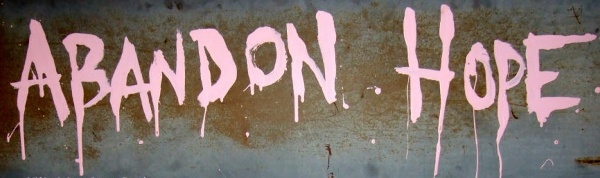
When we established our joint headquarters in 2001, many suggested that each external door should have a big sign ABANDON HOPE ALL YE WHO ENTER HERE. For different reasons, they were probably right: hope has no place in any organisation where lives are at stake.

So why do we do it so often? There are three factors:

Partly it is simple laziness – we’ve always done it like this and it’s always been OK before.

Another part is simply sticking with what we know – after decades of peacetime engagement and peacekeeping, it is difficult to shed that mindset for that necessary for operating in and around a warfighting environment where the threats are very really and unlikely to be assuaged by an umpire with a blue rag tied around one arm.

The third factor is that making good decisions has to be practiced regularly – and that includes being able to quickly sift through all the available information to extract the key points, digest them and then make the call.

Supporting good decisions is a firm ethical and cultural foundation based upon three key qualities:

The Competence to understand the environment and the issues.

The Courage to promote an unpalatable or unpopular line of reason.

The Integrity to see the issue through when the going gets tough.

Regularly we see news items when agents of government at all levels fail to display one or all of these qualities. And every time, the parent agency trots out its Code of Conduct, duly signed by all employees “Hey, look – it’s not our corporate fault!” And why isn’t it ‘our’ fault? Because it’s too hard for the HR Nazis to snap out of their nice objective competencies and consider applying some subjective qualitative assessments on potential recruits? It is interesting to note that those agencies where people are more likely to work collectively as opposed to as individuals are more likely to have a sound organisational ethos and culture – the two that spring to mind immediately are the military and the Fire Service; law enforcement to a far lesser extent because they tend to function as individuals not collective teams (STG, HRS, SWAT, etc being exceptions but only a small percentage of their respective agencies.

But developing, fostering and embedding an ethos and culture based on these qualities into an existing organisation is doable. We’re running an interesting ‘experiment’ here where the new Head of Customs is a highly-regarded former two-star who is doing exactly that. But what he’s brought to Customs is not so much thirty odd years of military experience – it is too easy to fall into the trap that ex-military staff have all the answers; they can have a lot of the problems too – but good old-fashioned command and LEADERSHIP.

So in terms of our discussions regarding decision-making in homeland security, the very first thing that we need to consider is raising the bar of competence. That means introducing more than just training, more than just practicing what we preach; it means that we need to set and conform to some basic standards of performance, weed out those who are more social than team members. I was once posted to a base that is quite isolated and where there was some institutional resistance to being posted there. Most of this was of the “well, everyone says it’s a bad place so it must be a bad place to go” variety and as a result, anyone volunteering to be posted there was usually snapped up. When I arrived, there was some debate raging over this posting policy and after about two weeks on the job, I feel firmer in to the camp of “‘it’s better to have a gap than to fill it with a warm body that does nothing; at least when you have a gap, you know you have a gap and can work around it. When the chair is filled, you keep kidding yourself that the incumbent may one day surprise you and actually do something useful – but it never happens”.

The flip side of competency is training, training that is relevant and current for the job at hand because it takes knowledge to fend off hope – yep, that’s right, Hope, we don’t want you here!! and this is where doctrine, lessons learned, organisational learning, knowledge management and all those other good things come together…to…get the right information…to the right people…at the right time…and ensure that they know what to do with it…

It all comes back to that…

Into the Blue

xvy2zlctq_ypm6ngt3qzr5ec3oatgbyc-large (2)

Yes, it’s cool; yes, it was in Die Hard 4.0; but it just has way too many dangly bits to do the business. Image (c) http://www.telegraph.co.uk

“We are shackled by the past and never has the future been more difficult to divine. What we must do is to quite ruthlessly discard ideas, traditions, and methods which have not stood the test…each of the fighting services must go for speed, mobility and economy, and develop the whole time with an eye on the other two members of the team in co-operation, not in competition.” This 1947 quote from Marshal of the RAF the Lord Tedder opens an article by the new UK Chief of Air Staff, The Future of British Air and Space Power: A Personal Perspective, in the Autumn 2009 Air Power Review. He follows this with a quote from Darwin on the second page of the article “It is not the strongest of the species that survive, nor the most intelligent, but the most adaptable.” I did comment briefly in this article in Resuming Normal Services last month but have only really considered the issues more fully today…

It is indeed good to see a newly-appointed service chief (appointed on 31 July 2009) publicly stating his opinions and intentions. Certainly, as a general rule across government, this is not something that we do well in New Zealand – tons of internal marketing and engagement but not too much with the poor old public or our friends and allies…I actually think that it should be mandatory for CEOs and chiefs within government and its ministries and agencies to release a public stance on where they think they will go during their tenure as ‘boss’.

The new CAS will most likely achieve much of what he sets out in this paper. He has steered clear of the ‘boots on the ground’ versus ‘ships at sea’ spat between the Chiefs of Army and Navy and it is only in late January this year that he issued a cautionary note regarding the risks involved in focusing Defence acquisitions too much on ‘the’ war and not enough on ‘a’ war “…the point is to have those discussions in the context of a proper review so we don’t end up making short-term decisions on the financial (question) of the availability of money in the current environment or the short term rationale. We need a long-term view…” This is somewhat of a contrast to the previous CAS who, only a month or so before handing over the role, predicted that the RAF would take over Royal Navy jet operations. While this may be the current situation through the establishment of the Joint Harrier Force, it certainly created waves as the Royal Navy anticipates the introduction into service of two new ‘real’ aircraft carriers equipped with brand spanking F-35 Lightning IIs. Lightning is the US name for the F-35 which the RAF has adopted although nothing published as yet defines whether they see it as the successor to the Lockheed Lightning ‘I’ which the RAF wasn’t that impressed with; or  as a possible successor to the English Electric Lightning ‘I’ which is and will always be one of the all-time grunter fighter aircraft.

I have my own reservations regarding the F-35 Joint Strike Fighter, all versions; it seems reminiscent of the McNamarist one-size-fits-all-roles aircraft in the F-111 debacle and comes across as an attempt to (ap)please everyone and will end up pleasing no one. Even though the RAF has stood fast in its procurement of the Eurofighter which lies in capability somewhere between the F-35 and the now-cancelled F-22, it has already shrunk its fleet from the 232 originally needed to only 123  aircraft. This seems scarcely enough for the RAF’s primary mission,as described by CAS’ article,  of controlling and protecting British airspace, let alone to support any but the most benign expeditionary operations. Even though the Typhoon will eventually be joined by the F-35, reading between the lines of the UK MOD’s current financial stresses, it is likely that its numbers will also be dramatically reduced from the 150 originally planned. This number has already been whittled down to 138 and there is speculation that this number will be reduced again.

While the Air Power Review article  sees the F-35 Lightning II as “…primarily an ISTAR asset…with hugely effective built-in Attack and Control of the Air capabilities...”, it does caution against the risks of “…putting all our investment into a small number of highly capable platforms…that we will field a ‘middle-weight’ force structure which is too sophisticated to fight low technology insurgencies in a cost effective manner but equally, is unable to be completely effective against the high technology equipment that future state adversaries…are likely to deploy…” Unfortunately, as costs spiral upwards passing budgets spiraling the other way, it does not seem like that the RAF as it is currently being structured will be able to meet its obligations to “…capitalise on air power’s ability to acquire and process intelligence, and to strike with proportion and precision…” The article concludes by listing ten key propositions for the future of British air and space power:

  1. Air and space power is all about creating influence.
  2. Control of the Air and Space remains the paramount air and space role.
  3. Air and space power is about the provision of capability, not the generation of platforms.
  4. Time is a weapon: air and space power offers the mean to dominate it.
  5. Combat ISTAR will lie at the heart of the RAF’s future capability.
  6. Unmanned Air Systems are here to stay. UAS are an integral part of the UK’s air power capability.
  7. Space and cyber are joint domains but the air component is best-placed to lead in coordinating the defence effort in these areas.
  8. Technology and air and space power are synergistically related.
  9. Agility and adaptability are the key to the delivery of capable, relevant and affordable air and space power in a complex and uncetain world.
  10. Network Enabled Capability is critical to unlocking air and space power’s potential.

First things first: the UK does not have a space capability – it got out of that game in the 60s.  Any interdiction and control of space will be reserved for those nations that can get into the operating environment: the US, Russia and maybe China and India one day. Even the EU is not a real player in the 21st Century space game which is a shame because there is not reason that it should not be, other than general apathy and too great an interest in keeping the here and now nice and comfortable…

ISTAR and cyber are and MUST be a Joint, Interagency, Multinational and Public (Bring out the JIMP!) responsibilities. As soon as any one player declares it is ‘their’ role and grabs for primacy in either role, it only demonstrates a total failure to grasp this fact. Both ISTAR and cyber relate to facets of information; attempts to cram them into legacy single service stovepipes only cripples the wider effort. There is not one single whit of evidence to suggest that any service is better or worse in these domains than any other. If our children are to be believed, it is the unkempt, Gen Z-ers with their trousers habitually halfway to their knees who rule in the information domains…

Technology and air and space power may be synergistically related but possibly not in the way intended in the article. I am a big fan of Alfred Thayer Mahan; in fact, The Influence of Seapower Upon History is one of only two books that I have as both Audible files and hard copy publications – the other being William Manchester‘s American Caesar. I first read The Influence of Seapower in the mid-90s when the third frigate debate raged across Defence. Although Mahan was oft-quoted by the frigate lobby, I always suspected that those doing the quoting hadn’t actually read the book as one of the key points I took away from it was that, in order to control the seas, you must actually be capable of doing so. Thus, the French and Spanish talked it (seapower) up but we never able to quite deliver whereas the Dutch and most definitely the Royal Navy were very much able to enforce their will on and dominate the waves. If the RAF seeks to control the Britain’s air space or the air space of an operational theatre, then perhaps it simply can not afford these high tech platforms like Typhoon and F-35. More importantly, it might not be able to afford to replace them should an opponent adopt an attritive strategy. Even if an adversary lacks its own air power capability, conflicts in Zimbabwe, Vietnam and the Falkland Islands have demonstrated how small groups of soldiers can apply their own counter-air campaigns on aircraft on the ground. Similarly, an over-dependence on UAS will come a cropper as an adversary targets the links between the UAV, its controllers and its ‘clients’.

In defining the way ahead for the RAF, I am not at all sure that the CAS has fully considered where it has been. Scene-setting early paragraphs in the paper cite the air policing of no-fly zones over Iraq from 1991-2003 as a relatively cost-effective (no loss of coalition lives and $1 billion annually) method of neutering Saddam compared to the 4000 US KIA and $12.5 billion monthly cost of OIF. This is very much a chalk and cheese comparison: the no-fly zone campaign was at the bottom end of a containment strategy that did little to curbs Saddam’s aspirations, power or depredations against his own people. OIF, on the other hand, was very much a high intensity state on state conflict that, rightly or wrongly, deposed Saddam’s regime and heralded significant change and consequences for all Iraqis. While I could by no means be accused of land-centricity, the simple fact is that there are few campaigns where the employment of air power in isolation has been a deciding factor in a conflict. The bombing of Nagasaki and Hiroshima, the Berlin Airlift, and Operation EL DORADO CANYON are three rare examples where this has occurred.

Immediately following this example, the article states that “…even where a significant presence is required on the ground as part of a joint campaign, air power is able to act as a force multiplier to dramatically reduce exposure. Ideally, the ‘boots on the ground’ required in a counterinsurgency operation will eventually be provided by indigenous forces after suitable training...” It cites no example to support this statement and it is unlikely that many examples exist. These two statements overlook two fundamentals of COIN (as opposed to Countering Irregular Activity as Op ELDORADO CANYON did) , namely the need to close with and engage (not necessarily ‘strike‘ or ‘attack‘) the people in the campaign theatre, and that, for the purposes of shaping UK forces for the future, the ‘long war‘ nature of COIN requires a long term commitment of land forces. It is only in the very late stages of a successful COIN campaign that air power might become the primary form of aid to the host nation.

Like Friends in High Places, this article only pays the barest lip service to the less kinetic aspects of air power. Instead of ‘engage‘ it still displays the archaic mindset of  ‘attack‘. The force multiplying value of RAF fixed and rotary wing transport capabilities is only skimmed over and does not earn so much as a mention in the ten key propositions for the future of British air and space power listed above. Relationships with the other services receive little mention, and even less is awarded to allies and coalition partners.  The RAF has yet to fully consider the final part of Lord Tedder’s advice that opens the article “…and develop the whole time with an eye on the other two members of the team in co-operation, not in competition...” In the frantic scrambling for the remnants of the British Defence budget, the RAF may have been a little too quick to “…ruthlessly discard ideas, traditions, and methods…” without fully considering the nature of the test that each should have withstood.

Indications of this are evident in the article in that there is not one single mention of control of the sea lanes upon which Britain relies so much. Although Mahan wrote of naval control of the sea, it is not difficult to extrapolate his principles to include control of the sea from the air as well, regardless of who, RAF or RN, might own that air power. The US Navy integration of air power into control of the sea is probably the most powerful example of Mahan’s work being put into action. From its earliest days, the RAF has played a key role in control of Britain’s sea lane’s; although it could be argued that this might fall under one of the ISTAR principles listed above, that does not include any capability (apart from F-35?) to actually inflict control on those areas i.e. the roles filled by the Hudson and Liberators of Coastal Command and now assumed by Nimrod today. The sea is the other ‘space’ the RAF should be seeking to control both as one of its core traditional roles and also as one directly linked to the prosperity and growth of Mother England.

The RAF has some tough decisions ahead of it, as do the Royal Navy and British Army. The simple fact is that Britain is no longer the world power that she once was and has not been for decades: the Falklands Islands campaign almost 30 years ago could easily be regarded as the last gasp of an Empire. Sometime less = less and more = more: maybe the RAF needs to be less swayed by the attractions of technologies it can no longer afford e.g. Typhoon and F-35 – who exactly might be the threat against which such capabilities maybe required? It may well be that such high-tech platforms are now solely in the bailiwick of those that can afford to operate them like the US and Singapore (sorry, Australia). In their place, perhaps the RAF should be considering adoption of  greater quantities of the 21st Century equivalents of the Hawker Hunter,  Douglas A-4 Skyhawk and Northrop F-5…?

[PDF version]

In other news

Peter @ The Strategist has released Part 2 of the Doomsday Device.

Paper Modelers has now been down for almost two days and I am most definitely missing my fix. Apparently the ISP lost (how careless!) a drive in its RAID array and is having trouble restoring the site – as the twins would say, uh-oh…what makes this double or triply frustrating is that I have news to share and no one to share it with: where it was thought that the Kalinin K-12 released a couple of weeks ago might be some seven inches short in wing span, I have now measured the relevant parts and the span, less skin thickness, in my opinion, is 606mm which is close enough to the correct 635mm span. Of course, that meant absolutely nothing to anyone but at least I have it off my chest now…

Neptunus Lex has a thought-provoking item on the “…moral continuum between killing our terrorist adversaries where we find them, detaining them as unlawful combatants and giving them the same constitutional rights as any US citizen…

A alternate slant on history

Peter @ The Strategist has begun a series of short stories and has published the first two on his blog:

The Doomsday Device

Beggars Can’t Be Choosers

I found both stories to be insightful and just the right length to provoke thought i.e. much longer and the reader would develop a serious nagging urge for more, more, more, give me more!! Along with a number of others, I hope that self-publishing via his blog is only the first step and that Peter will take heart from his first two stories to develop more for more formal publication as an anthology….publishing online is nice but it’s not quite the same as a title on the physical book shelf.

Peter has indicated that he would be interested in other short stories on his current themes so out goes the old gauntlet for anyone who thinks that they might be able to string a few words together – no more than 2000 – and spin up a yarn relating to…

What-if Germany won World War One? The circumstance, effects and extent of that ‘victory’ are entirely up to the budding author…I’m personally in favour of anything that involves that great European sport of slicing and dicing up France…

What would happen if civilisation as we know it collapsed? Again the circumstance, effects and extent of that collapse are left to the author to determine…although Aucklanders, please note, being forced to use public transport instead of driving everywhere does not constitute the end of civilisation we anyone knows it…

The one caution I would give is that developing an alternate history is a little more than shaking up the actual timeline and rearranging the characters – that becomes trite and mundane very quickly and you can see examples in the various discussions on building the Birmoverse – from the point of deviation from actual history, the author really has to sit down and consider how that new timeline will develop, identify key milestones and then flesh out the story to link those milestones. It is not outside the bounds of possibility that an alternate timeline might actually rejoin the actual timeline at some point as a story plays out in conjunction with great events.

As with the numerous discussions on developing the Birmoverse in the last few months, considering alternate and future histories can help us understand and place ourselves better in our own timeline but considering events and issues from a new perspective. I enjoyed Peter’s first two stories in their own right and am seriously considering having a crack at some myself. Of course, the last time I wrote any fiction (other than military doctrine!!) was when I had a short short story published in the Sunday Times when I was seven…

Round Up

Just a quick round up of what’s happening around the blogspace – have loads of domestic duties this week so focusing on those while the sun shines…

Europe Descends

Neptunus Lex continues to chronicle the decline of Europe as a major power, if it every was in the first place – certainly some of its member nations may have been – once – but EU Europe definitely seems to be less than the sum of its parts…Britain, Eire, Netherlands, Greece, Russia

Keep 558 alive

At Paper Modelers, there is a request to support XH558, the last flying Avro Vulcan bomber. 558 took to the skies once more in 2008 but exists only on donations and some minor corporate support…have a look at the Vulcan Trust site and at least sign the supporters card – give a little if you can….

Is this not both beautiful and super cool?

Birmoverse – The Movie

Following the creation of a Facebook page calling to Hollywood to option John Birmingham’s Axis of Time trilogy, Cheeseburger Gothic called for ideas on who should play who in the movies…still room for your 2 cents…

Mr Birmingham is also off to Puckapunyal again next week for another get together with Force Development Group on what future conflict environments might be like…interesting to be a fly on the wall for that chat…

RIP Charley Wilson

Coming Anarchy carries a brief obituary for the orchestrator of the mujahedeen victory against the Russians in the 80s.

Natural Selection in Action

Some would-be bombers in Adelaide have gone to a better place…

Be older and happier

Discover Magazine reports on a survey that finds we get happier as we get older – something to look forward to…

Kilcullen on Metrics

Tom Ricks at Foreign Policy is carrying a series of new material from David Kilcullen:

Kilcullen (I): Here’s what not to measure in a COIN campaign

Obviously more to follow on the nuggets in these articles…

Uh-huh

More thefts from Army Museum Stop dodgy crims at Crimestoppers.

And we should respect your traditions in our countries why?

Valentine’s police see red as Saudis crack down on Valentine’s Day…