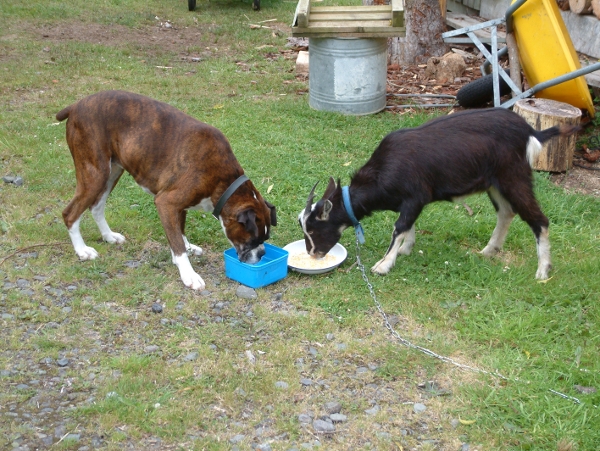
…at first Ruby wasn’t too sure about the new dog in the yard…

Do you make your kids finish all the food on their plates?
As a general rule, yes…but sometimes a battle is simply not worth it…equally generally, they are pretty good about hoovering up whatever is put in front of them…(talking grand-kids here so the rules might be a little different…)
Do you give an allowance?
Nope…they have both left home and are on their own, despite occasional hints … but we still feed them when they come round home though…
Do you actually park your car in the garage?
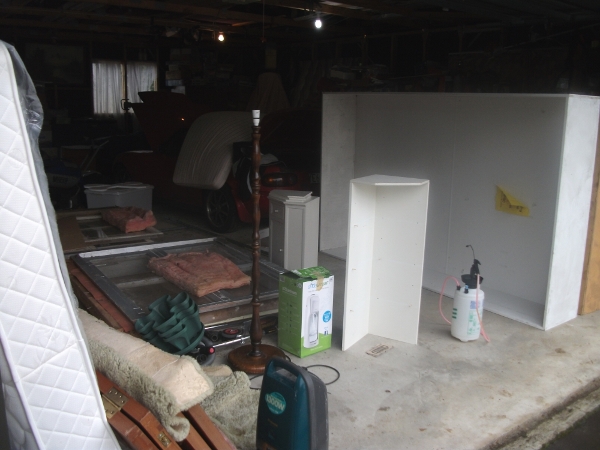
That’s the general idea and , yes, there is a car in there…with winter coming down here, we will probably have to get our act together so we can get the truck in there as well – had a couple of windfalls with ‘in-theme’ windows for the cottage/sleep-out and the big box things are displays cases from the Te Rapa Payless Plastics that Carmen scored from their closing down sale last weekend…both items need a temporary home til we get round to shifting them to either the storage garage (no, that’s not it in the picture; that IS the car garage!) or installing them…
What is one food you will NEVER cook?
Kina aka sea urchin…looks like snot and not interested in investigating further before the zombie apocalypse strikes…

I rest my case…
Do you have anything exciting planned for the summer?
Not really…just being able to bask in the sun and enjoy the great weather we never got this summer…first summer trip will probably be Brussels but it’ll be coming on to winter there so not sure if that will count? Hoping for an Aussie trip before Christmas though…


This was my first crack at Sun…I normally try to avoid it it for the obvious reason that it tends to wash out my shots and I’m too lazy to remember what camera settings will mitigate that effect (OK, that’s two obvious reasons)…in the flesh, this looked awesome as the sun burned through cloud directly over the cone of Mount Ruapehu – which is an active volcano so at first glance it appeared that it was acting up again…
But then, while aimlessly driving through Picasa, I came across this…
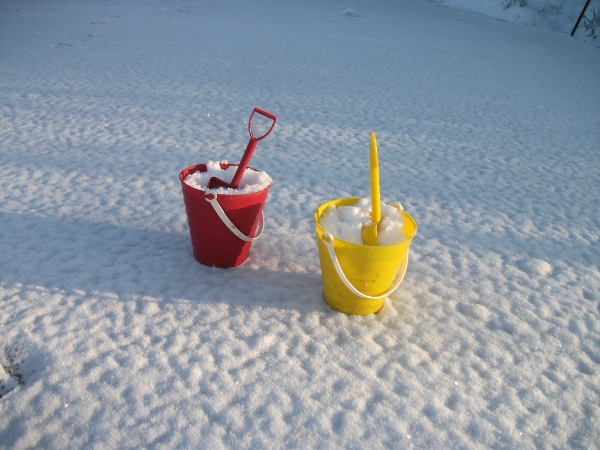
While not directly including the sun in the picture, the two sand buckets evoke sun, sea and surf, and the shadows on the snow offer quite a sharp contrast in both the imagery and what you can assume the ambient temperature to be…this is just one of those shots that appears a good idea at the time but which I can no longer remember what that idea might have been…and it was only last winter – or maybe that should be ‘this’ winter as the intervening summer doesn’t appear to have happened…
Note: another reason for placing my ‘best’ picture last in sequence on the page is that, when sharing or publicising via Facebook, it is always the last image that is the thumbnail for the post. I think that’s dumb too but, hey, it’s Facebook…let’s not look to closely for signs for life or logic in the machine behind the Timeline…

Randomly-selected COIN-themed pic
This image was drawn from a plug for Japanese Counterinsurgency, WW2 – from the text, the author has some issues with the contemporary approach to COIN and I’m not altogether convinced that he is 100% in the wrong:
Few students of history realize that the brutally effective Japanese Army of World War 2, also fought many campaigns that may be described as Japanese Counterinsurgency, WW2. The methods of Japanese Counterinsurgency in WW2 were unhindered by any of the guilt, lack of confidence, and/or confused thinking so apparent in the American-Marxist approach to counterinsurgency. In its own way, the Japanese Army was pure, and its distilled ferocity was unburdened by the treasonous misgivings of melting pot citizens harboring heterogeneous values and treasonous notions. Japanese Counterinsurgency, WW2 was carried out to obtain victory. The clear-minded Japanese Army did not bother to invent false rules of war or self-defeating rules of engagement crafted by non-warriors trying to work off their own poisoned karmic debt. Neither did they subscribe to such insanely defeatist rules as those of the Geneva Conference. The Japanese Army knew that if they were defeated, Japanese survivors would be murdered by the same fair-play hypocrites who advocated “rules of war”. The Japanese Army was not hypocritical and the methods described in the e-book, Japanese Counterinsurgency, WW2, provide important lessons for those uncorrupted by treasonous war rules, which favor enemy victory. Expose yourself to a different type of anti-partisan warfare, one which was always victorious and was feared as Japanese Counterinsurgency, WW2.
Excerpt from Japanese Counterinsurgency, WW2“The Japanese commander in the Philippines called for a minimum of 24 infantry battalions to secure his rear areas against guerrilla action and seven divisions to break up the regular invasion effort.”‘ This would mean a ratio of approximately three front-line troops for every one soldier tied down in rear-area security. In China, where guerrilla action was more fully developed, the requirements for rear-area security were greater and the number of troops so engaged at times actually exceeded those forces engaged in front-line action.
Strong Points
The Japanese made extensive use of strong points to ensure greater security in the occupied areas. Most of these were located in commanding positions, along railroad lines, near bridges, and adjacent to key industrial installations.In China alone an estimated 30,000 strong points were constructed. Of this number approximately 10,000, or one-third, were destroyed in the course of the struggle against the guerrillas.”
3. Are the current definitions of insurgency and counterinsurgency in FM 3-24, and updated by JP 3-24 (2009) adequate? If not, how would you change them and why?
See comment on IP1 – Definitions.
PART 1: History, Theory, Principles, and Fundamentals
4. Current US policy and attitudes, along with the contemporary media environment, make difficult the adoption of techniques such as massive resettlement of the population and the application of overwhelming firepower. Considering those limitations, what historical counterinsurgency case studies do you believe have the greatest benefit to determining the most successful counterinsurgent principles?
These limitations are false in terms of the study of counterinsurgency and the determination of enduring principles; while they may affect specific campaign planning, they should not be allowed to affect determination of the principles of counterinsurgency/irregular warfare. It would be assumed that any competent commander and staff would be able to determine during planning what courses of action may be untenable due to cultural issues nationally, globally and/or within the host nation.
The following case studies are recommended for study:
The American War of Independence from the perspectives of the American insurgents, British counterinsurgents, Hessian ‘contractors’ and French intervention forces.
The New Zealand Wars 1840-85 and the campaigns against the Native Americans in the US. It could be argued that both these insurgencies actually sought to maintain as opposed to overthrow the status quo which while possibly placing them outside the recommended definition of insurgency, does not detract from the fact that the principles of counterinsurgency still applied – possibly another indicator that Irregular Warfare might be a more suitable title for this publication. If one opts for the legitimacy path to COIN, it should be noted that the underlying causes of both these series of campaigns can be found in a series of legitimate treaties that were breached by those who became the counterinsurgents.
The French and Yugoslav resistance movements during WW2, both of which are also examples of majority insurgent movements.
The Malayan Emergency must be included if for no other reason than to ‘myth-bust’ the counterinsurgency truisms that have arisen from this campaign.
Both the French and US experiences in Vietnam must be included. The French campaign is an example of a militarily-focussed approach coupled with a failure to realise that the ways and means of the 19th Century no longer applied in the mid-20th Century. The US campaign in Vietnam illustrates the true nature of counterinsurgency without the artificial constraints of the Malayan scenario and the potential ‘three block war’ nature of irregular warfare/counterinsurgency. The Vietnam study can include the diplomatic and domestic fronts as part of the ‘comprehensive’ approach to the conflict by both sides, the high-end air war fought over North Vietnam, the high intensity infantry conflict fought within South Vietnam, the special operations campaigns fought not in South Vietnam but Cambodia, Laos and North Vietnam as well, and finally the OGA/NGO aspects of the conflict. Vietnam is one of the few conflicts that draws all these threads into a single narrative.
Mention must be made of Soviet approaches (see note 1) to counterinsurgency in Hungary, Czechoslovakia, Afghanistan and Chechnya; and Chinese approaches in places like Tibet, with mention of what worked for them and what did not.
A modern study of counterinsurgency must include Iraq post-2003 as this would ‘prove’ or validate the principles derived from the previous case studies in a contemporary context. Until the Afghan campaign is actually concluded, it will remain unclear whether it will stand as an example of how-to or how not to conduct a campaign.
Some thought may also be given to the 2011 campaign in Libya as means of countering an insurgency, in this case the one that was developing against the Gadhafi regime with scope to further destabilise the region if not addressed one way or another. The point derived from this, possibly as an adjunct to discussion on ‘colonial counterinsurgency’, is that the effects of an insurgency may be mitigated by actually supporting it. In terms of counterinsurgency/irregular warfare principles, this would support the principle of each and every potential campaign being examined against its own merits i.e. to avoid the cookie-cutter approach.
I considered the 2010 Rand study, Victory Has a Thousand Fathers, for this list but I have concerns about its veracity noting the limited period selected to review and the limited campaigns examined. It’s really a shame because the idea was sound – just let down by a flawed execution, ironically, just like many COIN campaigns…

This the picture that I really wanted to use for the ‘through’ photo challenge but couldn’t access because I was away from home – some days (just some days) the ‘cloud’ doesn’t seem like such a bad idea – I still like what I did use in the end though….

A journey we made just before Christmas 2009, flying from Auckland to Christchurch, Mount Tongariro peeking through the cloud…home is about one o’clock at the further edge of the gap in the cloud…trips to the South Island are always good and one highlight of this journey was lunch at Cafe Mes Amis in Orari, about halfway between Ashburton and Timaru…
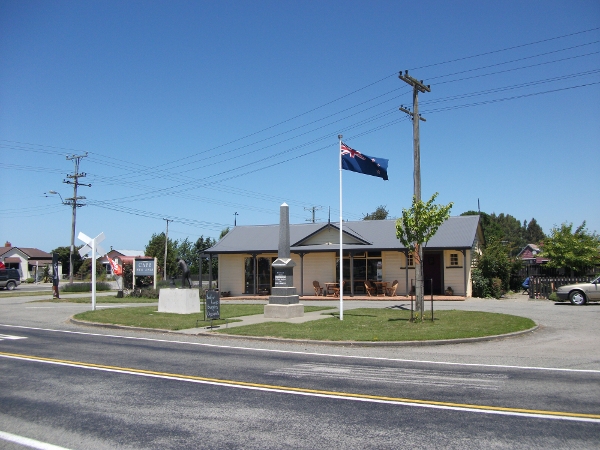
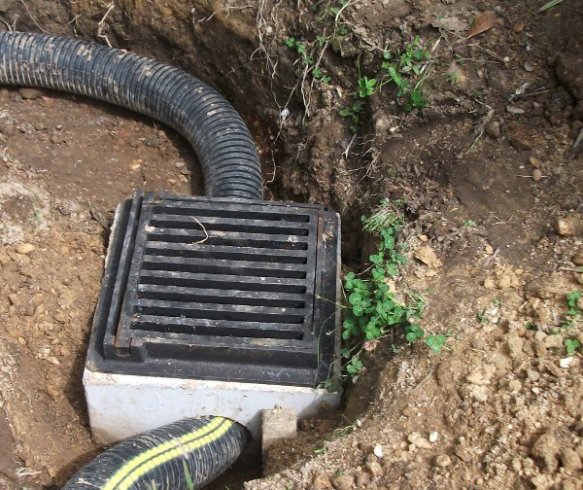
No, folks, you haven’t missed the latest WordPress Weekly Photo Challenge email…but I sure did as it has become a feature of my weekly programme, one which ensures that, if nothing else, I do one post a week…I missed it so much that in the absence of a formal challenge form WordPress this week, I’m selected my own…anyone is invited to kick in as well if they feel the need – or just have a big gaping hole where the Challenge usually lies…
‘Heavy’ came from yesterday’s task: digging in this sump to capture surface water and sediment from around the garage and to get it (the water) into our storm water system while dumping out the sediment which tends to clog the pipes…The prefab sump unit is 70cm high with an internal dimension of 40cm on a side – the walls are about 5cm thick: THIS THING IS HEAVY!!!
Our first attempt the hole wasn’t quite square enough and the whole thing wedged in about 10cm short of its target depth and too damn high to capture any anticipated run-off. If lifting it in was a challenge, lifting it out was quite definitely ‘character-building’. Edging out the hole by 2-3cm on each side (mostly done to free it up for the remedial lift) did the trick and the sump is now emplaced.
Over the next week or so we’ll shape the ground around it for optimal water capture and then concrete it in, using river rock for the final layer…
As a bonus, we also have some free Flintstone tyres from where the inlet and outlet holes were cut…one more sump and we’ll have enough for a go-kart….
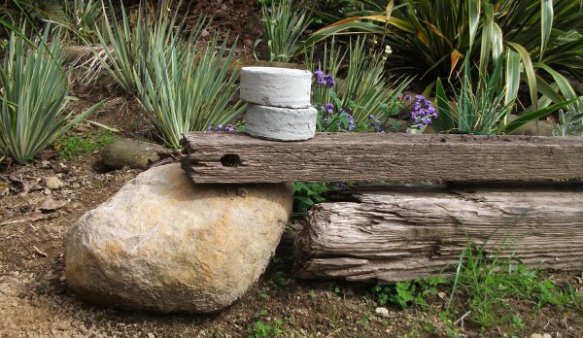
Off the back roads of faith and onto the super-freeway of hope....
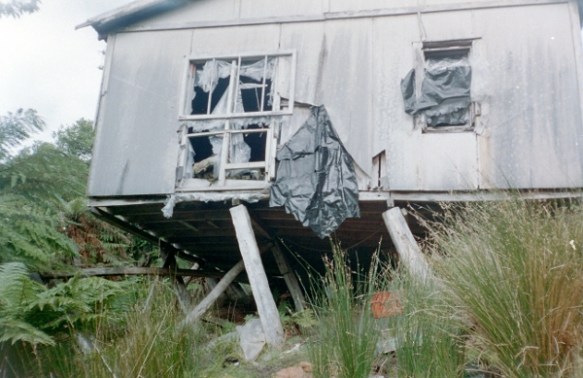
Had to think quite hard for this (actually last) week’s photo challenge until I stumbled across this memory from Exercise VELVET TOUCH which deployed a large chunk of the Army and Air Force from respective bases to Stewart Island (drive to the bottom of the South Island and keep on going) which, it was felt would offer some more practical challenges than the more routine drive to Waiouru or Tekapo training areas…
This fine building became Headquarters Alpha Company for the duration – it was warm and dry and that, for us, made it safe (enough). We swapped some ration pack boxes for a couple of bins of fish from a boat that pulled into the inlet one afternoon: they were well over fish and we were well over canned food so it worked out well for everyone although our warm and dry accommodation almost became warmer and drier when our artillery forward observer party started a roaring blaze in the coal range to start cooking up our kai moana haul. As it turned out the stove hadn’t been used in years and the reason that the fire was roaring so well was that the base of the range had burned through long ago and the floor board and joists were quite happily contributing to the blaze…every wonder just quickly a burning stove can be ripped out of the wall and ejected from a building…?
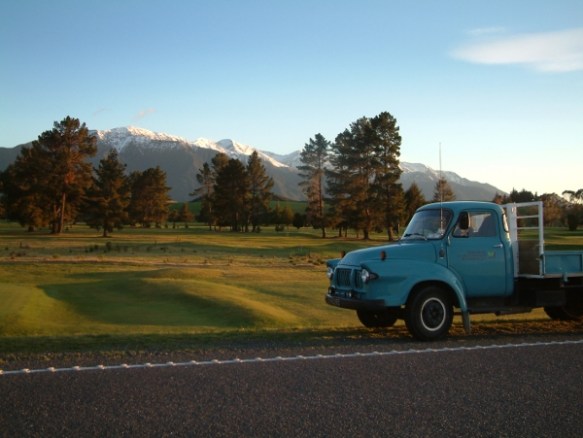
This week’s photo challenge is Bill the Bedford on his way to Gore on a very peaceful Kaikoura morning…funny sort of job….long story starting with a rimu spiral staircase that appeared on Trademe in 2008. Rimu staircases being somewhat rare, one’s with an opening bid of a dollar being even rarer, Carmen and I had a quick confab over the phone at work (this is when we were both in Waiouru) and tossed a fairly substantial maximum bid in on it with only a couple of hours to go. We were really surprised to win the auction for only $600…
A few weeks later, must have been just after the big snow of ’08, we took Oscar the Ssangyong on its first run to Wellington to pick up the stair case. Not only did we get the staircase but also a full set of rimu doors for kitcheb cupboards. The guy we got them off had just been made redundant and while unemployed was working his way through his ‘honey to-do’ list at home, task #1 being to remove “…that staircase that I’ve always hated…” His original plan had been to toss it on a bonfire but a mate suggetsed he stick it on Trademe just to see what would happen “…might be a bit of pocket money in it…you never know…”
So, we get this stair case home, all parts wrapped and numbered and it sat in the garages (migrating from the top garage to the bottom one as its installation date slipped further into the future…in mid-09, we got a joiner into to look at it to give as idea of what was involved in putting it in…he took one look and was dead keen to have a crack at it as “…things like this don’t just come along every day…” Next thing he’s shifted all the parts to his workshop in Turangi, along with some spare rimu to make a platform the top landing, as it needed to be assembled in a proper workshop where it could be supported. Apparently it became something of an attraction there once it has been assembled and polished with some interesting offers being made for it – well over our initial investment but by then we’d seen it too and we set on repalcing the front stairs with it.
What’s all this got to do with Bill the Bedford’s trip to Gore? Well, one smoke while it was being installed, the joiner mentioned that he’d sold Bill on Trademe but was at a bit of a loss on how to deliver him to the new owner in Gore. Carmen, at this point wasn’t working and promptly volunteered to drive it down for a small fee, staying with friends for a few days before meeting me in Wellington for Scale Model Expo 09. That was the year that Feral the Cat decided to go walkabout just as I was ready to leave home and we stayed at the delightful Belmont Cottage above the Hutt Valley…
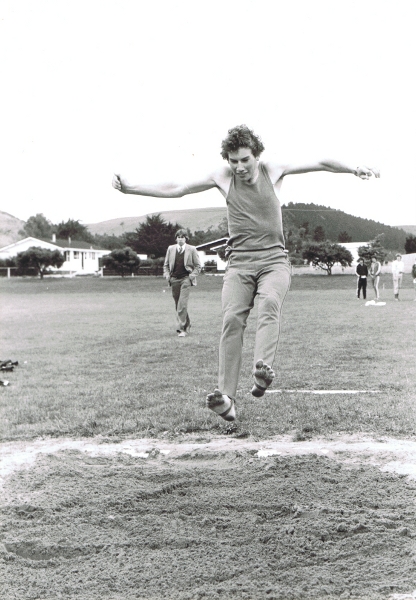
Long ago high school athletics trials....
This week’s WordPress weekly photo challenge…a long time ago in a galaxy far far away…
MacChick Academic
Savour, Relax & Enjoy
A home for us all.
Scattered to the Chaos of Life
Don't be bullied
Inspiration through my thoughts, experiences and travels
Indulge- Travel, Adventure, & New Experiences
My random musings and whatnot
Because stress is fattening and life is just too short
Lost and Found: rediscovering books, writing, destinations, childhood memories and more
mixing it up, one great recipe at a time...
I hope you dance....


 The World According to Me...