The Accidental Guerrilla

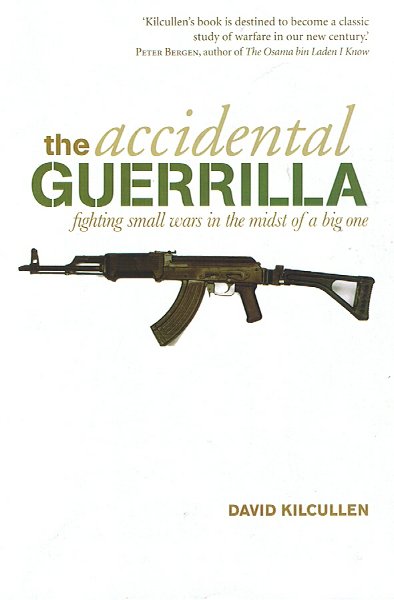
The nice people in G7 loaned me a copy of David Kilcullen’s Accidental Guerrilla to read on the promise that I would give them a book review in return – fair trade, I think, and one which provides me an opportunity to assess the actual time required to review and read a book for future jobs. I missed David Kilcullen’s briefs when he visited in October, having been required to save the free world at the CLAW in the UK that week. While I enjoyed that professionally and personally, I would much rather have had the afternoon listening to him talk…

First impressions of Accidental Guerrilla are that the author has not been well served by his editor…the sections where he talks about his own experiences flow very well; where he launches into more academic discourse, he becomes verbose and complex – if in doubt, use short sentences and don’t be shy to bullet lists – some parts so far (have just finished Chapter 1) are like playing literary Where’s Wally? when trying to filter out key points and themes. I’ve noticed the same in the other book I am struggling with at the moment, Brain Taafe’s The Gatekeepers of Galatas, a great story that deserves to be told – but told better than Taafe does…I track a number of writing blogs and I think it was John Birmingham who couldn’t emphasise enough not only the importance of a top editor but also the need for writers to retract their egos and take aboard the value an editor provides to a successful product…

I have no problem with the concept of the accidental guerrilla but do debate that it is anything new – almost by definition most guerrillas are accidental, born when the outside world, usually brutally, intrudes into their lives….the little people = the little war…Nor is the concept of global terrorist/guerrilla networks that new either…as far back as the American Revolution, global communications have been adequate to support international networks and the Great Game of international espionage and intelligence has been played across the known globe since that time. I agree with Rupert Smith that there are those who might be best described as the ‘franchisers of terrorism’ who target the disaffected and essentially sell their brand of terrorism, with commensurate training, networks and support. These are the people who need to be tracked and targeted a la Michael Scheiern’s ‘individual-based tracking’ concept – manage them and you open up a range of alternate approaches to mitigate potentially accidental guerrillas.

One of the problems I have with The Accidental Guerrilla to date is that it describes Al-Qaeda as an aberration, an exception, to the rules of guerrillas and terrorism, but keeps drawing upon AQ-based examples to support arguments in the book. While it is true that Islamic terrorism has a firm base in the tribes of Afghanistan and Pakistan that includes strong family links as well and that this extends back over a number of generations, I think it is a big leap to state this as standard practice for these type of organisations. This weakens the Infection, Contagion, Intervention, Rejection cycle that Kilcullen proposes, again relying on an AQ example. I agree with the takfiri model and think this would be a better one to promote over specific groups  like Al-Qaeda – more so since his definition of takfir lends itself to causes beyond those based upon an interpretation of Islam…takfir holds that those whose beliefs differ from the takfiri’s are infidels who must be killed. Takfir might apply to ANY hate-based xenophobic cause around the planet and if The Accidental Guerrilla achieves nothing else beyond bringing this phrase into more common usage, it will have achieved something.

In all fairness, I am only at the end of Chapter 1 and should suppress of any feelings of ‘old brass for new‘ and ‘publish or perish‘ til I get into the meat of it…onwards into Chapter Two…

The mist and rain…

…disappeared this morning and it has been that glorious day the Mountain is famous for. Last week I cleared away a lot of the self-seeded bush that was shading the vege garden and got all that mulched up today so that it can further contribute to future vege gardens. It’s been a while since I’ve mowed the lawns, leading to Carmen’s comment last weekend “Growing hay again, are we?” so that was the other project this afternoon, although I did use the scrub bar instead of the mower so as to do exactly that: make some hay for the chicken run and the coop for the chickens when they hatch. I was just about done and just finishing off around the water tank when I bumped the storm water pipe and cracked the damn thing – to add insult to injury, the forecast for tomorrow afternoon is crappy so it really needs to get fixed first thing tomorrow…just goes to show that nothing is simple…

Those two brave little sparrows from the other day have decided that they are in luff with any and all shiny things inside the house and will exploit any door, window or other opening left unguarded to get inside and rattattatat against the stainless kettle, rubbish bin, and benchtop, mirrors and windows. It might be OK except they aren’t really house trained and, of course, my two big helpers get all angsty and excited when there are birds inside…

It’s been interesting listening to all the squawking from the Brits about how poorly the Americans treated them in Iraq. Of course, when you are making stunning statements like ‘..the top British commander in the country, Major General Andrew Stewart, told how he spent “a significant amount of my time” “evading” and “refusing” orders from his US superiors...’, and you cut and run from the theatre of war before the job is done, you can hardly wonder that your national credibility is questioned…Yes, the American military are different; yes, they are less than receptive sometimes to other ways of doing things; yes, they do tend to focus on their way of doing things BUT…BUT maybe that is because they are so damn good at what they do in the application of combat power. What other nation in Iraq not only admitted that it had got it wrong in the post-transition phase of OIF, but implemented a complete cultural shift to address the issues, restructuring its development and acquisitions programmes (killing some sacred cows along the way), AND aligning its doctrine for the complex environment not just across the DoD, but also across and into the rest of government too.  What other nation sat on its moral high horse, resting on its withered old laurels and former glories, and sniped at those who were doing the business?

Jacks

A ‘jack’ is someone who makes sure that they are OK over anyone else. I believe the linkage originally comes from the 1959 Peter Sellers movie “I’m All Right, Jack“. This is one example of a jack:

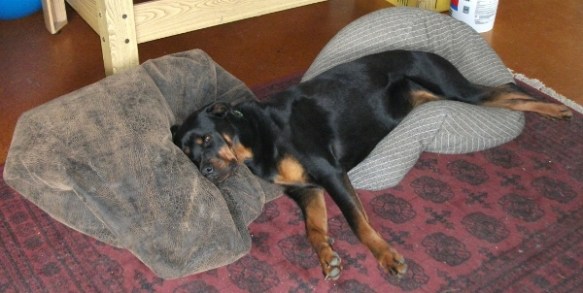
Kirk the Jack 003

This is big dog Kirk. There are two bean bags because there are two dogs. Our other big dog, Lulu, likes to rest on a bean bag because she has a sore hip (hopefully not the dreaded displasia!!). Kirk knows this. Does he care? No, he’s alright. Kirk is a jack big dog.

Here’s another example of a jack: LIND ON 4GW AND THE FORT HOOD KILLINGS. I mean, it’s nice that William Lind shares with us on his visits to this planet but this time he really just needs to get a grip! The reason that I posted a link to John Birmingham’s commentary on the Ft Hood shootings, and probably the reason that JB’s commentary quoted in full the earlier commentary by Stephen Murphy, (sorry if that’s a bit cumbersome), is that the Murphy commentary is as insightful a one that you will find on this tragedy – AND that it cuts directly to the chase on the core issue.

MAJ Nidal Malik Hasan was simply an individual struggling within himself. An individual no different really than any of those other individuals who faced similar struggles and ultimately directed their frustrations on those around them. I don’t know if there is a single nation on this Earth that has not had at least one such incident. Even here in quiet little New Zealand, we have had at least five in the past twenty years : Aramoana, Masterton, Pukekohe, Raurimu and Dunedin. It is something that happens, regardless of the best or the worst mental health, intelligence and law enforcement systems. Any system so efficient as to keep such people at risk off our streets would be so draconian as to sacrifice the freedoms our societies hold dear.

The reason that Mr Lind is a jack is that he is making sure that HE is alright by capitalising on the Ft Hood tragedy so further justify and validate his own 4th (would $th be more accurate perhaps?) Generation Warfare, aka 4GW, model. Mr Lind would have us believe that what happened in Ft Hood was a result of 4GW and the harbinger of waves of similar attacks across the US, and that the only way to prevent such attacks is for America to shed its ‘Give us your poor, your tired, your huddled masses longing to be free…’ heritage in favour of becoming a WASP state living by the moral minority’s own sharia law…

Not so, Mr Lind, not so, at all…if there is one thing we HAVE learned since 911, it is that our adversaries, individually and collectively,  in this war are very bit as intelligent, as skilled and as capable as we are: a gaping hole in the New York City skyline, hundreds of casualties in Madrid and Bali,  and 4000 flag-draped coffins out of Iraq are proof of that. Only in the UK have these forces been stymied to date – the one nation with decades of experience successfully facing a dedicated, vicious and evolving internal adversary. If MAJ Hasan’s attack in (not on) Ft Hood was what Mr Lind paints it as:

  • Would his tradecraft been so loose as to already be on the FBI’s and the military risk radar?
  • Would he really be overtly trying to contact known Al-Qaeda supporters?
  • Might he not have made better use of his access to Ft Hood to employ more lethal forces than a couple of pistols?
  • Would there not have been at least one simultaneous event somewhere else in the US, even one frustrated by circumstance or law enforcement?

Think about these things before blindly calling for the restriction or even expulsion of those with different belief structures. Remember what ‘Give us your poor, your tired, your huddled masses longing to be free…” once meant. Do not under-estimate an enemy who is smarter than this. Be a leader, not a follower.

Because if we follow jacks like Mr Lind and his cronies, we become no better than those who preach a litany of hate from the safety of their religious status….

A sobering thought

I’ve deliberately held off on any comment on the shootings in Fort Hood last week. Every man and his dog has been all over the event from every possible angle. Of all the commentary to date, one of the best is John Birmingham’s Blunty column in the Brisbane Times, largely quoting a commentary from US writer and historian, Stephen Murphy. Please read the comments under the article as well.

  • This was one individual who snapped, not an organised planned attack.
  • We should focus on why he snapped and NOT his culture or religion.
  • America and its friends and allies must resist the temptation to discriminate against other Muslims or people of Arabic descent because of this incident. One of our greatest strengths in the war on terror are those rights and freedoms that we fight so hard to protect but which also provide the opportunities for individuals to act as MAJ Hassan did.
  • It is not about having greater or lesser access to firearms.
  • It could have happened anywhere – not just in the US or the US military.

I think that perhaps were should be less amazed that this tragedy occurred and more mazed that it has not occurred more often: regardless of issues regarding the Islamic jihad, and the wars in Iraq and Afghanistan, hundreds of thousands of soldiers from the US, the UK, Canada, Australia and New Zealand have fought in COMBAT operations in Iraq and Afghanistan since 2001. Only ONE has taken issues to this extent: if nothing else, surely that is a good indication that the checks and balances ARE already in place AND that they are working well…As far back as 2005, the USMC had already identified the destabilising behavioural effects of minor traumatic brain injuries (MTBI) and introduced a robust screening programme to identify and treat at-risk individuals. The US Army has introduced similar programmes. Although GEN Casey has pledged more resources for mental health programmes, I do believe that the US DOD does need to credit itself for the steps that it has implemented already.

MTBI is a hot topic for me as I have had to deal with ACC and CRM (ACC managers contracted to NZ Police) to ensure that family members suffering from MTBI and TBI get a fair shake of the stick. So often victim of TBI do not get a fair shake because the effects of these injuries can be difficult to diagnose and may present themselves in a broad range of symptoms and effects. If nothing else, the one thing I did learn from a number of years battling with both organisations (those who think ACC is bad, wait til you try the privatised version like CRM!! Be careful what you wish for when you clamour for ACC privatisation!) is that screening and identification early definitely contributes to a faster recovery, mitigation and treatment of the injuries, reduction of long-term issues, and reintegration into society. At least the US DOD has learned this lesson and has no doubt saved many lives already  – it’s unfortunate that we fixate on the one who slipped through the system…