Facebook and Twitter strike a blow for democracy…

Egyptians celebrate on the streets after Vice President Omar Suleiman announced that President Hosni Mubarak has stepped down from his position

…a title that’s about as catchy as Jay and Silent Bob Do The World…and with about the same level of connection with the real world…Facebook and Twitter did NOT overthrow the President of Egypt, nor were they much more than enablers for communication (until the Egyptian government turned the internet lights out anyway). A population taking to the streets to demand the removal/resignation of a leader is not that common but it’s also not THAT unusual…Anyone who thinks that the ‘power’ of social networks created an unstoppable critical mass is living in LaLaLand (L3) – that the demonstrations continued after the net was switched off is a good combat indicator here.

If the conditions are right and there are some suitably skilled organisers/agitators available, then mass demonstrations are pretty easy to orchestrate…there are plenty of examples of this across history even prior to the invention of the interweb…to focus too much on social networking software is to distract oneself from the more important topics of the networks themselves AND who is manipulating them.

That a Google executive was involved in this right from the start is indicative of some form of leadership, planning and organisation and NOT of the spontaneous mass uprising that many in the media would have us believe this transfer of leadership relied on. I can’t not say transfer of power because it is simply too early to determine where the real power will lie…I also wonder how many remember how Hosni Mubarak came to power and that his strong consistent hand has probably saved Eqypt from the Moslem Brotherhood of Really Bad People Out For Some Headlines and World Peace (or some such group)…noting that and the lack of any sort of succession plan, I wonder how Google defends its ‘Do No Harm’ motto if Egypt continues to unravel (think it’s run it’s course)?

Much as I’d like see see the recent event in Tunisia and Egypt as a triumph for the information militia, I just can’t see any proof that it was…the upside of the information militia for the most part remains collaborative discussion on the like of Small Wars Journal whose discussion board and blog continue to make my brain run marathons; the downside is the like of Michael Yon who continues to just not get it.

Yes, I am miffed (but not that surprised) that he can blatantly claim that he has only ever blocked/banned 14 people from his Facebook page when the number is well above that; and doubly miffed that my name doesn’t appear on the list of those blocked – I learned today that one should only consider oneself banned if one also ‘unlikes’ Mike on FB as well – preschool hairsplitting at its best. I’m not losing sleep over Mike’s antics – following his FB page is like watching a good soap: you keep watching just to see what inanity happens next – but it annoys me that his antics drag others in the information militia down with him…what force would ever want an embed (from anywhere) are reading Mike’s slurs on GEN McCrystal and BGEN Menard last year? Or after considering the damage he has done to the coalition by constantly attacking key members of coalition forces – who needs the Taliban when Mike’s on your side?\

The Yon saga has been laid out in three interesting threads here:

Overview of the Michael Yon Saga PDFs: [Overview of the Michael Yon Saga – CommentsOverview of the Michael Yon Saga – Perspectives]

Banned by Yon! [PDF: Banned by Yon – Perspectives ]

Michael Yon Needs Money

I think the guy just needs some perspective in his diet and needs to get over being a 19 year old E-5 and look to what he is really good at (besides pissing people off and mudslinging) and get back to telling the human side of conflicts like Iraq and Afghanistan, and also offer an alternative perspective to events like Thailand’s recent Red Shirt troubles – when he was there: reporting from afar on Egypt does really cut the mustard…

On the topic of internet shutdowns, Wired has an interesting but pretty light article (PDF: US Has Secret Tools to Force Internet on Dictators _ WIRED) on the US’ apparent ability to turn it back on if it so desired – this concept is not really cutting edge. Yes, the delivery mechanisms will have a certain geeky appeal but the concept has its roots in the Voice of America broadcasts over the Iron Curtain and the Allied broadcasts into occupied Europe (you remember, Europe, the last time that everyone else had to come save you) during WW2. In Tom Clancy’s The Bear and The Dragon, Beijing after the US unleashed free (in every sense of the word) braodcasts into Chinese TV and radio systems, spurring a (you guessed it) population uprising.

And there we are back where we started…the good old spontaneous uprising…when it all gets post-mortemed, I am fairly confident that the dead Germans will have played a strong hand in all of it…that is, that the popular interpretation of Clauswitz’ trinity will bear out: there will have been a leadership group, an action arm and, coming a very slow third (like always), ‘the people’, the poor old bloody people…Small Wars Journal has on its blog, a very robust discussion entitled A Populace-Centric Foreign Policy which talks about the role of ‘the people’ and how best to engage them…it was quite satisfying for a while (won’t last) to see some other contributors following my practice of parenthesising ‘the people’ as an indication that the word represent influence and  power that doesn’t really exist…

[RDFs: A Populace-Centric Foreign Policy _ Small Wars Journal; A Populace-Centric Foreign Policy _ Comments 2; A Populace-Centric Foreign Policy _ Comments 1]

PS…when I post links to online discussions, it is with the faint hope that one or two readers might be bold enough to contribute their own thoughts to those discussions…Small Wars especially has not pretty impressive street cred in its active community (yeah, I know, they list Mike Yon as a author but no one’s perfect)…I recently read through some of the 65-odd pages of the ‘Introduce Yourself‘ thread and was humbled to see in whose presence I virtually walk…

Like, hello?

Is this where some people live?

I noticed an item on the Small Wars Journal blog this morning on my pre-breakfast scan of what’s up on the planet…in it Dr. Christopher Paul comments on an article (also in Foreign Policy) that is strongly critical of the RAND study Victory Has a Thousand Fathers, of which he was the lead author.

Dr Paul would be correct in his comments on the Hoyt/Rovner article except for the minor point that THEY are actually correct in what they say…

I hadn’t read the RAND ‘study’ in question until seeing this item in the SWJ Blog this morning but it is one that would have eventually crossed my desk for review…it’s 187 pages but having just read the summary and introduction, I don’t think it’s going to be a critical read for me anytime soon…

Although it quotes William Rosenau “…insurgency and counterinsurgency. . . have enjoyed a level of military, academic, and journalistic notice unseen since the mid-1960s…”, the authors have not included one single case study from this period that was the heyday of COIN (both as we know it and how others like the USSR and Cuba applied it)…like, hello? By selecting on those campaigns that started after 1978 – you didn’t consider Northern Ireland? Like, hello? – the RAND study only really focuses on a very narrow range of campaigns and even then I’m not convinced that there is much rigour in the selection of campaigns…we all know the COIN campaign in Kosovo, right? and Croatia and Bosnia? Some bad things may have happened in those countries but COIN? Hardly…the COIN campaign in Somalia was concluded in 1991? Papua New Guinea was a COIN loss? By PNG one assumes that the study is referring to Bougainville which is actually a success in that Bougainville is still a part of the nation it sought to break away from and the campaign that was conducted on that island actually addressed the root issues underlying the ‘insurgency’ – actually IAW one of the key COIN trusims…I also note that the use of repression as a strategy is frowned upon when, whether we in the West like it or not, historically (before and after 1978) it is one of the more consistently effective means of keeping a population in line…

I suspect that if I opt to wade through the remaining 161 pages of this ‘study’ (I have to use the term ‘study’ loosely), I will find find more such weak ‘logic’, poor research and inconsistency – and having written this, I find myself resigned to having to read the rest of it…

I wonder to what extent this paper was driven by statements at the COIN Symposium in May where various staff called for a COIN checklist, displaying a fundamental lack of ‘getting it’? While there are some fundamental principles/tenets/truisms for Countering Irregular Activity (COIN is too narrow a term for modern use) that a study like this may have analysed, one of them is that every campaign must be considered on its own merits i.e. there is no checklist in CIA!!

Perhaps, instead of using his position at Foreign Policy to have a self-righteous whiny-nana, Dr Paul might want to reflect on the comments here and in the Rovner/Paul article, and then go back to RAND and redo the job properly this time…

Critical thinking more and more seems to be superseded by a level of superficiality that is quite scary and I wonder if this is due to the economic crisis really putting the acid on academics to publish or really perish…? The really annoying this about products like this RAND ‘study’ is that so much information is freely available for them to do the job properly – the analysis is not that difficult – it’s the application in the contemporary environment that offers up the true challenges and weak superficial work like Victory Has a Thousand Fathers offers nothing to mitigate those challenges…

Later that day…Edit: just used this line in a discussion on this paper on Facebook…pretty well sums up my feelings…

“…I think it’s even worse than that…I simply don’t think they ‘get’ the environment we are operating in now so what they’ve done is pretty much like setting off to study the Third Reich and then limiting themselves to 1946 onwards…”

Today’s COIN Center VBB

As below, Dean presented at the COIN Center’s Virtual Brown Bag session this morning…the slides and audio file will be posted on the Center’s website in the next few days…I may be offline for a week or so as I am off globetrotting again but will link them in when I get an opportunity…in the meantime I strongly recommend that anyone with a personal or professional interest in contemporary intel issues, key an eye of the site and download both files when they become available. This is very good stuff and at least on a par with MG Flynn’s Fixing Intel paper from earlier this year…

Top effort from Dean and it is great to see a compadre’s efforts paying off like this….

As a taster, here’s some of the questions that were asked during the session (to hear the answers, you’ll need to download the files…)

MAJ Decker BCTP – guest: Coming in loud and clear

Peter Sakaris – guest: To understand the environment over time shouldn’t we be getting better more reliable HUMINT through increased population interaction? I would think that the example of a new officer working with a veteran police officer in the CONUS as you described would help to do this in the COIN environment. Obtaining the institutional knowledge of an environment can come from people that live in that environment because they live it every day and are in areas of the local community where it would be difficult for us to get into.

Kevin Frank JIWC – guest: Not will ing give up on the analysis issue- believe that if we collect the correct data and present it to the analyst correctly, we’ll get better analysis at the current training levels, especially if the commander is asking the right questions…comments?

DK Clark, DTAC/CGSC – guest: Did you use the pattern-analysis plot, activities matrix, association matrix, and societal considerations in FM 3-24.2? If so, could you comment on problems with these methods/techniques of framing and displaying the intel analysis in COIN?

MAJ Decker BCTP – guest: Afghanistan Reintegration Program (ARP) is now doing the same as the Boston Gun Project by providing retraining opportunities to former insurgents

HOMBSCH, DAVID G Lt Col : Comment only (no need to repeat):   I love the quote – “analysts to be historians, librarians, journalists” – spot on.   I also totally agree, with exploiting reach back – generate staff with expert knowledge on specific regions, who understand normality, and can interpret important changes (indicators and warnings) to cross cue counter insurgent forces.  Hypothesis – there is a place for more foreign nationals in analysis teams in CONUS and allied intelligence agencies?

CPT Linn – guest: how are we integrating analysis into Data collected from FETs and HUMINTs in theater?

Peter Sakaris – guest: The Stability Academy, Kabul (formerly the COIN center of Excellence) is a COIN Academy that the leadership of deploying BCTs cycle through as part of their RIP/TOAs. They recommend the ASCOPE/PMESII-PT crosswalk as an analytical tool for helping gain the needed detailed understanding of the “complex human terrain”. Are you familiar with this, or other tools like it such as TCAPF and do you find them useful for this purpose? Have you seen other approaches not discussed that are/have been in use?

CPT Linn – guest: also how is that data utilized in targeting packages?

MAJ Allen Smith – guest: Do you vet and confirm info from gang leaders using SIGINT?  How do you build trust on a Narc?

Kevin Frank JIWC – guest: There are many units out there reporting data (CATs, FETs, PRTs, unit reports etc) . But are they getting the right information? ASCOPE is one guide- are there other collection guides out there that can help us get better data? Does the LE community have anythi

Kevin Frank JIWC – guest: anything that can help?

RODRIGUEZ, ISMAEL R USA  2: Any thoughts on the application of GIS in a police intelligence role? Do you think these techniques could translate well in COIN?

And now…for your edification and education….

Just a quick advert that Dean from Travels with Shiloh will be presenting online at the COIN Center at 141500Z

Messages

Over the weekend, it was reported that there had been what appears to be a triple murder-homicide in the small town of Feilding, only a few kilometres from where I’m based. The story recapped Feilding’s unfortunate recent history which has in the last few months included a particularly nasty ambush murder of a young farmer, a mid-air collision that killed two people and the death of LT Tim O’Donnell in an IED attack in Afghanistan.

It particularly annoyed me that Tim O’Donnell was described as being killed by ‘insurgents’ which may or may not be correct but it struck me that the use of this word ‘insurgant’ without any supporting evidence, indications or other pointers is again conceding the information battle to our adversaries. Surely better to be part of a strategic communication plan in which those perpetrated that attack are referred to as criminals, thus robbing them of any possible perception of legitimacy or right that may be inherent in ‘insurgent’. After all, it is a COIN truism that one man’s insurgent is another’s freedom fighter and another that most insurgencies are built in one form or another on elements of righteous greivance…mere use of the term implies a base level of right in their actions…so let’s stop doing that and in doing so, erode further their conceptual foundations…

One man who does ‘get’ strategic communication is Steve Tatham, who was the Director of Advanced Communication Research at the Defence Academy at Shrivenham, but whom I see from the tailpiece of his latest paper is now “…completing a PhD in Strategic Communication…” I hope he’s not planning on taking too long on his PhD because we really needed him to be out there expounding the Strategic Communication message. The new paper, Strategic Communication & Influence Operations: Do We Really Get It?, builds further upon his previous works,  Behavioural Conflict – From General to Strategic Corporal: Complexity, Adaptation and Influence and Strategic Communication: A Primer.

Do We Really Get It? moves further into the how-to of Strategic Communication and, of particular note to anyone who’s ever wonder what the Strategic Communication group in their organisation actually does, defines the distinction between Strategic Communication and Strategic Communications:

Strategic Communication

The processes and sequencing of information for carefully targeted audiences

A paradigm that recognises that information & perception effect target audience behaviour and that activity must be calibrated against first, second and third order effects.

Strategic Communications

The paper also discusses in detail the concept of the Target Audience Analysis (TAA), a process clearly and sadly lacking from the coalition’s forays into the information arena against the takfiri: “…Understanding the audience is the beginning and end of all military influence endeavours. Without TAA, influence success is dependent upon randomness, luck and coincidence – in short, ‘a fluke’…” This is what we in the trade would call ‘good stuff’ however no more previews: to learn more you need to not just read the paper, but hoist its message aboard and look to applying it daily…

The Small Wars Journal Blog today linked to an interview with David Kilcullen on Australia’s rising casualty rate in Afghanistan – it is a very interesting read and well worth following the link to the full text of the interview. I offered a small comment of my own based on a discussion we had yesterday regarding the changing situation in Afghanistan and the vague endstates that still persist in most if not all nations with forces in ISAF. I was humbled by the response from one of the SWJ administrators “…and, BTW, nice blog. Added to our roll…” So way down the bottom of the Small Wars Journal blogroll is yours truly…I now know how Dean @ Shiloh felt after Tom Ricks picked up his blog comments on the COIN Symposium in May this year and am a little worried that I will be able to hold up my end in such company as other members of that list…

In the gathering dusk of 18 August 1966…

Long Tan Cross ceremony, 18 August 1969 (c) AWM

…44 years ago, D Company, 6 Royal Australian Regiment, fought a desperate battle for survival against a Viet Cong regiment, in  a rubber plantation near a little town called Long Tan. This is one of the great sub-unit battles of history, where a few stood against many. Today, it remains as an example of great junior leadership and “…of the importance of combining and coordinating infantry, artillery, armour and military aviation...” The Presidential Unit Citation tells part of the story…

By virtue of the authority invested in me as the President of the United States and as Commander-in-Chief of the Armed Forces of the United States, I have today awarded the Presidential Unit Citation (Army) for extraordinary heroism to D Company, Sixth Battalion, The Royal Australian Regiment, The Australian Army.
D Company distinguished itself by extraordinary heroism while engaged in military operations against an opposing armed force in Vietnam on 18 August 1966.
While searching for Viet Cong in a rubber plantation northeast of Ba Ria, Phuoc Tuy, Province, Republic of Vietnam, D Company met and immediately engaged in heavy contact. As the battle developed, it became apparent that the men of D Company were facing a numerically superior force. The platoons of D Company were surrounded and attacked on all sides by an estimated reinforced enemy battalion using automatic weapons, small arms and mortars. Fighting courageously against a well armed and determined foe, the men on D Company maintained their formations in a common perimeter defence and inflicted heavy casualties on the Viet Cong.
The enemy maintained a continuous, intense volume of fire and attacked repeatedly from all directions. Each successive assault was repulsed by the courageous Australians. Heavy rainfall and low ceiling prevented any friendly close air support during the battle. After three hours of savage attacks, having failed to penetrate the Australian lines, the enemy withdrew from the battlefield carrying many dead and wounded, and leaving 245 Viet Cong dead forward of the defence positions of D Company.
The conspicuous courage, intrepidity and indomitable courage of D Company were to the highest tradition of military valour and reflect great credit upon D Company and the Australian Army.

The rest of the story is well worth ferreting out, particularly the section in Mark Woodruff’s Unheralded Victory…many of the lessons from Long Tan from infantry section to coalition task force level still apply to today’s environment…Lest We Forget…

One might hope that The Battle of Long Tan, due for release in 2011, will be on  a par with We Were Soldiers and Blackhawk Down…and serve as a timely reminder to today of yesterday’s sacrifices…

…and thanks to Narelle for the reminder of this day…


Aaaah….yep

A picture's worth a 1000 words

A picture's worth a 1000 words

There is a great commentary at Small War Journal regarding the manner in which GEN McCrystal was brought down…

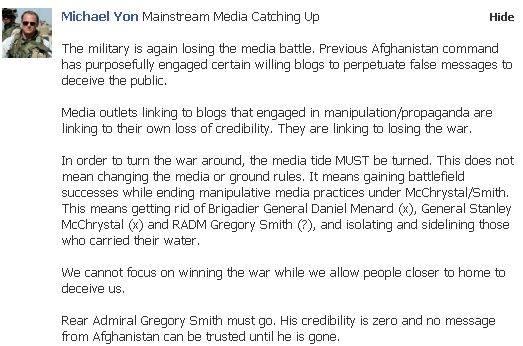
Meanwhile, back in LooneyToonville, Michael Yawn continues his sterling work for the Taliban and continues his campaign against RADM Greg Smith, the head PAO for ISAF…

Who needs enemies with friends like Yawn?

RADM Smith’s real crime, of course, was that he supported Yawn’s disembedment after he began his smear campaign against senior ISAF staff…

Contemporary Warfare

I’ve spent the last day or so typing out all my notes from the Contemporary Warfare sessions – who might have thought that some much great material could come from only two days?

Joining the dots

I’m sitting in on the two day Contemporary Wafare module at Command and Staff College  that is being conducted by Dr Michael Evans from the Australian Defence College. Although it is only a two day module (compressed down from 4-5 days to fit the study programme) it is a great learning experience both through Michael’s experience and the interaction with members on the staff course; I have almost a whole notebook full of notes (= a few nights typing them all up before I forget which scribble means what!) and some great insights to expand and write on…There was some very good material yesterday afternoon that has helped join some of the dots in our own work here and we’ve just finished working through some of the ethical dilemmas of the contemporary environment…

Winning the information battle

…or, at least, not losing it by default…

Now that I’m working again, the calls on my time have multiplied geometrically and this little corner of cyberspace has been somewhat quieter than during my seven month exile at the Raurimu Centre for Contemporary Studies aka  home. I have a two hour drive to and from base each week and, during those periods on the road, have introspected on the unfortunate sequence of events that led to the demise of GEN Stanley McCrystal and his departure from the COMISAF appointment.

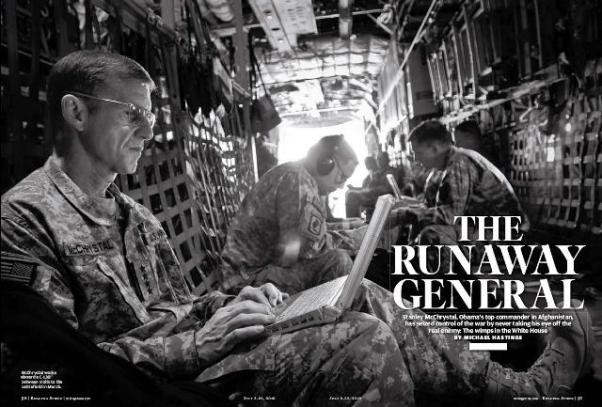
(c) Rolling Stone 2010

My first thought is that Michael Yawn had no more to do with what happened to GEN McCrystal that he did with the removal from ISAF of Canada’s most senior in-theatre officer..whether Michael Yawn had yapped on or not, the fate of both these officers would have been the same i.e. contrary to popular misinformation, Michael Yon did nothing to influence these events, other than perhaps besmirching them in his own personal smear campaign which says more about him that it doers either Daniel Menard or Stanley McCrystal. In 2005, I was fortunate to spend some time with the now Chief of the Canadian Defence Force, General Walter Natynczyk, and nothing about that officer struck me as the sort of guy who would or could casually overlook a negligent discharge by a senior Canadian officer and even less so, when it occurred in his presence.

I feel sad for GEN McCrystal, brought down by an angry Icelandic volcano (which is how they all came to be in a  bus together with an embedded reporter from Rolling Stone) magazine and a fickle and irresponsible reporter who, in my ever so humble opinion, abused the position that he was placed in by Eyjafjallajokull, reporting out of context the frustrations of  staff facing the unenviable task of winning a conflict that is unlikely to be winnable. I agree fully with Mike Innes’ comments @ Current Intelligence

I spent the better part of yesterday trying to wrap my head around Michael Hastings’ profile of Gen. Stanley McChrystal and his team of advisors. My initial thoughts on the subject at CNN hint at but don’t fully get to what I wanted to say on the matter… which places me in good company, since the chatter on this issue has been blazing across the wire/blog/twitter sphere since the piece was “leaked” on Monday.

My main point was about social distance – which is actually an issue that binds together pretty much everyone who reads, researches, writes, or does anything at all in relation to Afghanistan (or anywhere, really). It’s what soldiers have to contend with, sitting behind the fortified walls of armed camps, all the while trying to gain a more intimate understanding of local culture. It’s what people sent to a strange place have to contend with, absent the time and access needed for familiarization, much less to develop any profound “knowledge” of their environment. And it’s what war correspondents and other journalists have to contend with when reporting from zones so catastrophically different from their otherwise peaceful, functioning worlds.

Powers of observation, an eye for detail, and a nimble pen can go a long way toward telling a good, accurate, and full story, and toward overcoming some of that distance (or at least recognizing it for what it is). Sometimes, maybe, the gap is just too profound, too wide and too deep, to accurately convey a larger meaning – not factoids and datapoints, but meaning.

Anyway, don’t take my word for it. I think of all the bits and pieces I read yesterday and this morning – and there was a lot of good analysis out there – is this Danger Room piece and Peter Feaver’s clear and focusedbreakdown at Foreign Policy of Hastings’ story elements.

What’s really disappointing, too, is that Hastings and Rolling Stone might have missed out on a real opportunity to craft some truly fine and literary journalism. In an interview on National Public Radio yesterday, Hastings gave some background that would have added a great deal of context and nuance to the story, had they been included. The Paris interlude, for example – which is really where all the juiciest bits of the story come from – came about because of the Icelandic volcano eruption, which disrupted air travel worldwide, and stranded ISAF’s Command Group, like thousands of other travelers. To my mind, that would have been both a unique element of narrative color and detail, and an obvious and immediate source of frustration for men running a war, but trapped outside of it and unable to return to it.

I hear now that the Pentagon is staking steps to require all interviews with senior commanders to be pre-approved from the five-sided building…is this what we are coming to in our fear of the fourth estate…we can entrust senior staff with the live of the nation’s young men and women, empower them to sortie into harm’s way, place the instruments of global destruction in their hands but won’t trust them to say the right thing to a reporter without a thumbs-up from a carpeted office thousands of miles and possibly eons of reality away…Rolling Stone‘s The Runaway General and Michael Yawn’s lipping off about things he know nothing about e.g. senior command, strategy, responsibility, etc are excellent examples of the damage than can be done by irresponsible reporters and editorial staffs, just like 911, the Bali bombings, Lockerbie etc are similar example of the damage than can be done by terrorist organisations BUT we didn’t run away and hide then…we went out and learned a new way of warfare…and that’s what we need to do now in the information war…

The first battle must be internal to shed our fear of the censure and embarrassment  that may come from perceptions of dirty washing being aired in public…this thinking is tantamount to grandma concealing her bloomers  in a pillow case when she hangs out the washing…surely we’re past this stage and realise that we do more damage to ourselves and our causes by playing a manic game of Whac-A-Mole trying to suppress any and all reports that may not be the purest distillation of happy happy joy joy juice…nowhere have I seen it summed up so well as this commenter on Michael Yon’s Facebook page (of course, I can’t find the exact quote anymore) to the effect that the USMC mindset is that “...if we don’t want it exposed out in the open, then we probably shouldn’t be doing it…” And that attitude is the place we need to strive towards, to stopping fearing the media and hiding from them, of being able to stand up say “…we screwed up…AND…here’s what we’re (really) doing about it...” or, sometimes, simply “…this is a risky business and sometime crap simple happens…

If we can’t get our heads around this now, this key battle we are consistently losing int he minds of our people and those of our adversaries, what are we going to do one day when anyone can publish what they think, their own views, opinions and images…what are we going to do then…? Uh-oh….youtube…facebook, bebo…that intreenet thingamebobby… time to climb into the information fight, people….