
It’s all about understanding…yesterday, we worked with the grand-twins and understanding circles, triangles and squares…lots of fun in the sun…I wish understanding COIN, CIT and CIA could be as easy and as much fun…
I seem to have mildly upset some people…in the case of Patrick Lang’s entry on COIN as a failed strategy, I think that we both actually agree – our issue is more the semantics of COIN than whether COIN has worked in Afghanistan or not; neither of us believe that it has but my stance is that because the current campaign in Afghanistan is not the same campaign as the original OEF that went into deal to Al-Qaeda training bases and cadres.
Somewhere along the way OEF evolved from a Direct Action on a large-scale to a pseudo-COIN campaign. I say ‘pseudo’ because there never was an insurgency to counter until the end of the direct action phase of OEF, say, from the end of 2002 onwards. That insurgency was directed primarily against US/NATO forces that had, in the eyes of Afghans, invaded their nation. Thus the ‘logical’ way to neutralise that insurgency would be to remove the cause. Once the Al-Qaeda training camps and cadres in Afghanistan had been neutralised by the end of 2002, anti-terrorism efforts should have continued to pursue Rupert Smith’s ‘franchisers of terror’ wherever they may have gone, to apply those resources that have essentially been wasted in Afghanistan against the real threat.
A COIN strategy has been (mis)applied in Afghanistan: it’s not about a struggle for the people, it’s not about hearts and minds and it’s certainly NOT about trying to inflict our culture and values on another society – is that one of the reasons that WE have gone to war to fight against? That bit of unpleasantness 1939-45 springs to mind…for two millennia and more, Afghanistan has been a loose confederation of tribes with a vaguely ineffective central government – the government leaves the tribes alone and vice versa; the only time there is anything remotely resembling a unified Afghanistan is when there is the perception of an invader and no occupation of this country has succeeded in 2000 years.
It all comes down to the same issue in the end: what are the strategic objectives for the campaign in Afghanistan? What are the troops there to do? Those are the two questions that needed to be asked in late 2002.
The current campaign will not address historical issues with the border with Pakistan and the tribal areas(next to religion, the most common cause of war in the last century must be British imperial surveyors!!); it will not change the power bases in Pakistan; and it certainly is not going to address issues of Pakistan’s membership of the nuke club. If the aim is to develop a stable governance structure (possibly in lieu of a government) then the Taliban must be engaged with more than small arms and JDAMs: as the force that will (and is) filling the vacuum of control in Afghanistan, they must be encouraged to come to the table. What do we want? An Al-Qaeda-free Afghanistan under a Taliban-controlled/led alliance or another decade of what we’ve got now? The ‘secure the cities’ Cursed Earth approach may be sustainable but it brings us no closer to resolution.
So the problem that Patrick Lang identifies is not the failure of COIN as a means of statecraft but the application of the wrong tool for the job. In his post on the historical failure of COIN he uses a number of examples. Malaya and Kenya are written off as failures because of the resources in terms of time, blood and treasure applied for little return, more so since the UK let both nations go at the end of the respective campaigns. He misses the point that both Malaysia and Kenya have, since their independence, been islands of relative stability for the succeeding four decades.
From the Malayan Emergency came the establishment of the state of Singapore as a separate home for dissenting Chinese from Malaysia – Singapore is now a prime source of economic, political and security stability across the ASEAN region with strong relationships around the globe. Similarly the 70s campaign in Oman, which led to a number of reforms in that nation, also left an island of regional stability. That there are still ripples in the Cyrean pond are not due to the failure of the British COIN campaign there but to periodic posturing between the ethnic Greek and Turkish populations – but Cyprus has been pretty stable for decades. Northern Ireland is a classic example with few of the advantages that Commonwealth forces had in Malaya like ethnic differences between ‘the people’ and the insurgents, lack of offshore support, etc; others include Belize; East Timor, Solomon Islands and Bougainville; and Hungary and Czechoslovakia (you do not have to like the Soviet methods but you can not deny their effectiveness).
Did the COIN campaign in Vietnam fail? Only in that, like in Afghanistan, the campaign did not take into account the key issue: in the end, it was not about defending the South against the North: it was about reunification. Perhaps if the reunification of Vietnam had been the primary objective from the first advisor to set foot in that country, it may have worked out so differently. Let’s not forget that Ho Chi Minh originally wanted to align with the US to expel the French (the nation that is REALLY despised in Vietnam) but was screwed over in favour of bolstering the tottering remnants of French Empire. That was when the Communists (franchisers of terror?) stepped into the void.
So long as reunification was not on the table as an objective, Vietnam was probably never winnable – what are we really here for? – but is the failure to clearly identify the issues and the eventual erosion of political and domestic support a failure of COIN? We can and will argue about it for years but I am on the side of not – a good workman never blames his tools – and here, as in Afghanistan, the workman is not so much the soldier ( as I inadvertently applied on Sic Semper Tyrannis) but the political arm that decides such adventures are or are not a good idea…the biggest war amongst ‘the people’ is always at home….
This is one of the reasons the COIN Review adopted the USMC term Countering Irregular Threats (CIT) over COIN as a descriptor for the Contemporary Operating Environment: COIN is a subset of CIT. One of the main reasons for this decision was that as soon as COIN is mentioned the two immediate response are “Malaya” and “Winning hearts and minds” and we are off down the slippery slopes of assumptions and misapplied lessons.
Exploring the CIT concept further brought us to the British (and they do have some experience in this area, overseas and at home) term Countering Irregular Activity (CIA). This works on the premise that we should be thinking in terms of countering irregularity before it becomes a threat let alone a war and by starting to consider an irregularity before it becomes a threat, we are much more likely to NOT discount non-kinetic courses of action to address that irregularity. When you consider that there are only really two types of operation: stability (what else might you call operations to counter destabilising activities – counter-destability?) and warfighting. Perhaps stability operations should be led by ‘not the military’ in order to be able to consider other options, just as warfighting operations, by definition, should be military-led – both, of course, in support of clearly defined national objectives.
Patrick asked me if I thought that this was just a game played by academics in journals. My first response was denial but it is exactly that. What greater endorsement for a comprehensive approach to the problems of the COE than to be able to have such discussions outside of in-house military think-tanks; to be able to put one’s opinions and thoughts to the world without fear of formal censure (some harsh words perhaps at worst between differers of opinion); and perhaps by virtue of that openness to be able to contribute in some small way to the intellectual horsepower assembled to address those problems.
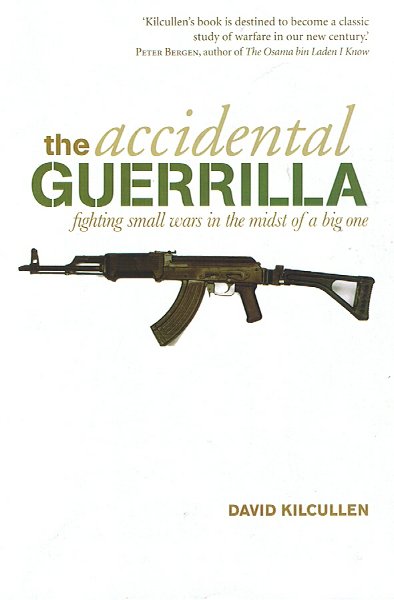
Hence the Information Militia concept: loosely organised; often fractured and factionalised; following a general direction but often only through the sum of a number of tangents – but still useful to have around. There was a post recently on the Small Wars Council Blog entitled Where is Our Kilcullen? that was critical of the Marines for not having developed its own Kilcullen – as a number of posters have pointed out, the US has its fair share of COIN thinkers and one of David Kilcullen’s big advantages was that, as an outsider, he probably had greater freedom to say the unpalatable. But there is no denying that many of these thinkers both exist and exist outside the formal structures of the Army (or Marine Corps, if you have one). It is this rich and robust discussion, that we encourage, foster and nurture that maybe gives us an edge over the takfiri who strive to suppress any and all who don’t agree, conform or comply…how else would our Gants and Wineeras ever get a word in otherwise…?
I mentioned a couple of days ago that I am reviewing the RAAF’s Friends in High Places publication and one of the themes emerging from this is an awareness of retaining, because we can, the old single service stovepipes and continuing to do what we do in isolation from other operators in the same environment…becoming dumber as we become smarter. The two posts by MattF and MikeF in the Kilcullen thread proposing that field-grade officers be posted on tours outside their service or the military as part of broadening cultural horizons are good ideas – and again examples of where we may have had a good thing in place once and allowed it to lapse…we don’t know what we don’t know and often the only way to find out is to get out and find out. So as military professionals perhaps we need to be getting out and getting our boots dirty, not in the field where we lead, but in areas of commerce, politics, diplomacy, aid, etc where we do not lead…and by doing so make ourselves better stronger and faster for dealing with irregular activities.
Police and COIN
The other person I have upset a little is one of the chaps from Coming Anarchy – in this case, that was my intention as I think that he had leapt a little before thinking – the whole concept behind COIN (still in a misuse of the term) is that it is solely not a military operation and often, the military might not even have the lead in what is more correctly a CIA (no, not that CIA!!!) campaign in Salinas. Thus the COIN doctrine being employed in Salinas might quite plausibly include no military courses of action at all – and rightly so for a domestic policing campaign. That campaign will probably include a strong element of law enforcement (and regardless of how some might dress, there are not the military), civil aid, political action at the town and possibly state levels, support initiatives from commercial and corporate entities e.g. jobs, etc etc. All these are approaches that can be find in most contemporary Western COIN doctrine – the adoption does not bring the advent of martial law any closer. If anything, the Salinas initiative is an indication that some traditional barriers have been eroded to allow the adoption and implementation of someone else’s good ideas…Equally, there is much that we can, should and are learning from how police operate in some situations…
If there is one major issue arising from the Salinas initiative, it is the one identified last month as “..a tradition of police officers who “love the chase. They get into this business to kick ass and take names, by and large. We’re at odds with ourselves because of the people we hire...” So before we get into any discussion of the rights or wrongs of what doctrine is used, we need to seriously consider who we recruit to apply it…I don’t know but I would be interested to learn how much ethos and values training is included in both formal police entry (recruit) training and also post-graduation on the job…
Up, up and away
I visited Palmerston North the Friday before last and caught up with a mate who is using flight simulation technologies in his work…he took me for a ‘flight’ out of RNZAF Ohakea in a Vulcan B.2, thundering through the valleys around home…only minor thing wrong was that a Vulcan coming out of Ohakea should look like this:

Avro Vulcan B.2, 75 Sqn RNZAF, 1972
-39.121821
175.394487







 The World According to Me...