A ‘poor western to arab death ratio!’

Curzon @ Coming Anarchy recounts his adventures flying on local airlines around the Gulf…sounds like feigning sleep is the best option…and while on the topic of Curzon, I have yet to finish reading his biography. The reason that it is taking so long is not that it is hard work and difficult to read – if anything, exactly the opposite: although some of the content is quite dry, it is so well written that I find myself savouring it like a fine dessert…comparing it to more contemporary writing, I think that we have lost a lot in the fifty years since this book was published…

Also on Coming Anarchy, Younghusband reviews David Kilcullen’s The Accidental Guerrilla. He summarises:

For close readers of COIN and CT theory, I do not think this book will offer any new insight. Kilcullen’s contribution though is an excellent overview of the “social work with guns” theory of COIN, as well as a succinct presentation of the realist arguments for non-intervention and conservation of military power…The last few pages, where he presents his policy ideas, is really where practitioners can sink their teeth in. Lots of debating points there. For example:

    • develop a new lexicon to better describe the threat (rather than UW, COIN, irregular warfare etc)
    • discuss a new grand strategy (have an ARCADIA conference on terrorism)
    • balance capability (Why is DOD 210 times bigger than USAID and State?)
    • identify new “strategic services” (ie. a new OSS)
    • develop a capacity for strategic information warfare.

As readers will now from the work published here, these insights are nothing new although it is refreshing to see them in a mainstream publication. It’s unfortunate that the conceptual COIN effort in the US especially (most others are simply followers) is still largely fragmented and lies predominately in the domain of the information militia. The focus on the Iraqi insurgency in 2005-6 has caused the term COIN to be used interchangeably across the contemporary environment and that has caused many to apply inappropriate concepts, policies and doctrine to the issues they face. Our findings in 2007 were initially that the Marines had a better grip on the issue in developing the Countering the Irregular Threat (CIT) concept; and then that the UK encapsulated it even better with Countering Irregular Activity (CIA) which covers the broad spectrum of irregular (potentially destabilising) activities from all sources and causes, natural and man-made. The flip side of both CIT and CIA is the need for a comprehensive approach harnessing the appropriate and relevant instruments of national power including those on NGOs and commercial/corporate interests which usually fall outside the accepted definitions of NGO. These are all themes that we have been exploring in the series The New War.

Bears in the Air

QRA Scramble to Intercept Russian Blackjack_Aircraft MOD_45151233

Well…Blackjacks actually…in a timely reminder that there are more bad things out there than just some nutjob hiding in a cave inciting the masses with poor quality video…the Russian Bear is alive and well and still has aspirations of Empire, certainly under its current keeper…perhaps we ought not be so quick in cancelling programmes like F-22 and planning total reliance on a committee-designed one-size fits all hybrid like the F-35…wasn’t the last time we tried – and failed – at a ‘joint’ aircraft the infamous F-111 project that skewered the TSR.2, set back the Aussie strike programme by over a decade and saw a less-than-stellar combat debut in Vietnam…thank the maker for the F-4 Phantom that carried the resulting load for the better part of a decade.

And on the topic of potential threats, STRATFOR carries an item on Chinese speed wobbles as the US ramps up a comprehensive (or unified, if you went to that school) approach to a potential threat…like Japan, China has built an economy on a foundation of sand and hope and its starting to get wobbly…all the more reason to keep the F-22 fires stoked and warm up that A-10 production line (and do a naval variant this time round!)…on yes, and you might need some decent SPGs to replace the M109s that grandpappy used in Vietnam…and don’t be counting on your data links staying up all the time so have a think about leaving the seats in any new airfames you invest in for combat… Neptunus Lex also carries some comment on this article…

The top ten manly movies

John Birmingham has been busy…The Geek discusses what are the top ten manly movies…JB votes for these with my comments in red:

1. True Grit. (Yes, you must fill your hands with this sonofabitch). Absolutely!

2. Saving Pvt. Ryan. (Because war is hell good lookin’ on blu-ray wide screen). Nah!! Too much gratuitous violence in the beginning that adds nothing to the story and the meandering journey across France is just boring. Blackhawk Down delivers all the same messages better and is based on a true story.

3. Master and Commander. (Tips out Gladiator because nobody wears skirts). Agree re Master and Commander not Gladiator which I slot in below.

4. Casino Royale (the remake, and the manliest Bond flick EVAARRR!). Yep!

5. Treasure of the Sierra Madre. (Or any Bogart flick, except the ones with a love interest). Ummm…no…Bogey never quite did it for me…from this era I’d opt for The 39 Steps.

6. The Magnificent Seven. (Well duh. It is magnificent, you know). Yep!

7. The Dirty Dozen. (Or Kelly’s Heroes, if you prefer your war movies with a psychedelic twist). Or both…

8. Cool Hand Luke. (Because I say no man can eat fifty eggs). Hmmmm…whatever…ditch in favour of 633 Squadron, the best flying movie every made.

9. Raging Bull. (Or any movie about boxers or wrestlers. They’re all good.) Replace with Kelly’s Heroes.

10. 300. (Because this is Sparta). How come these guys get to wear skirts, JB? Replace with Gladiator.

Cheeseburger Gothic also hosts a nice piece of fan fiction from The Wave section of the Birmoverse.

Get it off!

Dean @ Travels with Shiloh has developed a new counter to female suicide bombers…I wonder if the cure might not be worse than the problem…?

In more serious news, he summarises a recent workshop at Princeton on Afghanistan – in terms of being out of AFG in 2011, I hope that someone is working on the chopper pad on top of the Embassy…I think we all must have slept through the lesson on COIN re the long haul – or maybe that lesson took place during the five year summer holidays in Iraq?

Where it all began

Peter has released a prologue to The Doomsday Machine…great to see a local lad doing so well at this authoring thingie…

I also like his comments re President Obama’s snub at Israel…but disagree on the credibility of commenting on a book one has not read…I used to be prone to making similar judgements especially on movies so missed Gladiator on the big screen and gave the first series of Dr Who a miss as well…that learned me!!

Who am I?

Portable Learner discusses ways and means of promoting oneself on LinkedIn, something that I have been wresting with recently as well. The options available are quite prescriptive and I don’t think that will change regardless of what’s on the list. Lists, I think, are an industrial age tools that we have yet to evolve away from and, like so much industrial age legacy material, they hold us back. I agree with Shanta that ‘internet’ is probably more descriptive of how one might think than its clinical definition might imply.

I also agree totally with her points re e-learning which is sliding back into industrial age slime instead of being the shining beckon of knowledge it once appeared to be. In order to “…design effective learn ing environments in a networked world…” we must sever the ties with industrial tools and focus on the information and it s nurturing and growth…This is one reason that I think that the US Navy may have ever so slightly lost it in merging its 2 (intel) and 6 (comms) branches into the Information Dominance Corps (IDC) – yes, for real!! I see a very real risk that the information under this structure will be overshadowed by the fears and rules of the technicians and we will lose that timely dissemination that we so desperately need…it maybe that the victims of this merger will see their op critical information become a commodity that is delivered IDC…In…Due…Course – a phrase straight from the repertoire of petty bureaucrats and mindless chair polishers…


Targeting

This STRATFOR article Jihadism and the Importance of Place arrived in the mail last night. It is so good that I believe it is worth repeating in its entirety. My only comment is that, while this report reflects success in the campaign against Al Qaeda and its affiliates, that is still but one campaign in the wider war against those who preach and practice takfiri phliosophies.

As an admin note, I have edited yesterday’s post because I realised this morning that I had skipped out the first paragraph….

STRATFOR Security Weekly March 25, 2010

By Scott Stewart

One of the basic tenets of STRATFOR’s analytical model is that place matters. A country’s physical and cultural geography will force the government of that country to confront certain strategic imperatives no matter what form the government takes. For example, Imperial Russia, the Soviet Union and post-Soviet Russia all have faced the same set of strategic imperatives. Similarly, place can also have a dramatic impact on the formation and operation of a militant group, though obviously not in quite the same way that it affects a government, since militant groups, especially transnational ones, tend to be itinerant and can move from place to place.

From the perspective of a militant group, geography is important but there are other critical factors involved in establishing the suitability of a place. While it is useful to have access to wide swaths of rugged terrain that can provide sanctuary such as mountains, jungles or swamps, for a militant group to conduct large-scale operations, the country in which it is based must have a weak central government — or a government that is cooperative or at least willing to turn a blind eye to the group. A sympathetic population is also a critical factor in whether an area can serve as a sanctuary for a militant group. In places without a favorable mixture of these elements, militants tend to operate more like terrorists, in small urban-based cells.

For example, although Egypt was one of the ideological cradles of jihadism, jihadist militants have never been able to gain a solid foothold in Egypt (as they have been able to do in Algeria, Yemen and Pakistan). This is because the combination of geography and government are not favorable to them even in areas of the country where there is a sympathetic population. When jihadist organizations have become active in Egypt, the Egyptian government has been able to quickly hunt them down. Having no place to hide, those militants who are not immediately arrested or killed frequently leave the country and end up in places like Sudan, Iraq, Pakistan (and sometimes Jersey City). Over the past three decades, many of these itinerant Egyptian militants, such as Ayman al-Zawahiri, have gone on to play significant roles in the formation and evolution of al Qaeda — a stateless, transnational jihadist organization.

Even though al Qaeda and the broader jihadist movement it has sought to foster are transnational, they are still affected by the unique dynamics of place, and it is worth examining how these dynamics will likely affect the movement’s future.

The Past

The modern iteration of the jihadist phenomenon that resulted in the formation of al Qaeda was spawned in the rugged mountainous area along the Afghan-Pakistani border. This was a remote region not only filled with refugees — and militants from all over the globe — but also awash in weapons, spies, fundamentalist Islamism and intrigue. The area proved ideal for the formation of modern jihadism following the Soviet withdrawal from Afghanistan in 1989, but it was soon plunged into Muslim-on-Muslim violence. After the fall of the communist regime in Kabul in 1992, Afghanistan was wracked by near-constant civil war between competing Muslim warlords until the Taliban seized power in 1996. Even then, the Taliban-led government remained at war with the Northern Alliance. In 1992, in the midst of this chaos, al Qaeda began to move many of its people to Sudan, which had taken a heavy Islamist bent following a 1989 coup led by Gen. Omar al-Bashir and heavily influenced by Hasan al-Turabi and his National Islamic Front party. Even during this time, al Qaeda continued operating established training camps in Afghanistan like Khaldan, al Farook and Darunta. The group also maintained its network of Pakistani safe-houses in places like Karachi and Peshawar that it used to direct prospective jihadists from overseas to its training camps in Afghanistan.

In many ways, Sudan was a better place for al Qaeda to operate from, since it offered far more access to the outside world than the remote camps in Afghanistan. But the access worked both ways, and the group received far more scrutiny during its time in Sudan than it had during its stay in Afghanistan. In fact, it was during the Sudan years (1992-1996) when many in the counterterrorism world first became conscious of the existence of al Qaeda. Most people outside of the counterterrorism community were not familiar with the group until after the August 1998 East Africa embassy bombings, and it was not really until 9/11 that al Qaeda became a household name. But this notoriety came with a price. Following the June 1995 attempt to assassinate Egyptian President Hosni Mubarak in Addis Ababa, Ethiopia (an attack linked to Egyptian militants and al Qaeda), the international community — including Egypt and the United States — began to place heavy pressure on the government of Sudan to either control Osama bin Laden and al Qaeda or eject them from the country.

In May 1996, bin Laden and company, who were not willing to be controlled, pulled up stakes and headed back to Afghanistan. The timing was propitious for al Qaeda, which was able to find sanctuary in Afghanistan just as the Taliban were preparing for their final push on Kabul, bringing stability to much of the country. While the Taliban were never wildly supportive of bin Laden, they at least tolerated his presence and activities and felt obligated to protect him as their guest under Pashtunwali, the ancient code of the Pashtun people. Al Qaeda also shrewdly had many of its members marry into influential local tribes as an added measure of security. Shortly after returning to Afghanistan, bin Laden felt secure enough to issue his August 1996 declaration of war against the United States.

The rugged and remote region of eastern and northeastern Afghanistan, bordered by the Pakistani badlands, provided an ideal area in which to operate. It was also a long way from the ocean and the United States’ ability to project power. While al Qaeda’s stay in Afghanistan was briefly interrupted by a U.S. cruise missile attack in August 1998 following the East Africa embassy bombings, the largely ineffective attack demonstrated the limited reach of the United States, and the group was able to operate pretty much unmolested in Afghanistan until the October 2001 U.S. invasion of Afghanistan. During their time in Afghanistan, al Qaeda was able to provide basic military training to tens of thousands of men who passed through its training camps. The camps also provided advanced training in terrorist tradecraft to a smaller number of selected students.

The U.S. invasion of Afghanistan radically changed the way the jihadists viewed Afghanistan as a place. U.S. military power was no longer confined to the Indian Ocean; it had now been brought right into the heart of Afghanistan. Instead of a place of refuge and training, Afghanistan once again became a place of active combat, and the training camps in Afghanistan were destroyed or relocated to the Pakistani side of the border. Other jihadist refugees fled Afghanistan for their countries of origin, and still others, like Abu Musab al-Zarqawi, left Afghanistan for the badlands of northern Iraq — which, as part of the U.S. no-fly zone, was out the reach of Saddam Hussein, who as a secular leader had little ideological sympathy for the jihadist cause.

Pakistan’s rugged and remote Pashtun belt proved a welcoming refuge for jihadists at first, but U.S. airstrikes turned it into a dangerous place, and al Qaeda became fractured and hunted. The group had lost important operational leaders like Mohammed Atef in Afghanistan, and its losses were multiplied in Pakistan, where important figures like Khalid Sheikh Mohammed were captured or killed. Under extreme pressure, the group’s apex leadership went deep underground to stay alive.

Following the U.S. invasion of Iraq in March 2003, Iraq became an important place for the jihadist movement. Unlike Afghanistan, which was seen as remote and on the periphery of the Muslim world, Iraq was at its heart. Baghdad had served as the seat of the Islamic empire for some five centuries. The 2003 invasion also fit hand-in-glove with the jihadist narrative, which claimed that the West had declared war on Islam, and thereby provided a serious boost to efforts to raise men and money for the jihadist struggle. Soon foreign jihadists were streaming into Iraq from all over the world, not only from places like Saudi Arabia and Algeria but also from North America and Europe. Indeed, we even saw the core al Qaeda group asking the Iraqi jihadist leader, Abu Musab al-Zarqawi, for financial assistance.

One of the things that made Iraq such a welcoming place was the hospitality of the Sunni sheikhs in Iraq’s Sunni Triangle who took in the foreign fighters, sheltered them and essentially used them as a tool. Once the largesse of these tribal leaders dried up, we saw the Anbar Awakening in 2005-2006, and Iraq became a far more hostile place for the foreign jihadists. This local hostility was fanned by the brutality of al-Zarqawi and his recklessness in attacking other Muslims. The nature of the human terrain had changed in the Sunni Triangle, and it became a different place. Al-Zarqawi was killed in June 2006, and the rat lines that had been moving jihadists into Iraq were severely disrupted.

While some of the jihadists who had served in Iraq, or who had aspired to travel to Iraq, were forced to go to Pakistan, still others began focusing on places like Algeria and Yemen. Shortly after the Anbar Awakening we saw the formation of al Qaeda in the Islamic Maghreb (AQIM) and a revitalization of the jihadists in Yemen, who had been severely weakened by a November 2002 U.S. missile strike and a series of arrests in 2002-2003. Similarly, Somalia also became a destination where foreign jihadists could receive training and fight, especially those of Somali or other African heritage.

And this brings us up to today. The rugged borderlands of Pakistan continue to be a focal point for jihadists, but increasing pressure by U.S. airstrikes and Pakistani military operations in places like Bajaur, Swat and South Waziristan have forced many foreign jihadists to leave Pakistan for safer locations. The al Qaeda central leadership continues to lay low, and groups like the Taliban and al Qaeda in the Arabian Peninsula (AQAP) have taken over the leadership of the jihadist struggle on the physical battlefield. As long as the ideology of jihadism persists, transnational and itinerant jihadist militants will continue to operate. Where their next geographic center of gravity will be hinges on a number of factors.

Geographic Factors

When one looks for prime jihadist real estate, one of the first important factors (as in any real estate transaction) is location. Unlike most home buyers, though, jihadists don’t want a home near the metro stop or important commuter arteries. Instead, they want a place that is isolated and relatively free of government authority. That is why Afghanistan, the Pakistani border region, the Sulu Archipelago, the African Sahel and Somalia have all proved to be popular jihadist haunts.

A second important factor is human terrain. Like any militant or insurgent group, the jihadists need a local population that is sympathetic to them if they are to operate in numbers larger than small cells. This is especially true if they hope to run operations such as training camps that are hard to conceal. Without local support they would run the risk of being turned in to the authorities or sold out to countries like the United States that may have put large bounties on the heads of key leaders. A conservative Muslim population with a warrior tradition is also a plus, as seen in Pakistan and Yemen. Indeed, Abu Musab al-Suri, a well-known jihadist strategist and so-called “architect of global jihad,” even tried (unsuccessfully) to convince bin Laden in 1989 to relocate to Yemen precisely because of the favorable human terrain there.

The importance of human terrain is very evident in the Iraq example described above, in which a change in attitude by the tribal sheikhs rapidly made once welcoming areas into hostile and dangerous places for the foreign jihadists. Iraqi jihadists, who were able to fit in better with the local population, were able to persist in this hostile environment longer than their foreign counterparts. This concept of local support is one of the factors that will limit the ability of Arab jihadists to operate in remote and chaotic places like sub-Saharan Africa or even the rainforests of South America. They are not indigenous like members of the Revolutionary Armed Forces of Colombia or Sendero Luminoso, and differences in religion and culture will impede their efforts to intermarry into powerful tribes as they have done in Pakistan and Yemen.

Geography and human terrain are helpful factors, but they are not the exclusive determinants. You can just as easily train militants in an open field as in a dense jungle, so long as you are unmolested by an outside force, and that is why government is so important to place. A weak government that has a lack of political and physical control over an area or a local regime that is either cooperative or at least non-interfering is also important. When we consider government, we need to focus on the ability and will of the government at the local level to fight an influx of jihadism. In several countries, jihadism was allowed to exist and was not countered by the government as long as the jihadists focused their efforts elsewhere.

However, the wisdom of pursuing such an approach came into question in the period following 9/11, when jihadist groups in a number of places began conducting active operations in their countries of residence. This occurred in places like Indonesia, Saudi Arabia, Morocco and even Egypt’s Sinai Peninsula, where jihadist groups joined al Qaeda’s call for a global jihad. And this response proved to be very costly for these groups. The attacks they conducted, combined with heavy political pressure from the United States, forced some governments to change the way they viewed the groups and resulted in some governments focusing the full weight of their power to destroy them. This resulted in a dynamic where a group briefly appears, makes a splash with some spectacular attacks, then is dismantled by the local government, often with foreign assistance (from countries like the United States). In some countries, the governments lacked the necessary intelligence-gathering and tactical capabilities, and it has taken a lot of time and effort to build up those capabilities for the counterterrorism struggle. In other places, like Somalia, there has been very little government to build on.

Since the 9/11 attacks, the U.S. government has paid a lot of attention to “draining the swamps” where these groups seek refuge and train new recruits. This effort has spanned the globe, from the southern Philippines to Central Asia and from Bangladesh to Mali and Mauritania. And it is paying off in places like Yemen, where some of the special counterterrorism forces are starting to exhibit some self-sufficiency and have begun to make headway against AQAP. If Yemen continues to exhibit the will to go after AQAP, and if the international community continues to enable them to do so, it will be able to follow the examples of Morocco, Saudi Arabia and Indonesia, countries where the jihadist problem has not been totally eradicated but where the groups are hunted and their tactical capabilities are greatly diminished. This will mean that Yemen will no longer be seen as a jihadist haven and training base. The swamp there will have been mostly drained. Another significant part of this effort will be to reshape the human terrain through ideological measures. These include discrediting jihadism as an ideology, changing the curriculum at madrassas and re-educating militants.

With swamps such as Yemen and Pakistan slowly being drained, the obvious question is: Where will the jihadists go next? What will become the next focal point on the physical battlefield? One obvious location is Somalia, but while the government there is a basket case and controls little more than a few neighborhoods in Mogadishu, the environment is not very conducive for Somalia to become the next Pakistan or Yemen. While the human terrain in Somalia is largely made up of conservative Muslims, the tribal divisions and fractured nature of Somali society — the same things that keep the government from being able to develop any sort of cohesion — will also work against al-Shabaab and its jihadist kin. Many of the various tribal chieftains and territorial warlords see the jihadists as a threat to their power and will therefore fight them — or leak intelligence to the United States, enabling it to target jihadists it views as a threat. Arabs and South Asians also tend to stick out in Somalia, which is a predominately black country.

Moreover, Somalia, like Yemen, has broad exposure to the sea, allowing the United Stated more or less direct access. Having long shorelines along the Indian Ocean and the Gulf of Aden, it is comparatively easy to slip aircraft and even special operations teams into and out of Somalia. With a U.S. base in Djibouti, orbits of unmanned aerial vehicles are also easy to sustain in Somali airspace.

The winnowing down of places for jihadists to gather and train in large numbers continues the long process we have been following for many years now. This is the transition of the jihadist threat from one based on al Qaeda the group, or even on its regional franchise groups, to one based more on a wider movement composed of smaller grassroots cells and lone-wolf operatives. Going forward, the fight against jihadism will also have to adapt, because the changes in the threat will force a shift in focus from merely trying to drain the big swamps to mopping up the little pools of jihadists in places like London, Brooklyn, Karachi and even cyberspace. As discussed last week, this fight will present its own set of challenges.

Stick that in your pipe…

For some time, a  number of commentators, myself included, have been promoting peer engagement as a key factor in resolving insurgencies. By peer engagement, we mean like with like, which could be based on cultural grounds like the Pacific Island Countries (PIC) that contributed forces to the monitoring forces in Bougainville; regional grounds like ASEAN or the Organisation of African States that provides the greater proportion of peace support forces in Africa; religious grounds; or combinations thereof. This interesting article The Jihad against the Jihadis – How Moderate Muslim Leaders Waged War on Extremists-and Won arrived last night from one of my email distribution list sources. While I would argue that the war has yet to be truly won, it may be that the first paras are landing at Pegasus Bridge. The article is a very good example of both a comprehensive approach expanding well beyond the formal instruments of national power and also illustrates how Kilcullen’s Rejection phase can a. be overcome and b. backfire on the bad guys. It has an interesting insight into the law of unintended consequences perhaps being applied to Pakistan’s fence-sitting approach to the War on Terror…

Israel starts training its diplomats at an early age.

Peter @ The Strategist carries a great line on Israel’s latest attempt at biting the hand that protects it. It’s been 28 years since Israel’s adventures in the Bekaa Valley where it proved once and for all that it is no longer the helpless David surrounded by bullying Goliaths and that it can hold its own on its own, thank you very much….

Thomas Friedman, the newspaper columnist, wrote that instead of “fuming and making up” when wrong-footed by the announcement of new settlements, Mr Biden should have “snapped his notebook shut, gotten right back on Air Force Two, flown home and left a note telling Israel: ‘You have lost contact with reality’.”

I couldn’t agree more. Both the US and Israel should have revised their relationship in 1982 – like the 1978 Camp David Accords weren’t a big enough hint. Israel has now become the bull in the local china shop that offers no more to regional stability than Hamas, Hizbollah, Syria or Iran – yes, that’s right, Israel, you’re now just another member of the dumb nutjob thug club (DNTC for short).

George Friedman @ STRATFOR also writes on the broader US-Israel relationship as does Chirol @ Coming Anarchy. It is well past time for Israel to spend some time in the international ‘time out’ zone to consider the error of its ways. Next time round, the Stars and Stripes might be riding alongside moderates like Jordan and Egypt…

In Other News

Peter has released the next part of the Doomsday Device He Is The Man Who Everyone Fears And, no, it doesn’t feature Rodney Hide nor Winston Peters….

On Facebook Michael Yon comments on the diminishing number of engaged journos in the AFG theatre…

Have been permitting online publications to publish these dispatches freely for a link-back. (Budgets are being cut and they cannot afford to cover Afghanistan.) Of the majors, only FOX is keen enough to make the move. Just had lunch with a couple ABC folks about a week ago — their staff is being slashed on order of 20-30%. Good reporters, tiny budget. CNN and the rest are not serious players here. Coverage of Afghanistan is perfunctory. At the going rate, there will be just me, the New York Times, a few others, and some passers-through…

After eight years, is this war no longer news money-worthy for the big networks? And/or is this part of the information oops plan for the 2011 draw down so that when it occurs, no one will really notice the last helicopter leaving the roof of the embassy, nor the first of the Afghan boat people…?

Michael Yon has just released a new Dispatch, covering the coolest of aircraft, the now venerable Warthog

Open for Business (c) Michael Yon 2010

And way down the bottom, the US DoD has had a bit of a reorg and created a 4 star Cyber Command to “…unify and administer the U.S. Department of Defense’s vast computer networks to better defend against cyberattacks…” Jointness in Information Systems and Services should be a bit of a given but I can’t see this being an easy row to hoe. In addition to the two concerns raised in the article, I’d add a third…

How will someone balance the dual roles of CyberCom commander and NSA director?

Will the Defense Department have a source of future 4-star generals qualified to take on this challenge?

How on God’s green Earth are you going to get all those geeks to work and play well together?

Rapid Fire

Michael Yon still continues to drag the Bridgegate chain in releasing his Dispatch on the Tarnak Bridge attack and who was ultimately responsible for security on the bridge…on his Facebook page this morning, he said “…General Menard is definitely partially to blame. He’s got nowhere to hide. I’ll do this on my timeline, when the moment is right…”  This is the guy who had false accusations on the air in less than 24 hours after the attack… who then said that BG Hodges accepted full responsibility and that he would be apologising to GEN Menard (who I would suggest is not attempting to hide anywhere)…perhaps Mr Yon could enlighten us, and all those he accused over the Tarnak Bridge attack just when ‘the moment will be right‘ and how he goes about determining that? Surely the best time to apologise is as soon as he realised HIS error(s)…?

The story continues

Peter @ The Strategist has set up a new blog to host his short stories…the latest installment of Tales of the Collapse has been released this week…

The Falklands War 2010

No, not really…Cheeseburger Gothic has a thread on the likelihood and likely outcomes of another spat in the South Atlantic between Argentina and the UK…this follows items on The Strategist and Neptunus Lex on the same topic…it seems that the UK is getting a bit squirmy at the thought that the US might not be willing to commit unconditional support for any UK initiatives ‘down south’…funny, that…maybe that’s what happens when you bail and leave your friends holding the baby in places like…aaaahhhh, let’s see…Iraq? I said it there, I’ll say it here…

I posted this on a local blog a week or so ago that took a similar stance. I think that the US (regardless of what you think of the current tenant in the White House) has a right to expect some quid pro quo from its ‘friends and allies’ before supporting them in issues where they have decided to no longer be capable of supporting themselves. I’d dispute the 1 million protesters figure and also note that the UK in Iraq had a backwater AO (compared to the intensity of AOs further north), did nothing but snipe at US conduct of the war especially after the COIN phase kicked off, and had to be rescued by the US in Basra just before scuttling out of the theatre…

From http://kotare.typepad.com/thestrategist/2010/02/britain-us-argentina-falklands.html#comments

Fact time.

– The UK didn’t take a lot of casualties in Iraq…SFA considering they were right up there with the US promoting the cause. They had a backwater AO that the US had to bail they out of just before they ran away back to the UK.

– The UK contribution to Afghanistan is only notable in comparison to the rest of NATO, Australia and NZ. They have scrimped on every pound of support to that campaign (which once again, they talked up in 2001) at the expense of their own soldiers and their allies. They have had to be shamed into providing adequate support to their forces so that they are not a liability to themselves or other coalition partners.

– The UK and NATO were pretty lightweight and ineffective in Yugoslavia until the US bailed them out again in 1995.

– The US worked overtime under the table to ensure that the Brits would win the Falklands War in 82.

– The US had to stand ready to bail the UK and France out of Suez in ‘56 after they made such a botch up of putting Egypt in its place.

– The US had to bail the UK and France out of two world wars and provide the majority of the capability to NATO throughout the Cold War.

In the interests of fairness, I’ll also list those times that the UK has bailed the US out:

Well, that didn’t take long did it…?

So why would the US really give a fat rat’s about Britain’s problems with Argentina, especially since the UK still persists in touting itself as a ‘world’ power…?

If as one comment states on Lex’s item “…Britain is still a “world” power today, once you take American hyperpower out of the equation. She’s one of the very few countries in the world with both the economy and capability to provide “global intervention” military power today…” then Britain won’t really need help from anyone will she…? Certainly not small nations in the South Pacific that had their Argentinian ambassador on a plane home before the Brits could evict their own, that offered ships and troops to free UK forces from other commitments to be deployed ‘South’….

JMS on Superman

In one of my occasional random strolls through the blogosphere I came across this great article by J. Michael Straczynski (of Babylon 5 et al fame) [PDF] on the values he (and we can) draws from Superman…I don’t have much access to modern comic books here…Archie and Jughead are the upper limit in rural bookshops around the Mountain…

Seven fun ways to exercise the mind

Random stroll #2 took me to The Village Wise Woman…keeping the grey matter ticking over is a vital part of both individual and organisational learning – if we allow ourselves to fall into a nice safe comfortable rut e.g. like preparing the defence of the Fulda Gap…then we start to become less innovative and effective and our ability and will to question the things about us atrophies…take a slow day and try one or two of the exercises suggested – even better see if you can make one a habit…

No service = better service

Curzon @ Coming Anarchy describes the Dubai postal service (or lack of) and describes how this actually creates a better postal service for people living and working in a major regional hub and international center of finance and commerce.

The Oscars

Great to see The Hurt Locker take out Best Picture – just as good that it wasn’t any of the blockbuster movies that were nominated…I’m listening to various commentaries as I type and it is a concern that many of them seem to draw the dots between box office income and best picture…using this methodology, would we ever see any movies that challenge us, make us think or nudge us our of our comfort zones…in a few years who, less the scifi geek community, will really remember Avatar? In thirty years will children today describe a scene from Avatar with the same wonder that many today still describe that opening scene from Star Wars (which also did not win Best Picture in 1978), as the Star Destroyer fills the screen? What phrases from Avatar will be used three decades later by people with no interest at all in science fiction? Great bling ≠ great movie…

This year’s winners list

Old doctrine never dies…

Over the weekend both Neptunus Lex and Small Wars Journal have commented on the address by ADM Mike Mullen, Chairman of the Joint Chiefs, at Kansas State University which has been heralded as the death of the Powell Doctrine which dominated US military policy from the 1991 Gulf War. The Lex item links to a LA Times article Top U.S. military official outlines tempered approach to war which doesn’t quite get the right end of the stick in opening with “…The U.S. military must use measured and precise strikes, not overwhelming force, in the wars it is likely to face in the future, the nation’s top uniformed officer said Wednesday in outlining a revised approach to American security…” That’s not quite correct – the full text of ADM Mullen’s address is online and what he is actually advocating re overwhelming force is “…We must not try to use force only in an overwhelming capacity, but in the proper capacity, and in a precise and principled manner…” That is not discounting the overwhelming force option at all – he is saying the force and the approach should be customised to the threat – and inline with a philosophy of comprehensively employing all instruments of national power where they can have the best effect.

The SWJ item is actually a CNP of Robert Haddick’s article Foreign Policy The Long Death of the Powell Doctrine; unfortunately this story has been combined with another story re the potential for Myanmar to build a clandestine breeder reactor on behalf of the North Koreans and/or other bad  people – didn’t they learn from one visit from John Rambo…? The Mullen story is significant of a column all its own, more so when it appears that many are only drawing what they want in isolation from the entire speech. SWJ has a robust discussion on the speech.

The ‘Mullen Doctrine’ which supplants the ‘Powell Doctrine’ rests upon three principles:

The first is that military power should not – maybe cannot – be the last resort of the state.  Military forces are some of the most flexible and adaptable tools to policymakers.  We can, merely by our presence, help alter certain behavior.  Before a shot is even fired, we can bolster a diplomatic argument, support a friend or deter an enemy.  We can assist rapidly in disaster-relief efforts, as we did in the aftermath of Haiti’s earthquake.  We can help gather intelligence, support reconnaissance and provide security. And we can do so on little or no notice.  That ease of use is critical for deterrence.

No arguments there – this finally goes someway to closing the artificial gap between peacetime engagement and operations…there should only really be two types of military operations (always under a national policy framework a la Clausewitz): stability operations which counter any destabilising influences (irregularity) in national areas of interest (domestic or offshore), and war-fighting where specific and intense use of force has become necessary.

Force should, to the maximum extent possible, be applied in a precise and principled way.

I would be more comfortable with this point if it stated ‘military options’ in lieu of ‘force’ as all actions should be applied in a precise, principled AND tailored way.

Policy and strategy should constantly struggle with one another.  Some in the military no doubt would prefer political leadership that lays out a specific strategy and then gets out of the way, leaving the balance of the implementation to commanders in the field.  But the experience of the last nine years tells us two things:  A clear strategy for military operations is essential; and that strategy will have to change as those operations evolve.

I’m not sure that I agree with this last point – the wrangling between senior US military and government officials since 2003 has absorbed and diverted national focus and effort from the job at hand. Perhaps what ADM Mullen means is that the military and government need to have a clearer idea of where each is coming from. We don’t want a military that blindly follows policy without discussion, nor government that blindly ignores concerns from professional operators (this applies in government departments other than the military). The real issue arising from both high level policy strategy is knowing the answer to two key questions:

Why are we here? Clear objectives and the means by which to measure when they have been achieved.

What’s our plan for getting out? Apply the Princess Leia Doctrine “…when you broke in here, did you have a plan for getting out?” A clearly-defined exit strategy, based upon best and worse cases, that is developed as part of initial planning and robustly and regularly reviewed…

What does my boss expect me to achieve and why?

What freedoms enable me?

What constraints restrict me?

Has anything changed since I last thought about this?

My first thought when people start talking about the death of a doctrine is that doctrine never dies – it just gets filed for future reference. This first came home to me at  doctrine working group in Australia in 2006. There was a call from a number of operators and schools for doctrine NOW on convoy escort, roadside IEDs and other pressing contemporary topics and there was certainly a feeling that ‘someone’ had dropped the ball (not New Zealand as it wasn’t a World Cup year) in this regard. One of the things that the Aussies did then – and which I hope they still do – was to have a representative from the Army History Unit attend such working groups; when this call for contemporary doctrine was made, the elderly gentlemen from the AHU called for some semblance of order and advised all assembled that the Australian Army already had such doctrine “…ask your dad, young XXX [the officer who raised the original inquiry] , when he was in Vietnam…none of those topics is new and we have been here before. I suggest you review what’s in the archives and go from there…” In Australia, the Centre for Army Lessons is the default archive for retired doctrine (strangely, not the Doctrine Centre) and over the space of a coffee break, had located a number of Vietnam-era publications that certainly provided a useful start point for contemporary TTPs. I think is because of this, that the NZ Army’s Doctrine Centre (based not far from here in sunny Waiouru) maintains a doctrine library with publications that extend back to between the (world) wars classics like MAJGEN Charles Gwynn‘s Imperial Policing (strangely the only Wikipedia entries on this publication are in Spanish and German).

In last month’s The CoGs in the war go round and round… I discussed the applicability today of some of Napoleon’s writings in his Maxims as part of a broader piece on the Centre of Gravity construct. In this forum, doctrine as defined as what we teach on courses, expand and develop in collective training, and apply with judgement (implied in the real world, not solely on operations) so the traditional ‘out’ that doctrine is only a discussion of fundamental philosophies does not apply here. In purist terms, the Powell Doctrine will not die – the closest it may come is to be quietly filed away until such time as circumstances cause it to be dusted off and reviewed. That so many US pundits are joyous at its ‘death’ is indicative of the urge in the US to disassociate itself from the false beliefs in overwhelming technology, ‘shock and awe’, and adversaries who would cooperatively fold when confronted with the immutable logic of the manouevrist approach that ultimately drew them into the seven years of pain in Iraq.

I selected an image of Trafalgar as the header for today’s post because it is illustrative of both dogmatic application of doctrine (perhaps the  first lesson in any course on doctrine is to emphasise the difference between dogma and doctrine?) and the application of doctrine with judgement. In 1805, it was a capital offence for any captain or commander to not rigidly adhere to the Fighting Instructions in vogue at the time which essentially required opposing fleets to close up in parallel lines and hammer the living bejesus out of each other until a victor emerged or it got too hard due to weather, wind or nightfall…Looking back, this is really not too much different from our approach to state v state warfare where we lined up on respective sides of borders or other lines drawn in the sand until someone pushed the button. Certainly I believe that this linear approach dominated our thinking for the past four to five decades and to a large extent still does as we wrest with the geometrically more complex environment of today.

Nelson opted to disregard the Fighting Instructions at Trafalgar and break the French and Spanish lines in order to defeat them in some detail. Trafalgar was a hard-fought battle and the issues was in doubt for some time – certainly neither the French nor the Spanish were so devastated by this tactic as to strike their colours immediately; if they were devastated by anything it was good British gunnery…It is this ability to appreciate a specific situation, draw from relevant historical and personal experience, and develop a plan tailored to the current situation that we need to (re-)develop and foster amongst our planners and operators. In an area where the military is but just one of a number of instruments of national power, the growth must be applied across government…

Things are Blowing up but no more than usual

Coming Anarchy has an independent view of the progress of the elections in Iraq that is not polluted by the mainstream media’s need for sensationalism and loud noises…it would be nice to think that all the casualties and loss since 2003 will have a positive outcome…

Woof!

The Ironman 2 trailer will screen after the Academy Awards today

Bridgegate

Still waiting for Michael Yon’s Dispatch resolving the Tarnak Bridge episode and publicly apologising to Canada’s GEN Daniel Menard…as his tempo of releases has not slowed, it seems that it is easier for Mr Yon to get rounds of accusation in the air than it is to equally publicly tidy up the mess he makes when he gets it wrong – interestingly still no US or ISAF PAO comment on this story…

On learning

(c) Peter Hodge @ The Strategist

This amazing photo was on Peter’s latest post @ The Strategist…my only comment is WOW! To learn more, click on the image…

This post also carried a link to a recent Business Day article Unhappy workers the key to corporate culture which states organisations that wish to learn about themselves,  for example, what’s working and what’s not, could do worse things that seek out and listen to “…malcontents and marginalised workers in the firm…” Often these people are marginalised or malcontent because they are frustrated in their efforts to improve or progress their work environment. As I commented on Peter’s post, so often I have “…seen a visiting reviewing, audit, info gathering team sat down with the happy-happy joy-joy people in an organisation when they really need to to be getting together with those who have issues (real or perceived) with how the organisation operates…

Most organisations have a fundamental expectation that equipment and processes and staff will function as advertised. To be continually told that this is occurring really achieves little except perhaps a warm fuzzy feeling in the executive washroom. What organisations really need to know is what is NOT functioning as it should, or where things could be done smarter…you won’t get this from the mindless clones of the happy-happy joy-joy brigade. This is the foundation of any Lessons Learned or organisational learning process of system: to get over fear of bad news and actually welcome and seek it out. All to often though, the catalyst for this cultural shift is a king-size punch in the nose.

The most notable example of such cultural change is the US Army in the year from the end of the official war-fighting phase in May 2003 until the true scope of the insurgency was grasped in 2004. In no more than a year, this organisation of 500,000 plus was transformed from one where it was not cool to advertise screw-ups in your area of responsibility to one where it was no longer acceptable NOT to share what went wrong on your patch in order that others might learn and lives be saved…if the pie-in-the-sky plans of Rumsfeld, Cheney et al had actually worked and Iraq had snapped into a functioning democracy as soon as Saddam was toppled, I don’t think that even a quarter of the issues identified in the various post-Phase One AARs would have been addressed, and certainly any cultural shifts arising from those issues would have been incremental at best.

The first step in any Lessons Learned system is to consistently and continuously and honestly capture what’s not working and what could be done better. We found that the format for this is:

What happened? A simple statement that defines the problem or issue, e.g. boot laces keep snapping.

What does it mean? I.e. the ‘so what?’ factor…you can not assume that everyone else will perceive the same or any issues arising from the ‘what happened’ so this needs to be explained. e.g. affects soldier’s mobility as boots don’t fit properly until such time as laces are replaced or repaired – this is not always immediately possible i.e. at night (light discipline) or if spare laces are not available/accessible.

What do you think should be done about it? This is the originator’s recommendation from their perspective and may often serve only as a start point for investigation and bear no resemblance to the final solution e.g. replace the current crap boots with a new brand.

This was an OIL that we came across through direct contact with some of the afore-mentioned malcontents and marginalised who expressed their frustration that this problem was prevalent and nothing seemed to be happening about it. When we pulled on a few threads, we found that higher levels were prone to removing such low-level ‘trivia’ as reports drifted up the hierarchy, based on a misperception that high-level issues should be disseminated up to high levels. The response back down was more than often the good old ‘harden up!’

Investigating the actual issue was very frustrating because there was a continual stream of ‘no fault found’ with every test conducted on the laces held in stock. It was only in examining the boots that it was found that the fault was not in the laces but in a batch of lace eyelets that had an exceptionally sharp inner edge – the action of pulling a lace tight also pulled the lace over this edge which cut into the fibres of the lace. Murphy’s Law of laces states that they will always give way at the least convenient time, typically 0300 on a frosty no-moon night on a patrol in the tussock.

The solutions that were put in place were to:

Withdraw the affected boots and have them repaired by the manufacturer.

Review Quality Assurance processes for future boot shipments.

Review the defect reporting process.

Discuss with headquarters staffs the importance of NOT attenuating reports as they rose through the chain of command, including those issues that perhaps they could actually resolve at their own levels. By keeping these to themselves they constrain the ability of others to learn from them.

Man’s Best Friend

Neptunus Lex has a touching story about a boy and his dog…things you wouldn’t see your cat doing for you…

Bridgegate

Still waiting on Michael Yon’s Dispatch in which he winds up the Tarnak Bridge drama AND apologises to Canadian general Daniel Menard…

Getting out of the square

Travels with Shiloh discusses the need for intelligence operators to have training in snapping out of conventional squares to consider problems in the complex environment. I agree and think that his 2007 suggestion of using movies like John Carpenter’s The Thing as the basis for scenarios to achieve this has considerable merit. I had a similar idea in the early 90s when i was just getting into PC gaming that young officers could be given certain games to play that would broaden their problem-solving thought processes…TacOps springs to mind immediately but for some reason Megafortress springs to mind – will have to see if I can find my old notes on this…to add a pain/risk factor, it was suggested that they play for places (or not) on the monthly duty/orderly officer lists…

I also agree with Dean’s comments re using tactical decision-making games (TDG) – the Marines have been using them for years – I think they still publish one at the back of each issue of the Marine Corps Gazette? – but everyone else seems a little slow on the uptake. The zero defects people seem very cool on the idea unless each TDG comes with a 17 page ‘white’ sheet that details all the possible permutations and variations of solutions so that the supervising staff would be put on the spot and find their own knowledge and or capabilities challenged. I think this is a fundamental lack of understanding of what TDGs are for which is to allow students and instructors to explore the application of principles and considerations in different environments and scenarios and to totally NOT focus on any perceived need for the solution to be a thing that Norman Schwarzkopf would be proud of…

The double standard of nice war

Coming Anarchy discusses the drone ‘war’ in Pakistan. The acceptance of civilian casualties in this campaign against the Taliban seems to be in stark contrast with ISAF’s squeamishness in engaging Taliban hiding behind civilians in Marjah. Maybe it’s only OK to kill civilians in a war zone by accident where you (and the media) can’t see the bodies…? It’s probably all the same to the dead…

A rank outsider?

Many moons ago, I mentioned how much I enjoyed District 9, both as a movie in its own right and for the deeper themes within it. I’ve been following the District 9 Facebook page for a few months now and was rapt to see last night that it has been nominated for Best Picture for the Academy Awards this weekend…

Congratulations to producers PETER JACKSON & CAROLYNNE CUNINGHAM on their Academy Award™ Nomination in the category of BEST PICTURE for DISTRICT 9!

Did you know? Peter Jackson was originally going to produce Director Neill Blomkamp’s vision of HALO, but when that fell apart, he offered Blomkamp $30 million dollars to make any movie we wanted. District 9 was that movie.

District 9 is also up for Oscars® in the categories of Best Adapted Screenplay, Best Editing, and Best Visual Effects. Watch the 82nd Academy Awards™ THIS SUNDAY March 7th!

The FB item links to this article Oscar shocker: Could ‘District 9’ win best picture?

“It would be nice if the Academy surprised us. They don’t surprise us very often,” says Betsy Sharkey, film critic for the Los Angeles Times.

“If something unexpected walked away with an Oscar this year, particularly in the Best Picture category, it would say volumes to the industry,” says Sharkey.

“That Best Picture prize sets the tone for whole Oscar show. An unexpected win would get people talking and make the Academy Awards more relevant than they have been in a long time,” she says.

I, for one, would really like to see an adventurous enterprise like District 9 pip the big studios at the post this weekend – not only would it send a message to Hollywood (although whether Hollywood is actually listening is another issue) that we do actually want original innovative and entertaining movies not endless rehashs and remakes of someone else’s good ideas but it is another score on the board for the New Zealand film industry and the magic Mr Jackson. I haven’t seen Avatar – it been a while since I have been in a city big enough to have a 3D screening of Avatar with time on my hands to go to the movies and Carmen’s description of it as “Fern Gully on steriods...” hasn’t really motivated me that much – or The Hurt Locker yet but I think my second choice for Best Movie would have to go to The Hurt Locker if for not other reason than its topic and setting.

Bridgegate totters toward resolution

Michael Yon Facebook ‘Bridgegate’ posts in the last 24 hours…

#1

After the Monday attack, the Generals are avoiding responsibility for security of the Tarnak River Bridge. Worse, nobody is claiming responsibility for the bridge this morning. Tarnak River bridge, three miles from me, is a strategic artery. The Commanding Generals failed on Monday. They are failing today. Confidence in RC-South and TF-K leadership is plummeting. Dark clouds for the upcoming Kandahar offensive.

#2

U.S, considers Afghan command structure changes. (While they are at it, they might consider getting some generals down to Kandahar who know how to secure a little strategic bridge.)

This item links to an article on “…The United States and its allies are considering setting up an American-led command in southern Afghanistan to oversee operations in a key battleground province, U.S. officials said…” This is interesting and aligns with comments made when I was in the UK last year that the US war machine is very powerful and superbly organised to operate with itself and when you get right down to it, it doesn’t really need (from an operational perspective) much help from anyone to get the job done. Blistering coalition elements into US organisations often only creates unnecessary and drag-inducng friction, more so when those elements do not or will not (hello, UK, are you there?) read from the US playbook. While sharing command across other coalition members may make for a nice stand of flags in the higher headquarters and a strong ‘feel good’ factor for senior coalition staff, it is not an efficient nor an effective method of WARFIGHTING…”We’re not in PSO-ville now, Toto…

#3

Got a call out of the blue from the office of Brigadier General Ben Hodges. We will meet in 90 minutes at his office.I have only two questions. 1) Which Coalition partner was responsible for the security of Tarnak River bridge on Monday, before the explosion. 2) Which Coalition partner is in charge of security at Tarnak River bridge now.

That’s it. If the answer is fuzzy, the answer is that nobody was in charge of a vital bridge. Otherwise, the answer will be that X was in charge on Monday while X1 is in charge today. Simple questions, simple answers. We’ve got 20 minutes. Should take less than five.

It’s been astonishing that it has taken from Monday to Thursday afternoon. Meanwhile, there remain combat leaders whose soldiers cross that bridge every day, who do not know who is in charge of not letting their soldiers get blown up.

#4

Summary of meeting with Brigadier General Ben Hodges: The result was unexpected. General Hodges courageously accepted full responsibility. My respect for him doubled in about 30 seconds. Henceforth, Strykers will “own” the bridge. Bottom line: problem solved. BREAK. Something very important came up tonight, so will give accounting Friday. The accounting will include an apology from me to General Menard.

#5

Working on dispatch with more details about the Tarnak River Bridge. There are many assumptions flying in comments — often talking (incorrectly) about assumptions made here. Surprises are coming. Suggest cease fire until facts are presented. Some folks are wedging into corners by making assumptions about ‘assumptions.’The detailed dispatch will contain email traffic. After facts are presented, it will be a simple matter for pros to check the trail. (Many pros on this FB.) Remains amazing that MSM missed the fact that a strategic bridge was hit, and instead focused so much on hockey.

Have meetings today with Special Forces and others re ongoing matters. Further details on Tarnak River Bridge will not be published today. Will present ASAP.

Yon’s final Dispatch on this topic should be released today and I expect that it will make for interesting reading…

Travels

As I mentioned a couple of days ago, I was on the road the last couple of days on job-seeking activities: had what certainly felt like a very good interview in Taupo on Thursday, and a very interesting day yesterday exploring some alternatives that are closer to my heart, including a couple of left-field initiatives that had me buzzing the whole drive home.

I stopped for dinner, well, fish’n’chips anyway, at the Fastlane Takeaways in Waiouru which we used to frequent regularly when we were living there: sorry, guys, but that was YUK!!! Even the dogs weren’t too sure about the muddy-tasting fish…so you’re OFF the Eating Out list and I’ll be transferring my allegiance to the shop in Ohakune next to the Information Centre…

Hitting the target

Dartboard

Ironically, the Intentional Development website (edit 4 Feb 13: removed the link as it was dead as the proverbial door nail – managed to recover the image via the power of the Wayback Machine) from which I took this image specialises in…

Freeing the embedded wisdom of an organization’s most valuable assets (human resources) currently constrained by titles, roles, politics and procedures.

Mobilizing personnel at all levels to truly participate, become involved, and internalize objectives as their own so they willingly and eagerly contribute to solving their organization’s challenges.

Creating the circumstances and the environment to facilitate change.

Possibly there’s a job for them in Kandahar…?

The Canadian National Post has published Canadian Forces comment in response to Michael Yon’s criticism this week of security arrangements around an important bridge that was damaged in an attack near Kandahar this week. Interestingly, it is Michael Yon who disseminated the link to this article via his Facebook Page.

The release points out that “…all the land surrounding the airport has long been the responsibility of the Royal Air Force Regiment, a British infantry unit that specializes in protecting airports from attack. Most road checks in the area are carried out by Afghan National Police while sweeps for improvised explosive devices on the major highways in Kandahar are done by a U.S. Army Stryker brigade or by U.S. combat engineers attached to them...”

Although a whole three people have commented on the National Post Article, hundreds have offered comment on Yon’s items on his Facebook page, including this one on the RAF regiment in Kandahar…

Never seen this bridge Michael, but as a lowly British Inf NCO, am I making a fair assumption that as a natural/man-made choke point, this should have been identified as a weak point, in oh I don’t know…2 seconds? Therefore reinforced/defended accordingly?

On a slightly related note, there was some talk of the RAF Regt and their role. I personally have no love for them, being Infantry, but they do carry out a role that frees up our Army reservists who can get out and do their jobs. The RAF Regt’s mission is base/airfield protection and security up to 8km from the airfield. I believe this bridge was 10 miles out or something? Far from passing the buck, it should be asked then why this was not identified as an issue, and who was responsible for providing the security for a known high value choke point?

The article then goes on to link the Yon items with “…a growing frustration on the part of some Americans that NATO has put four U.S. battalions under Canadian command in Kandahar…the Americans answer to a Canadian who answers to a British major-general who in turn answers to an American. This is coalition warfare at its best…” At its best, huh? Sounds like an overly-complex recipe for buck-passing and gaps you could drive a LAV (or a VBIED) through…one mother’s comment on Yon’s Facebook page “…This was coalition warfare at its worst…a bridge was blown up! They should have to place the calls to us mothers…

Funnily enough, after presenting the current command and control  environment around Kandahar as hunky-dory, the National Post concludes “…the issue of who commands what in Kandahar is particularly sensitive at the moment, with NATO planning a major offensive in the province later this spring…

Meanwhile back in Kandahar…Michael Yon remains on the offensive… submitting two questions yesterday to Task Force Kandahar regarding the Monday bridge attack:

1) When will the bridge become fully operational?

2) What measures are being taken to prevent such attacks in the future?

A few hours later…Task Force Kandahar just answered the two questions I submitted yesterday. The TF-K answers beg for follow-up, which has just been submitted. Will publish in full when this is over. Something fishy going on.

And about an hour ago (all times are pretty lose as the Facebook clock leaves a lot to be desired)…

Bridge Update: Much information flowing. Just went through long conversations with key people. BLUF: the bridge has become an Orphan. TF-Kandahar says TF-K is not the father. We are waiting for U.S. Brigadier General Ben Hodges to say who is responsible for the bridge. BG Hodges is the Deputy Commander for RC-South. The British command RC-South. The Commanding General is Nick Carter.

My gut, based on what am seeing all over, is that this is between RC-South and TF-Kandahar. TF-K clearly has responsibility, as does their parent command RC-South. While the British command RC-South, the Canadians TF-K. The US is just sort of here under an obtuse command structure that can’t guard a strategic bridge ten minutes from the front gate of one of the biggest bases in Afghanistan.

Bridge situation — This smells like rotten fish. At a bare minimum, someone(s) at General Officer level dropped the ball. Going to take more time to sort this out and get the facts straight. One certainty: it’s not pretty.

A few minutes later…

Menard vs. Carter

Bridge failure heating up: TF-K has, for all intents and purposes, blamed RC-South for allowing the bridge to be attacked on Monday, resulting in the death of a US soldier and serious damage to a vital bridge. The controversy has reached the respective Generals at TF-K and RC-South. For those who understand the dynamics here, Brigadier General Daniel Menard (TF-K boss) has shifted the blame to Major General Nick Carter (RC-South boss).

This has become a dinosaur fight — Menard vs. Carter — wherein little people can get crushed.

If nothing else, ‘Bridgegate’ sends a clear message to ISAF that it needs to seriously up its Information and Influence Operations game…it is probably too broad a stretch to imagine that the Taliban planned or even anticipated this spatting between coalition partners but they must be loving it. It is a pretty simple question: who is responsible for the security of this bridge? Surely it must be in a clearly defined Area of Operations assigned to a specific formation or unit? That ISAF has resorted instead to bureaucratic tap-dancing and not released any comment on the issue is perhaps indicative of deeper rifts within the coalition. Jim Molan recounts in Running the War in Iraq that, prior to the final battle for Fallujah GEN Casey directed him “…in no uncertain terms to ensure that there was no more than a one-hour turnaround between an allegation appearing in the media and our response being fired back…the information fight required less physical courage and sacrifice, but was just as important as the combat on the ground…

Certainly from many of the comments on Yon’s Facebook posts, there is considerable anger in the US at Canada’s stated intention to withdraw from Afghanistan and at those NATO partners who do not pull their weight (which would probably be most of them). This latter issue was a theme in Yon’s posts last week before the bridge attack and I do wonder if the US, or some in it, are not running their own IO campaign to expose those who are not holding up their end of the stick…?

New word of the day

Thanks to Dean at Travels with Shiloh for today’s new word ‘fobbit’, replacing ‘poug’ and ‘REMF’ as a term of endearment for those personnel that spend the larger proportion of their deployment in camps and bases. This is not to say that these personnel do not perform valuable and vital functions in support of operations nor that it is their fault that higher minds decide to introduce as many home comforts as possible into these facilities. I do think however that it behooves such individuals to always remember where they are, why there are there and who they are supporting before bemoaning the quality of the GoatBurger at BK-Kandahar…

Edit: Oh, the joys of working in the information age!! Just as I was writing up ‘fobbits’ and hit the publish button, Michael Yon posted this link to a great description of the Life of a Fobbit in Afghanistan. Although humorous in nature, it is a reminder of the vital role that ‘fobbits’ play and I think that this blog, on the adventures of staff in a currently deployed Forward Surgical Team will be well worth watching…

Acronym of the day

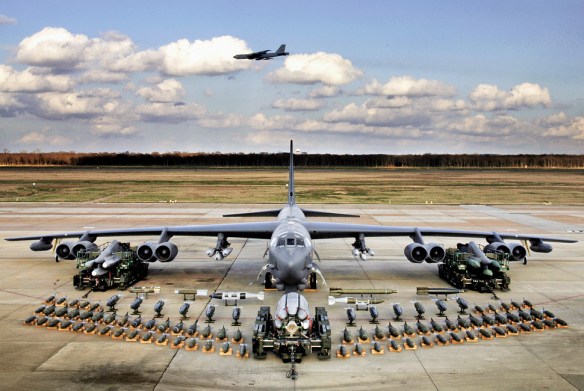
From Michael Yon’s posts, BLUF = Bottom Line Up Front, not to be confused with that ultimate hearts and minds tool, the BUFF:

b-52-bomber-2.jpg

BUFF