A time and a place


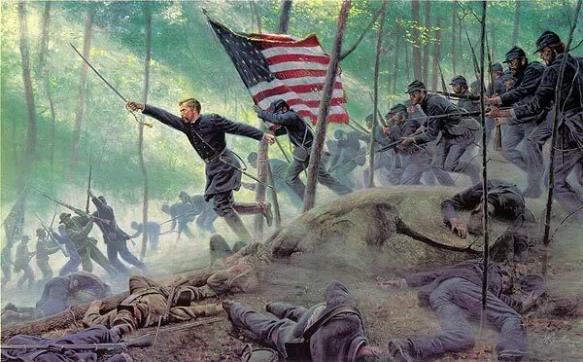
This seemed quite apt today…Chamberlain leading that final charge at Little Round Top, saving the day, the battle and very possibly the Union…

I didn’t really want to comment on the recent combat death of LT Tim O’Donnell in the NZ PRT in Bamyan Province, Afghanistan – it seemed at the time that everything that needed to be said – and perhaps some that didn’t – was being said…but, over the last few days, I have heard many people saying, no doubt with the best of intentions, that maybe he was simply in the wrong place at the wrong time…not at all…

I was privileged to spend some time with members of Lt O’Donnell’s unit as they waited for a C-130 to take them back down to Burnham Military Camp after they farewelled their mate that afternoon…something one of them said was so right…Tim was in the right the place – he was in the lead vehicle, leading his soldiers, he was where he was meant to be, and doing his job

And from the other side of the fence…

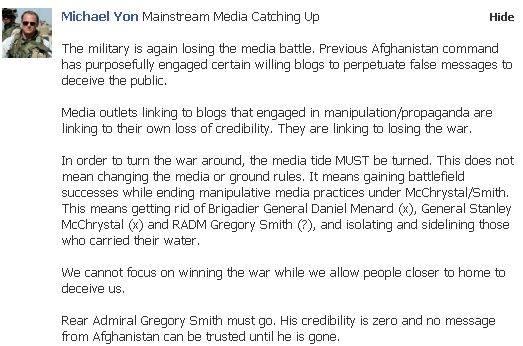
And while I was writing, this popped up from Michael Yon…back on our side of the information war….

...and from another direction...


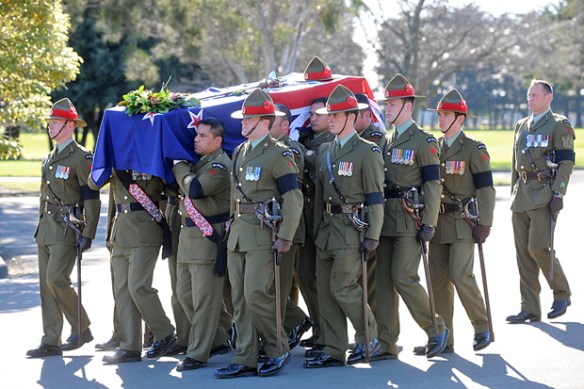
Last respects paid to slain NZ soldier

Lieutenant Tim O’Donnell who was killed in Afghanistan is taken from the funeral service to an awaiting gun carriage, Linton Military Base in Palmerston North. Photo / NZPA

It’s never good when a serviceman falls, on operations or in training and this has already been a sad year for the NZDF, following the CT-4 crash in January and the UH-1 on ANZAC Day…as Chief of Army Rhys Jones said, while the death in action of a soldier was not inevitiable it is certainly something that Kiwis have been steeling themselves for over the past 3-4 years…

I attended a presentation at Massey University just after the funeral…it was by former Chief of General Staff Piers Read, a contrast and compare look at the Reconstruction on post-Civil War America and modern Afghanistan (modern Afghanistan – now there’s an oxymoron!!)…he opened with an apology that this work had been in preparation and scheduled for this day for some months and he’d had no intention of ever presenting anything that might become so topical on such a day…it’s a good presentation and I’m going to ask if I can share the slides and supporting paper here…he made some good points, poignant and all the more effective against the background of the events in Linton that same afternoon…

…while at the same time, clowns Willie and JT of Radio Live was playing up the entertainment value of the funeral on Radio Live with Auckland’s University professor Caroline Daley suggesting about the funeral that the whole thing was really just a bit over the top and New Zealand just needs to get over it…all this hoop-la over one soldiers wasn’t something we did before for WW1, WW2, nor even Korea or Vietnam, those latter wars far smaller and perhaps more personal in their selectivity. If anyone needs to get over themselves, I think it may be Ms Daley whose timing in making those statements as the funeral was just ending was way off…

Perhaps Ms Daley needs to consider that, if we could, we would recognise EVERY soldier, sailor and airperson who fell in the service of their country in exactly that same way we did for Tim O’Donnell yesterday…that circumstances did not allow this at those times does not mean for one second that their sacrifice is any less nor the impact on their families any less painful and tragic…

I was privileged to spend some time with members of Lt O’Donnell’s unit as they waited for a C-130 to take them back down to Burnham Military Camp after they farewelled their mate that afternoon…something one of them said was so right…Tim was in the right place – he was in the lead vehicle, leading his soldiers, he was where he was meant to be, and doing his job

DSCF8729.JPG

And on this day, let’s not forget six other young men who died tragically while serving…twenty years ago today, Privates Brett Barker, Stuart McAlpine, Mark Madigan, Jason Menhennet and David Stewart and Naval Rating Jeffrey Boult died on Mt Ruapehu after being caught in a blizzard during a training activity…

Aaaah….yep

A picture's worth a 1000 words

A picture's worth a 1000 words

There is a great commentary at Small War Journal regarding the manner in which GEN McCrystal was brought down…

Meanwhile, back in LooneyToonville, Michael Yawn continues his sterling work for the Taliban and continues his campaign against RADM Greg Smith, the head PAO for ISAF…

Who needs enemies with friends like Yawn?

RADM Smith’s real crime, of course, was that he supported Yawn’s disembedment after he began his smear campaign against senior ISAF staff…

Contemporary Warfare

I’ve spent the last day or so typing out all my notes from the Contemporary Warfare sessions – who might have thought that some much great material could come from only two days?

Winning the information battle

…or, at least, not losing it by default…

Now that I’m working again, the calls on my time have multiplied geometrically and this little corner of cyberspace has been somewhat quieter than during my seven month exile at the Raurimu Centre for Contemporary Studies aka  home. I have a two hour drive to and from base each week and, during those periods on the road, have introspected on the unfortunate sequence of events that led to the demise of GEN Stanley McCrystal and his departure from the COMISAF appointment.

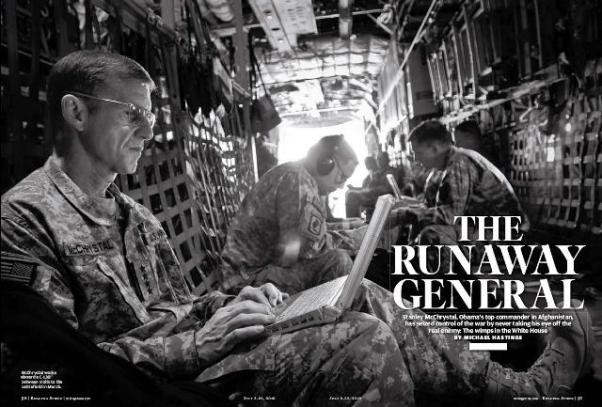
(c) Rolling Stone 2010

My first thought is that Michael Yawn had no more to do with what happened to GEN McCrystal that he did with the removal from ISAF of Canada’s most senior in-theatre officer..whether Michael Yawn had yapped on or not, the fate of both these officers would have been the same i.e. contrary to popular misinformation, Michael Yon did nothing to influence these events, other than perhaps besmirching them in his own personal smear campaign which says more about him that it doers either Daniel Menard or Stanley McCrystal. In 2005, I was fortunate to spend some time with the now Chief of the Canadian Defence Force, General Walter Natynczyk, and nothing about that officer struck me as the sort of guy who would or could casually overlook a negligent discharge by a senior Canadian officer and even less so, when it occurred in his presence.

I feel sad for GEN McCrystal, brought down by an angry Icelandic volcano (which is how they all came to be in a  bus together with an embedded reporter from Rolling Stone) magazine and a fickle and irresponsible reporter who, in my ever so humble opinion, abused the position that he was placed in by Eyjafjallajokull, reporting out of context the frustrations of  staff facing the unenviable task of winning a conflict that is unlikely to be winnable. I agree fully with Mike Innes’ comments @ Current Intelligence

I spent the better part of yesterday trying to wrap my head around Michael Hastings’ profile of Gen. Stanley McChrystal and his team of advisors. My initial thoughts on the subject at CNN hint at but don’t fully get to what I wanted to say on the matter… which places me in good company, since the chatter on this issue has been blazing across the wire/blog/twitter sphere since the piece was “leaked” on Monday.

My main point was about social distance – which is actually an issue that binds together pretty much everyone who reads, researches, writes, or does anything at all in relation to Afghanistan (or anywhere, really). It’s what soldiers have to contend with, sitting behind the fortified walls of armed camps, all the while trying to gain a more intimate understanding of local culture. It’s what people sent to a strange place have to contend with, absent the time and access needed for familiarization, much less to develop any profound “knowledge” of their environment. And it’s what war correspondents and other journalists have to contend with when reporting from zones so catastrophically different from their otherwise peaceful, functioning worlds.

Powers of observation, an eye for detail, and a nimble pen can go a long way toward telling a good, accurate, and full story, and toward overcoming some of that distance (or at least recognizing it for what it is). Sometimes, maybe, the gap is just too profound, too wide and too deep, to accurately convey a larger meaning – not factoids and datapoints, but meaning.

Anyway, don’t take my word for it. I think of all the bits and pieces I read yesterday and this morning – and there was a lot of good analysis out there – is this Danger Room piece and Peter Feaver’s clear and focusedbreakdown at Foreign Policy of Hastings’ story elements.

What’s really disappointing, too, is that Hastings and Rolling Stone might have missed out on a real opportunity to craft some truly fine and literary journalism. In an interview on National Public Radio yesterday, Hastings gave some background that would have added a great deal of context and nuance to the story, had they been included. The Paris interlude, for example – which is really where all the juiciest bits of the story come from – came about because of the Icelandic volcano eruption, which disrupted air travel worldwide, and stranded ISAF’s Command Group, like thousands of other travelers. To my mind, that would have been both a unique element of narrative color and detail, and an obvious and immediate source of frustration for men running a war, but trapped outside of it and unable to return to it.

I hear now that the Pentagon is staking steps to require all interviews with senior commanders to be pre-approved from the five-sided building…is this what we are coming to in our fear of the fourth estate…we can entrust senior staff with the live of the nation’s young men and women, empower them to sortie into harm’s way, place the instruments of global destruction in their hands but won’t trust them to say the right thing to a reporter without a thumbs-up from a carpeted office thousands of miles and possibly eons of reality away…Rolling Stone‘s The Runaway General and Michael Yawn’s lipping off about things he know nothing about e.g. senior command, strategy, responsibility, etc are excellent examples of the damage than can be done by irresponsible reporters and editorial staffs, just like 911, the Bali bombings, Lockerbie etc are similar example of the damage than can be done by terrorist organisations BUT we didn’t run away and hide then…we went out and learned a new way of warfare…and that’s what we need to do now in the information war…

The first battle must be internal to shed our fear of the censure and embarrassment  that may come from perceptions of dirty washing being aired in public…this thinking is tantamount to grandma concealing her bloomers  in a pillow case when she hangs out the washing…surely we’re past this stage and realise that we do more damage to ourselves and our causes by playing a manic game of Whac-A-Mole trying to suppress any and all reports that may not be the purest distillation of happy happy joy joy juice…nowhere have I seen it summed up so well as this commenter on Michael Yon’s Facebook page (of course, I can’t find the exact quote anymore) to the effect that the USMC mindset is that “...if we don’t want it exposed out in the open, then we probably shouldn’t be doing it…” And that attitude is the place we need to strive towards, to stopping fearing the media and hiding from them, of being able to stand up say “…we screwed up…AND…here’s what we’re (really) doing about it...” or, sometimes, simply “…this is a risky business and sometime crap simple happens…

If we can’t get our heads around this now, this key battle we are consistently losing int he minds of our people and those of our adversaries, what are we going to do one day when anyone can publish what they think, their own views, opinions and images…what are we going to do then…? Uh-oh….youtube…facebook, bebo…that intreenet thingamebobby… time to climb into the information fight, people….

Everybody fights!!

If there was one single takeaway from last week’s conference it was this…”Everybody fights…!!” It was hammered home by the US and Canadian representatives who attended and validates that concept that everyone deployed into an operational AO in high-end theatres like Iraq and Afghanistan must first and foremost be a warfighter…

Anyone who goes out the gate must have the same skills as those who habitually tread out in the bad lands and if there has been one single lesson for both these nations in the last six or seven years it has been that EVERYONE has the same probability of getting caught in a contact, activating an IED of some size, or getting in some other form of strife…

So EVERYBODY receives, extracts and delivers detailed and comprehensive orders; EVERYBODY conducts and participates in rehearsals; EVERYBODY is conversant with Immediate Actions and force SOPs; and, where possible, EVERYBODY has a secondary skill to bring to the party so that there are no single points of failure when it all goes noisy…

Those who may expect to spend a large proportion of their time within the wire might also wish to have a bit of a rethink as once all those containers are stacked, blankets counted and bolts tightened, they represent a large proportion of combat power that can be employed in local security, route clearance, population engagement, etc, etc, etc….

COIN is not and never will be a checklist…EVERYBODY needs to think and keep thinking to stay alive and achieve the mission…there is no room for rubber stamping compliance or templated solutions for their own sake – every situation is subtly different from the one before and must be considered in its own context…a key implication from this is that domestic training, outside the force generation or predeployment training environments, MUST provide opportunities for leaders at all level (including EVERY soldier – it’s called self-leadership) to confront complexity and uncertainty in every day they are on the job – and that this must be supported by a firm foundation of a well-embedded organisational ethos and culture…

Kudos to Dean @ Shiloh again for the top job he did in collating and distributing his detailed notes from the COIN Symposium at Ft Leavenworth – Dean, just so you know, we’re reading your stuff down here as well and it was interesting to see notes based upon your observations being distributed at the conference…unfortunately, significant portions of the conference material were classified so I’m unable to share to quite the same degree as Dean however a week away from home gave me a great opportunity to navel-gaze free of distractions and to also interact offline with a number of old and new colleagues and this is content that I’ll be developing over the next week or so…

It’s been bucketing down here for most of the weekend since I got home but I have been making the most of breaks in the weather to do outside jobs at the Lodge and Chalet in preparation for the ski season which starts here in a couple of weeks. In the wetter parts of the days, I have had a full range of inside jobs as part of that prep and this has eaten into PC time quite a bit…tomorrow, I am off to Ohakea again and, assuming that the Army has finally completed all the exit admin, I should be a member of the RNZAF by lunch time…

Getting it right

Just snippets today…

A couple of interesting comments (edit: made by visitors to his page – I just omitted the names for privacy reasons) on one of Michael Yon’s Facebook threads…

I’ve been in the army since Regan was president. i lived through the drawdown and saw how within several years the Army culture changed dramatically. zero defects was the norm… PC culture was jammed down our throats by new “sensitivity” initiatives. anyone that dared cross a PC line was slammed and pushed aside. when i attended the Strategy program at CGSC, we were fed a steady diet of liberal internationalist philosophy by Barnett, Nye, Fukuyama , and surprisingly the failed Sec of State Kissinger. these aren’t the people that are going to solve our strategic problems. in fact, they are the problem. we need to return to the classics of Sun Tzu, Machiavelli, Clausewitz, etc.

Personally I despise Sun Tzu, or certainly the popular pulp interpretations of his philosophies…I always mentally deduct marks when I see Sun Tzu quotes in papers and books I am reviewing…it’s, like, couldn’t you apply yourself enough to find a supporting quote with some substance behind it? But that’s just me…I do however support a return to study based upon the classic thinkers, especially as a foundation upon which to consider more contemporary works…

The government of South Vietnam was inept and corrupt … so it was illegitimate as far as the population was concerned. The South Vietnamese gov’t never won the support of its people and could not stand on its own without massive U.S. financial and military support. So the end was inevitable. I don’t know how much effect we can have on Karzai and his clown posse, but without an effective government in Afghanistan the fight is already lost.

The positive and negative parallels with the war in Vietnam continue to grow…on the positive side we see the incredible dedication and professionalism of individuals at the sharp end, regardless of the direction and reasons for the conflict; and we see the opportunity to get it write through the writings of people like Jim Gant, Josh Wineera and Steve Tatham, all of whom have identified key aspects that might make this war winnable – although chance is becoming slim indeed as the US prepares to meet its 2011 drawdown target…On the negative side we see war in an environment we do not understand; the top-down political meddling in the campaign plan; and the bolstering of a government that only serves to reinforce the opposition…

The Enemy Within

As I type this morning, the news is covering a taxi driver’s murderous rampage in Whitehaven in the UK…already here, commentators are noting the difficulties faced by UK Police due to their unarmed posture and linking this to our own unarmed police force. The anti-gun lobby hasn’t arced up yet but it must be winding up already…the simple fact is that the UK already has very strict gun control laws ans still something like this occurs…

More guns, less guns is not the core issue…if someone wants to go out like this, they will find a way, guns or no guns…and while I support the arming of Police (why not? everyone else is armed), that is a response whereas I think that we need to be looking at how to interdict this threat before it ever gets played out…

On the run…

Right that it for now…have to dash as I have a big day ahead maximising the sun while it has been out…we have had a lot of rain over the last few days and everything is drenched. Fortunately we live in top of a hill and have escaped the floods that hit Whakatane and Oamaru this week…

I have made considerable progress this week is identifying potential options that might finally get us (affordable) broadband access at home – I do so miss being able to listen in on the monthly Virtual Brown Bag sessions at the CAC COIN Center – either through the miracles of satellite or mobile technologies…

I also am steeling myself for the inevitable jabbing and stabbing medical assessments as part of transferring across to the Air Force…so long as there’s no pysch assessments, I should be OK…!!

My two COIN-related priorities remain completing my review of the Mandelbrot book and offering my two cents to the incredible amount of great insights that Dean @ Shiloh brought back from the COIN Symposium at Ft Leavenworth last month…

Edit: This Just In…

Hawkeye UAV in action

This came in just as I hit the Publish button…it’s some of the imagery captured during Hawkeye UAV sorties in the South Island last week that shows off the Hawkeye capability – like Transformers, ‘more than meets the eye’…it is way more than just a little UAV with a camera…the true value to the client is the real time geo-referencing and overlay of imagery over 3D terrain models and subsequent analysis using the Hawkeye suite of tools…all this happens in the field in real or close to real time…very cool…

Michael Yawn predicts…

(c) CJ O'Neill 9/2009

…that the sun will come up in the morning…where would we be without him…?

Yon is crowing on his Facebook page that…

This fight was expensive for me in many ways, but I got him.

Getting this man fired was worth the fight and the costs.

This will save American, Canadian, and Afghan lives.

…in regard to the news a couple of hours ago that BGEN Daniel Menard…

…has been relieved of duty and ordered home immediately, accused of having an inappropriate relationship with a female soldier…the news came only days after Menard faced a court martial in Canada, where he pled guilty to accidentally firing his weapon at the Kandahar airbase in March. The incident occurred as Menard walked with Canada’s chief of the defence staff, General Walter Natynczyk, on his way to a helicopter.

Unusually, the Canadian National Defence spokesperson omitted to credit Yon with BGEN Menard’s removal and this may be an indication that the Canadians think that they can police themselves without Yon’s guidance or assistance. Unfortunately for BGEN Menard, he was not found (nor even charged with incompetence in an operational theatre) so it is likely that Yon will continue his vindictive vendatta. Yon has yet to substantiate his allegations of incompetence against any of the senior commanders he accused following the bombing at the Tarnak bridge just outside Kandahar airfield but continues to play (one assumes that it is an act) dumb regarding the reasons for his disembedment from US forces in Afghanistan…those silly old generals, they should like being publicly accused of incompetence and conspiracy…after all, Michael Yon thrives on such comments – oh, no, that’s only when he is dishing them out…

Personally I think Menard should have been like most of his troops and kept it in his trousers but that’s no call for the likes of Yon to conduct a personal vendetta against him or anyone else – you notice that Menard’s partner in crime is being targeted by Yon? Maybe this is just (yet) another instance of the 19 year old private masquerading as a 45 year old adult playing petty score settling games – possibly due to some perceived wrong during his four whole years in the US Army in the mid-80s…

And now, having de-Yon-ed myself it’s back to real work…I’m just about done on my review of Benoit Mandelbrot’s The (mis)Behaviour of Markets and should be posting it early next week…

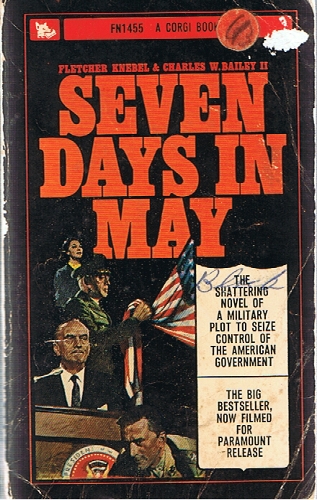
Seven Days in May

I’ve been on a recreational reading blitz over the last month or so…mainly to daily purge the professional reading I have been reviewing…sort of getting a literary life, I guess…

I started with old favourites from Steven Coonts (The Intruders, America), Clive Cussler (Raise the Titanic, Night Probe) and Dale Brown (Wings of Fire and Fatal Terrain). I overnighted at Carmen’s flat in Otorohanga a couple of weekends ago and, having forgotten to bring a book with me, grabbed Michael Connelly’s Echo Park for my pre-lights out read. This was followed by my two wins from Get Frank, Jonathan Kellerman’s Deception and Stephen Leather’s Nightfall.

Two nights ago, I felt the need to reread another favourite and grabbed Larry Bond’s Cauldron but while walking down the hallway, found I had picked out his Days of Wrath instead which was not really what I was in the mood for. As I was replacing it on the shelf in the study, I noticed Fletcher Knebel’s Seven Days in May beside it. I’d only ever read this as a teenager in the Reader’s Digest Condensed version and so opted to read it next.

What a great read!! Published in 1962, before Cuba, Dallas and Vietnam, it is set in the early 70s after a Cold War conflict that leaves Iran divided into Communist North and democratic South – logical for the time considering the Koreas, Vietnam and Germanys. A nuclear disarmament treat has been signed with the Soviet Union but elements of the US military have littler faith in either the Treaty or the President that signed it…to find out what happens you need to read the book (recommended) or see the movie (on my to-do list but it has Kirk Douglas and Burt Lancaster so I have high expectations).

In addition to being a damn fine read, delivering a gripping  storyline without needing the prop of a high body count as perhaps a contemporary equivalent would, Seven Days in May has a couple of lines that I felt are relevant to our contemporary environment…

Cleaning up the “sad debris of surrender”, as Todd called it, took time

The sad debris of surrender – a good phrase…someone said to me earlier this week that the US is not good at nation-building and I had to bite back quite sharply…this is one of those myths that has appeared since the end of the OIF warfighting phase in 2003, a result of moral high-horsing from the UN and sniping from the UK when post-war Iraq didn’t snap nicely into a nice shining example of Middle Eastern democracy (now there’s an oxymoron for you)…my response included three names…Douglas MacArthur, Dwight Eisenhower, and George C. Marshall…three generals who, between them, rebuilt Europe and Japan from the ashes of WW2. If there was any failure of nation-building in post-war Iraq, it was down to three factors:

The failure of the UN to get over itself and not step to the plate to take the lead in rebuilding Iraq. Regardless of the nature of the disaster that struck Iraq in 2003, the sad human debris of its surrender was left to suffer and endure after the UN’s half-hearted attempt at a presence in Iraq. The few casualties suffered by the UN in Iraq are but a drop in the bucket compared to the casualties suffered by the people of Iraq and those nations that did step forward…

The decision by the US to allow the bulk of development and reconstruction work to be let to US-based mega-corps that only had an eye out for the quick big bucks instead of perhaps applying a fraction of those billions to developing those construction capabilities in Iraq itself, thus contributing to the development and stability of the Iraqi economy. This was a point made by COL Dransfield in his presentation at Massey yesterday on his recent experience in  Afghanistan: he admitted some confusion as to how these contracts could cost so much when the daily rate for labour is about US$5 and all the raw materials like sand and gravel are there for the taking. He was surprised to learn that his PRT was one of the few forces in-theatre that purchased a lot of its support e.g. fresh food, minor mechanical repairs, etc from local resources.

The UK perception that it was on top of both conventional state versus state conflict AND low-level conflict and that it had nothing to learn from the US. The corollarative effect of this was that it also contributed little back into the Iraqi nation-building process at either the national level (after all, the UK was the other primary collaborator in the WMD ‘justification for the war in Iraq) or within it’s own AO which ultimately had to be ‘pacified’ by a US force as the UK was packing its bags to go home, it’s job not done…

At the Australian Army COIN Seminar in 2008, the comment was made that no one ordered Dwight Eisenhower to conduct reconstruction and nation-building tasks as he advanced across France and into Germany – they didn’t have to because it was such a logical and common sense method of pacificying the region. Similarly, Douglas MacArthur was expected to inflict draconian Versaille-like measures against the Japanese after Japan surrendered in August 1945 and many would have believed that he had a major axe to grind with Japan over the way it had treated his beloved Philippines. No doubt he did but, again, this senior US general determined that this would be counter-productive in the bigger picture. As a result, Germany and Japan sixty years on are still two economic powerhouses and one has to wonder what the Army of that day got right in training its senior officers.

Or possibly, as I’m not sure that the US has too much wrong with how it develops its generals today, what was so different sixty years ago that the governments and civil staff trusted those officers to just get on and do the job…?

“…the trouble is that democracy works only when a good majority of citizens are willing to give thoughts and time and effort to their government…”

And that remains the single biggest issue with the current campaign in Afghanistan: at the tribal and provincial levels the majority of citizens may be willing to contribute to government and leadership, there is simply no interest in a strong central government regardless of its composition or ethical philosophies. No matter how much you flog a dead horse it still isn’t going to get up and haul the cart any further…The McCrystal ‘Cursed Earth’ plan essentially abandons the centre of Afghanistan to whoever wants and only maintain a Maginot-like ring around the outer edges of the country – which might be useful if Afghanistan faced any credible conventional external threat. But it doesn’t, and ISAF’s failure to adopt a provincial/tribal based campaign along the lines of that proposed by Jim Gant that might, over time, allow the  ink blots of success to spread and merge only means that more lives and money will be wasted in ineffective and pointless kinetic operations.

MacArthur in particular achieved his success in reconstructing Japan not, by through kinetics or arbitrarily inflicting Western culture on the Japanese but by working within their own culture, evolving an his approach for that situation and no relying on templates from previous successes…what it it so hard to learn…?

Tres way cool…

Once upon a time, the Hind was the boogeyman helicopter that was going to sweep all before it on the battlefields of Western Europe…

Major Caleb Nimmo of the 438 Air Expeditionary Wing, Combined Air Power Transition Force, poses next to a Russian made Mi-35 attack helicopter at the Afghan National Army Air Corps base in Kabul, Afghanistan. (U.S. Navy photo by Mass Communications Specialist 1st Class (AW) Elizabeth Burke/RELEASED)

U.S. Air Force Maj. Caleb Nimmo is the first American Mi-35 HIND attack helicopter pilot to fly in combat. He is deployed to Afghanistan advising the Afghan National Army Air Corps’ rotary wing squadron as part of the 438th Air Expeditionary Wing, Combined Air Power Transition Force.

The 377th Rotary Wing Squadron of the Kabul Air Wing is advised by CAPTF’s coalition partners from the Czech Republic, Hungary and the U.S. The squadron flies the Russian made Mi-35 attack helicopter and the Mi-17 transport helicopter.

Major Nimmo received his Mi-35 training from a civilian contractor in the United States. The training consisted of 40 hours of basic familiarization: maneuvers, emergency procedures-engine fires, failures and autorotation. He also received instrument training and mission specific escort and weapons training. He followed that up with ten hours of military training with the Czech Republic in close air support, escort, formation with reference to high density altitude and also mentor training.

Afghan National Army Air Corp Airmen pilot two Mi-35 helicopters during a training sortie, with support from Czech Republic and U.S. coalition partners, over southern Afghanistan Oct. 3, 2009. (U.S. Air Force photo/Staff Sgt. Angelita Lawrence)

U.S. Air Force Capt. R. Tyler Rennell, a pilot mentor from the 450th Air Expeditionary Training Squadron, signs a receipt for fuel at Kandahar Air Field Oct. 2, 2009. Captain Rennell is part of the 438th AETS, the units mission is to mentor Afghans on flying operations. (U.S. Air Force photo/Staff Sgt. Angelita Lawrence)

Army Sergeant First Class Joseph Lemons, ANNAC flight medic advisor from the 438th Air Expeditionary Training Group, and his Afghan counterpart provide surveillance and security aboard an Afghan-piloted Mi-35 Hind helicopter on a training sortie over southern Afghanistan Oct. 3, 2009. (U.S. Air Force photo/Staff Sgt. Angelita Lawrence)

Army Sergeant First Class Joseph Lemons, ANNAC flight medic advisor from the 438th Air Expeditionary Training Group, and his Afghan counterpart provide surveillance and security aboard an Afghan-piloted Mi-35 Hind helicopter on a training sortie over southern Afghanistan Oct. 3, 2009. (U.S. Air Force photo/Staff Sgt. Angelita Lawrence)

More info here and here, including HIRES images…

…and I’ll bet that the Hind doesn’t have half the issues of modern helicopters…

This is for real

HMS Victory in paper

This is for real – details on PM here

…but are these guys?

There have been a growing number of reports from Afghanistan that senior ISAF commanders are losing in their desperation to win the information war with the Taliban on collateral damage. Two of the latest ‘initiatives’ include the creation of a medal awarded for not using lethal force during war and ordering soldiers to conduct patrols without a round chambered in their weapons. It seems clear that the ‘commanders’ fail to grasp that the role of the military in this environment is the application of force in support of national objectives – everything is subordinate to this role, unique to the military amongst other instruments of national power.  If the situation in Afghanistan is now so benign that soldiers no longer need to keep their weapons in an ‘action’ state, then we should be seeing an immediate transition from a military campaign to a civil campaign.

Of course, the fact that applying restraint in the use of lethal force in Afghanistan implies that there is still a significant threat against which lethal force might be used; and both ‘initiatives’ are is stark contrast to the indifference to collateral damage inherent in current cross-border UAV strikes into Pakistan. Possibly the further you are, and can keep the media, from collateral damage, the more palatable it is.

The Rules of War provide for the right of every soldier to use force in their own defence should they believe this to be warranted. Both of these ‘initiatives’ seek to undermine this right. Training provides both the means of applying that force and the means to determine a proportionate level of response. This training builds upon the organisational ethos and values developed throughout an individuals career. Maybe, in seeking to win what appears more and more tobe an unwinnable war, ISAF commanders are leading their own ethos and values be eroded in placing their soldiers at risk in favour of a population that doesn’t appear to be particularly supportive of either ISAF or the Karzai government.

One of the reports quotes one source linking this to the rules of engagement that contributed to the 1983 Marine Barracks bombing in Lebanon: this line is interesting…”…do not chamber a round unless told to do so by a commissioned officer unless you must act in immediate self-defense where deadly force is authorized…” …and we all saw how well that turned out…There’s never an officer around when you need one which is why most credible armies rely on the training and experience of their NON-Commissioned Officers to apply their judgement to any particular tactical situation. There must be a balance between experience and qualification which is a point that Dusty discusses in Security NZ this week.

On reconstruction

I see a recent note in the Marine Corps Gazette (real land forces have professional journals) that “…officials told lawmakers in Washington Thursday the reconstruction of Afghanistan is poised to become the largest overseas rebuilding operation in U.S. history…” Is there any point in rebuilding anything that is unlikely to last beyond that last helicopter lifting off the Embassy roof…? Who really gains from this rebuilding operation, the people of Afghanistan – or the corporate parasites clambering over them in search of profit before President Obama turns off the tap…?

Incidentally, I’m not sure that rebuilding Afghanistan will be a larger operation that the rebuilding of Germany and Japan and the Marshall Plan post-WW2…possibly only in terms of modern dollar levels…?

On networking…”

Michael Yon has been reporting from Bangkok and offering a distinct contrast to the pro-Red Shirt line taken by most of the mainstream media. One thing I have noticed is that large number of Thai people commenting on his Facebook page posts. Even accepting that Thailand is far more connected than Afghanistan, it is interesting to compare this with the number of Afghans commenting on his page which appears to be minimal at best. The  Sicuro Group report from 19 May states that there are 3.8 million Afghans subscribed to Roshan, the largest telecommunications operator in Afghanistan. You’d really think that if any of those 3.8 million people cared, they might offer up some comments; that they don’t might be an indicator to the true level of support for ISAF and the fantasy of a central government led by Karzai or anyone else.