Do Ideas Matter? Some thoughts…

I really enjoyed Adam Elkus’ article Do Ideas Matter? (full PDF) on the Small Wars Journal blog – right up to the paragraph before the conclusion. The author articulated and made his points well, concluding with logical sentence: “… For better or worse, American strategic culture embraces an engineering mindset, and the joint doctrine conceptualization of COG may or may not be the best tool for American strategy…

I thought from here he might be going to connect the dots between whatever doctrinal constructs you adopt and the need for a responsive delivery system to get that doctrine to where it is needed. Nope…what follows is a disintegration of the original issue into a mishmash of random thoughts and ideas. I get the feeling that the author had a bunch of lines that he’d been hanging out to use and hit us with all of them at once. The conclusion is almost a separate article and scarcely relevant to the good points made in the first two pages – the purpose of a conclusion is to conclude, not introduce new material.

I wonder if this was bounced off anyone else before it was published or just churned out in isolation, maybe after too many coffees and very late at night or early in the morning…That’s been a theme of mine here pretty consistently: the need for a good editor to cause an impartial eye over a draft BEFORE there is any thought of it hitting the streets. Even if it only picks up a couple of minor typos (one of my idiosyncrasies is transposing ‘now’ and ‘not’ – hands up if you can see that causing some strife?) or some logical disconnects, sharing your work with someone else before going live is a good thing.

Typos, errors in grammar, loose logic, inconclusive conclusions…all minor details that can irretrievably harm the (possibly quite valid) argument that you are making. This post originally started out as a comment on this post at the SMJ but after reading and rereading the absolutely crap conclusion in this paper, I had such a head of steam up, I figured I’d achieve more with it here. Bottom line: Mr Elkus needs an impartial sounding board before he launches off again…this paper gets a mark of D for Do it again…

The other reason I got so wound up about his non-conclusion was that it takes so much away from the first two and half pages which discusses the relevance of the Clausewitzian trinity to US centre of gravity doctrine. I don’t agree with his bottom line “… For better or worse, American strategic culture embraces an engineering mindset, and the joint doctrine conceptualization of COG may or may not be the best tool for American strategy…” because it reeks for building an Army best suited to fight itself – but I like the way he got there, especially in reminding us what Clausewitz really defined as his trinity and describing quite well the minefield that it interpreting Clausewitz.

I like Clausewitz, or at least those interpretations and translations of his work that I have read – certainly I would rate his influence as far greater than the homogenised drivel that Sun Tzu has become in the last decade or two. I think that most if not all of Clausewitz’s ideas remain applicable today and any that may not, are only temporarily out of vogue – doctrine never really dies, it just fades in and out of relevance from time to time. But, applicable or not, the issue that Adam Elkus was trying (I think) to unravel is that it’s all well and good developing all these new ideas and concepts – or polishing up old ones – but it’s largely irrelevant unless we  have a responsive and effective system to ‘inject’ for want of a better word those ideas and concepts into how we think and behave. FM 3-24 is a great publication but only useful for keeping the dust off the shelves if the ‘education (theory)and training (doctrine)’ (as defined by Phil Ridderhof in his comments on this paper on SWJ) doesn’t pick up on and deliver them before they are actually needed. Remember Simon’s soapbox…It’s all about the right information, to the right people, at the right time – and ensuring that they know how to use it.

I use that phrase regularly in discussions on intelligence, lessons learned, doctrine, training, and knowledge management. I wonder if they are all somehow connected?

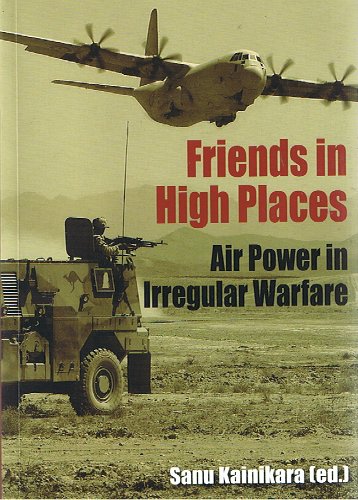
Friends in High Places – review

The cover raised such expectations

Friends in High Places – Air Power in Irregular Warfare was published in July 2009 by the RAAF Air Power Development Centre. It has been edited by Dr Sanu Kainikara, a former Indian Air Force pilot who is now the Air Power Strategist at the Air Power Development Centre in Canberra. Including the preface and glossary, the book has 267 pages divided into nine sections:

  • Foreword. Group Captain Rick Keir, AM, CSC. July 2009.
  • Introduction. Dr Sanu KainiKara. July 2009.
  • The War of the Running Dogs: The Malayan Emergency. Air Commodore Mark Lax, CSM (rtd). An edited version of the paper originally presented at the RAAF History Conference in Canberra, 1 April 2008.
  • Offensive Air Power In Counterinsurgency Operations: Putting Theory Into Practice. Wing Commander Glen Beck. An edited version of Air Power Development Centre Paper #26 published in August 2008.
  • Air Power and Special Forces: A Symbiotic Relationship. Wing Commander David Jeffcoat. An edited version of Air Power Development Centre Paper #14 published in February 2004.
  • Taking It To The Streets: Exploding Urban Myths About Australian Air Power. Wing Commander Gareth B.S. Neilsen. An edited version of Air Power Development Centre Paper #23 published in October 2007.
  • Air Power and Transnational Terrorism: The Possibilities, Advantages and Limits to using Australian Air Power in the ‘War on Terror’. Mr Sam Gray-Murphy. An edited version of Air Power Development Centre Paper #20 published in October 2005.
  • The Role of Air Power in Irregular Warfare: An Overview of the Israeli Experience. Dr Sanu Kainikari.
  • Conclusion. Dr Sanu Kainikari.

My initial visual impression of this book was “Yes! the Aussies have ‘got it’!”: the cover very positively shows a C-130 at low level over a Bushmaster Infantry Mobility Vehicle and not the F/A-18 and M-1/ASLAV combination that might be indicative of a conventionally focused publication. Unfortunately this warm buzz did not last beyond the second page of the foreword which notes the ‘…predilection towards precision strike…‘ in the collected papers as ‘…one of our key asymmetric capabilities against a typically asymmetric foe…(1)’

These comments set the scene for the remainder of the book. While various CIA(2) truisms appear through the papers, they are not supported by the text which largely drives towards supporting the maintenance and further development of current air power capabilities with continuing focus upon kinetic operations. Although it makes a case of a balanced spread of air power capabilities, the truth today is that only a very small number of nations can actually do this – the rest of us have to make some tough decisions about what capabilities we need to maintain nationally and what we may have to give up to do so.

Friends In High Places does not consider the lessons of allies and partners in coalition operations since WW2. Its conclusions focus on what was i.e. offensive kinetic air power and not upon what is and will be: a blended mission-specific capability mix drawn from national and coalition military, government and civilian sources – to use an obsolescent but appropriate term: Joint, Inter-agency, Multi-national and Public (JIMP)(3).

This publication has been written around a pre-assumed conclusion: that traditional kinetic air power will remain as the premier ADF air power output. While this may or may not be the case, by approaching this publication with that belief as a given, all the content is badly skewed from the reality of the COE. A more effective approach would have been to consider the COE and what makes it different from  the more comfortable traditional forms of warfare and then apply these findings to the employment of air power. Applying an open mind to the complexities and nuances of the COE may have produced a volume that lives up to the promise of its cover.

Although the foreword notes the minimal consideration of air power in contemporary COIN doctrine like FM 3-24 and LWD 3-0-1, there does not seem to have been any attempt to engage the COIN/CIA(2) community of interest (COI) in Australia or offshore. This is doubly disappointing as agencies like Force Development Group in Puckapunyal, the NZ Army’s Interbella Group, or the COIN Center at Ft Leavenworth could have added considerable value to relevant aspects of this book without detracting from its air-centric theme. As a result, both the land and CIA aspects of this book are very weak. Similar comment can be made regarding the Special Operations and Urban Operations chapters.

The editorial staff has not included any discussion of maritime considerations, from general or air-specific perspectives which is a significant omission for a nation surrounded by water, which is reliant upon the sea ways for trade and industry, and whose major military operations are far more likely to be expeditionary than domestic.

In considering how air power can best operate in a CIA environment, there has also been no mention of the aviation branches of either the Australian Army or RAN apart from a couple of inaccurate paragraphs on ARH (the Eurocopter Tiger Attack Recon Helicopter adopted by the Australian Army). There is also no mention of integration with other government or civilian air assets or those of likely operational partners like New Zealand or Singapore; nor any acknowledgement of the vital role of all sources fusion when discussing aspects of ISR.

The papers included in this collection do not have a good nor consistent grasp of the irregular environment and thus any conclusions they may draw are developed on a somewhat shaky foundation. By the time that the original portions of this book were drafted i.e. those that are not rehashed staff papers, vast quantities of analysis, comment and intellectual horsepower had been expended on defining the COE. Had these resources been tapped, Friends in High Places would be a must-read. As it stands at the moment, its most effective message is the cover photo.

(1) Page xii
(2) The UK term Countering Irregular Activity (CIA) is used instead of the more popular but less accurate term Counterinsurgency (COIN) to describe the complex Contemporary Operating Environment (COE).
(3) I think that I may have inadvertently helped kill off this term a few years back when I made a number of public comments along the lines of ‘Bring out the JIMP‘ from Pulp Fiction.

What’s up with all this Birmoverse stuff?

Good question.

First up, is that John Birmingham has asked via Cheeseburger Gothic for thoughts on what a post-WW2 world might look like in the Axis of Time (AoT) universe, with especial interest in Great Britain. It is rare for an author to do this and I think that it provides JB an opportunity to add a real richness to his books in adopting this approach.

If you hadn’t figured it out already, I like his alt-history after buying World War 2.1 Weapons Of Choice while stuck in Changi Airport in 2005 on my way home from CLAW 1 – it was an act of desperation as it was the only book on the shelves that even remotely appealed. Over two years, I managed to seek and devour 2.2 and 2.3 and then was pleasantly surprised to find Without Warning in the Taupo  Whitcoulls mid-last year. I was less impressed to find on completing it that, it was Part One of another series – there was not a single clue on the cover to indicate this which really hacked me off. Normally I won’t buy a book in a series unless I know that the whole series is published AND available – a lesson learned from War Against the Chtorr and Janissaries.

In thinking about the questions posed and subsequent dialogue on Cheeseburger, I am finding that I am able to view our current environment through a slightly off-centre perspective. By considering those things that we might want to do in the AoT universe that we didn’t get right in the real world, it is possible to divine perhaps some relevance back this way. As an example, I proposed that, in dissolving the Empire, that Great Britain establish India as a strategically-influential region power from the beginning instead of letting it muddle its way there over the decades as has actually happened. My thought at the time, was that,by doing this, we might be able to head off much of the instability in the Pakistan/Afghan area for the AoT universe. Thinking about it later, this also ties in with my belief that we have the wrong force composition in Afghanistan and they what it really needs is for the regional powers, namely India and Iran (might as well accept it and stop the name-calling), to pick up the burden of maintaining regional stability. Some thoughts on greater Indian involvement here

It’s an example of one writer harnessing the horsepower of the Information Militia.

It’s fun thinking about what-if, whether at the geo-strategic or micro-tech cool toys level; even more fun when there is a possibility that some of those ideas might actually be taken up into the storyline for the next book or form the basis for perhaps some fan fiction in the AoT universe. Nothing wrong with a bit of fun…

In other news…

Airmen from the 105th Airlift Wing's Logistic Squadron load cargo aboard a C-17 bound for Haiti early Saturday morning. (Photo: Tech Sgt. Michael O'Halloran, 105th Airlift Wing)

It’s also been a bit slow in the real world this week. Yes, lots of angsting over Haiti in just about every blog site on the planet with some interesting points being raised:

  • Humanitarian issues aside, at what point do we decide that it is simply just not worth it to keep saving these failed ‘nations’ from themselves? Here’s a couple of interesting threads from the Coming Anarchy side of the house:  The Latest Battlefield of the Monroe Doctrine and A Bit Of Realism Please? Our constant reinforcement of Third World cargo cults comes at a price and, sooner or later, it is going to become untenable unless we start to address the root issues. Step 1 would be to rein all these meddling NGOs that address the symptoms but actually only foster more suffereing in the long run…
    • Have a plan and impose control.
    • Blindly sending in supplies, aid, etc is a waste of time if the resources don’t exist ont he other end to do anything with them. Ditto for all the well-meaning dogooders who just want to arrive in Port-au-Prince to ‘help’.
    • If you are a ‘once-were’ nation, like the UK and France, then get with the programme and be thankful that someone is getting out there and filling the vacuum (and fixing the messes) left when you dumped your colonies. If you don’t like the new rules, then YOU rock up with the necessary capabilities and force structures to do the business. Here’s a subjective but interesting item on what a real power can bring to the party Do Americans Care About British Soldiers?
  • It’s funny how the US gets caned for even thinking about interfering in these rock show wannabe countries but then gets caned when something like this happens for allowing the country in question to decline to such a state in the first place. Same thing happened in Myanmar – why won’t the US make the government open up to accept aid? You really have to wonder sometimes why the US doesn’t just pack it all up and go home…?

The current operation in Haiti is a classic example of humanitarian assistance, disaster relief, stability operations and countering irregular activities – the earthquake could not be predicted and it is unrealistic to expect Haiti to construct quake-proofed buildings, so many of the current problems are unavoidable. However it will be interesting to see what follow-on activities are conducted to maintain stability in Haiti and address the core problems within the country.

Travels with Shiloh is running a series on the implications of MAJGEN Flynn’s paper on what’s wrong with intel – of course the shorter option to write might have been ‘what’s right with the intel world’ – while I don’t agree with all the points made, I think it is important that someone is raising them to get the discussion going…

The Information Militia

I’m coming to the conclusion that Michael Yon is a well-meaning but meddling journo who probably does need to slow down and consider his place in the universe. I like his website and think it is some great material – please check it out – as photojourno, he is very good and sends some very strong and often poignant messages. His Facebook page on the other hand is an example of the down side of the Information Militia – he is a guy who has, just this week, publicly bypassed the US military chain of command by inciting his fans to pressure CENTCOM and the Pentagon to release a Haitian-born officer in the US Army, current posted to Afghanistan, for duties in Haiti. Yes, sure, members of this officer’s family have died so there IS a compassionate case to be made and his cultural and language skills would definitely be employable BUT…BUT…do you not think that perhaps the DoD has its own processes to this to occur and that there might also be broader implications in releasing him from his current theatre? Michael Yon also posted an item critical of Starbucks and its relationships with the US military which was subsequently proven to be both incorrect and old news as covered in this story from 2004 – as HoaxSlayer points out, even when a retraction is released, it never gets the same degree of airtime as the original accusation.

Building the Birmoverse Deux

VJ-101 VTOL fighter in transitional flight (NB: transition with a small 't', thank you)

Some spillover from yesterday’s thread…

  • While SSTs and ballistic transports will make getting around that planet that much faster especially time spent in the worrisome skies over Europe and the UK, the airship will also make a come back. This will largely be in response to the increasing dangers of the sea lanes and will also reduce the need for massive harbours and maritime points of entry as airships will be able to deliver relatively large and bulky loads direct to the target location. Customs and Immigration will, of course, be tearing their hair…
  • What will happen with the Irish problem? With the Sovs posturing over half of Europe, like, more than the half they had the first time round, it is unlikely the Brits will have much tolerance for any bolshie Paddys. In any case, Ireland is too isolated for any meaningful insurgency to be conducted and it is likely that Eire would become part of Fortress Britain whether it really liked it or not. One impact this might have is that the Brits will no longer have the catalysts to develop their mastery of comprehensive approach Countering Irregular Activity and COIN. Then again, they have always played pretty fast and loose with the rules when playing the great game and managed to deal with most of Adolf’s spies and saboteurs in short order without much help from anyone. Perhaps, in revealing ahead of time, those like Philby and Co, the Brit public service will be purged and thus be similarly successful against Uncle Joe’s spies and saboteurs – which really makes the Irish question a non-issue.
  • I would like to see France used as a nuclear testing zone by everyone and for this to be encouraged.
  • In terms of nitty-gritty, technotoys I would like to see in service: after the TSR.2, the Rotodyne tops the list…let’s use them as feeders out to the floating airship terminals…
  • The quest for effective VTOL aircraft will continue with some urgency and aircraft like the VJ-101, P.1152, P. 1154 and XFV-12A will come into service as close range protection for naval platforms, including civilian vessels to fend off pirates and privateers (QE2 will have a hangar deck for two); and also because the much warmer Cold War (Cold War++) will again call into question the security of large concrete airbases.
  • At least one permanent space station will be developed in the 60s both to control the high ground and as an eventual stepping stone to the Moon and further. As I commented yesterday, all the biochemicals being sprayed with gay abandon around the planet in 1945 mean that we might want to be thinking of an Earth 2 – and we know now that wormholes are doable…
  • Also I do like the concept of Project Horizon that was raised yesterday in a comment by savO – not just because it aligns with my statements re a moonbase but because it has a high cool factor and introduces the potential for combat on the Moon.
  • Referring back to yesterday’s pic of the Vulcan in the Sound – I think that pic is actually in Milford Sound – I’m wondering if JB could slip in some sort of Vulcan low-level strike, basically what I’m after is 633 Squadron with Vulcans…
  • I’m also wondering if 21C technologies might not be focussed on alternate and clean (though why bother with all the NBC being used?) power sources so that the Middle East never gets the strangehold at the pumps that it enjoys now.
  • Israel, instead of stirring up the Arabs, and having decided to work and play nicely with them, conducts a very aggressive covert campaign against the Sovs to encourage the expatriation of Soviet Jews to Israel – alive. This becomes one of the major wild cards in the AoT post-war deck.
  • Is there a Marshall Plan? Yes, but focussed on the Middle East and North Africa as the new bastions against Soviet aggression. The Fertile Crescent become fertile again. Central Africa remains a shithole and pretty well plays out the same history as it has here.
  • With economies kickstarted by the Marshall Plan, a combination of Arab money and Israeli know-how widens the Suez Canal into a two lane facility. In 1956, Sov proxies from Greece and Turkey (yes, I know they hate each other but if we can have wormholes, we can have Greeks and Turks who get on) get a snotting when they try to seize the Canal to protect it as an ‘international asset’.
  • The Falklands War never gets a look in. By 1955, The Falklands Island have become the unsinkable fleet that holds Argentine and Chilean ambitions towards Antarctica in check – the Brits however do take the time to return all abandoned scrap metal to Argentina, just in case…
  • I don’t think McCarthyism will occur – what happened to Hoover pretty well sets the scene for what will happen to anyone else who gets out of control and surely amongst the Uptimer 21C lessons must be one relating to the folly of over-simplistic profiling; communist leaning ≠ Sov supporter or agent just like Islamic ≠ rabid nutjob terrorist…what there may be though because the Uptimer histories will have shown its effect, is the introduction of terror as a weapon a la what we see today.  Who might those terrorists be? Well, the both sides of the civil rights movement leaps out for a start; perhaps also some sort of movement kicking back against the Uptimers; the list so far is quite short as most of those who might feel that they were disadvantages in some way by the AoT version of WW2 are conveniently dead – I’m really leaning towards domestic than ‘transnational’ or external terrorists…
  • Maybe it is such as attack that thrusts Kohlhammer into the Presidency – he doesn’t need to be elected so long as he sits in the chain of succession as per Coppel’s 34 East or By Dawn’s Early Light (both stories where the chain of succession extends lower than the Vice-President)- maybe terrorists gatecrash a White House dinner party (we all know how easy that is now!) and Kohlhammer finds himself at the top of the food chain.
  • We’ve solved most of the worlds ills except for the Sovbloc – likely to be solved with a bright flash or flashes on the horizon – and South America – i think that South America may be where the global plot gets its tail twisted – there is little significant history on the continent so less in the way of 21C lessons to be applied in the AoT post-war era therefore we really have to take South America as it comes…
  • Will we move towards a standing force in support of the (toothless in our time) UN and will this perhaps be a relatively short leap towards a world government, certainly a good guy alliance government?
  • I think that we will see, in short order, a number of new inventions as smart people from the 1940s start to apply their new knowledge. RULE #1 – no wormhole experiments on Earth!! These new inventions will introduce some new life into the Uptimer story as well as more uncertainty as the timeline starts to deviate from what’s left of ‘our’ timeline as as technological edges start to smooth out.
  • I’d like to see the rather conventional Sovbloc versus US/UK plotline resolved and tossed out in short order and bring in a new story that takes us out of that comfort zone – what, I’m not sure. Maybe the Israel/Arab bloc might leap ahead in the application of Uptimer tech to new problems, make a breakthrough and become (again) a super-power…? Push the Uptimers into a situation where they really have to think rather than just succumb to the temptation to rehash Hackett’s The Third World War. What-if…the Judeo-Islamic Federation begins to dictate its values as the norm for global ethos and culture, just as we in the west tend to do to the Third World…?

Building the Birmoverse

Great thread over on Cheeseburger Gothic soliciting thoughts on what the world will look like after the war in the Axis of Time Birmoverse….even if I am a bit of a late starter…this is a great series, so a. have a think about tracking down the first trilogy and having a read and b. contributing some thoughts. I’m tossing my thoughts in here as I find it easier to add in links etc to sources…

  • The UK will revert back to a Battle of Britain frontline mentality i.e. a far higher rate of readiness than during the Cold War and a non-war that will be far hotter than the Cold War i.e. intercepts and shoot-downs, possibly much like the 67-73 War of Attrition in the Middle East.
  • The Sovs are much more likely to learn from our history or what’s left of it and plan on making their move for the rest of Europe early and there will be a lot more skirmishes, border incidents etc, again more like the Arab-Israel relationship in ‘our’ time.
  • Britain will give up the Empire but under far more controlled conditions: Singapore will be created immediately based upon the ethnic Chinese, ditto for Malaysia with the native Malays; India will become independent without much help from Mr Ghandi (so the movie will be much different too and possibly no longer Oscar material) and from the start be set up as a strong ally in the region a la AS and NZ in the Pacific; issues with tribes (i.e. we will get into advanced Gantism early) and borders will be sorted at the same time possibly along the same lines as the UAE  as per this item on Coming Anarchy. On similar lines, the handover from empire in the Gulf will be far more structured and only once a civil infrastructure a la India is well-embedded.
  • AS and NZ will be developed as regional allies to much the same level as Canada in terms of militaries, especially air and maritime forces, and NZ’s main focus will be patrolling/protecting the seaways and resources of the southern sea lanes and Antarctica before Argentina and Chile make a grab for them. I for one would like to see more RNZAF Vulcans (no, not the point eared type)
  • The convoy system will remain in vogue and the intensified Cold War will make the sea lanes operational environments to pressure the UK and other free world nations like AS and NZ that are dependent on shipping for trade and goods. Submarines may replace the nutcase terrorists like Baader-Meinhof etc. As mentioned in The Strategist today, there may well be an increase in private maritime forces to exploit this on both security and piracy/privateer sides of the house.
  • Just for shits and giggles and because I think he got a raw deal, MacArthur will be allowed to nuke the Yellow River if anyone looks even remotely sideways at crossing it.
  • Someone already mentioned the internet but via cable – Voice of America/Free Europe will beam out not just radio but information and TV streams into occupied Europe – two info war models spring to mind: one is Tom Clancy’s campaign against China in The Bear and the Dragon, and the other the UK Political Warfare Executive initiatives like Gustav Seigfied Eins, with more info on Wikipedia and an interesting paper here on Grey and Black Propaganda Against Nazi Germany. I remembering reading about this when I was about ten in a Reader’s Digest Condensed book, titled something like The House in Baker Street (Baker St being pretty much owned by the SOE during WW2)- I haven’t been able to find any references to this title via Google or Bing – I’d be much appreciated if anyone could put me on to either the full or abridged version as I’d love to reread it – the original have gone up in smoke many moons ago.
  • On the same lines, I think that we will see personal computing power (PCP) ramp up into the early fifties as the technology is made accessible through the uptimers – what we saw in the 90s will probably happen in the Birmoverse in the 50s. This will be both a byproduct and a deliberate policy to use information as a weapon both against the Soviets and also to mitigate the vulnerability of ignorance that enables the exploitation of people into proxy terrorists and fighters e.g. take the info war to the mullahs in the 50s – this approach will also be a major factor in decolonialisation.
  • The whole Vietnam thing will be headed off at the pass when the French get arbitrarily booted out of Indochina (with lots of parties and champagne and bugger-all tears from the locals), a US-based Constitution is adopted and President Ho Chi Minh leads Vietnam into an era of prosperity and progress (much like Lee Qwan Yew in Singapore) while becoming the region’s major foundation for stability against Chinese expansionism.
  • Ed Hillary still knocks the bugger off in 1953…and Queen Elisabeth II is crowned at the same time – but takes considerable steps to ensure that her children get better relationship counselling before being allowed to breed. The Queen Mother still lives on to 103 years old. Sir Ed sees that Nepal and Tibet become peaceful sanctuaries for eco-tourism while the UK realises the error of its ways and makes sure the Ghurkas get a fair shake decades earlier than in this timeline.
  • Winston Churchill doesn’t get booted out of office in 1945 by an ungrateful nation and remains Prime Minister until the late 50s when he hands over to someone way smarter than those who actually did the job between him and Maggie Thatcher.
  • JFK drops his (and his dad’s) political aspirations and gets into Hollywood, marries Grace Kelly and both go on to become Hollywood’s ‘royal’ family.
  • A peacekeeping force deploys into Palestine on the eve of the creation of the state of Israel in May 48 (Exodus never happens as the Brits are dicks about it this time around) – over the next 2-3 decades it oversees the successful blending of cultures and healing of wounds. Israel become a major technology centre ( a la Singapore), never needs to develop a major military capability (or submit its economy to one) – by 1980 the relationship of Jew and Muslim returns to the symbiotic one of a previous millenia.
  • The space race still occurs but a decade earlier with a man on the moon (one of the Mercury 7?) in 1959 – the Russians still can’t get it together in space without massive attrition in astronauts and hardware. Bombs in space are a reality a la Jeff Sutton‘s Bombs in Orbit Ace Publishing D-377 1959. Permanent bases are established on the moon by 1970 and the first landings on Mars happen by 1980. The UK is not a player in the space race other than to provide high calibre pilots due to its ongoing combat ops in the non-war with the Sovs.
  • Many British children and families are evacuated to the Dominions for education as Britain becomes a literal floating FOB against the Sovs. This is made more palatable by the SST network established by the late 50s (it took time to ramp up mass production of the high-tech metals necessary for mass supersonic flight) that reduces global travel times and also mitigates the maritime threats against shipping. Stratospheric ballistic travel become a reality in the 60s. Essentially the UK is someplace you work but you go on holiday anywhere else.
  • Due to its ongoing war footing, the mass immigration from the colonies never occurs and Britain remains essentially British – the Beatles and the Rolling Stones still kick off on schedule.
  • The B-49 is adopted by the RAF as the Vandal (sorry but I’m not giving this one up!) as its stealthy profile, along with the Vulcan and Victor, enables its to better operate in the air defence environments over Europe and the North Sea – the B-52 is too slab-sided and suffers too many losses. The TSR.2 also comes into service in the mid-50s as the F-111 concept is tossed out as the joke it always was + there will be no McNamaraism to foster its design anyway. McNamara himself goes on to become the head of the Tucker Motor Corporation.
  • Despite the early release of public CG software in the 50s, Gerry Anderson still starts out with SuperMarionation and Thunderbirds remains a mega-hit with children of all ages.
  • South Africa and Rhodesia remain members of the Commonwealth and over a period of decades transition from apartheid-based societies to successful blended cultures a la Singapore. Both nations form the bulwark of westernism against the Sovs in Southern Africa and win numerous wars against Sov-supported forces from Mozambique, Angola and Zambia a la Barrett Tillman’s The Sixth Battle and Larry Bond’s Vortex.  Nelson Mandela still becomes President but in the late 80s.
  • Britannia continues to rule the waves – the RN retains its full deck carriers and also expands the battleship fleet with more Vanguard class vessels – it remains the premier maritime force for littoral operations (a la lessons from the Med pre-Transition), whereas the US Navy rules in blue water ops.
  • The Sovs will be wise to the concept of containment but I still don’t think that they will be bright enough to do much about it as they have this habit of killing off all their best and brightest – while the steel-shod boot of terror may maintain its hold on Europe eventually this will weaken. Trite as it sounds I think that repressing its intellectual capabiltities will be sound the same eventual death knell for the Sovs in the Birmoverse as it did here in 1989.
  • Women will be empowered way earlier without having to ignite their undies (which we now know can get you locked up in Gitmo #2) – this will be one of the most significant long-term effects of the Transition, even more than the technological advances, and will spread like wild fire through all cultures. This notwithstanding, prominent bumpy bits on aircraft will still be known as ‘Sabrinas‘. Sometime in the fifties, either the British Prime Minister or the President should be a women – without wanting too many uptimers running the place, maybe Karen Halabi takes over from Churchill either by election or succession – this benign dictatorship thing seems to work quite well…and would a nation at war like Britain still is, really want to risk an election that might bring in the likes of MacMillan?
  • The All Blacks still only win the one Rugby World Cup but manage to hold the America’s Cup for three decades running as a bonus prize.

The Last Commando

Michael Asher‘s Death or Glory: The Last Commando hit the shelves here a couple of months before Christmas – I was tempted to grab a copy but, mindful of upcoming New Year’s resolutions and my current stash of unread books, I kept my card in my pocket. My eldest daughter did, however, buy it – this is Tasha, who left school early but now has a passion for history – so I got to read it over Christmas anyway.

I had high hopes for it based upon the author’s stated Para and SAS experience (although the blurb doesn’t actually say what he did in these units) and publishing history i.e. this book is not a first attempt, although it may be at a work of fiction. Tasha hadn’t finished it because she had trouble getting her head round the military jargon (this is the girl who ate up Blackhawk Down, Pearl Harbor and who is now starting to work through the Stephen Ambrose collection) but after the first couple of chapters I could see why. Not only only does this guy go into mindless detail on weapons and their effect e.g. a rifle can’t just be a rifle, it has to be endlessly referred to as a Gewehr 41, but he makes up his own words and thrashes them to death…Germans don’t just collapse, drop, or even ‘spin and fall’ when hit, they endlessly potatosack and gunnysack, whatever that is supposed to mean. The author’s clear knowledge and experience of the desert is not enough to overcome his over-enthusiasm for adjectives and adverbs (do we still teach what these are in schools?)

This is the third book I have reviewed recently that would benefit from the services of a good editor – Accidental Guerrilla was one and I don’t recall the other – it annoys me that a book like this was hyped so much when it was released instead of being concealed on the shelves with the Mills & Boone and other pulp fiction. The basic premise of the story is good and interesting but it is let down by verbose prose, poor (or no) editing and too much jargon…imagine if you will, Executioner-clone does Popski’s Private Army

The stories of the Middle East Commando and the other fledging Special Operations forces operating around the same time like Stirling’s SAS, Popski, and the LRDG deserve to be told as fact and fiction but not like this…for me, Death or Glory‘s sole redeeming feature is in the last five pages where a minor plot line is resolved in a most satisfying way…