My birthday was actually quite a while ago, but I have been meaning to write this since…partly by way of acknowledgement but also to show what cool people I have in my family…
Many ,many years ago (so long ago that we need to use two manys, and that’s not too many!), I saw an article in Look and Learn about a revolutionary jetplane-submarine that the Americans were developing. This Look and Learn issue was one of a batch that we had acquired at a St Lukes Church jumble sale and dated back into the mid-late 60s.
Just for situational awareness, this is what St Luke’s Church looks like…
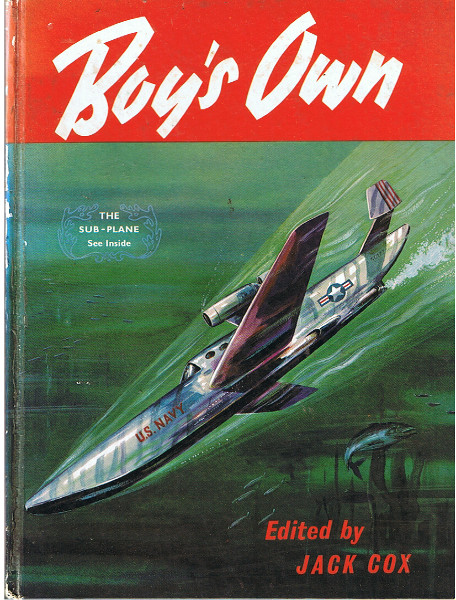
It had a couple of drawings of what such a device might look like in action but I never saw anything like them again, until I opened this gift from Carmen…what a score!!!! Who gives a fat rat’s that she bought it in the Op Shop and it probably didn’t even cost a dollar? I like these old annuals anyway but to find one with the ‘sub-plane’ from so long ago…yeah baby!! Coincidentally, I had just finished reading Attack from the Sea, the story of the US Navy’s attempt in the 50s to develop a credible sea-based airborne attack force and so was quite on top of this subject…it’s quite sad that had the sub-plane been scratched on the back of a napkin just a few years earlier, it might have made it at least to the mock-up stage…but I digress…very cool pressie numero uno…
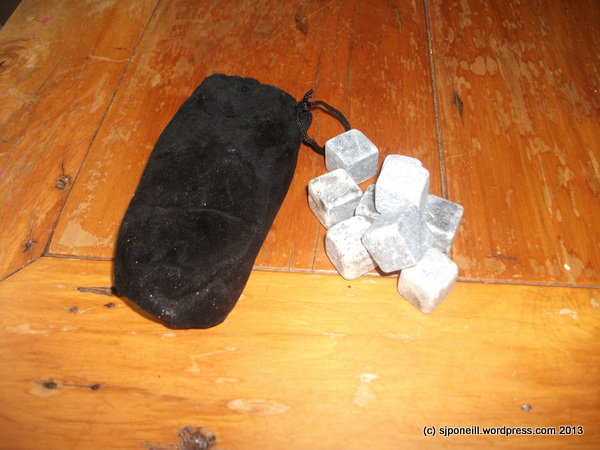
These two are pretty cool and are responsible for me writing this post …they were staying with us for the first week of the school holidays and hadn’t been here for more than half an hour before charging into my study to announce with some concern that ‘ice had turned to stone and I better come quick‘…OK, busted, yes, I had a teeny-weeny Glenfiddich while watching Shout At The Devil the night before and had left the glass on the coffee table…
These are the ‘stone ice’ in question…my parents gave them to me…I’m not sure if it was just a particularly insightful guess or whether I had mentioned at some point how much I hate the ice in my drink melting and diluting it, especially when it is almost finished but these things rock! They only take a few minutes to chill down in the freezer and hold their cold for quite a while, certainly longer than the life expectancy of the average drink…
This is the way cool birthday card made for me by my nephew, Toby in Dunedin…it is so cool that Aunty Carmen grabbed as soon as she saw it and framed it to share with everyone who visits us…
Toby and his younger brother, Arlo, also sent me these two pressies…the first, the Kermit green thingie is a USB port that plugs into the cigarette light of the truck and it is an absolute lifesaver. As many of you will know, I like to listen to Audible talking books when I am driving any sort of distance on my own, including doing laps on the lawnmower. Unfortunately my current MP3 player, a Creative Stone+, only lasts about 8 hours which isn’t enough for some one way trips and definitely not enough endurance for many of the round trips I make…
The sonic rocks are just cool…you can use them for lots of things ranging from the mundane like holding the grocery list on the fridge door to tossing them around and, yes, they do sizzle as well as snap, crackle and pop…I keep them hidden away most of the time because they are just the sort of uber-cool thing someone might think they have a greater need for than me…
And, finally, because I too am a cool member of my family, I gave myself this, a simple but effective paper model that will upsize quite nicely I think…one of the very first carrier-borne torpedo bombers, not so much cool as very very scary trying to get one of these off and back onto a carrier in the immediate Post-WW1 period…
So thanks to all the cool people who made this the coolest birthday….
In the not too distant future…the offshore patrol vessel, HMNZS Otago, slips silently across the moonlit Pacific, her destination, a small island nation experiencing unrest. Her mission, the recovery of an family of expatriate Kiwis being held for ransom…
P148, the offshore patrol vessel, HMNZS Otago
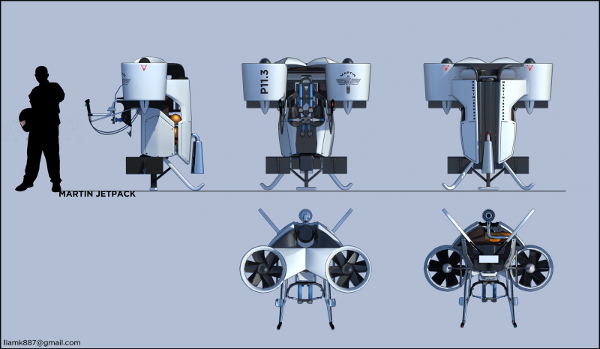
In her hangar, RNZAF and special operations support personnel are assembling a dozen unusual-looking devices, scarcely worth of the title ‘aircraft’. This is the first operational deployment of the Martin ‘jet’ pack – which is not actually a jet at all but two ducted fans able to carry soldier in combat equipment over 100 kilometres – after a period of evaluation and experimentation by the New Zealand Defence Force.
Otago had sailed four days previously, as an option should other alternatives to recover the family fail. Although she could deploy with a RNZAF SH-2(G)I Super Seasprite helicopter, the ‘Sprite was unable to carry a full recovery team and was considered too noisy for the level of stealth and deniability needed for this mission. The reef around the objective rendered it difficult to deploy and recovery a force using small boats. Enter the jetpack…
Although New Zealand had introduced a fleet of all-new military helicopter in the early mid-2010s (twenty-tens? twenty-teens?), the problem it faces is not so much that it does not not have enough of them but that it does not have enough or big enough flight decks to operate them from in the vastness of its South Pacific area of responsibility. One solution to this problem comes from classic Kiwi ingenuity: since 2004, a small company in New Zealand’s South Island has been working on development of a jet pack that would fulfil the promises of 1960s engineers for a personal aviation capability.
After a two year period of evaluation, experimentation and innovation, the partnership between the Martin Aircraft Company and the Defence Force has evolved the Jetpack into a stealthy reliable vehicle that not only meets all expectations for operational and technical airworthiness but which is also able to be operated by soldiers after a short but intense four week training course. The heart of the Jetpack that enables it to be operated by relatively inexperienced (from an aviation perspective) personnel is the New Zealand-designed flight control system. Although the operator can take control of the jetpack when necessary, especially to avoid potential obstacles and other hazards on landing, for the most part of their journey, they are passengers as the Jetpack flies its preprogrammed course under the control of an external remote control station. Full military operator certification is awarded after a three month course conducted at the Central Flying School at RNZAF Ohakea.
Late the previous day, Otago had surveyed the operations landing zone with one of its two RQ-84K UAS and conducted a final daylight reconnaissance over the objective. The data from this mission has been processing into a high resolution 3D dataset that updates the recovery force’s mission planning and rehearsal system – a simulation on some seriously bad steroids; and also allows flight planners to identify and avoid any potential hazards along the ingress and egress routes. As the mission preparation progresses, the two RQ-84s maintain a tag team watch over the landing zone and objective, monitoring any changes that may affect the mission. Powered by a lightweight hydrogen fuel cell, each RQ-84 has an endurance of six hours which provides an on-station period of four hours, with the remaining time for handover between aircraft and the transit from Otago’s over the horizon location.
RQ-84 – Kiwi tech – flying now
At 0300, twelve jetpacks stood ready on Otago’s flight deck: one for each of the ten person recovery team and two to carry additional stores. Each soldier completed a final check of their own and their comrades’ equipment…it was time and the ground support crew assisted each to strap into his jetpack, their personal weapons across their chests for ease of access, just in case…at 0320, the hand signal was given for engine start and each soldier, slipped their jetpacks master arm switch to the ‘on’ position, signifying that each was ready for launch. The control station operators authorised the launch and each jetpack first hovered above the deck and on completion of flight systems checks, lifted off into the darkness, the only sound a deep hum that quickly faded into the darkness – reducing the lawnmower-like sound signature of the original Martin jet packs had been on of the major challenges and successes of the Defence Force programme.
The dozen jetpacks hummed through the night a hundred feet over the swell, almost invisible as they flew towards the moon and the island. The ingress route stayed over water for as long as possible before cutting across the reef and the shoreline to the landing zone. Though their night vision goggles, the soldiers could see massive trees, all mapped to within centimetres by the UAS imagery, slipping by to their left and right as the jetpacks dropped to twenty feet and autonomously navigated along an overgrown logging track at 30 knots. Overheard the circling RQ-84 tracked their thermal signatures, confirming the the operators saw on their screen. Approaching the landing zone, the jetpacks slowed to a hover and gently touched down in the clearing selected as the landing zone.
Hitting their quick release connections, each member dismounted their steed and set the flight control to ‘return to base’, sending each jetpack back to Otago; the two cargo jetpacks were unloaded and also RTB’d. as the recovery force moved to its objective, the jetbacks would be refueled on Otago and readied for the extraction phase of the operation.
The recovery force moved swiftly through the low vegetation, the direct thermal feed from the RQ-84 confirming the absence of any people along their – it wasn’t considered likely that they would encounter any thermally-stealthed adversaries on this job. At the perimeter of their objective, each team members took up positions where they could observe the low bungalow and its approaches – they would maintain this observation for the hour before sunrise. Through thermal imagers they could identify one large group that was the two adults and two children that were the object of the recovery, and the individual signatures, two sleeping, two moving around the building, of the criminal elements holding them.
Just before dawn’s first light, advancing in the ‘special ops duck walk’, two teams approached the building, entering it from two directions. The thuds of 40mm less-lethal rounds put down two criminals to be quickly bound and secured; another signified the less-lethal neutralisation of one of the sleepers. The last sat up, pistol in hand, to be greeted by the spitting muzzle of a suppressed carbine – lights out. Secured, the hostages are checked for injuries and escorted from the house to the beachfront extraction area, still tracked by the unmanned aircraft overhead.
A kilometre away, a car roars into life and starts to move towards the extraction area – innocuous or not, this is a threat to the recovery phase: the RQ-84 locks onto the thermal signature of its engine and releases a Smart Dart from under its wingroot. Tracking the engine’s heat and boosted to terminal velocity by a small rocket, the Smart Dart brings the vehicle to a grinding halt as it plunges through the engine block. The driver sits surprised but unhurt behind the wheel.
Smart Dart
As the assault had commenced, Otago had relaunched the jetpacks and now their hum could be heard as they skimmed above the waves on a direct course for the extraction area, landing on the beach. The hostages were strapped into jet packs, the two children flying with soldiers, and launched back to Otago, which was ‘steaming’ at full speed towards the coast to reduce the flight time. The hostages on their way, and with no sign of a response to the raid, the remaining members of the recovery team ‘saddled up’ and launched themselves back to the waiting naval vessel…
All fiction, of course, and all totally implausible, of course, everybody knows that there’s no military application for things like the jetpack or RQ-84, of course…
But these are the types of devices that modern militaries need to start coming to grips with, either for introduction into their own forces or countering them when their adversaries start to employ them…individual air transport is coming – how are you going to deal with it? There only room in the sand for so many heads, you know…small UAS with extended endurance combined with state of the art ISR and kinetic payloads are coming...”Whatcha gonna do, whatcha gonna do, whatcha gonna do when they come for you..?”
Martin jetpack test flight – more Kiwi tech
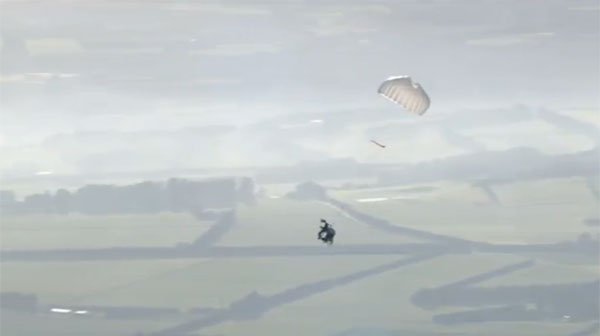
Testing the ballistic safety parachute on the jetpack – this activates if for any reason the jetpack becomes unflyable
Please note that these images show the early versions of the jetpack with the shoulder mounted ducted fans. The latest iteration of the design, known as P.12 for Prototype 12, has shifted the fans to a waist position that can be seen in this test flight:
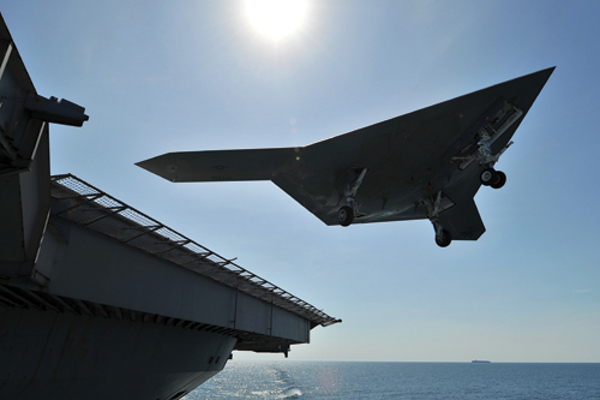
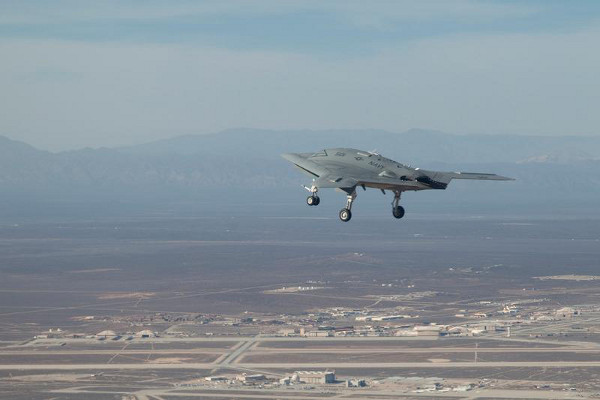
This is a really good article. Not only is the title intended to tempt in readers in much the same way as ‘Navy UAV takes on mud-wrestling’ might do but it is effective in that intent… The touch and go flight that was recently successfully conducted aboard the USS George HW Bush is a real advance in unmanned aircraft (UA) technology. As I stated at the time, the earlier catapult launching of the X-47B was a bit of a non-event as a block of concrete can be successfully launched by an aircraft carrier catapult, after which it flies in accordance with its design specifications.
The touch and go was probably even more of a challenge than the arrested landing on a carrier that has yet to occur. This is because an arrested landing is exactly that – the aircraft will stop (arrest) whether it really wants to or not (unless it’s an F-35C where the hook may or may not engage or simply bounce over the wire). In a touch and go, the UA must land on the carrier, remained aligned with the flight deck and take off again until its own power – no catapult-assisted kick in the rear to help out.
Now we are starting to see some real operating concepts being rolled out for an unmanned combat aircraft (UCA??) that give us some idea of how such a capability may be employed to complement the manned component of an aircraft carrier’s air wing and, by inference, the manned component of other air combat forces. Unfortunately the fight mentioned in the title is not over how we will use UCAs but more over who might build them and does the builder of the concept development platform have an unfair advantage over other contenders for the production run. This resurrects shades of the USAF KC-X tanker and light attack aircraft trainer (LAAT) programmes where the bigger issue was not which was the best aircraft for the role but who was going to make to damn things…
UCLASS will operate autonomously most of the time, but a pilot will control the aircraft during critical mission segments. Ultimately, Lockheed wants its design to allow one operator to fly as many as four aircraft at the same time, he said. “There’s going to be inherent systems aboard the aircraft and in the loop that will ensure safe separation” between the drones.
There are some interesting themes in this short paragraph…
“…will operate autonomously most of the time, but a pilot will control the aircraft during critical mission segments…” Please define ‘autonomously’: does this mean that the UCA will operate ‘most of the time’ thinking for itself, making its own decisions on how it will conduct tasks in the a similar manner to how the pilot/crew of a manned aircraft conduct themselves? Watch out, Skynet, here comes the competition!! Or, does it mean that the UCA will operate automatically for those portions of its mission where a human operator is not required, for example, during long transits through permissive (no credible bad guys) airspace or other ‘boring stuff’? One of the biggest problems facing the UA community is the misuse of UA-related terminology within the military and by the media and the public. We may not be able to do too much about the latter two but we can certainly get it right within our own communities…autonomous ≠ automatic!!
“…to allow one operator to fly as many as four aircraft at the same time…” Uh-huh…just how will this work when things get ‘busy’? I would say that this task would be a challenge akin to chainsaw-juggling (engines revving) and would question whether the human mind, even assisted by notional AI and the best situational awareness tools available will be severely challenged to keep track of multiple UCAs performing anything more than the most mundane of ‘bus-driving’ tasks…
“…between the drones…” OMG, see the point about getting the terminology right…a drone in nature and in technology is just that – why do you think it is not considered exactly complimentary to refer to someone as a ‘drone’? A drone is a semi-expendable minion, not noted for its ability for free thought or great displays of initiative. A military drone is something like the Teledyne Ryan ones flown over Vietnam et al in the 60s, or the good old CL-289 taught to glazed-eye tactics students during the Cold War.
A ‘drone’ is not the interactive, responsive tool that most contemporary UA are, even those acquired from Toyword, Ebay, or Trademe. We really need to square away the semantics within the UAS community so that we can sing off the same sheet of music to the uninitiated and not simply muddy the waters further. If this doesn’t come from the UAS community, it will be inflicted upon it by those unaware and uninitiated who think a drone is something to be afraid of – not because it is so dumb but because it might (apparently) take over the world…
So let’s keen an eye on progress with the X-47B and the upcoming US UCA competition but let’s also not be so blinded by its coolness that we don’t forget our own responsibilities towards enlightenment and responsibility.
…because, of course, the second rule of aircraft acquisition is that it must actually meet a user requirement. One of the great idiocies of UA in the last decade is that people who really should know better are regarding UA as capabilities in their own right. The sad unfortunate and inconvenient truth is that UA are just like any other aircraft in that they provide a means to carry a capability through the air to (hopefully) create or apply specific effects. Those effects will probably fall into one of three functional groups of air power: Sense, Move, or Engage.
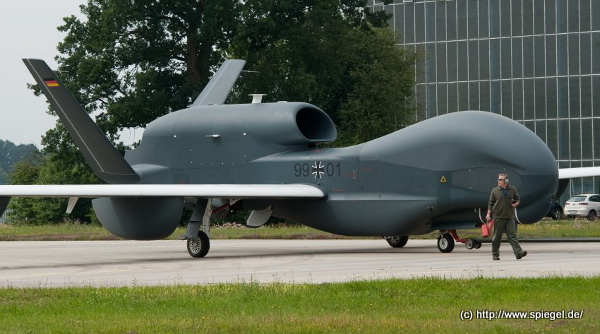
Some way down the acquisition path, there will be a decision point where the nature of the aircraft may need to be considered in terms of whether it should have seats or not. This decision should be based on a number of factors driven to a large extent by the environment in which it is expected that the aircraft will operate. And this is where the German methodology for Euro Hawk (assuming that such exists) unravels…surely not even the most zealous proponent on unmanned aircraft would realistically accept for a second that a large UA like Euro Hawk was ever going to be allowed to operate in the congested skies over western Europe?
The ‘sense and avoid’ issue is a bit of a red herring…the problem is not those airspace users that play by the rules: it is those that do not who pose the greater threat – unfortunately, as in so many things, it is the actions of the few that shape the rules that govern the many. The airways would most probably be far safer if all large aircraft flew automated courses, controlled by a central skynet air traffic control. Human error is one of the more common causes of air incidents and thus a higher, not lesser, degree of automation in the airways would promote flight safety. The Sully Sullenberger’s of the world aside, if a large modern aircraft suffers a major systems failure, the skill and experience of the crew is only so capable of countering that failure. The main benefit of a flight crew aboard an aircraft in distress is their real-time situational awareness that is denied to a emote operator.
But, getting back to the Germans…half a billion euros down the gurgler for a capability that it not only cannot operate at home but that it probably should not have ever thought it could so until UA are integrated into civilian airspace, something that is unlikely to occur on a large scale any time soon. But, airworthiness and compliance issues with Northrop-Grumman aside (get better contract writers), this investment need not be wasted. There is nothing stopping Germany entering into an agreement with one of more other nations for its Euro Hawks, if ever delivered, or a replacement UA (if they really really must have a UA in this class and not a more flexible manned ISR platform), to operate in someone else’s less congested airspace to maintain air and ground crew proficiency and possibly contribute to other outputs. There has been discussion that UK Reapers (which also cannot fly in western European airspace) may be based in Kenya to do exactly this. If Kenya does not appeal, why not Australia or New Zealand…?
Lessons?
UA are no more capabilities in their own right than manned aircraft. Aircraft are a means of getting a capability to a specific point to create a desired effect, and (ideally) back again.
Don’t give up the dream but definitely stop stoking the fire for premature integration of UAs into congested civilian airspace – just stoke the embers for now.
Read the contract before you sign it – if you don’t like it, then bin it (before you commit half a billion euros) and wait or identify a replacement supplier. Northrop Grumman is not the only player in this game.
The age of manned aircraft is not over yet.
Think outside the square – does your large expensive UA really have to be based at home?
Pitiful attempts at contemporary journalism like this get right up my nose! Not only is it poor practice to take an incident that occurred nine years ago and portray it in such a manner that it appears to be a recent occurrence, it is even worse to do it on a topic that a. the ‘journalist’ in question clearly know nothing about; and b. in such a manner that all the ignorati out there that take the internet as gospel will break out their pitchforks and torches.
In all fairness, I may be just a little sensitive with regard to the time issue as I have just completed a university marking marathon in which I have been disappointed at the number of students that think that they can take an incident in one point in time and link it casually to another event some time later.
It’s also a beef I have with Max Boot’s latest book Invisible Armies where he takes a stance that a coercive approach to quelling irregularity, insurgency and other signs of unrest amongst ‘the people’ is counter-productive and ultimately leads to the downfall of the coercing regime. I take issue with this because
a. I think that historically, the coercive approach has actually been more successful than more populist forms of maintaining peace and order;
b. it is a big leap to link the downfall of a regime to the sacking of a city or decimation of a population some centuries (yes, centuries, not decades) before’ and
c. there are just as many indications that ‘peace, love and we’ll-build-you-a-schoolhouse’ approach to pacification is not that successful, regardless of its current contemporary favour.
The constructive advice I give to students in my markers comments is to to construct a timeline of events that MAY be relevant to their argument and then to examine that timeline to see if they can still draw a causal line between an event and the outcome that they wish to link it to e.g. did coalition application of Warden’s Rings theory, specifically to Iraqi leadership, in the 1991 Gulf War air campaign directly lead to the capture of Saddam Hussein in December 2004? It almost sounds plausible until out into the context of time…Ms Becky Evans of the Daily Mail – and Max Boot, if you’re reading this – might wish to take note…
UAS operations are no more or no less safe than manned aircraft operations so long as the EXISTING rules are followed. In the case cited above by the Daily Mail, a combination of procedural air traffic control and air crew issues lead to the situation of the near miss, an actual collision being avoided by the crew of the UAS. The involvement of a UAS in a flight safety event does not automatically mean that the UAS is at fault. In another popular example of the dangers of UAS, where an Air National Guard C-130 struck an RG-7 Shadow in Afghanistan, the C-130 was at fault.
The Daily Mail does nothing but stir up ignorance and conceal the issues that do need to be addressed i.e. those of operators, of manned or unmanned systems, that fail to apply the minimum standards for safe operation of aircraft in a specific airspace environment. UAS are small and often fly close to the ground, making them very difficult to detect with time to take evasive action. As a result, airspace management ‘bureaucracy’ like NOTAMs, SPINs, ATOs, etc becomes so much more important for providing the situational awareness required by the operators of manned aircraft: might is only right until it gets to(o) stoopid…
‘…with great power comes great responsibility…’ and thus the operators of (more powerful, bigger, faster) manned aircraft have the responsibility to ensure that they deconflict with UAS approved to operate in a given area of airspace. There is little to be done about the cowboys on either side of the manned/unmanned fence that do not play by the rules e.g. the jet jocks that think that flying in a combat zone means they can zoom and boom wherever they like, or the private contractor that just flips their undeclared Ebay UAS into the sky because everyone knows that ‘…it’s a big-ass sky…’ apart from breeding those elements out of the aviation culture and fostering a sense of air-mindedness amongst anyone that thinks they need to operate an aircraft (with or without seats).
Here is New Zealand, small UAS fly commercially almost every day with the permission and blessing of the Civil Aviation Authority. They fly in and over urban areas, and in controlled airspace. How do they get away with it? Because the operators reviewed the rules, assessed the risk and offered a mitigation philosophy to the CAA. When, and only when, that mitigation philosophy was accepted, they were in business – literally.
The genie of small UAS proliferation is already out of the bottle, and it is unlikely that it will ever get drawn back in – not when camera-equipped UAS can be purchased from any Toys’r’Us – like so many other genies, small UAS are something that we need to get to grips with and the time for that is now…
Well, I cannot say that I am that sorry to hear this news – nothing personal against Matt Smith but I think that he has exploited the quirky side of the Doctor at the expense of the serious more introspective side and and had to rely more on the supporting cast to offset this; and no, I do not support the rumour that his last role before the Doctor was JarJar Binks…
It probably does not help that during his tenure the series has slipped more into the single episode story model than the more traditional serial model that original Whovians grew up with. While this change might be more commercially viable, it means that each self-contained episode has to have more peaks and troughs than the old serial format and as a result, we, the viewers, are subjected to a much higher proportion of ‘fish fingers and custard’ quirkiness than might have occupied using the older format.
The serial format was probably better for bringing fans back each week to see ‘what happens next’ (it works for Coro!) than the self-contained model; certainly I find myself less compelled to view the more recent series than when they were serialised. Another advantage of the serial format that might have been lost on BBC Wales is that longer stories offer greater opportunities for character development than trying to cram EVERYTHING into a single 42 minute episode…
Of course, the big teaser in the finale (the one where the Doctor’s name is mentioned – sorry, I yawned and missed that bit) of the current series is whether John Hurt might be the next Doctor; from my traditional Whovian perspective, this would be a welcome return to the traditional Doctor from the good days when the series used to terrify me, when Daleks were truly scary and not like metallic Energiser bunnies that JUST WON’T DIE, when the Cybermen and Abominable Snowmen were real threat to world peace and life as we know it, and the sets looked like they would fall over if you leaned on them. Yep, those sets, we might laugh at them know but, funny old thing, with good stories, who really cared? There’s a bit more to an enduring story than fish fingers and custard, glitzy special effects and an uber-franchise…
Our morning routine during the week goes something like wake around 0610, jug on…shower, dress etc…breakfast and a cuppa in front of TV1’s Breakfast show – really the only morning show in town plus it has an onscreen clock for those that need to be out the door by a certain time each morning…
Some issues were discussion this morning that I thought worthy of further comment…
The Gilmore Grenade
A couple of weeks back, lowest listed National Party MP, Aaron Gilmore, lipped off at the staff in a bar in Hamner Springs when they refused to serve him. Although he denies it, accounts from staff and others in his party (dobbed by your buds, Aaron!!) confirm that he threatened to get the Prime Minister to fire the staff member in question. Like, y’know, the PM just sits around like some sort of political Gargamel waiting to smite down any who dare to oppose his lowliest listed MP…
I’d never heard of this clown until the week before when he ‘starred” (not in the positive sense of the word) on Backbenchers, a local political talk-back session that screens every Wednesday night after Strike Back…which is not to say that I am a big fan of Strike Back or anything else derived from Chris Ryan but we have taken a bit of a shine to Elementarywhich screens just before it…A bit of a shine? Nah, let’s be honest about it – I prefer it over the overhyped pretension of Sherlock and the buffoonery of Robert Downey’s big screen Holmes AND it’s got not only a female Watson as a nice bit of contemporisation but it’s Lucy Liu who could also be described simply as a ‘nice bit’…
Anyway…back to clown boy…the topic for discussion that night was the passage of the same sex marriage act and the National Party representative aka clown boy was clearly unprepared and tried to bluster his way through the discussion – really he should just have had another pint and slid quietly under the table. So, it wasn’t really any surprise when news broken on his antics in Hamner Springs the following week. Since then we’ve all gotten to watch the Aaron Show as he has denied, apologised, denied again…I think it was a caller on Radio Live that suggested that the following night, Gilmore should have fronted at the bar, apologised (sincerely) to everyone and tossed a couple of grand on the bar…
Last night he announced his resignation from Parliament to a big sigh of relief from everyone – who says that the parties can not agree unanimously on anything? – but promising utu (revenge or payback) on ‘those responsible in his final speech today…while we all wait with baited breath to learn the contents of the Gilmore grenade today, my only advice to Clown Boy is “Throw the pin, Aaron!!”
Just get on with it now…
Before the 2011 election the Government announced its plans to create a national convention centre in central Auckland in partnership with Sky Casino – all the usual haters fired up at the time but now that Government has announced details of this project and the specifics of the relationship with the casino. Essentially, the casino will fund the construction of the convention centre – a projected cost around $420 million – in return for concessions to expand its number of pokie machines and gaming tables, and for some guarantee of protection from future anti-gaming legislation.
All the haters are in full cry again now, having squandered the last year and a half in which they could have sought to block the project. I’m not a big fan of gambling but I also don’t think that a few more pokie machines and gaming tables in the centre of Auckland is going to rip the fabric of the space-time continuum, certainly not when these and other forms of gambling continue to flourish across the country. If the Greens and Labour whiny-haters really wanted to do something about this, then instead of wasting the period from the flash of the initial announcements in 2011 to the bang of the confirmations this week, they could/should have:
Come up with their own plan for funding the construction of the convention centre – no-one really seems to think that this is a bad idea – noting the country is kinda broke due to the unforeseen need to rebuild a major city from scratch.
Developed their own comprehensive AND practical plan for reducing access to to gambling systems and machines across the country – including Lotto and the good old TAB.
Realised that there is more to be in opposition than just attacking everything that the Government does – the continual bleating from David Shearer, the ‘leader’ of the Opposition is just irritating – we might as well bring back Winston Peters: at least he’s entertaining and, funnily enough, was canny enough to include an anti-pokie stand in his manifesto for the 2011 election…
Nutty is as nutty does…
Apparently, in a fit of rampant nannystatism, schools are Australia are banning nuts from school lunches to protect those with nut-based allergies…I kid you not!! Is this a clear case of schools abdicating themselves of even more responsibility when, if there ever was something that kids need some education on, it is dealing with potentially lethal conditions like this…wrapping them in nanny state cotton wool will only prepare them LESS for the real world…
You can launch a 40 foot container off the end of a US Nimitz-class aircraft carrier so tossing an X-47 off the pointy end of a carrier is not really an achievement in itself. The real achievement and major step ahead for naval aviation will come when an X-47 lands autonomously on the blunt end of an aircraft carrier, catching the ‘3’ wire and all that other good Maverick stuff (will be be equipped for the mandatory post-mission high fives?), as the business of carrier aviation goes on around it – so long as some dodgy Chinese fiend doesn’t pop an electromagnetic pulse just as the UAV commits to landing on the deck – maybe there should be an extra Phalanx under the ramp – just in case…?
Please, don’t get me wrong…I think that the technology going into the X-47 programme is way cool and probbaly heard the next full generational of unmanned aviation but…please…stop with the endless hype…
PS…if you want to have a credible blog site, Navy Live, grow a set and stop moderating your comments…
Lost?
How appropriate that the air port inside the Flight Test Center Airspace is Truth or Consequences Airport? Maybe we could have one called Put up of Shut Up?
Inside the drone economydiscusses US plans to establish six UAS test flight areas within the continental UAS, and the current battle between the states to acquire one of these potentially lucrative areas. I just wonder, with our relatively clear and open airspace, domestically and over the big blue thing, whether we have lost an opportunity in attracting UAS-related technologies to New Zealand for test flight and other experimental activities…?
Survivor?
Fresh of the presses at Deep Diver Intel as I was typing this…for reasons unknown but bound to be scary, Global Hawk gets a US$555 million reincarnation to 2015…has anyone done any counter-UAS research on the effects of silver bullets, holy water and wooden stakes on aging technologies that just won’t die…?
Looking down on a novel and innovative mousetrap in A Department of Conservation hut near Mt Cook during a school trip in 1981…the beer bottle is wrapped in a sock to stop it rolling away and had a chunk of cheese jammed in the opening…the rest is simple physics…
As much as I aspire to always use my own images in these challenges, this time I can’t resist putting in a plug for my mate, Rowland at Hawkeye UAV who has combined cutting-edge geospatial technologies with state of the art small UAS technologies for the ultimate in commercially-useful look-down applications. In addition, this is largely based on Kiwi home-grown innovation and smarts…
This imagery is from a recent task over New Plymouth, New Zealand and over a clearly urban area which gives the lie to the know-it-all doomsayers that state that small UAS can not operate safely over urban areas…
…don’t forget that this is a 3D image – as you scroll it the perspective and relationships between features on the ground change…
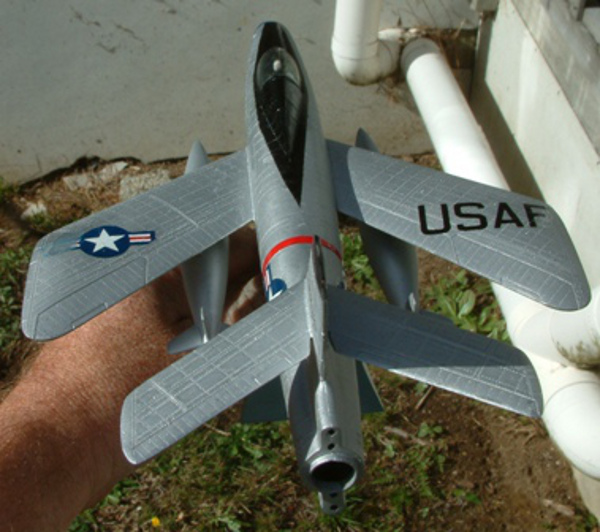
Actually, I didn’t quite finish it…the reason that many of my shots of this aircraft are looking up at it is that while I was adding the markings, I reached for my trusty bottle of Mr Mark Softener (bottle with a bright green top) to assist the US national marking to settle closely over the rivets etc on the wing but picked up instead my equally trusty but in this case not appropriate bottle of Tamiya Extra Thin Cement (bottle with a bright green top) with the result that half the the star and bar marking instantly dissolved into a murky smear…
One of these days, I’m planning on stripping it back and finishing it off properly, doing a decent paint job on, or replacing the original pilot, and adding the undercarriage…some day…













 Terrifying video captures moment German drone missed Afghan plane carrying 100 passengers by just two metre | Mail Online

















 The World According to Me...