

In More on Risk-based decision making in Homeland security, Dean introduces hope-based decision-making “… Hopefully the most significant threats are the ones you’re already focused on. As long as they are, you’re ok. When they aren’t, you stand by…and say to everyone who will listen ‘No one could have predicted this’.”
Remember that time when you were four, and that big plate glass window in the lounge kinda got broken and even though you were the only person in the lounge playing with Dad’s golf clubs, you still hope a whole lot that your invisible friend is going to materialise and take the rap? Fast-forward thirty years to when your boss says ‘we’ will carry the risk – you really hope that he really does mean ‘we’ and not ‘you’? Or that time you decided to invade Iraq and hoped that a. a lot of WMD would turn up really quickly and b. that the UN would get over itself and follow-on with civil aid and reconstruction programmes? Each of these scenarios has three things in common:
You have a nagging feeling how things are really going to turn out.
Those consequences are probably going to hurt.
When you think about it, you really knew better.
This week, Neptunus Lex published an item for aviators The ‘Possible’ Turn which discusses the options available to a pilot when an engine fails on take-off. The commonly held truism is that any attempt to turn back to the recently departed runway is doomed to fail – doom in the worse possible sense of the word – one of those manouevres based more upon hope than physics. Lex argues in aviation speak that this might not actually be the case for a suitably experienced pilot – equipped with an ability to make practical decisions fast. Also in the mail this morning was an article discussing the proposed shift in focus of the PRT in Afghanistan to a more civil focus at a time when surge-inflicted chaos may boil over into other provinces. I wondered about this too In the Ghan.
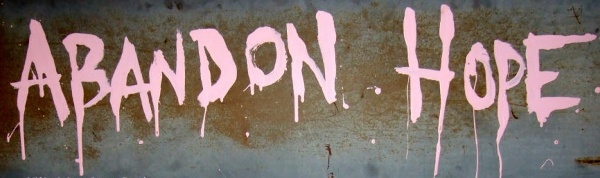
When we established our joint headquarters in 2001, many suggested that each external door should have a big sign ABANDON HOPE ALL YE WHO ENTER HERE. For different reasons, they were probably right: hope has no place in any organisation where lives are at stake.
So why do we do it so often? There are three factors:
Partly it is simple laziness – we’ve always done it like this and it’s always been OK before.
Another part is simply sticking with what we know – after decades of peacetime engagement and peacekeeping, it is difficult to shed that mindset for that necessary for operating in and around a warfighting environment where the threats are very really and unlikely to be assuaged by an umpire with a blue rag tied around one arm.
The third factor is that making good decisions has to be practiced regularly – and that includes being able to quickly sift through all the available information to extract the key points, digest them and then make the call.
Supporting good decisions is a firm ethical and cultural foundation based upon three key qualities:
The Competence to understand the environment and the issues.
The Courage to promote an unpalatable or unpopular line of reason.
The Integrity to see the issue through when the going gets tough.
Regularly we see news items when agents of government at all levels fail to display one or all of these qualities. And every time, the parent agency trots out its Code of Conduct, duly signed by all employees “Hey, look – it’s not our corporate fault!” And why isn’t it ‘our’ fault? Because it’s too hard for the HR Nazis to snap out of their nice objective competencies and consider applying some subjective qualitative assessments on potential recruits? It is interesting to note that those agencies where people are more likely to work collectively as opposed to as individuals are more likely to have a sound organisational ethos and culture – the two that spring to mind immediately are the military and the Fire Service; law enforcement to a far lesser extent because they tend to function as individuals not collective teams (STG, HRS, SWAT, etc being exceptions but only a small percentage of their respective agencies.
But developing, fostering and embedding an ethos and culture based on these qualities into an existing organisation is doable. We’re running an interesting ‘experiment’ here where the new Head of Customs is a highly-regarded former two-star who is doing exactly that. But what he’s brought to Customs is not so much thirty odd years of military experience – it is too easy to fall into the trap that ex-military staff have all the answers; they can have a lot of the problems too – but good old-fashioned command and LEADERSHIP.
So in terms of our discussions regarding decision-making in homeland security, the very first thing that we need to consider is raising the bar of competence. That means introducing more than just training, more than just practicing what we preach; it means that we need to set and conform to some basic standards of performance, weed out those who are more social than team members. I was once posted to a base that is quite isolated and where there was some institutional resistance to being posted there. Most of this was of the “well, everyone says it’s a bad place so it must be a bad place to go” variety and as a result, anyone volunteering to be posted there was usually snapped up. When I arrived, there was some debate raging over this posting policy and after about two weeks on the job, I feel firmer in to the camp of “‘it’s better to have a gap than to fill it with a warm body that does nothing; at least when you have a gap, you know you have a gap and can work around it. When the chair is filled, you keep kidding yourself that the incumbent may one day surprise you and actually do something useful – but it never happens”.
The flip side of competency is training, training that is relevant and current for the job at hand because it takes knowledge to fend off hope – yep, that’s right, Hope, we don’t want you here!! and this is where doctrine, lessons learned, organisational learning, knowledge management and all those other good things come together…to…get the right information…to the right people…at the right time…and ensure that they know what to do with it…
It all comes back to that…


 Natural Selection in Action







 Far from being discouraged by the ‘trench‘ lines, that was detail!; and ‘those multi-color parts‘? You could be finished and ready to fly the same day you bought the kit without having to wait for paint to dry. The Matchbox range expanded to a range of aircraft from
  Enjoy…
 The World According to Me...