Unknown's avatar

About SJPONeill

Retired(ish) and living on the side of a mountain. I love reading and writing, pottering around with DIY in the garden and the kitchen, watching movies and building models from plastic and paper...I have two awesome daughters, two awesome grand-daughters and two awesome big dogs...lots of awesomeness around me...

Nice


I see that the lads at Hawkeye UAS have updated their website from cool to uber-cool…(click above)

Also on the cool front…

From some very talented and generous folk in Poland…a new release in large scale paper planes…a Hawker Tempest V in 1/33….

Nice

…and something completely different…

While I totally lack anything like the hand-eye coordination needed to play even outdated computer games, let alone modern ones, I do really like the weird creations that seem to populate some of them…this too in in paper…


Y

Ugly but cool

A time and a place


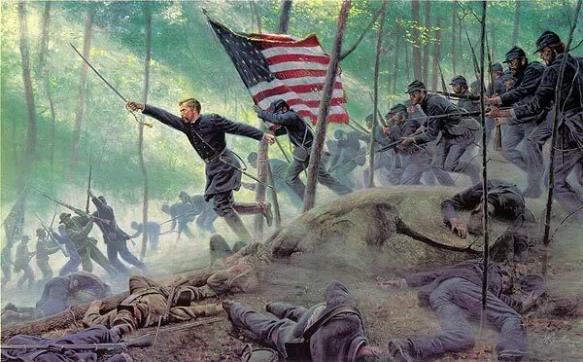
This seemed quite apt today…Chamberlain leading that final charge at Little Round Top, saving the day, the battle and very possibly the Union…

I didn’t really want to comment on the recent combat death of LT Tim O’Donnell in the NZ PRT in Bamyan Province, Afghanistan – it seemed at the time that everything that needed to be said – and perhaps some that didn’t – was being said…but, over the last few days, I have heard many people saying, no doubt with the best of intentions, that maybe he was simply in the wrong place at the wrong time…not at all…

I was privileged to spend some time with members of Lt O’Donnell’s unit as they waited for a C-130 to take them back down to Burnham Military Camp after they farewelled their mate that afternoon…something one of them said was so right…Tim was in the right the place – he was in the lead vehicle, leading his soldiers, he was where he was meant to be, and doing his job

And from the other side of the fence…

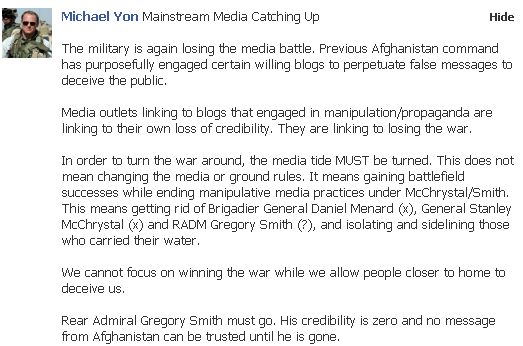
And while I was writing, this popped up from Michael Yon…back on our side of the information war….

...and from another direction...


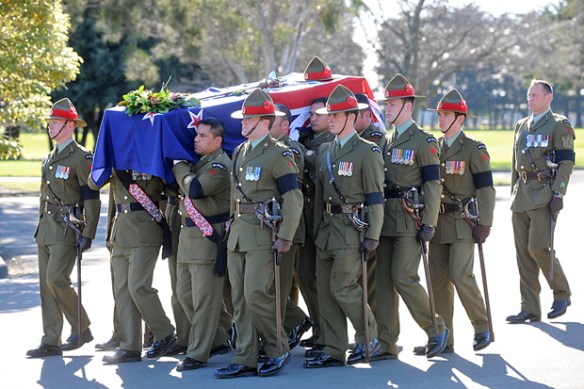
Last respects paid to slain NZ soldier

Lieutenant Tim O’Donnell who was killed in Afghanistan is taken from the funeral service to an awaiting gun carriage, Linton Military Base in Palmerston North. Photo / NZPA

It’s never good when a serviceman falls, on operations or in training and this has already been a sad year for the NZDF, following the CT-4 crash in January and the UH-1 on ANZAC Day…as Chief of Army Rhys Jones said, while the death in action of a soldier was not inevitiable it is certainly something that Kiwis have been steeling themselves for over the past 3-4 years…

I attended a presentation at Massey University just after the funeral…it was by former Chief of General Staff Piers Read, a contrast and compare look at the Reconstruction on post-Civil War America and modern Afghanistan (modern Afghanistan – now there’s an oxymoron!!)…he opened with an apology that this work had been in preparation and scheduled for this day for some months and he’d had no intention of ever presenting anything that might become so topical on such a day…it’s a good presentation and I’m going to ask if I can share the slides and supporting paper here…he made some good points, poignant and all the more effective against the background of the events in Linton that same afternoon…

…while at the same time, clowns Willie and JT of Radio Live was playing up the entertainment value of the funeral on Radio Live with Auckland’s University professor Caroline Daley suggesting about the funeral that the whole thing was really just a bit over the top and New Zealand just needs to get over it…all this hoop-la over one soldiers wasn’t something we did before for WW1, WW2, nor even Korea or Vietnam, those latter wars far smaller and perhaps more personal in their selectivity. If anyone needs to get over themselves, I think it may be Ms Daley whose timing in making those statements as the funeral was just ending was way off…

Perhaps Ms Daley needs to consider that, if we could, we would recognise EVERY soldier, sailor and airperson who fell in the service of their country in exactly that same way we did for Tim O’Donnell yesterday…that circumstances did not allow this at those times does not mean for one second that their sacrifice is any less nor the impact on their families any less painful and tragic…

I was privileged to spend some time with members of Lt O’Donnell’s unit as they waited for a C-130 to take them back down to Burnham Military Camp after they farewelled their mate that afternoon…something one of them said was so right…Tim was in the right place – he was in the lead vehicle, leading his soldiers, he was where he was meant to be, and doing his job

DSCF8729.JPG

And on this day, let’s not forget six other young men who died tragically while serving…twenty years ago today, Privates Brett Barker, Stuart McAlpine, Mark Madigan, Jason Menhennet and David Stewart and Naval Rating Jeffrey Boult died on Mt Ruapehu after being caught in a blizzard during a training activity…

Cultural awareness 101

I caught this on Michael Yon‘s Facebook page last week but forgot to post it…

Friday Cultural Lesson: Calling a Woman “Pig” Tonight in Thailand, I was over at the home of a Thai family. The woman of the house was rather…stout. Her nickname is “Moo,” and when I heard the nickname I asked quietly, “Why did you call her pig!?” After a flurry of conversation I was informed that pigs are cute and pink and it’s g…ood to call a stout woman Moo. I said, whoa whoa, whoa. Please never call an American woman pig! Which was met with equal disbelief. What? American women don’t like to be called pig if they are heavy? No, no, please never do! 🙂

A great example of how we carry our cultural truisms around with us and how quickly they might get us into strife before we even realise…at one level we might tend to associate democracy with something both good and useful which still gives us little right to inflict upon societies with other ideas…and at another level, the personification of an animal can be good or bad…

This is a great example of Michael Yon doing what he does so very well, illustrating the human level of the contemporary environment, maybe decomplexing it just a little…certainly providing food for thought for those who have to work in it….

Do Orders Really Matter?

Still in vogue: the mud model (c) Josh Wineera 2010

Fresh off the presses…a paper that discusses that traditional orders process, the ‘O group…

This article highlights the essential combat communication, mission orders,and the commander’s intent. It describes the means and methods by which a vertical-slice of commanders interpreted and analysed their orders; how they formulated and communicated their plan, and how the company commander monitored and adjusted the plan during its execution. The article is written primarily for junior leaders but also has utility for training staff, particularly practical lessons regarding the orders process.

Recently Josh Wineera, currently a Fellow at Massey University’s Centre for Defence and Security Studies (CDSS), observed the orders process from CO to section commander in a NZLAV company in the field. His observations form the basis of this paper. Josh presented his Interbella construct for the complex environment at the COIN Center VBB in September last year and has also released a paper considering domestic methamphetamine issues through a military lens

His consideration of the orders process concludes…

The importance of the battle-brief. There is merit in considering some sort of similar brief at the beginning of the orders. Everything else that follows would therefore be put in better context.

In the age of high tech command and control systems, mud models  still serve a purpose. Some of the quantitative data from the orders process however, could provide useful metrics for those charged with acquiring future command and control and decision-support tools.

The threshold between higher conceptual military constructs and plainer, clear, mechanistic detail appears to occur at the platoon level.

Offensive operations, that is close combat, still necessitates an infantry soldier to be prepared to ‘seek out and close with the enemy, to kill or capture him.’ These are ‘classic war-fighting skills’ and should not be degraded or regarded as obsolete.

Warfare in the 21st Century entails kinetic and non-kinetic missions; they are not mutually exclusive. The challenge will be to try and create a training activity that simultaneously tests soldiers in the application of both missions, being reflective of the character of war as we know it today.

New Zealand’s recent assessment as the most peaceful country in the world reaffirms the relevance of offensive operation’s training – a reminder from Vegetius’s maxim “Let him who desires peace prepare for war”.

The orders data captured from Exercise Absolute is but one source. This in itself would need to be validated against similar evaluations in order to confirm trends and recurring themes. Therefore, given the infrequency of combined-arms live-firing exercises it would be prudent to view all data and analysis in this article as an initial ‘yard-stick’.

The full text may be read here. The paper is also linked from a thread @ the Small Wars Journal should anyone wish to debate the content…

Today’s Question

Why do email systems persist in placing the ‘delete’ button right alongside the ‘reply’ button?

A little Kiwi ingenuity

…can go a long way…

(c) NZ Herald 2010

For decades, futurists have been predicting the advent of practical exoskeleton systems as being ‘just around the corner’; I remember reading about them in Look and Learn and TV Action in the early 70s…back when tilt-rotors and space stations were ‘newly-emerging’ technologies as well…well, a couple of enterprising Kiwis have advanced the cause quite dramatically as covered in Friday’s Herald…while there is clearly a lot of development life left in the design and the price will need to come down (running around US$130k at the moment), this seems to be a major breakthrough which obvious benefits for those with critical mobility illnesses and/or injuries. Down the track we may see spin-off designs heading off down the path of the Aliens’ PowerLoader…for more info check out the Rex Bionics site and this Gizmodo item

XSTOL

Extremely Short Take-Off and Landing (XSTOL)

Pacific Aerospace has a long history of practical solutions to light air transport problems, especially those with s blend of flexible configuration, large/heavy loads and short strips…the P-750 XSTOL is its latest creation, a ten-seater (when configured for passengers) that can:

  • Take off and landing in less than 800 ft (244m), even when it is hot and high.
  • Operate off semi-prepared airstrips in all types of terrain.
  • Carry a load of more than 4,000 lb even in hot and high conditions.

Is this the sort of thing that might be quite useful hopping in and out of short unprepared strips i.e. fields, paddocks, roads, etc, in support of land forces, manoeuvring or static, supporting air and reconstruction efforts, especially for those forces and nations that might not have ready access to helicopter support…

I also wonder how much of that 4000lb payload might be converted to light ballistic armour around the engine, pilot and other critical systems for a potential return to the (still valid) 1960s concept of the COIN support aircraft..?

More than meets the eye

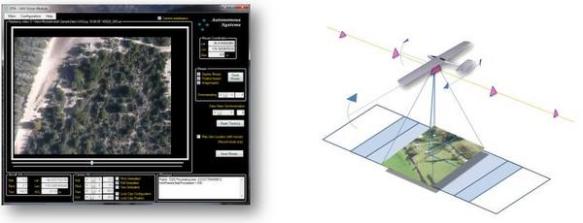
And these guys seem to be quietly going from strength to strength too…Hawkeye UAS

UAS - more than just an airframe

And now for something completely different…

Not Kiwi…just cool…

475 Coke cans flying in formation in a 1/18 scale Lockheed SR-71 Blackbird…for more info and a great ‘how-to’ tutorial, read on…

Apply with Judgement

It took a while but a couple of weeks ago I was finally able to take down all the dust clothes that we had put up around the library to protect the books from dust and mess during the renovations. It’d been a couple of months since I’d actually laid eyes on the books in the library, concealed as they were behind layers of old sheets, and it struck me that there were a large number (albeit a small proportion) of books that I hadn’t actually ready yet. For some time prior to that point, I had been doing a lot of nostalgic recreational reading…Ice Station Zebra, Cyborg (the original Steve Austin story),  various lite-works from Steven Coonts, Dale Brown, etc and I decided to commit to clearing some of the backlog of unread books – after all, there not much point having books if you aren’t going to read them at least once…so Wing Leader was the first that caught my eye as an ‘unread’…

Like many of the books in our library, I have no idea where I acquired this from…as much as possible I try to log all new acquisitions into our Book Collector database and record where each acquisition came from – the Collector software is actually quite good and we used it to track all our books, DVDs and my paper model collection: check it out @ http://www.collectorz.com. Anyway, this is the second printing of Wing Leader from September 1956 and seems to have spent an earlier part of its existence, from 18 October 1962 until 21 June 1963, in the Wairoa College Library. Where it was in the 47 years before appearing in our library is anyone’s guess.

It is what I call a ‘ripping good yarn’ starting with Johnson being turned away in various attempts to join the RAF until war broke out and there was a desperate need to build up the RAF to face the oncoming Nazi juggernaut. On only his second flight in a Spitfire, Johnson fudged his landing and drove the main gear up through the top of the wings – hardly an auspicious start for the pilot who ended WW2  as a Group-Captain and the RAF’s highest scoring fighter pilot with 38 confirmed kills. Wing Leader follows Johnson through the war through squadron and wing command and the dark days of the Battle of Britain through D Day and the advance across Europe. It ends with a celebratory air show in Denmark soon after VE Day.

One of the principles that emerged from our work in doctrine management over the last couple of years is that doctrine is something that can never be a set of hard and fast rules that applied dogmatically; to be effective doctrine must be applied with judgement. While, perhaps and only perhaps, in more simpler forms of warfare there might be a place for the soldier or commander who blindly follows without thinking, in the contemporary environment, facing complexity, irregularity and uncertainty, there is no place for a non-thinker: we must ALL think and apply our judgement. Wing Leader had what I thought were a couple of great examples of this.

…throughout this day and on all subsequent operations in the Falaise gap the Luftwaffe failed to provide any degree of assistance to their sorely pressed ground forces. faced with the threat of losing their forward airfields to our advance, they were busily occupied in withdrawing to suitable bases in the Paris area, so our fighter-bombers enjoyed complete air supremacy over the battle area. Quick to exploit such a great tactical advantage, Broadhurst issued instructions that until such time as the Luftwaffe reappeared to contest our domination of the Normandy sky all his aircraft would operate in pairs. This was a wise decision, for it meant that pairs of Spitfires and Typhoons could return to the fray immediately they were turned around on the ground. Detailed briefings were not necessary since all pilots knew the area and the position of our own ground troops. Valuable time was saved and it was possible to put the maximum number of missions into the air.

This was a dramatic deviation from extant doctrine which held that, while pairs of aircraft might be able to penetrate enemy airspace and attack opportunity targets along their way, if a lone pair of fighters ran into a group of enemy fighters it was pretty much a foregone conclusion that both pilots and aircraft would be lost. The cold hard lesson learned from the early days of sweeps over France was that there was quite definitely safety is numbers i.e. sweeps of at least squadron and more commonly wing strength that could hold their own against Luftwaffe defenders.

Since WW1, the commonly-held wisdom was to watch for the Hun in the sun with the corollary that higher altitude was always a great, almost necessary advantage over an aerial adversary. Thus is was with some concern that Johnson…

…watched Jamie when he drafted an operation order for the wing to sweep the Rouen area at 12,000 feet.

“12,000 feet seems a little low, Jamie,” I commented. “The boys are certain to get bounced at that height.”

“That’s right,” briefly answered the New Zealander.

“Then why don’t you put them higher?” I suggested.

“Because, dear boy, Ray Harries prefers to be below the Huns. In fact, his tactics depend on the Huns starting the attack.”

I expressed profound disbelief, for I had always been a firm believer in the old axiom that the leader who has the height advantage controls the battle…Ray and I walked to our Spitfires. before we climbed into our cockpits, I said:

“I always though the chap with the height held all the cards, Ray.”

“Yes, he does,” replied the wing leader. “But 12,000 feet is our best fighting height. Somehow we’re got to pull down the Hun to our level. once he’s down, our Spits are so much better that we can break into him, out-turn him and soon get on top of him…”

Johnson explains that…

The Luftwaffe had modified some of their Focke-Wulf 190s so that they had a very good performance at low-level…Our answer to this was the Griffon-engined Spitfire 12…At low and medium altitudes the Spitfire 12 was faster than its contemporary, the 109, and could cope with the low-flying 190s…

Wing Leader cites other examples including that of two Lancaster heavy bombers peeling out of formation after the post-D Day daylight bombing of Caen to strafe Germany ground transports along the roads…

Majestically, it ploughs along over the straight road with rear and front guns blazing away. Enemy drivers and crews abandon their vehicles and dive for the shelter of the hedgerows…There is a considerable amount of light flak, but the pilot obviously scorns this small stuff, since he is accustomed to a nightly barrage of heavy flak over the industrial cities of Germany…

It’s all about avoiding dogma – continuing always to think and too learn…to quote Dr Michael Evans from the Contemporary Warfare course last week “Who Learns, Wins”

Whatever…

(c) NZ Herald

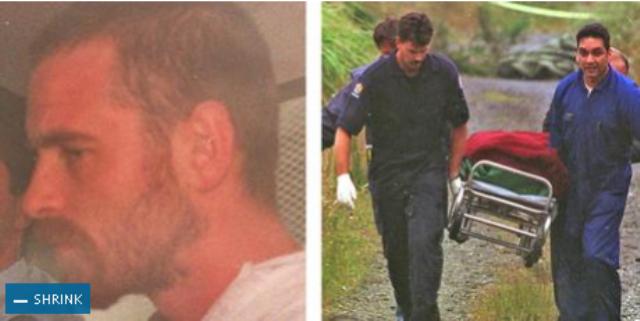
It must have been a slow news day for The NZ Herald yesterday as it dominated its front page with a cheap promo item promoting an item in the August 2010 North & South in which mass murderer Stephen Anderson puts ‘his side’ of the story and says he’s sorry…that’s OK, dude you only killed six defenceless people during your drug-induced spin-out…please, feel free to rejoin society – NOT!!!  The media release for the Aug 10 North and South says…

Murder and Insanity

In 1997 Stephen Anderson shot and killed six people – including his father – and wounded four others. The crime became known as the Raurimu massacre. Anderson, then 24, was found not guilty by reason of insanity.

Now sufficiently recovered to live in the community, he writes publicly – and very personally – for the first time about his descent into mental illness and its tragic consequences

Whichever way you spin it, this guy hasn’t even done thirteen years for killing six people and the ‘I was misunderstood’ defence carries no more weight that ‘they made me do it’…To add insult to injury, North & South even paid this criminal $2500 for his story and here I was thinking that crims were not allowed to profit from their crimes…The bottom line is that if Stephen Anderson had not been breaking the law in his initial drug use then it is unlikely that this massacre would ever have occurred – by being a minor criminal, he became a major criminal and thus should still be a guest of her majesty for some time to come…

I’m sorry but I just can not accept the way in which we seem so fixated on looking after the ‘rights’ of criminals and just gloss over the rights of victims and ordinary citizens…at the very least, the money paid for this article should go to some victim support fund as a very ‘in your face’ reminder that crime does not pay – although it seems that, in real life,  it does…

Fortunately, the other mainstream media had real news to cover yesterday so hopefully this festering sore will be allowed to heal and the sleepy hollow that is Raurimu can go back to being so…

Aaaah….yep

A picture's worth a 1000 words

A picture's worth a 1000 words

There is a great commentary at Small War Journal regarding the manner in which GEN McCrystal was brought down…

Meanwhile, back in LooneyToonville, Michael Yawn continues his sterling work for the Taliban and continues his campaign against RADM Greg Smith, the head PAO for ISAF…

Who needs enemies with friends like Yawn?

RADM Smith’s real crime, of course, was that he supported Yawn’s disembedment after he began his smear campaign against senior ISAF staff…

Contemporary Warfare

I’ve spent the last day or so typing out all my notes from the Contemporary Warfare sessions – who might have thought that some much great material could come from only two days?

Joining the dots

I’m sitting in on the two day Contemporary Wafare module at Command and Staff College  that is being conducted by Dr Michael Evans from the Australian Defence College. Although it is only a two day module (compressed down from 4-5 days to fit the study programme) it is a great learning experience both through Michael’s experience and the interaction with members on the staff course; I have almost a whole notebook full of notes (= a few nights typing them all up before I forget which scribble means what!) and some great insights to expand and write on…There was some very good material yesterday afternoon that has helped join some of the dots in our own work here and we’ve just finished working through some of the ethical dilemmas of the contemporary environment…