Part of my Green Journey has been working to reduce the number of processing steps between me and the raw materials of my diet…In many on my experiments, I have been using alternatives to staples like butter but, sometimes, nothing butters like butter…
Growing up, strawberries and cream was a Sunday dinner treat but the risk always was that we would be a little too enthusiastic with the beating and the cream would become butter. This was the first time that I set out deliberately to take cream as far as it would go…like many such ventures, the doing was a lot easier than the thinking about the doing prior…
The recipe I used I found, like most, via Google, this one on Stuff, it is so simple. I bought a litre of cream because I thought that there would be more loss than there was – that litre made me a good 250 grams of butter and, if I hadn’t accidentally spilled it all, an easy 250mls of buttermilk (know you know where that comes from) .
As you can see from the Stuff article, the process is dead easy: beat the cream with an electric mixer – a hand one won’t cut it once it starts to thicken up – until it is thick and lumpy, then beat it some more. Drain off the buttermilk – without spilling it! – and, using your hands knead some fresh chilled water through the butter to rinse out the rest of the buttermilk. Strain the water out through some cheese cloth or voile et voila, your own homemade butter…
I actually made way too much for my needs, I just wanted to try it in my stock [insert your vege here] cake recipe but had made so much that I had to keep using it before it went off…next time I’ll probably only use a quarter litre of cream and just make enough for a the menu at hand…
Looks like butter, tastes butter, butters like butter, can’t beat it, it is butter…
…what would I say to any one venturing into Tongariro National Park for a day walk or an overnighter..? I had been thinking about writing something like this after my Brutal post yesterday but this comment on my Carry a Big Stick post from my last excursion up Mt Ngauruhoe pretty much made the decision for me (thanks, Rob!)…
I would start with the weather. I would say to only check the Metservice forecast for Tongariro National Park. There may be other sites and apps that may tell you want to want to hear but only Metservice has trained meteorologists in the analytical loop. The Metservice forecast for the park is only for five days: three in detail for Whakapapa Village at 1135m and Red Crater at 1868m; the last two days in outline.
Snow in December
Updates are issued each day around 7-30AM and around midday: each update may be quite different from the forecast it replaces. Do not expect the actual weather to always conform to the letter of the forecast. In the end it is your decision to carry on: if you think the conditions are taking you outside your comfort zone (perhaps too hot, too cold, too windy, too wet, too slippery i.e. icy, too cloudy, etc) stop and think about what you are doing and review your options…
The weather here is very changeable so sometimes even the five day forecast is subject the swings of extreme: unlike the South Island which has long mountain ranges that keep the weather pattern relatively stable, our weather can not only switch just like that but can also manifest itself as radically different micro-climates in close proximity to each other..a couple of years back, two inches of hail were dumped at Mangatepopo without even darkening the blue skies over Whakapapa Village…
Regardless of the forecast, be prepared for four season in one day: a good thermal layer and a good wind- and rain-proof layer, gloves and beanie but also sun hat, sunglasses and sunblock; good walking shoes or boots – not jandals or heels; enough water, at least 1.5 litres, for the day and enough food for the day: good snacky energy food…
So what if something happens…?
In New Zealand, cell phone coverage generally follows the highways : Tongariro National Park is sandwiched between four highways and enjoys reasonable but NOT PERFECT coverage – a lot may depend on the specific model of phone and your service provider – if you need assistance, for example, you are lost, injured or assisting someone else, dial 111 and ask for Police – in New Zealand, the Police are responsible for all off-road rescues. Even if it is an injury: if you are off the road, ask for the Police!!
Three safety questions
Regardless of whether you are going out for a day or overnight, there are three questions you need to ask yourself:
Does someone I trust know what my detailed plans are? Contrary to some myths, this does not have to be someone in New Zealand. It is better that it is someone you trust at home than some bloke you met the night before in the backpackers.
Does this person know when I will contact them after the walk to say I am OK? Ideally this would be no later than the night you finish the walk. If your trusted person is overseas, be very clear about whose time zone it is that you will contact them.
Does this person know who to call if I do not return? If they are in New Zealand, they should dial 111, ask for police and say that they have a friend or family member in Tongariro National Park on the XXXX walk, that you did not contact them when expected and that they are unable to contact them. Information that it is good for your trusted person to have ready to pass onto the Police:
Your DOC booking number if you are booked into one of the huts or campsites. If you are just on a day walk, where are you staying that night?
Your car registration number. This allows Police to check cars parked around the Park and also to check to see if you may have left the Park and then been involved in an accident somewhere else.
Your cell number – written out not just as a number in an address book: for when the Police ask for the number.
Your Personal Locator Beacon ID number, if you have one. If you do not, especially if travelling on your own, a PLB can be rented for about $10 from various locations around the Park.
Any medical history you or anyone in your group may have that may affect your ability to complete the walk and/or that may be useful for a search party to know.
It is quite important that your trusted person does not fall into the trap of ‘Oh, I’ll just give it another couple of hours’ or ‘I’m sure they’re OK, I’ll call in the morning‘. If they do not hear from you when they expect to and cannot contact you they should make the call.
If your trusted person does not speak good English, it is a good idea for you or them to write down what they want to say in English so they can just read it out (www.translate.com is your friend)
If you are the trusted person for someone, don’t waste time playing amateur detective trying to find someone. Under New Zealand law, companies and agencies cannot release information on who may be booked with them or not. All you are doing is wasting time – call the Police and let them do this.
New Zealand is a beautiful place and we all want everyone to come here to enjoy it but…
We don’t close things if they might be unsafe: we rely on visitors to make informed decisions against their own experience and equipment. If in doubt don’t…
Don’t believe everything you read on Facebook or hear in the backpackers about what is or is not doable…
Take responsibility for your safety and that of your friends and family…
Have a Plan B…and C and probably D…
There is no view worth a free helicopter ride…
…it’s not actually free…these cost a lot of money to maintain and operate…
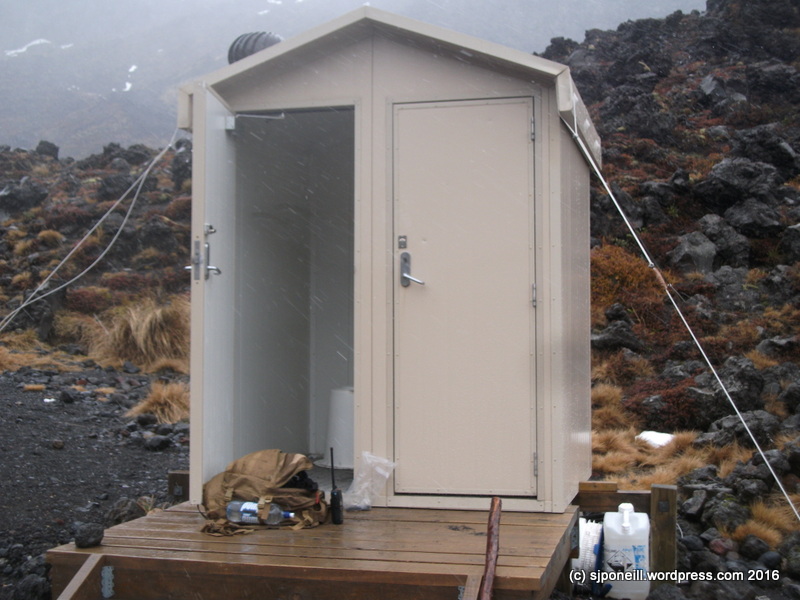
My temporary office/shelter at Soda Springs, about 1200m ASL
A few weeks back, work was pretty slow, so I decided to go for a walk up to Red Crater to check the ground conditions: even though the rest of the country might have been enjoying Spring, Tongariro weather is always changeable and even now, almost into December, the forecast promises gale force winds and snow to low levels…
The original forecast for my day in the Park looked quite nice but turned for the worse overnight…I almost gave it a miss but decided to go up to see how many people also decided to venture into the mess…I’m always interested to learn where our visitors get their information from and what decision process they apply (or perhaps not) when deciding to venture out into the Park when the weather is less than its best.
The first leg up to Soda Springs was quite pleasant, drizzly but not really cold and just a light wind. I made good time as there were only a very few people on the trail – a stark change from the ant farm of a decent weather day…a few hundred metres short of the Springs, there was a distinct temperature gradient and the light drizzle changed into a quite brutal sleet shower: not pleasant at all. It was clearly snowing further up and I didn’t see much point pressing on…
A guided group preparing to head further up the trail – going with a guide in these conditions adds an extra layer of safety
A group of three that I had passed on my way up stopped for a chat. They had checked the forecast before departing but were unaware that the first morning update comes though about 7-30. The previous forecast had been for nicer weather and improving as the day progressed: the guy leading them had fixated on this improvement and was expecting this to happen as they worked their way up the Crossing. One of the girls only had a light jacket and was only wearing tight-fitting track pants: it wasn’t hard to see the early signs of hypothermia…dragging feet, slurred speech, diminished motor control…. I suggested that perhaps they might to turn back and get her dried off and warmed up…
I walked back with them to make sure they made it back alright. The guy, Eric, was quite a good bloke and we chatted on that walk back: Chinese, he had attended high school in Hamilton and had considered himself reasonably experienced in the New Zealand bush: many weekends he and his fellow boarders had been dispatched on bush tramps and walks. He was quite annoyed that no one at the lodge they were staying at had warned them about the weather or told them to wait until the morning update before checking the weather.
As we descended towards Mangatepopo car park, and away from that temperature gradient, the weather warmed up and Eric’s friend improved along the way. Misinformation about conditions and hazards in Tongariro National Park is common. Where information does exist it is more often of a tourism promotion ‘happy happy joy joy‘ nature and less of the simple easy to understand bullet points that should be shaping visitor expectations from the time they first consider visiting New Zealand.
All’s well that ends well and Eric and his friends came in the next day to say thank you for the assist.That notwithstanding, there have been some gnarly rescues in this area of the Park, most of which have been caused by the rescuees’ aspirations getting a head of their capabilities…
Never volunteer. That’s like one the the greatest military truisms – ever. And one of the wrongest. Nothing risked, nothing gained. My experience always was that something good generally came from volunteering – being volunteered, perhaps not so much…
I’m starting on a new volunteer adventure. The Fire Service was never something I really considered before…I travelled so much in my Army, then Air Force lives that I would have been unlikely to have been able to meet the training commitments but really, my head wasn’t really in that space. Most of my post-infantry career was in TTI roles (Top Two Inch) , thinking jobs, often working on my own, solo…not really the team environment from way back then.
Way back then…
My lifestyle changes over the past year have changed my ‘headspace’…an Outdoor First Aid course brought back all those Band 4 Medical memories and encouraged me onto the Pre Hospital Emergency Care course in September and that team working environment showed just how much I missed team work. On top of that, I needed some place to keep up those PHEC skills..
A friend joined another local brigade and I followed her progress…mid-winter, the local brigade delivered a recruiting pitch to our Business Association meeting and, although I wasn’t ready then, that sowed a seed that took root post-PHEC. I went down one training night and, in half an hour, I was helping a firefighter into a hazsubs ‘carrot suit’…
Training is officially two hours every Wednesday night but that’s the minimum…National Park 281 is only a small brigade but most members work odd hours and days so there are usually ad hoc training sessions throughout the week. For recruits like me, there is also a lot of study and training – just getting on top of the language is a mission – to be signed off before the week-long recruit firefighter course at the National Training Centre in Rotorua…with a little luck and a few more people falling off the wait-list I may get on the January course…
So volunteering…it’s a bit more than a couple of hours a week and a bit of study…lifestyles need to change: a pager can go off anytime so little things like ‘cap, shirt, Bata Bullets, need to be more prescribed and practiced; parking the truck pointing up the driveway saves a few seconds…many of us live in Raurimu, a time-consuming 5km north of the station: we don’t have the critical mass or number of calls to justify standing watches…
Small team, good team…hard training, good training…repetitive training, even better…








 The World According to Me...