Sadness and gladness of the Last Post

anzac poppy 2016

This was an editorial in one of the national newspapers for Anzac Day 1997…I can’t find any notes I may have made identifying the paper or the author…

The Last Post always makes me cry. I can’t help it. There is something in those crisp clear notes ringing out in the sharp-edged air of ANZAC morning that takes my breath away. It sets up a curious chemical reaction in the soul, where sadness and gladness are fused together and one is lifted out of oneself and into the unending reverberations of history.

The bugler speaks to the dead – the “glorious” dead – inscribed on countless cenotaphs and roadside memorials from one end of New Zealand to another. Not that there is anything glorious about dying. In the paintings of our country’s battles, the death of young men, far from home, in agony and fear, is seldom portrayed with much accuracy. We spare ourselves the horrors of war – and rightly so. Veterans of the real thing seldom speak of what they have seen and heard lest their words conjure up again the screams, the blood, the shattered flesh, the cries of “Mother!”.

The Last Post speaks to the silence beyond death; the space in which we contemplate the meaning of the final “sacrifice”. The Last Post asks us to ask ourselves “What did these young men die for?”

When I was a little boy, I would spend my ANZAC Days drawing pictures of soldiers climbing up the rocky hillsides of the Dardanelles. And, over the vivid colours of the battle scenes, I would print in the laborious hand of the young: “For King and Country”.

I do not think that there are many today who would die for the House of Windsor. But, in the silent crowds of young New Zealanders – more every year – who join the old diggers on ANZAC morning, I sense a longing to serve, to sacrifice, to give something back to their country.

The generations of New Zealanders born after World War II have been spared what the United Nations charter calls “the scourge of war”. It is a mixed blessing. To be sure, we have never had to hold our friends in our arms and watch them die or receive a telegram informing us of the death of a loved one. But neither have we experienced the powerful sense of unity with which a nation at war is infused, not the bonds of comradeship forged when men and women from all walks of life are brought together and transformed into a  fighting force.

Most importantly, the post-war generations will never know what it feels like to play for history’s highest stakes – when the issues of ultimate significance hung in the balance.

I often ask myself: “Is political activism a substitute for war?” “What is it that we go on protest ‘marches’?” “Why do we seek out those moments of ‘confrontation’?” When we see that line of helmeted police officers, their long batons drawn; when we experience that lonely thrill of fear, that sudden rush of adrenalin, are we not, in our own way, playing soldiers?

People often ask me: “What’s wrong with today’s young people? Why aren’t they protesting like we did?” My answer is brutally simple: “Because of what we did” Our generation has reduced those “issues of ultimate significance ” – Roosevelt’s “four freedoms” (freedom of speech, freedom of conscience, freedom from want, freedom from fear) down to just one: the freedom to buy and sell. Once a year, on ANZAC Day, we call forth the dead and invoke the myths that animate our nation. In the half-light of dawn, as the bugler draws out our tears and we “remember them”, remember the living also, and never forget that there are greater things to die for than a balance sheet.

And remembering other young soldiers in other wars…

Object | The Daily Post

Write a new post in response to today’s one-word prompt: object.

Source: Object | The Daily Post

Draw a picture of a chair by looking at a real chair not a photograph. ~Pre-instruction drawings; Drawing on the Right Side of the Brain; Betty Edwards

I had thought the original task was to draw a picture of any object by looking at it but it was 1999 that I started this so I may be excused for a minor memory lapse. This was the period that I was working closely with Wingnut Films and the Lord of the Rings crew and my uber-latent arty side was being nudged daily. Drawing and screen-writing were the two main areas in which I took an interest up to the day that people started flying planes into buildings…

Being much more comfortable with writing and story-telling, these became my comfort zone and while my interest in drawing remained, my discipline for the exercises waned. I unearthed my drawing pad recently during a clean-out and then, only a week or so, stumbled across the subject of one of those early exercises.

DSCF9908

Wow…seventeen years ago…so much water under the bridge since then…I’m quite keen on restarting this programme…it’s all based on the book so no enrolments or administration necessary just some willpower and motivation…

DSCF9910

Today…

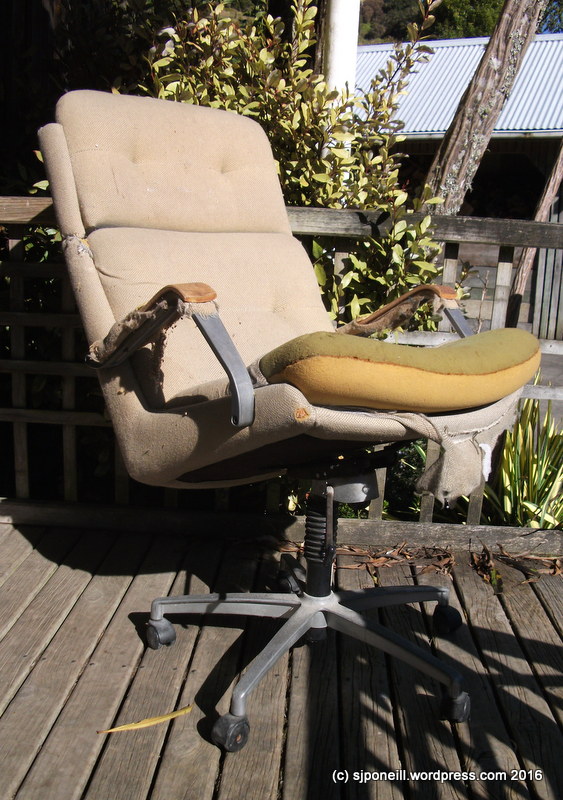
This is the original on which the drawing is based. It has some history.

Until July 1989, this chair was occupied by the Officer Commanding, Charlie Company, the First Battalion, the Royal New Zealand Infantry Regiment, or, in military shorthand, OC C Coy, 1 RNZIR. From this seat, that individual dispensed justice, ‘offered’ guidance to young officers, and oversaw with ruthless scrutiny, the development and training of a hundred or so lean and keen infantry soldiers.

Near the end of 1987, the New Zealand Government decided it was time for its own version of ‘nothing east of Suez’, announcing that the New Zealand force based in Singapore, aka NZFORSEA, would be withdrawn to New Zealand by the end of 1989. This was called OP(eration) KUPE.

The force in Singapore was a legacy of the Commonwealth intervention into Malaya in the 1950s, Borneo in the 1960s and, for Australia and New Zealand, Vietnam. For over three decades, in various incarnations, it had contributed to the secure and stable development of the states of Malaysia and Singapore: rightly or wrongly, the Government felt it was now time to for New Zealand to focus more closely on its immediate South Pacific neighbourhood. Perhaps lost in the political mix, were the second and third order effects of our presence in Singapore, particularly in providing access to prime jungle training areas in Malaysia, and opportunities for young New Zealanders to experience and mature in a foreign culture.

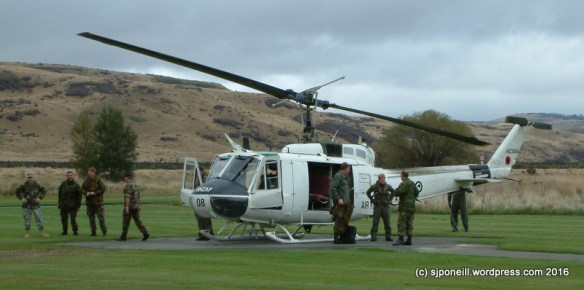
While we didn’t quite get to the stage of pushing helicopters off aircraft carriers – all our helicopters were safely repatriated to serve faithfully for another quarter century…

ABCA Executive Council visit to ATG 001

Still going strong in 2005…finally retired in 2015…

…many items deemed non-essential were fated to remain in Singapore, many destined for the ignominious end of the rubbish fires…

CCI21042016_0001

Burning off pre-RTNZ rubbish

When a whisper on the rumour advised that the company office furniture was due to be hauled away to the tip, there was competition to secure anything worth securing for repatriation as personal effects. the only time I have moved faster was when Trevor Sexton chased me down the final leg of the Burnham fitness circuit threatening to do me an impropriety with his pacestick if I didn’t pick up the pace – that was the first and only time I ever broke nine minutes on the required fitness test 2.4km run.

I seized possession of the chair seconds before company clerk, Steve Carrick, burst into the office, much miffed at missing out. I should point out, in all fairness, that, as company clerk, he already had a pretty nice chair in his own office; as a private rifleman, my issued seating was a camouflaged foot-square piece of rubber thermal mat used in the field.

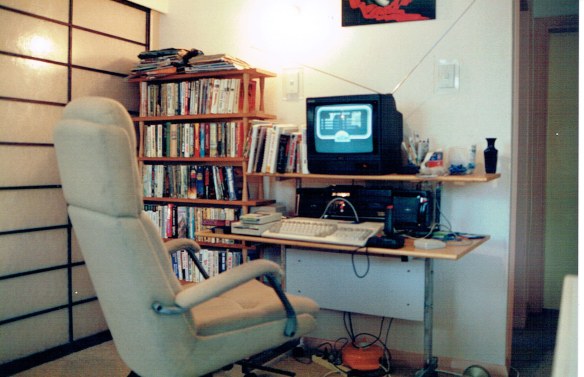
The OC’s chair served me well through various roles and homes in Palmerston North, Linton, Trentham and Wellington…

CCI21042016_0002

The chair of power in front of the mighty Amiga 500

…but got misplaced in a house move over a decade ago. It has clearly seen better days but I was rapt to find it clearing out a storage unit last week…an object of days gone by history…


AS I SEE IT (1 April)

virgin cola blue can                  

By Terry O’Neill.

The new Springbok rugby coach is to be announced today.

After months of uncertainty following South Africa’s exit from the rugby World Cup last October and former coach Heyneke Meyer’s decision to stand down, Allister Coetzee apparently is the firm favourite although Rassie Erasmus or Johan Ackermann have support.

On a less serious sporting theme may we acknowledge today harks back to the Roman Hilaria, the Indian Holi Festival and the medieval Feast of Fools first recorded in Chaucer’s “Canterbury Tales in the 1300s. You know his story of the vain cock Chauntecleer who was subtly tricked by a wily fox, and it heralded that date for playing harmless pranks on family and friends.

The media have not been slow on that date to call on the good sport in us all. Back in the 1980s the evening newspaper The Oamaru Mail responded to a hot topic and published a photo of a substantial industrial building on Oamaru’s Cape Wansbrow connected by conveyor belt down to the wharf in the harbour to indicate the proposed cement works’ construction would enable cement to be exported. Absolute outrage gave a new meaning to indignation. 

It was the Otago Daily Times that pictured a tractor and plough rooting up Carisbrook’s hallowed turf. Phones scorched many ears in the furore that followed.           

And the Guardian newspaper introduced a “British Weather Machine”. This discovery would control weather within a 5000 kilometre radius – good news for the Brits with a guarantee of long summers with rain falling only at night.

The BBC’s 1957 “spaghetti tree hoax” was either a joke or hoax to newspaper. In 1996 Virgin Cola ran an advertisement in British newspapers suggesting that, in the interest of consumer safety, it had integrated a new technology into its cans so when the Cola passed its use-by date, it would react with the can to turn it bright blue. And Virgin Cola warned consumers to avoid purchasing all blue cans. Meanwhile opposition company Pepsi had recently unveiled its newly designed cans which were bright blue.  Sporting?

Recently a line of socks, “Fatsox”, was advertised as a weight loss product incorporating a nylon polymer, Flora Satra Tetrazine, previously used in the nutrition industry. Apparently as the wearer’s body heat rose and blood vessels dilated, the socks drew “excess lipid from the body through the sweat from the feet”.  So, after sweating off the fat, the wearer simply washes the socks, and fat, down the plughole. The franchise is available for these in North Otago.

But above all, after enjoying a tad of sporting fun and belly laughs, remember the Feast of Fools ends at noon today after which the instigator is the fool!

ENDS

AS I SEE IT(24 March)

nanny state

By Terry O’Neill.

Are we becoming the world’s“cotton wool country” an extension of the old “nanny state”? Before we begin to leap in the air in an over indignant protest against what too many will claim are “ infringements of our rights” let’s take a good look at the first health and safety reform in a couple of decades.As you land back on your feet for the first time, the new reforms refer only to paid employees not volunteers. So any person who owns and/ or is a paid organiser of an event ,comes under the new rules. Thus if anything goes wrong the owner is liable for prosecution but the new compliance requirements are bigger and prosecution is higher.So does this mean that organisers of  the Coast to Coast,Christmas parades,school activities, multi sport races, bike races and marathons may  become things of the past as the owners/organisers fear personal liability prosecutions.Many such people are calling in auditors to check their events against the new reforms.

Locally this mean that any event which is run by a paid organiser comes under the new reform?It’s just not limited to workplaces which have paid staff, but the law does not apply to a group of volunteers where nobody is paid as an employee.

It is believed by many that the reforms are really the product of the Pike River mine disaster where twenty nine people are killed, but government denies this stating that its concern is about the high level of deaths and serious injuries in the workplace. So why place paid individuals such as school teachers responsible for the health and safety of students placed  in the same basket as national industry?And why are ordinary New Zealanders being asked to bear the brunt of the increase in workplace deaths.

With fines of up to $600,000 some principals have considered putting their personal homes into trusts so that they will not have to sell homes to pay fines or maybe to avoid gaol times in extreme cases.But others say its simply a case of the more detail being released to assist clarification.

Will this mean that clarification will create a more sensible application of the reforms? Apparently not as such reforms will apply to sports clubs who employ staff.Examples from one bowling club would suggest the opposite.It’s been informed that any steps must be painted so players and visitors could see that they were steps, and signs had to be put up in the shelters warning against sitting on the top rail,in case someone falls off.And the coat racks had to be taken down in case someone impaled themselves upon them ,while any pointed edges had to be wrapped with rubber so that people will not be injured.So if you have a club that runs tournaments more dollars will be required to get your facilities up to scratch.

George Orwell of 1984 fame will be smiling wryly I’m sure.

ENDS

NNNN

AS I SEE IT(18 March)


By Terry O’Neill.

Waitaki Boys High School First X1 and Valley will meet in tomorrow afternoon’s Borton Cup final,the major trophy for the North Otago Cricket Association which was formed in 1899. In the first season six teams,Oamaru A, Oamaru B, Tureka, Capulet, Waitaki Boys High School and a Ngapara-Maraewhewnua combined team.In the first season a series of home and away games were played to decide the initial champion. Because of a lack of grounds most games were played at Takaro Park and Tureka was the first champion.It wasn’t until the end of the second season that a trophy was presented to the winner of the senior competition. The North Otago Cricket Association however was in 1919and John Borton an Oamaru club member who donated a trophy. This trophy was referred to as,”The North Otago Cup” or “The Association Cup” but it was generally called the” NOCA Cup.”The advent of prohibition and the lack of adequate grounds saw cricket virtually defunct in 1909 and it was the opening of King George Park and the return of soldiers from World War 1 that saw senior club cricket restart.Waitaki Boys High School was the first winner of the relaunched competition and was presented with the old trophy at the end of the season.Waitaki Boys stored the Cup in the front block at the school but a major fire broke out and the trophy was lost. Frank Milner, the rector of the school presented a new cup to the association as a replacement ,the Borton Cup.

Waitaki Boys has won the senior trophy on four occasions, 1905/06, 1919/20, 1925/26(Colts), and 1967/68.

Mr Borton was a well known and successful farmer during the 1800’s.This Borton Cup was then used until 2011 before it was lost by the holders, Union.A replica of the Borton Cup now in use is engraved with the names of the winners of the senior competition since that very first season in 1899-90.

Waitaki Boys High School first won the trophy in the 1919/1920 season but it had to wait until the 1967/68 season to reclaim the trophy.If successful in the Borton Cup final tomorrow fternoon it will be only the third time that it has held the cup.

The Valley Cricket Club’s origins reach back into the early 1900s with the Waitaki Sub Association based in the Waitaki Valley which saw a population boom during the building of major dams at Waitaki, Benmore and Aviemore with clubs such as Kurow and Hydro(based in Otematata) taking part in a competition with at one stage the Kurow club taking part in Borton Cup competition in the 1930s.Such was the strength of “country” cricket that at one stage more than half of the North Otago Hawke Cup team were country members.

As the dam projects began to wind down cricket clubs began to struggle to find members.Eventually only three teams were left, Kurow, Otematata and Duntroon.These three teams decided to combine and form a new club to take part in the Oamaru competition.The team was called the Upper Waitaki Cricket Club but during the 1970s it changed its name to Country and up until the 1980s had managed to win the Borton Cup on five occasions.In 1991 it joined with the Weston Cricket Club to become part of the Valley Sports Organisation which involves other sports such as rugby and netball.

Since this amalgamation the Valley Club has won the Borton Cup on five occasions,1994/95, 1997/98, 2003/04, 2004/05, and 2006/07.

ENDS

NNNN

AS I SEE IT (11 March)

ancient mariner

By Terry O’Neill.

Hot arid conditions may push humans into out-of-character behaviour.

This is well-documented in Samuel Taylor Coleridge’s graphic 18th century poem, “The Rime of the Ancient Mariner” in which the albatross which guided the ship out of stormy waters was blamed for the it’s  becalming. The ancient mariner shot the albatross, his crew died all around him, and he paid the penalty by the albatross being hung around his neck. A situation, one would think is a long way from a dry and dusty Weston Park sports ground.

To the ancient mariner in the doldrums all he could see was “water, water everywhere, and not a drop to drink”.

The Valley cricketers and rugby players would agree whole heartedly, although it’s not the potability of the water that’s worrying them, it is its availability. The extremes of dry weather created a playing surface almost resembling concrete. It is ironic to note that the main oval also has drainage difficulties and is about to have its drainage system restructured.

The problem facing the Valley Sports Club as it caters for a multitude of players in summer and winter, is its inability to irrigate the surfaces which have reached the stage of being unofficially classified as “dangerous”, especially for contact sport.

Apparently local illegal water users, recently identified, have contributed to the problem and now must use the water registers or measures to monitor the flow to their properties.

To some the Waitaki District Council has become the ogre because this sports ground is under its umbrella. The WDC has demonstrated its willingness to cooperate with sports groups. This was illustrated in practice, particularly in the recent Hawke Cup cricket challenge between North Otago and Hawkes Bay, when it came to the party prior to the game and poured an estimated 650,000 litres of water onto Milner Park, cricket’s temporary main ground while a new ground and block is being developed at Centennial Park.

Hopefully Weston Park, which will be out for the next three weeks, will be able to benefit from a satisfactory solution to its predicament.

The worst scenario for the club, or the WDC, would be for OSH to step in and close the grounds because of this condition.

Doses of aqua pura. That’s all.

Bic Runga, Tim Finn and Dave Dobbyn have the solution in their song, “YOU JUST ADD WATER”.

Another magnificent cause for celebration in North Otago! An amazing array of talented young sportspeople was on display as the sporting awards were announced on Monday   evening.New Zealand under 19 cricketer Nathan Smith took the major award,Supreme Sportsperson of the Year.At the other end of the age spectrum Bruce”Bruiser” Rowland was deservedly awarded the Denis Birtles Memorial Award for his forty years of rugby refereeing. A great night amidst a galaxy of talent.

ENDS

How I got muffins for the next few days…

DSCF9678Having people around for afternoon tea means two things: tidy the house and sort afternoon tea…here, it’s not quite so simple as just popping down to the eclair shop for some ‘clairs and lamingtons; more so when the message comes through “…on our way, just leaving Whakapapa now…” and I’ve got nothing ready but an idea…
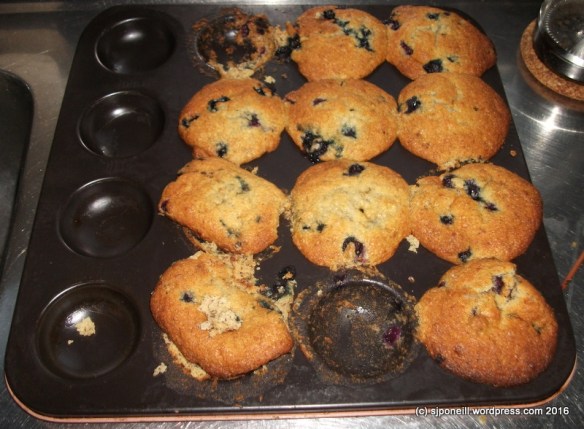
Speed cooking is, for me, analogous to speed dating: just not something I do…I like a more deliberate planned kitchen experience…but not today…it normally takes me about 15 minutes to drive from home to Whakapapa so time was the one ingredient I was short off…I had selected a good Kiwi recipe the night before and dug the muffin tray out of the back pantry but that was it in terms of preparation…

I am quite chuffed that I managed to get it all together and into the oven before my guests arrived:

What I used:

  • 125g Melted Butter
  • 1 Cup of Sugar
  • 1 Egg
  • 1 t Baking Soda
  • 3 T warm milk
  • 2 Mashed Bananas
  • 1 1/2 Cups of Flour
  • 1 1/2 t Baking Powder
  • 1 – 2 Cups of Blueberries

How I used it:

Heat the oven to 180 degrees.

Mix the butter and sugar together.

Next time remember to add the egg – just realised that I forgot to add this: not quite so chuffed then…

Dissolve the baking soda into the milk and mix in to the rest.

Add the bananas. I used frozen bananas that I had remembered to take out of the freezer earlier to thaw out. Today’s lesson is that you can squeeze the banana – in toothpaste fashion – from the skin by cutting the stalk off and squeezing…way less messy…I mashed them as I blended them into the mix but this would have been better if I had mashed them, THEN added them – didn’t seem to make a lot of difference to the final product though…

Blend in the flour and baking powder.

Mix in the blueberries – I used about a cup and a half – using frozen ones means you don’t have to be so gentle with them plus I am saving our fresh ones for breakfast each morning…

I used a folded up paper towel to swab out the container that I had melted the butter in and quickly greased up the muffin tray. The tray seats sixteen but my mix only lasted for a dozen…

Place the tray in the oven and hit the fan bake.

Keep them cooking until a skewer comes out cleanly…

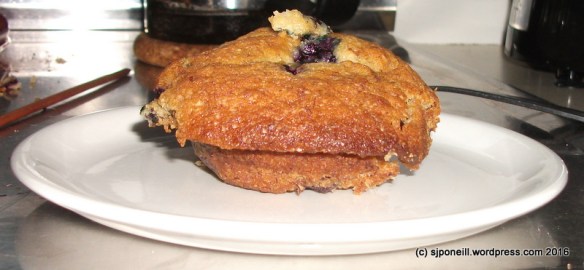
Now the bit I really mussed up: let them sit in the tray after you take it out of the oven until they have cooled down and ‘set’…I tried to remove them while they were still warm and it was just disintogram time…

DSCF9675I meant to come back to them once them had cooled but once we’d had a bit of a show round the property and an abortive attempt to walk down to the stream, and got into conversating, I forgot about them til latter…so muffins for the next few days…
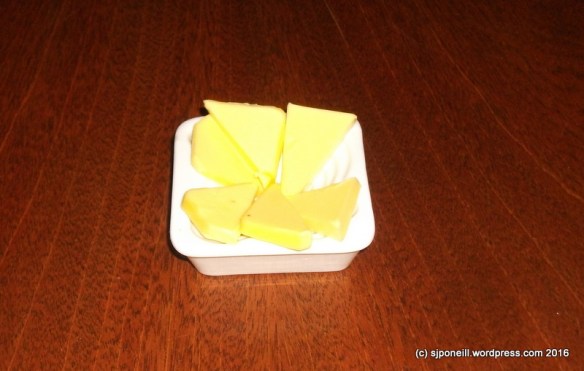
My plan was to serve them simply with just butter – yes, “…pure poison…”, I know…but am keen to suss out some other ideas…DSCF9679

Insights

Remember to add the egg next time – although they seem to have come out OK regardless…

Let the muffins cool before trying to remove them from the tray.

Get a new muffin tray: this one came with the house and has seen better and more non-stick days, even when greased…time for retirement and replacement…

‘Toothpasting’ thawed bananas works well.

Frozen blueberries are easier to mix in…

The amount of sugar could be reduced and I’m wondering if the milk could be replaced by an alternative non-cow milk..?

They taste good with a crunchy crust that most likely comes from the sugar…I was worried that I would over-mix the ingredients and end up with a rubbery texture – all the muffin recipes seem to warn about this –  but nope, all good…

Definitely a keeper recipe and one I will try again just as soon as all the current muffins are consumed and I have a new muffin tray…


AS I SEE IT(4 March)

By Terry O’Neill.

What? Volunteers made redundant?

Volunteering is an integral New Zealand response whereby people selflessly offer services, skills and time for the benefit of others. Every community has people who do their bit with grace, skill and charm.

It can be a two-headed coin. Each volunteer gives to meet a particular need and is often surprised to receive a sense of accomplishment, fellowship, and contentment, the blessings of true generosity.

 A recent Oamaru Mail article on Girl Guides in North Otago suggested the national body is “revitalising”, whatever that means, so it can fulfil its goals of developing self-esteem, confidence and leadership, and a centralised business and administration arm will reduce the work of volunteers in these fields. But to maintain the national “ivory tower”, annual fees for each Girl Guide must be increased from $180 to $300, though in some cases there may be a decrease. Some local guide leaders believe the fees may push the movement into an elite club beyond the reach of many including loyal families with Girl Guide members throughout generations.

When former Prime Minister Rob Muldoon introduced the “think big” philosophy mixed results evolved, and now it appears some organisations which survived, and indeed grew, applied this philosophy in a very practical way. The Society for the Intellectually Handicapped (IHC), Save the Children (SFC) and Riding for the Disabled (RDA) are but three which experienced, and resisted in some cases, the nudges or heaves towards centralisation. Many local branches had a rich complement of competent volunteers before top-of-the-tower decisions effectively attempted to bypass this invaluable resource of experience and support. “Bigger would be better”. Maybe.

Centralisation appears to require paid “executives” whose salaries enable them to direct and organise the remaining, often disillusioned, volunteers. And this rejection of volunteer input ultimately affects the vitality and growth of local support for the national body and its dedicated services.

It’s a New Zealand “thing” to support financially what we believe to be worthy  organisations. I wonder how many find it offensive when a wealth of attractive glossy material regularly is sent out to squeeze even greater donations from already dedicated supporters of the institution?  Exactly how much of each regular donation contributes to such simplistic unsolicited expensive-looking material.  Many charities come to mind.  Surely regular voluntary subscribers could be spared this practice? Sincere volunteers and supporters are too valuable to be treated with disrespect.

Sports bodies are feeling the impact of a smaller volunteer base, and I don’t apologise for bringing this up again. Often loyal supporters hold positions of responsibility for long periods, and are the butts of criticism because nobody is willing to ‘step into their shoes’. Eventually, burnt out, the stalwarts eventually take their skills and drop off the code’s radar into oblivion.

In these days of semi-professional sport, there’re suggestions from some volunteers that those getting paid should do all the work!  But is this just a cop out?
    

ENDS

Seeing corn in a new light…

…through a veil of tears…

DSCF9652

In Happy Endings a few weeks back, I described the origin of my green journey…further into that discussion, I offered a number of obstacles to my starting the journey…among these was “Without butter, how can I have corn on the cob with pepper?” The butter, of course is the enabler for the pepper to stick to the corn – you can’t beat home-cooked pepper corn!!

One of Bubble’s alternatives was drizzling basil oil (I didn’t know what it was either and had to look it up) over the corn in lieu of butter, or possibly even in lieu of the pepper…I’ve tried this and yep, it works however my key insights were that:

We need to load more basil flavour into the oil.

The taste gets stronger with the passage of time.

This tastes too damn good to only make up in 100ml batches…more to follow on this one as I (finally) have a surviving basil crop…

Bubble’s other offering for to-die-for corn on the cob was to use chilli oil, although she used a flash name for it, oilio picannte…I had to hunt for this: it’s not common in rural supermarkets and I had to get some when I was in the big smoke last week.

In my first outing with it, I thought it  quite mild and a tad disappointing…really? Trust Bubble, Bubble is always right is the rule…

Just substitute Bubble for Ivanoa and I think you get the message

Corn on the cob is cheap as at the moment and I had some for dinner tonight, intending to revert (regress) back to good old butter (it’s not pure poison, surely?) and pepper like I always had. I relented at the last moment and poured a little chilli oil along each corn cob. Feeding my delusion that this was a  weak oil with barely any heat, I peppered them up as well…

Ha…!

I wonder now if the oil is heat-activated..? I sure didn’t need the pepper for warmth…when the chilli kicked in, I took a deep cooling (for about 3 milliseconds) breath, spreading the love through my sinuses and nasal cavities in the same spirit as snorting wasabi…as I used to warn the twins…hot…hot…hot…

Once the tears cleared, I realised…we don’t need no stinking butter…

DSCF9655

Yeah, baby…

A post in four courses – apres

We’re both coffee people so ending dinner with a coffee seemed natural…

But maybe something a little more special than just instant and hot water..? This was a by-product of our research into (yet to be tried) pumpkin spice latte waffles…simply (said if not prepared) coconut pumpkin spice latte…

I opted for this recipe from Half Baked Harvest because it seemed to offer a good blend of healthy themes and flavours…

Ingredients

For the coffee base, you need:

2 cups of coconut water

1/2 cup of freshly ground coffee grounds: yes, I know that sounds like a lot – it  is – but I think that the cold infusion is less effective as traditional coffee making processes plus I suspect that the coconut water is not as effective at absorbing the coffee flavour as water water…

For the pumpkin spice latte:

2 tablespoons pumpkin puree

1/2 teaspoon pumpkin pie spice (I made up a bigger batch substituting tablespoon for teaspoon in this list):

1 teaspoon ground cinnamon

1/4 teaspoon ground nutmeg

1/4 teaspoon ground ginger

1/8 teaspoon ground cloves

pinch of black pepper

2 tablespoons pure maple syrup

1 1/2 cups canned coconut milk

1/2 cup coconut water

2 tablespoons pure vanilla extract (yes, also a lot – this is a very sweet brew..!)

Making the components

Make the base by mixing the coconut water and coffee grounds together and letting sit overnight.

Filter the grounds out.

Combine all the latte ingredients in a small pan over the stove.

Simmer and stir until the mixture is steaming hot.

I made both components the night before but I think this mix would go best made fresh with no delays. My inner coffee lover cringes at reheating the coffee base in the microwave and the latte syrup does not like being frothed some much once it has cooled.

DSCF9638

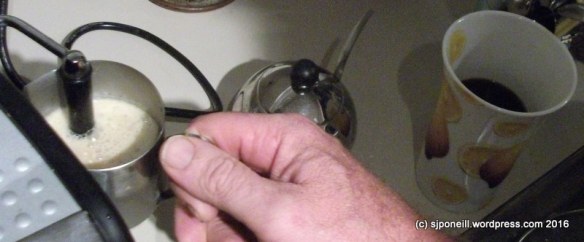
I  used the steam frother on my coffee machine and that was OK but not ideal…partly because the reservoir is not that big and, by the time it heated, only pumped out enough steam to froth a coffee at a time…

DSCF9639

I got a light froth on an OK coffee…OK in that it was very smooth but not as strong tasting (of coffee) as I like…

DSCF9641

…which tasted OK but lacked texture and heat (I like hot coffee)

Insights

Next time I will make the coffee base in a pan over the stove and use it immediately. This is actually the alternate method in the recipe and I don’t know why they don’t simply do this anyway and avoid the whole reheating thing.

Using coconut water for the coffee base does seem to provide a smoother coffee but I will see how this goes. My gut feeling is that if I can master the syrup, this drink will be just as good with conventionally brewed coffee – note to self, overcome anxiety and master the coffee syphon…

I used the recommended quantity of pumpkin puree but apart from possibly adding to the texture of the latte syrup, did not appear to add much unique to the flavour – although it is up against some pretty intense competition. I think I will double this next time.

The coconut milk and maple syrup tend also to override the flavours of the pumpkin pie spice. It may be – quite likely, I think at the moment – this may become a coconut maple syrup latte if the pumpkin components can’t step up to the plate…

…or maybe dump the maple syrup – I don’t think this needs any MORE sweetening – in favour of the pumpkin flavours…

The blending option – over the whisk/stir strongly or steam approaches – that is mentioned as an alternative in the original recipe is probably the best for frothing a mix like this and that it how we will do it next time…

Like the dairy-free ice cream, this is probably more philosophically healthy than actually healthy…it is very sweet and one probably needs to plan some extra physical owrk to compensate

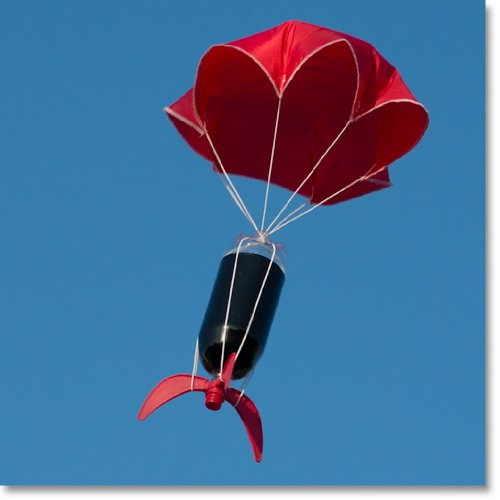
toy para rocketSo…don’t get me wrong…this makes a nice coffee…I described its effect to a friend the next day as being like one of those toy rockets with a recovery parachute: the caffeine kicks you up to about a thousand feet then the sweetness kicks in and lowers you gently back down…time it right and you’ll float to the ground just as your head hits the pillow… as I did…slept like a baby…