Opportunities Lost

‘Opportunity is missed by most people because it is dressed in overalls and looks like work.’ – Thomas A. Edison.

Conversely, some opportunities are seized because they appear easy and not really like work at all. I’ve just watched an item on the midday TV News covering the handover of the town of Sangin in Helmand Province from Royal Marines to US Marines. Approximately one-third all all British combat casualties in Afghanistan have been in and around Sangin…

The British “have decided, given limited resources, to focus on the central part of the province” and leave the hot spots of northern Helmand to the U.S., says Col. Paul Kennedy, commander of U.S. Marine forces in the area.

The true test will come over the next two months, when the last Royal Marines leave Sangin to the U.S. Marines. Right now, the Americans just have to fight; they don’t have to manage relations with the local Afghan government, navigate tribal politics or promote economic growth.

Once the Royal Marines are gone, those jobs will fall to the U.S. Marines.

Going into Afghanistan in 2001 probably looked like an easy win for the Blair Government in Great Britain and a far easier ‘sell’ than Iraq in 2003. I heard Tony Blair in a TV interview here a couple of weeks ago and all the problems in Iraq and Afghanistan were someone else’s fault…largely Al-Qaeda in Iraq and Iran in Afghanistan…without their meddling, one got the impression that Messrs Blair and Bush (Jnr) would have triumphed in both campaigns…

The simple fact is that with intervention comes responsibility and, whatever else people might think or say about the US, it is doing its level best to uphold its end of the stick – in stark contrast to its former ally that bailed in Iraq – from the relative back water of Basra and is now starting to slither away in Afghanistan…335 casualties (so far) and for what? The UK Government does a disservice to every soldier who served by failing to step up to the plate and accept responsibility for its actions

While the UK bleats about being undermanned in Helmand, it continues to slash back its military forces in all three services with all the enthusiasm and passion of Freddy Krueger or Jason from Friday the 13th…in the final analysis, I guess that Britain finally decided that it was only ‘in’ war and not ‘at’ war after all…

Soon they all be getting back on the helos...

In the gathering dusk of 18 August 1966…

Long Tan Cross ceremony, 18 August 1969 (c) AWM

…44 years ago, D Company, 6 Royal Australian Regiment, fought a desperate battle for survival against a Viet Cong regiment, in  a rubber plantation near a little town called Long Tan. This is one of the great sub-unit battles of history, where a few stood against many. Today, it remains as an example of great junior leadership and “…of the importance of combining and coordinating infantry, artillery, armour and military aviation...” The Presidential Unit Citation tells part of the story…

By virtue of the authority invested in me as the President of the United States and as Commander-in-Chief of the Armed Forces of the United States, I have today awarded the Presidential Unit Citation (Army) for extraordinary heroism to D Company, Sixth Battalion, The Royal Australian Regiment, The Australian Army.
D Company distinguished itself by extraordinary heroism while engaged in military operations against an opposing armed force in Vietnam on 18 August 1966.
While searching for Viet Cong in a rubber plantation northeast of Ba Ria, Phuoc Tuy, Province, Republic of Vietnam, D Company met and immediately engaged in heavy contact. As the battle developed, it became apparent that the men of D Company were facing a numerically superior force. The platoons of D Company were surrounded and attacked on all sides by an estimated reinforced enemy battalion using automatic weapons, small arms and mortars. Fighting courageously against a well armed and determined foe, the men on D Company maintained their formations in a common perimeter defence and inflicted heavy casualties on the Viet Cong.
The enemy maintained a continuous, intense volume of fire and attacked repeatedly from all directions. Each successive assault was repulsed by the courageous Australians. Heavy rainfall and low ceiling prevented any friendly close air support during the battle. After three hours of savage attacks, having failed to penetrate the Australian lines, the enemy withdrew from the battlefield carrying many dead and wounded, and leaving 245 Viet Cong dead forward of the defence positions of D Company.
The conspicuous courage, intrepidity and indomitable courage of D Company were to the highest tradition of military valour and reflect great credit upon D Company and the Australian Army.

The rest of the story is well worth ferreting out, particularly the section in Mark Woodruff’s Unheralded Victory…many of the lessons from Long Tan from infantry section to coalition task force level still apply to today’s environment…Lest We Forget…

One might hope that The Battle of Long Tan, due for release in 2011, will be on  a par with We Were Soldiers and Blackhawk Down…and serve as a timely reminder to today of yesterday’s sacrifices…

…and thanks to Narelle for the reminder of this day…


A time and a place


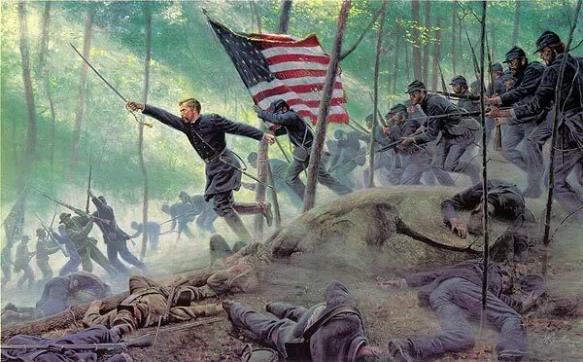
This seemed quite apt today…Chamberlain leading that final charge at Little Round Top, saving the day, the battle and very possibly the Union…

I didn’t really want to comment on the recent combat death of LT Tim O’Donnell in the NZ PRT in Bamyan Province, Afghanistan – it seemed at the time that everything that needed to be said – and perhaps some that didn’t – was being said…but, over the last few days, I have heard many people saying, no doubt with the best of intentions, that maybe he was simply in the wrong place at the wrong time…not at all…

I was privileged to spend some time with members of Lt O’Donnell’s unit as they waited for a C-130 to take them back down to Burnham Military Camp after they farewelled their mate that afternoon…something one of them said was so right…Tim was in the right the place – he was in the lead vehicle, leading his soldiers, he was where he was meant to be, and doing his job

And from the other side of the fence…

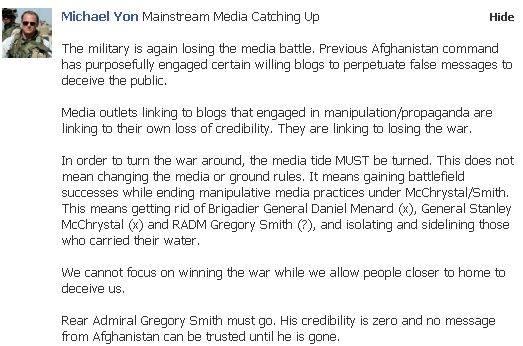
And while I was writing, this popped up from Michael Yon…back on our side of the information war….

...and from another direction...


Do Orders Really Matter?

Still in vogue: the mud model (c) Josh Wineera 2010

Fresh off the presses…a paper that discusses that traditional orders process, the ‘O group…

This article highlights the essential combat communication, mission orders,and the commander’s intent. It describes the means and methods by which a vertical-slice of commanders interpreted and analysed their orders; how they formulated and communicated their plan, and how the company commander monitored and adjusted the plan during its execution. The article is written primarily for junior leaders but also has utility for training staff, particularly practical lessons regarding the orders process.

Recently Josh Wineera, currently a Fellow at Massey University’s Centre for Defence and Security Studies (CDSS), observed the orders process from CO to section commander in a NZLAV company in the field. His observations form the basis of this paper. Josh presented his Interbella construct for the complex environment at the COIN Center VBB in September last year and has also released a paper considering domestic methamphetamine issues through a military lens

His consideration of the orders process concludes…

The importance of the battle-brief. There is merit in considering some sort of similar brief at the beginning of the orders. Everything else that follows would therefore be put in better context.

In the age of high tech command and control systems, mud models  still serve a purpose. Some of the quantitative data from the orders process however, could provide useful metrics for those charged with acquiring future command and control and decision-support tools.

The threshold between higher conceptual military constructs and plainer, clear, mechanistic detail appears to occur at the platoon level.

Offensive operations, that is close combat, still necessitates an infantry soldier to be prepared to ‘seek out and close with the enemy, to kill or capture him.’ These are ‘classic war-fighting skills’ and should not be degraded or regarded as obsolete.

Warfare in the 21st Century entails kinetic and non-kinetic missions; they are not mutually exclusive. The challenge will be to try and create a training activity that simultaneously tests soldiers in the application of both missions, being reflective of the character of war as we know it today.

New Zealand’s recent assessment as the most peaceful country in the world reaffirms the relevance of offensive operation’s training – a reminder from Vegetius’s maxim “Let him who desires peace prepare for war”.

The orders data captured from Exercise Absolute is but one source. This in itself would need to be validated against similar evaluations in order to confirm trends and recurring themes. Therefore, given the infrequency of combined-arms live-firing exercises it would be prudent to view all data and analysis in this article as an initial ‘yard-stick’.

The full text may be read here. The paper is also linked from a thread @ the Small Wars Journal should anyone wish to debate the content…

Today’s Question

Why do email systems persist in placing the ‘delete’ button right alongside the ‘reply’ button?

Aaaah….yep

A picture's worth a 1000 words

A picture's worth a 1000 words

There is a great commentary at Small War Journal regarding the manner in which GEN McCrystal was brought down…

Meanwhile, back in LooneyToonville, Michael Yawn continues his sterling work for the Taliban and continues his campaign against RADM Greg Smith, the head PAO for ISAF…

Who needs enemies with friends like Yawn?

RADM Smith’s real crime, of course, was that he supported Yawn’s disembedment after he began his smear campaign against senior ISAF staff…

Contemporary Warfare

I’ve spent the last day or so typing out all my notes from the Contemporary Warfare sessions – who might have thought that some much great material could come from only two days?

More snakes than ladders

I started to draft this post on Saturday night, thinking to comment on the ups and down of life…eight hours later, an RNZAF Iroquois had crashed on its way to Anzac commemorations in Wellington, and this morning we heard that a young soldier had been killed outside Linton Army Base in the Manawatu so…more downs that ups at the moment…

The second-guessing of yesterdays Iroquois crash has already started…people just need to STFU until the inquiry is done and released…there’ll be no whitewash and the truth will out…in the meantime, so-called experts show feel for the families and show some respect…

The picture is of a cool playground version of Snakes and Ladders, clicking on it takes you to the GoogleMap of how to find it…found the picture on Doing New Zealand

Because of the downs, it’s just snippets today…

You think?

Wired has a brief item wondering if US pilots will fire on Israeli strike aircraft crossing no-fly zones in Iraq to attack Iranian nuclear facilities…it is really in question? I think that any qualms about engaging targets disappeared on the morning of September 11, 2001, when US pilots had to confront the spectre of engaging hijacked airliners. If Israeli still doesn’t get the message, it may find that big brother carries a very big and nasty stick…and in some ways, a good punch in the nose from the US may be the best way to drag Israel out of its Masada mentality into the 21st Century…

Oh, no!

Yeah, St Michael of Yon again…Wired reports that “Smears Turn Milbloggers on their Frontline Hero“. Actually, Yon is a hero to few but the most blinkered of his followers, the hardliner conspracy theorists who would still follow him if he reported that GENs McCrystal and Menard are actually alien lizards planning to take over the world.  Guys like Herschel Smith who may soon be having second thoughts after his latest outburst…

From what I have heard, Canadian BG Menard fired more than 1 round. The high-profile person in his presence was the Canadian 4 star general. This is a stupid investigation, however. Worst kept secret at TF K is BG Menard’s adulterous affairs with female soldiers at KAF under his command. This is a distracted and selfish commander. He should not be leading troops who are sacrificing everything.

…and even his Facebook fans are now starting to kickback (I wonder how many more will have their ability to comment blocked?)…

Michael… This is not reporting. This is rumor proliferation akin to a TMZ. Come on, man. You’re better than that.

So this reaches us third hand. You’re accusing the man of serious crimes. You’d better have some evidence.

Rumors of rumors of rumors. Mike, you are above this.

Michael. Seems like you take this too far.

Third stool down rumors mean nothing to me!! Just makes you look even worse..why don’t you just stick to reporting about the troops and leave the brass alone.

I agree with Carol. This is the rumour profligation, bordering on tabloid rumour mill, versus professional journalism. It makes a reader wonder if this is bitterness from losing embed privileges, or the inability to report on news because of the lack of access. I wonder if Canadian attorneys are monitoring for possible slander?

Regarding that last comment, I think it would be funny as all hell if the targeted generals play Yon at his own game and actually do start a campaign against him – probably starting with Facebook and any other services and ISPs that host his libel…as an independent, I’m not sure how far journalistic privilege will protect him, if at all…

On target

Smart guy that GEN Mattis…

Mattis is an evangelist for risk with two core principles. The first is that intellectual risk-taking will save the military bureaucracy from itself. Only by rewarding nonconformist innovators will the services develop solutions that match the threats conceived by an enemy that always adapts. The second is that technology cannot eliminate, and sometimes can’t even reduce, risk. Mattis warns about the limitations of sophisticated weapons and communications. They can be seductive, luring military planners into forgetting war’s unpredictable and risky nature, leaving troops vulnerable.

I couldn’t agree more. I’d heard a few ripples in the pond that the US military (or elements of it) might be reverting back to the old Fulda Gap zero defects way of thinking, what you might call i-don’t-want-to-get-into-trouble-itis rather than making judgement calls. Ben Shaw’s comments on Herschel Smith’s Yon post at the end of last week are worth reading regardless of the original post. Ben raises a number of issues regarding this – I’ve since contacted him direct and it sounds pretty dire in some units. It’s unknown yet whether contributing factors could be ‘winning the war in Iraq’ or maybe a lowering of standards to meet deployment outputs. More to follow on this…

There is also still a strong school of thought in the US DoD that still sees this whole COIN, ‘little war’ thing as an aberration, a side step or even a step backwards from ‘real war’. This especially seems to be driven from senior echelons of the USAF (except for the A-10 drivers) and USN, with a following in those branches like Armour and Arty that perceive that they have taken a back seat to the SF and infantry in Iraq and Afghanistan. For these types, technology rules in the sterile structured environments of a Tom Clancy story – wouldn’t be surprised if some sleep with The Bear and The Dragon under their pillows…dreaming of push-button wars…

In the end it’s all about risk-taking AND judgement – and teaching and practising it before ever getting close to the start line. Of course that would mean that DS might have to part with their trusty whites and actually think…

Wow! Way cool…

It’s not logical…

On February 12th 1942, No 825 Squadron, based at RAF Manston, carried out a virtual suicide mission in an attempt lo damage or sink the Scharnhorst, Gneisenau, and Prince Eugen, and remove them from the Kriegsmarine’s order of battle when they made the infamous Channel Dash from Brest back to Germany. All six aircraft were lost for no effect on the enemy ships, but for the sheer courage shown in carrying out the attack, a posthumous award of the Victoria Cross was made to the CO of the Squadron Lieutenant Commander Eugene Esmonde, and the other aircrew were mentioned in dispatches, only five of the eighteen men involved in the attack survived. (c) http://www.marklittlejohn.com

@ Small War Council yesterday, I kicked off a thread The Dumbness of Oneness. Readers will, I’m sorry, have to pop over to Small Wars to view the original post and subsequent comments [edit: not anymore: PDFs below]. The short version is that I am challenging the industrial age mentality that is still so evident in much of our thinking, even after eight and a half years, 5000+ combat casualties and thousands of civilian victims of this ‘new war’ against takfiri jihadists of all races, religions and persuasions.

The Dumbness of Oneness pt 1 The Dumbness of Oneness pt 2

In the quotes in the thread, a theme emerged that perhaps the commanders from WW1 and WW2 actually had a far better handle on the art of war than those today who seek to make it a simple push-button science based more on Harvard Business School methodologies than the accumulated experience and lessons of history. War is not simple, not is it logical nor rational…it can not be distilled down to simple formulae and calculations that will determine the outcome of an engagement. War is about much more than a simple financial bottom line.

It was no more rational for 825 Squadron to fly into the German guns than it was for the New Zealand Division to break out from Minqar Qaim, the Marines to hold out at Wake, or for any of the hundreds of US CSAR missions in Vietnam and other conflict zones – these actions do not stack up in a balance sheet calculation that has no place for courage, camaraderie or commitment, no value that quantifies the human spirit. This is the myth of modern manoeuvre warfare – that achieving a position of dominance over a foe takes the place of actually defeating that opponent. History is as full of ‘sure thing’ plans that ended in tears as it is of desperate acts that paid off.

The myth of oneness is equally false. Although there is no dispute that there are advantages in common approaches and equipment, this should never be allowed to adversely affect effectiveness. Amanda Lennon stated at the New Zealand Chief of Army’s Conference last year that “…coalition interoperability requirements drive conceptual laziness…” and this is the risk of oneness as well: under the guise of interoperability, we create a bubble of dumbness that expands throughout an organisation. Driven by drives for efficiency, we forgot not so much how to do things but WHY we do them. We rationalise away the need for drill and colours and things as unnecessary in modern war, forgetting that they foster the courage, camaraderie and commitment that bolsters a force when the going gets really tough.

I surf the Get Frank site periodically, mainly because it has good competitions, and came across this editorial item Schama on New Zealand. In summarising, it states “…but beyond that, these people see only money. They measure the worth of a society solely in terms of GDP. As a result, they are utterly blind to our real achievements, and place no value on them…” This is not simply a question of core values although they are part of it. It is about remembering what is important in maintaining, nurturing and evolving the art of war…for there will come a time when we will face a foe is both prepared to and capable of going toe to toe with us in real War…where the blandness of oneness will be exposed at what cost?

Edit: 20 Nov 2018. The original Get Frank article is gone but I found a similarly-themed article from Simon Schama from the same period that also notes the value of diversity to New Zealand.

“Can’t handle half a year without a Whopper?”

J000117_2for10Whoppers_Website_Banner_Desktop_1800x760px_022

Today’s title is drawn from a comment in a Michael Yon Facebook item over the weekend:

Fast Food Purge in Afghanistan: It’s the end of the war as some people know it. In reality, there will be lots of places still open. There is a big pizza sit-down at KAF (the pizza is okay, too), and TGI Fridays and so forth. The shutdowns are limited. Most bases actually don’t have coffee shops, Pizza Huts and so forth. Only the mega-bases have such places.

It linked to this National Post article Tim Hortons escapes U.S. fast-food purge in Afghanistan. I have fond memories of the Tim Hortons on the Kingston waterfront. It was about the halfway point on our daily trek from our hotel to Fort Frontenac during the 2006 CLAW and a logical spot to stop off for our first real coffee each day.

I’m not sure if this ‘purge’ is part of the fallout from the Tarnak Bridge debacle where Michael Yon challenged the emphasis placed on maintaining the comforts of home on the FOB at Kandahar and, by implication, other mega-FOBs in Afghanistan; or whether GEN McCrystal, who maintains an austere lifestyle in Kabul, already intended to re-introduce a greater element of austerity into the mega-FOBs.

This move is long overdue. As McCrystal’s Command Sergeant Major states “…this is a war zone — not an amusement park…” By allowing some troops more of the comforts of home, typically those groups known endearingly as REMFs, pogues or fobbits, than other troops, typically those that go out to the sharp end, ISAF has introduced a major divisive element into its force. No matter how it is spun, it is simple human nature that such a disproportionate gap in the lifestyles of various groups of deployed soldiers will adversely affect morale and cohesion.

The article also makes a couple of other good points regarding the logistic effort needed to support these comforts, In case anyone hasn’t noticed, Afghanistan isn’t well-served by shipping lines or railways – most stuff that comes in, comes in by air “…what it comes down to is focus, and to using the resources we have in the most efficient and effective ways possible. Supplying non-essential luxuries to big bases like Bagram and Kandahar makes it harder to get essential items to combat outposts and forward operating bases, where troops who are in the fight each day need to be resupplied with ammunition, food and water…

I understand that the USAF faces similar issues with its US-based UAV operators who deploy virtually to the sharp end every day but return to the mundane issues and distractions of the real world at the end of each shift. Some operators were experiencing difficulty reconciling their work life where lives are often dependent on the UAVs to the stark contrast of domestic life each evening. It is now proposed that operators will deploy on-base for a ‘deployment’ period of some weeks in order to be able to better focus upon supporting the deployed forces.

The time for deployed troops to re-acquaint themselves with the niceties of the real world is when they go on leave out of theatre. Regardless of the length of deployment, trying to recreate these niceties in-theatre, unless at a secure leave centre, is just a recipe for disaster. That BK, Starbucks et al were ever allowed to establish themselves in the FOBs is indicative of the prevalent attitude in many sectors that Afghanistan is a war in lower case only. William Tecumseh Sherman had some thoughts on what war is…

You people speak so lightly of war; you don’t know what you’re talking about. War is a terrible thing!

I am sick and tired of fighting — its glory is all moonshine; even success the most brilliant is over dead and mangled bodies, with the anguish and lamentations of distant families, appealing to me for sons, husbands, and fathers …

Some of you young men think that war is all glamour and glory, but let me tell you, boys, it is all Hell!

Similarly, that Greatest Generation that defeated the Axis in World War 2 came to do a job, get it done and then go home again. They knew what they were there (wherever ‘there’ may have been) to do, and that to get home again, they had to do the job. Charles Upham commented once, when asked why he hated the Germans so much, that he just wanted to go back to his farm. The Germans stood between him and going back  to his farm. As he saw it, the sooner they ran out of Germans, the sooner he could go back to his farm. It’s tough to maintain that kind of commitment when the war has too many comforts…

Peace in our time?

Curzon @ Coming Anarchy comments on the results of the Iraqi elections. I suppose like many others, I daren’t hope that Iraq might actually pull this one off and stay the course it appears to be on. It would at least be some return on the investment in blood…

“Militias” – racist scum with wacky ideas

Read more at The Strategist – I agree with Peter on these nutjobs and the suggestion that they be harnessed as an instrument of national power…the instrument would probably be a banjo…I’m not so sure that I totally agree re citizen militia as the distinction between these and run of the mill nutjob militia is possibly a little fine. There is a mega-gap between citizen militia, a concept that probably did its dash with the gentlemen of Walmington-on-Sea, and the citizen armies that dealt to the Axis…

The New War #4 Ethos and Values

Peter McIntyre, The breakthrough, Minqar Qa'im, 27-28 June 1942

While searching for something totally unrelated, I cam across this extract from a Department of Corrections handbook which i think fits nicely into today’s item on ethos and values and their relevance and importance to successfully navigating the complexity and uncertainty of the contemporary environment. [yes, this paragraph was added AFTER the initial post when I realised that I had skipped off the opening paragraph from my original paper.]

What is culture?

Every culture:

  • has its own internal logic, coherence and integrity
  • has an intertwined system of values, attitudes, beliefs and norms that give meaning and significance both to the individual and group identity
  • is equally valid as a variation of human experience, and
  • provides the individual with some:
    • sense of identity
    • regulation of behaviour, and
    • sense of personal belonging.

All persons are to some extent bound by culture.

Our army relies upon other nations for a large proportion of its military doctrine, and has been referred to as the ‘doctrinal packrats of ABCA‘. This is a pragmatic and sensible approach based upon its limited resources to develop – and maintain – a complete library of national land operations doctrine; and upon the reasonable degree of conceptual commonality between the ABCA ‘Tight Five’. We are the only ABCA member to rely so heavily on externally sourced doctrine and thus have created a unique publication to manage this.

P(ublication) 50 Land Operations Doctrine consists of three parts:

Part One.  This details the management/development requirements and processes for Land Operations Doctrine.

Part Two.  An on-line dynamic database of authorised Land Operations publications.

Part Three. An on-line dynamic database of non-authorised Land Operations publications.

Why P50 and not 7, 42 or 657? No idea but rumour has it that the Army got a good deal on the original Lotto ball selector…

Part 2 is the authority for any land operations publication or other reference to be used i.e. if it’s not listed, it doesn’t get used. The flip side of this is that there is a short loop system in place for rapid approval of publications for general or specific use.

Right then, one of the trends we noted during the COIN Review was the high rate of turn-over of COIN/CIA/CIT-related concepts and that much of the cutting edge material was less in traditional doctrine publication format and more in the form of papers, blogs, articles, etc and short-loop doctrine notes. The operating environment was also noted as being far more complex and theatre-specific than in the good old days of the Fulda Gap. How then to control what and how doctrine was applied, managed and controlled by end-users?

In formal coursing in schools and units, it seemed fairly simple: the authority is Part 2 of the P50 as this is developing the science; similarly in collective training in units where there will be more flexibility to develop more the ‘art’, the Part 2 remains in vogue although is tempered by the experience and training of company and unit commanders; but what to do on operations? Clearly dogmatic adherence to the P50 failed to provide the flexibility to meet the demands of an operational contingency, but equally clearly there is a need to provide a degree of national guidance.

The penny dropped during a doctrine brief to a warrant officers course where this question was discussed. A student stood up and stated with total conviction that “…what counts when the heat is on, is what’s in the heart, not in the head…” He felt that you could have all the disciplinary and compliance mechanisms on the planet, but when the pressure is on, an individual, or even a group, will be most guided by their ethos and values. This is why setting and maintaining standards starts the minute a recruit steps off the bus at the recruit training centre and doesn’t stop until it is well embedded – ideally it will be an ongoing and enduring process throughout their career, be it for three or for thirty years…thus…

Doctrine is the body of knowledge on the nature, role and conduct of military operations. The Concise Oxford Dictionary defines doctrine as “…what is taught, body of instruction; religious, political, scientific, etc, belief, dogma, or tenet…” It is that simple: doctrine is the foundation of what is:

Developed in individual training,

Practised and further develop in collective training, and

Applied with judgement on the job.

Doctrine guides our actions in support of national objectives and is an important element of capability. Doctrine is not a black and white set of rules for success: it is guidance that should be tailored to account for the factors unique to each situation and requires judgment in application. Management and mitigation of risk is what we do and all personnel must be prepared to make decisions based upon the current situation but supported by the foundation of doctrine and experience developed through training.

When the situation is for real, be it on operations or in routine activity, it is the commanders and soldiers on the spot who must combine the science and art into making the right decisions and doing the right thing – here, where it really counts, it is how well we have embedded the ethos of Courage, Commitment, Camaraderie and Integrity (C3I) that ultimately defines how a solder or officer will react and respond under pressure.

Personally, I think that there should be a fourth ‘C’, for Competence, otherwise you may have a bunch of well-intentioned numpties running around the mission space but that’s another story…

The use of terminology like “…on the job…” and “…when the situation is for real...” instead of perhaps the original “…on operations…” recognises that real decisions are made very day, not juts when the start line is crossed, and that we want soldiers to make considered decisions all the time, to resist the easy path of least resistance…I’ve quoted Jerry Pournelle here before on this theme “…the hardest decisions is probably the right decision…

While ethos-driven decision-making may be a quality we would like to think that all soldiers apply all the time, it is far more vital in the contemporary environment than it ever was in the mass-oriented doctrine of the Fulda Gap. As covered in The New War #1 the new war is the war of the individual where one poor decision by one individual or group can have far-reaching and perhaps strategic consequences. Much as I hate compliance for its own sake, it may be that we accord ethos and culture the same level of emphasis in peacetime training as we do shooting and job-specific skills maintenance; AND that we practice it continually to both reinforce and develop the attributes and also to identify perhaps those who can’t make the cut…

When we talk about cultural sensitivity training for force generation, it’s already too late: force generation should focus on developing those mission-specific skills and capabilities for the assigned mission NOT on things that should be part of daily routine. If the ethos and culture is not embedded by the end of recruit or officer training, then it is not likely to ever truly take hold. When the bean-counters rock and want to cut training, ethos and culture has to be a keeper. I actually think we could save way more and become far more effective if we just got rid of the bean-counters…

Just like it is sometimes difficult to justify the retention of drill as a core skill, so it may be challenging to justify a high emphasis on intangibles like ethos and values…right up to the point where the brown stuff hits the spinny-round thing…

The Big Gun

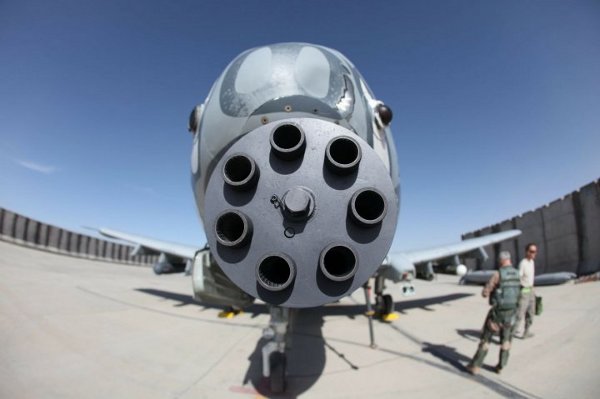
The Business End (c) Michael Yon 2010

There is no doubt that the A-10 Warthog is one of the coolest aircraft ever, no argument…it was designed to do one thing and one thing only: kill tanks. Against the mass exposed targets so thoughtfully provided by the Iraqi Army in 1991 and 2003, it proved eminently successful. So successful that the fast jet jocks who run the US Air Force that were scheming to do away with the A-10 were forced to back down and implement long overdue upgrade programmes. Unfortunately the production jigs for this flying tank had already been destroyed so what we have now is what we’ve got.

The thing about the A-10 that makes it so successful is not just its big gun but the fact that, in addition to dishing it out, it can take a ton of punishment as well everything about this aircraft is designed to bring the aircraft and its pilot back after a hard day converting armour to pillars of smoke. The same could not be said for the A-10’s proposed replacement, an F-16 with the 30mm GEPOD pod strapped to its belly. Not only does the F-16 totally lack the armour and built-in survivability features of the A-10, e.g. like two engines, experience with the gunless versions of the F-4 Phantom showed just how much you lose with a bolt-on gun and how little extra you might gain in ‘adaptability’. That then A-10 for all its utility in the complex environment is a diminishing resource is due to the undue influence of ego over fact within the senior echelons of the USAF. Similar mindset in the Navy maybe why the A-6 Intruder’s successful career was prematurely terminated after Gulf 1 in favour of multi-role-ism.

Similar ego-fed posturing seems to be behind the US hard-line attitude towards Iran and its nuclear programme. The sole redeeming feature of the current US rhetoric is that it appears to have more substance than the WMD arguments that led it into Iraq (and didn’t that work out well?). The nuclear genie is well out of the bottle and the US just needs to get over it, more so since it tacitly supported Israel’s nuclear weapons programme in the 60s and 70s; has opted to partner with Pakistan against the Taliban (also supported by Pakistan!), and take a ‘hope it turns out OK’ approach to xenophobic North Korea. The Sunday Herald reports that the US appears to be restocking its base in Diego Garcia with a range of earth penetrating bunker-buster munitions – of limited utility in Afghanistan except against cave complexes but ideal for disrupting work in underground research and storage facilities.

This is a worry on two counts. Firstly, you’d like to think that the most powerful nation in the world might be able to shift weapons around the planet without some journo plastering it across the media. Secondly. you’d also like to think that senior staff in the US Government might get over the unfortunate events of THIRTY YEARS AGO, get with the 21st Century, and realise that one of the reasons that the Islamic world burns effigies of The Great Satan every Tuesday is ego-driven idiocy like this. As Scott Atran says in his Edge article Pathways to and From Violent Extremism:
The Case for Science-Based Field Research

In sum, there are many millions of people who express sympathy with Al Qaeda or other forms of violent political expression that support terrorism. They are stimulated by a massive, media-driven global political awakening which, for the first time in human history, can “instantly” connect anyone, anywhere to a common cause — provided the message that drives that cause is simple enough not to require much cultural context to understand it: for example, the West is everywhere assaulting Muslims, and Jihad is the only the way to permanently resolve glaring problems caused by this global injustice.

If the road to Hell is paved with good intentions, then the spritual of the road gangs is Bomb Bomb Bomb, Bomb Bomb Iran