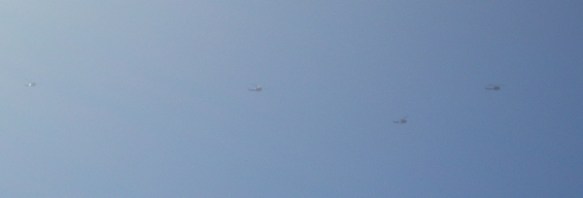
It’s a sight we don’t see very often these days, a four ship formation of Hueys, and will see even less of once NH-90 starts to come online at the end of the year…
We heard the familiar thwokka- thwokka approaching and ran outside – fortunately the camera was to hand as it always is when the twins are here – to choruses of “…hewicoppa, hewicoppa…” I snapped blindly into the sun and got one frame that caught all four…
I’ve got many hours in the back and memories of the venerable Huey and will be sad to see the last one depart our skies in a few years. They have been the mainstay of our tactical rotary wing capability for 45 years and pulled off some amazing feats…
I was on exercise in Malaysia in 1985, harboured up on one of the steep-as razorback ridges with massive trees reaching high into the sky. Late one afternoon, the company medic was drying his blistered feet by an open fire (you know how it goes: one rule for company HQ and another for the troops!!). Knowing he was due to go for a helo ride the following morning, he thought that he would be proactive and remove the gas canister from his cooker (gas canister are considered dangerous air cargo once the seal is broken and the Air Force is zealous in jettisoning such risks to the aircraft – nothing quite like seeing your pack spiraling into the jungle from a couple of thousand feet). Trouble is, said medic hadn’t quite joined the dots between the open fire he was drying his feet by and the highly flammable nature of th contents of the cylinder.
The inevitable happened: the gas from the cylinder as he removed it sprayed all over his feet and into the fire. In seconds he had literally roasted the flesh from both feet. Fortunately our CSM was an old soldier, former SAS and had spent his youth in South East Asian holiday spots like Borneo and South Vietnam – he was able to dose the medic up with morphine and dress the burns as the sigs called in a dust-off. When the Huey came in, it wasn’t able to drop the stretcher through the canopy. With the light fading and serious doubts as to the medic’s ability to last the night without hospital treatment – he was well into shock by this time – word was spread for everyone to get int heir pits and keep their heads down.
Robert Mason’s Chickenhawk had only been released the year before and was pretty much compulsory reading for soldiers at the time – in it he described the construction of the Huey’s rotor and how on occasion, it would be used to open up a tight LZ in emergencies. That’s exactly what happened in this instance: the Huey pulled back, dropped down a few metres and just drove into the trees. We, who all had our cameras ready, were suddenly burrowing into the bottom of our pits trying to make them deeper, as head-sized hunks of mahogany slammed into the ground all around us…the winch came down, the medic was strapped into the stretcher and lifted out, just as the sun disappeared…onya, 141 Flight RNZAF – we always knew you’d come for us when the brown stuff hits the spinny-round thing…


 Army Sergeant First Class Joseph Lemons, ANNAC flight medic advisor from the 438th Air Expeditionary Training Group, and his Afghan counterpart provide surveillance and security aboard an Afghan-piloted Mi-35 Hind helicopter on a training sortie over southern Afghanistan Oct. 3, 2009. (U.S. Air Force photo/Staff Sgt. Angelita Lawrence)


