Does New Zealand’s legal system favour some ahead of the rest of us?

ICCWC15As I See It By Terry O’Neill.

Does New Zealand’s legal system favour some ahead of the rest of us?

2014 Junior World Cup promising rugby star Tevita Li (19) was caught drink-driving in Auckland last May. Last week the Blues-contracted player was discharged without conviction by Judge Gus Andree Wiltens as long as he paid $210, the costs to establish his blood alcohol level. Judge Wiltens took into account that Li completed The Right Track programme and alcohol counselling, and justified his decision because, “A conviction would prove to be a real impediment to what so far has been a stellar career. All indications are that you can go a long way in rugby.”

A conviction possibly would restrict Li’s international rugby travel, and if he pursued a career overseas, teams may overlook him because of that black mark against his name. After his rugby days a clean record would keep the door open for his intention to follow his father into a police career. Another Blues player, George Moala, recently found guilty of assault with intent to injure, appears for sentencing in May, and will apply for a discharge without conviction. Try telling an ordinary 19 year old club rugby player that’d be a fair deal.

Recently I commented on former Olympic triathlete Kris Gemmell. The Court of Arbitration for Sport ruled Gemmell a 15 month ban after Drug-Free Sport NZ had appealed the NZ Sports Tribunal’s decision not to impose a sanction on him for missing a drug test in August, 2012. Last week the Tribunal cut his ban to 12 months stating his conduct would not be a violation under the new rules confirmed January 2015. Gemmell, basically vindicated, lost his International Triathlons Unions athletes’ committee role plus his position as its Global Head of Partnerships for the world triathlon series. He retired from international competition after the World Cup in 2012 but remained on the drug testing programme because he intended to involve himself in long distance racing.

Who had the self-righteous knife out at Drug-Free Sport NZ? Another graceless Tall Poppy blitz.

The Cricket World Cup kicks off next week amidst concerns for security during the tournament. If visitors seek easy access to NZ over the tournament period, visa-free entry is permitted provided an individual’s cricket interest is proved with, say, game tickets. This visa-free entry is primarily to allow ease of movement for cricket fans between NZ and Australia. Many “cricket supporters” from countries for which visas are usually required to enter NZ, have apparently used the “loophole” for easy entry. By last week 94 people had travelled here under the arrangement and others were prevented from boarding flights to NZ. Several Chinese passengers emphasised their intention to attend games and produced Cricket World Cup tickets as evidence but, ironically, those games were scheduled after their NZ departure dates.

And what a temptation to anyone “terroristically” inclined.

ENDS

Note: this version differs from that published in The North Otago Times.

Crisis in Syria and Iraq: All-in or all-out?

Manstan 231014

Josh Wineera is having a busy week…a successful engagement at the New Zealand Association for Training and Development Conference, followed by this op-ed for Fairfax. For me, a most refreshing change from the ‘usual suspect;’ domestic talking heads that are being trotted out to ‘comment’ on the developing situation in the Middle East. Read on…

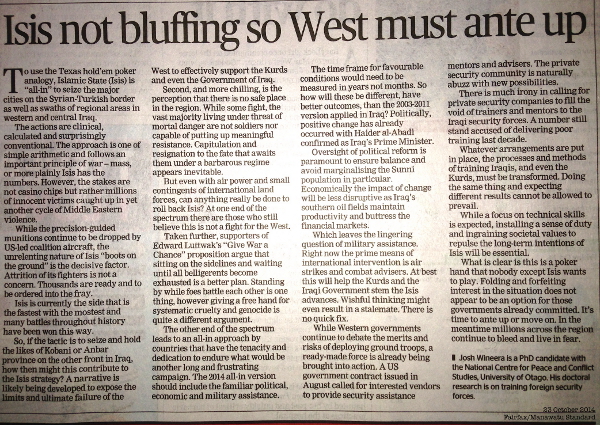
To use the Texas Hold’em poker analogy, Islamic State (ISIS) is ‘all-in’ to seize the major cities on the Syrian-Turkish border as well as swathes of regional areas in western and central Iraq. The actions are clinical, calculated and surprisingly conventional. The approach is one of simple arithmetic and follows an important principle of war – mass, or more plainly ISIS has the numbers. Unlike poker however, the stakes are not casino chips but rather millions of innocent victims caught up in yet another cycle of Middle Eastern violence.

While the much-vaunted precision-guided munitions continue to be dropped by U.S.-led coalition aircraft, the unrelenting nature of ISIS ‘boots on the ground’ is the decisive factor. Attrition of its fighters is not a concern. Thousands are ready and better positioned to be ordered into the fray. To coin the phrase, ISIS is currently the side that is the fastest with the mostest and many battles throughout history have been won this way.

So, if the tactic is to seize and hold the likes of Kobani or Anbar province on the other front in Iraq, how then might this contribute to the ISIS strategy? First and foremost a narrative is likely being developed to expose the limits and ultimate failure of the ‘West’ to effectively support the likes of the Kurds and even the Government of Iraq. This is certainly being helped along with media commentators such as Middle East correspondent Patrick Cockburn asserting the ‘U.S. strategy is in tatters as ISIS marches on’.

Second, and more chilling, is the perception that there is no safe place in the region to escape the onslaught. While some fight, the vast majority living under threat of mortal danger are not soldiers nor capable of putting up meaningful resistance. Capitulation and being resigned to the fate that awaits them under a barbarous regime appears inevitable.

But even with air power and small contingents of international land forces can anything really be done to roll back ISIS? At one end of the spectrum there are those that still believe this is not a fight for the West. Continued intervention is not the answer they decry.

Taken further, supporters of Edward Luttwak’s ‘Give War a Chance’ proposition argue that sitting on the sidelines and waiting until all belligerents become exhausted is a better plan. Standing by while foes battle each other is one thing, however giving a free hand for systematic cruelty and genocide is quite a different argument.

On this issue, if widespread butchery and carnage is the trigger for international reaction then according to Canadian journalist Neil MacDonald intervention in places like the Democratic Republic of Congo is more warranted.”ISIS’s acolytes are just apprentices at atrocity compared to some in the Congo”.

The other end of the spectrum leads to an all-in approach by countries that have the tenacity and dedication to endure what would be another long and frustrating campaign. The 2014 all-in version should include the familiar political, economic and military assistance. The time frame for favourable conditions would need to be measured in years not months. So how will these be different, have better outcomes, than the 2003-2011 version applied in Iraq? Politically, positive change has already occurred with Haider al-Abadi confirmed as Iraq’s Prime Minister. UN Secretary-General Ban Ki-moon welcomed al-Abadi’s formation of a new inclusive Government in Iraq.

Oversight of political reform is paramount to ensure balance and avoid marginalising the Sunni population in particular. Economically the impact of change will be less disruptive as Iraq’s southern oil fields maintain productivity and buttress the financial markets. Inter-Governmental Organisations such as the World Bank and International Monetary Fund are not expected to have to significantly intervene.

Which leaves the lingering question of military assistance. Right now the prime means of international intervention is air strikes and combat advisors. At best these immediate efforts will help the Kurds and the Iraqi Government stem the ISIS advances. Wishful thinking might even result in a stalemate. There is no quick fix. Pentagon spokesman Rear Admiral John Kirby has said “people need to understand we need a little strategic patience here…it is going to take a bit of time”.

While western governments continue to debate the merits and risks of deploying ground troops, a ready-made force is already being brought into action. A U.S. Government contract issued in August called for interested vendors to provide security assistance mentors and advisors. The private security community is naturally abuzz with new possibilities.

Eric Prince, founder of controversial security contractor Blackwater, has waded into the conversation. Calling the Iraqi Army inept after billions spent on training and equipping them, Prince suggests, “if the old Blackwater team were together, I have high confidence that a multi-brigade size unit of veteran American contractors or multinational force could be rapidly assembled and deployed to be the necessary ground combat team”. He goes on stating, “a competent professional force of volunteers would serve as the pointy end of the spear and would strengthen friendly but skittish indigenous forces”.

There is much irony in calling for private security companies to fill the void of trainers and mentors to the Iraqi security forces. A number still stand accused of delivering poor training last decade.

Whatever arrangements are put in place by international military forces or private security companies, the processes and methods of training Iraqi’s and even the Kurds must be transformed. Doing the same thing and expecting different results cannot be allowed to prevail. While a focus on technical skills is expected, installing a sense of duty and ingraining societal values to repulse the long-term intentions of ISIS will be essential.
What is clear is this is a poker hand that nobody except ISIS wants to play. Folding and forfeiting interest in the situation does not appear to be an option for those governments already committed. It’s time to ante up or move on. In the meantime millions across the region continue to bleed and live in fear.


Josh Wineera is a member of the New Zealand National Forum for the Council for Security Cooperation in the Asia Pacific. He is also a PhD candidate with the National Centre for Peace and Conflict Studies at the University of Otago. His doctoral research is on training foreign security forces.

Training the Iraqi Army: The Sequel

Manawatu Standard 1 Jul 14

A sequel often fails to live up to the success of the original movie. A rehashed storyline, tired characters and predictable dialogue often make for painful viewing. Some things are simply best left as they are.

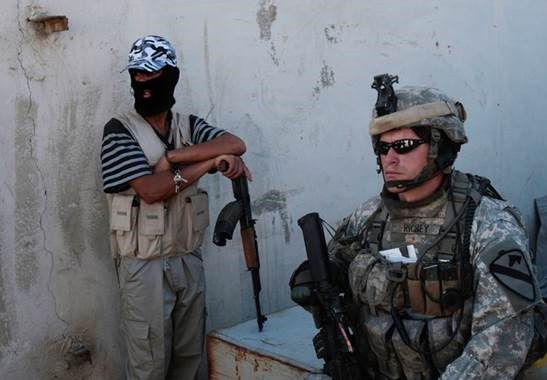
So what then to make of the recent announcement by U.S. President Barak Obama to send some 300 military advisors to help train the Iraqi Army to defeat the forces of Islamic State of Iraq and Syria? Certainly the light footprint, rather than deploying tens of thousands of American combat troops, represents a more pragmatic approach from a nation still battle-weary from Afghanistan and Iraq Part 1 (though some could argue this new commitment is Part 3 when considering the Gulf War of 1990-1991). During the past seven days many western media and security experts have had to resort to hourly news cycles, such is the speed of this fast-moving crisis.

While there is no stated intention for U.S. troops to engage in combat, the rapid advances by Islamic militants and the chaotic environment of this intensified and new insurgency may, in some circumstances, make that very difficult. No doubt once on the ground the advisors will be careful to keep out of the battle but as all veterans know, when you’re caught in a fire-fight everybody fights.

Within the United States, there are furious accusations and blame concerning the training and resources dedicated to raising the Iraqi Army. As reported in the New York Times, “training the Iraqi Army and other security forces was a seminal mission for United States forces before the last American troops left in 2011”. $25 billion has been spent training and equipping Iraq’s security forces, according to a report by the special inspector general on Iraq.

Lieutenant General Mark Hertling and Lieutenant General James Dubik, both former senior U.S. commanders who served in Iraq, defend the training of the local security forces despite the recent losses. Blame appears to be directed at Prime Minister Nouri al-Maliki’s, with claims of purging some of the most talented commanders and using the military to target political rivals. Dubik is reported to have panned the political interference of the military, simply stating “they are crumbling”.

Questions will now be asked of the training of foreign security forces and undoubtedly the preparation of the trainers themselves. Was cultural awareness and language proficiency sufficient to teach indigenous forces? Did it matter that ones teaching style might be different to the learners learning style, especially if the skills such as firing a rifle are more akin to rote learning? Certainly ‘mechanical’ skills are taught quite quickly, and remaining competent is more about repetition than critical thinking.

But, what then of developing such things as morale, esprit de corps, and defending both the state and the individuals of the state – regardless of ethnicity? What about ingraining an understanding of the rule of law and subordination of the security force to its civilian leaders? Leaders, that scholar Marina Ottaway reasons “should not try to impose common identities on deeply divided peoples but to organise a state that can administer their territories and allow people to live together despite differences”.When conditions such as these are met, meaningful reform and increased and enduring capability of the indigenous security sector has a chance for success.

Ironically, many commentators seem to have forgotten Obama’s speech at the West Point Military Academy just five weeks ago. “I am calling on Congress to support a new counterterrorism partnership fund of up to $5 billion, which will allow us to train, build capacity and facilitate partner countries on the front lines”, said the President. His speech was either prescient or coincidental. Irrespective, from a foreign policy standpoint, the training of foreign security forces will be a long-term objective. American historians will no doubt hear echoes of President John F. Kennedy’s 1962 speech at West Point, “In the years ahead, some of you will serve as advisors to foreign missions or even to foreign governments”. Kennedy further impressed on his audience the need to understand the utility of military power and also the limits of military power.

The intervention of American advisors, even in concert with airstrikes requested by the government of Iraq, will not bring closure to this current crisis. For the U.S. or even the U.N. the dilemma remains familiar. Do something, which could turn out to be counter-productive, or do nothing which might seem counter intuitive. Regardless, as the intervention of advisors has already occurred the focus must be on helping arrest the threat of total civil war and establishing the necessary space for political dialogue, negotiation and ultimately reform.

If this is the outcome achieved, then perhaps this whole situation is not so much a sequel but rather an epilogue that is desperately needed by all the people of Iraq.

____________

Josh Wineera is a former irregular warfare lecturer with Massey University. He is a PhD candidate with the National Centre for Peace and Conflict Studies, University of Otago. His doctoral research is on training foreign security forces. 


Unmanned aircraft for Search and Rescue: not quite that simple, TV3…

(c) TV3 2014

(c) TV3 2014

There was an interesting item on Campbell Live last night about the use of ‘cutting edge’ unmanned aircraft for search and rescue applications (note the video in the linked article may not work for overseas readers). While it all looked very cool and exciting, it was a little misleading when it presented these small UAs as ‘…running on the spell of an oily rag…’, beyond the blindingly obvious fact that all the UA shown were electrically-powered and thus rather unimpressed by the proffered ‘oily rag’!

A reliable UA of any size is not cheap…your average Toyworld flying camera device may last for a while, but eventually you will end up with a large number of them scattered over the land- and seascapes. In addition they tend not to have the endurance necessary for any practical employment for search and rescue other than perhaps peeking into nearby spots not easily accessible by a person. You get what you pay for and if lives are relying on it, the device must be reliable and have sufficient endurance to be useful.

Unmanned aircraft systems are not really unmanned: it’s just that the flying component lacks seats in most cases. They all require at least one person to operate them and, for safe operation, generally at least two are required: one to control the aircraft, and others to observe the airspace for any other users and these may include not just other aircraft but para-surfers, kites and any of our feathered friends that may take offence at this noisy intruder into their domain. If operating at very low altitudes as shown in the video clip, the ground observers may also have to watch for vessels on the surface as well. Relying on volunteers is all very nice but UAS operators need to be trained and accredited to conduct any but the most limited flying.

The supporting infrastructure costs as well, not just in the cost of initial setup and acquisition but also in the ongoing maintenance including the regular replacement of critical components as they reach the end of their defined life. If supporting a SAR operation in a remote area, the unmanned aircraft system will probably need to include some form of vehicle, also not cheap.

All those video visors, laptops and viewing screens seen in the video clip? Again, not cheap.

It appeared that all the UA shown in the clip were flown directly from a controller similar to that used by the remote control aircraft community. While this may be practical for short (in time and distance) flights, this form of control for longer flights is inefficient and places a greater burden on the operator. All the flights shown in the clips appeared rather ad hoc and ‘zoomy’ i.e. all very cool looking but lacking the methodical search pattern essential in a for-real search and rescue operation. An effective autopilot allows the UA to maintain controlled flight and follow a methodical search pattern without constant operator input. Again, this necessary technology is not cheap; it’s not THAT expensive either but has to be reliable and also professionally integrated into the other systems that make up the UAS.

While I think that it is great that the national search and rescue community are researching the potential of unmanned aircraft for this role, and that there is a great potential for UA in this role, I also think that they would get a better return on their investment in time and money by not seeking to design their own UA or supporting the ‘I built a UAV in my garage‘ community and instead engaging directly with the existing (and growing) commercial UAS community both in New Zealand and overseas. I think that they would find that there would already be existing mature reliable designs that would meet all the requirements shown in the video item…and that reliability comes at a cost…

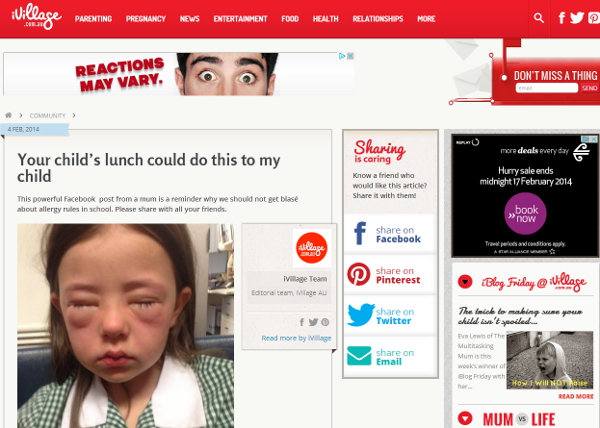
My child has a peanut allergy. This is what a lunchbox did to her

nutz

My child has a peanut allergy. This is what a lunchbox did to her.

I’m sorry but, while not unsympathetic, this just annoys me…yes, it is really sad but trying lump responsibility on to the rest of the world for what happened to this little girl is just wrong. It is symptomatic of the “my problems are everyone’s problems” attitude that typify our growing inability to take responsibility for our own problems.

In this instance, the little girl did not eat any nuts but her allergy was triggered by exposure to another child who had eaten something nut-based.

Sorry, Mum, but if your children has a disability is is YOUR responsibility to keep them safe and ensure that they can live as normal a life as possible. Wrapping your little girl in cotton wool or glad wrap is not going to help prepare her for life especially if she does not  eventually outgrow her nut allergy. Even if all daycares, preschools, schools and after-schools totally ban all nut products and derivatives of nut products and and apply bio protective measure that CDC would be proud of, that will still not protect her from casual contact with nuts, nut derivatives or nut byproducts…

It may be that she does need to become like The Girl in the Plastic Bubble in order to avoid contact with the elements that trigger her allergy but it is your responsibility as a parent to implement the measures necessary to protect her from exposure to those triggers. Reasonably one might expect those with whom she is in regular contact to work with you to implement and apply those measures and to reduce as much is reasonably possible the opportunities for such exposure…But is is not reasonable, especially when it appears that she is so sensitive to the allergenic triggers to expect everyone that she may encounter during a day at school to also avoid all exposure to nut-based elements that may trigger her allergy…

We need to stop simply following our emotions in sharing such links and start thinking about what we are actually doing. This is a family that may actually be in need of some serious assistance to mitigate  the effects of this little girl’s allergy but that assistance is not going to come from some knee-jerk Facebook link sharing…use your brains, folks, they are there for more reason that to keep your ears apart…

Three things

1

DSCF7567

Paul Henry is back. Excellent! More excellent when they reunite him with Pippa to keep him honest…

2

DSCF7566

Stephen Hoadley has suggested that the best future for Afghanistan may be one split into North (for the normal people) and South (for the rabid nutjobs). This is one of the more coherent options to be put forward so far, especially as ongoing Karzai intransigence draws the US and NATO ‘zero option’ closer to reality…

dm claus…and in a timely and related comment, Doctrine Man reminds us that we need to think about outcomes before we launch into any knee-jerk good ideas for military deployments post- 2014 Afghanistan…like they used to say at the Tactics School “…every task must have a purpose…” i.e. it is not enough just to be or, worse, to be nice…

3

whaleHa-bloody-ha…there is such a thing as karma after all…while I don’t condone death threats at all – be nice to see proof of said threats though, Cam – I think that it is funny-as that this guy who quite happy lips off at all and sundry has been taken to task for being a dick…I can not believe that he had the gall to refer to someone else as ‘feral‘…

Zygons…Schmygons…

Image

I would like to say that I made a special effort to get up early on a Sunday morning for this but even for me on a sunny Sunday  morning, 9AM is comfortably civilised…

I only vaguely remember the first Doctor, William Hartnell, but grew up with the Patrick Troughton, Jon Pertwee and, to a lesser extent, Tom Baker takes on the role. I guess it would have been midway through the Tom Baker era that I grew up and gave up such childhood tales in favour of adult things like girls and beer…I remember think that the Doctors after Tom Baker’s #4 were quite silly and frivolous and the monsters pale in the face of the Daleks, Autons, Cybermen and Abominable Snowmen…

So now, fifty years on, where are we? The Doctor is now a major exploitable franchise being worked for all it is worth. I was a latecomer to the revitalised Doctor in the mid-2000s…I equated it with my memories of silliness and frivolity and that might never have changed if I hadn’t stopped over with friends on my way back from a trip to the UK and they were watching the finale of the Christopher Ecclestone series and I hooked drawn back into the world of the Doctor. I still haven’t seen any of that series bar the finale but loved the David Tennant era with companions Rose, Martha and Donna. I thought that that era ended well but have been unimpressed totally with the much more commercially-exploited Matt Smith era where the fez, fish fingers and custard, and the whole Amy Pond thing just left me cold – mercifully the BBC resisted the temptation to thrash the Pond thing any further in the 50th Anniversary special, The Day of the Doctor, that screened globally this morning…

If you haven’t seen it yet, you may not wish to read past this point…you have been warned…

There were too many cutesy distractions in this 75 minute special…although the multiple Doctor thing has been done before, there was no real sense of drama of impending threat in this story and what there might have been was continually eroded away by the Morecombe and Wise style of repartee between the Tennant and Smith Doctors: if the intention was to play the 50th for laughs, then the story should have reflected this…

The Zygons were never amongst the great or scariest of Doctor Who aliens…barely Second XI, if that…what value they added to this story is tenuous at best and resolution of this part of the plot really only seemed like a loose vehicle to enable the Tennant and Smith Doctors to work off each other. Take the Zygons out of the story, and you essentially have…the same story, just shorter – I’d be keen to see a Zygon-less bootleg version of The Day of the Doctor

The time wasted on the Zygons could have been employed much more effectively to further develop the thirteen Doctor concept and the ultimate destruction of Gallifrey – an apparently pivotal event that the Smith Doctor regularly angsts about – we seem to have forgotten that the Tennant Doctor committed genocide on a universal level against the Daleks in his final series and that this has never been mentioned since. That may be because the Daleks have become like British Paints and ‘keep on keepin’ on‘ and so never did quite get genocided…

One of the things that I liked about the Tennant series was that it was all about hope, where the Smith era has been characterised by alternate frivolity and angst. It is revealed this morning that it was the (John) Hurt Doctor that pushed the button on Gallifrey as the only way to end the war between the Time Lords and the Daleks. Hurt’s depiction of the dilemma of sacrificing to few to save the many is very well done and if maintained, would have made this special an epic…unfortunate the writers succumbed to contemporary niceness and introduce an unlikely hope-based solution in which everyone (less the Daleks) gets to live happily ever after…

Although, yes, this is only a TV special and science-fiction at that, this is symptomatic of a malaise that seems to be affecting us more and more, a distancing from the realities of the world in favour of a cloud cuckooo vunderland where there are no harsh dilemmas and everything always turns out alright on the day. Sometimes  there are no real winners, just maybe lesser losers, where hard decisions have to be made…as much I may diss the Fulda Gapists that long for a return to the less complex days of conventional conflicts, one thing that those dinosaurs knew was the use of force as an instrument of, not so much national power, but of national survival…where the needs of the few are outweighed by the needs of the many.

This is not just in the sense of wielding the big nuclear stick but also in how even tactical actions are conducted where it may be necessary to risk one element in order to enable or save a larger formation, to employ area weapons to neutralise greater threats like air defence structures, or the growing spectre of accidental or deliberate release of bio-chem weapons…and sometimes civilians and other non-combatants get caught in the middle of all this and become part of ‘the few’…

…that war can be conducted in clean surgical manner is the ongoing Myth of Desert Storm that fails to take into account that there has not been a major force on force conflict since Vietnam and the October War in the early seventies…this myth ignores cold hard realities and results is military generations that are not capable of considering the hard issues and making those hardest calls where there are no winners…just lesser losers…ultimately it is NOT all about ‘the people’ but achieving national objectives…

So this morning we were presented, in the end, a happy happy joy joy ending instead of the deeper darker theme implied in the original idea…hope is nice but sometimes you have to be prepared to get down and dirty and make those tough decisions when hope is not enough…

With the (finally) demise of the Smith Doctor, the ball is now in the 13th Doctor’s court to restore some of the drama to the Doctorverse and dispel the silliness and frivolity that have been allowed to, Seeds of Doom-like run amok and dominate the ‘verse…

The great rift

Open Letter to My U.S. Government – This Veteran is Mad as Hell – Listen Up! That’s an Order
This good Catholic girl is mad as hell (and I never use that word, so that should tell you just how mad I am!) Read more…

image

  Yes, the great rift…and I am not referring to a major geographic feature in Africa…as an external observer, it has been fascinating and concerning to watch the US government slowly shake itself to pieces with impasse between both irresponsible factions in the Senate.

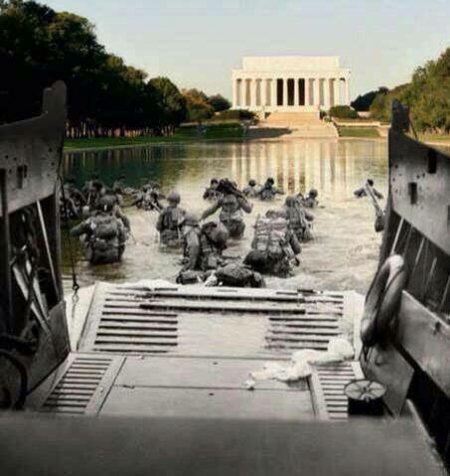
Impasses over budgets, national debt and welfare policy are not unknown nor that unexpected…the real concern is the manner in which the government has resorted to the most petty means to maximize the hurt and inconvenience for the people. This is clearly a campaign if not led, certainly endorsed at the highest levels – such pettiness could not be sustained otherwise. To bar survivors of ‘The Greatest Generation’ on what for some may be their first and last visit to the memorial erected in their honour is not only inexcusable, it is the sort of petty arrogance that would see governments unceremoniously evicted in almost every other western nation. It has already been pointed out that, when this happened in Australia in the 70s, the government was promptly sacked by the Governor-General.

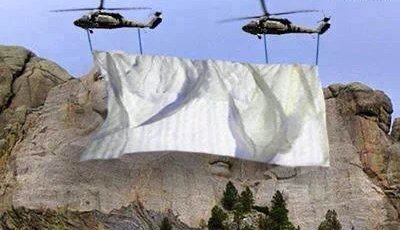
 How do you get to close Mount Rushmore or shut off the sea or prevent people from living in holiday homes on federal land? Yeah, sure, I get that government agencies have to close when staff can not go to work but closing websites and preventing photography or access to memorials that do not require staffing? Puhlease! Give us a break…

The scary thing about all of this is it displays the almighty rift between government apparently from the people, by the people and from the people and the people themselves – representatives who appear more interested in playing petty political games than actually doing their level best to ensure that the best interests not those they present – the actual people, not the endless and mindless lobby and special interest groups – are looked after. Big fail, Congress, epic fail, Senate, super epic fail, Mr President.

It is good to see people getting angry about this but will it do any good unless the system itself is changed, unless political representatives are made responsible to the people they apparently are from, by and for, unless that rift is closed…? As one of the comments on Cynthia’s blog states ‘…time to take your country back...’ And that’s not a call to war, it’s a call for change, to return to your core values – and  that includes putting big business back in its box – in all fairness to the reigning president, he did give the banks a thrashing when he first came to power – and perhaps a period of introspection about your place in the world…

That is all.

Carry on.

wpid-IMG_20131012_205152.JPG

A battle lost…

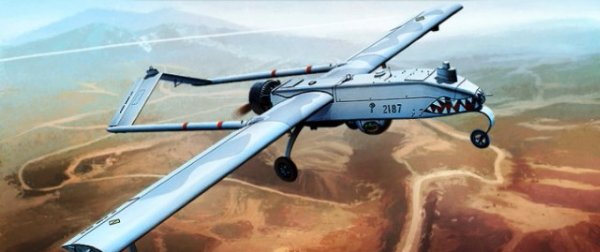
Don’t Use the ‘D’ Word: They’re ‘UAVs’ or ‘RPAs’ But Definitely Not ‘Drones’

I came across this article on the Information Dominance Corps Self Synchronization (yes, it is bit of mouthful) Facebook feed…once upon a time this argument may have mattered but now it is nothing more than ambient noise. We have far more important things to worry about in the UAS world than mindless semantic games…

IMG_20131012_113957

Does it matter really if I call this a plane, an aircraft or an airplane?

IMG_20131012_111627

Or this a helicopter, a whokka, a helo, a rotary-wing aircraft or a whirlybird.

IMG_20131012_112608

Or this, a car, an automobile or a vehicle?

No…it doesn’t, not in normal colloquial speech and writing…many years ago, I remember great battles ranging over whether vehicles like LAVIII and Stryker were medium infantry, mech infantry or some weirdo thing called heavy infantry. This went on for months and about the points of agreement were that they were neither the light infantry or tanks so dear to our hearts. In the end, the general issued an all-points stating that he didn’t care if they were called the Third Pink Flying Pig Brigade and that he was more interested in what we could do with these things.

Dictionaries have already added the unmanned aircraft definition of ‘drone’ so there is not much point arguing the toss anymore. What is important is that we use the correct terminology when we talk about unmanned aircraft within our community and when we engage with external audiences. The general public can quite happily refer to them as drones, just all of us equally happily refer to cars, planes and choppers…

Personally I think that we need to stop treating UAS as something mystical and special and start to treat them simply as what they: unmanned aircraft…aircraft that do not normally operate with an onboard pilot…and within unmanned aircraft, we have , in our  technically correct lexicon, remote-piloted aircraft, optionally-piloted aircraft, remote control aircraft, drones (in the technical sense), etc,etc…

The more that we treat UAS as something special, the harder we make it employ properly and integrate them in to our airspace. Do we really need Unmanned Combat Aerial Vehicle or UCAV, or would unmanned combat aircraft suffice? …and unmanned fighter, unmanned bomber, unmanned transport etc? Hmmm…

image

Just call me Al

The Resurgency of Insurgency

clip_image002

© Chris Hondros/Getty Images News

The Resurgency of Insurgency

Intervening to support an insurgency – not fight it

Josh Wineera

After 10 years of fighting two major insurgencies, many western nations can feel comfortable that they have advanced their thinking and practice of counterinsurgency operations. The intellectual and policy effort brought to bear on countering the Iraqi and Afghan insurgencies has been quite staggering, perhaps even greater than the proliferation of deterrence and containment theories promoted during the Cold War.

The establishment of new think-tanks in Washington D.C. such as the Center for New American Security, aside more traditional institutions such as the Carnegie Endowment for International Peace, has helped cultivate and revitalise military counterinsurgency strategies and doctrine. The language of counterinsurgency is ubiquitous, to the point that politicians, academics, generals and soldiers can quite easily converse about “protecting the population” and “building the capacity of the host nation”. In the 21st century, counterinsurgency has been codified, systemised and established as ‘must-do training’ for land forces in particular. “Insurgents are bad” and “we must support the weak or fledging host government” is not just a catch-cry but is firmly embedded in the military psyche. But this is not good, not good at all.

In becoming proficient, maybe even obsessed with counterinsurgency training, the dangerous assumption is that military forces will only be used to counter insurgents and establish or re-establish a host government’s right to govern. What then if the government or the state elites are actually the problem? That either through corruption, disregard for the international system or most likely an oppressive and brutal approach to its citizenry – surely that type of government, with any preceding military intervention calls for a 180-degree turnaround from countering an insurgency to actively encouraging and supporting an insurgency to remove it. What then if the insurgents are the “good guys” and the government is the “bad guy”?

The resurgency of insurgency has been a feature of the Arab Spring. Libya, Egypt and Syria are classic examples of governments being re-characterised as ‘regimes’, with many in the international community willing to encourage insurgents to depose the regime. This of course is nothing new, aiding the weak to vanquish the strong. Military intervention in these cases has been primarily the use of strategic stand-off capabilities, such as attack aircraft, and Special Forces. Provision of weapons to the insurgents, such as lifting of the embargo in Syria, is a case in point of trying to equalise the conflict.

So what then of the counterinsurgency training of the general purpose military force? How hard or easy is it to change, or even balance the training to be prepared to support and fight with insurgents to depose recalcitrant governments and their state forces? If in a counterinsurgency sense, working with the fledging security forces of governments we like is hard, how about then in a pro-insurgency sense, the greater difficulties of fighting alongside a less structured and less organised mish-mash of rebels who seek to oust their political leaders? Where is the manual for that, where is the Field Manual FM 3-34 Counterinsurgency for supporting insurgencies?

For sure, there are doctrines that relate to associated operations such as guerrilla warfare and subversion. By and large however, these remain the purview of Special Forces. The thought that general purpose forces would re-orientate to irregular warfare, towards counterinsurgency in particular, was considered fanciful prior to 9/11. But look where we are today. There would hardly be a land forces training exercise that doesn’t incorporate some kind of insurgent activity – insurgents equals bad, host government equals good.

It is time to consider weighting an equal amount of military thinking and training around intervening and supporting other government forces as well as opposing them and supporting anti-government forces. The intellectual and policy effort has already recognised this. Some governments we like and will support, some governments we don’t and may have to take action to remove them. The pressing challenge for military planners and trainers therefore, is to prepare for both.

_________________________
Josh Wineera lectures on joint, interagency and multinational operations and irregular warfare at the Centre for Defence and Security Studies, Massey University. His research interests include international security, state-building and security sector reform.