Unknown's avatar

About SJPONeill

Retired(ish) and living on the side of a mountain. I love reading and writing, pottering around with DIY in the garden and the kitchen, watching movies and building models from plastic and paper...I have two awesome daughters, two awesome grand-daughters and two awesome big dogs...lots of awesomeness around me...

Hey, Skippy! Bugger off!!

In my last post I commented on how these guys…

have been picking on these guys…
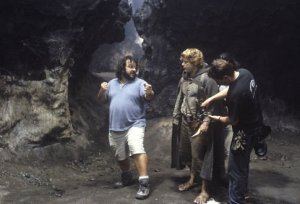
In Get Frank, Sir Peter Jackson offers his own thoughts on this blatant attempt to muscle in and screw up the Kiwi film industry and these are well worth repeating in their entirety….this may not be a biggie to the rest of the planet but way down under we get a little miffed when the Big Brother to our west tries to throw its weight around, more so when it has managed to screw up its own film industry – although after the last Star Wars trilogy it probably didn’t need much help…in terms of Countering Irregular Activity – and it just struck me that we could change this to Countering Irregular Behaviour and get away from that whole CIA issue – this is exactly the type of activity that comes under the heading of irregular…the potential cost to this little nation of losing not only production of The Hobbit, but possibly other big ticket productions is just as harmful as if a terrorist incident shut down our tourism business…

As of this morning, the Government has stepped up to the plate to get this squared away…Govt offers to mediate The Hobbit dispute…like Bridget Smith in Imagine a World, I like not only going to the movies, but that fact that many of the movies I like are made here….

Anyway here’s what Sir Peter says…

Statement regarding The Hobbit and claims by the Australian Media Entertainment and Arts Alliance (MEAA):

The Australian Labour Union, the MEAA is using our production The Hobbit in an attempt to widen it’s membership, and power within the New Zealand film industry. As a New Zealand filmmaker, who has nothing to hide or be ashamed about, I’m not going to see this threatening behaviour continue without some form of sensible discussion about the “facts” and “truth” behind their various allegations.

It’s incredibly easy to wave the flag on behalf of workers and target the rich studios. It’s not hard to generate an emotive response, nor is it hard to sway public opinion, since nobody seems to like the facts to get in the way of a good story in these situations.

Behind the claims of exploiting actors who are cast in the “non-Union” Hobbitproduction, and claims that various high-profile stars will refuse to take part in the films, there are clear agendas at work. As usual with these agendas, they are based on money and power.

I am not a lawyer, nor am I an expert in unions and how they operate – but I like to think I have a degree of common sense, and that’s what I’m basing my observations on. Let me run over a few facts:

– Personally speaking, I’m not anti-Union in the slightest. I’m a very proud and loyal member of three Hollywood Unions – the Directors Guild, the Producers Guild and the Writers Guild. I support the Screen Actors Guild (SAG). All these organisations (I must confess I’m not entirely sure what the difference is between a “Guild” and a “Union”) do terrific work on behalf of their members.

– Many Actors are members of SAG, but many are not — especially younger actors and many Australian and New Zealand performers. MEAA claims we are “non-Union”, but whenever we hire an actor who belongs to SAG, we always honour their working conditions, their minimum salary agreements and their residuals.

– The SAG residuals is a small pot of money that comes from the movie’s profits. The DGA and WGA have similar schemes. An agreed upon percentage of movie profits is placed in a pot, which is shared amongst the members of the guild who worked on the film in question. Despite MEAA claims that The Hobbit is “non-Union”, our studio, Warner Brothers, is honouring these residuals, and making the profit sharing available to all the various Guild members – just as it did on The Lord of the Rings, and Universal did on King Kong.

– These residuals can be worth tens of thousands of dollars to an individual if the film is successful – however the normal situation is that if an actor is not a member of SAG, they do not share in the profit pot.

– This has always struck us as unfair, since most Kiwi actors are not lucky enough to be SAG members. For the Hobbit, Warner Brothers have agreed to create a separate pot of profit participation, which will be divided up amongst non-SAG actors who are cast in the film. This was not done because of any pressure from Guilds or Unions – it was actually Warners doing the decent thing, and New Zealand and Australian actors will be the principle beneficiaries. SAG members have their pot, and non-SAG members now have theirs. We have introduced the scheme to Kiwi agents and it’s now part of all our Hobbit cast deals.

– Whatever damage MEAA is attempting to do — and it will do damage, since that’s their principal objective in targeting The Hobbit – we will continue to treat our actors and crew with respect, as we always have.

– As I said earlier, money and power lies behind this threatening behaviour from our Australian cousins, and to fully understand that, you simply have to step back and look at the greater picture in context.

– It starts with “NZ Actors Equity”. This is a tiny organisation that represents a small minority of New Zealand Actors. They are not a Union, and have none of the legal status of a Union. They are a … well, a smallish group who have some New Zealand actors as members. How many actors are members of NZ Equity? They guard that information very closely, but various reports I’ve seen put their membership at 200, although somebody in the know swears it’s nearer 100.

– How many professional actors are there in New Zealand? Somewhere between 2000 and 4000, depending on just how you describe a “professional actor”. Obviously most Kiwi actors have other employment too, but there’s certainly over 2000 actors available to cast in a film production.

– So taking the most generous numbers, NZ Actors Equity represents 200 out of 2000 Kiwi actors, or 10%. Perhaps I’m wrong, and if so, NZ Equity will no doubt reveal their real membership numbers.

– Now there’s nothing wrong with NZ Actors Equity representing 10% of the actors in this country. It’s great that they offer that service, and if an actor chooses, there’s a supportive group they can join. Obviously the more actors that join NZ Equity, the better, since these organisations usually survive by taking a small percentage of their members acting fees. I’m guessing that Equity do something like that. Recently they have been part-funded by MEAA.

– Over the last 10 years our relationship with NZ Equity has been rocky — whenever we cast an “overseas actor”, we get a letter telling us why such and such Kiwi actor would be so much better in the role. In most cases we have already auditioned the actor in question, and formed our own opinions — but what strikes me as unfair, is how this “helpful” service of suggesting better choices only includes the “Equity 200″. If you happen to be a good actor who doesn’t belong to NZ Equity (and many don’t), you’re automatically not good enough to be put forward.

– What really does strike me as wrong, and this is my personal opinion, is the why that the MEAA is using NZ Actors Equity as a vehicle to represent the voices and opinions of New Zealand actors. A couple of years ago, the members of NZ Actors Equity voted to join some kind of alliance with the Australian MEAA group. At the time, there were voices of alarm at how this relationship could damage the interest of Kiwi Actors, but the merger went ahead – and now we’re about to find out just how damaging it’s going to be.

– As far as I know, the membership of NZ Actors Equity was allowed into the MEAA, meaning that the Australian MEAA organisation represents 200 out of 2000 Kiwi actors. I don’t believe it represents non-Equity NZ actors. It speaks on behalf of a tiny minority of our actors.

– The management of NZ Equity are clearly happy to be used as a political football by the Australians — but my sympathy goes to the 1800 New Zealand Actors who are not part of the “Equity 200″, but who are going to suffer the fallout if this Hobbitthing goes nuclear.

– I also feel a growing anger at the way this tiny minority is endangering a project that hundreds of people have worked on over the last two years, and the thousands about to be employed for the next 4 years. The hundreds of millions of Warner Brothers dollars that is about to be spent in our economy.

– Why is this endangered? Because the “demands” of MEAA cannot be agreed to, or even considered – by law – and therefore the only options that remain involve closing the Hobbit down, or more likely shifting the production to Europe. It could so easily happen. I’ve been told that Disney are no longer bring movies to Australia because of their frustration with the MEAA.

– The MEAA is demanding that the Hobbit production company (Warners owned, 3foot7 Ltd) enter into negotiations for a Union negotiated agreement covering all performers on the film.

– I personally have a problem with any organisation who represent a small minority, but attempt to take control of everyone – but that’s not the real issue. The complex web of NZ labour laws are the reason why this demand will never be agreed to.

– NZ law prohibits engaging in collective bargaining with any labour organisation representing performers who are independent contractors, as film actors clearly are. The NZ Commerce Act claims it would be unlawful to engage with an Australian Union on these matters.

In closing:

My personal opinion is that this is a grab for power. It does not represent a problem that needs a solution. There will always be differing opinions when it comes down to work and conditions, but I have always attempted to treat my actors and crew with fairness and respect. We have created a very favourable profit sharing pool for the non-Union actors on The Hobbit — and now the Union is targeting us, despite the fact that we have always respected SAG conditions and residuals.

I can’t see beyond the ugly spectre of an Australian bully-boy, using what he perceives as his weak Kiwi cousins to gain a foothold in this country’s film industry. They want greater membership, since they get to increase their bank balance.

The conspiracy theories are numerous, so take your pick: We have done better in recent years, with attracting overseas movies — and the Australians would like a greater slice of the pie, which begins with them using The Hobbit to gain control of our film industry. There is a twisted logic to seeing NZ humiliated on the world stage, by losing the Hobbit to Eastern Europe. Warners would take a financial hit that would cause other studios to steer clear of New Zealand.

– Seriously, if the Hobbit goes east (Eastern Europe in fact) — look forward to a long dry big budget movie drought in this country.

– Others gain from that too. SAG would much rather have it’s members hired on movies — as opposed to non-SAG actors. The easiest way to control that, is to stem what are called “runaway productions”, which are American funded films made outside of America. The Hobbit is one of them, as was King Kong andLOTR. SAG, which is naturally supporting MEAA, would see it’s own benefit in studios having a miserable experience in Australia/New Zealand. That may well be pushing the conspiracy theories one step too far, and it’s perfectly natural that one Union would support another – but the point is that in the complex web of Hollywood intrigue, you never really know who’s doing what to whom and why.

But it sure feels like we are being attacked simply because we are a big fat juicy target – not for any wrong doing. We haven’t even been greenlit yet! It feels as if we have a large Aussie cousin kicking sand in our eyes … or to put it another way, opportunists exploiting our film for their own political gain.

Peter Jackson

(NB: This represents Peter Jackson’s opinion as a Kiwi filmmaker, and not that of Warner Bros or New Line Cinema, who were not consulted about this statement.)

Irregular?

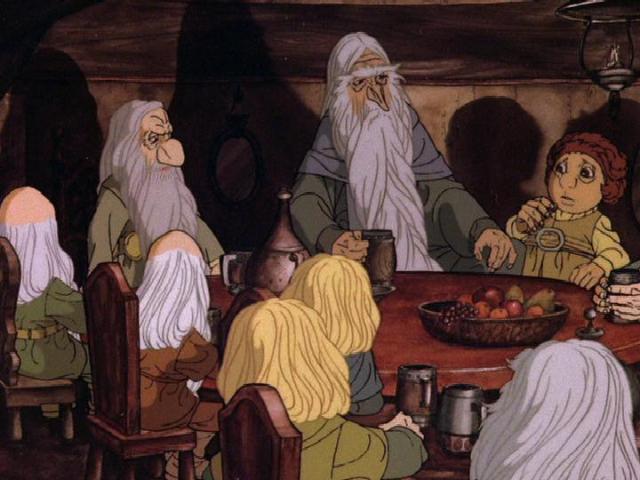
...and then the big Aussie Union wizards got grumpy with The Hobbit...

…and then the big Aussie Union wizards got grumpy with The Hobbit…

Irregular?” might be the opening line of a laxative advertisement and I have to admit that this issue of Aussie unions being allowed to muscle in on a New Zealand company producing a movie in New Zealand has about the same effect on me as a good laxative…

Regardless of whether Peter Jackson pays union rates that the Australian and US unions are happy with, this is a New Zealand domestic matter to be resolved and not the business of a couple of overseas unions that have probably done more to skittle the movie business over the decades than movie pirates.  the crux of the matter, as summarised by the Dominion Post this morning, relates to conditions of work:

If film crews were hired as employees, with a contractual promise of ongoing employment, there would be no film industry, he said. “It’s an industry built on short-term work opportunities, with a finite time limit.”

Many contractors preferred being independent contractors – they were paid more, had more breaks, could claim back on expenses, and could also leave with short notice.

He would not be meeting unions because all contract negotiations were being handled by Warner Bros.

New Zealand Film and Video Technicians’ Guild president Alun Bollinger said film workers could be fired on a whim and only one week’s notice was needed to be given by either party.

In other countries, including Australia, film workers were usually employed as employees with full workers’ rights, though they were still only employed for the duration of each movie.

At first glance, a storm in a teacup, this offshore meddling in national affairs has already cost the New Zealand film industry the Halo production, although this did free up resources for the outstanding District 9, and now risks the production of The Hobbit in New Zealand. If not filmed in New Zealand, the movie will probably head off to Eastern Europe somewhere, probably where those large meddling unions have no sway – or where incomes are so low that meeting daily rate requirements under a union contract won’t be a major drain on studio resources.

As an example of irregular activity threatening national interests, should the Government get involved? Absolutely!! Not because some Aussie whiners says so but because this issue does highlight some apparent inconsistencies in current labour laws regarding the status of employees as employees or contractors and this does need to be resolved. Whether or not it will be resolved by the Government that brought in the 90 day fire-at-will labour law ‘reform’ is another question…

Having been involved on the periphery of production of the Lord of the Rings trilogy 1999-2003,  and seen first-hand the positive effects that this production had on the growth of the NZ film production industry, it would be a real shame to see us take one big step backwards…but this is an issue that needs to be resolved by Kiwis…

The Information (R)evolution

I’ve been marking papers for the last week or so, some good, some indifferent and a couple, well, you know…I handed the last lot back on Friday and, on my way out of the office on Friday, tossed the September issue on C4ISR Journal in my bag to snap my mind back into reading structured material by people who at least know how to write…

I haven’t been disappointed in the content in this issue, although it has made me long somewhat for the free time to be able to read more if not ALL of the journals that we receive each month…the title of this thread comes from the editorial in this month’s issue…Keep the revolution on course…

In this item, editor Ben Ianotta, applauds the US Army’s initiative to adopt commercial ‘smart’ phones as means of distributing and sharing (they ARE two different functions) information to troops on the ground. The idea came from Army Vice-Chief Peter Chiarelli last year “Give troops the same power over information enjoyed by the average commercial iPhone user.” While I’m sure that Apple enjoyed the iPhone plug, it will have to move fast if it wants any significant share of this initiative. Already competitors using competitive operating systems like Google’s Android are hitting the streets and at considerably LESS cost than iProducts. Apple, I think, seems to have a habit of misjudging the market and relying on customer loyalty for expensive products that offer LESS interoperability for vague and illusory benefits.

Much like, perhaps, some military product developers…who have still not figured out that, since the end of the Cold War, primacy in technological development has reversed from military R&D leaders to the commercial sector…that it has taken two decades from the turning point for the Army to accept distributing commercial communication devices to soldiers as something that it MUST do is mildly disturbing and also somewhat ironic in that the information-based revolution in military affairs, the long-vaunted RMA, focussed on massive bloated central information systems that never really delivered. In the meantime, there was this thing called the internet…

Another change heralded by this programme is a long overdue acceptance that classifying any and all information relating to operations does NOT have to be classified up the wazoo, and even less so if you actually want it to get to those who need it…what was that definition of knowledge management, sorry…information management…that we use…

…the right information…

…to the right people…

…at the right time…

…AND ensuring that they know what to do with it…?

Of course, this does NOT mean that everything should be tossed on the intranet and levels of classification done away with – although it would be an interesting experiment post-Wikileaks to see if the sudden flood of information could ever be processed by an adversary fast enough to act decisively on it.

On page 12 of this issue, there’s a short item on a mobile 3G network access system known as MONAX that would allow soldiers to access information with less reliance on commercial cellular systems. MONAX base stations “…could be positioned as fixed mast antennas on the ground, on vehicles, or in airborne assets such as aerostats, C-130 transport aircraft or – potentially – unmanned planes…” immediately below this item, is another on a Google Android-based wearable computer known as Tactical Ground Reporting or TIGR. It’s intended to facilitate situational awareness for individual soldiers and although currently designed to work over a tactical radio network, Android is designed for smart phone connectivity so it’s probably not too hard to join the dots here.

And speaking of joining the dots, page 8 reports on the first flight of the AeroVironment Global Observer. Weighing in it less than 10,000lbs but with a wingspan of 175 feet and a payload of 380lbs, the Global Observer is intended to fly at 65,000 feet for 160+ hours (that’s over a week!) for customers who might range from weather services to cell phone companies and others that need persistent coverage over an area.

More and more commercial off-the-shelf is the way to go, simply to get something out there now, instead of tediously slow, often bloated and inefficient, development projects…

The cover article starting on page 16 advises that Global Hawk will probably NOT be able to meet the current target date of 2013 to replace the venerable U-2 for high altitude long-range surveillance and reconnaissance. The problem is not so much that there is anything wrong with Global Hawk except it was never designed to replace the U-2 and thus has not been integrated with a number of the key collection systems employed by the U-2. This all dates back to a 2005 directive by the Rumsfeld administration in the US DoD to retire a number of older aircraft types including the U-2 and hammered home in 2007 with Rumsfeld’s certification that the U-2 was “…no longer needed to cover intelligence gaps…” I wonder which of that administration’s cronies might have stood to gain the most from contracts for a fleet of new S&R platforms..?

Unfortunately there is no even any agreement that Global hawk is a suitable replacement for the U-2…another go-round of the efficiency (cheaper) versus effectiveness (does the job) argument in which the chair polishing advocates of efficiency still demonstrate that they simply do not get that people are actually useful…SKYNET has nothing on some of these drones in diminishing the value of the human component of military, and thus national, power…

Woman to woman

MG Michael Flynn, 2Lt Roxanne Bras

I’m a little cynical about this next item, leading off on page 34, written by MG Michael Flynn, of Fixing Intel fame/notoriety (I thought it was both very good and long overdue but many consider otherwise) and 2Lt Roxanne Bras on the value of Female Engagement Teams (FETs). The one question that kept coming back to me as I read and then re-read this article was ‘What do FETs really do?’ Don’t get me wrong…I’m sold on the concept as it’s one that was used to considerable good effect during the six year BEL ISI mission on Bougainville (giving the lie to the description in the article of FETs as “…the newest tool to emerge from battlefield innovation…”) and was also described as a key enabler in a recent brief here by a visiting UK psyops practitioner.

My first concern with this paper is that it feels like ‘spin’ – maybe I’m just a bit too set in my ways but I’m having trouble understanding why a two-star general and a junior officer would need to collaborate on a two page article (two and a half if you include the pictures) – paper? Yes perhaps. A book, definitely but this just doesn’t feel right or genuine. Perhaps a better approach would have been to have write the paper and the other provide comment from their own perspective? I always remember an instructor at Tac School who hammered into us the concept of ‘task with a purpose’ – what is something there to do. Reading this article, I wonder what the intent of the author’s is. Clearly there has been some resistance to the FET concept but I’m not sure that this article is going to help any…

The FETs are described as key to gathering information within Afghan village culture but are specifically excluded from collecting intelligence. This implies that there is some distinction between intelligence and information but surely ANY information on adversaries and competitors (once known as the enemy), the weather and terrain (physical, human, informational, whatever) might fall under the heading of intelligence…? And surely, by mere virtue of engaging Afghan women in conversation, FETs will be gathering elements of actionable information be it actionable in training, targeting, situational awareness, etc, etc…

The article even goes so far to distinguish between FETs and Human Terrain Teams which also gather information on social and cultural terrain on the grounds that “…FETs have not been trained in information gathering and they do not know how to vet the information they gather…” Huh? So a FET is not trained to vet information that it is not trained to gather but which is the primary raison d’etre for its existence in the first place i.e. “…the FET can provide valuable information to the commander…”. Moreover while FETs are (quite rightly) not “…working to change Afghan culture and ‘liberate’ the women…”, they “…are a strategic asset…” and  “…should be applied using the very same inkblot strategy applied to [the] wider COIN strategy…” However the inkblot in COIN is indicative of spreading change, typically in growing (hopefully) support for the government and security forces…so what FET-inspired effect will be inkblotted across Afghanistan?

I’m sorry but as much as I think MG Flynn hit the nail fair on the head with Fixing Intel at the beginning of the year, in this case, I think he would have achieved more stepping back and allowing 2Lt Bras to promote the case for FETs based on her own experiences than with this top-level ‘spin’.

Shifting Terrain

Enter a caption

Following immediately on from the FET article is a rather superficial one criticising both Flynn’s Fixing Intel and the human terrain concept by “…US Army experts Paul Meinshausen and Schaun Wheeler…” In arguing that “…information about the human terrain is not the information that decision makers need to be able to work with local populations or defeat insurgencies…” They argue (weakly) that “…more important than data…is an understanding of the influences that drive behaviour…

As near as I can figure, their concept is that physical terrain and, more broadly, the physical environment is the key factor that affects a population and if we understand that environment, we can not only understand but influence the population. “The US and its allies need to let go of the assumption that conventional operations are somehow fundamentally different from counterinsurgent operations and consider the possibility that the population is just another group of people that adapts to its terrain just like any other friendly, neutral or enemy…” Ya think? Is that the arrogant ill-informed assumption that the flawed shock and awe doctrine was based on; the same doctrine that proved so bloodily ineffective in the first three years in Iraq ? Are these two “…experts…” really trying to say that it’s that simple, that all the work in the last five years on the shift from platform-based to individual-based warfare was just wrong and we had it right all along? Give me a break, please…

Nowhere in this article do the authors actually define where such understanding might come from, more so in the absence on what they claim is worthless ‘data’. I wonder if they might stop to think one night about the simple concept that perhaps understanding might be based upon analysis of lots and lots of bits of data and the application of that data against the context of the local environment. While dismissing the means by which we learn about cultures, including the old chestnut about anthropologists specifically criticising the human terrain system programme (in reality only a very small proportion of very vocal anthropologists have done so – the remainder seem happy to go about their anthropological business), they tell us that we need to learn about those same cultures in order to be able achieve our objectives in Afghanistan.

In the last paragraph before the ‘The Human Terrain Fallacy’ heading, the article states that an abundance of information on Afghanistan already exists from a vast range of non-military sources. This is absolutely correct but it is false to say this removes any requirement for the intelligence community to collect its own information. If anything the real problem that the authors allude to but never pin down in this article is that the problem is not in the collection but in the processing and analysis of this data, as both individual data sets and/or as a collated fused national data set. That the authors don’t ‘get’ this is clear when they follow on to declare a finding (in isolation) like “Dispute resolution must remain adaptive and flexible to setbacks and changes” as “…uselessly vague…”. As a statement on its own, this does seem like a statement of the blindingly obvious but then so do many other doctrinal statement – which is probably why they are espoused in doctrine in the first place. Examining that “uselessly vague” finding through a doctrinal lens, one might expect the context from which it has been ripped to include:

Examples of how dispute resolution processes have been applied with varying degrees of success.

A description of how that finding was derived.

Some distilled best practice guidelines, tips and techniques to assist the practitioner in getting it right.

Having spent a decade or so in the lessons learned game, some many clear and distinct observations and issues are ultimately distilled into similarly “uselessly vague” lessons which then form the basis of doctrinal change and evolution. Nowhere has this been more or better validated than through the ABCA Coalition Lessons Analysis Workshop (CLAW) process which was first implemented in 2005 and is now a key driver in ABCA processes.

This paper actually (painfully) reminds me of some of the less sharp papers I have graded in the last week or so. Instead of tasking itself with a clear purpose, it has the feel of a couple of first-year students more focused on being clever and impressing the staff with their brilliance…or what we call IntCorps-itis: always searching for the crucial piece of intelligence that will win the war instead of focusing on simply delivering good solid intelligence product…

I note that on Page 42, C4ISR itself awards this article a red ‘DANGER’ comment in its Attitude Check column and I wonder if someone else cancelled and this was all the C4ISR staff could find to fill the gap…it’s an article that’s not just immature but outright wrong and which would struggle to get an ‘F’ for ‘Fantastic’ on the marking scale….

In other news (in this issue)

There’s also some interesting updates on semi-autonomous EOD robots, iris scanning biometrics, the Blue Heron airborne multi-spectral imager and US Cyber Command and its challenges and opportunities.

On the R&R front…

A slow day today, just taking advantage of it being the weekend to catch up on some work  – I’ve been feeling a bit under the weather this week so haven’t gone home for the weekend and have stayed on base to just have a quiet weekend without the 600+ km round trip home…I also don’t really want to drive the little red car too much until the ding I put in it during the snow storm on Wednesday morning is repaired – well, actually, I didn’t ding it…there was this old guy, see, who jammed on his brakes on the snow and slid across the centreline – all I did was broadside trying to get out of his way and he smacked, tapped actually into the rear panel between the passenger door and the rear wheel – fortunately only pushing the panel in and not inflicting any sort of mobility kill: an MX-5 is the last thing I’d be wanting to shelter in waiting for the snow to clear and the towie to arrive…I have pictures but they are stuck on the camera as I left the (cursed proprietary!!!) cable at home…

Leon Scott Kennedy from Resident Evil

Saw this picture on Paper Modelers this morning: a pretty good effort, I thought, considering that it is, of course, ‘only’ constructed from folded and curved paper.

Also, in ‘tidying’ the study on Tuesday, I found the manual for the big Dora which has been hiding for a couple of years…this means that this monster should rise somewhat on the production schedule over the next few months…

It’s a monster!

After a number of (dis)organisational issues i.e. I needed to get my act together and arrive on base with both model parts AND tools, I have made some progress on my upscaling of the Modelik Udarnyj…this is start #3 after the first two attempts aborted after I found that I had made some serious error s in the upscaling conversion process…anyway, now back on track and this is my on-base project when I am away from home…it’s working out to be a little bigger than expected as seen by the CD case for size comparison…the parts here are just sitting in place hence the slightly out-of-kilter appearance…

First hull formers

It was Carmen’s birthday the other weekend and one of the things that she got from the kids was the Ultimate (with the two pistols) version of House of the Dead for Wii – we both miss not be able to use the Xbox guns on the plasma TV so this brought this capability back – we both really like the Wii because a. you have to get up off your butt to play and b. you don’t have to be a competent thumb twiddler to play as you must with Xbox and Playstation…

A bit of a disappointment…

While blasting away at the screen is a ton of fun, the game itself is a bit of the disappointment…the video cutscenes that players are forced to endured are not only poorly rendered and constructed but the add nothing to game play and are riddled with bad language…so I’m now on the hunt for a better (which wouldn’t be hard) Wii shooter…I did see Marines Urban Combat on the shelf in JB Hifi the other day but we’ve got enough hand cannons now so just want the game on its own….

9-6 The under-dog bites…

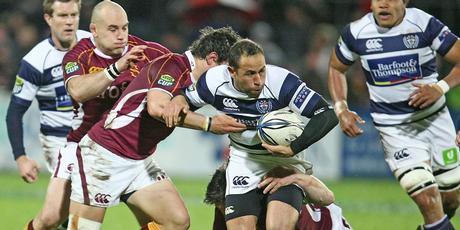
Jamie Hellur of Auckland tries to make a break during the round nine ITM Cup match between Southland and Auckland. Photo / Getty Images

 It’s always good to see an underdog holds it own, better when it not only thrashes one of the most affluent clubs but gets to retain THE Shield, and better when the trounced club is Auckland…of course, this will mean zip to overseas readers (imagine the SuperBowl but maybe played for 4-5 times a season) but as one who was a temporary Southlander in the early 80s and was there when they clawed their way in the First Division, Southland’s retention of the Shield is a great achievement…a massive morale spike in our southernmost province that can only be a good thing…

Opportunities Lost

‘Opportunity is missed by most people because it is dressed in overalls and looks like work.’ – Thomas A. Edison.

Conversely, some opportunities are seized because they appear easy and not really like work at all. I’ve just watched an item on the midday TV News covering the handover of the town of Sangin in Helmand Province from Royal Marines to US Marines. Approximately one-third all all British combat casualties in Afghanistan have been in and around Sangin…

The British “have decided, given limited resources, to focus on the central part of the province” and leave the hot spots of northern Helmand to the U.S., says Col. Paul Kennedy, commander of U.S. Marine forces in the area.

The true test will come over the next two months, when the last Royal Marines leave Sangin to the U.S. Marines. Right now, the Americans just have to fight; they don’t have to manage relations with the local Afghan government, navigate tribal politics or promote economic growth.

Once the Royal Marines are gone, those jobs will fall to the U.S. Marines.

Going into Afghanistan in 2001 probably looked like an easy win for the Blair Government in Great Britain and a far easier ‘sell’ than Iraq in 2003. I heard Tony Blair in a TV interview here a couple of weeks ago and all the problems in Iraq and Afghanistan were someone else’s fault…largely Al-Qaeda in Iraq and Iran in Afghanistan…without their meddling, one got the impression that Messrs Blair and Bush (Jnr) would have triumphed in both campaigns…

The simple fact is that with intervention comes responsibility and, whatever else people might think or say about the US, it is doing its level best to uphold its end of the stick – in stark contrast to its former ally that bailed in Iraq – from the relative back water of Basra and is now starting to slither away in Afghanistan…335 casualties (so far) and for what? The UK Government does a disservice to every soldier who served by failing to step up to the plate and accept responsibility for its actions

While the UK bleats about being undermanned in Helmand, it continues to slash back its military forces in all three services with all the enthusiasm and passion of Freddy Krueger or Jason from Friday the 13th…in the final analysis, I guess that Britain finally decided that it was only ‘in’ war and not ‘at’ war after all…

Soon they all be getting back on the helos...

In or at: that is the question

I recollected that her eye excelled in brightness, that of any other animal, and that she has no eye-lids—She may therefore be esteemed an emblem of vigilance.—She never begins an attack, nor, when once engaged, ever surrenders: She is therefore an emblem of magnanimity and true courage.—As if anxious to prevent all pretensions of quarreling with her, the weapons with which nature has furnished her, she conceals in the roof of her mouth, so that, to those who are unacquainted with her, she appears to be a most defenseless animal; and even when those weapons are shewn and extended for her defense, they appear weak and contemptible; but their wounds however small, are decisive and fatal:—Conscious of this, she never wounds till she has generously given notice, even to her enemy, and cautioned him against the danger of treading on her.—Was I wrong, Sir, in thinking this a strong picture of the temper and conduct of America? ~ Ben Franklin

Since returning to the work force on a semi-fulltime basis, I have been somewhat remiss in monitoring on those sites I’ve added to my blogroll over time…this morning, in response to an item on the Small Wars Journal Blog on 4GW/5GW, I wanted to link to the work that Peter had done his The Strategist blog on a Cohorts of War model that was considerably more robust than William Lind’s flawed 4GW construct. I knew that Peter had stopped contributing to The Strategist when he departed for Vanuatu a couple of month s ago but I was surprised to find that I couldn’t get into it at all this morning (hopefully a minor glitch relating more to the server firewall at this end and not to any issues with Peter’s old blog).

Anyway, since the intention was there to revisit members of the blog roll, I continued to do so…Neptunus Lex has an interesting item on the symbolism of flags, It’s Been A Long Time, in which he describes the history of the First Jack, the first flag under which the US Navy fought in the War of Independence and one which was reinstated post-911.  He recounts Benjamin Franklin’s word on the reason behind the snake on the flag ..post-911, Don’t Tread On Me, was an apt banner under which to go to war…and he concludes with the thought that “…It’s been a long time, but we are still at war. Outside my house the Jack is still flying...”

Lex’s statement “…we are still at war…” is interesting. I don’t think there is any doubt that most Americans see their nation as at war and when you’re at war, you behave a certain way. I still remember the day of 911, of waking for breakfast in the Mess at Waiouru to learn of a terrorist attack in America and not thinking too much of it until I turned on the TV just in time to see the first tower come down. The school I was working at had an instructor who’d just completed the staff course at Ft Leavenworth…he spoke of how this was another Pearl Harbor Day, where the America that was so concerned about casualties in peace support/OOTW like Bosnia and Somali and of being perceived as playing by international rules, would shift to a war-fighting stance and leave no stone unturned in its hunt for those responsible and those who supported or abetted them. Thus, then, an America at war will bear the  ‘blood and treasure’ cost of that war and stay the course to see it through to a conclusion.

What then of those nations that might only be in a war…this is a question that came up when I was lecturing at Massey University a couple of weeks ago and led into an interesting discussion…the bottom line was that a nation in war can opt out at any stage when it convinces itself that its national objectives have been met, are no longer being achieved or even when it simply can’t remember why it got involved in the first place. On the other hand, a nation at war has a greater commitment to seeing matters through to a conclusion, regardless of cost – or certainly where the cost is a lesser concern than resolution of the issue.

But in 21st Century informal war, even resolution of the issue becomes blurred – once upon a time, a war was ‘resolved’ when the opponent was defeated and the victors occupied their territory – how now (brown cow?) do we define victory when our opponents don’t actually occupy any ground worth seizing and the nation’s capital is already occupied by our (apparent) friends and allies. The phrase that always comes to my mind when I think of this is from that great military theorist, Princess Leia Organa “When you broke in here, did you have a plane for getting out?” Defining the conditions for victory can be tricky: Phase One of WW2 was all about restoring Polish sovereignty but, despite occupying Berlin in 1945 we didn’t actually achieve this until 1989 – and then without occupying Moscow…In Iraq (version 2 anyway), it was a relatively simple task to define, although somewhat bloodier and more expensive to achieve, but then Iraq had been a centrally-governed society before March 20 2003.

Afghanistan is a whole different ball game and we now see the coalition start to wobble as some nations simply pack their bags and leave, although doing it to the tune of The Animals’ We’ve Got To get Out Of This Place instead of Het Wilhelmus was probably a bit tacky….while others discover that amazingly, they are now actually closer to achieving their in-theatre endstates that they had realised and thus can commence transition to a steady state Afghan-led structure…and recently we have seen the resurgence of statistics ‘proving’ how well that transition programme is going, especially the training of the Afghan National Police and Army but numbers aren’t everything. In fact, in this arena, they may be meaningless, certainly without some form of qualitative measures to accompany them…some interesting viewpoints on endstates here:

Kiwi-soldier-killed—full-interview-with-Louis-Gardiner

Tomgram: Body Count Nation

The other enemy

What does the Military Endstate in Bamiyan look like?

One of the things that those who might only be in war should remember, and one which may drive those at war, is that by opting to intervene or interfere in someone else’s country, they accept a certain responsibility for their actions. As those in war nations slowly slip away, they should remember that the people of those countries have no such option to just walk away and that the last helicopter off the Embassy roof always leaves someone behind…

In other news

John Birmingham seeks new ideas to develop the America-less post-Wave environment…the way things are developing in the latest thread on this topic, the rest of the world will write itself off in petty score-settling and an almost vacant America will reassert itself by default…

The Lite version of the UK’s Joint CombatOperations Virtual Environment (JCOVE) simulation based on Bohemia’s uber-successful Virtual Battlefield System 2 is availbale for download (and has been for some time but I only just found it) through the JCOVE Lite forum – yes, you do have to register and then you do have to post a welcome post to a thread before the download link activates but it is well worth it…VBS2 is the de facto standard simulation across the Anglospheric nations, well, the land forces anyway and is a superior tool for SOP and TTP development, AO familiarisation and mission rehearsal and well worth a look from anyone in the training or capability development arena….

On irregularity

We’ve had a bit of a beating in this little nation down-under in the last week or so…more speed wobbles than one might reasonably expect in a year…I’ve mentioned on a number of occasions how the UK phrase Countering Irregular Activity offers a more relevant construct for current and near-future periods of uncertainty and complexity than either the Marines’ Countering Irregular Threats or the overly-simplistic and over-used COIN. Who would have thought that in the space of a week we might experience four significant irregular and potentially destabilising events of such magnitude? It was only on Friday night that I was down at the local, discussing this item and observing that whether it would remain an issue into the next week would very much depend on what happened over the weekend – normally here, that means we either get or dish out a thumping on one sports field or another…

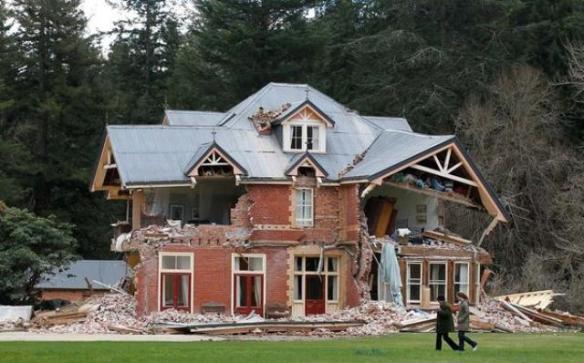
At around 4-30am on Saturday morning, our second largest city, Christchurch in the South Island was severely shaken by a 7.2 Richter earthquake centred some 30km west of the city. This area is not generally noted as a high-risk for earthquakes, more common problems being occasional seasonal snow, flooding and smog. As a result, people were not as physically nor psychologically prepared as they might have been in other areas. This is the most powerful earthquake ever recorded here and, although no lives were lost, the final repair bill will be in the billions and a number of heritage buildings will have to be demolished due to irreparable damage.

Deans Homestead (c) NZ Herald

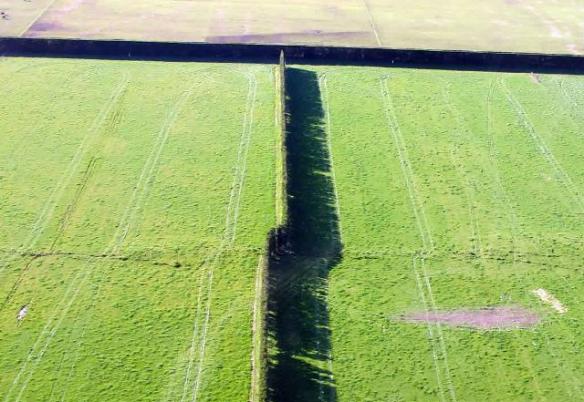
This image is one of a series taken during an early scientific survey of the fault line area (the Youtube file of the overflight is linked through the image). To give an idea of the lateral and vertical ground movement during the main quake, the lateral shift in this image is around four metres, and vertically around 1.5 metres. Only a tenth of that degree of movement would be a nasty jolt! This image was sent to us as an example of some of the underlying issues that might have to be resolved in the wake of the quakes (after shocks up to 5.2 Richter are still rolling in, on top of the obvious tasks of rebuilding and reinforcing,  in terms of changes to boundaries and potentially ownership, to say nothing of the requirement to update every digital and hard copy map of the region. It’s resolving this little issues that may be the bigger long term problem…

Exploring new boundaries (c) geonet.org.nz 2010

While Canterbury was coming to grips with its devastated major city, the lower North Island braced itself against a series of floods that swept through a number of small towns, further stretching Civil Defence and infrastructure agencies that were already focussed on deploying aid south. We got lucky and the front that dumped all this rain hit everywhere BUT Canterbury sparing Christchurch from further damage from rising water levels.

The Mangatainoka river in flood, with the old Tui Brewery building in the background.

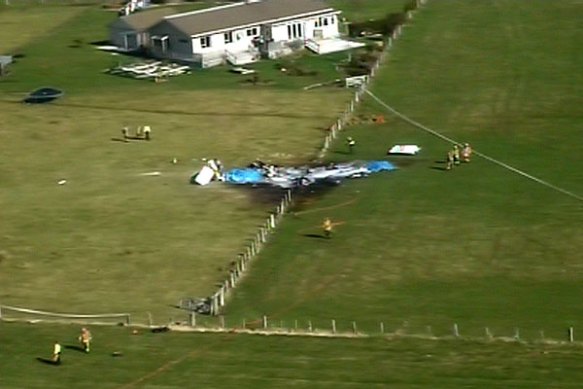
At 1-30pm on Saturday, a light aircraft conducting skydiving operations at Fox Glacier on the other side of the South Island, crashed on take-off killing all nine occupants: the pilot,  four divers-master;  and four tourists from Ireland, England, Germany and Australia. This is the worst air disaster in national history in decades, the worst being the 1963 DC-3 crash in the Kaimai Ranges that killed 23. Any other weekend, such a tragedy would bring to nation to a halt but against the backdrop of the Canterbury earthquake it didn’t even get to lead the 6 O’clock News.

Skydive aircrash kills nine (c) TVNZ 2010

Earlier last week, the Government announced a NZ$1.7billion bail-out for the crumbling South Canterbury Finance (SCF) empire…although some had protested that the Government’s approach was heavy-handed and had helped causer the problem.I think that the simple truth is that it has acted responsibly to prevent the loss of people’s saving due to the doddering of an aging business magnate. I recall not so long ago seeing SCF advertising 8-8.5% interest rates on 18 month investments. At the time, I (rather naively) thought this must be a sign of recovery for this company but of course it wasn’t…it was a last gasp grab for cash flow to bail it out of its current problem – by creating another one 18 months out…I have to admit only a small degree of sympathy for investors who fail to apply the ‘Is it too good to be true?’ rigor test to such proposals and who then get bailed out by the government. The national cost per capita of this bail-out is $372 each so South Canterbury, please note, i don’t expect to be buying too many beers next time I pass through…mine’ll be a Tui…!

The cost (c) TVNZ

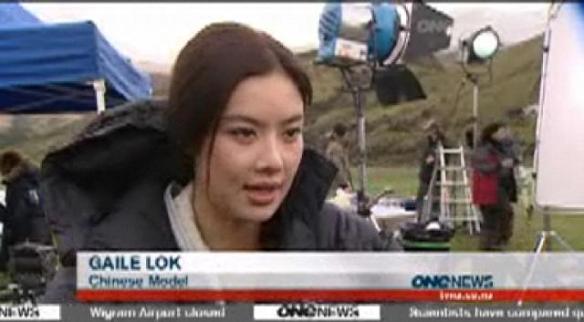
And it goes on…there has been for some time, concern over how much of the country is being bought up by offshore investors and what the potential risks are if we opt for short-term gain without really considering long-term pain…a Chinese consortium has offered to buy a large number of dairy farms, ostensibly as part of a move to introduce high-quality dairy products to the Chinese domestic market. I had no idea that cows couldn’t grow in China or that our national output of dairy produce would be anymore than a drop in the milk bucket of China’s internal market’s…and I do wonder if anyone has actually wargamed what the impact might be on domestic dairy markets if the new owners (if approved by Government) perhaps decide to move cease dairy production on that land…already Fonterra milk product exports have linked domestic dairy prices to overseas prices with the result that the price of milk and cheese has effectively doubled – it IS actually cheaper to feed your children Coke than milk so watch for the destabilising effects of declining dental health on future Government health budgets – or will it just be easier and more pragmatic to swap out your natural teeth for some nice handmade wooden items?

Model Gaile Lok promotes Chinese dairy project in New Zealand (c) TVNZ 2010

My point in all of this is that we can not count on the destabilising cataysts we may face to be purely of man-made origin, or that they might be Militant in nature. What if our adversaries, or competitors, opt to employ the three other components of the DIME construct: Diplomatic, Informational and Economic, perhaps catching the wave of a natural disaster or two….?

And on the subject of considering endstates, Mr Wineera has written another commentary, speculating on the end state sought by our PRT in Afghanistan

Messages

Over the weekend, it was reported that there had been what appears to be a triple murder-homicide in the small town of Feilding, only a few kilometres from where I’m based. The story recapped Feilding’s unfortunate recent history which has in the last few months included a particularly nasty ambush murder of a young farmer, a mid-air collision that killed two people and the death of LT Tim O’Donnell in an IED attack in Afghanistan.

It particularly annoyed me that Tim O’Donnell was described as being killed by ‘insurgents’ which may or may not be correct but it struck me that the use of this word ‘insurgant’ without any supporting evidence, indications or other pointers is again conceding the information battle to our adversaries. Surely better to be part of a strategic communication plan in which those perpetrated that attack are referred to as criminals, thus robbing them of any possible perception of legitimacy or right that may be inherent in ‘insurgent’. After all, it is a COIN truism that one man’s insurgent is another’s freedom fighter and another that most insurgencies are built in one form or another on elements of righteous greivance…mere use of the term implies a base level of right in their actions…so let’s stop doing that and in doing so, erode further their conceptual foundations…

One man who does ‘get’ strategic communication is Steve Tatham, who was the Director of Advanced Communication Research at the Defence Academy at Shrivenham, but whom I see from the tailpiece of his latest paper is now “…completing a PhD in Strategic Communication…” I hope he’s not planning on taking too long on his PhD because we really needed him to be out there expounding the Strategic Communication message. The new paper, Strategic Communication & Influence Operations: Do We Really Get It?, builds further upon his previous works,  Behavioural Conflict – From General to Strategic Corporal: Complexity, Adaptation and Influence and Strategic Communication: A Primer.

Do We Really Get It? moves further into the how-to of Strategic Communication and, of particular note to anyone who’s ever wonder what the Strategic Communication group in their organisation actually does, defines the distinction between Strategic Communication and Strategic Communications:

Strategic Communication

The processes and sequencing of information for carefully targeted audiences

A paradigm that recognises that information & perception effect target audience behaviour and that activity must be calibrated against first, second and third order effects.

Strategic Communications

The paper also discusses in detail the concept of the Target Audience Analysis (TAA), a process clearly and sadly lacking from the coalition’s forays into the information arena against the takfiri: “…Understanding the audience is the beginning and end of all military influence endeavours. Without TAA, influence success is dependent upon randomness, luck and coincidence – in short, ‘a fluke’…” This is what we in the trade would call ‘good stuff’ however no more previews: to learn more you need to not just read the paper, but hoist its message aboard and look to applying it daily…

The Small Wars Journal Blog today linked to an interview with David Kilcullen on Australia’s rising casualty rate in Afghanistan – it is a very interesting read and well worth following the link to the full text of the interview. I offered a small comment of my own based on a discussion we had yesterday regarding the changing situation in Afghanistan and the vague endstates that still persist in most if not all nations with forces in ISAF. I was humbled by the response from one of the SWJ administrators “…and, BTW, nice blog. Added to our roll…” So way down the bottom of the Small Wars Journal blogroll is yours truly…I now know how Dean @ Shiloh felt after Tom Ricks picked up his blog comments on the COIN Symposium in May this year and am a little worried that I will be able to hold up my end in such company as other members of that list…

In the gathering dusk of 18 August 1966…

Long Tan Cross ceremony, 18 August 1969 (c) AWM

…44 years ago, D Company, 6 Royal Australian Regiment, fought a desperate battle for survival against a Viet Cong regiment, in  a rubber plantation near a little town called Long Tan. This is one of the great sub-unit battles of history, where a few stood against many. Today, it remains as an example of great junior leadership and “…of the importance of combining and coordinating infantry, artillery, armour and military aviation...” The Presidential Unit Citation tells part of the story…

By virtue of the authority invested in me as the President of the United States and as Commander-in-Chief of the Armed Forces of the United States, I have today awarded the Presidential Unit Citation (Army) for extraordinary heroism to D Company, Sixth Battalion, The Royal Australian Regiment, The Australian Army.
D Company distinguished itself by extraordinary heroism while engaged in military operations against an opposing armed force in Vietnam on 18 August 1966.
While searching for Viet Cong in a rubber plantation northeast of Ba Ria, Phuoc Tuy, Province, Republic of Vietnam, D Company met and immediately engaged in heavy contact. As the battle developed, it became apparent that the men of D Company were facing a numerically superior force. The platoons of D Company were surrounded and attacked on all sides by an estimated reinforced enemy battalion using automatic weapons, small arms and mortars. Fighting courageously against a well armed and determined foe, the men on D Company maintained their formations in a common perimeter defence and inflicted heavy casualties on the Viet Cong.
The enemy maintained a continuous, intense volume of fire and attacked repeatedly from all directions. Each successive assault was repulsed by the courageous Australians. Heavy rainfall and low ceiling prevented any friendly close air support during the battle. After three hours of savage attacks, having failed to penetrate the Australian lines, the enemy withdrew from the battlefield carrying many dead and wounded, and leaving 245 Viet Cong dead forward of the defence positions of D Company.
The conspicuous courage, intrepidity and indomitable courage of D Company were to the highest tradition of military valour and reflect great credit upon D Company and the Australian Army.

The rest of the story is well worth ferreting out, particularly the section in Mark Woodruff’s Unheralded Victory…many of the lessons from Long Tan from infantry section to coalition task force level still apply to today’s environment…Lest We Forget…

One might hope that The Battle of Long Tan, due for release in 2011, will be on  a par with We Were Soldiers and Blackhawk Down…and serve as a timely reminder to today of yesterday’s sacrifices…

…and thanks to Narelle for the reminder of this day…