Messages

Over the weekend, it was reported that there had been what appears to be a triple murder-homicide in the small town of Feilding, only a few kilometres from where I’m based. The story recapped Feilding’s unfortunate recent history which has in the last few months included a particularly nasty ambush murder of a young farmer, a mid-air collision that killed two people and the death of LT Tim O’Donnell in an IED attack in Afghanistan.

It particularly annoyed me that Tim O’Donnell was described as being killed by ‘insurgents’ which may or may not be correct but it struck me that the use of this word ‘insurgant’ without any supporting evidence, indications or other pointers is again conceding the information battle to our adversaries. Surely better to be part of a strategic communication plan in which those perpetrated that attack are referred to as criminals, thus robbing them of any possible perception of legitimacy or right that may be inherent in ‘insurgent’. After all, it is a COIN truism that one man’s insurgent is another’s freedom fighter and another that most insurgencies are built in one form or another on elements of righteous greivance…mere use of the term implies a base level of right in their actions…so let’s stop doing that and in doing so, erode further their conceptual foundations…

One man who does ‘get’ strategic communication is Steve Tatham, who was the Director of Advanced Communication Research at the Defence Academy at Shrivenham, but whom I see from the tailpiece of his latest paper is now “…completing a PhD in Strategic Communication…” I hope he’s not planning on taking too long on his PhD because we really needed him to be out there expounding the Strategic Communication message. The new paper, Strategic Communication & Influence Operations: Do We Really Get It?, builds further upon his previous works,  Behavioural Conflict – From General to Strategic Corporal: Complexity, Adaptation and Influence and Strategic Communication: A Primer.

Do We Really Get It? moves further into the how-to of Strategic Communication and, of particular note to anyone who’s ever wonder what the Strategic Communication group in their organisation actually does, defines the distinction between Strategic Communication and Strategic Communications:

Strategic Communication

The processes and sequencing of information for carefully targeted audiences

A paradigm that recognises that information & perception effect target audience behaviour and that activity must be calibrated against first, second and third order effects.

Strategic Communications

The paper also discusses in detail the concept of the Target Audience Analysis (TAA), a process clearly and sadly lacking from the coalition’s forays into the information arena against the takfiri: “…Understanding the audience is the beginning and end of all military influence endeavours. Without TAA, influence success is dependent upon randomness, luck and coincidence – in short, ‘a fluke’…” This is what we in the trade would call ‘good stuff’ however no more previews: to learn more you need to not just read the paper, but hoist its message aboard and look to applying it daily…

The Small Wars Journal Blog today linked to an interview with David Kilcullen on Australia’s rising casualty rate in Afghanistan – it is a very interesting read and well worth following the link to the full text of the interview. I offered a small comment of my own based on a discussion we had yesterday regarding the changing situation in Afghanistan and the vague endstates that still persist in most if not all nations with forces in ISAF. I was humbled by the response from one of the SWJ administrators “…and, BTW, nice blog. Added to our roll…” So way down the bottom of the Small Wars Journal blogroll is yours truly…I now know how Dean @ Shiloh felt after Tom Ricks picked up his blog comments on the COIN Symposium in May this year and am a little worried that I will be able to hold up my end in such company as other members of that list…

In the gathering dusk of 18 August 1966…

Long Tan Cross ceremony, 18 August 1969 (c) AWM

…44 years ago, D Company, 6 Royal Australian Regiment, fought a desperate battle for survival against a Viet Cong regiment, in  a rubber plantation near a little town called Long Tan. This is one of the great sub-unit battles of history, where a few stood against many. Today, it remains as an example of great junior leadership and “…of the importance of combining and coordinating infantry, artillery, armour and military aviation...” The Presidential Unit Citation tells part of the story…

By virtue of the authority invested in me as the President of the United States and as Commander-in-Chief of the Armed Forces of the United States, I have today awarded the Presidential Unit Citation (Army) for extraordinary heroism to D Company, Sixth Battalion, The Royal Australian Regiment, The Australian Army.
D Company distinguished itself by extraordinary heroism while engaged in military operations against an opposing armed force in Vietnam on 18 August 1966.
While searching for Viet Cong in a rubber plantation northeast of Ba Ria, Phuoc Tuy, Province, Republic of Vietnam, D Company met and immediately engaged in heavy contact. As the battle developed, it became apparent that the men of D Company were facing a numerically superior force. The platoons of D Company were surrounded and attacked on all sides by an estimated reinforced enemy battalion using automatic weapons, small arms and mortars. Fighting courageously against a well armed and determined foe, the men on D Company maintained their formations in a common perimeter defence and inflicted heavy casualties on the Viet Cong.
The enemy maintained a continuous, intense volume of fire and attacked repeatedly from all directions. Each successive assault was repulsed by the courageous Australians. Heavy rainfall and low ceiling prevented any friendly close air support during the battle. After three hours of savage attacks, having failed to penetrate the Australian lines, the enemy withdrew from the battlefield carrying many dead and wounded, and leaving 245 Viet Cong dead forward of the defence positions of D Company.
The conspicuous courage, intrepidity and indomitable courage of D Company were to the highest tradition of military valour and reflect great credit upon D Company and the Australian Army.

The rest of the story is well worth ferreting out, particularly the section in Mark Woodruff’s Unheralded Victory…many of the lessons from Long Tan from infantry section to coalition task force level still apply to today’s environment…Lest We Forget…

One might hope that The Battle of Long Tan, due for release in 2011, will be on  a par with We Were Soldiers and Blackhawk Down…and serve as a timely reminder to today of yesterday’s sacrifices…

…and thanks to Narelle for the reminder of this day…


Nice


I see that the lads at Hawkeye UAS have updated their website from cool to uber-cool…(click above)

Also on the cool front…

From some very talented and generous folk in Poland…a new release in large scale paper planes…a Hawker Tempest V in 1/33….

Nice

…and something completely different…

While I totally lack anything like the hand-eye coordination needed to play even outdated computer games, let alone modern ones, I do really like the weird creations that seem to populate some of them…this too in in paper…


Y

Ugly but cool

A time and a place


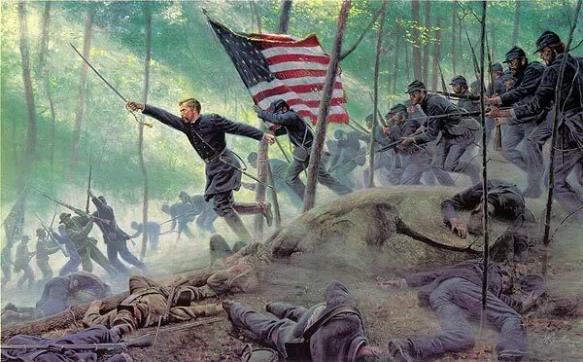
This seemed quite apt today…Chamberlain leading that final charge at Little Round Top, saving the day, the battle and very possibly the Union…

I didn’t really want to comment on the recent combat death of LT Tim O’Donnell in the NZ PRT in Bamyan Province, Afghanistan – it seemed at the time that everything that needed to be said – and perhaps some that didn’t – was being said…but, over the last few days, I have heard many people saying, no doubt with the best of intentions, that maybe he was simply in the wrong place at the wrong time…not at all…

I was privileged to spend some time with members of Lt O’Donnell’s unit as they waited for a C-130 to take them back down to Burnham Military Camp after they farewelled their mate that afternoon…something one of them said was so right…Tim was in the right the place – he was in the lead vehicle, leading his soldiers, he was where he was meant to be, and doing his job

And from the other side of the fence…

And while I was writing, this popped up from Michael Yon…back on our side of the information war….

...and from another direction...


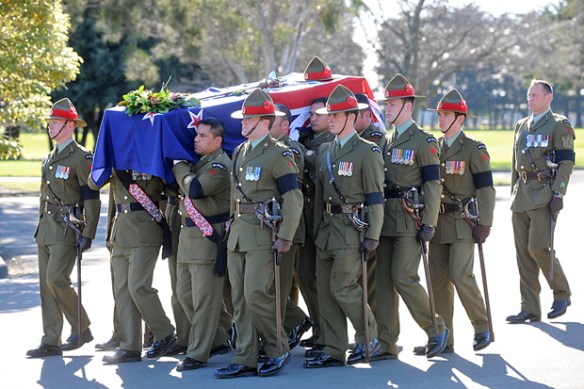
Last respects paid to slain NZ soldier

Lieutenant Tim O’Donnell who was killed in Afghanistan is taken from the funeral service to an awaiting gun carriage, Linton Military Base in Palmerston North. Photo / NZPA

It’s never good when a serviceman falls, on operations or in training and this has already been a sad year for the NZDF, following the CT-4 crash in January and the UH-1 on ANZAC Day…as Chief of Army Rhys Jones said, while the death in action of a soldier was not inevitiable it is certainly something that Kiwis have been steeling themselves for over the past 3-4 years…

I attended a presentation at Massey University just after the funeral…it was by former Chief of General Staff Piers Read, a contrast and compare look at the Reconstruction on post-Civil War America and modern Afghanistan (modern Afghanistan – now there’s an oxymoron!!)…he opened with an apology that this work had been in preparation and scheduled for this day for some months and he’d had no intention of ever presenting anything that might become so topical on such a day…it’s a good presentation and I’m going to ask if I can share the slides and supporting paper here…he made some good points, poignant and all the more effective against the background of the events in Linton that same afternoon…

…while at the same time, clowns Willie and JT of Radio Live was playing up the entertainment value of the funeral on Radio Live with Auckland’s University professor Caroline Daley suggesting about the funeral that the whole thing was really just a bit over the top and New Zealand just needs to get over it…all this hoop-la over one soldiers wasn’t something we did before for WW1, WW2, nor even Korea or Vietnam, those latter wars far smaller and perhaps more personal in their selectivity. If anyone needs to get over themselves, I think it may be Ms Daley whose timing in making those statements as the funeral was just ending was way off…

Perhaps Ms Daley needs to consider that, if we could, we would recognise EVERY soldier, sailor and airperson who fell in the service of their country in exactly that same way we did for Tim O’Donnell yesterday…that circumstances did not allow this at those times does not mean for one second that their sacrifice is any less nor the impact on their families any less painful and tragic…

I was privileged to spend some time with members of Lt O’Donnell’s unit as they waited for a C-130 to take them back down to Burnham Military Camp after they farewelled their mate that afternoon…something one of them said was so right…Tim was in the right place – he was in the lead vehicle, leading his soldiers, he was where he was meant to be, and doing his job

DSCF8729.JPG

And on this day, let’s not forget six other young men who died tragically while serving…twenty years ago today, Privates Brett Barker, Stuart McAlpine, Mark Madigan, Jason Menhennet and David Stewart and Naval Rating Jeffrey Boult died on Mt Ruapehu after being caught in a blizzard during a training activity…